

The situation in Kazakhstan is terrible for its people and we hope everyone there is staying safe.
On a financial level we think what we saw with the Bitcoin price dipping ~7% overnight is a simple supply and demand story. It’s likely we saw Kazakhstani cryptocurrency miners looking to flee the country and liquidating Bitcoin they had already mined, in order to finance that move. With a greater supply of Bitcoin hitting the market, the price fell.
Kassym-Jomart Tokayev, the president of Kazakhstan, upended Bitcoin miners’ businesses on Wednesday 5 January when he ordered the country’s largest telecom provider Kazakhtelecom to pull the plug on the nation’s internet.
The largest global Bitcoin mining pools such as AntPool and F2Pool showed an almost immediate dip.
Normally we know that quite a lot of Bitcoin supply is stored up in HODLers’ wallets and in very popular exchange traded products like our Bitcoin ETP (BTCE), and therefore isn’t available to the general market. As Brian Brooks, former acting head of the US federal banking regulator, told the House Financial Services Committee last month, something like 80% of Bitcoin holders have never sold any at all. So when there’s a sudden increase in supply it naturally depresses the price.
There is also a lot of speculative leverage in the riskier portions of the crypto daytrading market.
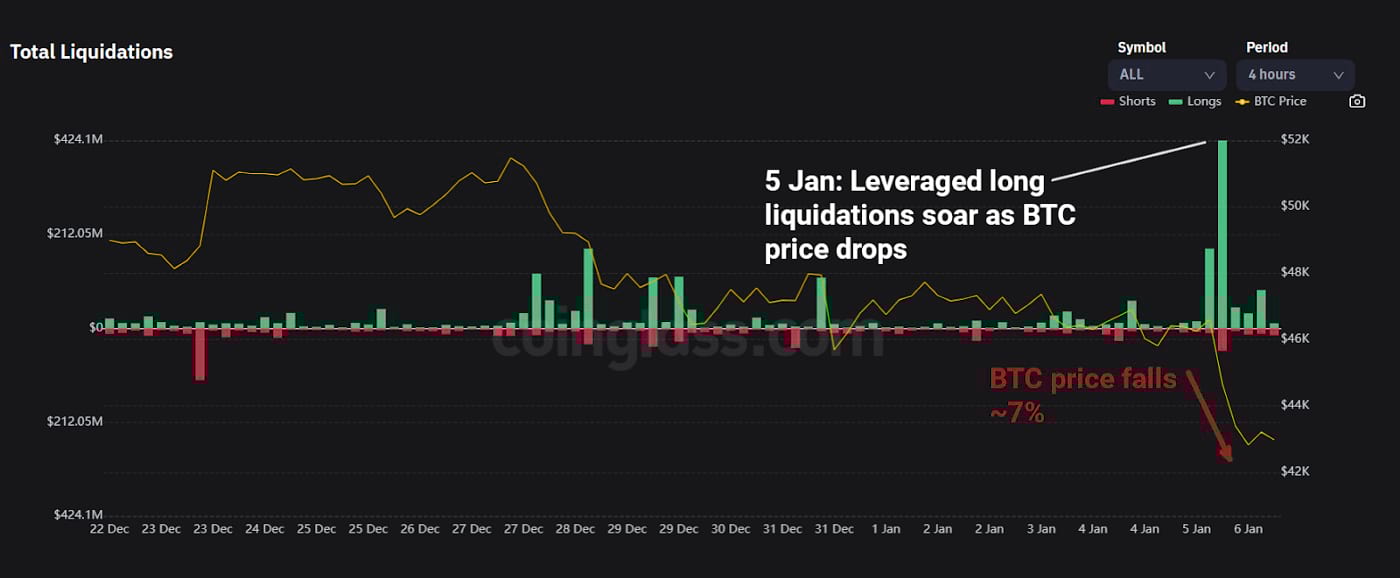
With supply hitting the market and the price falling suddenly, we saw a cascade of highly leveraged long positions being liquidated — and the subsequent margin calls — and more liquidations. ETPs like ours aren’t leveraged to the hilt, or leveraged at all, they are physically-backed 1:1 and so just track the price of Bitcoin and other cryptoassets very accurately, so they aren’t subject to these same kinds of risks.
More than 225,000 traders had nearly $1bn of leveraged long positions liquidated in the following 24 hours, according to Coinglass.
How do we know Kazakhstani miners dumped BTC supply onto the market? Well, it happened before, in China.
With the Kazakhstan government turning off the internet, it was widely reported that cryptominers along with everyone else were unable to get online.
As of last week, Kazakhstan accounted for around a fifth (18.1%) of the Bitcoin hashrate, that’s the amount of computing power globally that is dedicated to mining Bitcoin, verifying transactions and creating new bitcoins. These are figures from the pre-eminent researchers in the space, the Cambridge Centre for Alternative Finance.
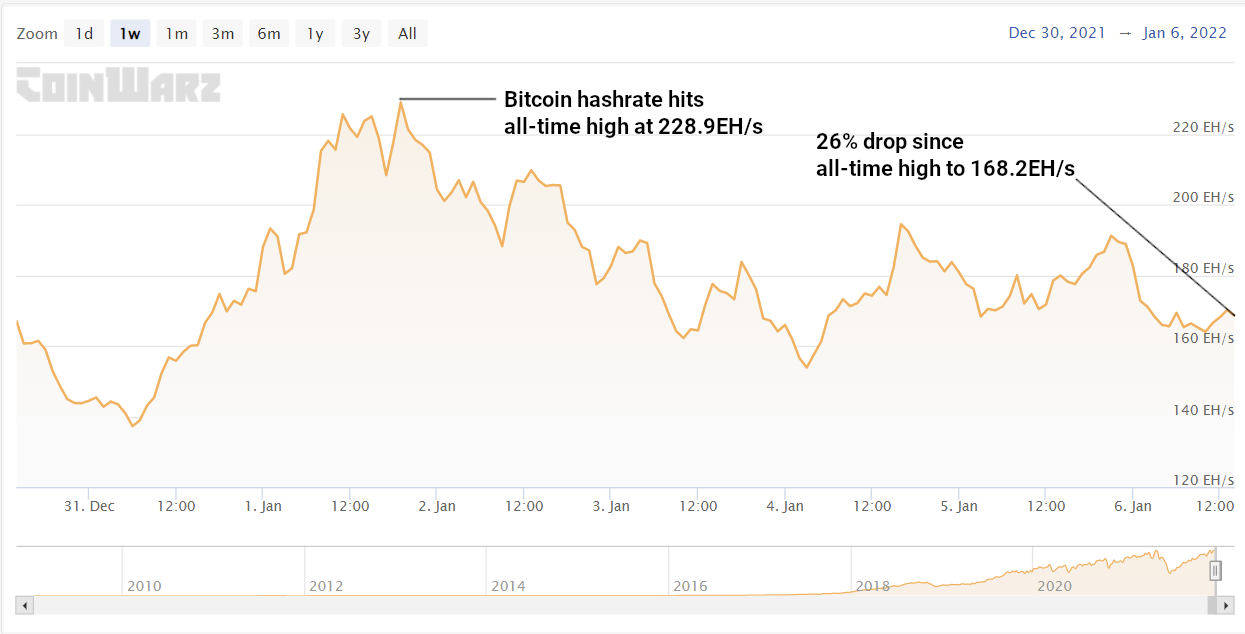
We’re starting to see this situation represented in the Bitcoin hashrate, which has fallen 26% from its all time high of 228 EH/s to 168 EH/s in the last few days.
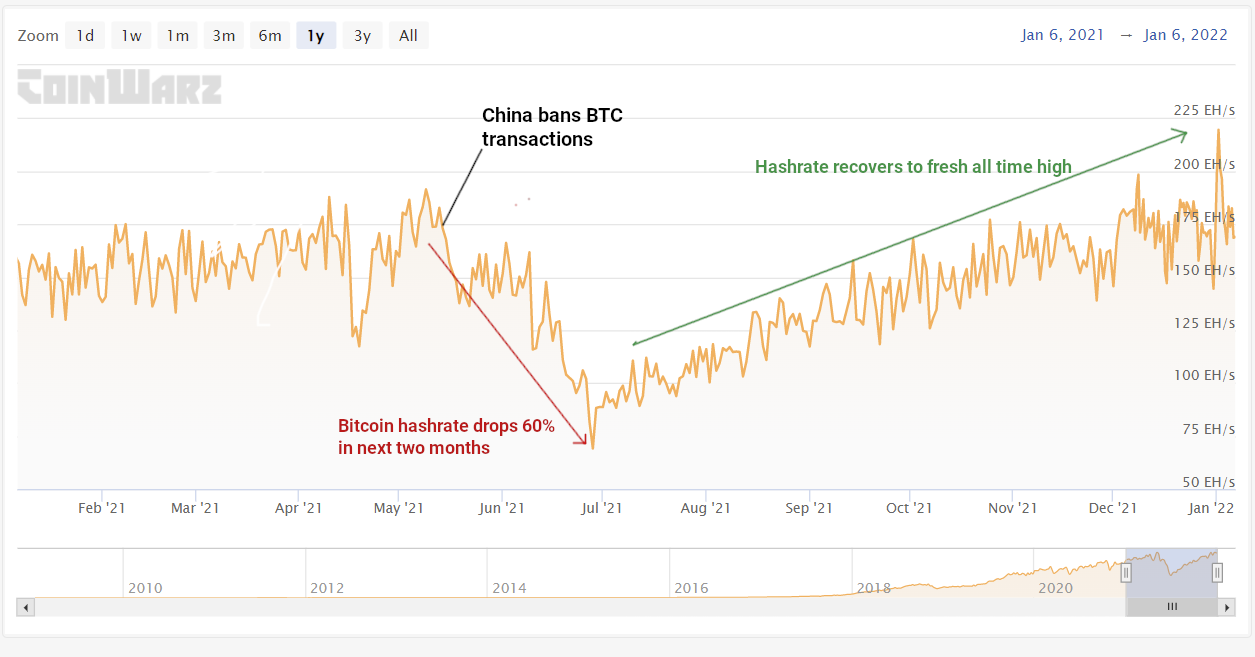
The same thing happened in China in May 2021, when the government started to turn off the power to crypto miners in large centres like Inner Mongolia.
At the time, the region, known for its cheap power, accounted for around 8% of global hashrate. In March 2021 the region’s provincial government cracked down on Bitcoin mining, giving businesses a two-month window to get out. The Chinese government then banned Bitcoin transactions altogether, and by July the Bitcoin hashrate had dropped 60%.
A glut of Bitcoin hit the market, a lot of it likely coming from Chinese miners looking to liquidate their holdings, and the price of 1 BTC cratered from $58,800 on 8 May to $29,700 by mid-July.
Hashrate had recovered to fresh all time highs as recently as 1 January 2022.
Bitcoin miners forced out of China had originally chosen Kazakhstan for its cheap energy prices: around $0.05Kw/h compared to jurisdictions like the US which charge in the region of $0.12Kw/h. Hong Kong-based BIT Mining sent thousands of ASIC mining machines to the state in June last year, alongside Beijing’s Canaan.
With miners operating in Kazakhstan controlling such a large proportion of the Bitcoin hashrate they now face the same kinds of decisions as those businesses in Inner Mongolia, although circumstances demand a less orderly exit and much accelerated time-frame.
Again, this story is one of simple supply and demand.
The price action this time round may be much different: yes, there is a glut of bitcoin on the market but we are seeing some seller exhaustion in the $42k region and there is likely to be a relief rally that we are watching out for. If I’m an institutional investor, I’m finding it hard to see a 2x or 3x from Bitcoin from $69k when it’s already up 5x from January to November 2021. That calculation is a lot easier now at $42k.
We’re looking to US crypto miners like Riot Blockchain to win in the short term from picking up the slack in Bitcoin hashrate from Kazakhstan-based mining operators (like Canaan) going offline, and the time necessary in moving their operations overseas. And easy-access ETFs, like our Digital Assets and Blockchain Equity ETF (KOIN) that hold a good cross section of US crypto miners will likely be the immediate beneficiaries.
Informations importantes
Communication à caractère promotionnel. Les informations contenues dans le présent Document sont fournies à des fins d’information et de pédagogie. Elles ne constituent ni un conseil en investissement, ni une recommandation personnalisée, ni une sollicitation en vue d’acheter ou de vendre un instrument financier.
Le présent Document (qui peut prendre la forme d’une présentation, d’un communiqué de presse, d’une publication sur les réseaux sociaux, d’un article de blog, d’une communication audiovisuelle ou d’un support similaire – ci-après le « Document ») est émis par Bitwise Europe GmbH (« BEU » ou l’« Émetteur »).
Bitwise Europe GmbH est constituée selon le droit allemand et agit en qualité d’émetteur des produits négociés en bourse (« Exchange Traded Products » ou « ETP ») mentionnés dans le présent Document. Les ETP sont émis sur la base d’un prospectus de base et de conditions définitives, susceptibles d’être complétés. Un prospectus a été publié ou, le cas échéant, sera publié conformément au Règlement (UE) 2017/1129. Les investisseurs peuvent obtenir gratuitement le prospectus de base, les conditions définitives applicables ainsi que tout supplément éventuel sur le site www.bitwiseinvestments.eu/fr
L’approbation d’un prospectus par l’autorité compétente ne constitue ni une approbation ni une recommandation des instruments financiers concernés.
Capital à risque. Les crypto-actifs sont des actifs hautement volatils et présentent un risque élevé. La valeur des investissements dans des crypto-actifs ou dans des ETP liés aux crypto-actifs peut fluctuer fortement à la hausse comme à la baisse et les investisseurs peuvent perdre tout ou partie de leur capital investi.
Les ETP liés aux crypto-actifs sont des instruments financiers complexes et peuvent ne pas convenir à tous les investisseurs. Ils peuvent exposer les investisseurs à des risques spécifiques, notamment un risque de crédit de l’émetteur, un risque de liquidité, des risques opérationnels ainsi que des risques liés au fonctionnement, à la réglementation et à la valorisation des marchés des crypto-actifs sous-jacents.
Aucun mécanisme de garantie du capital ne s’applique. Selon la juridiction et le mode de détention, les investisseurs peuvent ne bénéficier d’aucun mécanisme public d’indemnisation ou de protection des investisseurs.
Les performances passées ne constituent pas un indicateur fiable des performances futures. Toute déclaration prospective reflète des hypothèses et des anticipations et ne constitue pas une garantie de résultats futurs.
Avant toute décision d’investissement, les investisseurs doivent lire attentivement le prospectus de base, les conditions définitives applicables et notamment la section intitulée « Avertissements ». Une décision d’investissement doit tenir compte de la situation personnelle de l’investisseur, de ses objectifs, de son horizon d’investissement et de sa capacité à supporter des pertes potentielles. Le cas échéant, il convient de solliciter un conseil indépendant en matière financière, fiscale et juridique.
Un avertissement détaillé sur les risques applicables aux ETP liés aux crypto-actifs est disponible à l’adresse suivante : www.bitwiseinvestments.eu/fr/risk-warning