
- The de-Chinafication of Bitcoin: Cryptomining migration begins
China’s continuing crypto crackdown commanded most of the newsflow throughout the week and dictated the markets. It’s the only story really worth considering in this week’s Crypto Minutes, for its wide-reaching ramifications.
In May China’s political cabinet ignited a campaign to crack down on mining and cryptocurrency trading, ostensibly to control risks to its population. The People’s Bank of China, the country’s de-facto central bank, said this week it had called upon big banks and payment processors, including Alibaba (NYSE:BABA) subsidiary Alipay, and state-owned lenders like the Agricultural Bank of China, the Postal Savings Bank of China and the Industrial and Commercial Bank of China.
Speculative trading in virtual currencies roils economic and financial order, spawns the risks of criminal activities such as illegal asset transfers and money laundering, and endangers people’s wealth. People’s Bank of China, 21 June
China cannot control Bitcoin. And that is perhaps why the notoriously authoritarian state is redoubling efforts to extricate itself from its crypto dominance. China has the perfect surveillance technology coming in the form of the e-CNY, the country’s Central Bank Digital Currency. All of its citizen’s purchases tracked, everywhere they go.
As of April 2020, an approximate 65% of Bitcoin hashrate — the computing power used to generate new bitcoins, confirm transactions and secure the network — was concentrated in China.
Those numbers are shifting daily as Bitcoin miners now flee China in ever increasing numbers.
All signals seem to be indicating the greatest shakeup in the geographic makeup of bitcoin mining since the start of the industrial mining era. Nic Carter, CoinMetrics co-founder, 22 June
BIT Mining (NYSE:BTCM) has delivered its first batch of 320 mining machines to Kazakhstan, Coindesk reports, with plans to move two more tranches totalling 2,600 machines by July. The company’s Sichuan operations were effectively shut down on 19 June when it received notice that the state energy regulator would cut off its electricity supply. Guangzhou’s Fengua International also told CNBC on 21 June it was airlifting 3,000kg of mining machines to Maryland.
Authorities in the southwestern Chinese province ordered a halt to crypto mining, according to a report from the Communist Party-backed newspaper Global Times. More than 90% of China’s bitcoin mining capacity is estimated to be shut down, the paper said.
One of the more interesting points to come out of this is how malleable the Bitcoin mining network is. What other industry could simply break down its operations and move them across the world in a matter of days?
Could Google’s parent company Alphabet (NASDAQ:GOOGL) pick up its server farms and deposit them in a more energy efficient place overnight? Unlikely.
As CNBC reports , Texas could be one of the biggest winners from the great cryptomining migration.
Texas often has some of the world’s lowest energy prices, and its share of renewables is growing over time, with 20% of its power coming from wind as of 2019. It has a deregulated power grid that lets customers choose between power providers, and crucially, its political leaders are very pro-crypto – dream conditions for a miner looking for a kind welcome and cheap energy sources. MacKenzie Sigalos, CNBC, 15 June
Bitcoin mining pools located outside of China — like Foundry USA — are expected to be among the biggest winners of China’s policy shift.
So while in the near-term, crypto markets are taking this unprecedented uncertainty rather badly, it does mean a reconfiguration of crypto power back into the hands of the West.
A more transparent future for Bitcoin and cryptoasset markets beckons. And the ability to say definitively that cryptomining is being undertaken with more renewable energy? Surely that will be a positive for those who can look beyond the immediate market drop.
Markets
BTC/USD
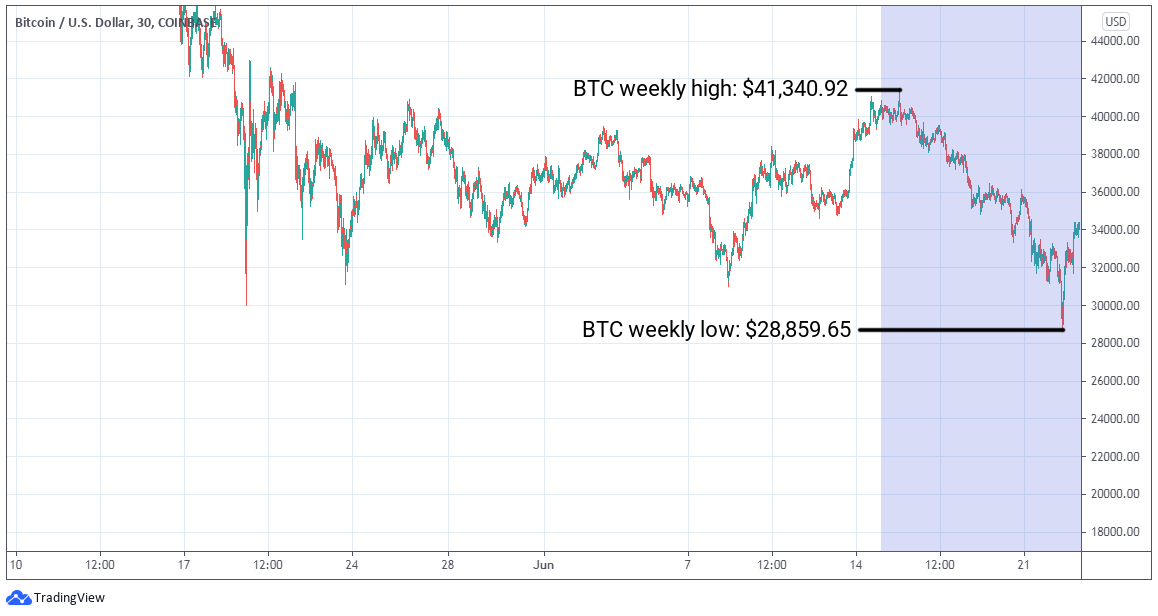
Throughout the week Bitcoin prices dropped back to where they were in late January, sliding 30.1% from a high above $41,000 under $29,000. By Tuesday, BTC was struggling to hold on to $30,000 with a significant area of support in the $29,000 region. But as soon as pundits were calling a bear market, Bitcoin rallied 18% back up into the $34,000 region, with resilience the watchword of the week.
ETH/USD
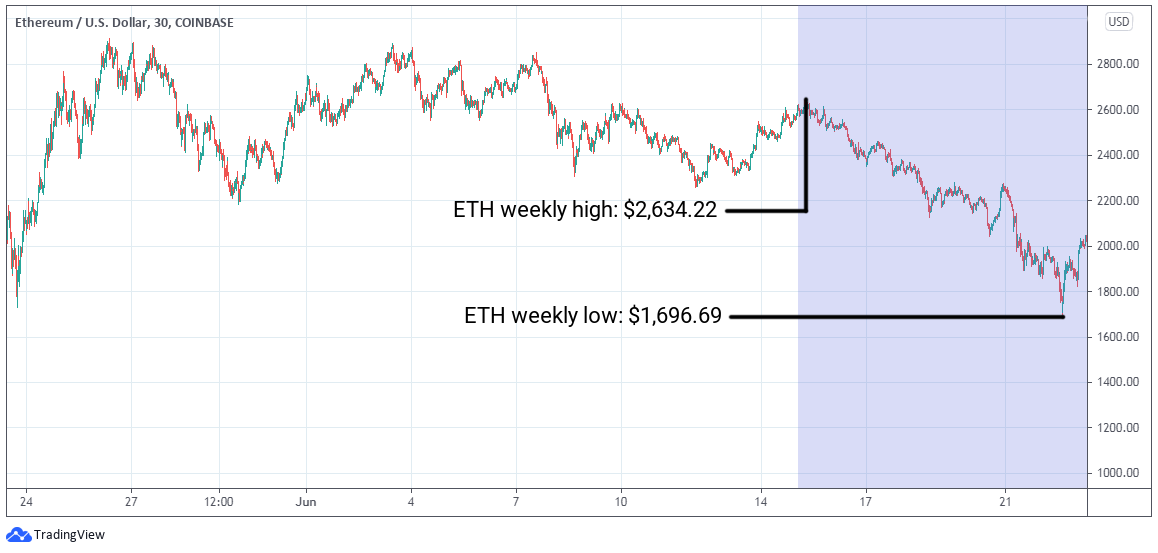
Ether too was roiled by retail uncertainty, with Ethereum’s base currency falling well below the $2,000-mark it first captured in February 2021. The fundamentals of ETH continue to impress, with DeFi total value locked still rising, but spot prices showed weakness throughout out the week, shedding 35% from a high of $2,634.22 to to hit $1696.69, a two- month low. By Wednesday morning it had rebounded 20.4% with lower values below $2,000 clearly rejected.
LTC/USD
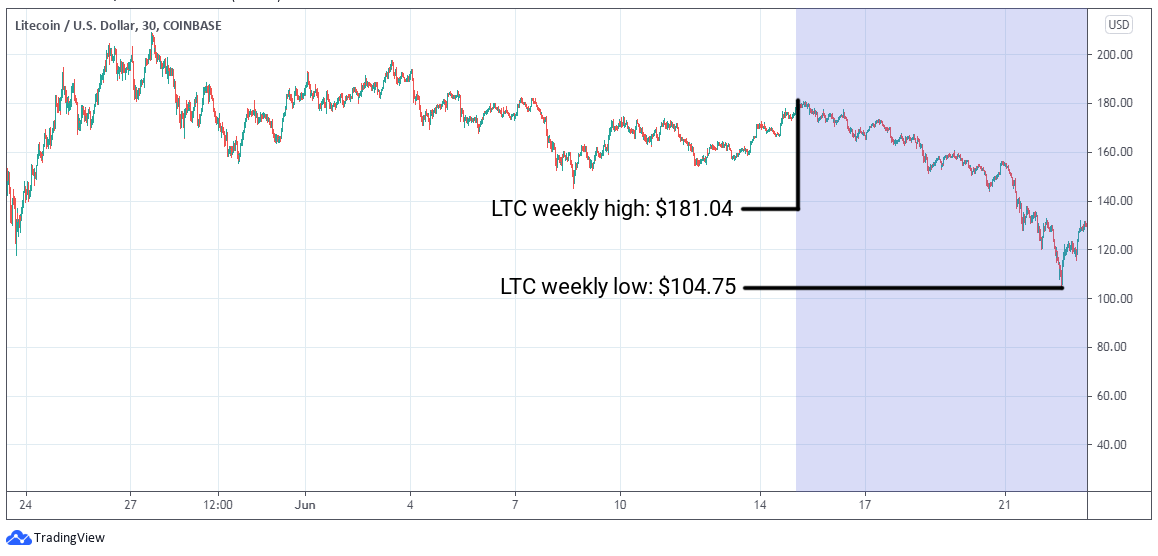
The start of the week at $181.04 was the best it got for Litecoin, as the popular payments protocol suffered a 42.1% capitulation from its peak to its zenith. Those intraday lows were numbers not seen since the bull run of late December 2020, piquing interest in the potential for a Litecoin bear market. There were brighter signs for LTC against the dollar, though, as it bounced back 25.7% to end the week at $131.77.
Informations importantes
Communication à caractère promotionnel. Les informations contenues dans le présent Document sont fournies à des fins d’information et de pédagogie. Elles ne constituent ni un conseil en investissement, ni une recommandation personnalisée, ni une sollicitation en vue d’acheter ou de vendre un instrument financier.
Le présent Document (qui peut prendre la forme d’une présentation, d’un communiqué de presse, d’une publication sur les réseaux sociaux, d’un article de blog, d’une communication audiovisuelle ou d’un support similaire – ci-après le « Document ») est émis par Bitwise Europe GmbH (« BEU » ou l’« Émetteur »).
Bitwise Europe GmbH est constituée selon le droit allemand et agit en qualité d’émetteur des produits négociés en bourse (« Exchange Traded Products » ou « ETP ») mentionnés dans le présent Document. Les ETP sont émis sur la base d’un prospectus de base et de conditions définitives, susceptibles d’être complétés. Un prospectus a été publié ou, le cas échéant, sera publié conformément au Règlement (UE) 2017/1129. Les investisseurs peuvent obtenir gratuitement le prospectus de base, les conditions définitives applicables ainsi que tout supplément éventuel sur le site www.bitwiseinvestments.eu/fr
L’approbation d’un prospectus par l’autorité compétente ne constitue ni une approbation ni une recommandation des instruments financiers concernés.
Capital à risque. Les crypto-actifs sont des actifs hautement volatils et présentent un risque élevé. La valeur des investissements dans des crypto-actifs ou dans des ETP liés aux crypto-actifs peut fluctuer fortement à la hausse comme à la baisse et les investisseurs peuvent perdre tout ou partie de leur capital investi.
Les ETP liés aux crypto-actifs sont des instruments financiers complexes et peuvent ne pas convenir à tous les investisseurs. Ils peuvent exposer les investisseurs à des risques spécifiques, notamment un risque de crédit de l’émetteur, un risque de liquidité, des risques opérationnels ainsi que des risques liés au fonctionnement, à la réglementation et à la valorisation des marchés des crypto-actifs sous-jacents.
Aucun mécanisme de garantie du capital ne s’applique. Selon la juridiction et le mode de détention, les investisseurs peuvent ne bénéficier d’aucun mécanisme public d’indemnisation ou de protection des investisseurs.
Les performances passées ne constituent pas un indicateur fiable des performances futures. Toute déclaration prospective reflète des hypothèses et des anticipations et ne constitue pas une garantie de résultats futurs.
Avant toute décision d’investissement, les investisseurs doivent lire attentivement le prospectus de base, les conditions définitives applicables et notamment la section intitulée « Avertissements ». Une décision d’investissement doit tenir compte de la situation personnelle de l’investisseur, de ses objectifs, de son horizon d’investissement et de sa capacité à supporter des pertes potentielles. Le cas échéant, il convient de solliciter un conseil indépendant en matière financière, fiscale et juridique.
Un avertissement détaillé sur les risques applicables aux ETP liés aux crypto-actifs est disponible à l’adresse suivante : www.bitwiseinvestments.eu/fr/risk-warning