
- Inflows to digital asset ETPs topped $373m last week, as inflation concerns rippled through the market and pointed high-net-worth and institutional investors to bitcoin, ether and litecoin ETPs
ETH breaks all records in rise over $4,000
It has been difficult to focus on much more than the Ethereum price this week, given how the smart contract blockchain has boomed in the last seven days, showing irrepressible strength and leaving the rest of the market scrambling in its wake.
February's burst through $2,000 was a serious marker laid down by the programmable money blockchain, followed by its first ever breach of $3,000 on 3 May. That ETH is now holding steady above $4,000 is entirely new territory.
With only two months to go until the scheduled London hard fork that will implement a new deflationary structure for the ETH currency, it is perhaps not surprising that institutions are looking to increase their exposure. The supply constraints imposed by DeFi also appear to be contributing to this dizzying rally. After several weeks of faster growth the total value locked in DeFi contracts as recorded by DeFiPulse is now approaching $100bn.
As we note in our research report Valuing Ethereum, Vitalik Buterin's cryptoasset achieved a $200bn valuation in just six years: Bitcoin took eight years to reach this point. And now, with a market cap approaching half a billion dollars, Ethereum is worth more than Siemens (ETR: SIE),Shopify (NYSE: SHOP), and Astrazeneca (LSE: AZN) combined.
If it were a traditional publicly traded company, Ethereum would be the 14th largest in the world, snapping at the valuation heels of JP Morgan Chase (NYSE: JPM) and Visa(NYSE: V).
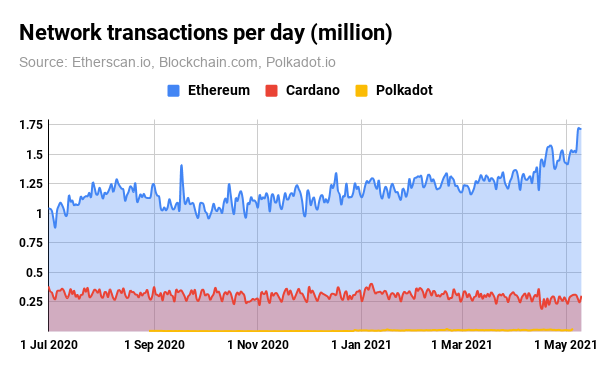
The attention on Ethereum has been intense in recent days, with daily transactions hitting a 1.7 million per-day all-time high.
Compare that figure to two other self-styled 'Ethereum-killers' gunning for the title of the best smart contract blockchain.
On one side is the $55bn-rated Cardano, the seventh-largest blockchain by market cap, and on the other is the highly-touted $32bn interoperability blockchain Polkadot. Both these self-styled rivals have Ethereum co-founders as their lead.
But the narrative unwinds somewhat when we look at their actual utility. Polkadot, for its part, is high on promise but low on delivery as yet, and with average daily transactions since its 2020 launch of 10,000-15,000, isn't really in the same universe.
News of increasingly costly exploits on the Binance Smart Chain blockchain may have helped reinforce the security message to institutions interested in DeFi, too.
Binance's Uniswap clone Uranium Finance suffered a breach and irretrievable loss of $50m in late April, according to Coindesk. Days later the BSC-based decentralised synthetic asset protocol Spartan was hacked for more than $30m, according to a Medium post by cybersecurity analysts Peckshield.
Digital asset ETP inflows hit $373m as inflation fears spiral
Inflows to digital asset ETPs topped $373m last week, as inflation concerns rippled through the market and pointed high-net-worth and institutional investors to bitcoin, ether and litecoin ETPs.
Inflation-watchers need only look at China's factory gate prices, which this month climbed at the fastest speed in more than three years, after being stuck in negative territory for much of 2020.
The country's producer price index, a measure of industrial profitability, surged 6.8% in April, driven by higher commodity prices, according to Reuters and the South China Morning Post. The index has long been seen as a harbinger of prices to come.
And as we hit Tuesday 10 May, world stock markets were on track for their worst day of 2021. A general retracement in tech stocks, paired with these inflation concerns, saw indices slide across the board. The FTSE 100 dipped more than 2%, Japan's Nikkei fell 3% and the Stoxx 600 was down 2% in mid-morning trading following the Nasdaq's 2.6% dive on Monday 9 May
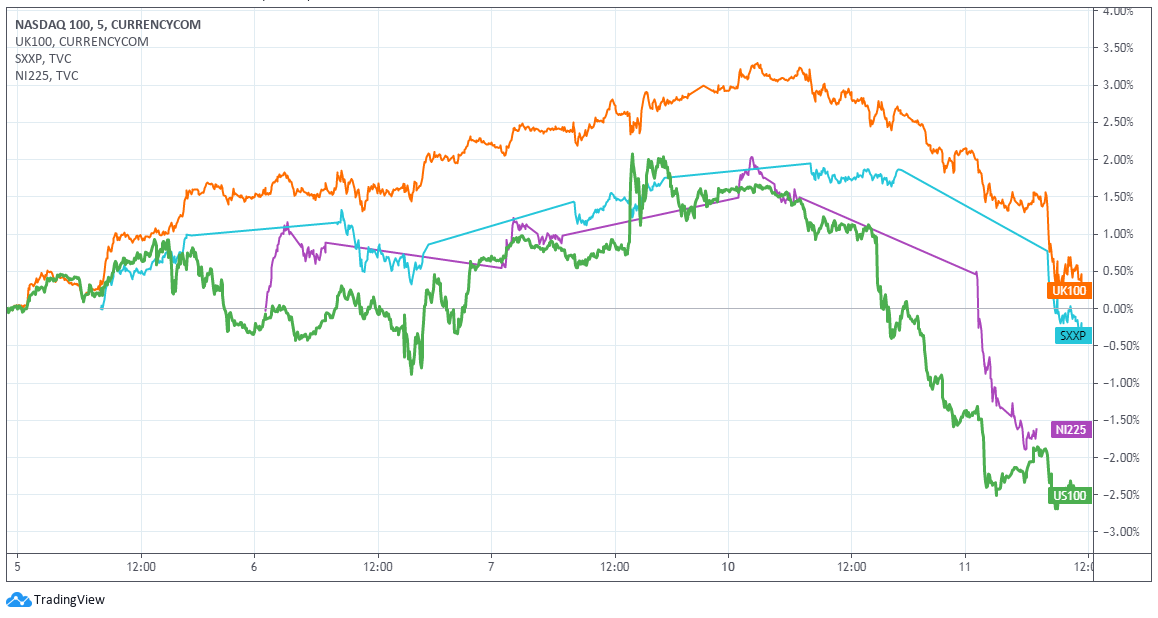
Analysts suggested the sell down in equities was long overdue, after surging post-Covid optimism caused weeks of relentless bid-up price action.
Global equities have suffered an ugly shift in sentiment after US stocks declined sharply, led by the tech-heavy Nasdaq 100 index, which suffered one of its worst sessions this year and closed at is lowest in over a month. The weak sentiment spilled over into Asia, with the Nikkei declining sharply towards major support. Russ Mould, investment director, AJ Bell
One of the few US tech stocks to beat the drop was big data analytics provider Palantir (NYSE: PLTR). Peter Thiel's firm climbed not so much from its Q1 reported earnings, which met Wall Street expectations, but the reveal that it now accepts bitcoin and plans to join the growing list of multinationals to add the cryptoasset to its balance sheet.
Markets
Overall market movements were generally bullish this week, with 37 of the top 50 coins (excluding stablecoins) generating a positive weekly performance. A handful of heavily-hyped altcoins in the lower-end of this market cap list lost out, however, while large-cap altcoins Ethereum and Litecoin continued to extend their 2021 outperformance.
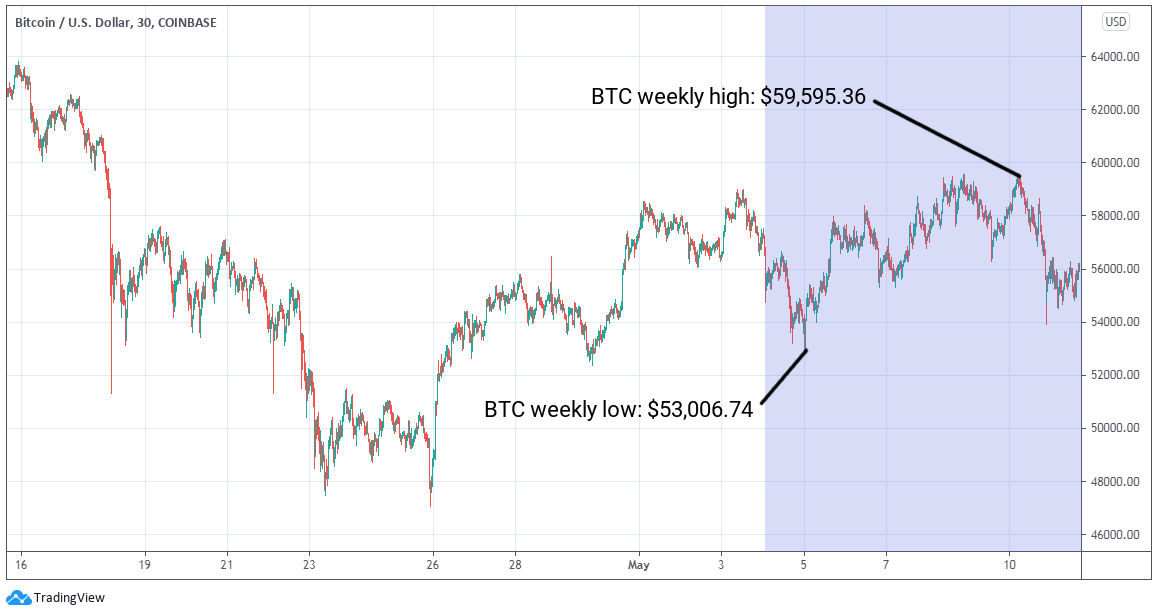
With the overriding focus on Ethereum, Bitcoin had a rather quiet week and remained largely flat, trading in a fairly tight range from a low of $53006.74. The largest cryptoasset by market cap clung on to its $1trn+ valuation, but failed to climb further and was soundly rejected just south of $60,000. Overall it gained just 2.62%.
BTC/USD
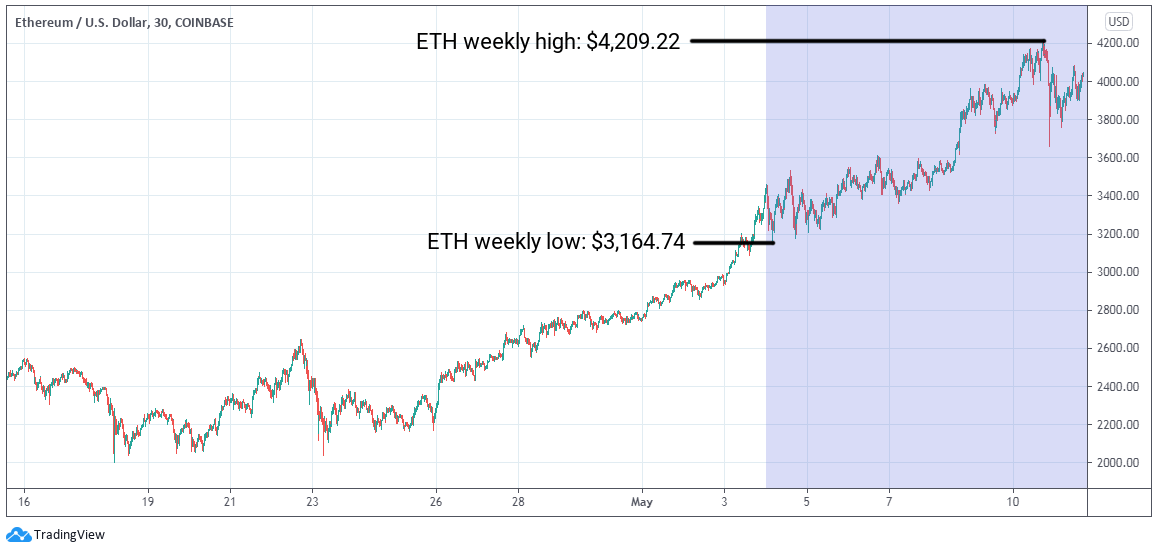
Ethereum took the prize for the most talked-about asset of the week, scoring a 33% rise before falling back from its new record high of $4209.22.
ETH/USD
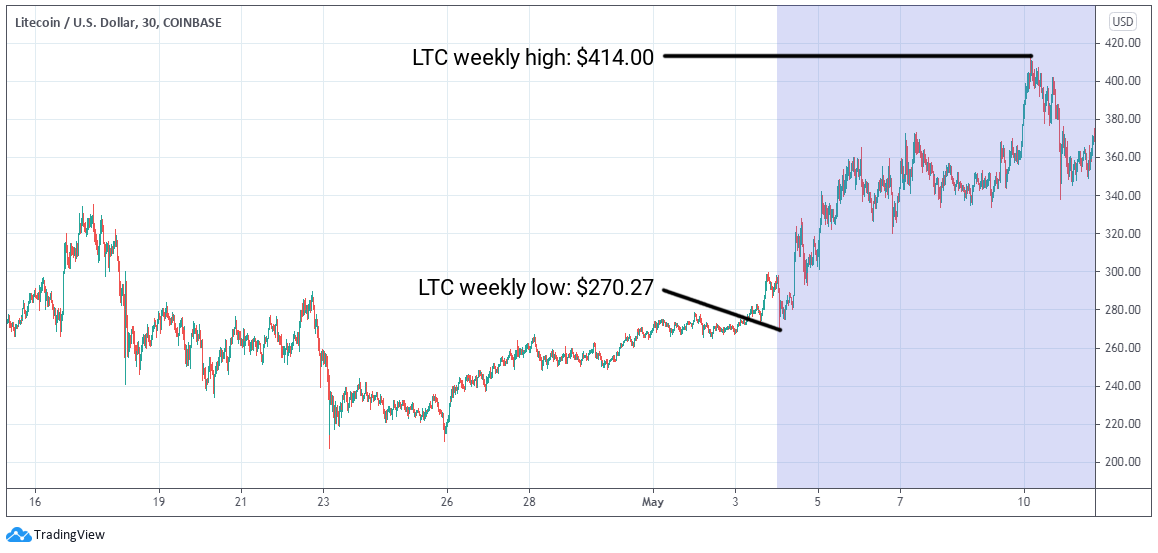
Litecoin too added strength in depth with it's rise peaking at 53.18% midweek, topping out 10.62% beyond its previous all time high from December 2017 of $372. The payments blockchain could not hold on to all of its gains, edging back a little to finish the week at $374.66.
LTC/USD
Informations importantes
Communication à caractère promotionnel. Les informations contenues dans le présent Document sont fournies à des fins d’information et de pédagogie. Elles ne constituent ni un conseil en investissement, ni une recommandation personnalisée, ni une sollicitation en vue d’acheter ou de vendre un instrument financier.
Le présent Document (qui peut prendre la forme d’une présentation, d’un communiqué de presse, d’une publication sur les réseaux sociaux, d’un article de blog, d’une communication audiovisuelle ou d’un support similaire – ci-après le « Document ») est émis par Bitwise Europe GmbH (« BEU » ou l’« Émetteur »).
Bitwise Europe GmbH est constituée selon le droit allemand et agit en qualité d’émetteur des produits négociés en bourse (« Exchange Traded Products » ou « ETP ») mentionnés dans le présent Document. Les ETP sont émis sur la base d’un prospectus de base et de conditions définitives, susceptibles d’être complétés. Un prospectus a été publié ou, le cas échéant, sera publié conformément au Règlement (UE) 2017/1129. Les investisseurs peuvent obtenir gratuitement le prospectus de base, les conditions définitives applicables ainsi que tout supplément éventuel sur le site www.bitwiseinvestments.eu/fr
L’approbation d’un prospectus par l’autorité compétente ne constitue ni une approbation ni une recommandation des instruments financiers concernés.
Capital à risque. Les crypto-actifs sont des actifs hautement volatils et présentent un risque élevé. La valeur des investissements dans des crypto-actifs ou dans des ETP liés aux crypto-actifs peut fluctuer fortement à la hausse comme à la baisse et les investisseurs peuvent perdre tout ou partie de leur capital investi.
Les ETP liés aux crypto-actifs sont des instruments financiers complexes et peuvent ne pas convenir à tous les investisseurs. Ils peuvent exposer les investisseurs à des risques spécifiques, notamment un risque de crédit de l’émetteur, un risque de liquidité, des risques opérationnels ainsi que des risques liés au fonctionnement, à la réglementation et à la valorisation des marchés des crypto-actifs sous-jacents.
Aucun mécanisme de garantie du capital ne s’applique. Selon la juridiction et le mode de détention, les investisseurs peuvent ne bénéficier d’aucun mécanisme public d’indemnisation ou de protection des investisseurs.
Les performances passées ne constituent pas un indicateur fiable des performances futures. Toute déclaration prospective reflète des hypothèses et des anticipations et ne constitue pas une garantie de résultats futurs.
Avant toute décision d’investissement, les investisseurs doivent lire attentivement le prospectus de base, les conditions définitives applicables et notamment la section intitulée « Avertissements ». Une décision d’investissement doit tenir compte de la situation personnelle de l’investisseur, de ses objectifs, de son horizon d’investissement et de sa capacité à supporter des pertes potentielles. Le cas échéant, il convient de solliciter un conseil indépendant en matière financière, fiscale et juridique.
Un avertissement détaillé sur les risques applicables aux ETP liés aux crypto-actifs est disponible à l’adresse suivante : www.bitwiseinvestments.eu/fr/risk-warning