
- We expect the Bitcoin Halving to occur on the 20th April at around 18:20 GMT assuming an average block time of around 10 minutes
- Bitcoin Halvings are best understood as supply shock - historical Halving events were followed by very significant price appreciations in the past
- The quantitative analysis suggests that the performance differences 100 days after the Halving are so significant that it is unlikely to be random; we conclude that the Halving is most likely not "priced in"
The historical track record
The Bitcoin Halving is probably the most anticipated event in Bitcoin and cryptoassets in general.
As the name suggests, the block subsidy, that is the reward miners receive for finding the right hash and secure the blockchain, will be cut in half at that event.
In other words, the supply growth of bitcoins will decline by -50%.
The Halving is an essential feature of the Bitcoin protocol that not only ensures a decreasing disinflationary supply growth schedule but also ultimately ensures that the Bitcoin circulating supply will converge towards a maximum of 21 million coins.
We already had 3 Halvings in the past since the genesis of Bitcoin which happened in 2012, 2016, and 2020, respectively.
These Halvings saw the block subsidy cut in half from initially 50 BTC to 25 BTC, from 25 BTC to 12.5 BTC, and from 12.5 BTC to 6.25 BTC now.
At the time of writing, we expect the Bitcoin Halving to occur around the 20th of April 2024 at around 19:20 GMT, assuming an average block time of 10 minutes.
At that time, the Bitcoin block subsidy will be reduced by -50% again, from 6.25 BTC to 3.125 BTC.
As Bitcoin blocks get mined approximately every 10 minutes, this implies that the daily supply issuance of bitcoins will fall from ~900 BTC to ~450 BTC per day.
The Bitcoin Halving is best thought of as a supply shock.
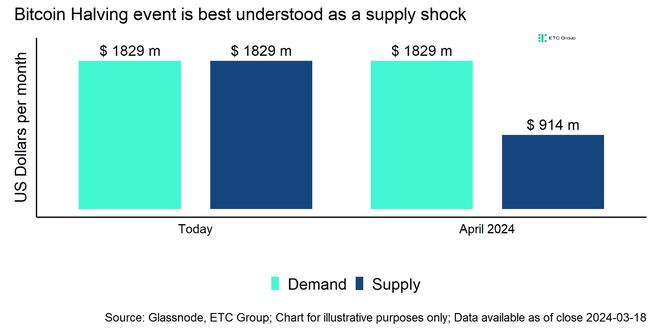
Assuming a constant flow of demand for bitcoins, the reduction in the supply flow of bitcoins should theoretically lead to a higher equilibrium price for bitcoins – prices need to adjust higher to accommodate the lower flow of supply.
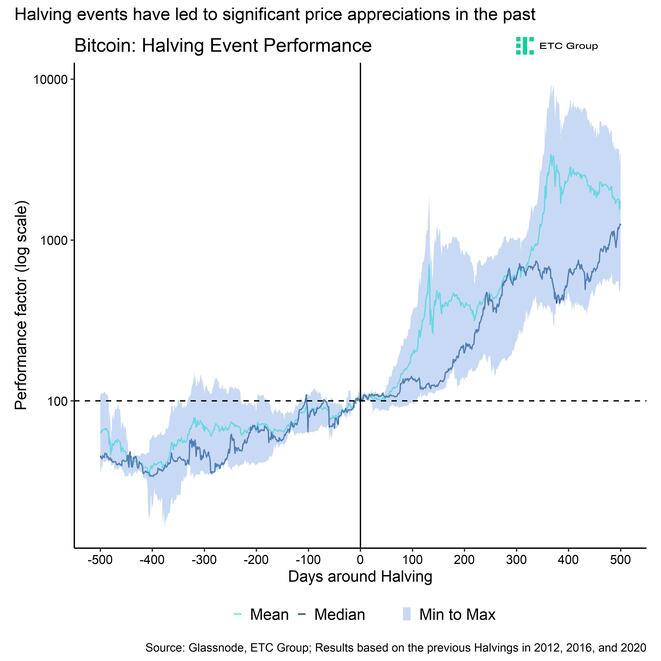
In fact, historical Bitcoin Halvings were followed by a very significant increase in the price of Bitcoin in the months following the event.
More specifically, the post-Halving performance of Bitcoin was around ~17x (~1800%) 500 days after the Halving averaged across the last 3 Halvings.
Is the Bitcoin Halving priced in?
Traditional investors are usually puzzled by the significant post-Halving performance in the past and tend to think that the upcoming Halving is already priced in.
The reason is that the dominant Efficient Market Hypothesis assumes that any public information should be immediately reflected in the price. Since the Halving date and the effect are publicly known, the logic goes that this and subsequent Halving events should already be reflected in the price in advance, i.e. “priced in”.
We tried to analyse this question by asking the following question:
If the Bitcoin Halving was not significant, then there should be no significant performance difference X days after the Halving date relative to X days before the Halving date?
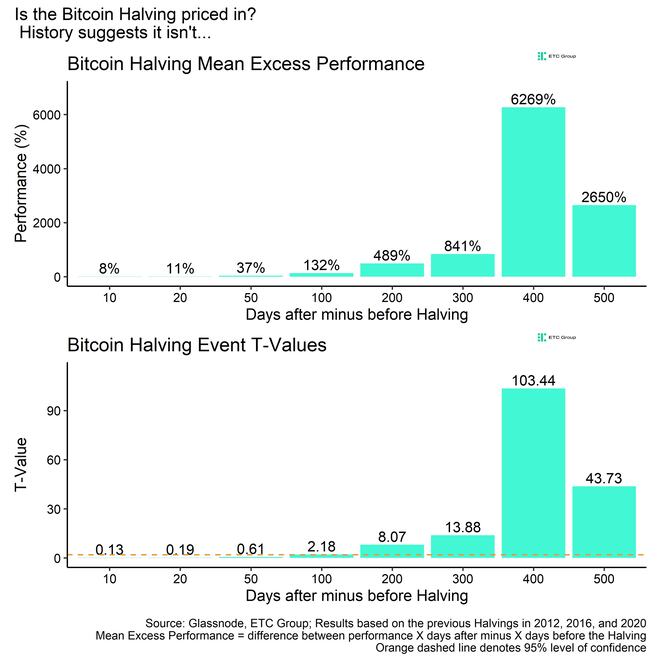
The following bar chart shows the respective performance differences in the upper panel while the lower panel shows the respective T-value of those performance differences.
Here are some key observations from the analysis:
- There has been no significant performance difference until around 100 days after the Halving
- After 100 days following the Halving, performance differences become increasingly statistically significant
- The performance effect of the Halving tends to be highest at 400 days after the Halving
The results suggest that the performance difference after 100 days after the Halving has been so significant that it is unlikely to be random and pure coincidence.
These observations are also consistent with the fundamental on-chain mechanics that happen around the Halving.
If the price increased in anticipation of the Halving, Bitcoin miners would start selling more than their daily mined supply which would in turn suppress the price again. After the Halving, Bitcoin miners will be limited to sell more bitcoins by the decrease in block subsidy which is why the price will find a higher equilibrium.
In fact, we tend to see increased selling by miners, i.e. miners selling even more than the mine on a daily basis, whenever prices increased above their average marginal cost of production. However, this amount of selling cannot be sustained after Halving.
In general, we still expect prices to converge to a higher equilibrium price in 2024 et seqq. due to the positive effect of the Halving and increasing scarcity.
More specifically, our model suggests that Bitcoin’s equilibrium price could increase to 103k USD by the end of 2024, to 172k USD by the end of 2025 and ultimately to 215k USD by the end of the next Bitcoin epoch in 2028.
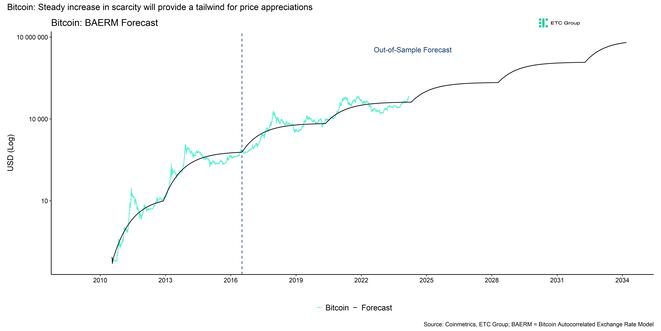
- We therefore conclude that the Bitcoin Halving is most likely not priced in.
This model also assumes that the effect from the Halving will not be visible immediately but will be reflected gradually over time as the supply deficit induced by the Halving itself accumulates only gradually over time.
This model even factors in the fact that the effect from every Halving is bound to marginally decrease over time, unlike the stock-to-flow that assumes that the effect of the Halving is increasing exponentially with every Halving. Thus, the abovementioned estimates are rather conservative.
Bottom Line
- We expect the Bitcoin Halving to occur on the 20th April at around 18:20 GMT assuming an average block time of around 10 minutes
- Bitcoin Halvings are best understood as supply shock - historical Halving events were followed by very significant price appreciations in the past
- The quantitative analysis suggests that the performance differences 100 days after the Halving are so significant that it is unlikely to be random; we conclude that the Halving is most likely not "priced in"
Informations importantes
Communication à caractère promotionnel. Les informations contenues dans le présent Document sont fournies à des fins d’information et de pédagogie. Elles ne constituent ni un conseil en investissement, ni une recommandation personnalisée, ni une sollicitation en vue d’acheter ou de vendre un instrument financier.
Le présent Document (qui peut prendre la forme d’une présentation, d’un communiqué de presse, d’une publication sur les réseaux sociaux, d’un article de blog, d’une communication audiovisuelle ou d’un support similaire – ci-après le « Document ») est émis par Bitwise Europe GmbH (« BEU » ou l’« Émetteur »).
Bitwise Europe GmbH est constituée selon le droit allemand et agit en qualité d’émetteur des produits négociés en bourse (« Exchange Traded Products » ou « ETP ») mentionnés dans le présent Document. Les ETP sont émis sur la base d’un prospectus de base et de conditions définitives, susceptibles d’être complétés. Un prospectus a été publié ou, le cas échéant, sera publié conformément au Règlement (UE) 2017/1129. Les investisseurs peuvent obtenir gratuitement le prospectus de base, les conditions définitives applicables ainsi que tout supplément éventuel sur le site www.bitwiseinvestments.eu/fr
L’approbation d’un prospectus par l’autorité compétente ne constitue ni une approbation ni une recommandation des instruments financiers concernés.
Capital à risque. Les crypto-actifs sont des actifs hautement volatils et présentent un risque élevé. La valeur des investissements dans des crypto-actifs ou dans des ETP liés aux crypto-actifs peut fluctuer fortement à la hausse comme à la baisse et les investisseurs peuvent perdre tout ou partie de leur capital investi.
Les ETP liés aux crypto-actifs sont des instruments financiers complexes et peuvent ne pas convenir à tous les investisseurs. Ils peuvent exposer les investisseurs à des risques spécifiques, notamment un risque de crédit de l’émetteur, un risque de liquidité, des risques opérationnels ainsi que des risques liés au fonctionnement, à la réglementation et à la valorisation des marchés des crypto-actifs sous-jacents.
Aucun mécanisme de garantie du capital ne s’applique. Selon la juridiction et le mode de détention, les investisseurs peuvent ne bénéficier d’aucun mécanisme public d’indemnisation ou de protection des investisseurs.
Les performances passées ne constituent pas un indicateur fiable des performances futures. Toute déclaration prospective reflète des hypothèses et des anticipations et ne constitue pas une garantie de résultats futurs.
Avant toute décision d’investissement, les investisseurs doivent lire attentivement le prospectus de base, les conditions définitives applicables et notamment la section intitulée « Avertissements ». Une décision d’investissement doit tenir compte de la situation personnelle de l’investisseur, de ses objectifs, de son horizon d’investissement et de sa capacité à supporter des pertes potentielles. Le cas échéant, il convient de solliciter un conseil indépendant en matière financière, fiscale et juridique.
Un avertissement détaillé sur les risques applicables aux ETP liés aux crypto-actifs est disponible à l’adresse suivante : www.bitwiseinvestments.eu/fr/risk-warning