
- 100 million people already use Bitcoin. But parts of the ecosystem remain too challenging for beginners to use. So as Visa (NYSE:V) reports over $1bn of crypto card payments so far this year, and touts cross-border stablecoins key to its development, Square (NYSE:SQ) announces plans for a hardware wallet to accelerate adoption and get cryptocurrency into the hands of the next 100 million people much faster.
Jack Dorsey is building a mainstream Bitcoin wallet
Not your keys, not your crypto. That’s the mantra of the cryptoasset fanatic. But for too long, it’s felt too sketchy to be a Bitcoin fan. For too long, it was something that money managers only mentioned in hushed tones and private conversations. Taking Bitcoin truly mainstream means making it easy to use and available everywhere.
That’s why there’s so much excitement about a well-known and highly-regarded public company like Square (NYSE:SQ) — co-founded by Twitter CEO Jack Dorsey — building a hardware cryptocurrency wallet.
Square is considering making a hardware wallet for #bitcoin. If we do it, we would build it entirely in the open, from software to hardware design, and in collaboration with the community. We want to kick off this thinking the right way: by sharing some of our guiding principles.
— jack (@jack) June 4, 2021
While mainstream hardware wallets like the Paris-based Ledger and Czech firm Trezor have built up decent reputations in the last few years, neither are household names outside the crypto bubble. And both have been hurt by cybersecurity issues. First, Kraken researchers showed up a vulnerability in the Trezor’s wallet that could leak users’ private keys and personal details in under 15 minutes. Then, in July 2020 Ledger admitted it was hacked, with an extensive trove of customer data from email addresses to phone numbers posted online.
We’re reminded of a phrase by one legendary equities investor.
Investors should always keep in mind that the most important metric is not the returns achieved by the returns weighed against the risks incurred. Ultimately, nothing should be more important to investors than the ability to sleep soundly at night. Seth Klarman, founder, Baupost Group
Sleeping soundly at night while also taking on the massive liability of being one’s own bank? Not so simple. These are the risks incurred for too many people investing in cryptoassets today.
And not everyone wants to take on the responsibility of securing their own sources of wealth. For the same reason: easy access, regulated and centrally-custodied products like ETFs and ETPs have exploded in value in recent years.
Scams, email phishing and cyberattacks dupe millions each year into giving away their personal information, payment, or credit card details. And yet some in the crypto realm still insist these people must manage the intricacies and the insanely steep learning curve of private key cryptography. That kind of exclusionary high-mindedness will be a thing of the past, Dorsey’s move proves.
The man leading the task is Square’s hardware development chief and former engineering director at Apple (NASDAQ:AAPL), Jesse Dorugusker. His mission is to reach beyond the hardcore of crypto users who don’t mind jumping through complex hoops to secure and access their assets.
We have decided to build a hardware wallet and service to make bitcoin custody more mainstream. We’ll continue to ask and answer questions in the open. This community’s response to our thread about this project has been awesome - encouraging, generous, collaborative, & inspiring. https://t.co/CHf9hAmKnn
— Jesse Dorogusker (@JesseDorogusker) July 8, 2021
Visa reports $1bn+ of crypto card payments in H1 2021
Visa (NYSE:V), famously, became the first global payments network to settle payments using USDC stablecoins on the Ethereum blockchain. And so it is with some interest that it reports its crypto-enabled cards processed more than $1bn in spending across the first six months of 2021.
In a full-throated update, the $523bn conglomerate said it would continue to support the development and adoption of the cryptocurrency industry as a key part of its business.
With more than $1bn spent on crypto-linked Visa cards, in the first half of 2021, it’s clear that the crypto community sees value in linking digital currencies to Visa’s global network. It’s the magic of tap and go without the complexity...of cryptographic keys.
Today the value of cryptoassets held in regulated digital wallets is in the hundreds of billions. For the tens of millions using those platforms, one of the simplest ways to spend crypto is through a Visa card. We’re partnering with 50 of the leading crypto platforms on card programs that make it easy to convert and spend digital currency at 70 million merchants worldwide.
Note the language. “Make it easy”. “Simple”. “Don’t require”. “Without the complexity”. This is exactly why Square are investing in a hardware wallet and why there remains a huge untapped market for crypto adoption.
Stablecoins are another key element of Visa’s crypto growth, it said in the update, announcing the FTX cryptoexchange as the newest member of its Fintech Fast Track programme. Under the deal, the fintech would use Visa’s USDC cross-border settlements to pay 50% of their remote employees.
Stablecoins are on track to become an important part of the broader digital transformation of financial services. With more than $100 billion of stablecoins in circulation and hundreds of billions exchanged each more on public blockchains stablecoins are starting to live up to the promise of digital fiat.
Removing the need for merchants to accept cryptocurrencies directly, and instead providing easy on-off ramps between crypto and fiat is one of the key measures that will expedite adoption.
$13.5bn megadeals: SPACs take Circle and Bullish public
We noted in last week’s Crypto Minutes that, despite flat spot markets, private equity and venture capital are devoting increasingly larger sums to crypto infrastructure.
Boston-based Circle, the creator of USDC, launched its first products in 2013. In the intervening years, it pulled in over $130 million in VC funding, including a $50 million round led by Goldman Sachs (NYSE:GS).
Now those angel investors will see a potentially massive ROI, as Circle has announced plans to go public on the New York Stock Exchange, in a $4.5bn SPAC eal with Concord Acquisition Corp (NYSE:CDN), led by former Barclays (LSE:BARC) boss Bob Diamond.
Another huge SPAC deal is Bullish Global. On 9 July the Peter Thiel-backed exchange announced plans to merge with Far Peak Acquisition Corp (NYSE:FPAC), run by former NYSE president Tom Farley. The merger implies a pro forma equity value of $9bn, according to the company.
It means Bullish will become the latest cryptoasset exchange to go public, joining Coinbase (NASDAQ:COIN) and Bakkt — which is itself expected to merge with VPC Impact Acquisition Holdings by the end of Q2 2021.
SPACs, special purpose acquisition companies were first created in 1993 but have become one the most popular ways to take a company public in recent years.
It’s a similar process to the so-called ‘reverse merger’ common among on the UK’s junior AIM stock market. Investors pool their capital in a listed cash shell that has no assets of its own, in advance of knowing which company will reverse into the already-public SPAC. Once the merger is completed, shares in the new vehicle can then begin trading on a public exchange without the need for a massive capital-raising IPO.
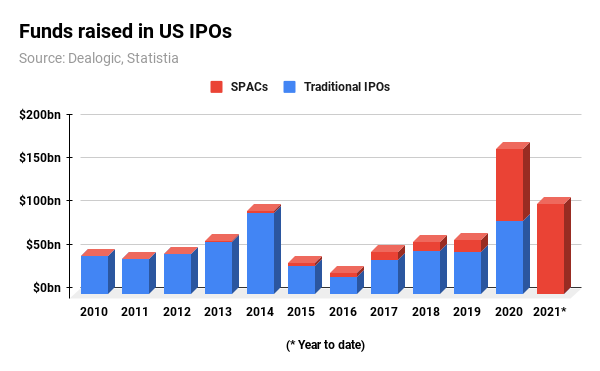
In 2020 these blank check (or blank cheque) vehicles raised a record $82.1 billion, 6 times higher than the previous year’s all-time high.
As of mid-June 2021s, SPAC had already eclipsed that annual total, raising over $105 billion.
Markets
BTC/USD
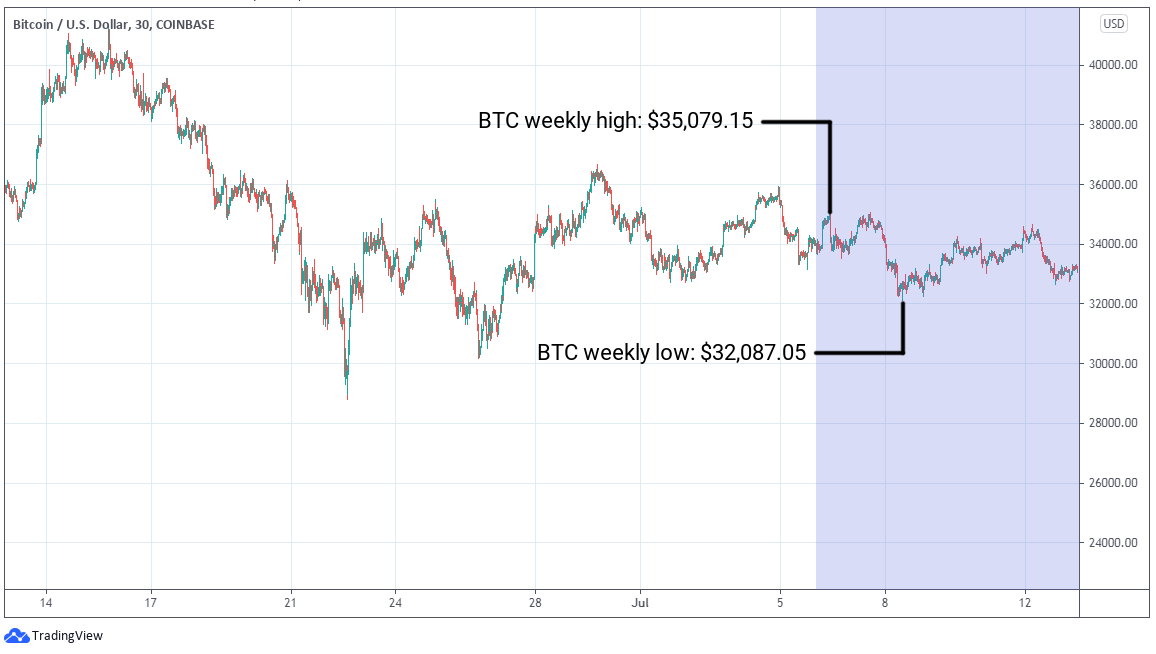
There was little volatility to speak of in Bitcoin markets this week, with the world’s largest cryptoasset remaining largely range bound. BTC held above support at around $32,000 but failed to capitalise further, hitting rejection just above $35,000. In total the BTC price moved down just $600 across the seven days, for a weekly loss of 1.8%.
ETH/USD
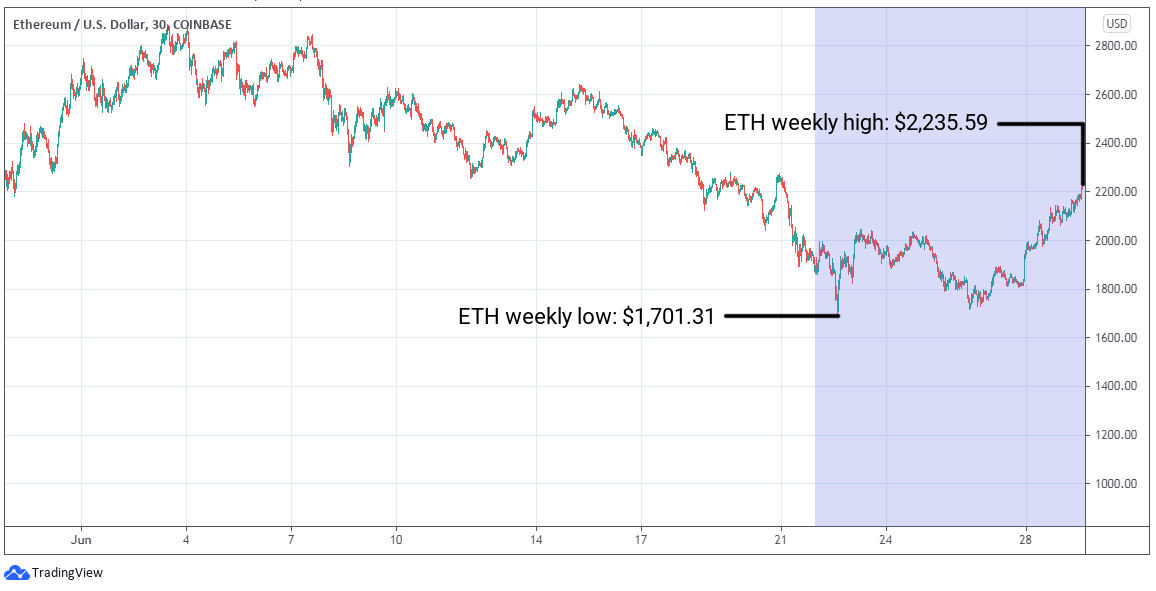
Ether markets climbed 9.8% this week to a high of $2,410.09 before losing that momentum and sliding as low as $1,976.83. Traders found some encouragement in the fact that ETH bounced strongly off support at this sub-$2,000 level, but the familiar recent pattern of short-term weakness in the price against the US dollar continues unabated. Volatility has decreased, however, with peaks and troughs remaining far more moderate than we have seen so far in 2021.
LTC/USD
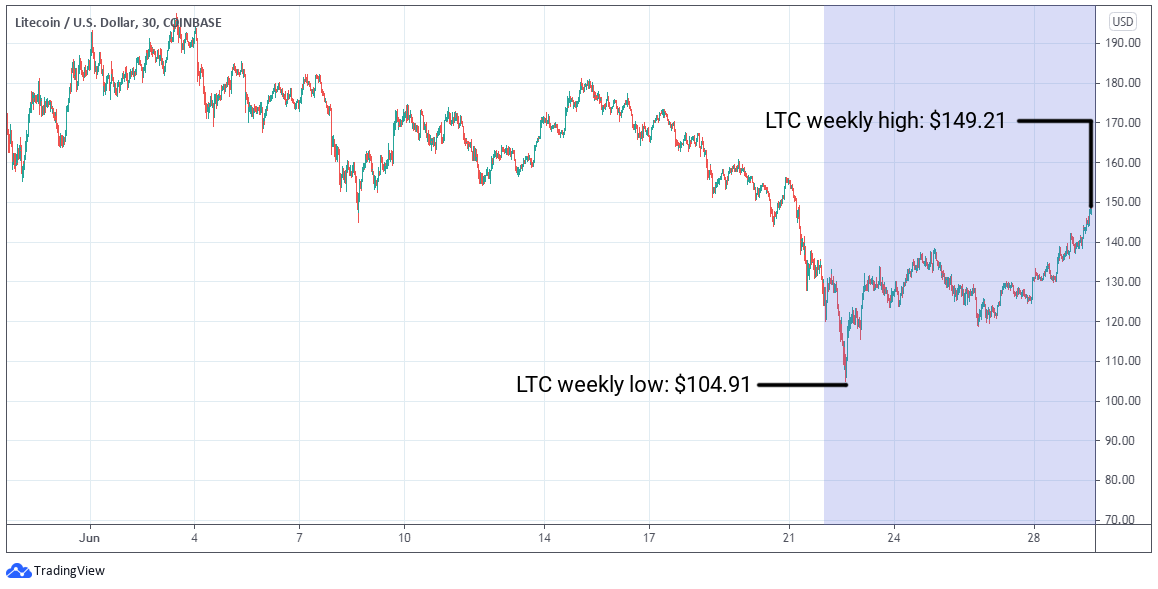
Litecoin fared much the same as its cryptoasset rivals this week, with intraday volume soft and everything rather muted on the price side. LTC climbed 3.5% to an early-week peak of $142.63, then returned from a Friday 9 July low at $125.86 to finish proceedings 5% higher at $132.15.
Informations importantes
Communication à caractère promotionnel. Les informations contenues dans le présent Document sont fournies à des fins d’information et de pédagogie. Elles ne constituent ni un conseil en investissement, ni une recommandation personnalisée, ni une sollicitation en vue d’acheter ou de vendre un instrument financier.
Le présent Document (qui peut prendre la forme d’une présentation, d’un communiqué de presse, d’une publication sur les réseaux sociaux, d’un article de blog, d’une communication audiovisuelle ou d’un support similaire – ci-après le « Document ») est émis par Bitwise Europe GmbH (« BEU » ou l’« Émetteur »).
Bitwise Europe GmbH est constituée selon le droit allemand et agit en qualité d’émetteur des produits négociés en bourse (« Exchange Traded Products » ou « ETP ») mentionnés dans le présent Document. Les ETP sont émis sur la base d’un prospectus de base et de conditions définitives, susceptibles d’être complétés. Un prospectus a été publié ou, le cas échéant, sera publié conformément au Règlement (UE) 2017/1129. Les investisseurs peuvent obtenir gratuitement le prospectus de base, les conditions définitives applicables ainsi que tout supplément éventuel sur le site www.bitwiseinvestments.eu/fr
L’approbation d’un prospectus par l’autorité compétente ne constitue ni une approbation ni une recommandation des instruments financiers concernés.
Capital à risque. Les crypto-actifs sont des actifs hautement volatils et présentent un risque élevé. La valeur des investissements dans des crypto-actifs ou dans des ETP liés aux crypto-actifs peut fluctuer fortement à la hausse comme à la baisse et les investisseurs peuvent perdre tout ou partie de leur capital investi.
Les ETP liés aux crypto-actifs sont des instruments financiers complexes et peuvent ne pas convenir à tous les investisseurs. Ils peuvent exposer les investisseurs à des risques spécifiques, notamment un risque de crédit de l’émetteur, un risque de liquidité, des risques opérationnels ainsi que des risques liés au fonctionnement, à la réglementation et à la valorisation des marchés des crypto-actifs sous-jacents.
Aucun mécanisme de garantie du capital ne s’applique. Selon la juridiction et le mode de détention, les investisseurs peuvent ne bénéficier d’aucun mécanisme public d’indemnisation ou de protection des investisseurs.
Les performances passées ne constituent pas un indicateur fiable des performances futures. Toute déclaration prospective reflète des hypothèses et des anticipations et ne constitue pas une garantie de résultats futurs.
Avant toute décision d’investissement, les investisseurs doivent lire attentivement le prospectus de base, les conditions définitives applicables et notamment la section intitulée « Avertissements ». Une décision d’investissement doit tenir compte de la situation personnelle de l’investisseur, de ses objectifs, de son horizon d’investissement et de sa capacité à supporter des pertes potentielles. Le cas échéant, il convient de solliciter un conseil indépendant en matière financière, fiscale et juridique.
Un avertissement détaillé sur les risques applicables aux ETP liés aux crypto-actifs est disponible à l’adresse suivante : www.bitwiseinvestments.eu/fr/risk-warning