
The biggest crypto story of 2021 has undoubtedly been the rise of serious competition for Ethereum. Among the new crop of contenders vying to knock it from its throne as the largest ecosystem of decentralised apps is Avalanche.
The layer 1, Proof of Stake smart contract blockchain launched its mainnet in September 2020.
Its main focus is on providing smart contract functionality for decentralised finance at faster speeds and lower costs than Ethereum, while also being compatible with that blockchain. Avalanche is EVM and Solidity-compatible, which means that Ethereum-based apps can easily migrate to the chain.
The blockchain is split into three main sub-layers, called “subnets” in Avalanche terminology. The C-Chain or Contract Chain is used for DeFi applications. The X-Chain or Exchange Chain is used for asset transfers, while the P-Chain or Platform Chain is used for staking.
The ultimate goal for the perfect blockchain is to be able to run a network that is broadly decentralised, with bulletproof security, while also able to process internet-scale transaction throughput.
Founder Emin Gün Sirer’s method with Avalanche is to separate out blockchain security mechanisms from other functions like computation and data storage.
The fastest smart contract blockchain?
Avalanche claims to be the fastest smart contract blockchain on the market today, as measured by time-to-finality.
Instead of asking each node in the network to independently verify the correct copy of the ledger of transactions, the Avalanche Consensus Protocol uses random subsampling of nodes in the network to build confidence that the entire set is valid.
AVAX token
Avalanche’s internal currency is the AVAX token. It is used to pay transaction fees on the network and in staking. As a Proof of Stake blockchain, Avalanche offers staking rewards to users who lock up their tokens. At present those staking rewards for delegators are in excess of 9% yield, with 9.5% available for validating nodes [https://www.stakingrewards.com/earn/avalanche/].
AVAX is also, like Ethereum, deflationary over time. 720 million tokens were created at launch and AVAX is burned (removed from circulation) whenever:
- a transaction takes place
- assets are created
- subnets are created
The inflection point for Avalanche’s network growth was October 2021. By then, around 250,000 distinct addresses were using Avalanche, and growth was in the 1,000-1,500 range. In the weeks that followed, the growth turned from a trickle into an exponential curve.
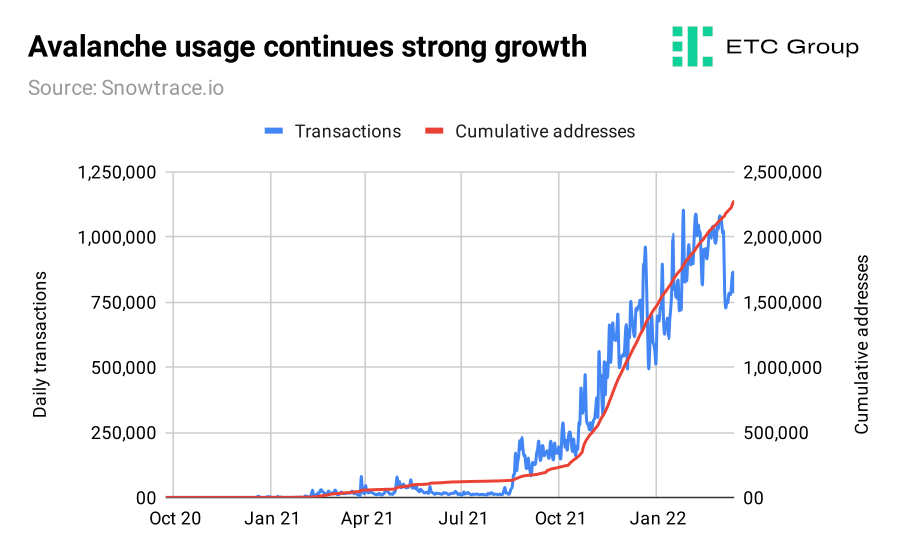
One of the main things that Avalanche has managed to do is to make its UI easy to grasp and simple to use. With Snowtrace.io [https://snowtrace.io/] it has a blockchain explorer to rival Ethereum’s Etherscan [https://etherscan.io/], providing backdated statistics and analytics that show precisely where and how operations are growing.
Rival blockchains could learn much from this user-centric design.
Additionally, there are many, many blockchain projects to choose from, so it is important for investors to note which ones users are actually paying to use. Cryptofees.info shows that [https://cryptofees.info/] Avalanche has the fourth-highest daily revenue total after Ethereum, Uniswap and Binance Smart Chain.
At more than $630,000 daily, the average amount of fees paid to Avalanche are nearly double that of Bitcoin, and 10 times more than smart contract DeFi competitors Solana and Fantom.
Outlook
Avalanche’s clear focus is scaling and DeFi. Sub-second transaction finality is a key feature, and user growth has clearly been rapid. Avalanche’s success in attracting 180+ DeFi protocols to its stable sets it up well for 2022.
If DeFi continues to grow in scale and complexity, then it stands to reason that Avalanche will grow in the same way. Avalanche’s innovation in time-to-finality makes it perfectly suited to complex financial interactions using smart contracts, and we suggest that it could continue to build and capture market share from Ethereum.
Informations importantes
Communication à caractère promotionnel. Les informations contenues dans le présent Document sont fournies à des fins d’information et de pédagogie. Elles ne constituent ni un conseil en investissement, ni une recommandation personnalisée, ni une sollicitation en vue d’acheter ou de vendre un instrument financier.
Le présent Document (qui peut prendre la forme d’une présentation, d’un communiqué de presse, d’une publication sur les réseaux sociaux, d’un article de blog, d’une communication audiovisuelle ou d’un support similaire – ci-après le « Document ») est émis par Bitwise Europe GmbH (« BEU » ou l’« Émetteur »).
Bitwise Europe GmbH est constituée selon le droit allemand et agit en qualité d’émetteur des produits négociés en bourse (« Exchange Traded Products » ou « ETP ») mentionnés dans le présent Document. Les ETP sont émis sur la base d’un prospectus de base et de conditions définitives, susceptibles d’être complétés. Un prospectus a été publié ou, le cas échéant, sera publié conformément au Règlement (UE) 2017/1129. Les investisseurs peuvent obtenir gratuitement le prospectus de base, les conditions définitives applicables ainsi que tout supplément éventuel sur le site www.bitwiseinvestments.eu/fr
L’approbation d’un prospectus par l’autorité compétente ne constitue ni une approbation ni une recommandation des instruments financiers concernés.
Capital à risque. Les crypto-actifs sont des actifs hautement volatils et présentent un risque élevé. La valeur des investissements dans des crypto-actifs ou dans des ETP liés aux crypto-actifs peut fluctuer fortement à la hausse comme à la baisse et les investisseurs peuvent perdre tout ou partie de leur capital investi.
Les ETP liés aux crypto-actifs sont des instruments financiers complexes et peuvent ne pas convenir à tous les investisseurs. Ils peuvent exposer les investisseurs à des risques spécifiques, notamment un risque de crédit de l’émetteur, un risque de liquidité, des risques opérationnels ainsi que des risques liés au fonctionnement, à la réglementation et à la valorisation des marchés des crypto-actifs sous-jacents.
Aucun mécanisme de garantie du capital ne s’applique. Selon la juridiction et le mode de détention, les investisseurs peuvent ne bénéficier d’aucun mécanisme public d’indemnisation ou de protection des investisseurs.
Les performances passées ne constituent pas un indicateur fiable des performances futures. Toute déclaration prospective reflète des hypothèses et des anticipations et ne constitue pas une garantie de résultats futurs.
Avant toute décision d’investissement, les investisseurs doivent lire attentivement le prospectus de base, les conditions définitives applicables et notamment la section intitulée « Avertissements ». Une décision d’investissement doit tenir compte de la situation personnelle de l’investisseur, de ses objectifs, de son horizon d’investissement et de sa capacité à supporter des pertes potentielles. Le cas échéant, il convient de solliciter un conseil indépendant en matière financière, fiscale et juridique.
Un avertissement détaillé sur les risques applicables aux ETP liés aux crypto-actifs est disponible à l’adresse suivante : www.bitwiseinvestments.eu/fr/risk-warning