

The biggest crypto story of 2021 has undoubtedly been the rise of serious competition for Ethereum. Among the new crop of contenders vying to knock it from its throne as the largest ecosystem of decentralised apps is Avalanche.
The layer 1, Proof of Stake smart contract blockchain launched its mainnet in September 2020.
Its main focus is on providing smart contract functionality for decentralised finance at faster speeds and lower costs than Ethereum, while also being compatible with that blockchain. Avalanche is EVM and Solidity-compatible, which means that Ethereum-based apps can easily migrate to the chain.
The blockchain is split into three main sub-layers, called “subnets” in Avalanche terminology. The C-Chain or Contract Chain is used for DeFi applications. The X-Chain or Exchange Chain is used for asset transfers, while the P-Chain or Platform Chain is used for staking.
The ultimate goal for the perfect blockchain is to be able to run a network that is broadly decentralised, with bulletproof security, while also able to process internet-scale transaction throughput.
Founder Emin Gün Sirer’s method with Avalanche is to separate out blockchain security mechanisms from other functions like computation and data storage.
The fastest smart contract blockchain?
Avalanche claims to be the fastest smart contract blockchain on the market today, as measured by time-to-finality.
Instead of asking each node in the network to independently verify the correct copy of the ledger of transactions, the Avalanche Consensus Protocol uses random subsampling of nodes in the network to build confidence that the entire set is valid.
AVAX token
Avalanche’s internal currency is the AVAX token. It is used to pay transaction fees on the network and in staking. As a Proof of Stake blockchain, Avalanche offers staking rewards to users who lock up their tokens. At present those staking rewards for delegators are in excess of 9% yield, with 9.5% available for validating nodes [https://www.stakingrewards.com/earn/avalanche/].
AVAX is also, like Ethereum, deflationary over time. 720 million tokens were created at launch and AVAX is burned (removed from circulation) whenever:
- a transaction takes place
- assets are created
- subnets are created
The inflection point for Avalanche’s network growth was October 2021. By then, around 250,000 distinct addresses were using Avalanche, and growth was in the 1,000-1,500 range. In the weeks that followed, the growth turned from a trickle into an exponential curve.
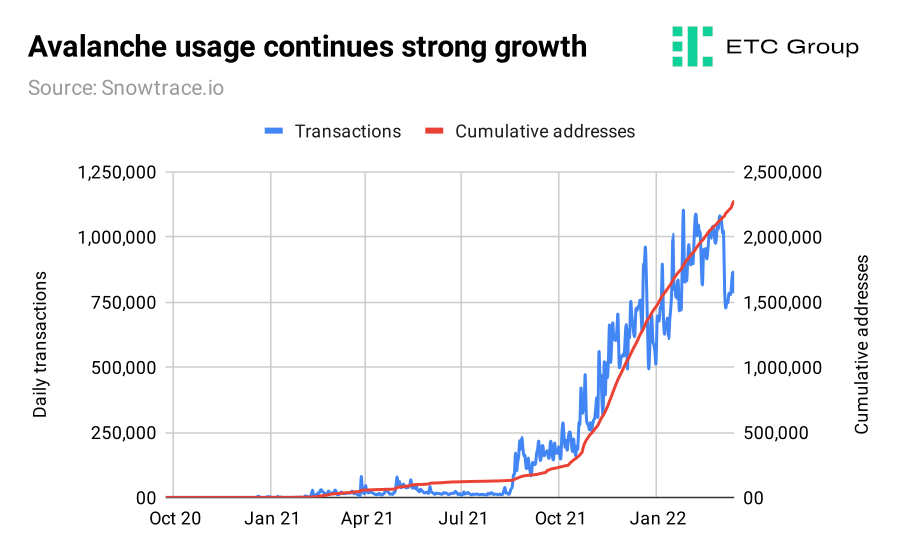
One of the main things that Avalanche has managed to do is to make its UI easy to grasp and simple to use. With Snowtrace.io [https://snowtrace.io/] it has a blockchain explorer to rival Ethereum’s Etherscan [https://etherscan.io/], providing backdated statistics and analytics that show precisely where and how operations are growing.
Rival blockchains could learn much from this user-centric design.
Additionally, there are many, many blockchain projects to choose from, so it is important for investors to note which ones users are actually paying to use. Cryptofees.info shows that [https://cryptofees.info/] Avalanche has the fourth-highest daily revenue total after Ethereum, Uniswap and Binance Smart Chain.
At more than $630,000 daily, the average amount of fees paid to Avalanche are nearly double that of Bitcoin, and 10 times more than smart contract DeFi competitors Solana and Fantom.
Outlook
Avalanche’s clear focus is scaling and DeFi. Sub-second transaction finality is a key feature, and user growth has clearly been rapid. Avalanche’s success in attracting 180+ DeFi protocols to its stable sets it up well for 2022.
If DeFi continues to grow in scale and complexity, then it stands to reason that Avalanche will grow in the same way. Avalanche’s innovation in time-to-finality makes it perfectly suited to complex financial interactions using smart contracts, and we suggest that it could continue to build and capture market share from Ethereum.
Rechtlicher Hinweis
Diese Veröffentlichung stellt eine Marketingmitteilung dar und dient ausschließlich Informationszwecken. Sie stellt weder eine Anlageberatung noch eine persönliche Empfehlung oder eine Aufforderung zum Kauf oder Verkauf von Finanzinstrumenten dar.
Bitwise Europe GmbH ist Emittentin der in dieser Veröffentlichung gegebenenfalls genannten Exchange Traded Products („ETPs“) unter einem von der Bundesanstalt für Finanzdienstleistungsaufsicht (BaFin) gebilligten Basisprospekt. Die Billigung durch die BaFin bezieht sich ausschließlich auf die Vollständigkeit, Kohärenz und Verständlichkeit des Prospekts gemäß der Prospektverordnung und stellt keine inhaltliche Bewertung oder Empfehlung der Produkte dar.
Die dargestellten Marktanalysen, Einschätzungen und Szenarien spiegeln die aktuelle Einschätzung zum Zeitpunkt der Veröffentlichung wider und beruhen auf Informationen, die als zuverlässig erachtet werden. Es wird jedoch keine Gewähr für die Richtigkeit oder Vollständigkeit übernommen. Prognosen und zukunftsgerichtete Aussagen sind mit Unsicherheiten behaftet und stellen keine Garantie für zukünftige Entwicklungen dar. Die Wertentwicklung in der Vergangenheit ist kein verlässlicher Indikator für zukünftige Ergebnisse.
Investitionen in Krypto-Assets und krypto-bezogene Finanzinstrumente sind mit erheblichen Risiken verbunden und unterliegen starken Kursschwankungen. Anleger können einen Teil oder ihr gesamtes eingesetztes Kapital verlieren.
Eine Anlageentscheidung sollte ausschließlich auf Grundlage des jeweils gültigen Basisprospekts, der Endgültigen Bedingungen sowie des Basisinformationsblatts (KID), insbesondere des Abschnitts „Risikofaktoren“, getroffen werden. Der Basisprospekt, die Endgültigen Bedingungen sowie weitere Risikohinweise sind abrufbar unter: www.bitwiseinvestments.eu/de
Anleger sollten prüfen, ob eine Investition unter Berücksichtigung ihrer individuellen Anlageziele, ihrer finanziellen Situation und ihrer Risikobereitschaft geeignet ist, und gegebenenfalls unabhängigen fachlichen Rat einholen.


