
- Argentina's President says he hasn't ruled out adopting cryptocurrency to curb 50% inflation, Microsoft and EY double down on Ethereum, and crypto unicorn Bitpanda triples valuation to $4bn, proving that strong regulatory compliance brings the biggest institutional cheques to the table.
Argentina President: We've not ruled out adopting crypto to beat 50% inflation
The President of Argentina has not ruled out adopting cryptocurrency, he said in a televised interview this week.
Alberto Fernández said that while cryptocurrency was a sensitive issue, in his view, digital assets could help to curb inflation in the South American country.
Fernández was speaking to Filo.news editorial director Julio Leiva. The full interview is available on Youtube here.
??"La discusi?n sobre el funcionamiento de las criptomonedas es mundial y debo confesar que es un tema de cuidado, en mi caso, por lo desconocido. Pero no hay que negarse, tal vez es un buen camino". El presidente @alferdez con @juleiva en #CajaNegra de @filonewsOK. pic.twitter.com/tRCcnFA3pm
— Alberto Fern?ndez Prensa (@alferdezprensa) August 12, 2021
The discussion about the operation of cryptocurrencies is global, and I must confess that it is a matter of caution. But there is no denying it, perhaps it is the way forward (for Argentina). [translated from Spanish] Alberto Fernández, 11 August 2021
Annual inflation has topped 50% this year, well above the government's 29% target.
Argentina's runaway inflation has made consumer prices soar, damaging the economy, drastically cutting spending power, forcing struggling businesses to close and hurting savers and investors.
While the IMF carries no current statistics for Argentina, the countr's official INDEC agency said in July 2021 that consumer prices climbed 25.3% in the first half of the year, and were 50.2% higher than in 2020. That makes Argentine inflation one of the four worst in the world, after Sudan, Zimbabwe and Venezuela.
Taming inflation is key to restoring economic stability after three years of recession, heading off social upheaval as poverty levels rise and for the Peronist government to avoid painful defeat in midterm elections at the end of the year. Hernan Nessi, South America correspondent, Reuters
Goldman Sachs (NYSE:GS) analyst Alberto Ramos said that price rises had come despite soft domestic demand, high unemployment and depressed real wages.
High inflation remains one of the key macroeconomic challenges facing the government, and a significant political liability for the government coalition. Alberto Ramos, Latin American research lead, Goldman Sachs
In separate comments on 10 August 2021, Miguel Pesce, president of the Central Bank of the Argentine Republic (BCRA), said that while Bitcoin does not constitute an asset in his view, the bank was preparing to regulate cryptocurrencies where they intersect with payments systems and the exchange market.
Pesce was speaking at the opening of the Digital Finance Forum, organized by the Argentine Institute of Finance Executives (IAEF). At the same event, Pesce categorically ruled out creating a Central Bank Digital Currency, which has happened in China with the e-CNY and is being actively explored in Europe, the UK and the US.
Latin America remains one of the largest regions for cryptocurrency adoption. In a world first in June 2021, El Salvador made Bitcoin legal tender.
Microsoft doubles down on enterprise Ethereum
In a newly-published research paper, Microsoft said it was using the Ethereum blockchain for combating online piracy. The 11-page paper outlines the system - called Argus - and notes how it uses smart contracts and cryptographically provable security to prevent copyright theft. Cointelegraph was first to report the news, on 16 August 2021.
We see this as a distributed system problem. In the implementation, we overcome a set of unavoidable obstacles to ensure security despite full transparency. Microsoft, Argus: A Fully Transparent Incentive System for Anti-Piracy Campaigns
The world's second-largest public company, Microsoft (NASDAQ:MSFT) has a market cap currently larger than the entire cryptoasset sector at $2.2 trillion.
In December 2020, Microsoft said it had adopted Ethereum to solve complex business challenges around gaming royalties for its Xbox platform.
EY partnered Microsoft for that particular announcement. It's perhaps no surprise given that the Big Four audit firm has invested heavily in Ethereum in recent years. Its developers began releasing zero-knowledge protocols into the public domain in June 2019, and just last month, published an open-source layer 2 scaling solution for Ethereum called Nightfall 3. That codebase uses a technology called zk-Optimistic rollups to aggregate transactions into groups, vastly reducing the often high fees needed to process Ethereum transactions.
In March 2020, EY debuted Baseline, another Ethereum-centred project with Microsoft, a package of public domain blockchain tools allowing enterprises to build and deploy procurement on Ethereum using offchain storage, zero-knowledge proofs and distributed identify, so that businesses do not have to store sensitive information on the blockchain itself. The protocol supports smart contracts and tokenisation standards, which means purchase orders and receivables can be tokenised and integrated into the DeFi ecosystem.
The use of Ethereum by the world's largest tech companies is testament to its revolutionary architecture, and wide-scale adoption across industry. Amazon Web Services, the most profitable and fastest-growing division of of Amazon (NASDAQ: AMZN) announced the general availability of Ethereum on Amazon Managed Blockchain in March 2021.
Crypto unicorn Bitpanda raises $263m for $4.1bn valuation
Austrian cryptocurrency broker Bitpanda, the latest company in the space to reach unicorn status, has tripled in value with its latest funding round, Reuters reported on 17 August.
The retail-focused Vienna-headquartered exchange claims 3 million users worldwide, and is a platform where people can trade fractional stocks, crypto and commodities in one place.
Founded in 2014, it is now one of the fastest-growing fintechs in Europe, with over 500 employees.
The funding round was led by Paypal co-founder Peter Thiel's Valar Ventures, a VC fund that has invested heavily in European fintech. Its portfolio companies include German neobank N26, Spotify and British AI tech developer Deepmind.
This proves that a strong regulatory focus in crypto brings the biggest institutional cheques to the table.
Bitpanda has succeeded where other cryptocurrency brokers have failed, because of its commitment to regulatory compliance. The venue is licenced as a MiFID II investment firm and as a PSD2 payment institution, and is AMLD5 compliant, as well as being registered as a Virtual Asset Service Provider (VASP) with the Austrian Financial Market Authority and France's Autorit? des March?s Financiers.
The Financial Action Task Force, the world's leading anti-money laundering intergovernmental organisation, brought in guidelines for digital asset markets in 2020. In its second 12-month review, it noted that the crypto sector had made great strides to institute strong KYC and AML reporting in line with its controversial 'Travel Rule'. 58 out of 126 jurisdictions have implemented revised FATF standards into their national law, it said.
The report finds that many jurisdictions have continued to make progress in implementing the revised FATF Standards. While the supervision of VASPs and implementation of AML/CFT obligations by VASPs is generally emerging, there is evidence of progress. Financial Action Task Force, 5 July 2021
Among the other investors in the current Bitpanda round were famed British hedge fund manager Alan Howard, whose $13bn hedge fund Brevan Howard began to invest in digital assets in March this year.
Bitpanda is not currently seeking to go public, Reuters said, quoting chief executive officer Eric Demuth, but added that sources suggested when it did occur, it was likely to be via a direct listing, following the likes of Coinbase (NASDAQ:COIN), Wise(LSE:WISE) and Robinhood (NASDAQ:HOOD).
We will take our time in that regard. We are profitable for five years now, every year. Eric Demuth, CEO, Bitpanda
Markets
BTC/USD
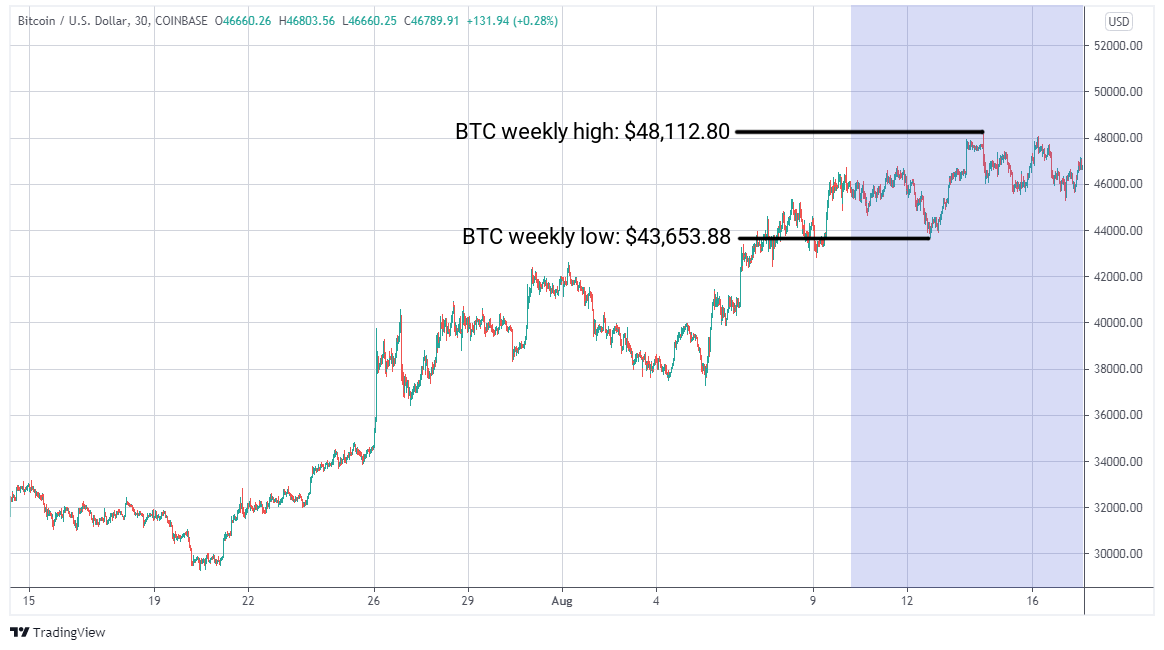
Bitcoin had a steady 7-day trading session after the euphoria of the past couple of weeks. Bullish sentiment remains strong and the cryptoasset appears ready to make the next leg up to test $50,000 for the first time since its record-breaking climb to $60,000 and beyond earlier this year. The low point of the week's trading came in a brief 4.2% dip to $43,653.88, but that level was quickly snapped up. BTC now looks to be in an ascending triangle, with the top of the range at $48,112.80 some 5.5% higher than at the start of the week.
ETH/USD
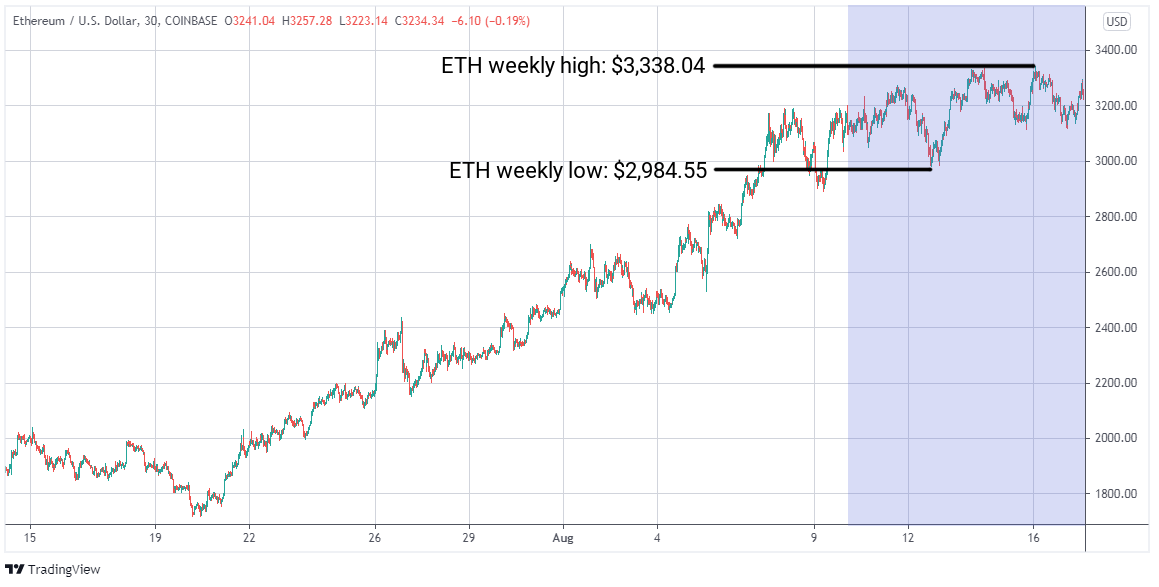
Ethereum's trading week was consistent, if unspectacular, but the programmable money blockchain continued its unbroken winning run that began around 20 July 2021. A double bottom formed right on the $3,000 line, creating the low point of this week's trading activity, at $2,984.55, just 3.7% below the week's starting price. That, however, was quickly rejected before ETH resumed its upward climb. Ether moved as high as 7.6% above its beginning point to hit $3,338.04, but backslid a little to $3,222.61, adding a total of 3.9% across the week.
LTC/USD
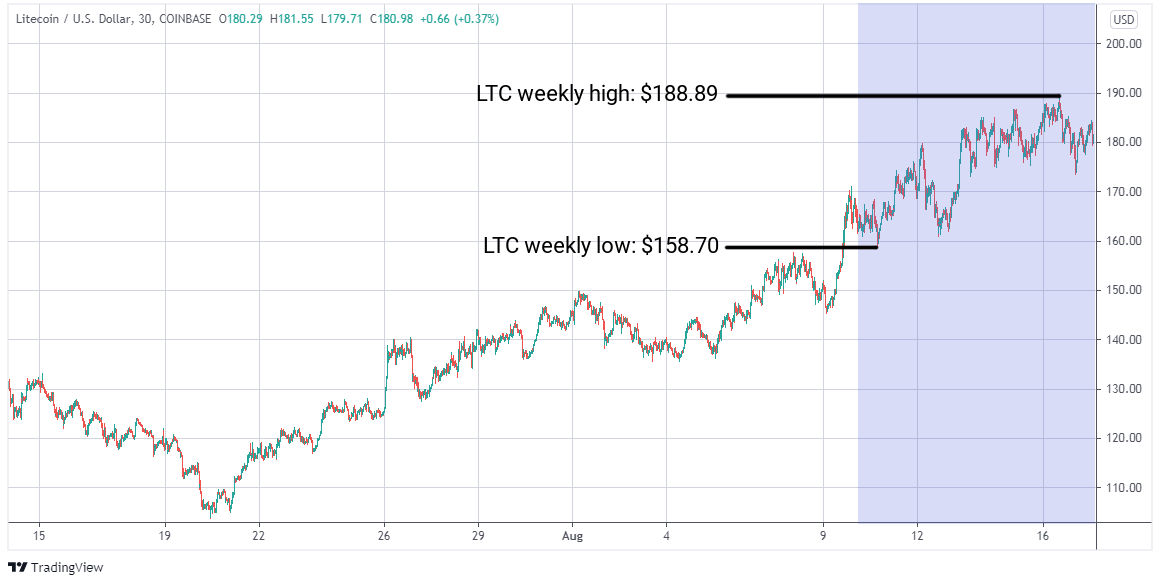
This week Litecoin hit its highest point in more than two months, as positive sentiment continues to filter through to the payments blockchain. From a starting point of $163.53, LTC climbed a total of 15.5% to reach the heady heights of $188.89. That's not the near-20% jump we witnessed last week, but it is a strong double-digit showing for a protocol that has seen adoption for its fast, cheap cross-border payments spike in the past six months. Now all eyes are on what happens if and when Litecoin retests the psychologically-important $200-level.
Informations importantes
Communication à caractère promotionnel. Les informations contenues dans le présent Document sont fournies à des fins d’information et de pédagogie. Elles ne constituent ni un conseil en investissement, ni une recommandation personnalisée, ni une sollicitation en vue d’acheter ou de vendre un instrument financier.
Le présent Document (qui peut prendre la forme d’une présentation, d’un communiqué de presse, d’une publication sur les réseaux sociaux, d’un article de blog, d’une communication audiovisuelle ou d’un support similaire – ci-après le « Document ») est émis par Bitwise Europe GmbH (« BEU » ou l’« Émetteur »).
Bitwise Europe GmbH est constituée selon le droit allemand et agit en qualité d’émetteur des produits négociés en bourse (« Exchange Traded Products » ou « ETP ») mentionnés dans le présent Document. Les ETP sont émis sur la base d’un prospectus de base et de conditions définitives, susceptibles d’être complétés. Un prospectus a été publié ou, le cas échéant, sera publié conformément au Règlement (UE) 2017/1129. Les investisseurs peuvent obtenir gratuitement le prospectus de base, les conditions définitives applicables ainsi que tout supplément éventuel sur le site www.bitwiseinvestments.eu/fr
L’approbation d’un prospectus par l’autorité compétente ne constitue ni une approbation ni une recommandation des instruments financiers concernés.
Capital à risque. Les crypto-actifs sont des actifs hautement volatils et présentent un risque élevé. La valeur des investissements dans des crypto-actifs ou dans des ETP liés aux crypto-actifs peut fluctuer fortement à la hausse comme à la baisse et les investisseurs peuvent perdre tout ou partie de leur capital investi.
Les ETP liés aux crypto-actifs sont des instruments financiers complexes et peuvent ne pas convenir à tous les investisseurs. Ils peuvent exposer les investisseurs à des risques spécifiques, notamment un risque de crédit de l’émetteur, un risque de liquidité, des risques opérationnels ainsi que des risques liés au fonctionnement, à la réglementation et à la valorisation des marchés des crypto-actifs sous-jacents.
Aucun mécanisme de garantie du capital ne s’applique. Selon la juridiction et le mode de détention, les investisseurs peuvent ne bénéficier d’aucun mécanisme public d’indemnisation ou de protection des investisseurs.
Les performances passées ne constituent pas un indicateur fiable des performances futures. Toute déclaration prospective reflète des hypothèses et des anticipations et ne constitue pas une garantie de résultats futurs.
Avant toute décision d’investissement, les investisseurs doivent lire attentivement le prospectus de base, les conditions définitives applicables et notamment la section intitulée « Avertissements ». Une décision d’investissement doit tenir compte de la situation personnelle de l’investisseur, de ses objectifs, de son horizon d’investissement et de sa capacité à supporter des pertes potentielles. Le cas échéant, il convient de solliciter un conseil indépendant en matière financière, fiscale et juridique.
Un avertissement détaillé sur les risques applicables aux ETP liés aux crypto-actifs est disponible à l’adresse suivante : www.bitwiseinvestments.eu/fr/risk-warning