
Worldwide: 10 August 2021 - Litecoin (CRYPTO: $LTC), a leading decentralized payments network, reports financial results for its second quarter ended 30 June 2021.
Key Indicators
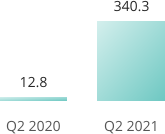
Total transaction volume increased over 2,500% YOY on the Litecoin blockchain:
to $340.3 billion in Q2 2021, compared to $12.8 billion in Q2 2020.
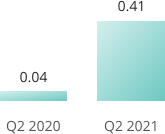
Total transaction fees increased almost 1,000% YOY.
Also known as network revenue (the fees paid to miners) transaction fees increased 968.4% to US$ 0.41 million in Q2
2021, compared to US$ 0.04 million in Q2 2020.
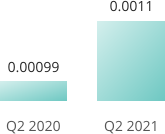
Median transaction fees remained remarkably stable despite large ecosystem gains.
Median fees increased just 11.0% to $0.0011 in Q2 2021, compared to $0.00099 in Q2 2020.
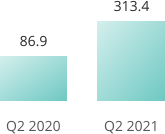
Daily active addresses increased more than 250% YOY.
A proxy for daily active users, active addresses climbed 260.8% to 313.4k in Q2 2021, compared to 86.9k in Q2 2020.
Results Table
| Q2 2020 | Q2 2021 | Y/Y | |
|---|---|---|---|
| Transaction volume ($b) | 12.8 | 340.3 | 2.563% |
| Transaction fees ($m) | 0.04 | 0.41 | 968% |
| Median transaction fee ($) | 0.00099 | 0.0011 | 11% |
| Daily active adresses (k) | 86.9 | 313.4 | 261% |
| LTC supply (m) | 65.4 | 68 | 4% |
Litecoin Quarter Review: Q2 2021
In Q2 2021 Litecoin saw the most significant US$ value transfer over its network in its almost ten-year history, totaling US$28,1 billion or 91.1 million Litecoins. This value eclipses the previous largest day printed on December 21 in 2017, which reached $11.5 billion.
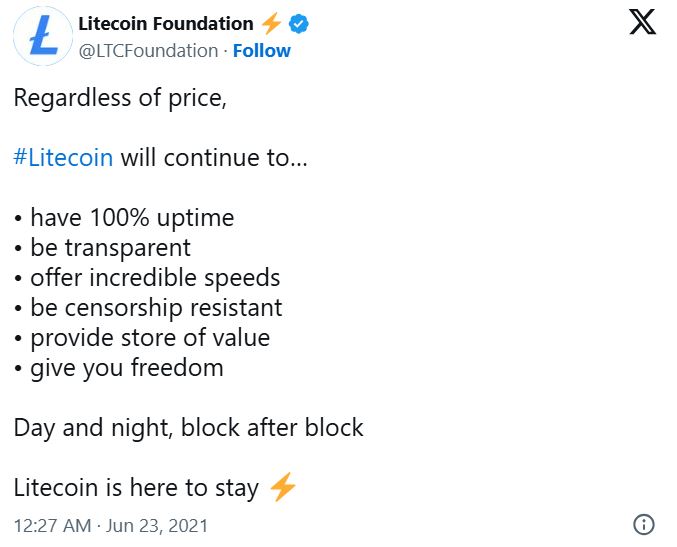
Litecoin was created by Charlie Lee as a fork of Bitcoin in 2011 and as such remains the most enduring altcoin in the cryptoasset sector. As the Litecoin Foundation, the non-profit organisation dedicated to promoting the decentralised payment network noted on 22 June 2021, Litecoin continues to have 100% uptime, maintaining security and transparency for users.
While in Q2 2021 it has been overtaken in the top 10 most valuable cryptoassets by market cap, Litecoin’s stability and longevity remains an important factor in institutional portfolio allocation.
As demand for digital assets amongst the traditional investment community steadily increases, we are starting to see the green shoots of demand for investment exposures outside of the top two dominant networks, Frank Spiteri, CRO at CoinShares.
As we heard in Q1 2021, Grayscale bought 80% of all Litecoin mined in February (over 174,000 LTC), demonstrating demand among accredited and institutional investors for the premier altcoin.
The release of physically-backed Litecoin ETPs by ETC Group’s Litecoin ETC (ELTC) on Deutsche Börse XETRA on 12 April and Coinshares (LITE) on the SIX Swiss Exchange on 6 April 2021, reflect this growing appetite for a greater depth of cryptoasset allocation. As the name suggests, Lee’s intention for Litecoin was to be a ‘light’ version of Bitcoin: an altcoin more suited to payments than the original cryptocurrency, with faster transaction times and lower fees.
Litecoin Core, the code that underpins the blockchain, is written in the highly-popular and common programming language C++, while Python is used for some ancillary tools. That means its code is simple for external developers to use and understand.
With its faster block times and higher transaction throughput, Litecoin was conceived as a more practical and scalable medium of exchange than Bitcoin. The growing results of this can be seen in Litecoin’s daily active addresses, which grew strongly in Q2 2021 to an average of over 300,000 users.
The stability of its transaction fees — as Litecoin is used primarily as a payments network — is key, and we saw network fees rise only 11% to a median of less than 1 US cent per transaction.
In terms of adoption, the number of companies accepting Litecoin also increased 73.4% to 2,713 in Q2 2021, compared to 1,565 in Q2 2020.
Litecoin has grown by 342% in the past 12 months and is the ninth-largest cryptocurrency by market capitalization at US$14.6 billion with growing interest from institutional and retail investors. Bradley Duke, CEO, ETC Group.
Key Litecoin Events
Venmo, currently ranked the second most popular financial app in the U.S., has started allowing its
52m+ users to store, buy, and sell Litecoin, and other cryptocurrencies, on its platform.

ForUsAll Inc., a 401(k) provider, announced a deal with the institutional arm of Coinbase Global Inc,
that will allow workers in plans it administers to invest up to 5% of their 401(k) contributions in Litecoin.

Saxo Bank, an online trading and investment specialist, is launching a new cryptocurrency offering.
Clients from the MENA region will be able to trade Litecoin, Bitcoin, and Ether against EUR, USD, and JPY from a single
margin account.
Hello Pal, a Canadian tech firm, became the first listed company to own a
Litecoin mining arm when it bought the Crypto Pal startup on 25 May 2021.

Two investment firms, ETC Group and CoinShares, launched institutionally-focused Litecoin ETP products
in Q2 2021. ETC Group Physical Litecoin (ELTC) launched on SIX Swiss Exchange on 25 May 2021, just
four weeks after listing its
ELTC Physical Litecoin ETC on Deutche Börse XETRA. On 6 April 2021, CoinShares listed its Physical Litecoin ETP (LITE)
on the SIX Swiss Exchange.
Litecoin Technical Update
In March 2021, The Litecoin Foundation completed the code for MWEB (Mimblewimble via Extension Blocks), an essential upgrade to the Litecoin protocol. With this update, Litecoin will become more scalable and able to transaction amounts un-viewable to the public, making it the best choice for payments while protecting sender/receiver’s data.
Litecoin’s implementation of MWEB continues apace, and a 5 May 2021 update noted that the privacy and scalability update remains on track for launch the end of 2021. Lead developer David Burkett has added automated builds for Linux and Windows, allowing for faster feedback, as well as allowing non-developers to aid with testing without needing to build the code themselves.
On 19 June, the largest supplier of cryptocurrency mining machines, Bitmain, announced it would release a new ASIC-based Scrypt miner that is four times faster than current hardware. Journalists at the event reported the L7 miner purports to have a hash rate of 9500MH/s. Scrypt is the consensus algorithm that secures Litecoin, along with several other cryptocurrencies including Dogecoin, Digibyte and Verge. Quicker and more readily available mining systems are expected to make securing Litecoin’s network more simple and cost effective, as well as upping transaction process throughput.
Litecoin Outlook
Litecoin does get additional value from being so closely tied to Bitcoin and is commonly referred to as the ‘digital silver’ to Bitcoin’s ‘digital gold’. Both assets have a hard-capped supply that gives the assets a scarcity aspect similar to precious metals. However, the developments we have seen this quarter run far beyond that simplistic analogy.
And while Litecoin has fallen out of the top ten crytpoassets by market cap in Q2 2021, significant upcoming technical developments may pull it back into contention.
The development of the Litecoin project is overseen by a non-profit Singapore-based Litecoin Foundation, with Charlie Lee as a managing director. Although the Foundation and the development team are independent, the Foundation provides financial support to the team.
MWEB represents is a significant evolution for the Litecoin protocol, promising to improve privacy and fungibility and its release towards the end of 2021 is on track, according to the Foundation.
And so while comparatively little academic or media attention is focused on Litecoin, its network effects continue to improve. Now in its tenth year of 100% uptime, Litecoin remains a secure blockchain with a large user base, and the addition of institutionally-focused ETP products is testament to this effect. More institutional investors are seeking exposure to Litecoin but, true to the ETP theme across cryptoassets, want it with the safety and liquidity of a centrally cleared exchange-traded product.
Litecoin has also benefited and is continuing to benefit from the recently released Checkout with Crypto service from PayPal. Users can now use digital currency to purchase on all 29 million merchants that accept PayPal.
Credits: Article layout originally inspired by James Wang
Informations importantes
Communication à caractère promotionnel. Les informations contenues dans le présent Document sont fournies à des fins d’information et de pédagogie. Elles ne constituent ni un conseil en investissement, ni une recommandation personnalisée, ni une sollicitation en vue d’acheter ou de vendre un instrument financier.
Le présent Document (qui peut prendre la forme d’une présentation, d’un communiqué de presse, d’une publication sur les réseaux sociaux, d’un article de blog, d’une communication audiovisuelle ou d’un support similaire – ci-après le « Document ») est émis par Bitwise Europe GmbH (« BEU » ou l’« Émetteur »).
Bitwise Europe GmbH est constituée selon le droit allemand et agit en qualité d’émetteur des produits négociés en bourse (« Exchange Traded Products » ou « ETP ») mentionnés dans le présent Document. Les ETP sont émis sur la base d’un prospectus de base et de conditions définitives, susceptibles d’être complétés. Un prospectus a été publié ou, le cas échéant, sera publié conformément au Règlement (UE) 2017/1129. Les investisseurs peuvent obtenir gratuitement le prospectus de base, les conditions définitives applicables ainsi que tout supplément éventuel sur le site www.bitwiseinvestments.eu/fr
L’approbation d’un prospectus par l’autorité compétente ne constitue ni une approbation ni une recommandation des instruments financiers concernés.
Capital à risque. Les crypto-actifs sont des actifs hautement volatils et présentent un risque élevé. La valeur des investissements dans des crypto-actifs ou dans des ETP liés aux crypto-actifs peut fluctuer fortement à la hausse comme à la baisse et les investisseurs peuvent perdre tout ou partie de leur capital investi.
Les ETP liés aux crypto-actifs sont des instruments financiers complexes et peuvent ne pas convenir à tous les investisseurs. Ils peuvent exposer les investisseurs à des risques spécifiques, notamment un risque de crédit de l’émetteur, un risque de liquidité, des risques opérationnels ainsi que des risques liés au fonctionnement, à la réglementation et à la valorisation des marchés des crypto-actifs sous-jacents.
Aucun mécanisme de garantie du capital ne s’applique. Selon la juridiction et le mode de détention, les investisseurs peuvent ne bénéficier d’aucun mécanisme public d’indemnisation ou de protection des investisseurs.
Les performances passées ne constituent pas un indicateur fiable des performances futures. Toute déclaration prospective reflète des hypothèses et des anticipations et ne constitue pas une garantie de résultats futurs.
Avant toute décision d’investissement, les investisseurs doivent lire attentivement le prospectus de base, les conditions définitives applicables et notamment la section intitulée « Avertissements ». Une décision d’investissement doit tenir compte de la situation personnelle de l’investisseur, de ses objectifs, de son horizon d’investissement et de sa capacité à supporter des pertes potentielles. Le cas échéant, il convient de solliciter un conseil indépendant en matière financière, fiscale et juridique.
Un avertissement détaillé sur les risques applicables aux ETP liés aux crypto-actifs est disponible à l’adresse suivante : www.bitwiseinvestments.eu/fr/risk-warning