Guide sur le
Staking avec les ETP
- Les protocoles reposant sur des mécanismes de consensus Proof of Stake permettent aux détenteurs de tokens de percevoir des récompenses sous forme de tokens supplémentaires (appelé le « staking »).
- Les investisseurs dans des ETP répliquant ces tokens peuvent également percevoir des récompenses, conçues pour s’accumuler au sein de l’ETP et améliorer le rendement global dans le temps.
- Les émetteurs d’ETP effectuent le staking des actifs sous-jacents via des prestataires institutionnels, tandis que les clés privées sont conservées auprès du dépositaire réglementé de l’ETP.
- Le staking comporte des risques tels que des pénalités de slashing potentielles, un risque de liquidité et un risque lié à la plateforme, bien que les prestataires institutionnels s’efforcent de les atténuer. Une section détaillée sur les risques figure à la fin du présent document.
Au fur et à mesure que la technologie blockchain se développe, les mécanismes de consensus évoluent. Dans les réseaux Proof of Stake tels qu’Ethereum, les participants peuvent « staker » (bloquer) leurs tokens pour valider les transactions et sécuriser le réseau. En contrepartie, ils perçoivent des récompenses. Ces participants agissent en tant que « validateurs » et sont chargés de vérifier les transactions et d’ajouter de nouveaux « blocs » (groupes de transactions) à la blockchain, un registre numérique permanent.
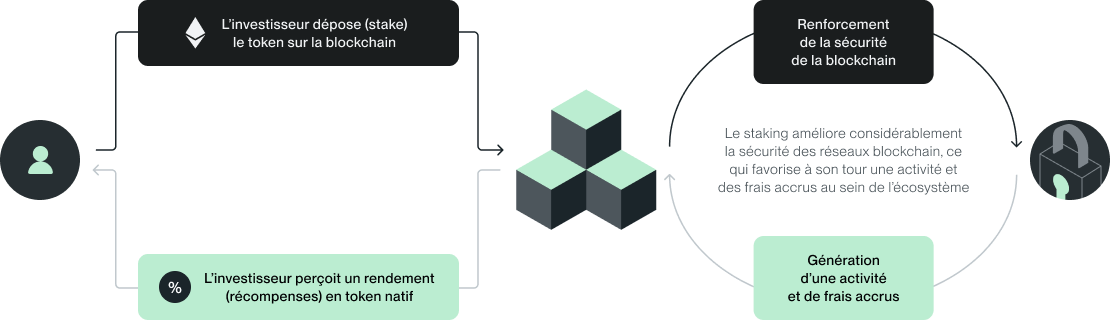
Le staking est devenu un élément important de l’écosystème des actifs numériques, car il permet aux investisseurs de générer des rendements supplémentaires tout en soutenant le réseau. Il est souvent comparé à la perception de dividendes sur des actions, mais avec une différence essentielle : les participants doivent contribuer activement au fonctionnement du réseau, et un comportement défaillant ou malhonnête peut, dans certains systèmes blockchain comme Ethereum (mais pas tous, comme Solana), entraîner des pénalités appelées « slashing », où une partie ou la totalité des actifs stakés sont perdus.
Pour les investisseurs, le staking peut améliorer les rendements, par exemple en combinant les plus-values avec les récompenses de staking, ou aider à amortir les pertes en cas de baisse des prix. Les récompenses sont généralement versées dans le même token, augmentant ainsi les avoirs de l’investisseur au fil du temps, et peuvent être réinvesties (« restaking ») pour capitaliser les rendements, de manière similaire au réinvestissement des dividendes en finance traditionnelle.
Comment fonctionnent les Exchange Traded Products (ETP) de staking ?
Les ETP de staking sont conçus pour offrir aux investisseurs souhaitant s’exposer à l’évolution des prix d’un crypto-actif un accès négocié en bourse, ainsi que la possibilité de bénéficier de potentielles récompenses de staking susceptibles de s’accumuler au sein de l’ETP.
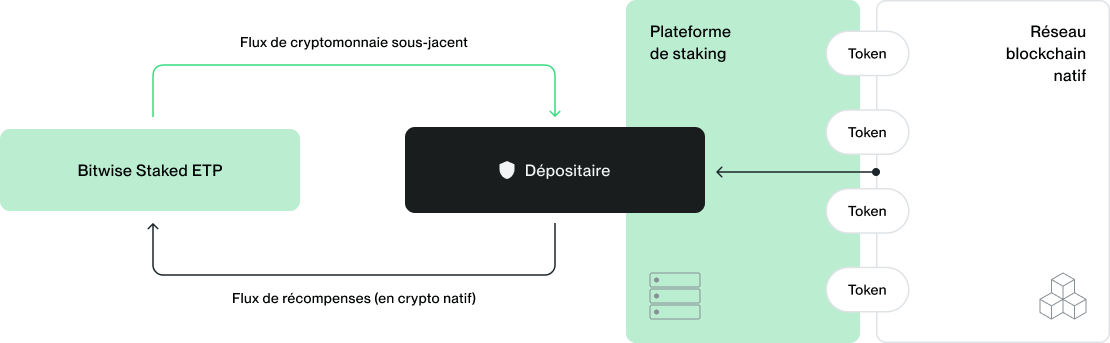
- L’émetteur effectue le « staking » des actifs sous-jacents de certains ETP sur des plateformes sélectionnées gérées par des prestataires de staking professionnels et institutionnels. Les clés privées restent en permanence ségréguées et conservées en cold storage auprès de dépositaires réglementés.
- Le prestataire de staking stake les actifs pour le compte de l’ETP, qui sont utilisés pour sécuriser le réseau et générer des rendements.
- Les récompenses de staking sont réinvesties dans l’ETP quotidiennement, augmentant ainsi la performance de l’ETP en accroissant son droit contractuel en cryptomonnaie sous-jacente.
Bien que les ETP de staking puissent réduire certaines complexités opérationnelles par rapport au staking direct, les ETP crypto comportent leurs propres risques et peuvent ne pas convenir à tous les investisseurs. Les rendements ne sont pas garantis.
Comparaison des ETP de staking et des ETP classiques
Les ETP de staking et les ETP classiques diffèrent principalement dans leur approche de génération de rendements, leur structure de coûts et l’expérience offerte aux investisseurs.
Profil de rendement
Les ETP de staking visent à répliquer la performance spot de l'actif sous-jacent tout en intégrant les récompenses de staking. Ces récompenses peuvent être partiellement ou intégralement capitalisées au sein du produit, ce qui peut contribuer à un rendement total supérieur à celui des ETP classiques. Note : les récompenses de staking sont variables et non garanties.
Considérations relatives aux coûts et à l'efficacité
Les émetteurs d'ETP de staking peuvent utiliser les récompenses de staking pour compenser les coûts du produit ou améliorer l'efficacité globale pour les investisseurs. Le coût total de possession peut donc différer entre les ETP de staking et les ETP classiques. Les investisseurs doivent tenir compte à la fois des frais et de la participation potentielle aux récompenses lors de la comparaison des produits. Le ratio de frais totaux, la structure de frais et la mesure dans laquelle les récompenses de staking sont répercutées aux investisseurs font partie des facteurs communiqués par les émetteurs dans la documentation produit.
Liquidité et accessibilité
Les ETP de staking et les ETP classiques sont généralement négociés sur des marchés réglementés et offrent une liquidité quotidienne. Les ETP de staking sont structurés de manière à ce que les investisseurs ne soient pas directement exposés aux complexités opérationnelles du staking, telles que les périodes de blocage ou les exigences techniques. La négociation et le règlement restent conformes aux pratiques standard des marchés de valeurs mobilières.
Les différents types d'ETP de staking
Les ETP de staking partagent de nombreuses similitudes structurelles avec d'autres produits négociés en bourse. Les caractéristiques fondamentales telles que le TER, les dépositaires, la place de cotation et le cadre général de l'ETP sont souvent comparables entre émetteurs. Ils peuvent cependant différer dans plusieurs aspects opérationnels, notamment la proportion des ETH des investisseurs mis en staking, la part des récompenses distribuées, l'erreur de suivi et les méthodes d'exécution.
Il existe cependant des différences entre les différents produits, et les investisseurs doivent effectuer une diligence raisonnable auprès des prestataires pour comprendre comment les récompenses de staking sont partagées.
Questions clés :
- Quelle part des récompenses de staking revient aux investisseurs et quelle part revient à l'émetteur de l'ETP et/ou au prestataire de staking ?
- Les récompenses quotidiennes perçues par les investisseurs sont-elles communiquées par l'émetteur de l'ETP ?
- Les variations quotidiennes du droit contractuel en cryptomonnaie sont-elles communiquées par l'émetteur de l'ETP ?
- Existe-t-il d'autres risques ou coûts cachés ?
Les émetteurs d'ETP retiennent généralement une partie des récompenses brutes de staking en tant que frais de service de staking, utilisés pour couvrir les coûts opérationnels associés au staking, notamment les services de validation, la garde, l'infrastructure et la gestion continue du processus de staking.
Les récompenses de staking sont généralement capitalisées en continu et reflétées au sein de l'ETP, généralement par une augmentation du droit contractuel en cryptomonnaie par unité au fil du temps. Le taux de staking effectif est variable et dépend de facteurs tels que les conditions du réseau, les mécanismes de récompense propres au protocole, les performances des validateurs et la dynamique générale du marché.
Risques des ETP de staking
Les récompenses de staking ne sont pas garanties et peuvent fluctuer dans le temps. Les résultats effectifs peuvent différer en raison des règles du protocole, de la participation des validateurs, des performances du réseau, de la volatilité des marchés et de la dynamique des frais de transaction. Le staking comporte des risques, notamment la perte potentielle des actifs stakés et/ou des récompenses à la suite d'événements de slashing, de pénalités, de vulnérabilités des smart contracts, de risques au niveau du protocole ou de défaillances opérationnelles. Les investisseurs peuvent perdre une partie ou la totalité du capital investi.
Files d'attente d'entrée et de sortie
Certaines blockchains disposent de « files d'attente de sortie » qui limitent la vitesse à laquelle une quantité donnée d'actifs stakés peut être déstakée par les validateurs. Ethereum, par exemple, dispose d'une file d'attente dynamique limitant le nombre de validateurs pouvant entrer ou sortir par epoch (~6,4 minutes). Un epoch est une période de temps utilisée par le réseau pour organiser l'activité des validateurs. Si de nombreux validateurs tentent de sortir simultanément, une file se forme et les délais de retrait peuvent s'étendre à plusieurs semaines. Les validateurs en attente dans la file de sortie continuent de percevoir des récompenses de staking. Les récompenses cessent uniquement après la sortie du validateur, suivie d'un délai de retrait supplémentaire de ~256 epochs (~27 heures) avant que l'ETH devienne retirable.
Pour les ETP de staking, cela crée à la fois des considérations de liquidité et de rendement. Alors que les tokens numériques dans la file de sortie continuent de générer du rendement, ils ne peuvent pas être immédiatement rachetés. Pour gérer cela, de nombreux émetteurs d'ETP maintiennent une réserve de liquidité, laissant une portion du token numérique non stakée afin que les rachats des investisseurs puissent être honorés sans attendre le cycle complet de déblocage.
Considérations relatives à la liquidité
Les actifs stakés peuvent généralement être retirés ; toutefois, selon le protocole sous-jacent, une période de déblocage ou d'attente peut s'appliquer avant que les actifs soient pleinement accessibles. Cette période peut aller d'une disponibilité immédiate à plusieurs semaines, bien que dans la plupart des cas elle ne dépasse pas un mois.
Pour garantir une liquidité continue et une négociabilité fluide pendant les heures de négociation en bourse, les émetteurs et gestionnaires d'ETP ont développé des mécanismes propriétaires de ponts de liquidité. Ces processus sont conçus pour gérer efficacement les exigences de liquidité du produit et soutenir la négociabilité sur le marché secondaire dans des conditions normales de marché, bien que la liquidité puisse être réduite en périodes de tensions significatives sur les marchés. Parallèlement, les créations et rachats sur le marché primaire peuvent généralement être exécutés en un à deux jours ouvrables, sans exposer les investisseurs à un risque de contrepartie.
Ces dispositifs de pont de liquidité sont soutenus par des acteurs établis des marchés financiers traditionnels, garantissant un cadre opérationnel robuste et fiable.
Risque de slashing
Une erreur dans la confirmation d'une transaction ou la violation des règles du protocole peut entraîner une pénalité appelée « slashing », où certaines récompenses de staking (ou dans certains cas les actifs stakés initiaux) sont perdues. Malgré les efforts des plateformes de staking pour éviter les erreurs et les pénalités de slashing, de tels problèmes peuvent survenir en raison d'aspects opérationnels du processus de staking. Les ETP de staking réduisent souvent le risque de slashing en recourant à des plateformes de staking institutionnelles professionnelles dont le seul objectif est de staker des actifs.
Risque lié à la plateforme de staking
Les ETP de staking font appel à des prestataires de staking reconnus qui s'efforcent d'atténuer le risque de slashing par des mesures telles que des assurances tierces et des obligations on-chain. Il peut cependant exister des exceptions où le risque de slashing n'est pas entièrement couvert.
La dépendance vis-à-vis d'une plateforme de staking crée une dépendance à l'égard d'un tiers pour une fonction essentielle de l'ETP. Si un prestataire de staking subit une défaillance opérationnelle, une faille de sécurité, une insolvabilité, ou fait l'objet de mesures réglementaires, les actifs stakés peuvent être temporairement inaccessibles, soumis à des délais de récupération, ou partiellement ou totalement perdus.
Volatilité des prix et du marché
Le prix de marché des crypto-actifs et des ETP qui les répliquent peut fluctuer de manière significative et imprévisible. Les investisseurs sont exposés aux mouvements de prix de l'actif sous-jacent, ce qui peut entraîner des pertes substantielles, y compris la perte de la totalité du capital investi. Les mouvements de marché plus larges, notamment les événements macro-économiques, les changements de sentiment du marché et les évolutions de la liquidité de négociation, peuvent affecter matériellement la valeur de l'ETP indépendamment de toute activité de staking ou d'accumulation de récompenses.
Liquidité du marché secondaire
La négociabilité d'un ETP de staking sur un marché secondaire dépend de la profondeur du marché, des volumes de négociation disponibles et de la présence continue de teneurs de marché. En période de tensions accrues sur les marchés ou d'activité réduite, les écarts acheteur-vendeur peuvent s'élargir et les volumes de négociation peuvent diminuer, ce qui peut affecter la capacité d'un investisseur à exécuter des transactions aux prix attendus.
Risque de conservation et risque cyber
Les actifs sous-jacents d'un ETP de staking sont détenus par des dépositaires réglementés selon des modalités institutionnelles, notamment le cold storage. Malgré ces mesures de protection, les actifs numériques peuvent être exposés à des cybermenaces, notamment le piratage, la compromission de l'infrastructure de conservation ou des pertes résultant de défaillances opérationnelles dans la chaîne de conservation.
Risque réglementaire
Les crypto-actifs et les cadres réglementaires qui les régissent sont soumis à des changements continus. Des modifications des lois, réglementations ou interprétations réglementaires applicables dans les juridictions concernées peuvent affecter la structure, le fonctionnement ou la valeur des ETP de staking. Les investisseurs doivent être conscients que l'environnement réglementaire pour les crypto-actifs et les ETP crypto continue d'évoluer et que de futurs développements réglementaires pourraient avoir un effet négatif sur le produit.
Conclusion
Les ETP de staking offrent un accès aux mécanismes de staking via une structure d'investissement réglementée et accessible, permettant une exposition aux récompenses de staking sans la complexité opérationnelle de la gestion directe des validateurs. Bien que le staking puisse améliorer le rendement total grâce aux effets de rendement et de réinvestissement, les investisseurs doivent rester attentifs aux risques opérationnels, de liquidité et liés au protocole. À mesure que le segment du staking continue de se développer au sein du marché crypto au sens large, il est susceptible de jouer un rôle de plus en plus important dans les cadres d'investissement en actifs numériques.
Points clés
-
Les protocoles reposant sur des mécanismes de consensus Proof of Stake permettent aux détenteurs de tokens de percevoir des récompenses sous forme de tokens supplémentaires (appelé le « staking »).
-
Les investisseurs dans des ETP répliquant ces tokens peuvent également percevoir des récompenses, conçues pour s'accumuler au sein de l'ETP et améliorer le rendement global dans le temps.
-
Les émetteurs d'ETP effectuent le staking des actifs sous-jacents via des prestataires institutionnels, tandis que les clés privées sont conservées auprès du dépositaire réglementé de l'ETP.
-
Le staking comporte des risques tels que des pénalités de slashing potentielles, un risque de liquidité et un risque lié à la plateforme, bien que les prestataires institutionnels s'efforcent de les atténuer. Une section détaillée sur les risques figure à la fin du présent document.
Informations importantes :
Ce document est fourni à des fins d'information et d'éducation uniquement et ne constitue pas un conseil en investissement, une recommandation personnalisée, ni une offre ou sollicitation d'achat ou de vente d'un instrument financier.
Bitwise Europe GmbH, constituée en vertu du droit allemand, est l'émetteur des Exchange Traded Products dans le cadre d'un prospectus de base approuvé par l'Autorité fédérale de surveillance financière allemande (BaFin). L'approbation du prospectus par la BaFin porte uniquement sur l'exhaustivité, la cohérence et la compréhensibilité du prospectus et ne constitue pas une approbation, une recommandation ou une évaluation des mérites des produits. Le prospectus de base et les conditions définitives sont disponibles sur bitwiseinvestments.eu/resources.
Tous les exemples chiffrés, indicateurs de performance, taux de pourcentage et mouvements de prix utilisés dans ce document sont fournis à titre illustratif uniquement. Ils ne représentent pas des performances historiques réelles et ne doivent pas être interprétés comme une indication ou une garantie de résultats futurs. Les résultats effectifs peuvent varier significativement.
Pour de plus amples informations, veuillez consulter l'avis de non-responsabilité complet disponible sur : bitwiseinvestments.eu/disclaimer
À propos de Bitwise
Bitwise est l’un des principaux gestionnaires d’actifs spécialisés dans les cryptoactifs au niveau mondial. Depuis 2017, Bitwise accompagne des milliers de conseillers financiers, de family offices et d’investisseurs institutionnels à travers le monde afin de faciliter la compréhension et l’accès aux opportunités liées aux cryptoactifs. Bitwise dispose d’une solide expérience dans la gestion d’une large gamme de solutions delta-one, indicielle et active, incluant des ETP, des ETF, des mandats de gestion dédiée, des fonds privés et des stratégies de hedge funds, aux États-Unis et en Europe.
Contact
Renseignements généraux
europe@bitwiseinvestments.com
Investisseurs institutionnels
clients@bitwiseinvestments.com
Demande de renseignements à la presse
europe@bitwiseinvestments.com
Cela pourrait vous intéresser



Bienvenue chez Bitwise
Sélectionnez votre pays
Bienvenue chez Bitwise
Confirmez votre position pour que nous puissions vous offrir l’expérience du site la plus pertinente possible.
Bienvenue chez Bitwise
Confirmez votre position pour que nous puissions vous offrir l’expérience du site la plus pertinente possible.
Bienvenue chez Bitwise
Confirmez votre position pour que nous puissions vous offrir l’expérience du site la plus pertinente possible.
Switch to local website
We noticed you may be accessing this website from a different location than the one currently selected.
English
Pays
English
Pays
Ce site web est exploité par Bitwise Europe GmbH (« Bitwise », « nous »). Les informations contenues sur ce site sont destinées aux clients particuliers du Royaume-Uni et aux autres visiteurs se trouvant au Royaume-Uni. Si vous n’êtes pas au Royaume-Uni, les lois et réglementations locales peuvent différer et les documents présentés ici peuvent ne pas vous convenir.
Tout le contenu est fourni uniquement à titre d’information générale. Il ne constitue pas un conseil en investissement, fiscal ou juridique, ni une offre ou une sollicitation d’achat ou de vente d’un investissement, et ne doit pas être utilisé comme base de décision d’investissement. Vous devez évaluer si un investissement est adapté à votre situation et, le cas échéant, demander un conseil professionnel indépendant.
Les crypto-actifs et les produits liés aux crypto-actifs sont à haut risque. La FCA classe les promotions crypto destinées aux clients particuliers comme « Restricted Mass Market Investments » (RMMI). Par conséquent, des exigences supplémentaires de mise en évidence, d’avertissement sur les risques et de résumé des risques s’appliquent aux communications destinées aux particuliers. Vous pourriez perdre la totalité de votre investissement.
Les investissements dans les crypto-actifs ou de nombreux produits liés aux crypto-actifs ne sont généralement pas couverts par le Financial Services Compensation Scheme (FSCS) du Royaume-Uni ni par le Financial Ombudsman Service (FOS). Vous ne devez pas vous attendre à être protégé en cas de problème.
L’accès à certaines pages, fonctionnalités ou transactions peut être soumis à une catégorisation des clients et à des évaluations d’adéquation exigées par les règles de la FCA. Nous pouvons vous demander de compléter des vérifications ou déclarations avant de pouvoir continuer.
Lorsque ce site contient une promotion financière de détail pour des crypto-actifs ou d’autres RMMI, vous verrez l’avertissement sur les risques prescrit par la FCA ainsi qu’un lien (« Prenez 2 minutes pour en savoir plus ») vers le résumé des risques de la FCA, présenté sous forme de fenêtre contextuelle ou de page dédiée. Pour plus de commodité, vous pouvez accéder à ce résumé à tout moment ici.
Lorsque des performances sont présentées, les performances passées ne constituent pas un indicateur fiable des résultats futurs. Toute projection, objectif ou déclaration prospective est par nature incertaine et pourrait ne pas se réaliser. Les frais et dépenses réduisent les rendements.
Les rendements peuvent être réduits par les frais, charges, spreads et taxes. Le traitement fiscal dépend des circonstances individuelles et peut évoluer. En cas de doute, demandez conseil à un professionnel.
Lorsqu’un prospectus (y compris un prospectus de base ou complémentaire) ou un KID/PRIIPs KIID ou document équivalent est fourni, il s’agit d’une information réglementaire et non d’une communication commerciale. Ces documents ne relèvent généralement pas des restrictions britanniques en matière de promotion financière.
Conformément aux règles de la FCA sur les investissements à haut risque, nous n’offrons pas d’incitations à investir (par exemple, primes de parrainage, avantages monétaires ou non monétaires) en lien avec les promotions crypto destinées aux particuliers.
Les liens externes sont fournis uniquement pour plus de commodité. Nous ne contrôlons pas et ne sommes pas responsables des sites web tiers ou de leur contenu. Nous prenons des mesures raisonnables pour assurer l’exactitude, mais ne garantissons pas l’exhaustivité, l’actualité ou la disponibilité du site web ou de son contenu ; les informations peuvent être modifiées sans préavis.
Nos produits ou services peuvent ne pas être disponibles dans toutes les juridictions ou pour tous les investisseurs. L’accès peut être limité par la loi. Vous êtes responsable de la compréhension et du respect des lois et réglementations applicables.
Pour toute question ou réclamation, contactez : clients@bitwiseinvestments.com | Des informations de contact et juridiques supplémentaires sont disponibles dans nos Conditions d’utilisation du site web et notre Politique de confidentialité.
Droits d’auteur & marques
© 2025 Bitwise. Tous droits réservés. Les noms de produits, logos et marques appartiennent à leurs propriétaires respectifs.
The selected location is intended only for people resident in that country. If you are accessing from the UK, you should not use this version of the website or access the products and services shown here, as they are not available in your country and may not be suitable for you.
We recommend switching to your local version of our website to view information relevant to your jurisdiction.
Les produits d’investissement domiciliés en Europe et présentés sur ce site sont des Exchange Traded Commodities (« ETC »), instruments financiers considérés comme des titres de créances complexes par l'Autorité des Marchés Financiers, présentant des risques difficilement compréhensibles par le grand public. À ce titre, leur distribution en France répond à des règles spécifiques. Il relève de la responsabilité des intermédiaires et investisseurs professionnels souhaitant offrir des ETCs à leurs clients de s'assurer que leur distribution auxdits clients est réalisée dans le respect de la réglementation française.
Le présent document constitue une traduction de l’exclusion de responsabilité originale rédigée en langue anglaise. En cas de divergence ou d’incohérence entre la présente traduction et la version originale anglaise, seule la version originale anglaise disponible à l’adresse bitwiseinvestments.eu/disclaimer/ fait foi et est juridiquement contraignante.
Les informations fournies dans la présente communication à caractère promotionnel sont destinées exclusivement à des fins d’information et ne constituent ni un conseil en investissement, ni une recommandation, ni une sollicitation en vue de la conclusion d’une opération.
Le présent site internet, ainsi que l’ensemble de la documentation et des autres informations fournies sur celui-ci ou par son intermédiaire (collectivement, le « Site »), sont publiés par Bitwise Europe GmbH (« BEU » ou l’« Émetteur »). Le présent Site est fourni exclusivement à des fins d’illustration, d’éducation et d’information et peut faire l’objet de modifications.
Dans la mesure où le présent Site constitue une publicité au sens de l’article 22 du Règlement (UE) 2017/1129, tel que modifié (le « Règlement Prospectus »), ou de la Regulation 3 des Public Offers and Admissions to Trading Regulations 2024, et lorsque l’offre ou l’admission à la négociation concernée est soumise à l’obligation d’établir un prospectus, le prospectus applicable a été ou sera publié et est ou sera disponible dans la section « Ressources » du site internet de Bitwise Europe à l’adresse bitwiseinvestments.eu/fr/resources/.
Bitwise Europe GmbH, Thurn- und Taxis-Platz 6, 60313 Francfort-sur-le-Main, Allemagne, immatriculée au registre du commerce du tribunal de Francfort-sur-le-Main (Amtsgericht Frankfurt am Main) sous le numéro HRB 116604, est l’émetteur des Exchange Traded Products (« ETP ») décrits dans le présent Site, émis conformément à un prospectus de base applicable approuvé par la BaFin ou, le cas échéant, par une autre autorité compétente, tel que complété le cas échéant, ainsi qu’aux conditions définitives applicables. Les conditions définitives sont publiées et déposées auprès de l’autorité compétente conformément à la réglementation applicable et ne sont pas soumises à approbation. La documentation du produit concernée indique l’autorité compétente ayant approuvé le prospectus applicable.
L’approbation d’un prospectus signifie que l’autorité compétente l’a examiné au regard des normes applicables de complétude, de compréhensibilité et de cohérence ; elle ne constitue ni une approbation ni une recommandation de l’Émetteur ou des ETP. Si vous envisagez d’investir dans des produits émis par BEU, il vous est conseillé de vérifier auprès de votre intermédiaire ou de votre banque que ces produits sont disponibles dans votre juridiction et adaptés à votre profil d’investissement. Toute décision d’investir un montant dans un ETP proposé par BEU doit tenir compte de votre situation personnelle, après avoir obtenu un conseil indépendant en matière d’investissement, fiscal et juridique.
Avant d’investir, il est recommandé de lire le prospectus de base applicable, les éventuels suppléments ainsi que les conditions définitives applicables et, en particulier, la section intitulée « Facteurs de Risque » pour plus de détails sur les risques associés à un investissement. Le cas échéant, il est également recommandé de lire le document d’informations clés au titre du Règlement (UE) n° 1286/2014 (PRIIPs), le résumé du produit au titre des Consumer Composite Investments (Designated Activities) Regulations 2024, ou le document d’information équivalent applicable dans votre juridiction. Les prospectus, suppléments, conditions définitives, documents d’informations clés et autres documents réglementaires pertinents relatifs aux ETP de BEU sont disponibles électroniquement et gratuitement dans la section « Ressources » du site internet de Bitwise Europe à l’adresse bitwiseinvestments.eu/fr/resources/.
L’accès à ces documents n’est subordonné ni à l’achèvement d’une procédure d’inscription, ni à la sélection d’un pays ou d’un type d’investisseur, ni à l’acceptation des Conditions d’Utilisation du Site ou de toute clause d’exclusion de responsabilité limitant la responsabilité juridique, ni au paiement d’une redevance, conformément à l’article 21, paragraphe 4, du Règlement Prospectus ou aux Prospectus Rules du FCA Handbook. Des avertissements précisant les juridictions dans lesquelles une offre ou une admission à la négociation est réalisée peuvent être affichés en lien avec certains contenus ; il ne s’agit pas de clauses d’exclusion de responsabilité limitant la responsabilité juridique.
Toute sélection de pays ou de type d’investisseur utilisée sur le présent Site détermine le contenu marketing susceptible d’être affiché. Elle ne constitue pas en elle-même une classification réglementaire formelle de la clientèle, une évaluation du caractère approprié ou adéquat, une confirmation de l’éligibilité juridique à investir, ni un conseil en investissement.
Si Vous Vous Trouvez au Royaume-Uni, aux États-Unis ou au Canada
Les informations contenues dans le présent Site ne constituent, et ne doivent en aucun cas être interprétées comme constituant, une offre de vente ou une sollicitation d’achat de titres, ni aucune autre démarche visant à favoriser une offre publique, aux États-Unis ou au Canada, ou dans tout État, province ou territoire de ceux-ci, où ni l’Émetteur ni ses produits ne sont autorisés ou enregistrés en vue de la distribution ou de la vente et où aucun prospectus de l’Émetteur n’a été déposé auprès d’une quelconque autorité de régulation des valeurs mobilières. Ni le présent Site, ni les informations qu’il contient, ne doivent être reçus, transmis ou diffusés (directement ou indirectement) aux États-Unis.
Au Royaume-Uni, le présent Site est fourni exclusivement à des fins d’information et est en tout état de cause fourni conformément à l’exemption à l’obligation, prévue par la Section 21 du Financial Services and Markets Act 2000, selon laquelle les communications relatives à des invitations ou incitations à exercer une activité d’investissement doivent être approuvées par une personne agréée par la Financial Conduct Authority. Le présent Site s’adresse par conséquent exclusivement aux personnes relevant d’une exemption pertinente à la restriction applicable aux promotions financières prévue par le Financial Services and Markets Act 2000 (Financial Promotion) Order 2005, telles que : les investisseurs professionnels (Article 19) ; les personnes physiques fortunées (« high net worth individuals », Article 48) ; les sociétés fortunées, associations non constituées en société et entités similaires (Article 49) ; les investisseurs avertis (« sophisticated investors », Article 50) ; les investisseurs avertis autocertifiés (Article 50A) ; ainsi que les associations d’investisseurs fortunés ou avertis (Article 51). Les personnes ne relevant d’aucune exemption pertinente ne doivent ni accéder au présent Site, ni s’y fier, ni agir sur son fondement ; elles doivent consulter la version du Site destinée aux investisseurs particuliers (« Private Investor »). Ni l’Émetteur ni ses produits ne sont autorisés ou réglementés par la Financial Conduct Authority du Royaume-Uni, et le contenu du présent Site n’a pas été approuvé par une personne agréée au sens du Financial Services and Markets Act 2000.
Information sur les Publications et les Réseaux Sociaux
Les communications sur les réseaux sociaux, y compris les publications sur LinkedIn et X (collectivement, les « Réseaux Sociaux »), peuvent constituer des publicités, des promotions financières ou des recommandations d’investissement au sens du Règlement (UE) n° 596/2014, du Financial Services and Markets Act 2000, ou d’autres communications réglementées, selon leur contenu et la juridiction dans laquelle elles sont diffusées. Sauf indication contraire expresse, ces communications ne sont pas destinées à constituer un conseil en investissement ni une recommandation personnalisée.
BEU met en œuvre tous les efforts raisonnables pour garantir que les informations contenues dans les documents et sur les Réseaux Sociaux sont exactes et fiables ; toutefois, des erreurs peuvent survenir. Dans la mesure permise par la réglementation applicable, les documents et supports disponibles sur les Réseaux Sociaux sont fournis sans garantie expresse ou implicite quant à leur exactitude, validité, actualité ou exhaustivité. Aucune disposition du présent paragraphe n’exclut ni ne limite une responsabilité légale ou réglementaire qui ne peut être légalement exclue ou limitée, y compris les obligations applicables aux publicités ou aux promotions financières et la responsabilité relative à un prospectus ou à toute autre information réglementaire.
Sauf approbation ou adoption expresse par Bitwise Europe, les commentaires exprimés par les membres de la communauté en ligne représentent exclusivement les opinions personnelles de ces personnes et ne sont pas approuvés par Bitwise Europe.
Risques Liés aux ETP et aux Cryptomonnaies
Un investissement dans un ETP adossé à une ou plusieurs cryptomonnaies, tel que ceux émis par BEU, dépend de la performance de la cryptomonnaie sous-jacente, déduction faite des coûts ; toutefois, il ne peut être attendu que la performance de l’ETP corresponde exactement à celle de l’actif sous-jacent. Investir dans des ETP comporte également de nombreux risques, notamment des risques de marché généraux liés au sous-jacent, des mouvements de prix défavorables, des risques de change, de liquidité, opérationnels, juridiques et réglementaires ; les investisseurs doivent être prêts à perdre tout ou partie du montant investi.
Les ETP adossés à des cryptomonnaies sont des instruments hautement volatils dont la performance est imprévisible. Les performances passées ne constituent pas un indicateur fiable des performances futures. Le prix de marché des ETP est sujet à variation et ces instruments n’offrent pas de revenu fixe. La valeur d’un ETP peut être affectée par les taux de change et l’évolution du prix de la ou des cryptomonnaies sous-jacentes. Le présent Site peut contenir des déclarations prospectives, y compris des déclarations relatives aux convictions ou aux attentes actuelles de Bitwise Europe quant à la performance de certaines classes d’actifs. Les déclarations prospectives sont soumises à certains risques, incertitudes et hypothèses, et rien ne garantit que ces déclarations se révèleront exactes ; les résultats réels pourraient différer sensiblement de ceux indiqués. Vous ne devez pas vous fier à des déclarations prospectives ou à d’autres informations similaires contenues dans le présent Site.
Les cryptomonnaies sont hautement volatiles et connues pour leurs fluctuations de prix extrêmes et rapides. Bien qu’un potentiel de gains significatifs puisse exister, vous vous exposez au risque de perdre tout ou partie du capital investi. Le prix des cryptomonnaies peut fluctuer fortement et peut être influencé, par exemple, par des événements politiques, économiques ou financiers mondiaux et régionaux, par des événements réglementaires ou des déclarations d’autorités de régulation, par des activités de négociation, de couverture ou d’autres activités menées par un large éventail d’intervenants sur le marché, par des forks des protocoles sous-jacents, ainsi que par des perturbations de l’infrastructure ou des moyens par lesquels les crypto-actifs sont produits, distribués, conservés et négociés. Les caractéristiques des cryptomonnaies et la divergence des normes réglementaires applicables créent un potentiel d’abus de marché. Le prix des cryptomonnaies peut également évoluer en fonction de la confiance changeante des investisseurs quant aux perspectives futures de cette classe d’actifs.
Pour un aperçu détaillé des risques associés aux cryptomonnaies et, en particulier, aux produits de BEU, veuillez consulter le prospectus et les conditions définitives, disponibles dans la section « Ressources » du site internet de Bitwise Europe à l’adresse bitwiseinvestments.eu/fr/resources/. Vous ne devez investir que si vous êtes en mesure de comprendre et d’évaluer les risques associés. En cas de doute quant à l’adéquation d’un investissement, il est recommandé de consulter une personne agréée spécialisée dans le conseil en investissement, y compris pour les ETP adossés à des cryptomonnaies.

