Leitfaden zum
Staking mit ETPs
- Protokolle, die auf Proof-of-Stake-Konsensmechanismen basieren, ermöglichen es Token-Inhabern, Belohnungen in Form zusätzlicher Token zu verdienen (bekannt als „Staking“).
- Anleger in ETPs, die diese Token abbilden, können ebenfalls Belohnungen erzielen, die innerhalb des ETPs akkumuliert werden und die Gesamtrendite steigern sowie mit der Zeit Zinseszinseffekte erzeugen können.
- ETP-Emittenten staken die zugrunde liegenden Vermögenswerte über institutionelle Staking-Anbieter, während die privaten Schlüssel sicher beim regulierten Verwahrsteller des ETPs verwahrt werden.
- Staking birgt Risiken wie mögliche Slashing-Strafen, Liquiditätsrisiken und Risiken der Staking-Plattform, wobei institutionelle Anbieter bestrebt sind, diese Risiken zu mindern. Eine detaillierte Risikoübersicht finden Sie am Ende dieses Dokuments.
Mit der Weiterentwicklung der Blockchain-Technologie entwickeln sich auch die Konsensmechanismen weiter. Bei Proof-of-Stake-Netzwerken wie Ethereum können Teilnehmer ihre Token „staken“ (sperren), um Transaktionen zu validieren und das Netzwerk zu sichern. Im Gegenzug erhalten sie Belohnungen. Diese Teilnehmer agieren als „Validatoren“ und sind dafür verantwortlich, Transaktionen zu prüfen und neue „Blocks“ (Transaktionsbündel) zur Blockchain hinzuzufügen, einem dauerhaften digitalen Buchführungssystem.
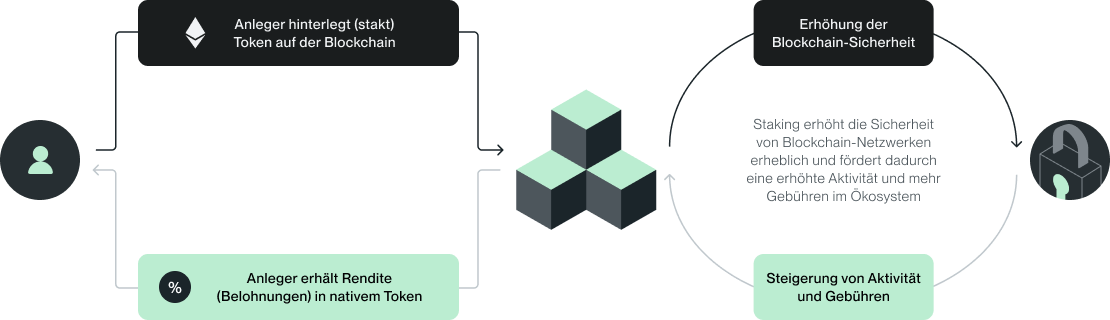
Staking ist zu einem wichtigen Bestandteil des digitalen Anlageökosystems geworden, da es Anlegern ermöglicht, zusätzliche Renditen zu erzielen und gleichzeitig das Netzwerk zu unterstützen. Es wird oft mit dem Erhalten von Dividenden aus Aktien verglichen, jedoch mit einem wesentlichen Unterschied: Teilnehmer müssen aktiv zum Netzwerkbetrieb beitragen, und fehlerhaftes oder unehrliches Verhalten kann in einigen Blockchain-Systemen wie Ethereum (nicht jedoch in allen, wie z. B. Solana) zu Strafen führen, dem sogenannten „Slashing“, bei dem ein Teil oder alle gestakten Vermögenswerte verloren gehen.
Für Anleger kann Staking die Rendite steigern, indem es beispielsweise Kursgewinne mit Staking-Belohnungen kombiniert oder Verluste bei fallenden Kursen abfedern kann. Belohnungen werden in der Regel im gleichen Token ausgezahlt, was die Bestände des Anlegers im Laufe der Zeit erhöht, und können reinvestiert werden („Restaking“), um Zinseszinseffekte zu erzielen – ähnlich der Dividendenreinvestition im traditionellen Finanzwesen.
Wie funktionieren Staking Exchange Traded Products (ETPs)?
Staking-ETPs sind darauf ausgelegt, Anlegern, die eine Kurspartizipation an einem Krypto-Asset anstreben, einen börsennotierten Zugang zu bieten und darüber hinaus von potenziellen Staking-Belohnungen zu profitieren, die sich innerhalb des ETPs ansammeln können.
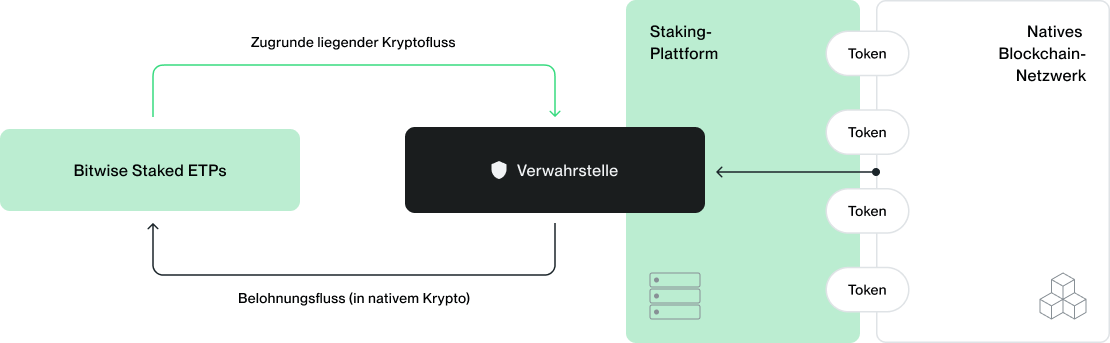
- Der Emittent „stakt“ die zugrunde liegenden Vermögenswerte bestimmter ETPs auf ausgewählten Plattformen, die von professionellen, institutionellen Staking-Anbietern verwaltet werden. Die privaten Schlüssel werden stets getrennt verwahrt und in Cold Storage bei regulierten Verwahrstellen gehalten.
- Der Staking-Anbieter stakt die Vermögenswerte im Namen des ETPs, die zur Netzwerksicherung eingesetzt und zur Renditegenerierung verwendet werden.
- Staking-Belohnungen werden täglich in den ETP reinvestiert und steigern so die Performance des ETPs, indem der zugrunde liegende Kryptoanspruch erhöht wird.
Obwohl Staking-ETPs im Vergleich zum direkten Staking bestimmte operative Komplexitäten reduzieren können, sind Krypto-ETPs mit eigenen Risiken und strukturellen Besonderheiten verbunden und sind möglicherweise nicht für alle Anleger geeignet. Renditen sind nicht garantiert.
Vergleich von Staking- und Nicht-Staking-ETPs
Staking- und Nicht-Staking-ETPs unterscheiden sich in erster Linie darin, wie sie Renditen anstreben, in ihrer Kostenstruktur und in der Anlegererfahrung.
Renditeprofil
Staking-ETPs zielen darauf ab, die Spot-Performance des zugrunde liegenden Krypto-Assets abzubilden und zusätzlich Staking-Belohnungen einzubeziehen. Diese Belohnungen können teilweise oder vollständig im Produkt thesauriert werden, was im Vergleich zu Nicht-Staking-ETPs, die nur die Kursentwicklung widerspiegeln, zu einer höheren Gesamtrendite beitragen kann. Hinweis: Staking-Belohnungen sind variabel und nicht garantiert.
Kosten und Effizienzüberlegungen
Emittenten von Staking-ETPs können Staking-Belohnungen nutzen, um Produktkosten auszugleichen oder die Gesamteffizienz für Anleger zu verbessern. Die Gesamtbesitzkosten können daher zwischen Staking- und Nicht-Staking-ETPs abweichen. Anleger sollten beim Produktvergleich sowohl Gebühren als auch die potenzielle Belohnungsbeteiligung berücksichtigen. Die Gesamtkostenquote, die Gebührenstruktur und das Ausmaß, in dem Staking-Belohnungen an Anleger weitergegeben werden, sind unter anderem Faktoren, die von Emittenten in der Produktdokumentation offengelegt werden.
Liquidität und Zugänglichkeit
Sowohl Staking- als auch Nicht-Staking-ETPs werden in der Regel an regulierten Börsen gehandelt und bieten tägliche Liquidität. Staking-ETPs sind so strukturiert, dass Anleger nicht direkt den operativen Komplexitäten des Stakings ausgesetzt sind, wie z. B. Sperrfristen oder technische Anforderungen. Handel und Abwicklung bleiben an den üblichen Wertpapiermarktpraktiken ausgerichtet.
Die verschiedenen Arten von Staking-ETPs
Staking-ETPs weisen viele strukturelle Gemeinsamkeiten mit anderen börsennotierten Produkten auf. Kernmerkmale wie die Gesamtkostenquote (TER), Verwahrstellen, Börsenplatz und das allgemeine ETP-Rahmenwerk sind bei verschiedenen Emittenten oft vergleichbar. Sie können sich jedoch in verschiedenen operativen Aspekten unterscheiden, insbesondere hinsichtlich des Anteils der gestakten ETH der Anleger und des Anteils der an die Anleger ausgeschütteten Staking-Belohnungen, des Tracking Errors sowie der Ausführungsmethoden aufgrund von Unterschieden bei den Marktteilnehmern, einschließlich Brokern, Market Makern und autorisierten Teilnehmern.
Es bestehen jedoch Unterschiede zwischen den verschiedenen Produkten, und Anleger sollten eine angemessene Sorgfaltspflicht gegenüber den Anbietern wahrnehmen, um zu verstehen, wie Staking-Belohnungen aufgeteilt werden.
Wichtige Fragen:
- Wie viel der Staking-Belohnung geht an die Anleger und wie viel an den ETP-Emittenten und/oder den Staking-Anbieter?
- Werden die von den Anlegern täglich verdienten Belohnungen vom ETP-Emittenten offengelegt?
- Werden die täglichen Veränderungen des Kryptoanspruchs vom ETP-Emittenten offengelegt?
- Gibt es weitere versteckte Risiken oder Kosten?
ETP-Emittenten behalten in der Regel einen Teil der Brutto-Staking-Belohnungen als Staking-Servicegebühr ein. Diese Gebühr dient zur Deckung der mit dem Staking verbundenen operativen Kosten, einschließlich Validator-Dienste, Verwahrung, Infrastruktur und laufendes Management des Staking-Prozesses.
Staking-Belohnungen werden in der Regel kontinuierlich akkumuliert und im ETP abgebildet, typischerweise durch eine Erhöhung des Kryptoanspruchs pro Einheit über die Zeit. Der effektive Staking-Satz ist variabel und hängt von Faktoren wie Netzwerkbedingungen, protokollspezifischen Belohnungsmechanismen, Validator-Performance und der allgemeinen Marktdynamik ab.
Risiken von Staking-ETPs
Staking-Belohnungen sind nicht garantiert und können im Laufe der Zeit schwanken. Tatsächliche Ergebnisse können aufgrund von Protokollregeln, Validator-Beteiligung, Netzwerkperformance, Marktvolatiliät und Transaktionsgebührndynamik abweichen. Staking ist mit Risiken verbunden, einschließlich möglicher Verluste von gestakten Vermögenswerten und/oder Belohnungen infolge von Slashing-Ereignissen, Strafen, Smart-Contract-Schwachstellen, protokollbedingten Risiken oder Betriebsausfällen. Anleger können einen Teil oder ihr gesamtes investiertes Kapital verlieren.
Ein- und Ausstiegswarteschlangen
Einige Blockchains haben „Exit-Warteschlangen“, die die Geschwindigkeit begrenzen, mit der ein bestimmter Betrag an gestakten Vermögenswerten von Validatoren entsperrt werden kann. Ethereum hat beispielsweise eine dynamische Warteschlange, die begrenzt, wie viele Validatoren pro Epoche (~6,4 Minuten) ein- oder austreten können. Eine Epoche ist ein vom Netzwerk verwendeter Zeitraum zur Organisation der Validator-Aktivität. Wenn viele Validatoren gleichzeitig versuchen auszutreten, bildet sich eine Warteschlange und Auszahlungszeiten können sich auf mehrere Wochen verlängern. Wichtig: Validatoren, die in der Exit-Warteschlange warten, erhalten weiterhin Staking-Belohnungen, da sie Teil des aktiven Validator-Sets bleiben. Belohnungen enden erst nach dem Austritt des Validators, gefolgt von einer weiteren Auszahlungsverzögerung von ~256 Epochen (~27 Stunden), bevor die ETH abrufbar wird.
Für Staking-ETPs entstehen dadurch sowohl Liquiditäts- als auch Renditeüberlegungen. Während digitale Token in der Exit-Warteschlange noch Rendite erwirtschaften, können sie nicht sofort eingelöst werden. Um dies zu managen, halten viele ETP-Emittenten einen Liquiditätspuffer vor und lassen einen Teil des digitalen Tokens ungestakt, damit Anlegerrücknahmen ohne Wartezeit auf den vollständigen Entsperrungszyklus bedient werden können.
Liquiditätsüberlegungen
Gestakte Vermögenswerte können grundssätzlich abgezogen werden; jedoch kann abhängig vom zugrunde liegenden Protokoll ein Entsperrungszeitraum gelten, bevor die Vermögenswerte vollständig zugänglich sind. Dieser Zeitraum kann von sofortiger Verfügbarkeit bis hin zu mehreren Wochen reichen, in den meisten Fällen überschreitet er jedoch einen Monat nicht.
Um eine kontinuierliche Liquidität und reibungslose Handelbarkeit während der Börsenhandelszeiten zu gewährleisten, haben ETP-Emittenten und -Manager proprietäre Liquiditätsüberbrückungsmechanismen entwickelt. Diese Prozesse sind darauf ausgelegt, die Liquiditätsanforderungen des Produkts zu managen und die Handelbarkeit am Sekundärmarkt (d. h. an der Börse) unter normalen Marktbedingungen zu unterstützen, wobei die Liquidität in Phasen erheblicher Marktanspannungen eingeschränkt sein kann. Parallel dazu können Zeichnungen und Rücknahmen im Primärmarkt (abgewickelt durch autorisierte Teilnehmer) in der Regel innerhalb von ein bis zwei Geschäftstagen ausgeführt werden, ohne die Anleger einem Gegenparteirisiko auszusetzen.
Diese Liquiditätsüberbrückungsarrangements werden durch etablierte Teilnehmer der traditionellen Finanzmärkte unterstützt, was einen robusten und zuverlässigen operativen Rahmen gewährleistet.
Slashing-Risiko
Ein Fehler bei der Bestätigung einer Transaktion oder ein Verstoß gegen Protokollregeln kann zu einer Strafe führen, die als „Slashing“ bezeichnet wird, bei dem ein Teil der Staking-Belohnungen (oder in einigen Fällen der ursprünglich gestakten Vermögenswerte) verloren geht. Trotz der Bemühungen der Staking-Plattformen, Fehler und Slashing-Strafen zu vermeiden, können solche Probleme aufgrund operativer Aspekte des Staking-Prozesses auftreten. Staking-ETPs reduzieren das Slashing-Risiko häufig, indem sie professionelle institutionelle Staking-Plattformen einsetzen, deren einziger Zweck darin besteht, Vermögenswerte zu staken und mit diesen operativen Herausforderungen umzugehen.
Staking-Plattformrisiko
Staking-ETPs nutzen etablierte Staking-Anbieter, die versuchen, Slashing durch Maßnahmen wie Drittversicherungen und On-Chain-Anleihen zu minimieren. Es können jedoch Ausnahmen bestehen, bei denen das Slashing-Risiko nicht vollständig abgedeckt ist.
Die Abhängigkeit von einer Staking-Plattform schafft eine Abhängigkeit von einem Dritten für eine Kernfunktion des ETPs. Wenn ein Staking-Anbieter einen Betriebsausfall, eine Sicherheitsverletzung, Insolvenz erlärt oder regulatorischen Maßnahmen unterliegt, können gestakte Vermögenswerte vorübergehend nicht zugänglich sein, Verzögerungen bei der Wiederbeschaffung unterliegen oder teilweise oder vollständig verloren gehen.
Kurs- und Marktvolatiliät
Der Marktpreis von Krypto-Assets und der ETPs, die diese abbilden, kann erheblich und unvorhersehbar schwanken. Anleger sind den Kursbewegungen des zugrunde liegenden Vermögenswerts ausgesetzt, was zu erheblichen Verlusten führen kann, einschließlich des vollständigen Verlusts des investierten Kapitals. Breitere Marktbewegungen, einschließlich makroökonomischer Ereignisse, Veränderungen der Marktstimmung und Veränderungen der Handelsliquidität, können den Wert des ETPs unabhängig von Staking-Aktivitäten oder Belohnungsakkumulierung wesentlich beeinflussen.
Sekundärmarkt-Liquidität
Die Handelbarkeit eines Staking-ETPs auf dem Sekundärmarkt hängt von der Markttiefe, den verfügbaren Handelsvolumina und der kontinuierlichen Präsenz von Market Makern ab. In Phasen erhöhten Marktdrucks oder reduzierter Aktivität können sich Geld-Brief-Spannen ausweiten und Handelsvolumina sinken, was die Fähigkeit des Anlegers beeinträchtigen kann, Transaktionen zu erwarteten Preisen auszuführen.
Verwahrungs- und Cyberrisiko
Die zugrunde liegenden Vermögenswerte eines Staking-ETPs werden von regulierten Verwahrstellen unter Verwendung institutioneller Verwahrungsvereinbarungen, einschließlich Cold Storage, gehalten. Trotz dieser Schutzmassnahmen können digitale Vermögenswerte Cyberbedrohungen ausgesetzt sein, einschließlich Hacking, Kompromittierung der Verwahrstellen-Infrastruktur oder Verluste durch operative Ausfälle in der Verwahrungskette.
Regulatorisches Risiko
Krypto-Assets und die für sie geltenden regulatorischen Rahmenbedingungen unterliegen einem kontinuierlichen Wandel. Änderungen der geltenden Gesetze, Vorschriften oder regulatorischen Auslegungen in den relevanten Rechtsordnungen können die Struktur, den Betrieb oder den Wert von Staking-ETPs beeinflussen. Anleger sollten sich bewusst sein, dass sich das regulatorische Umfeld für Krypto-Assets und Krypto-ETPs weiterentwickelt und dass künftige regulatorische Entwicklungen nachteilige Auswirkungen auf das Produkt haben könnten.
Fazit
Staking-ETPs bieten über eine regulierte und zugängliche Anlagestruktur Zugang zu Staking-Mechanismen und ermöglichen eine Partizipation an Staking-Belohnungen ohne die operative Komplexität der direkten Verwaltung von Validatoren. Obwohl Staking die Gesamtrendite durch Ertrags- und Reinvestitionseffekte steigern kann, sollten Anleger die operativen, liquiditäts- und protokollbedingten Risiken im Auge behalten. Da das Staking-Segment im breiteren Kryptomarkt weiter wächst, wird es voraussichtlich eine zunehmend bedeutende Rolle in digitalen Anlagerahmen spielen.
Fazit
-
Protokolle, die auf Proof-of-Stake-Konsensmechanismen basieren, ermöglichen es Token-Inhabern, Belohnungen in Form zusätzlicher Token zu verdienen (bekannt als „Staking“).
-
Anleger in ETPs, die diese Token abbilden, können ebenfalls Belohnungen erzielen, die innerhalb des ETPs akkumuliert werden und die Gesamtrendite steigern sowie mit der Zeit Zinseszinseffekte erzeugen können.
-
ETP-Emittenten staken die zugrunde liegenden Vermögenswerte über institutionelle Staking-Anbieter, während die privaten Schlüssel sicher beim regulierten Verwahrsteller des ETPs verwahrt werden.
-
Staking birgt Risiken wie mögliche Slashing-Strafen, Liquiditätsrisiken und Risiken der Staking-Plattform, wobei institutionelle Anbieter bestrebt sind, diese Risiken zu mindern. Eine detaillierte Risikoübersicht finden Sie am Ende dieses Dokuments.
Wichtige Informationen:
Dieses Dokument dient ausschließlich Informations- und Bildungszwecken und stellt keine Anlageberatung, persönliche Empfehlung oder ein Angebot oder eine Aufforderung zum Kauf oder Verkauf eines Finanzinstruments dar.
Bitwise Europe GmbH, nach deutschem Recht gegründet, ist der Emittent der Exchange Traded Products im Rahmen eines Basisprospekts und der jeweiligen endgültigen Bedingungen, die von der Bundesanstalt für Finanzdienstleistungsaufsicht (BaFin) genehmigt wurden. Die Genehmigung des Prospekts durch die BaFin bezieht sich ausschließlich auf die Vollständigkeit, Kohärenz und Verständlichkeit des Prospekts und stellt keine Empfehlung, Billigung oder Beurteilung der Vorzüge der Produkte dar. Der Basisprospekt und die endgültigen Bedingungen sind unter bitwiseinvestments.eu/resources verfügbar.
Alle in diesem Dokument verwendeten numerischen Beispiele, Renditeangaben, Prozentsätze und Kursentwicklungen dienen ausschließlich der Veranschaulichung. Sie stellen keine tatsächliche historische Wertentwicklung dar und sind nicht als Hinweis oder Garantie für zukünftige Ergebnisse zu verstehen. Tatsächliche Ergebnisse können erheblich abweichen.
Weitere Informationen finden Sie im vollständigen Haftungsausschluss unter: bitwiseinvestments.eu/disclaimer
Über Bitwise
Bitwise ist einer der weltweit führenden spezialisierten Vermögensverwalter im Bereich Kryptoassets. Seit 2017 arbeitet Bitwise mit tausenden Finanzberatern, Family Offices und institutionellen Investoren weltweit zusammen, um den Zugang zu und das Verständnis für Kryptoassets zu ermöglichen. Bitwise verfügt über eine langjährige Erfahrung in der Verwaltung einer breiten Palette von Delta-One-, Index- und aktiven Anlagestrategien, darunter ETPs, ETFs, individuell verwaltete Mandate, Private Funds und Hedgefonds-Strategien, sowohl in den USA als auch in Europa.
Kontakt
Allgemeine Informationen
anleger@bitwiseinvestments.com
Institutionelle Anleger
clients@bitwiseinvestments.com
Presseanfragen
europe@bitwiseinvestments.com
Das könnte Sie auch interessieren



Willkommen bei Bitwise!
Standort auswählen
Willkommen bei Bitwise!
Bestätigen Sie Ihren Standort, damit wir Ihnen für Sie relevante Inhalte anzeigen können.
Willkommen bei Bitwise!
Bestätigen Sie Ihren Standort, damit wir Ihnen für Sie relevante Inhalte anzeigen können.
Willkommen bei Bitwise!
Bestätigen Sie Ihren Standort, damit wir Ihnen für Sie relevante Inhalte anzeigen können.
English
Land
English
Land
Diese Website wird von Bitwise Europe GmbH („Bitwise“, „wir“, „uns“) betrieben. Die Informationen auf dieser Website sind für Privatkunden im Vereinigten Königreich sowie andere Besucher im Vereinigten Königreich bestimmt. Wenn Sie sich nicht im Vereinigten Königreich befinden, können lokale Gesetze und Vorschriften abweichen und die hier bereitgestellten Materialien möglicherweise nicht für Sie geeignet sein.
Alle Inhalte dienen ausschließlich allgemeinen Informationszwecken. Sie stellen weder eine Anlageberatung, Steuer- oder Rechtsberatung, noch ein Angebot oder eine Aufforderung zum Kauf oder Verkauf einer Anlage dar und dürfen nicht als Grundlage für eine Anlageentscheidung herangezogen werden. Sie sollten prüfen, ob eine Investition für Ihre persönlichen Umstände geeignet ist, und gegebenenfalls unabhängigen professionellen Rat einholen.
Krypto-Assets und krypto-gebundene Produkte sind hochriskant. Die FCA stuft Krypto-Werbung für Privatkunden als „Restricted Mass Market Investments“ (RMMI) ein. Daher gelten zusätzliche Anforderungen an Hervorhebung, Risikohinweise und Risikozusammenfassungen für Privatkundenkommunikation. Sie könnten Ihr gesamtes eingesetztes Kapital verlieren.
Investitionen in Krypto-Assets oder viele krypto-gebundene Produkte sind in der Regel nicht durch den britischen Financial Services Compensation Scheme (FSCS) oder den Financial Ombudsman Service (FOS) abgesichert. Sie sollten nicht erwarten, geschützt zu sein, wenn etwas schiefläuft.
Der Zugang zu bestimmten Seiten, Funktionen oder Transaktionen kann von der Kundeneinstufung und Eignungsprüfungen abhängen, die von den FCA-Regeln verlangt werden. Wir können Sie auffordern, Prüfungen oder Erklärungen abzugeben, bevor Sie fortfahren können.
Enthält diese Website eine Finanzwerbung für Krypto oder andere RMMIs für Privatkunden, sehen Sie den von der FCA vorgeschriebenen Risikohinweis sowie einen Link („Nehmen Sie sich 2 Minuten Zeit, um mehr zu erfahren“) zur FCA-Risikozusammenfassung, die in einem Pop-up oder auf einer eigenen Seite angezeigt wird. Zur Bequemlichkeit können Sie diese Zusammenfassung jederzeit hier abrufen
Sofern Wertentwicklungen dargestellt werden, ist die vergangene Wertentwicklung kein verlässlicher Indikator für zukünftige Ergebnisse. Jegliche Prognosen, Ziele oder zukunftsgerichteten Aussagen sind naturgemäß unsicher und könnten nicht eintreten. Gebühren und Kosten mindern die Renditen.
Renditen können durch Gebühren, Kosten, Spreads und Steuern reduziert werden. Die steuerliche Behandlung hängt von den individuellen Umständen ab und kann sich ändern. Im Zweifel sollten Sie professionellen Rat einholen.
Wenn ein Prospekt (einschließlich eines Basis- oder Nachtragsprospekts) oder ein KID/PRIIPs KIID oder ein gleichwertiges Dokument bereitgestellt wird, handelt es sich um eine gesetzlich vorgeschriebene Offenlegung, nicht um Werbung. Diese Dokumente unterliegen in der Regel nicht den britischen Beschränkungen für Finanzwerbung.
Gemäß den FCA-Regeln für Hochrisikoinvestitionen bieten wir keine Anreize für Investitionen an (z. B. Prämien für Freundschaftswerbung, monetäre/nicht-monetäre Vorteile) im Zusammenhang mit Krypto-Werbung für Privatkunden.
Externe Links werden ausschließlich zur Benutzerfreundlichkeit bereitgestellt. Wir kontrollieren weder Drittanbieter-Websites noch deren Inhalte und übernehmen hierfür keine Verantwortung. Wir achten mit angemessener Sorgfalt auf Richtigkeit, garantieren jedoch nicht die Vollständigkeit, Aktualität oder Verfügbarkeit der Website oder ihrer Inhalte; Informationen können sich ohne Vorankündigung ändern.
Unsere Produkte oder Dienstleistungen sind möglicherweise nicht in allen Rechtsordnungen oder für alle Investoren verfügbar. Der Zugang kann gesetzlich eingeschränkt sein. Sie sind selbst dafür verantwortlich, die geltenden Gesetze und Vorschriften zu verstehen und einzuhalten.
Für Anfragen oder Beschwerden wenden Sie sich bitte an: clients@bitwiseinvestments.com | Weitere Kontakt- und rechtliche Informationen finden Sie in unseren Nutzungsbedingungen der Website und der Datenschutzerklärung.
Urheberrecht & Marken © 2025 Bitwise. Alle Rechte vorbehalten. Produktnamen, Logos und Marken sind Eigentum der jeweiligen Inhaber.
Les produits d’investissement domiciliés en Europe et présentés sur ce site sont des Exchange Traded Commodities (« ETC »), instruments financiers considérés comme des titres de créances complexes par l'Autorité des Marchés Financiers, présentant des risques difficilement compréhensibles par le grand public. À ce titre, leur distribution en France répond à des règles spécifiques. Il relève de la responsabilité des intermédiaires et investisseurs professionnels souhaitant offrir des ETCs à leurs clients de s'assurer que leur distribution auxdits clients est réalisée dans le respect de la réglementation française.
Dies ist eine Übersetzung des englischsprachigen Original-Haftungsausschlusses. Im Falle von Abweichungen oder Unstimmigkeiten zwischen dieser Übersetzung und der englischen Originalfassung ist ausschließlich die englische Originalfassung unter bitwiseinvestments.eu/disclaimer/ maßgeblich und rechtsverbindlich.
Die in dieser Werbemitteilung bereitgestellten Informationen dienen ausschließlich zu Informationszwecken und stellen keine Anlageberatung, Empfehlung oder Aufforderung zum Abschluss einer Transaktion dar.
Diese Website sowie sämtliche Dokumentationen und sonstigen Informationen, die auf oder über sie bereitgestellt werden (zusammen die „Website“), werden von der Bitwise Europe GmbH („BEU“ oder die „Emittentin“) herausgegeben. Diese Website dient ausschließlich zu Anschauungs-, Bildungs- und Informationszwecken und kann jederzeit geändert werden.
Soweit diese Website eine Werbung im Sinne von Artikel 22 der Verordnung (EU) 2017/1129 in der jeweils geltenden Fassung (die „Prospektverordnung“) oder von Regulation 3 der Public Offers and Admissions to Trading Regulations 2024 darstellt und das jeweilige Angebot oder die Zulassung zum Handel der Pflicht zur Erstellung eines Prospekts unterliegt, wurde bzw. wird der anwendbare Prospekt veröffentlicht und ist bzw. wird im Bereich „Resources“ der Website von Bitwise Europe unter bitwiseinvestments.eu/de/resources/ verfügbar sein.
Die Bitwise Europe GmbH, Thurn- und Taxis-Platz 6, 60313 Frankfurt am Main, Deutschland, eingetragen im Handelsregister des Amtsgerichts Frankfurt am Main unter HRB 116604, ist die Emittentin der auf dieser Website beschriebenen Exchange Traded Products („ETPs“) gemäß einem anwendbaren, von der BaFin oder, sofern einschlägig, einer anderen zuständigen Behörde gebilligten Basisprospekt in seiner jeweils ergänzten Fassung sowie den jeweils geltenden endgültigen Bedingungen. Die endgültigen Bedingungen werden gemäß den anwendbaren gesetzlichen Vorschriften veröffentlicht und bei der zuständigen Behörde hinterlegt; sie unterliegen keiner Billigungspflicht. Die jeweilige Produktdokumentation nennt die zuständige Behörde, die den anwendbaren Prospekt gebilligt hat.
Die Billigung eines Prospekts bedeutet, dass die zuständige Behörde diesen im Hinblick auf die anwendbaren Standards der Vollständigkeit, Verständlichkeit und Kohärenz geprüft hat; sie stellt keine Billigung oder Empfehlung der Emittentin oder der ETPs dar. Wenn Sie eine Anlage in von BEU begebene Produkte in Erwägung ziehen, sollten Sie bei Ihrem Broker oder Ihrer Bank prüfen, ob solche Produkte in Ihrem Rechtsraum verfügbar und für Ihr Anlageprofil geeignet sind. Eine Entscheidung, einen Betrag in ein von BEU angebotenes ETP zu investieren, sollte Ihre individuellen Umstände berücksichtigen, nachdem Sie unabhängigen Rat in Anlage-, Steuer- und Rechtsfragen eingeholt haben.
Vor einer Anlage sollten Sie den maßgeblichen Basisprospekt, etwaige Nachträge sowie die anwendbaren endgültigen Bedingungen lesen, insbesondere den Abschnitt „Risikofaktoren“ für weitere Einzelheiten zu den mit einer Anlage verbundenen Risiken. Soweit erforderlich, sollten Sie zudem das Basisinformationsblatt gemäß Verordnung (EU) Nr. 1286/2014 (PRIIPs), die Produktzusammenfassung gemäß den Consumer Composite Investments (Designated Activities) Regulations 2024 oder die entsprechende in Ihrem Rechtsraum geltende Produktinformation lesen. Die Prospekte, Nachträge, endgültigen Bedingungen, Basisinformationsblätter und sonstigen für die ETPs von BEU relevanten regulatorischen Dokumente sind elektronisch und kostenlos im Bereich „Resources“ der Website von Bitwise Europe unter bitwiseinvestments.eu/de/resources/ verfügbar.
Der Zugang zu diesen Dokumenten ist gemäß Artikel 21 Absatz 4 der Prospektverordnung bzw. den Prospectus Rules des FCA Handbook nicht davon abhängig, dass ein Registrierungsverfahren abgeschlossen, eine Länder- oder Investorentyp-Auswahl getroffen, den Nutzungsbedingungen der Website oder einem die Haftung beschränkenden Haftungsausschluss zugestimmt oder eine Gebühr entrichtet wird. Im Zusammenhang mit bestimmten Inhalten können Hinweise angezeigt werden, die die Rechtsräume angeben, in denen ein Angebot oder eine Zulassung zum Handel erfolgt; hierbei handelt es sich nicht um die Haftung beschränkende Haftungsausschlüsse.
Eine auf dieser Website verwendete Länder- oder Investorentyp-Auswahl bestimmt, welche Marketinginhalte angezeigt werden können. Sie stellt für sich genommen keine förmliche aufsichtsrechtliche Kundenklassifizierung, keine Beurteilung der Angemessenheit oder Geeignetheit, keine Bestätigung der rechtlichen Anlageberechtigung und keine Anlageberatung dar.
Wenn Sie sich im Vereinigten Königreich, in den USA oder in Kanada befinden
Die auf dieser Website enthaltenen Informationen stellen kein Angebot zum Verkauf oder eine Aufforderung zur Abgabe eines Angebots zum Kauf von Wertpapieren dar und sind unter keinen Umständen als solches auszulegen, ebenso wenig wie sie einen sonstigen Schritt zur Förderung eines öffentlichen Angebots in den Vereinigten Staaten oder Kanada oder einem Bundesstaat, einer Provinz oder einem Territorium davon darstellen, in denen weder die Emittentin noch ihre Produkte zum Vertrieb oder Verkauf zugelassen oder registriert sind und in denen kein Prospekt der Emittentin bei einer Wertpapieraufsichtsbehörde hinterlegt wurde. Weder diese Website noch die darin enthaltenen Informationen dürfen (direkt oder indirekt) in die Vereinigten Staaten übernommen, übermittelt oder verbreitet werden.
Im Vereinigten Königreich wird diese Website ausschließlich zu Informationszwecken bereitgestellt und in jedem Fall im Einklang mit der Ausnahme von dem in Section 21 des Financial Services and Markets Act 2000 festgelegten Erfordernis, wonach Mitteilungen im Zusammenhang mit Einladungen oder Aufforderungen zur Aufnahme einer Anlagetätigkeit von einer durch die Financial Conduct Authority zugelassenen Person gebilligt werden müssen. Diese Website richtet sich daher ausschließlich an Personen, die unter eine einschlägige Ausnahme von der Beschränkung für Finanzwerbung gemäß der Financial Services and Markets Act 2000 (Financial Promotion) Order 2005 fallen, wie etwa: professionelle Anleger (Article 19); vermögende Privatpersonen („high net worth individuals“, d. h. Personen mit einem Jahreseinkommen von mindestens 100.000 £ und/oder einem Nettovermögen von mindestens 250.000 £) (Article 48); vermögende Gesellschaften, nicht rechtsfähige Vereinigungen usw. (Article 49); erfahrene Anleger („sophisticated investors“, d. h. Personen mit einer gültigen entsprechenden Bescheinigung, aus der hervorgeht, dass sie über ausreichende Kenntnisse verfügen, um die mit dieser Anlage verbundenen Risiken zu verstehen) (Article 50); selbstzertifizierte erfahrene Anleger (d. h. Personen, die: in den letzten zwei Jahren beruflich im Private-Equity-Sektor oder im Bereich der Finanzierung kleiner und mittlerer Unternehmen tätig waren; in den letzten zwei Jahren Mitglied der Geschäftsleitung eines Unternehmens mit einem Jahresumsatz von mindestens 1 Mio. £ waren; in den letzten zwei Jahren zwei oder mehr Investitionen in ein nicht börsennotiertes Unternehmen getätigt haben; oder mehr als sechs Monate lang Mitglied eines Netzwerks oder Syndikats von Business Angels waren) (Article 50A); sowie Vereinigungen vermögender oder erfahrener Anleger (Article 51).
Personen, die unter keine einschlägige Ausnahme fallen, sollten nicht auf diese Website zugreifen oder sich anderweitig auf sie stützen oder auf ihrer Grundlage handeln; sie sollten stattdessen die Private-Investor-Version der Website aufrufen. Mit dem Zugriff auf diese Website bestätigen Sie, dass Sie unter eine einschlägige Ausnahme fallen. Weder die Emittentin noch ihre Produkte sind durch die britische Financial Conduct Authority zugelassen oder reguliert, und der Inhalt dieser Finanzwerbung wurde nicht von einer im Sinne des Financial Services and Markets Act 2000 zugelassenen Person gebilligt. Das Vertrauen auf diese Finanzwerbung zum Zweck der Aufnahme einer Anlagetätigkeit kann eine Person dem erheblichen Risiko aussetzen, das gesamte investierte Vermögen oder sonstige investierte Vermögenswerte zu verlieren. Für weitere Informationen oder sonstige Anfragen zu den Angelegenheiten, auf die sich diese Website bezieht, können Sie uns unter eu-legal@bitwiseinvestments.com kontaktieren.
Offenlegung zu Veröffentlichungen und Social Media
Kommunikationen in sozialen Medien, einschließlich Beiträgen auf LinkedIn und X (zusammen „Social Media“), können je nach Inhalt und dem Rechtsraum, in dem sie verbreitet werden, Werbung, Finanzwerbung oder Anlageempfehlungen im Sinne der Verordnung (EU) Nr. 596/2014, des Financial Services and Markets Act 2000 oder sonstige regulierte Mitteilungen darstellen. Sofern nicht ausdrücklich anders angegeben, sind sie nicht dazu bestimmt, eine Anlageberatung oder persönliche Empfehlung darzustellen.
BEU unternimmt alle angemessenen Anstrengungen, um sicherzustellen, dass die in Dokumenten und auf Social Media enthaltenen Informationen zutreffend und verlässlich sind; gleichwohl können Fehler auftreten. Soweit nach anwendbarem Recht zulässig, werden Dokumente und Materialien, die auf Social Media verfügbar sind, ohne ausdrückliche oder stillschweigende Gewährleistung hinsichtlich Richtigkeit, Gültigkeit, Aktualität oder Vollständigkeit bereitgestellt. Keine Bestimmung dieses Absatzes schließt eine gesetzliche oder aufsichtsrechtliche Verantwortlichkeit oder Haftung aus oder beschränkt diese, soweit sie rechtlich nicht ausgeschlossen oder beschränkt werden kann; dies gilt auch für Pflichten im Zusammenhang mit Werbung oder Finanzwerbung sowie für die Haftung im Zusammenhang mit einem Prospekt oder einer sonstigen aufsichtsrechtlichen Offenlegung.
Sofern nicht ausdrücklich von Bitwise Europe gebilligt oder übernommen, geben Kommentare von Mitgliedern der Online-Community ausschließlich die eigenen Ansichten dieser Personen wieder und werden von Bitwise Europe nicht gebilligt.
Risiken von ETPs und Kryptowährungen
Eine Anlage in ein durch eine oder mehrere Kryptowährungen besichertes ETP, wie etwa die von BEU begebenen, hängt von der Wertentwicklung der zugrunde liegenden Kryptowährung abzüglich Kosten ab; es ist jedoch nicht zu erwarten, dass die Wertentwicklung des ETPs der Wertentwicklung des zugrunde liegenden Vermögenswerts genau entspricht. Eine Anlage in ETPs ist zudem mit zahlreichen Risiken verbunden, einschließlich allgemeiner Marktrisiken in Bezug auf den Basiswert, nachteiliger Preisentwicklungen, Währungs-, Liquiditäts-, operationeller, rechtlicher und regulatorischer Risiken; Anleger sollten darauf vorbereitet sein, einen Teil oder den gesamten investierten Betrag zu verlieren.
Durch Kryptowährungen besicherte ETPs sind hochgradig volatile Vermögenswerte, deren Wertentwicklung nicht vorhersehbar ist. Die Wertentwicklung in der Vergangenheit ist kein verlässlicher Indikator für die zukünftige Wertentwicklung. Der Marktpreis von ETPs unterliegt Schwankungen, und sie bieten kein festes Einkommen. Der Wert eines ETPs kann durch Wechselkurse und die Preisentwicklung der zugrunde liegenden Kryptowährung(en) beeinflusst werden. Diese Website kann zukunftsgerichtete Aussagen enthalten, einschließlich Aussagen zur Einschätzung oder aktuellen Erwartung von Bitwise Europe hinsichtlich der Wertentwicklung bestimmter Anlageklassen. Zukunftsgerichtete Aussagen unterliegen bestimmten Risiken, Unsicherheiten und Annahmen; es kann keine Zusicherung gegeben werden, dass solche Aussagen zutreffend sind, und die tatsächlichen Ergebnisse können wesentlich von den angegebenen abweichen. Sie dürfen sich nicht auf zukunftsgerichtete Aussagen oder ähnliche Informationen auf dieser Website verlassen.
Kryptowährungen sind hochgradig volatil und bekannt für extreme und schnelle Preisschwankungen. Zwar besteht möglicherweise das Potenzial für erhebliche Gewinne, jedoch besteht das Risiko, einen Teil oder das gesamte investierte Kapital zu verlieren. Der Preis von Kryptowährungen kann erheblich schwanken und beispielsweise durch globale und regionale politische, wirtschaftliche oder finanzielle Ereignisse, regulatorische Ereignisse oder Äußerungen von Aufsichtsbehörden, Handels-, Absicherungs- oder sonstige Aktivitäten einer Vielzahl von Marktteilnehmern, Forks der zugrunde liegenden Protokolle sowie Störungen der Infrastruktur oder der Mittel, mit denen Krypto-Assets erzeugt, verteilt, gespeichert und gehandelt werden, beeinflusst werden. Die Eigenschaften von Kryptowährungen und die Unterschiede der anwendbaren regulatorischen Standards schaffen das Potenzial für Marktmissbrauch. Der Preis von Kryptowährungen kann sich zudem aufgrund eines veränderten Anlegervertrauens in die zukünftigen Aussichten dieser Anlageklasse ändern.
Eine detaillierte Übersicht über die mit Kryptowährungen und insbesondere mit den Produkten von BEU verbundenen Risiken finden Sie im Prospekt und in den endgültigen Bedingungen, die im Bereich „Resources“ der Website von Bitwise Europe unter bitwiseinvestments.eu/de/resources/ verfügbar sind. Sie sollten nur investieren, wenn Sie in der Lage sind, die damit verbundenen Risiken zu verstehen und zu beurteilen. Sollten Sie Zweifel haben, ob eine Anlage für Sie geeignet ist, sollten Sie eine zugelassene Person konsultieren, die auf die Beratung zu Anlagen einschließlich kryptobesicherter ETPs spezialisiert ist.

