
- BNY Mellon, Mastercard and the world's biggest asset manager Blackrock make moves into crypto infrastructure
It’s no particular secret that wealthy investors are seeking ever greater exposure to Bitcoin and cryptocurrencies in general. The largest custodian bank by assets, BNY Mellon BNY Mellon, payments behemoth Mastercard Mastercard and the world’s biggest asset manager Blackrock Blackrock have all made moves into crypto infrastructure in 2021.
Adding fuel to the fire of the exploding interest in this nascent asset class this week was the chief investment officer of Soros Fund Management, Dawn Fitzpatrick.
She told Bloomberg’s Front Row on 26 March 2021 that she sees cryptocurrency at “an inflection point”, noting that the $27bn AUM hedge fund had been making investments in infrastructure companies, including crypto custodians; asset managers; cryptoexchanges and tax reporting service providers. Soros Fund Management is generally regarded as one of the most successful hedge funds of all time, returning 44% annually since it was founded in 1970.
Fitzpatrick’s words echo the suggestion made in a Citibank research note from the beginning of the month, where analysts said Bitcoin was at “a tipping point” for mainstream acceptance that could see it become the preferred currency of choice for international trade.
But it was confirmation this week from Visa, that it has become the first major payments network to settle payments in the stablecoin USDC, that has really seen cryptocurrencies hit the mainstream.
The announcement today marks a major milestone in our ability to address the needs of fintechs managing their business in a stablecoin or cryptocurrency. Jack Forestell, Chief product officer
According to a Reuters exclusive, later confirmed by the $456bn market cap multinational, Visa will settle USDC transactions using the Ethereum blockchain. This removes the need to convert cryptocurrencies into fiat in order to settle payments. The settlement agent for Visa’s USDC transactions is Anchorage, which in January 2021 became the first federally-chartered cryptocurrency bank , as approved by the US Office of the Comptroller of the Currency (OCC).
These moves are among the first real-world results of regulatory guidance laid out in summer 2020 and early 2021 by the former head of the OCC (and former Coinbase legal chief) Brian Brooks. It was his Interpretive Letters that allowed US banks the legal leeway to act as nodes on blockchain networks and use stablecoins for payment settlement, as well as custody cryptoassets for their clients.
In other news, the UK’s tax office HMRC has updated its 2019 guidance on the treatment of cryptoassets to include income from staking in Proof of Stake networks. The revision collates two existing sets of guidelines for individuals and businesses into one single document and marks the first time that the authority has made a clear point of difference between the rewards gained from cryptocurrency mining and staking. Previously it was assumed that the two types of reward-seeking from cryptocurrencies would be treated the same under UK tax law.
HMRC’s older 2019 guidance came before the rapid expansion in the largely Ethereum-based DeFi and NFT markets, and before the wide-scale institutional adoption of cryptocurrencies as treasury reserve assets.
The rise of highly-liquid DeFi marketplaces, and the subsequent ability of companies and individuals to stake their owned cryptocurrency has, for many, transformed the investment case. In effect it turns a non-yielding asset into one that produces additional rewards, like any dividend-paying equity, with the obvious risks also attached.
And as one of the world’s financial centres the UK has long sought to be the first to provide clear regulatory guidance on cryptoassets.
The new documents say that the taxation of staking activities by businesses depends on whether the activity falls under the definition of “a taxable trade”. This depends on a range of factors, including the commerciality of the activity, the nature of the organisation involved, and the degree of risk involved. If it is determined to be “trade”, profits must be calculated “according the relevant tax rules” but “with any appropriate expenses reducing the amount chargeable”. HMRC noted that any cryptoasset sold for profit would be subject to capital gains tax and corporation tax on chargeable gains.
If staking activity does not amount to trade, HMRC said the pound sterling value of cryptoassets awarded would be taxable as miscellaneous income.
In a statement to industry news website Coindesk, a HMRC spokesperson said the guidance formed part of a “more flexible approach to updating customers in this fast-moving sector.”
Another Reuters exclusive on 30 March 2021 explained how Paypal had launched a crypto ‘checkout’ service to allow its US customers to use their bitcoin, ether, litecoin or bitcoin cash holdings to pay at 29 million online merchants globally.
This is the first time you can seamlessly use cryptocurrencies in the same way as a credit card or debit card inside your Paypal wallet, Dan Schulman, CEO
Customers who hold one of the four supported cryptoassets can convert them into fiat at checkouts to make purchases.
Reuters chief fintech correspondent Anna Irrera noted that it was “a move that could significantly boost use of digital assets in everyday commerce”.
Markets
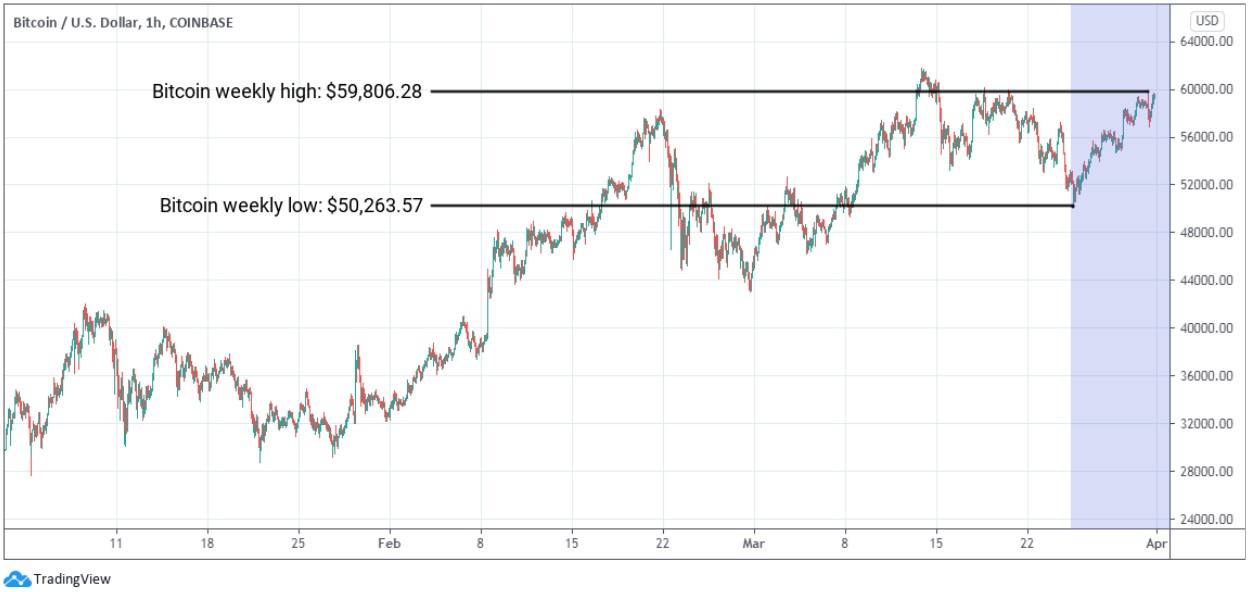
In the markets this week, Bitcoin fell to a three-week low of $50,623 late on Wednesday 24 March where it touched $50,263. As the week continued the BTC price retested the much-vaunted $60,000 level. This is an area of significant psychological resistance, much like the $50,000 price point has become recent support.
Overall positive market sentiment for Bitcoin, like any other financial asset — gold at $2,000 per ounce, for example — is somewhat dictated by these arbitrary round numbers.
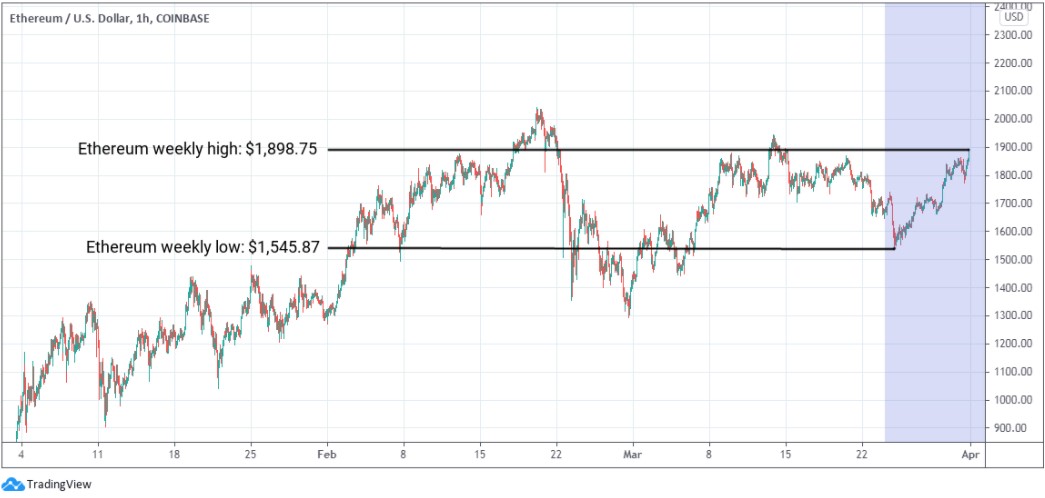
In the week to 31 March 2021 Ethereum dipped by 6.6% to a three-week low of $1,545.87 before paring back those losses. The ETH price briefly spiked towards the $1,900 mark before settling at $1,898.75.
Informazioni importanti
Le informazioni contenute nel presente materiale hanno finalità esclusivamente illustrative o informative e non costituiscono consulenza in materia di investimenti, raccomandazione personalizzata, né un’offerta o sollecitazione al pubblico risparmio.
Il presente documento (che può assumere la forma di presentazione, comunicato stampa, post sui social media, articolo di blog, comunicazione audiovisiva o altro strumento analogo – di seguito, per semplicità, “Documento”) è emesso da Bitwise Europe GmbH (“BEU” o “l’Emittente”) ed è redatto in conformità alla normativa applicabile, incluse le disposizioni in materia di comunicazioni promozionali relative a strumenti finanziari.
Bitwise Europe GmbH, costituita secondo il diritto tedesco, è l’emittente degli Exchange Traded Products (“ETP”) descritti nel presente Documento ai sensi di un prospetto di base e delle relative condizioni definitive, eventualmente integrati nel tempo e approvati dalla Bundesanstalt für Finanzdienstleistungsaufsicht (BaFin). L’approvazione del prospetto da parte di BaFin non costituisce un giudizio di merito sull’investimento né un’approvazione del presente contenuto da parte di CONSOB.
Prima di effettuare un investimento in prodotti emessi da BEU, è opportuno verificare con i propri consulenti professionali e con il proprio intermediario che tali prodotti siano disponibili nella propria giurisdizione e coerenti con il proprio profilo di rischio. Ogni decisione di investimento dovrebbe essere assunta tenendo conto della propria situazione personale, dopo aver ottenuto consulenza indipendente di natura finanziaria, fiscale e legale.
Capitale a rischio. Le cripto-attività sono strumenti ad elevato rischio e caratterizzati da elevata volatilità. Il valore degli investimenti in cripto-attività e in ETP con esposizione a cripto-attività può diminuire così come aumentare e gli investitori possono perdere parte o la totalità del capitale investito. Nessun sistema di garanzia o indennizzo protegge dalle perdite derivanti dall’andamento di mercato. Le performance passate non sono indicative di risultati futuri. Le dichiarazioni previsionali non costituiscono garanzia di risultati.
Prima di investire, si raccomanda di leggere attentamente il prospetto di base e le relative condizioni definitive, in particolare la sezione “Fattori di rischio”, disponibili sul sito https://bitwiseinvestments.eu/it/
L’accesso a determinati documenti può richiedere una dichiarazione in merito alla propria giurisdizione e alla propria categoria di investitore e può essere soggetto a ulteriori avvertenze e informazioni importanti.
Ulteriori informazioni sui rischi sono disponibili al seguente indirizzo: https://bitwiseinvestments.eu/it/risk-warning/


