

- Fusaka’s impact is more positive for user experience and L2 margins than it is on Ethereum’s revenue generation.
- We expect post-Fusaka blob fees to generate over the next-twelve-months between 5.39 ETH ($16k) and 78.2 ETH ($234k).
- Over time, blob fees will continue to get cheaper from continued increases in blob counts per block and a continued decline in execution fees.
Ethereum’s approach to scaling is deliberate. Rather than forcing every transaction to compete for block space on the main network, most activity is expected to take place on Layer 2s (L2), which periodically settle back to Ethereum for storage and transaction finalisation reasons. The first major step in this strategy arrived in March 2024 with the Ethereum Improvement Proposal (EIP)-4844. The upgrade introduced blobs, which were designed as a new data type built specifically for rollups. Because blobs are only stored temporarily on Layer 1 nodes, they can be priced far more cheaply, materially reducing costs for L2 users.
Blob prices have their own market to determine cost to users, and were originally designed to adjust smoothly with demand. In practice, however, realized blob fees were bipolar: They collapsed towards zero during quiet periods and spiked sharply when usage surged. This was not optimal from a user or L2 point of view.
The Fusaka upgrade, implemented on 3 December 2025 through EIP-7918, introduced a meaningful evolution of Ethereum's L2 fee pricing mechanics. It established a pricing "floor" whereby the effective blob price is the higher of two values: either 1/16th of the execution gas base fee or the price determined by the blob market’s own supply and demand.
In effect, if the 1/16th floor value is higher than the raw blob market price, the cost is set by that floor. Conversely, in a scenario where the 1/16th floor is lower than the natural market demand for blobs, the price remains determined by the blob fee market itself.
Some observers have argued (or, at least, hoped) that this minimum blob fee would significantly boost Ethereum revenues over time. This Espresso shows that to be false. While Fuuska the floor on blob fees, the marginal benefit is offset by continued scaling upgrades, which have been (and we believe will continue to) keep blob costs trending lower. As a result, we forecast that next-twelve-month blob fees will barely contribute to Ethereum’s overall revenue. The more durable impact lies in the second-order effects of greater fee predictability, which are likely to be far more meaningful for Layer 2s and end users over time.
Blob prices were historically too cheap, for too long, and didn’t track real-time demand.
The core issue with Ethereum’s initial blob fee design was not a lack of demand, but a failure of price discovery. While blob usage increased steadily, the pricing mechanism proved unable to track utilisation in a stable or consistent way. As a result, blob fees repeatedly collapsed during normal operating conditions.
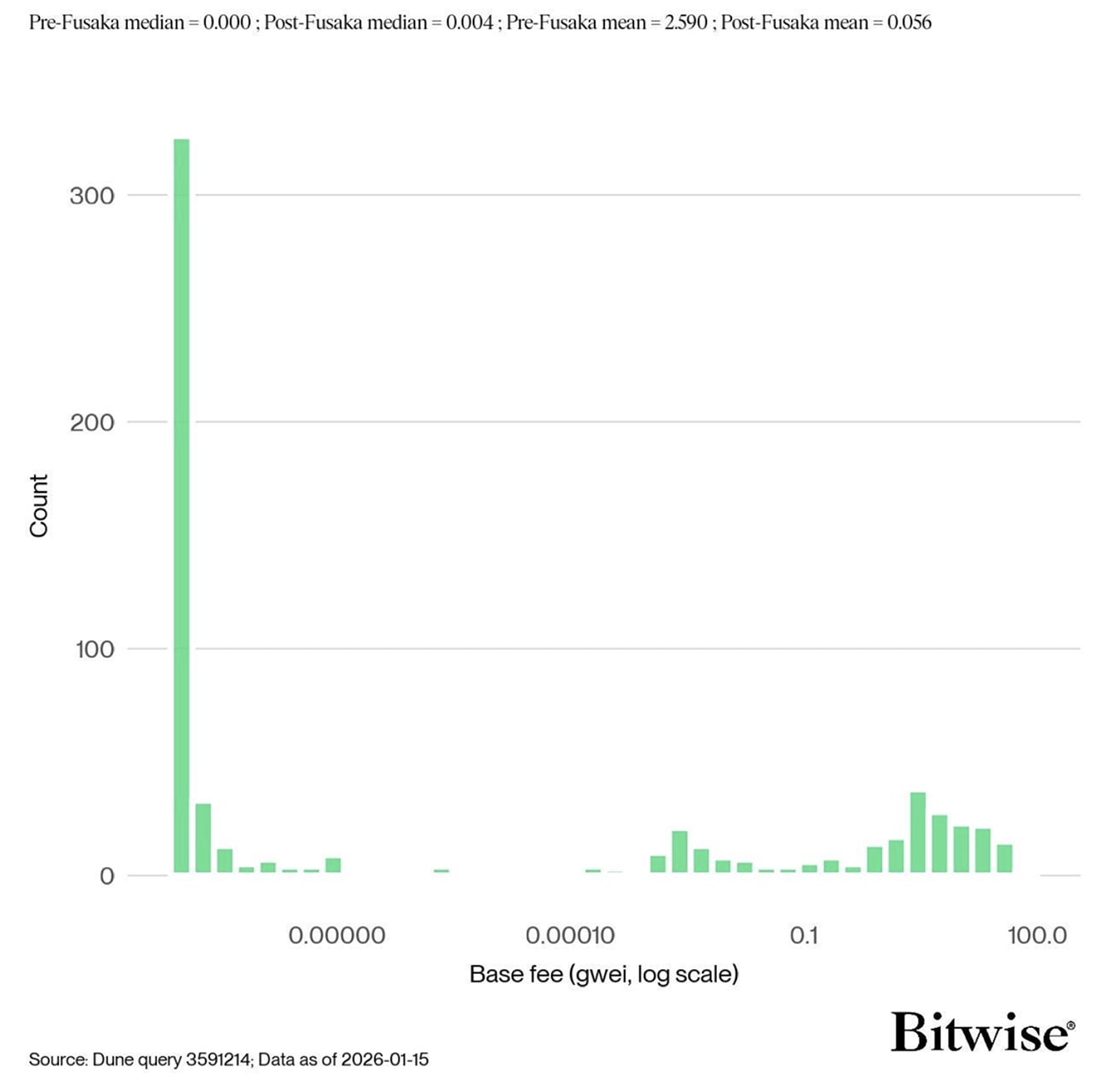
The chart below highlights two key observations. First, the distribution of daily blob base fees is highly skewed, with the vast majority concentrated at extremely low levels. Second, there is a clear absence of pricing in the middle range: most blobs cost close to zero, a small number were charged very high fees during periods of congestion, and almost none were priced at moderate levels. As a result, blob revenue was highly concentrated: around 90% of cumulative fees were generated on just 12% of days.
This is exactly what the time series below illustrates. Blob costs are driven by how many blobs are used per block relative to a target level. When usage reaches this threshold, demand becomes saturated and fees spike sharply, often remaining elevated. Conversely, when utilisation sits persistently below target, excess capacity causes the blob base fee to decay rapidly towards near-zero levels. This dynamic prevents prices from settling in a meaningful middle range and stops the market from stabilising.
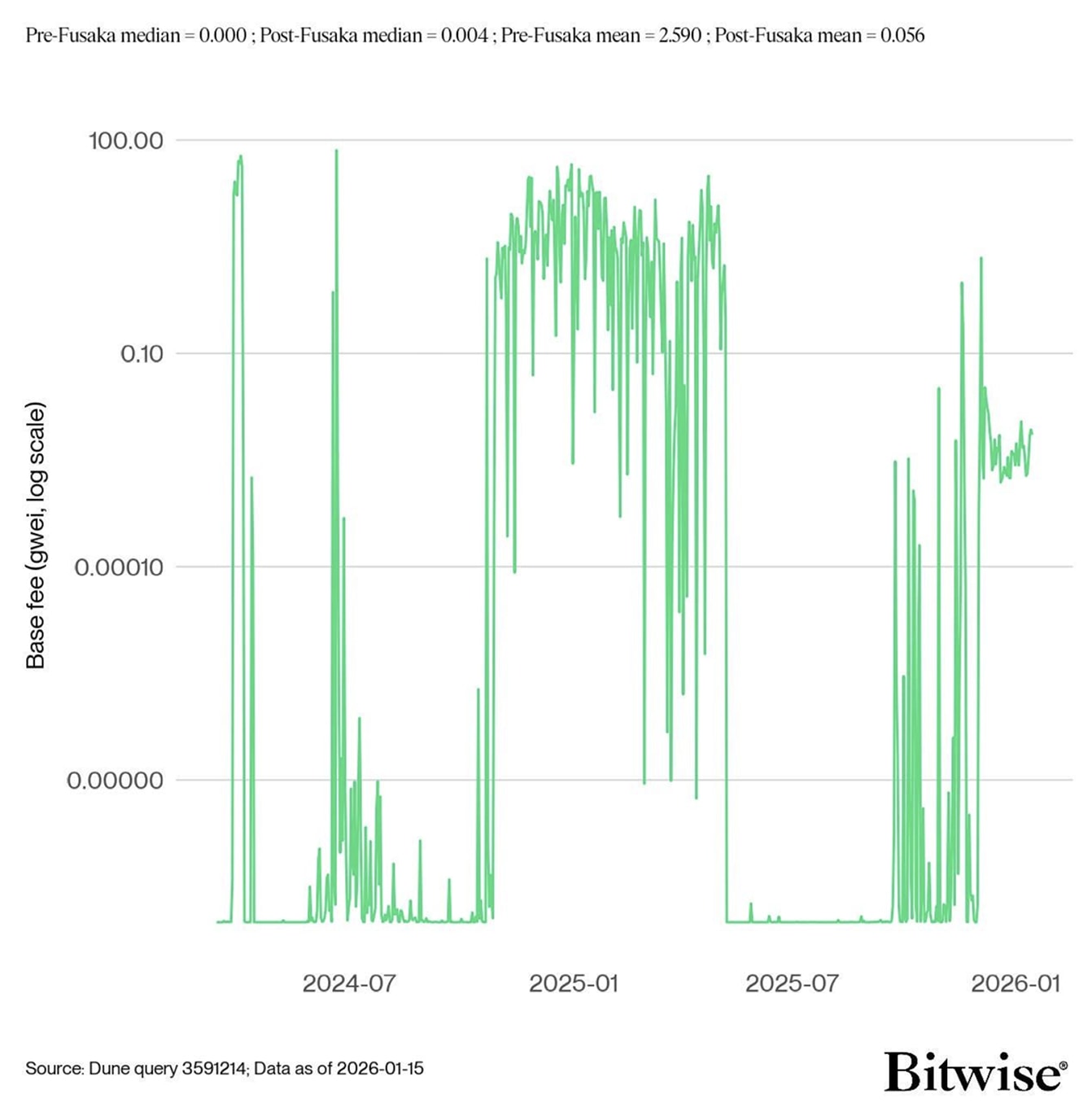
For sustainable scaling, a blockchain should support moderate, consistent fees, with surge pricing reserved for periods of genuinely extreme demand, rather than oscillating between being almost free and prohibitively expensive.
The post-Fusaka revenue-generation narrative was mostly Fugazi
You might expect creating a floor fee to boost overall Ethereum revenues, but our study shows that the effect will be minimal. Because Ethereum is scaling so effectively, we observe negligible positive effects to Ethereum’s longer-term revenue profile.
Under different blob pricing regimes, and assuming an ETH price of $3,000, the table translates observed gwei levels into next-twelve-month (NTM) annualised revenue expectations.
- Based on post-Fusaka conditions with a median fee of 0.00386 gwei, a mean of 0.056 gwei, and a 75th percentile of 0.00702 gwei, blob fees are projected to generate between 5.39 ETH ($16k) and 78.2 ETH ($234k).
- By comparison, using the pre-Fusaka EIP-7918-implied median (0.453 gwei) and mean (3.24 gwei), calculated as if the Fusaka EIP-7918 soft-coupling had been active since the Dencun launch 629 days ago, blob fees would have generated between 632 ETH ($1.8m) and 4,523 ETH ($13.5m). This should be viewed as an upper bound and is skewed by the excessive fee spikes caused by the previously broken blob pricing mechanism.
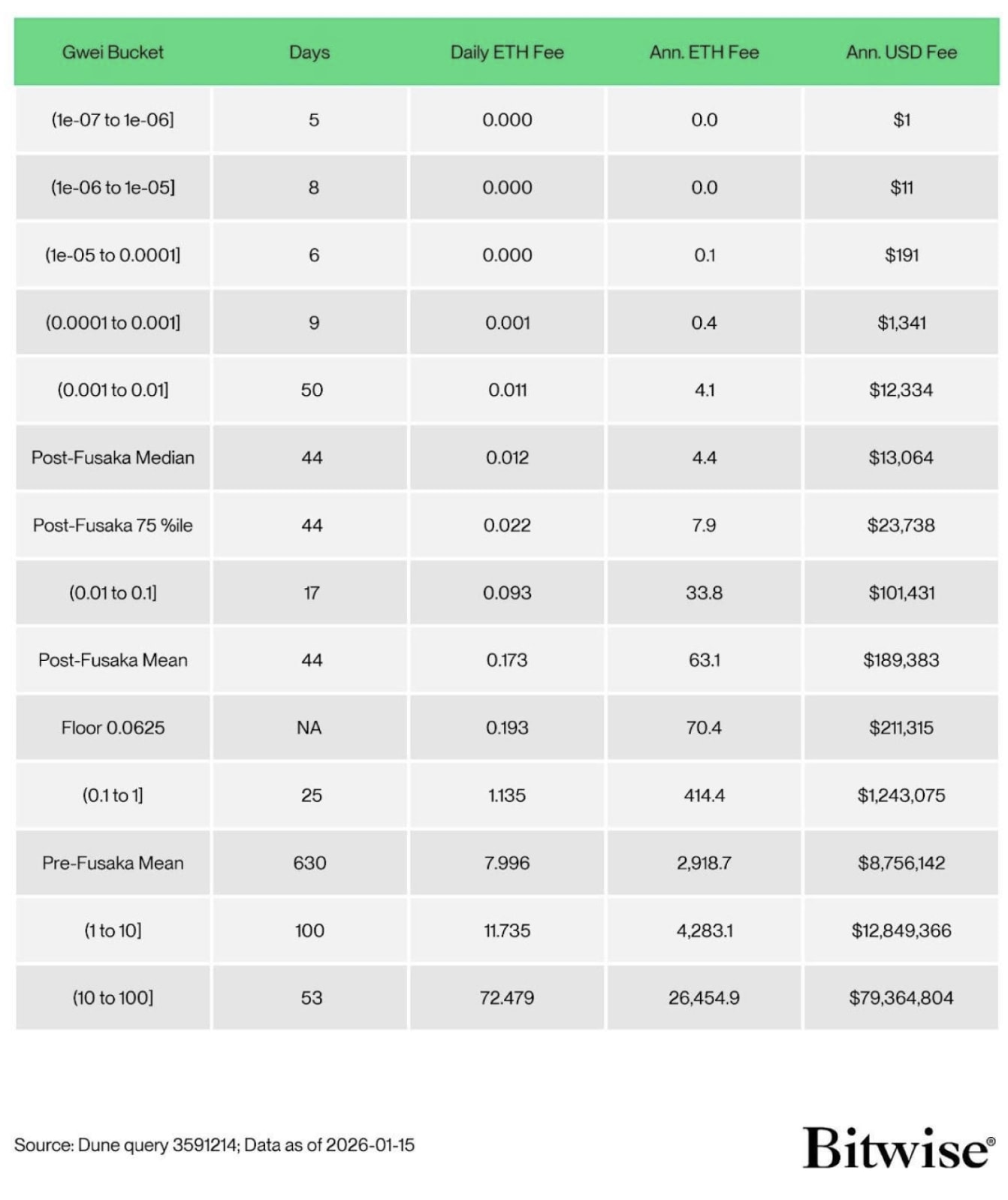
We view >$1 mn as a realistic upper bound, with post-Fusaka conditions likely to be more representative going forward. Continued scaling across Ethereum and its L2s should drive further increases in the gas limit per block and raise the target number of blobs per block through blob-parameter-only forks. In addition, the Glamsterdam and Hegota upgrades, scheduled for H1 and H2 respectively, should further expand capacity across both Ethereum and the L2 ecosystem.
Conclusion
In the run-up to Fusaka, many argued that EIP-7918 would be game changing for Ethereum. That claim is only partially correct. Instead, the proposal is transformative in terms of user experience for both users and L2s, but not from a revenue-generation perspective.
Prior to Fusaka, blob pricing was fundamentally broken. Supply and demand rarely equilibrated, leading to extreme volatility and mispricing. Fees stayed too low for extended periods, effectively allowing L2s to use Ethereum’s data availability almost for free. When demand did spike, blob fees often became prohibitively expensive for too long, making blobs less competitive than alternative platforms such as Solana.
The idea that Fusaka would materially boost Ethereum’s revenues was largely based on the assumption that raising the blob fee floor would mechanically lift cumulative fees. In reality, Fusaka primarily fixes the pricing mechanism rather than creating a new revenue engine. By linking blob fees to at least 1/16th of execution fees, it makes pricing more responsive to changes in supply and demand. The key benefit is improved fee predictability, which materially enhances the experience for L2s and end users.
What we have observed so far is telling. While average and median blob fees have increased post-Fusaka, L2 margins have also improved. This apparent contradiction is best explained by greater fee predictability, which allows L2s to optimise their sequencers and price user transactions more efficiently.
Looking ahead, we still expect low annualised blob fees over the next twelve months. Continued scaling will exert downward pressure on prices. Fusaka increased the Layer 1 gas limit, reducing execution fees, and raised the target number of blobs per block, expanding supply faster than demand. With further increases in gas limits and blob capacity likely, the network remains in a structurally low-fee environment.
In short, Fusaka should not be viewed as a revenue-driven inflection point for Ethereum. Its real impact lies in second- and third-order effects: making it more attractive to build and operate Layer 2s, improving margins, and strengthening Ethereum’s role as the settlement layer for scalable on-chain activity.
Bottom Line:
- Fusaka’s impact is more positive for user experience and L2 margins, than it is on Ethereum’s revenue generation.
- We expect post-Fusaka blob fees to generate over the next-twelve-months between 5.39 ETH ($16k) and 78.2 ETH ($234k).
- Over time, blob fees will continue to get cheaper from continued increases in blob counts per block and a continued decline in execution fees.
Informazioni importanti
Le informazioni contenute nel presente materiale hanno finalità esclusivamente illustrative o informative e non costituiscono consulenza in materia di investimenti, raccomandazione personalizzata, né un’offerta o sollecitazione al pubblico risparmio.
Il presente documento (che può assumere la forma di presentazione, comunicato stampa, post sui social media, articolo di blog, comunicazione audiovisiva o altro strumento analogo – di seguito, per semplicità, “Documento”) è emesso da Bitwise Europe GmbH (“BEU” o “l’Emittente”) ed è redatto in conformità alla normativa applicabile, incluse le disposizioni in materia di comunicazioni promozionali relative a strumenti finanziari.
Bitwise Europe GmbH, costituita secondo il diritto tedesco, è l’emittente degli Exchange Traded Products (“ETP”) descritti nel presente Documento ai sensi di un prospetto di base e delle relative condizioni definitive, eventualmente integrati nel tempo e approvati dalla Bundesanstalt für Finanzdienstleistungsaufsicht (BaFin). L’approvazione del prospetto da parte di BaFin non costituisce un giudizio di merito sull’investimento né un’approvazione del presente contenuto da parte di CONSOB.
Prima di effettuare un investimento in prodotti emessi da BEU, è opportuno verificare con i propri consulenti professionali e con il proprio intermediario che tali prodotti siano disponibili nella propria giurisdizione e coerenti con il proprio profilo di rischio. Ogni decisione di investimento dovrebbe essere assunta tenendo conto della propria situazione personale, dopo aver ottenuto consulenza indipendente di natura finanziaria, fiscale e legale.
Capitale a rischio. Le cripto-attività sono strumenti ad elevato rischio e caratterizzati da elevata volatilità. Il valore degli investimenti in cripto-attività e in ETP con esposizione a cripto-attività può diminuire così come aumentare e gli investitori possono perdere parte o la totalità del capitale investito. Nessun sistema di garanzia o indennizzo protegge dalle perdite derivanti dall’andamento di mercato. Le performance passate non sono indicative di risultati futuri. Le dichiarazioni previsionali non costituiscono garanzia di risultati.
Prima di investire, si raccomanda di leggere attentamente il prospetto di base e le relative condizioni definitive, in particolare la sezione “Fattori di rischio”, disponibili sul sito https://bitwiseinvestments.eu/it/
L’accesso a determinati documenti può richiedere una dichiarazione in merito alla propria giurisdizione e alla propria categoria di investitore e può essere soggetto a ulteriori avvertenze e informazioni importanti.
Ulteriori informazioni sui rischi sono disponibili al seguente indirizzo: https://bitwiseinvestments.eu/it/risk-warning/


