

In traditional equity markets, the Capital Asset Pricing Model (CAPM) posits a straightforward trade-off: investors demand more returns for more risk. Theoretically, higher-beta stocks should, over time, earn higher returns than their lower-beta peers.
But 50+ years ago, researchers noticed an anomaly: In practice, low-beta stocks often outperformed their higher-beta peers over time. Researchers have proposed various reasons for this, including investor preference for high-flying stocks that are well covered by the media.
But whatever the reason, the anomaly has been stubbornly persistent, and has offered savvy investors a way to get more return with less risk in their equity portfolios. As crypto emerges as a major new asset class, we've seen few studies of whether this low volatility anomaly exists in crypto. In this Crypto Market Espresso report, we aim to decipher if the Low Beta Anomaly is present and significant in crypto or not.
Key Takeaways:
- The Low Beta Anomaly is neither present nor significant.
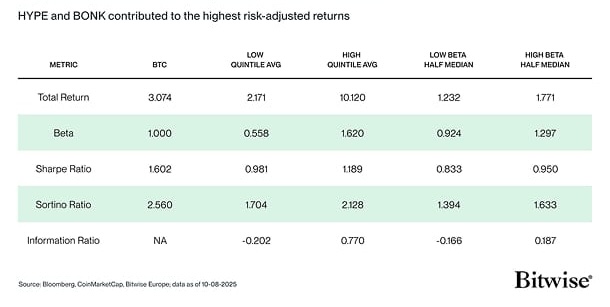
- High-beta buckets outperform low-beta buckets across all total return and risk-adjusted metrics including Sharpe Ratio, Sortino Ratio and Information Ratio.
- The Information Ratio is statistically significant but still shows that BTC outperforms high-and-low beta buckets.
Main Methodology
The universe is the top 50 cryptoassets by market cap, excluding stablecoins. Bitcoin (BTC) is the yardstick for beta, active return, and tracking error. The risk‑free benchmark is the U.S. 10‑year Treasury yield. We use daily log returns and annualize where appropriate.
We measure overall efficiency (Sharpe Ratio), downside discipline (Sortino Ratio), and benchmark‑relative risk-adjusted return (Information Ratio).
After ranking the crypto asset universe by beta, we cut the list two ways to fit the test we're running. For Welch's t-test, we compare the extremes-the lowest 20% vs the highest 20%-to see if their average results are different. For the Mann–Whitney U test, we make a simple halfway split (about 50/50) and compare the rank order of results across the two halves; keeping more tokens in each group gives this rank-based test more statistical power.
Results
Low-beta tokens underperform across all total return and risk-adjusted return ratios. In practice, that means low beta tokens may experience shallower drawdowns but fail to compound as effectively as high-beta buckets or BTC.
Due to the retail nature of the asset class, especially ex-BTC & ETH, flows clearly favour assets with visible upside optionality as depicted in the total return of memecoins and the 6–9-month craze in the lead up to and aftermath of the 2024 US election. Investors also allocated to major blue-chip assets with strong fundamentals such as Hyperliquid and Solana.
Narrative flow has clearly concentrated in high-beta leaders (e.g., top L1s and L2s such as Solana, Near, Hyperliquid; memecoins such as Doge, Pepe, Bonk, TRUMP and Pengu) compared to low-beta laggards (e.g., Bitget Token OKB, GateToken, UNUS and others). These names absorb capital in risk-on regimes and deliver outsized upside capture that supports Sharpe Ratio, Information Ratio and total return.
Low Beta Anomaly is not significant to crypto asset returns
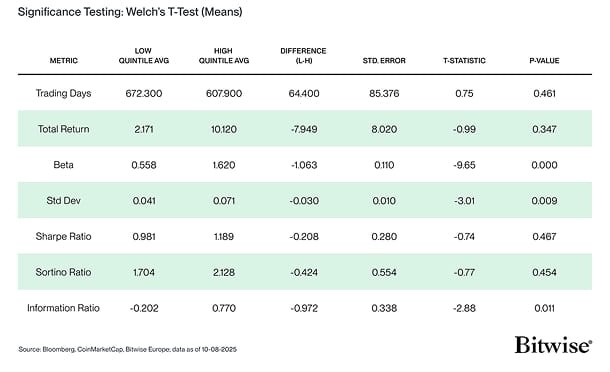
Now, to address the significance of these results. The Information Ratio is benchmarked to BTC: it asks how much excess return was earned over BTC for each unit of tracking error. By judging everything relative to BTC, you strip out the broad market move that pushes most crypto assets together. That removal of the common trend lowers the noise and highlights where tokens truly differ in performance versus the benchmark.
High beta buckets still don't beat BTC's upside by a wider margin without a proportional jump in tracking error, while low-beta names tended to lag BTC yet still carried idiosyncratic risks.
That creates a cleaner separation in the Information Ratio-large enough for the tests to flag significance (≈0.05 on Welch; ≈0.01 on Mann–Whitney). Overall, only the Information Ratio was statistically significant.
By contrast, Sharpe Ratio and Sortino Ratio remain absolute measures; higher upside and higher volatility largely offset each other, so their group differences wash out and the p-values stay high.
Allocation Implications
BTC still provides the best exposure to risk-adjusted returns than compared to Alt coins. However, it is also clear that total returns are skewed by high-beta outliers, in the extreme splits (quintiles).
Avoid over-allocating to the “belly” of the crypto curve-neither blue chip or narrative plays; select high-beta quality such as SOL and tightly size convex exposures such as PEPE, BONK, or others, where appropriate.
The High-Beta Quality Rebel: Solana (SOL)
SOL's outperformance sits on real “quality” supports-busy developer ecosystem, clear consumer use-cases, high throughput and reliability, deep liquidity, and strong retail mindshare. Those fundamentals help SOL turn big moves into compounding and recover faster after setbacks, even though the ride is still bumpy.
Solana has been rewarded for shipping through adversity. A clear roadmap, an aligned and active developer base, and rising product-market fit in internet-native capital markets continue to compound. Solana is positioning to serve both institutional and retail flows, with escape velocity within reach.

Conclusion
In this cross-section, the low-beta anomaly does not show. Relative to a BTC benchmark, low-beta cohorts trail on total return, Sharpe, and Information Ratio, while their advantage on Sortino Ratio-most visible in the tail (quintile) splits-reflects shallower drawdowns rather than superior compounding. Welch's t-tests and Mann–Whitney U confirm the picture: the performance gap favours high beta, with median Information Ratio negative for low beta and positive for high beta. In practice, flows, leverage, and narrative intensity continue to concentrate in select high-beta assets-quality leaders and reflexive memes-leaving much of the low-beta “belly of the curve” with active risk that is not compensated by active reward.
For allocation, the implication is straightforward. If the goal is downside efficiency, a measured low-beta sleeve can lift portfolio Sortino Ratio; if the goal is outperformance versus BTC or benchmark-relative efficiency, emphasis should remain on select high-beta quality complemented by tightly sized convex exposures.
Avoid over-allocating to the belly, monitor upside/downside capture by bucket, and revisit the conclusions by regime as market structure and liquidity conditions evolve.
Rechtlicher Hinweis
Diese Veröffentlichung stellt eine Marketingmitteilung dar und dient ausschließlich Informationszwecken. Sie stellt weder eine Anlageberatung noch eine persönliche Empfehlung oder eine Aufforderung zum Kauf oder Verkauf von Finanzinstrumenten dar.
Bitwise Europe GmbH ist Emittentin der in dieser Veröffentlichung gegebenenfalls genannten Exchange Traded Products („ETPs“) unter einem von der Bundesanstalt für Finanzdienstleistungsaufsicht (BaFin) gebilligten Basisprospekt. Die Billigung durch die BaFin bezieht sich ausschließlich auf die Vollständigkeit, Kohärenz und Verständlichkeit des Prospekts gemäß der Prospektverordnung und stellt keine inhaltliche Bewertung oder Empfehlung der Produkte dar.
Die dargestellten Marktanalysen, Einschätzungen und Szenarien spiegeln die aktuelle Einschätzung zum Zeitpunkt der Veröffentlichung wider und beruhen auf Informationen, die als zuverlässig erachtet werden. Es wird jedoch keine Gewähr für die Richtigkeit oder Vollständigkeit übernommen. Prognosen und zukunftsgerichtete Aussagen sind mit Unsicherheiten behaftet und stellen keine Garantie für zukünftige Entwicklungen dar. Die Wertentwicklung in der Vergangenheit ist kein verlässlicher Indikator für zukünftige Ergebnisse.
Investitionen in Krypto-Assets und krypto-bezogene Finanzinstrumente sind mit erheblichen Risiken verbunden und unterliegen starken Kursschwankungen. Anleger können einen Teil oder ihr gesamtes eingesetztes Kapital verlieren.
Eine Anlageentscheidung sollte ausschließlich auf Grundlage des jeweils gültigen Basisprospekts, der Endgültigen Bedingungen sowie des Basisinformationsblatts (KID), insbesondere des Abschnitts „Risikofaktoren“, getroffen werden. Der Basisprospekt, die Endgültigen Bedingungen sowie weitere Risikohinweise sind abrufbar unter: www.bitwiseinvestments.eu/de
Anleger sollten prüfen, ob eine Investition unter Berücksichtigung ihrer individuellen Anlageziele, ihrer finanziellen Situation und ihrer Risikobereitschaft geeignet ist, und gegebenenfalls unabhängigen fachlichen Rat einholen.


