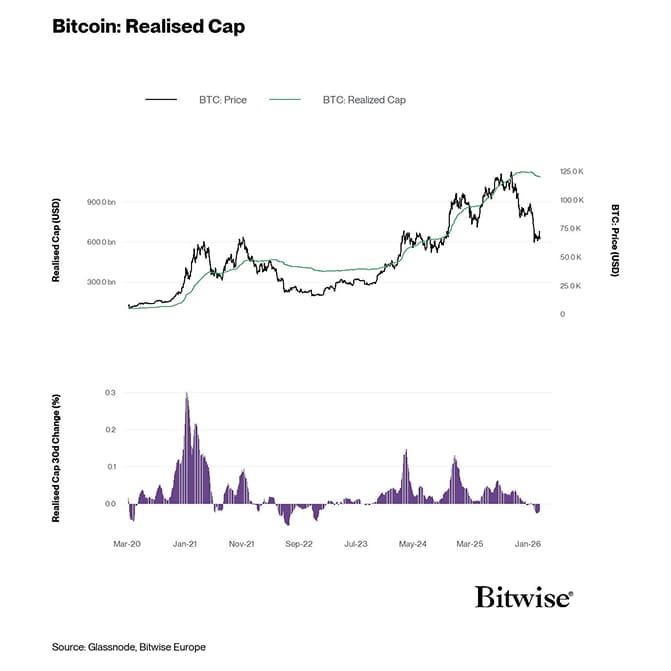
- Capital is beginning to exit the Bitcoin network on a net basis, signalling a contraction in liquidity conditions as realised losses outweigh profits following the recent market capitulation.
- As liquidity tightens, correlations across the altcoin complex have climbed. Additionally, altcoin beta to Bitcoin has also surged, indicating that the altcoin sector is increasingly moving in directional lockstep with Bitcoin whilst acting as high-beta proxies.
- Evidence suggests liquidity conditions determine whether the digital asset market behaves as a dispersed multi-sector ecosystem or collapses into a single Bitcoin-dominated factor.
Liquidity Contracts
Liquidity remains a critical concept across financial markets and is often cited as one of the dominant drivers of asset price performance. However, methodologies for measuring liquidity vary widely across analysts, with no single framework universally accepted as the definitive approach.
With this in mind, one alternative method of assessing liquidity conditions is through the Realised Cap metric. Unlike traditional market capitalisation, which values all circulating supply at the current spot price, the Realised Cap prices each coin at the value of its most recent on-chain transaction. As a result, the metric provides insight into the cumulative capital that has flowed into and out of the network over time, as coins are continually rued through investor spending behaviour.
At present, capital is beginning to exit the Bitcoin network on a net basis, with investors realising more losses than profits as coins are rued lower following the recent capitulation. In this article, we examine the direct effects of a contracting and increasingly scarce liquidity environment on the broader digital asset ecosystem.
Bitcoin: Realised Cap
 Source: Glassnode, Bitwise Europe
The Gravity Well
Bitcoin, as the largest and most liquid asset in digital asset markets remains the dominant centre of gravity for the broader ecosystem. As such, contractions in Bitcoin liquidity tend to propagate across the entire market stack.
One notable observation is that the correlation between Bitcoin and altcoin log returns has approached all-time highs, suggesting that price movements across the two segments are currently highly synchronised and largely indistinguishable in direction.
Bitcoin vs Total Altcoin Market Cap: Rolling Correlation (90D)
_thumb.jpg "Bitcoin vs Total Altcoin Market Cap: Rolling Correlation (90D)") Source: Glassnode, Bitwise Europe
Source: Glassnode, Bitwise Europe
Additionally, the beta between Bitcoin and the broader altcoin complex has surged during the recent market contraction, reaching an all-time high of 1.45. This shift indicates that not only is Bitcoin increasingly dictating the direction of the digital asset landscape, but altcoins are also behaving as more sensitive proxies to Bitcoin's movements. In effect, Bitcoin functions as the digital asset market's equivalent of a global benchmark asset during liquidity stress.
Taken together, these observations suggest that declining liquidity concentrates market direction while amplifying volatility across more speculative assets.
Bitcoin vs Total Altcoin Market Cap: Rolling Beta (90D)
_thumb.jpg "Bitcoin vs Total Altcoin Market Cap: Rolling Beta (90D)") Source: Glassnode, Bitwise Europe
Source: Glassnode, Bitwise Europe
Interestingly, a more granular view across sector cohorts reveals a similar dynamic. Examining rolling correlations between Bitcoin and major altcoin sectors, including L1, L2, DeFi, and Memecoins shows that co-movement remains elevated across the entire market complex.
Among these groups, the L1 sector consistently exhibits the strongest correlation with Bitcoin, reaching near all-time highs. This is broadly consistent with the sector containing many of the largest market capitalisation assets, which tend to move most closely in line with Bitcoin in general.
The L2 and DeFi sectors remain highly correlated with Bitcoin as well, although to a slightly lesser degree than the L1 cohort, reflecting modest dispersion in relative performance.
By contrast, the Memecoin sector has experienced a notable decline in correlation, falling to its lowest level since March 2024. This suggests extremely speculative assets are struggling to attract sustained buy-side demand in the current risk-off environment, resulting in increasingly isolated price behaviour as speculative demand fades.
Bitcoin vs Crypto Sectors: Rolling Correlation (90D)
_(2)_thumb.jpg "Bitcoin vs Crypto Sectors: Rolling Correlation (90D)") Source: Glassnode, Bitwise Europe
Source: Glassnode, Bitwise Europe
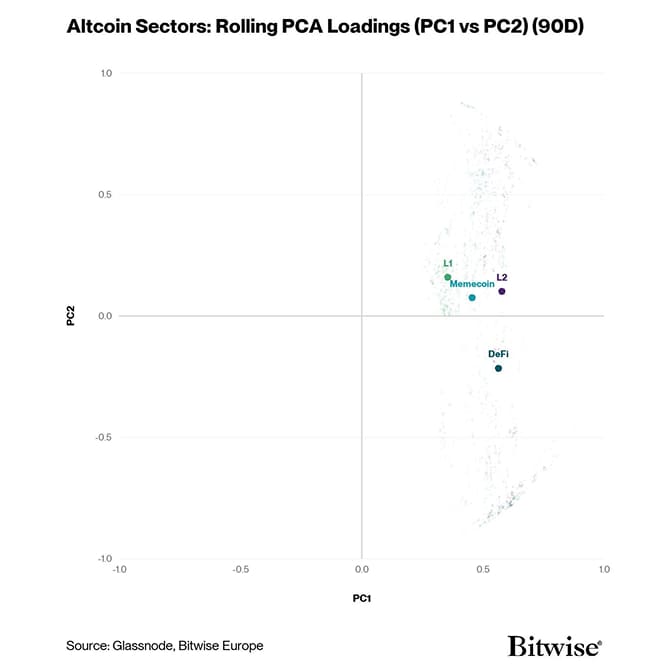
Furthermore, a principal component analysis of sector returns reveals a dominant common factor. Notably, the first principal component loads with the same sign across all major sectors, including L1, L2, DeFi and Memecoins, and explains approximately 78% of total return variance.
While individual observations may vary widely, sector-level averages remain tightly clustered, reinforcing the existence of a dominant common market factor. This bolsters the observation that, on aggregate, the digital asset market continues to behave as a highly unified system, with most sectors largely responding to the same underlying market forces.
Altcoin Sectors: Rolling PCA Loadings (PC1 vs PC2) (90D)
 Source: Glassnode, Bitwise Europe
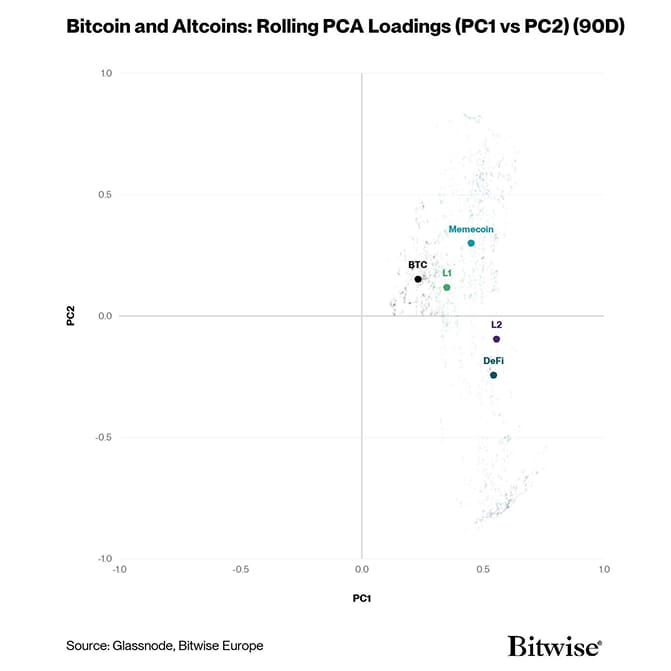
Furthermore, when Bitcoin returns are included in the analysis, we can assess whether the dominant market component is effectively a Bitcoin-driven factor. Interestingly, incorporating Bitcoin does not materially alter the share of variance explained by PC1. This suggests Bitcoin forms part of the same dominant market factor rather than acting as an additional orthogonal driver.
Bitcoin and Altcoins: Rolling PCA Loadings (PC1 vs PC2) (90D)
 Source: Glassnode, Bitwise Europe
Exploring the Liquidity Singularity
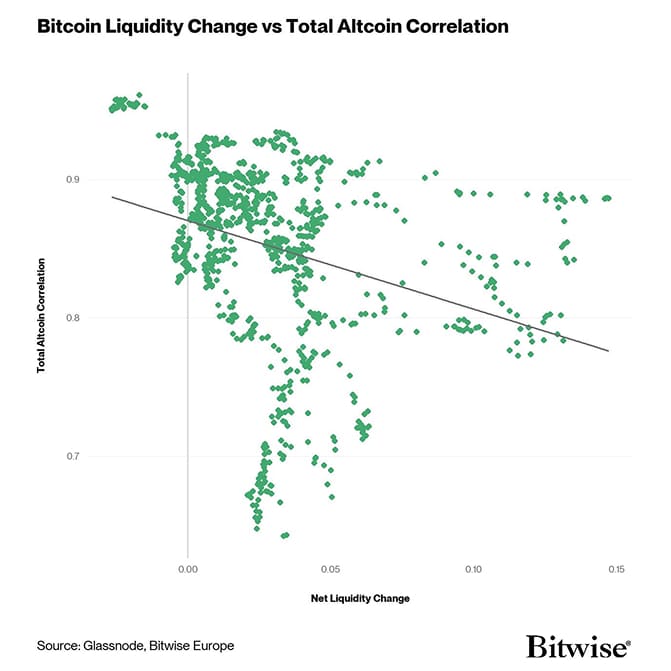
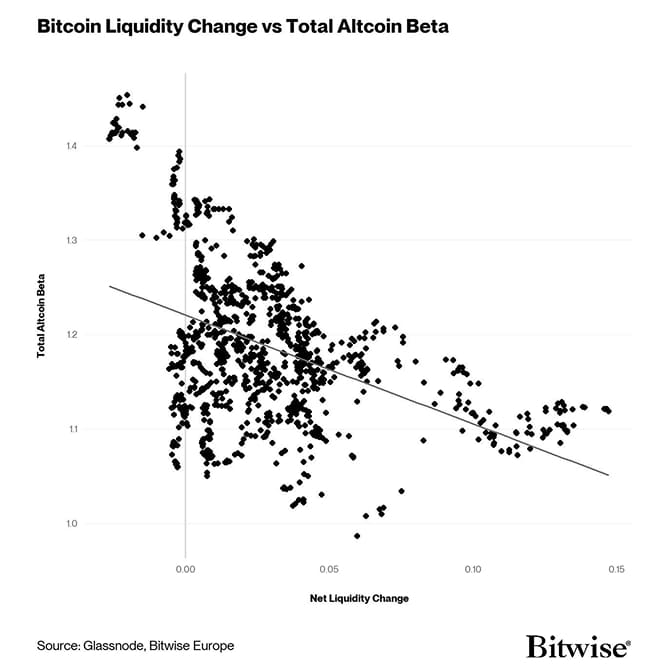
Finally, we can examine this relationship more directly by comparing changes in liquidity with measures of market movement and sensitivity. To model this, we utilise the 30d percentage change to Realised Cap as our liquidity measure, as discussed as the start of this article.
Notably, a clear structural dislocation emerges. As liquidity expands, correlations typically decline and market sensitivity compresses, allowing altcoins to behave more idiosyncratically as capital constraints ease and investment breadth widens. In these conditions, new investment narratives tend to emerge, with rising prices fuelling cultural excitement and expanding risk appetite into the right tail of the risk curve.
The opposite dynamic generally occurs during liquidity contractions. As capital consolidates into the market leader, altcoins tend to trade more closely in line with Bitcoin, with correlations rising and beta often increasing as thinner liquidity amplifies reflexive price behaviour.
This appears to mark two distinct market regimes: a high-liquidity environment characterised by sector dispersion, and a liquidity-constrained regime where Bitcoin dominates cross-asset behaviour.
At present, the market appears to be respecting historical precedent, with liquidity contracting while both correlations and betas rise. These dynamics highlight a mechanical process whereby illiquid conditions drive greater uniformity in market direction, yet higher sensitivity across assets, a phenomenon we describe as the Liquidity Singularity.
Bitcoin Liquidity Change vs Total Altcoin Correlation
 Source: Glassnode, Bitwise Europe
Bitcoin Liquidity Change vs Total Altcoin Beta
Source: Glassnode, Bitwise Europe
Bitcoin Liquidity Change vs Total Altcoin Beta
 Source: Glassnode, Bitwise Europe
Bottom Line:
Liquidity remains one of the primary drivers of an asset's valuation. As liquidity conditions tighten across both the digital asset landscape, the altcoin complex's correlations and betas relative to Bitcoin returns have risen toward all-time highs on a quarterly rolling basis. However, these relationships tend to weaken when liquidity conditions are abundant.
Taken together, these observations support the above thesis that liquidity conditions determine whether the digital asset market behaves as a multi-factor ecosystem or collapses into a single dominant market factor centred on Bitcoin.
This dynamic resembles the behaviour observed in traditional financial markets during liquidity crises, where cross-asset correlations rise sharply as investors retreat toward the most liquid benchmark assets. Often described as a “Correlation-1” event, these periods are characterised by the dominance of a single market factor. Within digital asset markets, Bitcoin appears to play a similar role, acting as the system's liquidity anchor and driving increasingly synchronised behaviour across the altcoin complex when liquidity conditions tighten.
Interestingly, preliminary Granger-causality tests suggest the relationship between liquidity and market structure may be bidirectional, indicating feedback effects between capital flows and cross-asset behaviour. However, a detailed treatment of this dynamic lies beyond the scope of this report.
Important information
This material is intended solely for professional investors and is not suitable for retail distribution and reliance. The information provided in this material is for illustrative, educational or information purposes only and does not constitute investment advice, a recommendation or solicitation of an offer to buy any product or to make any investment.
This document (which may be subject to change and may be in the form of a presentation, press release, social media post, blog post, broadcast communication or similar instrument – we refer to this category of communications generally as a “document” for purposes of this disclaimer) is issued by Bitwise Europe GmbH (“BEU” or “the Issuer”). This document has been prepared in accordance with applicable laws and regulations (including those relating to financial promotions).
BEU, incorporated under the laws of Germany, is the issuer of Exchange Traded Products (“ETPs”) described in this document under a base prospectus and final terms, which may be supplemented from time to time, and which are approved by BaFin. If you are considering investing in products issued by BEU you should check with independent financial adviser, your broker or bank that such products are available in your jurisdiction and suitable for your investment profile. A decision to invest any amount in an ETPs offered by BEU should take into consideration your specific circumstances after seeking independent investment, tax and legal advice.
Capital at risk. Cryptoassets are high-risk and volatile. The value of investments in cryptoassets and crypto-linked ETPs may fall as well as rise, and investors may lose some or all of their invested capital. No investor protection or compensation scheme applies. Past performance is not a reliable indicator of future results. Forward-looking statements are not guarantees. You should read the relevant base prospectus and final terms before investing and, in particular, the section entitled ‘Risk Factors' for further details of risks associated with an investment. The prospectuses, final terms and other documents relevant to BEU's ETPs are available under the “Resources” section at www.bitwiseinvestments.com. When visiting this website, you will need to self-certify as to your jurisdiction and investor type in order to access these documents, and in so doing you may be subject to other disclaimers and important information.
Important Analytical Limitations: The observations and analyses presented in this document are based on historical market patterns and data correlations which may not repeat or continue in future market conditions. Past correlations between capital flows and performance metrics are not indicative of future performance and should not be extrapolated as predictive indicators. Material downside risks remain present across all investment timeframes regardless of current undervaluation metrics or favourable technical indicators. All model outputs, fair value calculations, and quantitative assessments are subject to significant uncertainty and methodological limitations, and should not be relied upon as the sole basis for making investment decisions. Investors should conduct independent due diligence and consider multiple factors beyond the scope of this analysis.
Read the full disclaimer here: https://bitwiseinvestments.eu/disclaimer/