- Bitcoin ETPs have become the marginal force in Bitcoin markets.
Since the launch of US spot Bitcoin ETFs in January 2024, Bitcoin ETPs have evolved from access vehicles into one of the dominant marginal buyer in the market. ETP flows now exert a first-order influence on Bitcoin’s short-term price dynamics, absorb a material share of new supply, rival on-chain activity in economic relevance, and increasingly shape liquidity and price discovery across the ecosystem.
- Bitcoin ETP flows are not driven by classic risk-on/risk-off allocation.
Empirically, global Bitcoin ETP flows show little meaningful co-movement with equity, bond, credit, or gold ETF flows. Correlations with macro risk proxies such as the VIX, MOVE, and financial conditions are modest at best and fade once placed in a multivariate framework. This evidence rejects a simple cross-asset rotation narrative and suggests that macro conditions act as background context rather than as primary mechanical drivers of Bitcoin ETP demand.
- Flows follow flows – and flows follow performance.
The dominant drivers of Bitcoin ETP flows are strong internal persistence and Bitcoin’s own recent returns. Flows cluster over time due to implementation frictions and investor behaviour, while Bitcoin performance consistently leads flows at short horizons, reflecting attention- and performance-sensitive demand. Once these effects are accounted for, macro and risk variables add little incremental explanatory power. Overall, Bitcoin ETP flows appear best described by an adoption- and allocation-driven process, characterized by flow momentum and return-chasing rather than systematic macro-driven rebalancing.
From Wall Street Milestone to the Dominant Force Driving BTC Performance
The evolution of Bitcoin exchange-traded products (ETPs) has transitioned from a niche innovation to a cornerstone of digital-asset market structure, underscoring Bitcoin's maturation as an investable asset class.
The path to regulated spot Bitcoin ETPs reflects more than a decade of incremental progress: early attempts such as the Winklevoss Bitcoin Trust in 2013 faced regulatory resistance, and for years market access was largely limited to vehicles like Grayscale's closed-end trust, which suffered from persistent valuation inefficiencies.
A pivotal shift occurred with the US Securities and Exchange Commission's simultaneous approval of eleven spot Bitcoin ETFs on the 10th of January 2024. The subsequent launch of these ETFs was one of the most successful ETF launches in financial history and signaled Bitcoin's integration into mainstream capital markets.
Since early 2024, net flows into Bitcoin ETPs have emerged as one of the dominant drivers of short-term Bitcoin price dynamics, with the explanatory power of these flows for returns reaching unprecedented levels.
This structural change has redefined market microstructure: ETP trading volumes now rival on-chain activity, institutionalized demand increasingly dictates order flow across venues, and the absorption of supply via ETP inflows has outpaced newly mined Bitcoin following the most recent halving.
These developments position Bitcoin ETPs not merely as investor access vehicles but as central determinants of liquidity, price discovery, and broader ecosystem evolution.
In part 1 of this series we have shown that flows into Bitcoin ETPs exert a dominant effect on the balance between buying and selling volumes on native crypto exchanges.
In fact, we believe that Bitcoin ETPs have effectively become “the marginal buyer” in the market, especially after the US spot bitcoin ETF launch in 2024.
The rise of Bitcoin ETPs can also explain other important on-chain phenomena like the decline in transaction fees, as we have sen a significant migration of native on-chain transactions to these off-chain vehicles.
We have also shown that flows into global Bitcoin ETPs have started explaining an increasing share of Bitcoin's performance variation.
But what is the actual driving force behind global Bitcoin ETP flows?
This question will be the focus of this report – Part 2 of our series on Bitcoin ETPs.
Is Bitcoin just a “risk-on/risk-off” asset?
The following paragraphs examine whether daily net flows into global Bitcoin ETPs (in % of AuM) are linked to traditional cross-asset flows and macro risk proxies.
In general, the analysis focuses on four building blocks:
- Weekly correlations
- Daily cross-correlations
- Pairwise Granger causality tests, and
- joint regression model
A key hypothesis to test is whether flows into Bitcoin ETPs have shown any kind of co-movement especially with flows into risky assets such as equities or high yield bonds.
However, weekly correlations suggest that Bitcoin ETP flows do not meaningfully co-move with any of the major cross-asset flow series.
For instance, the correlation between BTC flows and flows into SPDR S&P 500 ETF (SPY) is small and slightly positive (+0.04). The same is true for the Invesco Nasdaq 100 ETF (QQQ) with a correlation of around +0.06. Meanwhile, the correlations with the iShares 20+ Year Treasury Bond ETF / TLT (−0.01), iShares iBoxx High Yield Corporate Bond ETF / HYG (+0.01), and SPDR Gold Shares ETF / GLD (−0.03) are effectively close to zero.
In other words, the data do not support a simple “risk-on/risk-off rotation” narrative in which advisors allocate into Bitcoin ETPs in tandem with broad equity or credit inflows, or step aside in lockstep with bond or gold allocations.
Weekly Correlation Matrix
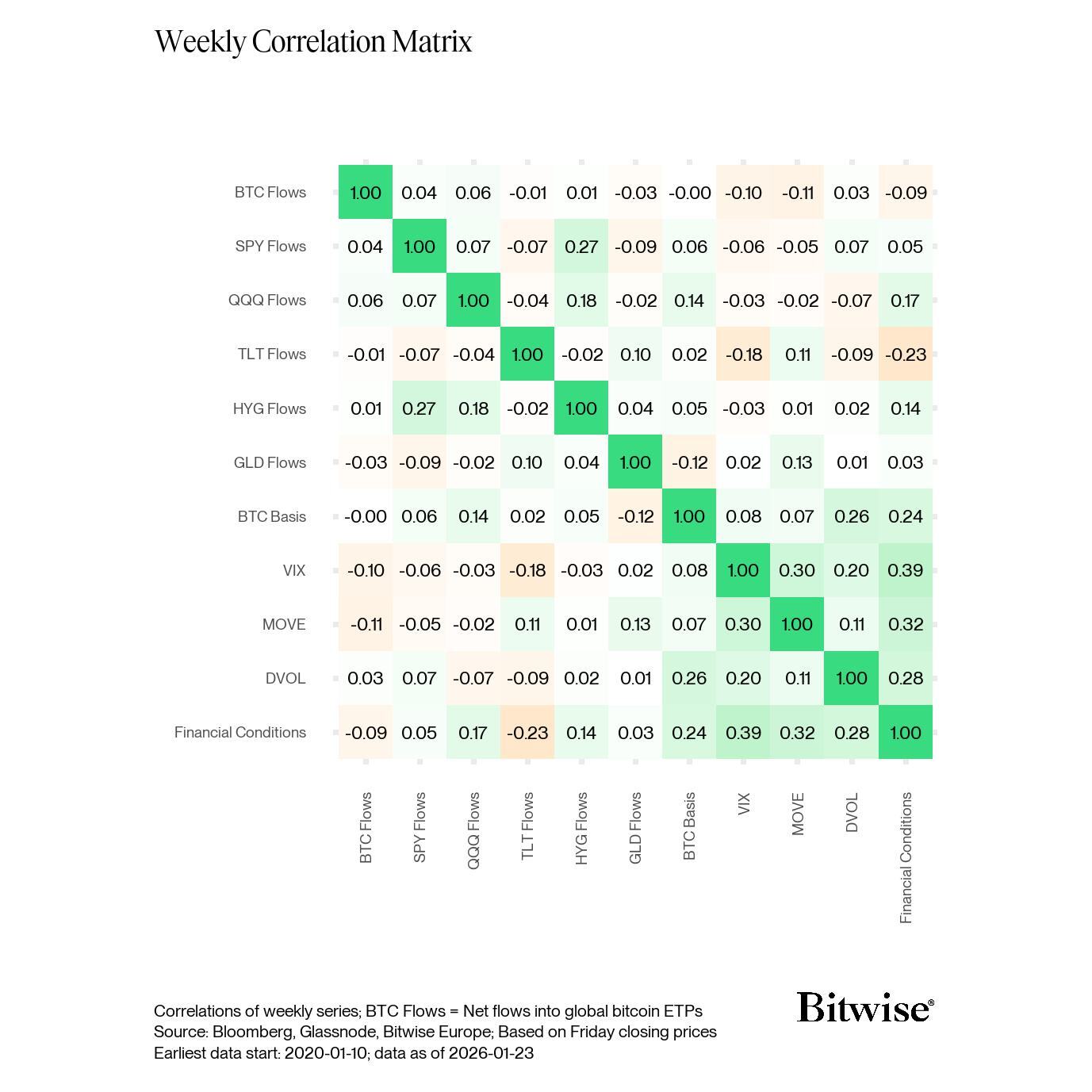
Apart from traditional asset flows, global Bitcoin ETP flows show modestly negative correlations with standard risk indicators.
For instance, weekly correlations with the VIX (−0.10), MOVE (−0.11), and Financial Conditions (−0.09) indicate that global Bitcoin ETP inflows tend to be somewhat softer in weeks characterised by elevated market stress or tighter financial conditions.
However, these relationships are not tight, which already hints that macro risk is likely more of a background condition than a dominant mechanical driver of flows.
Note that financial conditions are often cited as a key determinant for bitcoin demand – when financial conditions are loose, demand for hard assets like bitcoin rises and vice versa – so the theory goes. But the empirical evidence suggests that changes in financial conditions are only slightly correlated with flows into Bitcoin ETPs.
Cross Correlations – which variables are leading (or lagging) bitcoin ETP flows?
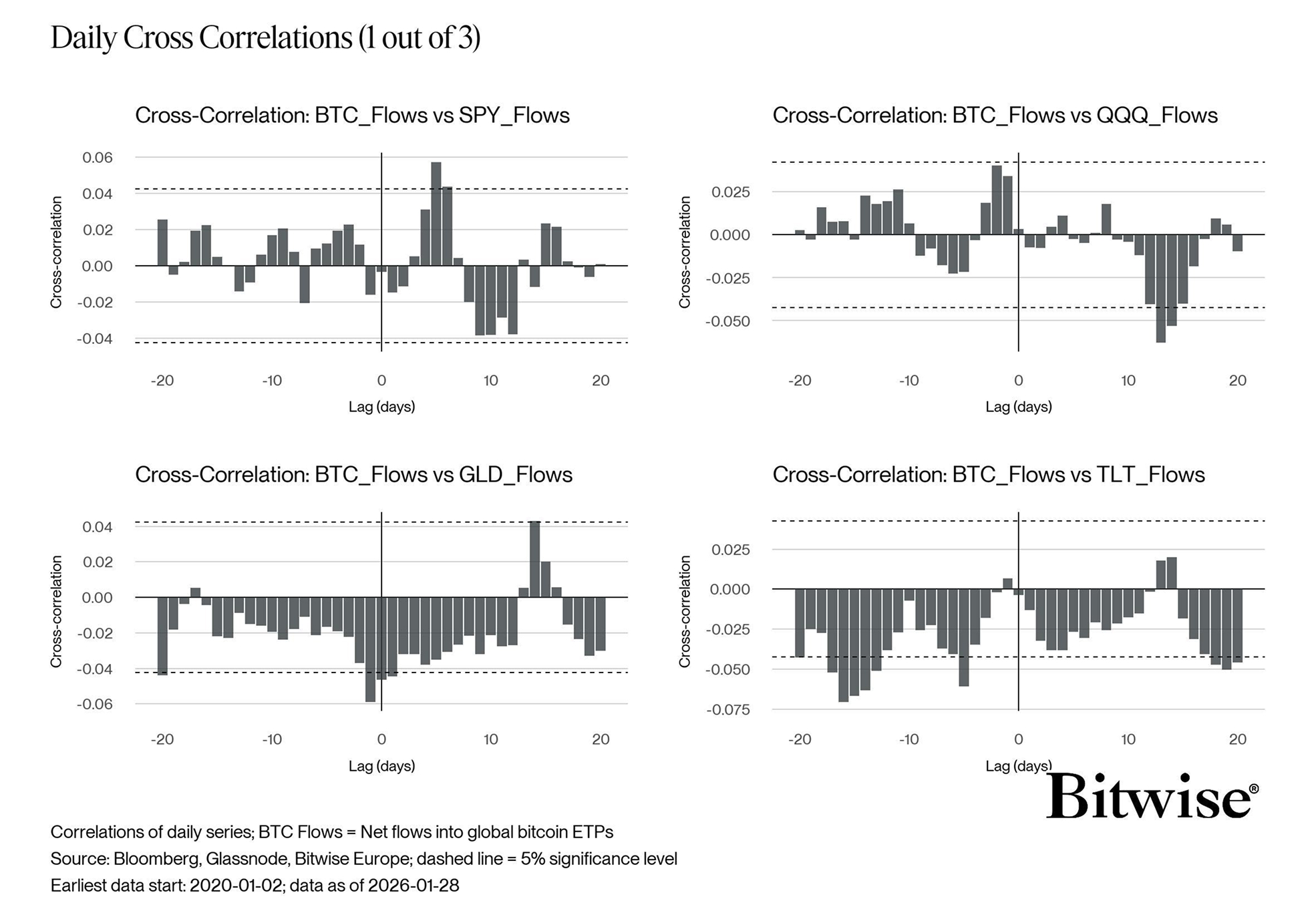
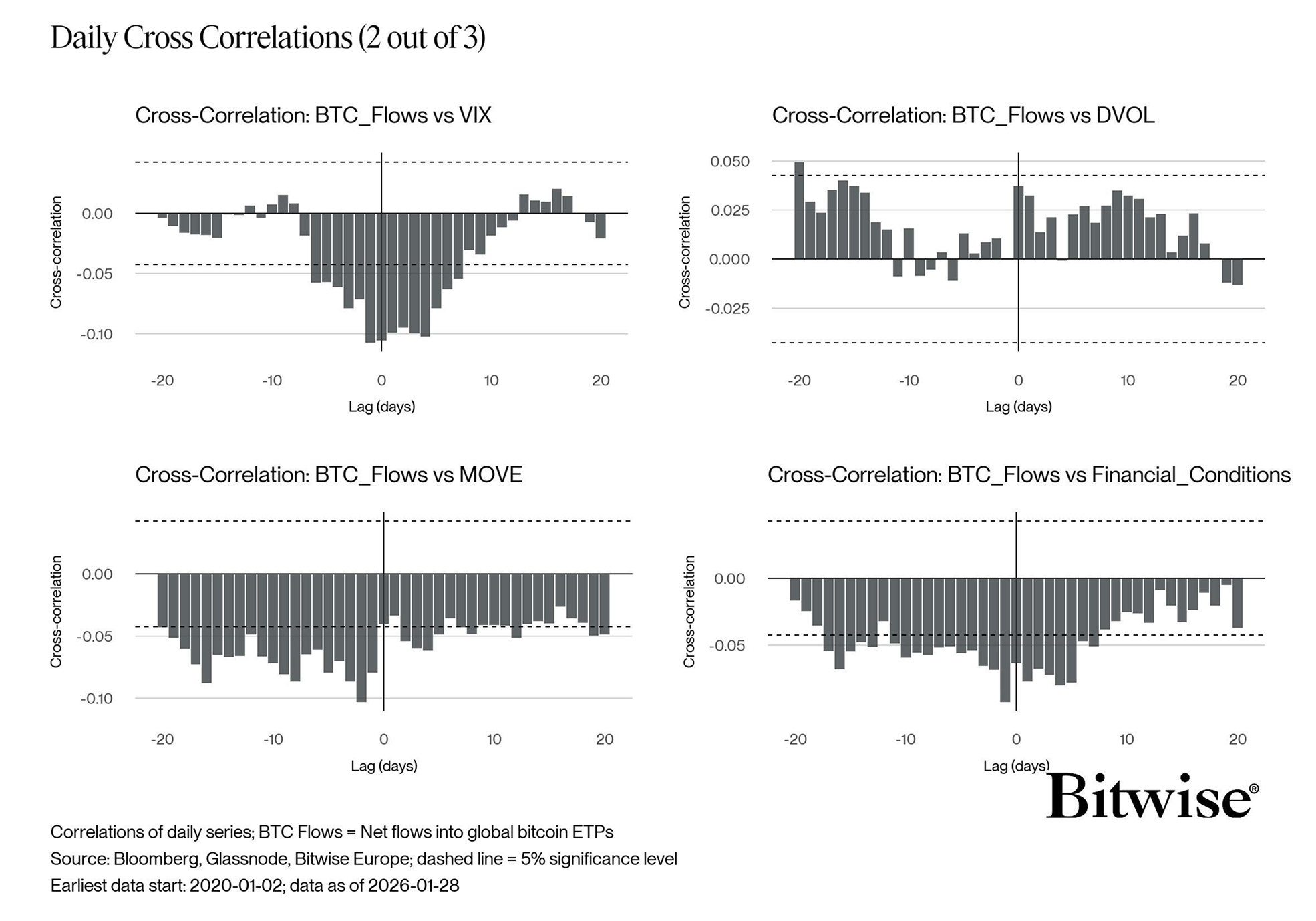
Daily cross-correlation functions reinforce this interpretation and sharpen the key driver.
Across most variables - SPY/QQQ/TLT/GLD flows, the BTC futures basis, VIX, MOVE, DVOL, and Financial Conditions - the cross-correlations with BTC flows remain small across a wide range of leads and lags.
Daily Cross Correlations (1 out of 3)
 Daily Cross Correlations (2 out of 3)
 Daily Cross Correlations (3 out of 3)
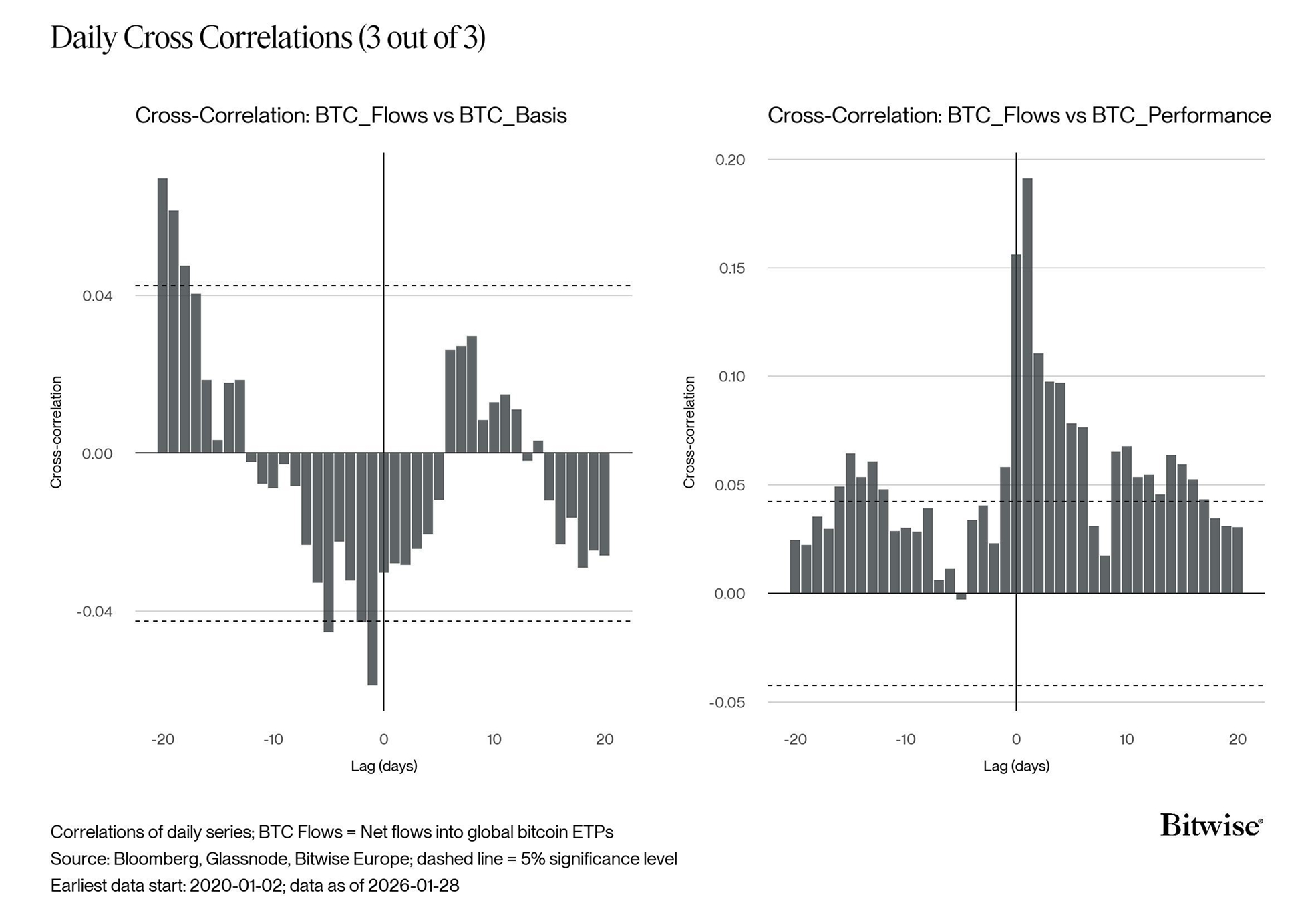
By contrast, BTC performance (Bitcoin's own daily log return) stands out clearly.
The cross-correlation between BTC flows and BTC performance shows a pronounced positive pattern around the present and the near future, with the strongest value occurring when BTC performance leads flows by one day (lag +1 of roughly 0.19) and a still sizable contemporaneous correlation at lag 0 (roughly 0.16).
This structure is consistent with a straightforward behavioural channel familiar from traditional markets: recent performance attracts attention and capital.
Put simply, when Bitcoin performs well, flows tend to follow shortly after, often within the next trading day, and the effect persists for several days.
Chicken versus egg – is there a potential causality?
Pairwise Granger causality tests provide a useful screening view of predictive relationships, but they should not be read as structural causality.
In pairwise tests, several variables show statistically significant predictive content for BTC flows at short horizons (up to 10 days).
Financial Conditions, VIX, and MOVE frequently ‘Granger-predict' BTC flows at low lags, and the BTC futures basis rate also shows significance at some lag specifications.
Most notably, BTC performance ‘Granger-predicts' BTC flows at short lags as well, consistent with the cross-correlation evidence shown above.
Importantly, the reverse direction – BTC flows Granger-predicting BTC performance - is also highly significant in our results across many lag lengths.
Granger causality test results (p-values)
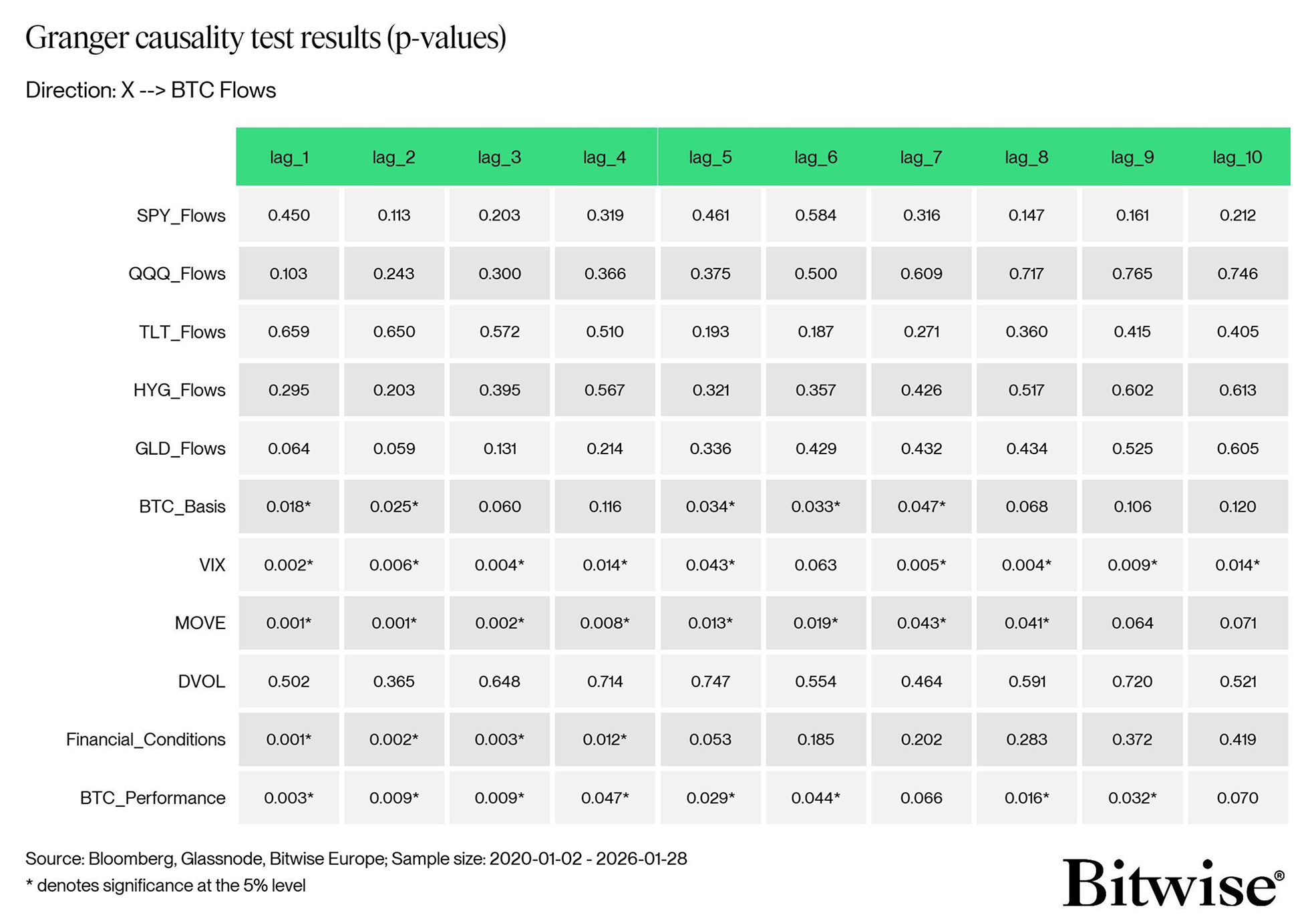 Granger causality test results (p-values)
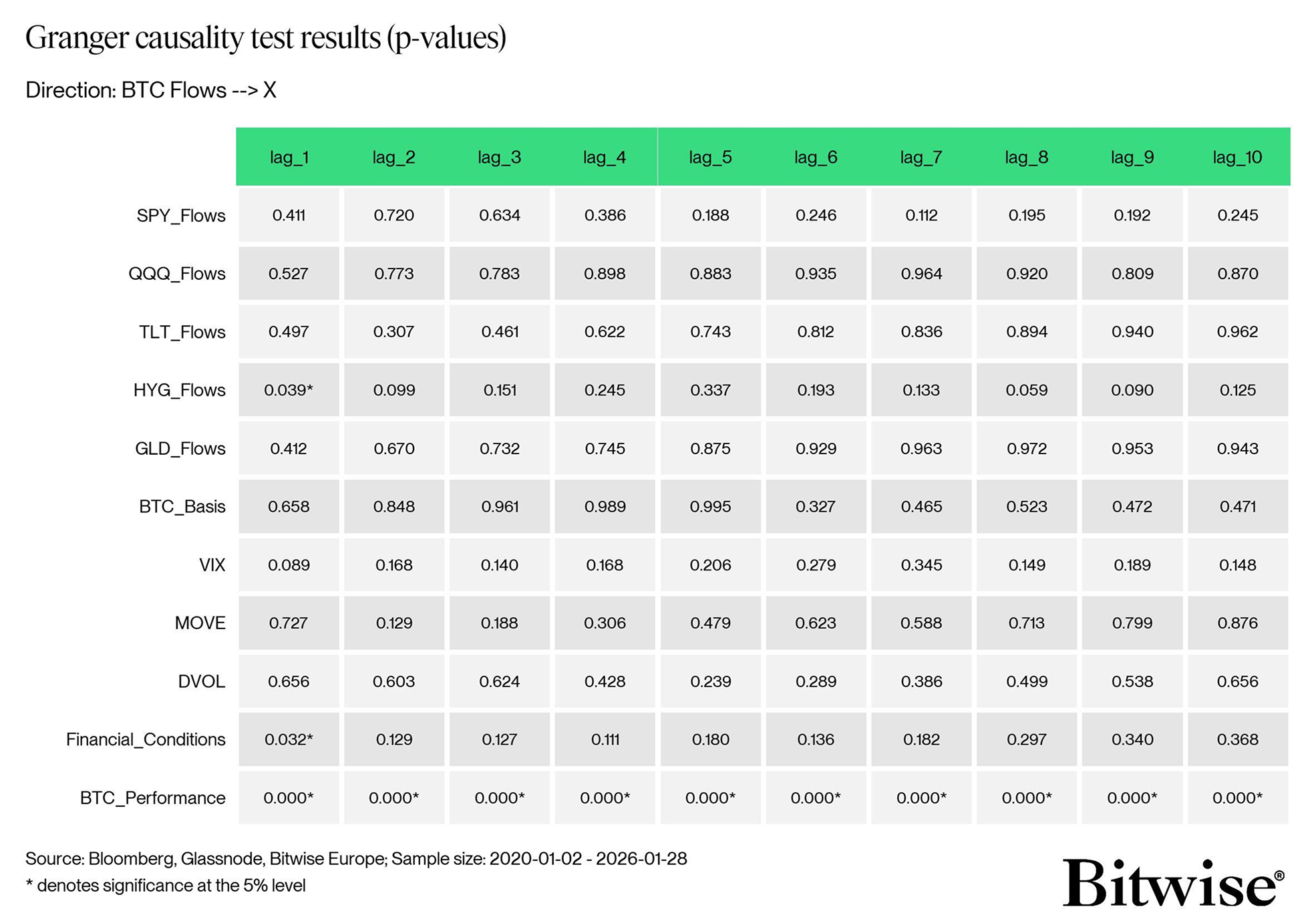
Note that there appear to be several significant causal links from other variables to BTC flows such as the BTC basis rate, the VIX, MOVE index and financial conditions as well as BTC's own past performance (Table 1), but only one significant causal relationship from BTC flows to its own performance (Table 2).
The most cautious interpretation is that returns and flows are jointly intertwined at daily frequency through feedback effects and common shocks: price moves can pull in flows, and flow dynamics can align with subsequent price dynamics in a way that is statistically predictive, without necessarily implying a clean one-way causal mechanism.
What is driving Bitcoin ETP flows after all?
The joint regression model is the most informative piece of this report because it puts these candidates into a single framework and controls for the dominant time-series property of flows: persistence.
Once you include lagged BTC flows (lagged by 1 to 3 days – L1 to L3), the model shows very strong day-to-day clustering in flows, with the first lag carrying most of the explanatory power (BTC_Flows_L1 around 0.64 and highly significant).
That persistence is consistent with practical allocation mechanics: advisors and platforms do not adjust positions continuously; orders can be split over days; authorized participants can take more than one day in certain cases to create or redeem shares; and investor demand tends to come in waves.
Against that backdrop, BTC performance remains the only variable that adds robust incremental information beyond lagged BTC flows.
Joint Model: BTC ETP Flows
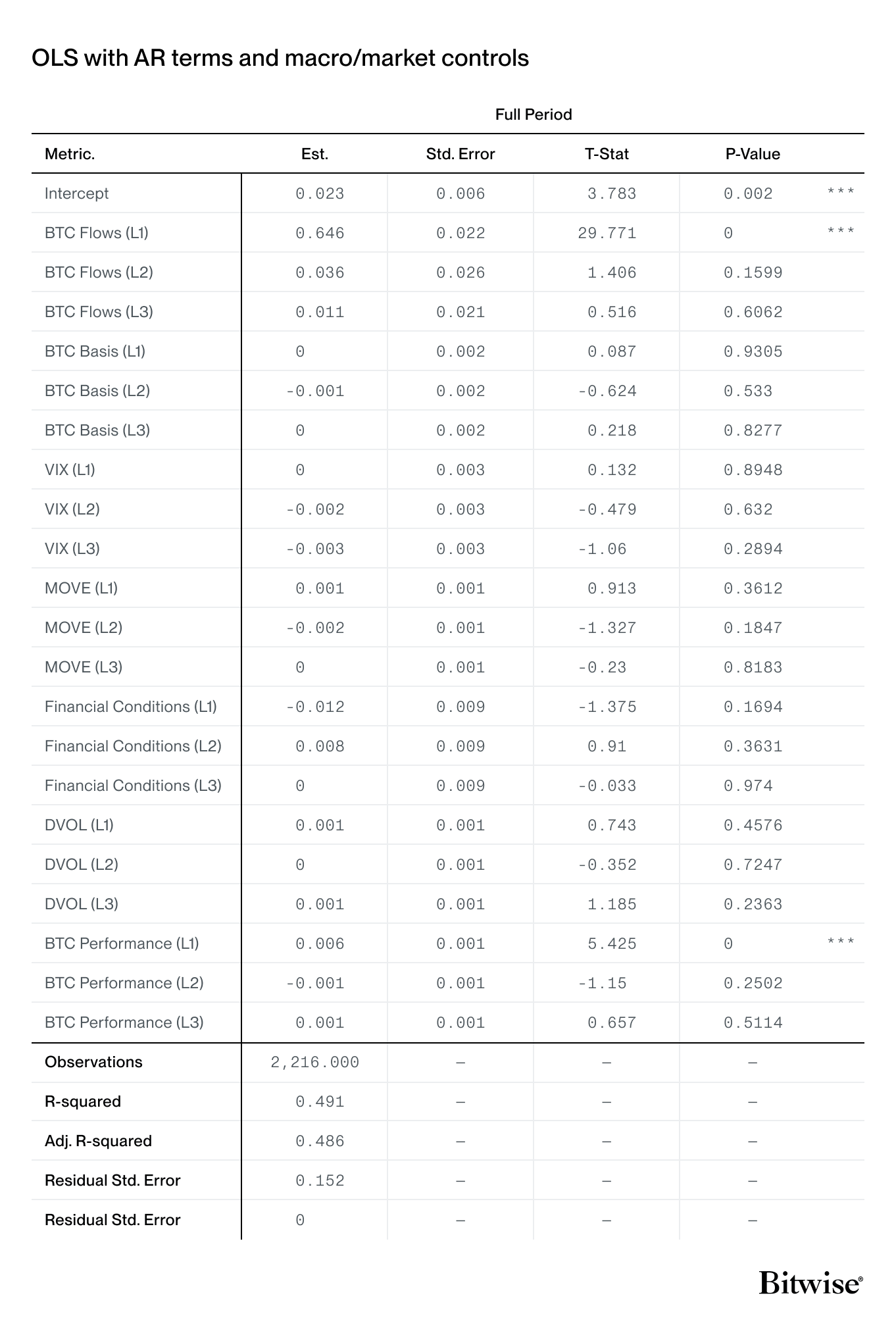
The one-day lag of BTC performance is highly significant, implying that yesterday's Bitcoin return helps explain today's flows even after controlling for flow persistence and a broad set of macro/risk indicators.
By contrast, the BTC basis rate, VIX, MOVE, DVOL, and Financial Conditions do not contribute reliably once BTC returns are included in the multivariate setting.
The block tests align with this conclusion: BTC performance is strongly significant as a block, while the other blocks are not, indicating that their apparent influence in bivariate tests likely reflects shared information that is better captured by Bitcoin's own returns and the persistence of flows.
Practical implications for professional investors
For traditional financial advisors, the practical implication is that Bitcoin ETP flows do not behave like a simple extension of equity, bond, credit, or gold ETF flow rotation.
Instead, flows are best described by a simple, intuitive framework:
'Flows follow flows, and flows follow performance.'
Macro risk measures such as VIX, MOVE, and Financial Conditions help describe the environment - flows are somewhat weaker during stress - but they do not appear to be primary independent drivers once Bitcoin's own return dynamics are taken into account.
The bottom line is that the dominant near-term determinants of global Bitcoin ETP flows are internal flow momentum and the recent performance of Bitcoin itself, which is consistent with an adoption and allocation process that is still heavily influenced by investor attention and return-chasing behaviour rather than systematic cross-asset rebalancing rules.
Overall, the data are more consistent with an allocation/adoption-driven flow process - characterised by persistent implementation and performance-sensitive demand - than with a flow rotation primarily explained by macro or risk indicators.
Macro conditions may still matter as background context, but they do not emerge as strong independent drivers once Bitcoin's own return and flow dynamics are taken into account.
Bottom Line
- Bitcoin ETPs have become a key force in Bitcoin markets. Since the launch of US spot Bitcoin ETFs in January 2024, Bitcoin ETPs have evolved from access vehicles into a dominant marginal buyer in the market. ETP flows now exert a first-order influence on Bitcoin’s short-term price dynamics, absorb a material share of new supply, rival on-chain activity in economic relevance, and increasingly shape liquidity and price discovery across the ecosystem.
- Bitcoin ETP flows are not driven by classic risk-on/risk-off allocation. Empirically, global Bitcoin ETP flows show little meaningful co-movement with equity, bond, credit, or gold ETF flows. Correlations with macro risk proxies such as the VIX, MOVE, and financial conditions are modest at best and fade once placed in a multivariate framework. This evidence rejects a simple cross-asset rotation narrative and suggests that macro conditions act as background context rather than as primary mechanical drivers of Bitcoin ETP demand.
- Flows follow flows – and flows follow performance. The dominant drivers of Bitcoin ETP flows are strong internal persistence and Bitcoin’s own recent returns. Flows cluster over time due to implementation frictions and investor behaviour, while Bitcoin performance consistently leads flows at short horizons, reflecting attention- and performance-sensitive demand. Once these effects are accounted for, macro and risk variables add little incremental explanatory power. Overall, Bitcoin ETP flows appear best described by an adoption- and allocation-driven process, characterized by flow momentum and return-chasing rather than systematic macro-driven rebalancing.
Important Information
This publication constitutes a marketing communication and is provided for informational purposes only. It does not constitute investment advice, a personal recommendation, or an offer or solicitation to buy or sell any financial instrument.
This document (which may take the form of a presentation, press release, social media post, blog article, broadcast communication or similar instrument – collectively referred to as a “Document”) is issued by Bitwise Europe GmbH (“BEU” or the “Issuer”) and has been prepared in accordance with applicable laws and regulations, including those relating to financial promotions.
Bitwise Europe GmbH, incorporated under the laws of Germany, is the issuer of the Exchange Traded Products (“ETPs”) referenced in this Document under a base prospectus and the applicable final terms, as supplemented from time to time, approved by the German Federal Financial Supervisory Authority (BaFin). The approval of the prospectus by BaFin relates solely to the completeness, coherence and comprehensibility of the prospectus in accordance with the Prospectus Regulation and does not constitute an endorsement, recommendation or assessment of the merits of the products.
The market analyses, views and scenarios presented reflect the assessment as of the date of publication and are based on information considered reliable. However, no representation or warranty is made as to their accuracy or completeness. Forward-looking statements involve risks and uncertainties and are not guarantees of future performance. Past performance is not a reliable indicator of future results.
Capital at risk. Cryptoassets are highly volatile and involve a high degree of risk. The value of investments in cryptoassets and crypto-linked ETPs may fluctuate significantly, and investors may lose part or all of their invested capital. No capital protection or guaranteed compensation mechanism applies in respect of market losses.
Any investment decision should be made solely on the basis of the relevant base prospectus, the applicable final terms and the key information document, in particular the section entitled “Risk Warning”. The base prospectus, final terms and additional risk information are available at: www.bitwiseinvestments.eu
Access to certain documents may require self-certification regarding your jurisdiction and investor status and may be subject to additional disclaimers and important information.
For further details, please refer to the full disclaimer available at: www.bitwiseinvestments.eu/disclaimer