- Bitcoin recorded its largest single-day price move on record, alongside one of the most extreme relative downside events in its trading history.
- Capitulation across the drawdown ranks as the largest in USD-terms, and remains exceptionally elevated when normalised across cycles.
- While short-term volatility and further downside cannot be ruled out, a range of technical, on-chain, and valuation indicators are currently at levels that have been among the lowest on record, a configuration that has historically occurred infrequently in past market cycles.
A Broad-Based Price Collapse
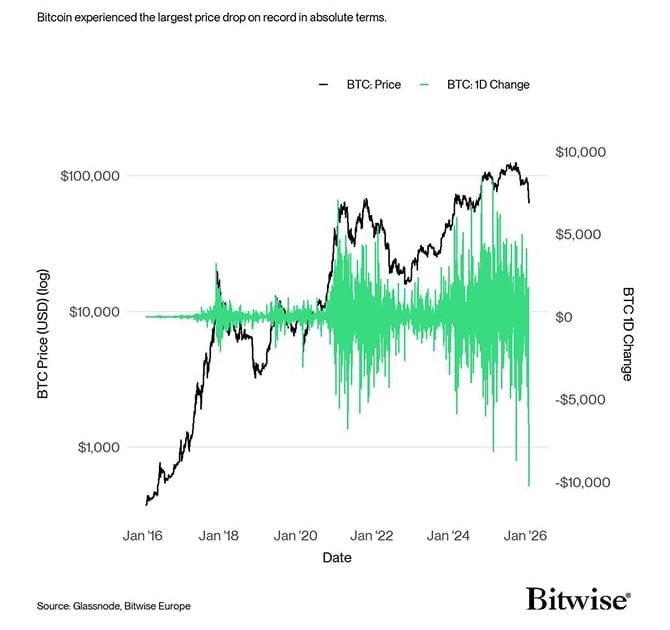
On February 5th, 2026, Bitcoin underwent one of the most severe capitulation events in its history. Price collapsed from a session high near $73k to a low of $60.2k, producing the largest single-day open-to-close decline on record at -$10.2k.
BTC: 1-Day Price Change
 Source: Glassnode, Bitwise Europe
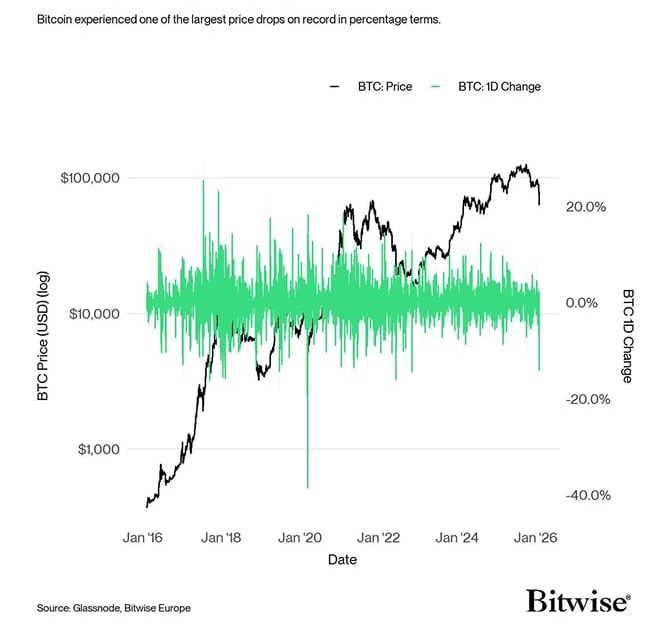
The severity of the contraction is also reflected in the percentage price change, which reached -14%. Across Bitcoin’s full trading history, only 46 out of 5,681 trading days (approximately 0.8%) have recorded a larger move. This places the recent decline among the most extreme downside events on record, both in absolute magnitude and relative rarity.
BTC: 1-Day Percentage Price Change
 Source: Glassnode, Bitwise Europe
Down in the Doldrums
With the market firmly entrenched in a bear-market regime, we next evaluate investor sentiment and positioning to contextualise current conditions relative to prior cycle lows.
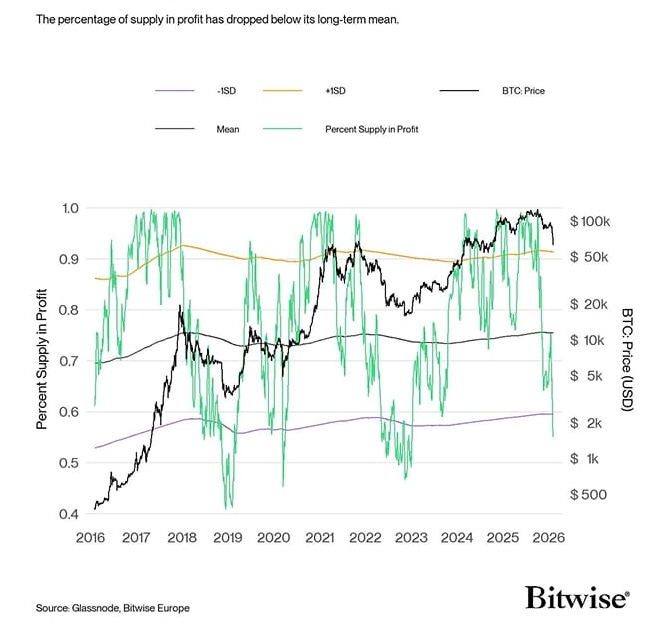
Following the recent price decline, the share of supply held in profit has compressed sharply, falling to 55%. Historically, readings below this level have only been observed during the later stages of deep bear markets.
Bitcoin: Percent Supply in Profit
 Source Glassnode, Bitwise Europe
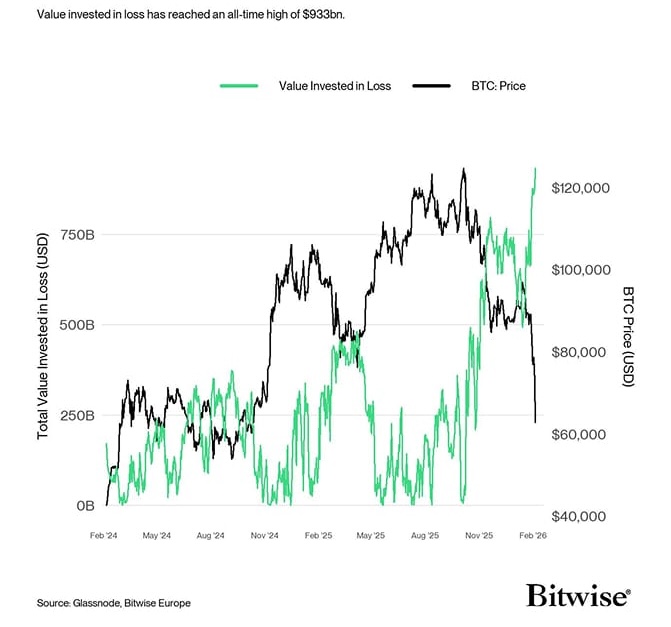
In addition, the share of invested capital currently held at a loss has reached a new all-time high of $933B, representing 84% of total capital deployed.
When viewed through both a capital-weighted and supply-weighted lens, these metrics point to a market where the majority of investors are experiencing substantial unrealised drawdowns.
Value Invested in Loss
 Source: Glassnode, Bitwise Europe
To further contextualise these loss metrics, we evaluate the aggregate unrealised losses held by coins currently trading below their cost basis. Aggregate unrealised losses across these coins have also climbed to an all-time high of $309B.
However, as Bitcoin’s market capitalization expands from cycle to cycle, the nominal value of these paper losses increases structurally. At the same time, the severity of peak-to-trough drawdowns has continued to compress as the asset matures.
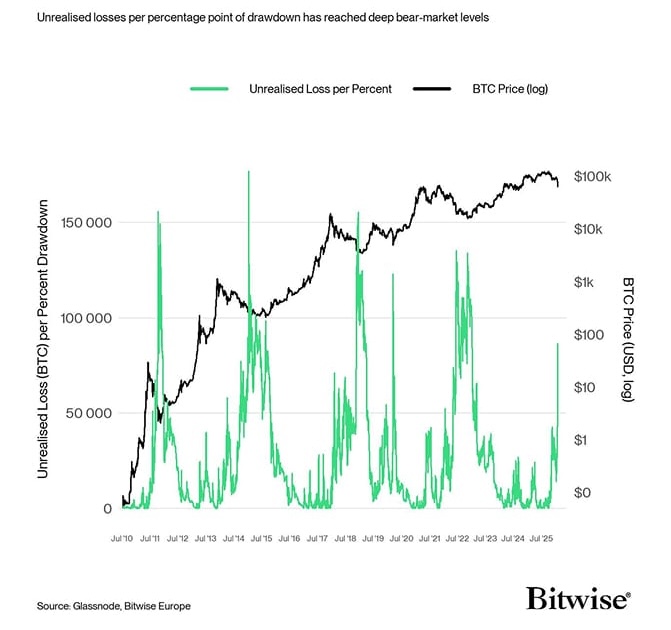
To account for both effects, unrealised losses can be normalised in BTC terms and measured relative to the percentage drawdown from the all-time high. On this adjusted basis, unrealised losses per percentage point of drawdown have climbed to their highest level since the FTX-driven sell-off.
That said, the scale of losses remains notably smaller than those observed at prior cycle lows, implying that downside risk may not yet be fully exhausted if historical patterns continue to hold.
Unrealised Loss (BTC) per Percent Drawdown
 Source: Glassnode, Bitwise Europe
Historic Capitulation
With sentiment and behaviour now aligned with historical bear-market conditions, we assess how market participants are responding to sustained downside pressure.
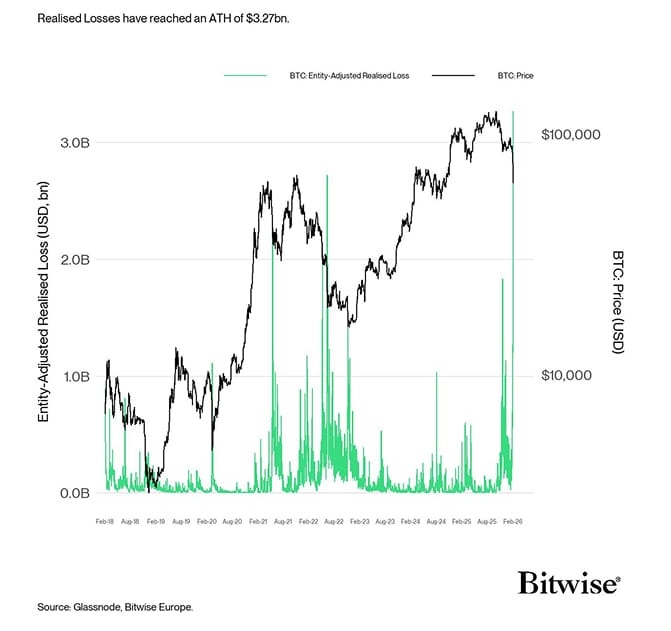
Investors have recorded the largest realised loss event on record, totalling approximately $3.3B, surpassing the $2.7B1 realised during the FTX capitulation. While extreme, this degree of loss realisation can be interpreted constructively, as it reflects the active transfer of coins from lower-conviction holders to buyers willing to absorb supply at depressed prices.
Historically, market bottoms are ultimately formed through extended redistribution process, where assets move from forced or capitulating sellers to higher-conviction participants. As a peer-to-peer market, the magnitude of realised losses also reflects the scale of demand required to absorb selling pressure, highlighting meaningful buyer participation despite the contraction.
Entity-Adjusted Realised Loss
 Source: Glassnode, Bitwise Europe
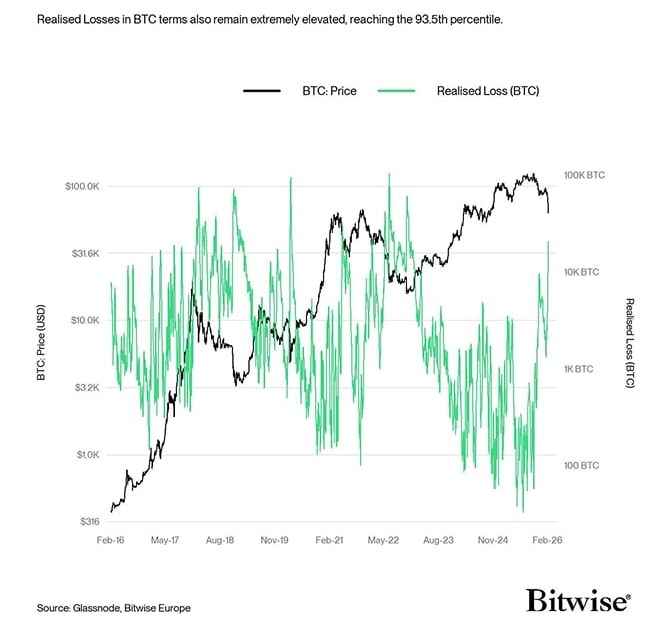
When normalised in BTC terms, realised losses have expanded to an equivalent of -52k BTC, marking the largest loss event since the FTX-driven capitulation, which peaked near -96k BTC. This places current loss realisation in the 93.5th percentile of all historical observations, underscoring the scale of this event on a cycle-normalised basis.
BTC Realised Loss (BTC)
 Source: Glassnode, Bitwise Europe
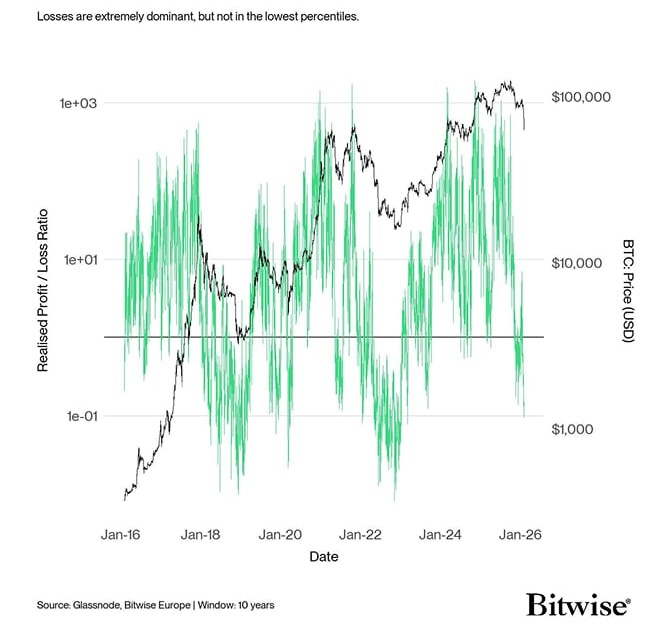
The Realised Profit/Loss Ratio has collapsed to a new cycle low of 0.1, indicating that realised losses are currently 10× larger than realised profits. While this represents a severe imbalance, it remains less extreme than readings observed at prior cycle capitulation points. Historically, loss dominance has tended to intensify further as markets approach major cycle lows.
Bitcoin Realised Profit / Loss Ratio
 Source: Glassnode, Bitwise Europe
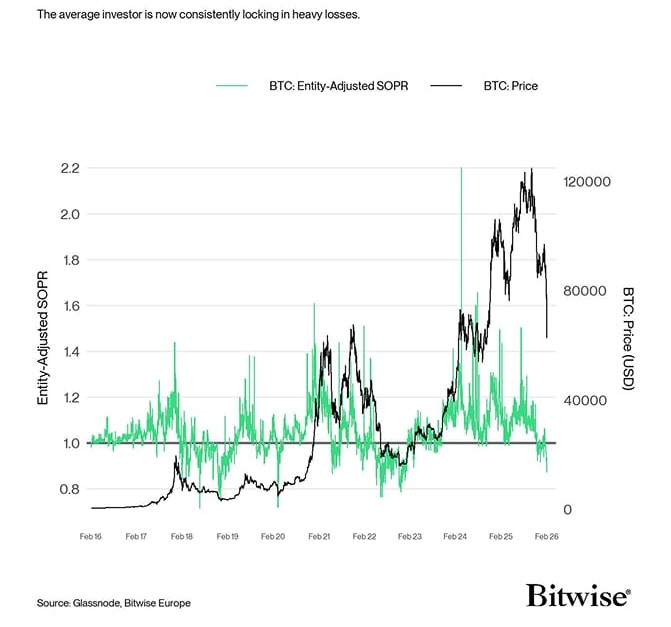
The SOPR metric enables an assessment of the average profit or loss being realised across the network, offering insight into how market participants are responding to deteriorating financial conditions.
In line with the Realised Profit/Loss Ratio, SOPR has declined to a new cycle low of 0.87, indicating that investors are, on average, realising losses of approximately 13% per transaction. While this marks one of the most severe capitulation events of the past four years, readings remain above those observed at prior cycle troughs, suggesting realised loss multiples could still expand if historical patterns persist.
Entity-Adjusted SOPR
 Source: Glassnode, Bitwise Europe
Ultimately, this drawdown has produced the largest USD-denominated capitulation on record, alongside one of the most severe BTC-normalised loss events in Bitcoin’s history.
Off-Chain Suggests Further Room to Fall
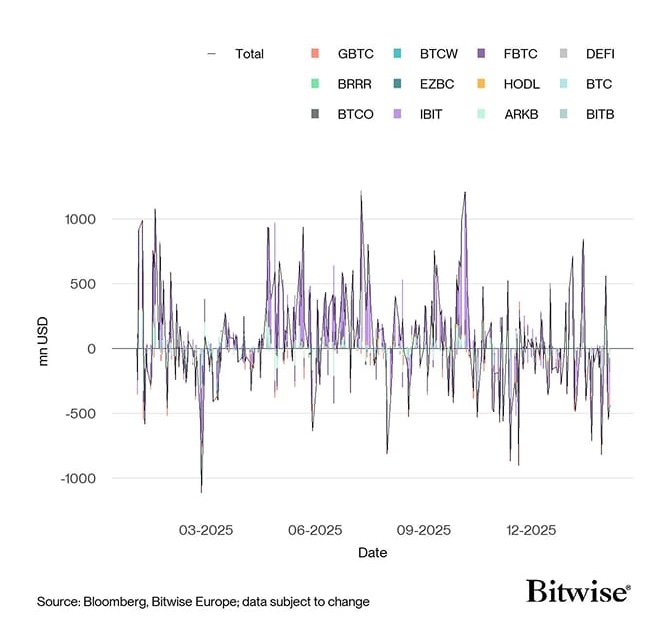
While on-chain data points to extremely depressed investor sentiment alongside the highest realised and unrealised losses on record, the ETF complex has thus far remained resilient. Recent market weakness has not yet translated into meaningful ETF outflows, suggesting institutional investors are, for now, holding their positions through the drawdown.
However, this resilience also introduces an additional downside risk. Historically, sustained ETF outflows have tended to coincide with capitulation events, implying that a decisive shift in ETF flows could still serve as a crescendo moment for broader market capitulation.
US Spot Bitcoin ETF Fund Flows
 Source: Bloomberg, Bitwise Europe; data subject to change
Within the futures market, long liquidations have accelerated sharply over the past week, totalling $6.5B, marking one of the largest liquidation events on record. This has driven a substantial reduction in open interest and a broad unwind of leveraged positioning.
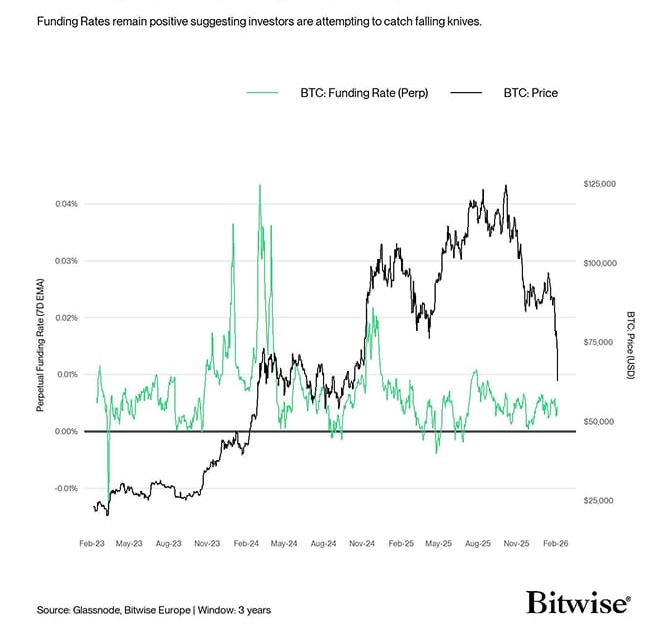
Despite this deleveraging, funding rates have remained marginally positive, indicating that directional bias continues to lean long. This suggests a cohort of traders is attempting to position into the decline, maintaining leveraged exposure despite the ongoing sell-off.
From a contrarian perspective, a shift toward negative funding would be more consistent with late-stage derivatives capitulation, where traders flip short near local low, often contributing to a final volatility expansion.
Bitcoin Perpetual Futures Funding Rate (7D EMA)
 Source: Glassnode, Bitwise Europe | Window: 3 years
Support and Valuations
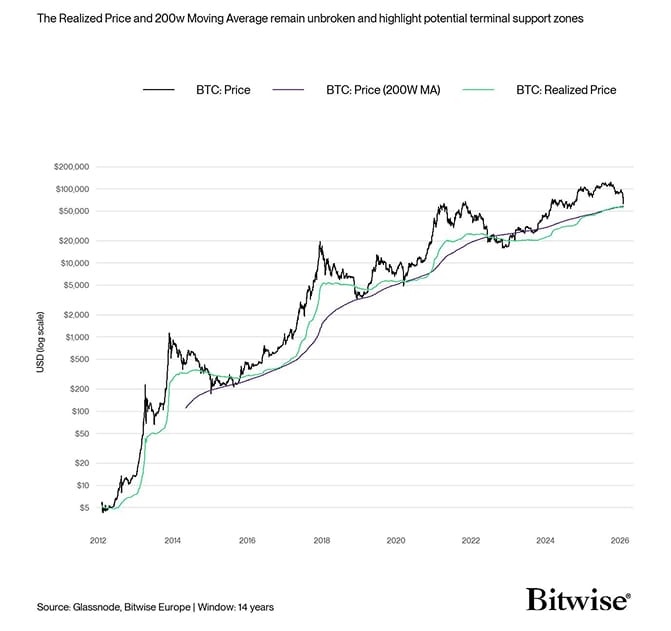
Following the contraction, we turn to a combination of key on-chain and technical benchmarks to identify potential terminal support levels. In particular, we focus on the Realised Price ($55k), which represents the aggregate cost basis of the average investor, alongside the 200-week moving average ($58k). Historically, both measures have acted as long-term support levels for Bitcoin across multiple market cycles.
While these levels are widely monitored, price may not interact with them cleanly, either front-running the zone or briefly overshooting before stabilising. Even so, they continue to define the final major support region on the downside.
Bitcoin: Realized Price and 200w Moving Average.
 Source: Glassnode, Bitwise Europe | Window: 14 years
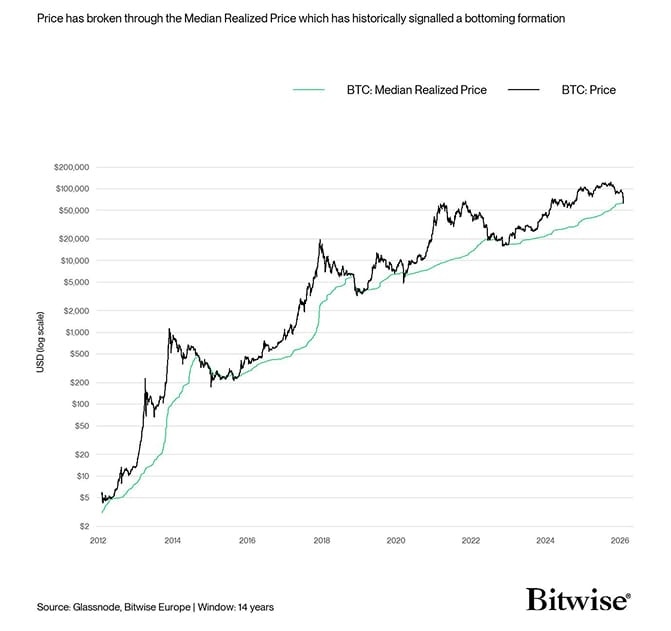
The Median Realised Price, which reflects the cost basis of the 50th percentile investor, has also historically functioned as a durable support level across cycle bottoms.
At present, the Median Realised Price sits near $62k and acted as a clear inflection point during the recent sell-off. Historically, Bitcoin has closed below this level on only 424 of 6242 trading days (6.8%), reinforcing its significance as a key structural support.
With price near enough interacting with both benchmarks, market behaviour remains broadly consistent with prior cycles, each of which has followed its own distinct path yet adhered to similar structural patterns. As such, current conditions do not represent uncharted territory.
Bitcoin: Median Realized Price
 Source: Glassnode, Bitwise Europe
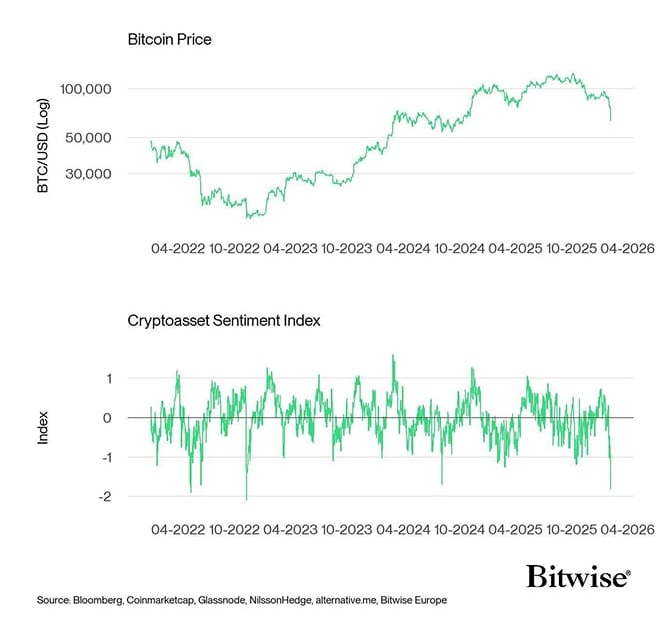
Notably, our in-house Crypto Sentiment Index has fallen to its lowest level since the FTX collapse in November 2022, underscoring the severity of the deterioration in market sentiment.
Bitcoin Price vs Cryptoasset Sentiment Index
 Source: Bloomberg, Coinmarketcap, Glassnode, NissonHedge, alternativeme, Bitwise Europe
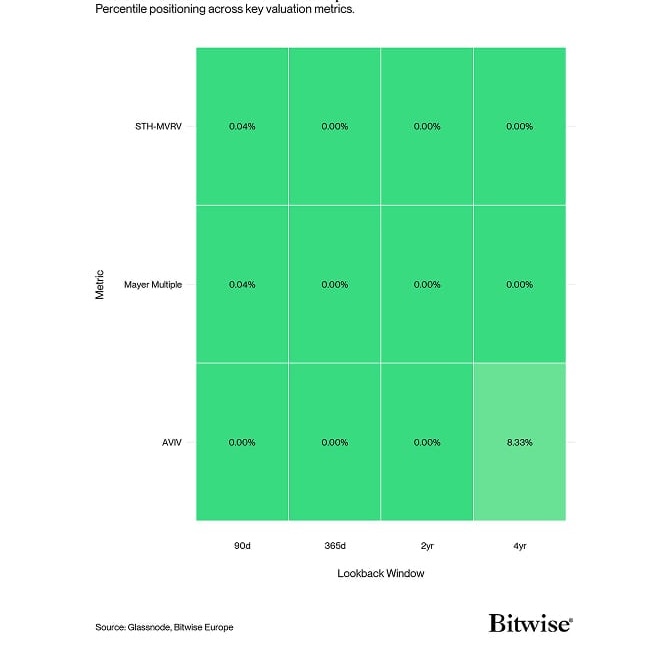
With measures of capitulation reaching historical extremes and market sentiment under notable strain, we revisit a set of key technical and on-chain valuation metrics to contextualise current conditions within their historical distributions. The following indicators form the basis of this assessment:
- Mayer Multiple – a widely referenced momentum metric that often delineates the boundary between long-term trend expansion and contraction.
- AVIV Ratio – measures the average unrealised profit or loss held by active investors, offering insight into the degree of stress or euphoria across the market.
- STH-MVRV – captures the average profit or loss held by recent buyers and has historically acted as a regime boundary between local bullish and bearish conditions.
Across all time horizons, percentile rankings have compressed toward 0%, indicating that, across multiple valuation frameworks, Bitcoin is currently trading near the lower bounds of several historical valuation and on-chain ranges. Comparable configurations have appeared only at limited points within previous cycles, often during phases of structural reset.
Bitcoin: Valuation Percentile Heatmap
 Source: Glassnode, Bitwise Europe
Bottom Line
- Bitcoin recorded its largest single-day price move on record, alongside one of the most extreme relative downside events in its trading history.
- Capitulation across the drawdown ranks as the largest in USD-terms, and remains exceptionally elevated when normalised across cycles.
- While short-term volatility and further downside cannot be ruled out, a range of technical, on-chain, and valuation indicators are currently at levels that have been among the lowest on record, a configuration that has historically occurred infrequently in past market cycles.
Important Information
This publication constitutes a marketing communication and is provided for informational purposes only. It does not constitute investment advice, a personal recommendation, or an offer or solicitation to buy or sell any financial instrument.
This document (which may take the form of a presentation, press release, social media post, blog article, broadcast communication or similar instrument – collectively referred to as a “Document”) is issued by Bitwise Europe GmbH (“BEU” or the “Issuer”) and has been prepared in accordance with applicable laws and regulations, including those relating to financial promotions.
Bitwise Europe GmbH, incorporated under the laws of Germany, is the issuer of the Exchange Traded Products (“ETPs”) referenced in this Document under a base prospectus and the applicable final terms, as supplemented from time to time, approved by the German Federal Financial Supervisory Authority (BaFin). The approval of the prospectus by BaFin relates solely to the completeness, coherence and comprehensibility of the prospectus in accordance with the Prospectus Regulation and does not constitute an endorsement, recommendation or assessment of the merits of the products.
The market analyses, views and scenarios presented reflect the assessment as of the date of publication and are based on information considered reliable. However, no representation or warranty is made as to their accuracy or completeness. Forward-looking statements involve risks and uncertainties and are not guarantees of future performance. Past performance is not a reliable indicator of future results.
Capital at risk. Cryptoassets are highly volatile and involve a high degree of risk. The value of investments in cryptoassets and crypto-linked ETPs may fluctuate significantly, and investors may lose part or all of their invested capital. No capital protection or guaranteed compensation mechanism applies in respect of market losses.
Any investment decision should be made solely on the basis of the relevant base prospectus, the applicable final terms and the key information document, in particular the section entitled “Risk Warning”. The base prospectus, final terms and additional risk information are available at: www.bitwiseinvestments.eu
Access to certain documents may require self-certification regarding your jurisdiction and investor status and may be subject to additional disclaimers and important information.
For further details, please refer to the full disclaimer available at: www.bitwiseinvestments.eu/disclaimer