This report is for professional investors and information purposes only. Persons without professional investment experience should not rely on it. Not investment advice or a personal recommendation. Cryptoassets are high risk and volatile and you may lose all capital invested. See full risk information at the end of this document.
- Ethereum’s returns have recently been largely driven by BTC, though over the past year financial conditions have emerged as a meaningful secondary influence.
- BTC captures most of the broader equity effect, making standalone equity factor less important.
- Network activity tends to be cyclical, while ETP flows act as a steady, but small marginal driver.
Ethereum is in a paradoxical position. Regulatory clarity in the U.S. has advanced through legislation such as FIT21 and the Genius Act, and potentially through the Clarity Act by year-end. Institutional access has deepened through spot and futures CME markets. Ethereum hosts over 50% (~$150bn) of the $300bn stablecoin market, and about 60% (~$15bn) of the $25bn tokenised assets market.
To facilitate this financial activity, Ethereum remains the most economically secure and globally distributed Proof of Stake blockchain enabling permissionless and censorship-resistant finance. Scalability has improved materially via the Layer 2 (L2) route, and the Ethereum Foundation has reoriented around a clearer roadmap targeting two upgrades per year to enhance L1 scalability and user experience, while preserving resilience.
Despite this progress, ETH remains roughly 62% below its all-time high.
Given the disconnect between fundamentals and price, it's natural wonder, what's driving the price?
This article provides analytical context for understanding ETH's historical market returns and the factors that have driven them.
What are the most important factors driving ETH returns?
To answer this, we built an Ethereum factor model with 406 weekly observations, starting from May 2018, designed to identify which forces have mattered most for ETH returns, and how their importance has shifted across different market regimes.
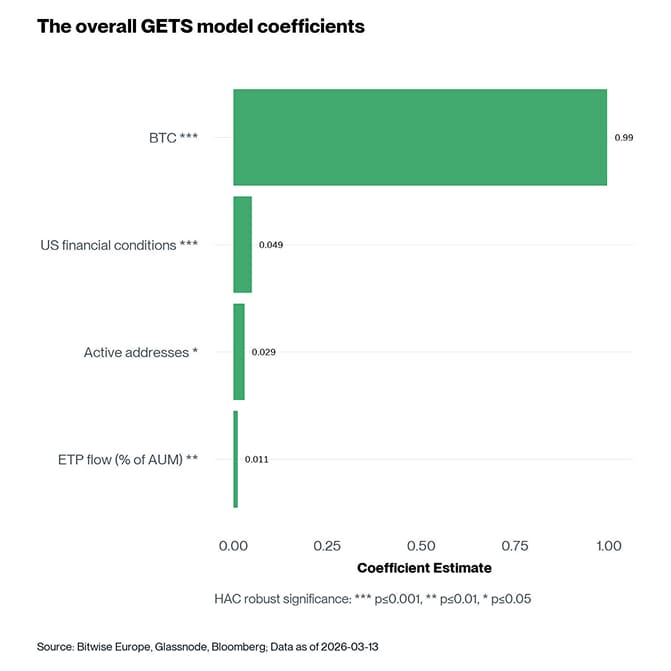
BTC is the dominant driver. ETH moves nearly 1:1 with BTC on a weekly basis (coefficient ≈ 0.99), representing the core market beta. BTC alone explains roughly 65% of the ETH's return variance, meaning broad market direction has driven most of ETH's weekly returns.
The macro environment (denoted by the Bloomberg US Financial Conditions Index, otherwise known as FCI) is the second most impactful and explanatory variable for ETH. A coefficient of ≈ 0.05 and a mean R^2 of 11.3% that increases to ~40% at its peak, suggests FCI is time-varying and dynamic.
Network activity (active addresses) has a more modest effect and explanatory power on ETH. Approximately a coefficient of ≈ 0.03, with an average 6% explanatory power that increases to 30% at its peak.
ETP flows as a % of AUM (≈ 0.01) are highly significant, explaining on average 10% of ETHs variance; that increases to 40% at its peak as well. This points to a consistent price effect rather than an impactful driver of returns.
Other factors were excluded as redundant with BTC or too noisy at weekly frequency.
The overall GETS model coefficients
 Source: Bitwise Europe, Glassnode, Bloomberg; Data as of 2026-02-20
What do these insights mean for valuation?
Given the results above, adoption fundamentals, such as active addresses, clearly have less impact on Ethereum's price than many assume. Extending this further, revenue generation appears even less relevant, as it was removed from the GETS model (please refer to the methodology section of the appendix) as “noise rather than signal.” Combining both of these conclusions supports the idea that since the start of the model in 2018, Ethereum has been priced more like a network-driven commodity than a business with durable cash flows. Or at least, that this is how the market currently treats it.
This interpretation also aligns with our long-term cycle indicator, which measures the logged relative value of active addresses and transfer volume to price. It currently sits at the 6th percentile, while the price-to-sales ratio stands at the 99th percentile. (If revenues truly mattered, elevated multiples relative to L1 and equity peers would likely compress. That is not what we observe.)
Whether this dynamic persists depends on how investors frame Ethereum. If it remains a high-beta BTC proxy, active addresses and revenues will stay secondary. If it is treated as an equity alternative, perhaps once tokenholder rights are legally enforceable, revenue metrics would need to anchor valuation, potentially implying lower multiples in line with L1 and equity peers. On balance, current market behaviour appears more consistent with the high-beta BTC proxy framing, though this may shift materially if tokenholder rights become legally enforceable.
Furthermore, the equity factor showed a small negative coefficient and a statistically insignificant p-value at the 5% threshold, which removed it from the final GETS model. This was likely subsumed by the BTC factor, suggesting its incremental explanatory power for ETH returns, at least under this specification, is limited.
In which regimes do different factors matter?
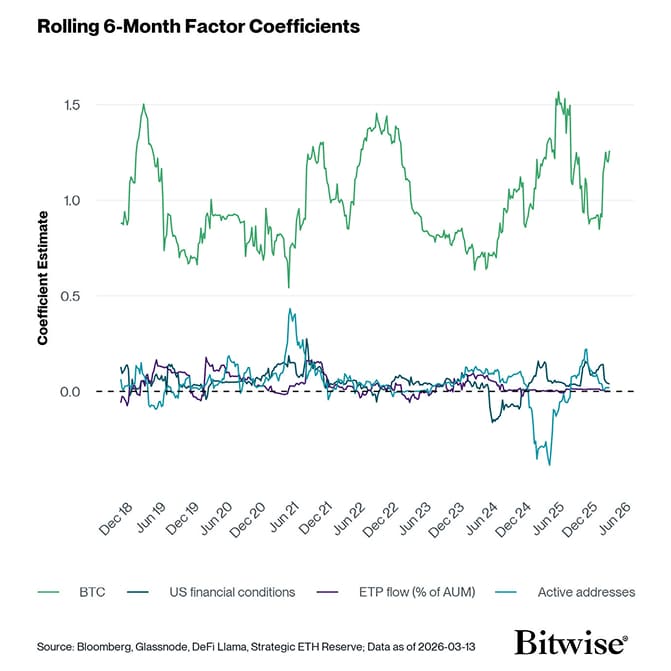
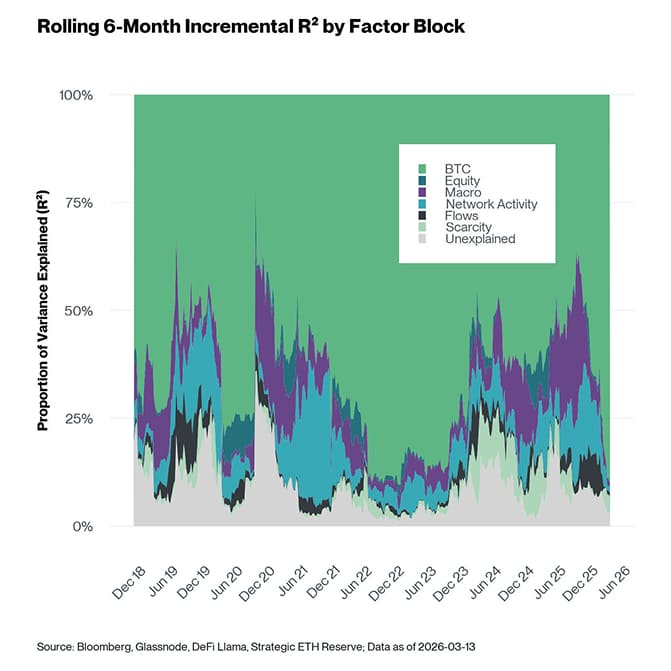
BTC tends to be the most dominant driver in peaks and troughs when ETH acts as a either levered BTC trade or an asset sucked dry of idiosyncratic catalysts. Between June-August 2025, the coefficient rose to between 1.5-1.6, as Ethereum was emerging deep from the lows not seen since 2023 lifted by BTC trundling toward All-Time-Highs (ATHs). During this period, ETH has behaved as a levered BTC trade, although only averaging around 50% of all explanatory power (see chart 1 in the appendix). The remaining substantial positive beta came from the macro channel as financial conditions loosened.
A similar but slightly less extreme BTC-dominant phase occurred in H2 2022, particularly around the post-FTX stress period. Every factor except BTC carried a negative coefficient as returns were explained up to 90% by BTC. In moments like these, cash liquidity is what matters. Not fundamentals, flows or macro. As such, ETH was essentially anchored to BTC.
Conversely, the lowest BTC sensitivity appears in May 2021, when BTC had already peaked while ETH continued rallying as active addresses surged to ATHs led by NFT mania extending the hype cycle from DeFi Summer.
Finally, the most interesting part of the current regime is ETP flows. Flows are significant in 91% of weeks, which is the most statistically reliable flow-price relationship in ETH's history. But the magnitude of impact per unit has never been lower. Flows have become a persistent, dependable signal rather than a powerful one.
Rolling 6-Month Factor Coefficients
 Source: Bloomberg, Glassnode, DeFi Llama, Strategic ETH Reserve; Data as of 2026-02-20
Model Results
The diagnostic results suggest the model is generally well-behaved and usable. There is no evidence of serious overlap between the retained factors, which means each variable is contributing distinct information rather than duplicating another. The residuals also do not show meaningful patterns over time, suggesting the model is not systematically missing a predictable dynamic. There are no red flags suggesting misspecification, just the usual features of financial time series.
Overall, BTC is clearly the main driver. Its coefficient is about on average 0.99 and relatively reliable, but dynamic. ETP flows as a percentage of AUM is also a highly significant driver of returns, albeit marginally impactful. Financial conditions and network activity are still statistically significant but contribute more modestly, whereas the equity markets are arguably disregardable because most of the dynamics are captured by BTC, however are included in the GETS model because it still technically provides more signal than noise according to our variable reduction technique.
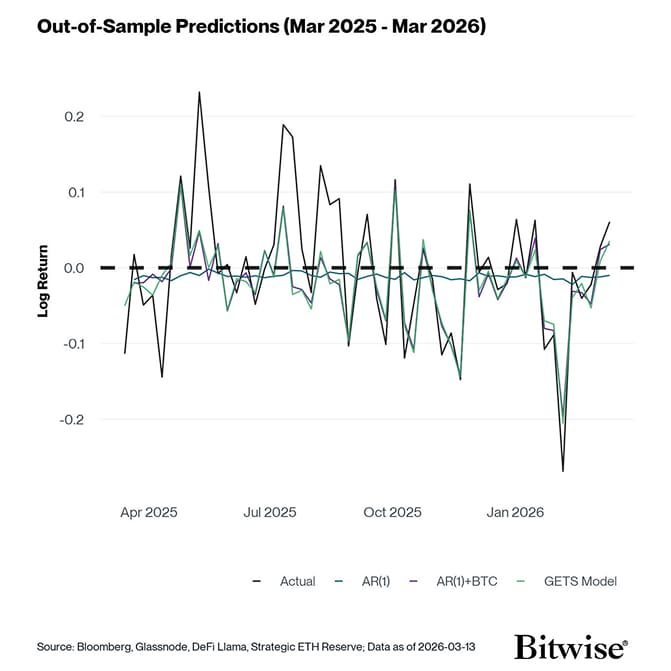
When we look at forecasting performance, the factor model clearly improves on a simple benchmark. However, most of that improvement comes from including BTC itself. Once BTC is in the model, the additional factors add only limited incremental forecasting value. Equity, in particular, shows only weak evidence of improving predictions.
Drawbacks of the Model
When benchmarking the GETS model against other similar models, the Out Of Sample (OOS) performance shows it does not beat the simpler AR(1)+BTC specified model. The four additional factors (equity, FCI, active addresses, ETP flows) that were statistically significant in-sample did not translate into better prediction accuracy during the test year (see Chart 2 in the appendix). This suggests that while the additional factors help explain past ETH returns, short-term forecasting is largely driven by BTC exposure and price persistence, with the AR component effectively capturing crypto's strong momentum dynamics.
Bottom Line
- Ethereum is largely driven by BTC, though over the past year financial conditions have emerged as a meaningful secondary influence.
- BTC captures most of the broader equity effect, making standalone equity exposure less important.
- Network activity tends to be cyclical, while ETP flows act as a steady, but small marginal driver.
Methodology
The model seeks to explain weekly ETH returns using a multi-factor regression framework.
- The approach begins with a set of potentially explanatory variables in a General Unrestricted Model (GUM), across 5 blocks:
- Bitcoin,
- Macro (DXY log return, Citi Economic Surprise Index change, Bloomberg US Financial Conditions Index change, Global Money Supply change, VIX change, MOVE Index change),
- Network activity (Active addresses log change, Transaction count log change, TVL (in ETH) log change, Stablecoin supply log change),
- Flows (ETP flow as % of market cap, ETP flow % change),
- Scarcity (Burn as % of supply, Burn % change, Net issuance (weekly level), Net issuance change).
- Systematically, variables are eliminated if they do not contribute meaningfully to the end model, using the general-to-specific (GETS) reduction method. This ensures the end model retains only the factors with genuine explanatory power.
- The GETS model is then subject to diagnostic testing, specifically multicollinearity, autocorrelation, heteroskedacity and normality.
- The GETS dataset is subsequently split into a one-year training window and a subsequent one-year test window, 52 weeks each, for OOS testing where prediction accuracy is measured by RMSE (root mean squared error, penalising large misses more heavily) and MAE (mean absolute error, treating all misses equally).
- The GETS model's OOS performance is compared against three increasingly rich autoregressive benchmarks that include lagged returns, BTC, and Equity factors to improve forecasting power beyond what simpler specifications already capture.
- Rolling window analysis is finally conducted via 26-week rolling coefficients that tries to reveal whether a factor's influence is persistent or episodic, and 26-week rolling incremental R^2 that tries to show how the relative importance of different driver categories evolve throughout time.
Important Information
This material is intended solely for professional investors and is not suitable for retail distribution and reliance. The information provided in this material is for illustrative, educational or information purposes only and does not constitute investment advice, a recommendation or solicitation of an offer to buy any product or to make any investment.
This material is issued by Bitwise Europe GmbH and has been prepared in accordance with applicable laws and regulations (including those relating to financial promotions).
Capital at risk. Cryptoassets are high-risk and volatile. The value of investments in cryptoassets and crypto-linked ETPs may fall as well as rise, and investors may lose some or all of their invested capital. No investor protection or compensation scheme applies. Past performance is not a reliable indicator of future results.
Important Analytical Limitations: The observations and analyses presented in this document are based on historical market patterns and data correlations which may not repeat or continue in future market conditions. Past correlations between capital flows and performance metrics are not indicative of future performance and should not be extrapolated as predictive indicators. Material downside risks remain present across all investment timeframes regardless of current undervaluation metrics or favourable technical indicators. All model outputs, fair value calculations, and quantitative assessments are subject to significant uncertainty and methodological limitations and should not be relied upon as the sole basis for making investment decisions. Investors should conduct independent due diligence and consider multiple factors beyond the scope of this analysis.
Read the full disclaimer here: https://bitwiseinvestments.eu/disclaimer/
Appendix
Chart 1
Rolling 6-Month Incremental R2 by Factor Block
 Source: Bloomberg, Glassnode, DeFi Llama, Strategic ETH Reserve; Data as of 2026-02-20
Chart 2
Out-of-Sample Predictions (Feb 2025 - Feb 2026)
 Source: Bloomberg, Glassnode, DeFi Llama, Strategic ETH Reserve; Data as of 2026-02-20