- A shift in Ethereum’s core development culture is evident. It is the first time in history, two scaling-focused upgrades have been released in one year.
- Fusaka is the most important value capture improvement since The Burn Upgrade (EIP-1559)
- Ethereum’s upgrades have been shown to have little impact on price, historically. But continually reinforce its position as the leading platform for on-chain institutional finance.
Ethereum has spent the past couple of years under growing criticism from investors and the retail community for its slower development pace. As upgrades fell to roughly one per year and internal disagreements became louder, claims emerged that the project had lost its identity. Tensions intensified when Justin Drake, one of Ethereum's most influential developers, challenged the long-term roadmap with his Beam Chain proposal, which drew backlash for pushing full scaling into the 2030s. This period marked a clear low point in Ethereum's recent history and signalled a cultural shift within the ecosystem.
A restructuring followed, centred on scaling and user experience. The goal was to defend Ethereum against faster and cheaper competitors while reinforcing its role in institutional on-chain finance.
Momentum has since begun to return. The community had long admired Solana for its rapid upgrade cadence and strong developer alignment, and similar signs of renewed coordination are now visible in Ethereum. The network has not delivered two upgrades in a single year since 2022. In 2025, both scheduled upgrades focus exclusively on scaling, marking a first in Ethereum's history.
With DAT purchases slowing and ETF investor conviction weakening, this Espresso turns to the nearest potential catalyst, the Fusaka upgrade, and assesses the influence it may have on price.
Upgrades do not significantly impact price
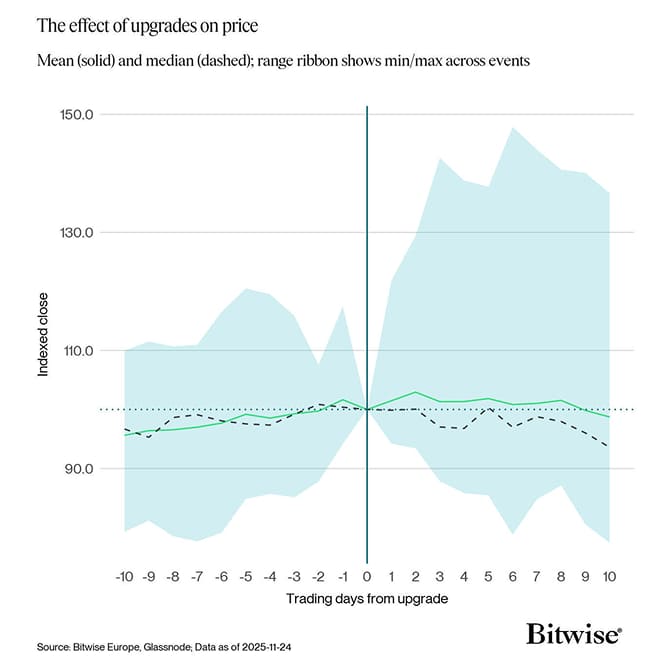
Overall, price does not seem to react strongly to upgrades. There is a mild sell the news tendency, with the median line rising into the upgrade, suggesting strength beforehand, and falling in the days that follow, indicating some post-event weakness. The effect is present but statistically small and inconsistent across upgrades.
It is also evident that across the 20 upgrades analysed, the distribution of outcomes widens after the event. This likely reflects investors pricing in the success of each upgrade. Was liveness or finality affected? Were any blocks missed? How did validator participation change?
However, Ethereum's Fusaka upgrade is bullish longer-term for three reasons.
- Increase Layer 1 capacity: The gas limit increased to 60 million per block, which raises throughput and reduces fees by allowing more computation per block. This is a 2x increase in a single year.
- Scale validator efficiency inline with Layer2 throughput: PeerDAS cuts validator storage needs to one eighth of previous levels and allows validators to sample only half of all blobs while preserving correctness. This keeps performance efficient as throughput grows and enables lightweight, blob-parameter-only upgrades on Layer 2s for faster scaling.
- Stronger value capture: A new base fee is applied to each blob so that rollups pay more accurately for the bandwidth and storage they consume.
Ethereum's Most Important Value Capture Improvement Since EIP-1559
The most important element of Fusaka is its impact on Ethereum's value capture. The upgrade introduces a minimum base fee for blobs through EIP-7918, which materially strengthens the link between Layer 2 activity and ETH demand and burn. In practice, it ensures that Ethereum earns more from the growth of stablecoins, DeFi and tokenisation on Layer 2s.
Today, blob fees can fall to almost zero when Layer 2 usage is quiet. This suppresses ETH burns and weakens the connection between real economic activity and value accrual. Fusaka corrects this by setting a reserve price for blob base fees that is anchored to the execution base fee. This produces a more durable and predictable revenue stream because blob fees can no longer collapse to negligible levels during periods of low demand.
The mechanism is straightforward. After Fusaka, the minimum blob base fee becomes the execution base fee divided by sixteen. When the normal gas price is 1 gwei, the blob fee floor becomes 0.0625 gwei. This is dramatically higher than the current minimum of 0.000000001 gwei. Under the present regime, the network would require roughly thirty two minutes of fully saturated blobs to reach 0.0625 gwei. Under Fusaka, that price floor is immediate. It accelerates price discovery, ensures that rollups cannot consume blobspace for free when execution is expensive, and requires them to pass more of Ethereum's data costs through to end users.
This matters for two reasons. First, it creates consistent and meaningful ETH burns from Layer 2 data posting, even during quieter periods. Second, it aligns the economics of rollups with the burden they place on Ethereum's bandwidth and storage. When combined with rising demand for stablecoin transfers and tokenised assets, it creates a structural foundation for stronger ETH value accrual. In effect, Ethereum is providing rollups with a very large increase in blob supply via the blob-parameter-only increase to keep user fees low, and in return it sets a sensible minimum price that ensures the network captures a fair share of the economic value that rollups generate.
The impact can be significant. Had this mechanism existed since the Dencun upgrade, Ethereum would have accrued roughly seventy eight million dollars in additional revenue. Based on Ethereum's average market capitalization to fees ratio over the same time period, this could have added more than fifty billion dollars to its valuation. In that sense, the introduction of a blob fee floor through EIP-7918 is arguably the most important value capture change since EIP-1559.
Bottom Line
- A shift in Ethereum’s core development culture is evident. It is the first time in history, two scaling-focused upgrades have been released in one year.
- Fusaka is the most important value capture improvement since The Burn Upgrade (EIP-1559)
- Ethereum’s upgrades have been shown to have little impact on price on average. But continually reinforce its position as the leading platform for on-chain institutional finance.
Important Information
This publication constitutes a marketing communication and is provided for informational purposes only. It does not constitute investment advice, a personal recommendation, or an offer or solicitation to buy or sell any financial instrument.
This document (which may take the form of a presentation, press release, social media post, blog article, broadcast communication or similar instrument – collectively referred to as a “Document”) is issued by Bitwise Europe GmbH (“BEU” or the “Issuer”) and has been prepared in accordance with applicable laws and regulations, including those relating to financial promotions.
Bitwise Europe GmbH, incorporated under the laws of Germany, is the issuer of the Exchange Traded Products (“ETPs”) referenced in this Document under a base prospectus and the applicable final terms, as supplemented from time to time, approved by the German Federal Financial Supervisory Authority (BaFin). The approval of the prospectus by BaFin relates solely to the completeness, coherence and comprehensibility of the prospectus in accordance with the Prospectus Regulation and does not constitute an endorsement, recommendation or assessment of the merits of the products.
The market analyses, views and scenarios presented reflect the assessment as of the date of publication and are based on information considered reliable. However, no representation or warranty is made as to their accuracy or completeness. Forward-looking statements involve risks and uncertainties and are not guarantees of future performance. Past performance is not a reliable indicator of future results.
Capital at risk. Cryptoassets are highly volatile and involve a high degree of risk. The value of investments in cryptoassets and crypto-linked ETPs may fluctuate significantly, and investors may lose part or all of their invested capital. No capital protection or guaranteed compensation mechanism applies in respect of market losses.
Any investment decision should be made solely on the basis of the relevant base prospectus, the applicable final terms and the key information document, in particular the section entitled “Risk Warning”. The base prospectus, final terms and additional risk information are available at: www.bitwiseinvestments.eu
Access to certain documents may require self-certification regarding your jurisdiction and investor status and may be subject to additional disclaimers and important information.
For further details, please refer to the full disclaimer available at: www.bitwiseinvestments.eu/disclaimer