- Performance: December’s Bitcoin weakness reflects a late-stage shakeout rather than deteriorating fundamentals, occurring amid improving global liquidity, robust macro conditions, and clear cross-asset divergence. Valuation, positioning, and on-chain dynamics point to a historically rare mispricing, with downside increasingly constrained and risk-reward skewed decisively to the upside. As liquidity, institutional flows, and positioning realign, Bitcoin appears well positioned for renewed upside rather than trend exhaustion.
- Macro: We expect global growth to remain robust in 2026, supported by further rate cuts, improving forward-looking indicators, and a re-acceleration in the US business cycle without a recession. This macro backdrop, combined with rising global liquidity, a structurally weaker US dollar, and accelerating institutional demand, implies that bitcoin remains materially underpriced and well positioned for a renewed risk-on phase and higher prices in 2026.
- On-Chain: Bottoming formations are a process, not an event, marked by a meaningful shift in investor sentiment toward loss-taking as assets transfer from weaker to higher-conviction holders. While this creates near-term headwinds, it is a necessary condition for a sustainable bottom, and our duration-based metrics suggest the process may take an additional 2–4 months, probabilistically. Notably, the market is entering this phase from a structurally stronger position than prior cycles, with robust recent accumulation indicating perceived value at current levels and key price levels remaining critical to assess progress toward recovery.
Chart of the Month
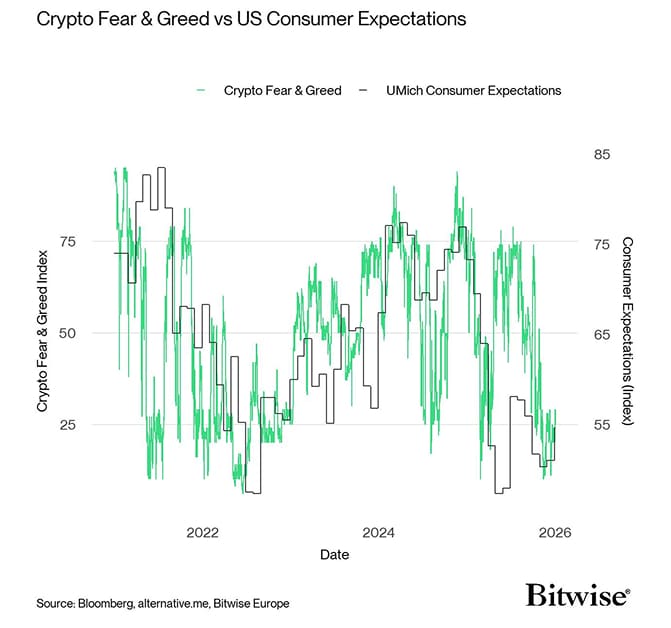
Increasing US consumer confidence could lift crypto sentiment as well
Performance
December was characterized by a growing disconnect between macro liquidity conditions, cross-asset performance, and Bitcoin price action, creating a compelling asymmetry.
While equities pushed to new all-time highs and gold resumed its structural uptrend, Bitcoin traded roughly 35% below prior peaks, resulting in a historically rare mispricing as outlined in our previous Bitcoin Macro Investor report as well. Similar reminder signals have previously marked major inflection points rather than trend exhaustion.
At the macro level, easing US inflation dynamics and a de facto resumption of balance sheet expansion through the Fed's “stealth QE” improved global liquidity conditions. This backdrop typically supports a rotation into higher-beta assets, with bitcoin historically lagging early before catching up decisively.
The renewed strength in gold and other precious metals further reinforced this signal, as precious metals have often led bitcoin at turning points, with subsequent capital rotation favoring more risky assets like bitcoin once liquidity conditions improve.
Our key macro thesis remains that global growth will most-likely stay surprisingly robust in 2026 due to the preceding amount of monetary stimulus across the globe. Against this backdrop, bitcoin appears to be significantly mispriced, effectively pricing in a recession which will most-likely not materialise next year. This is where we see a very attractive risk-reward opportunity for bitcoin and other major cryptoassets.
In this context, it is also worth highlighting that both crypto and US consumer sentiment are currently depressed which adds to the asymmetric macro set-up described above. Once US consumer sentiment improves again, it should lift crypto sentiment as well (Chart-of-the-month).
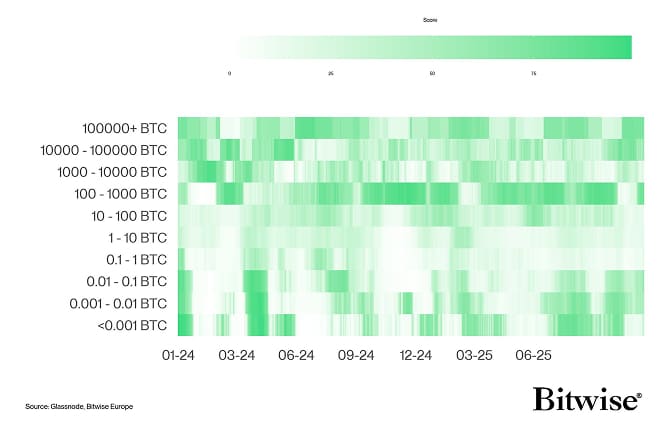
From a market structure perspective, December saw persistent distribution from retail participants amid elevated fear readings, even as larger holders continued to accumulate. On-chain data confirmed that large investors absorbed supply aggressively, with whales adding significant exposure while weaker hands capitulated into year-end. Note that whales are defined as entities that control at least 1,000 BTC.
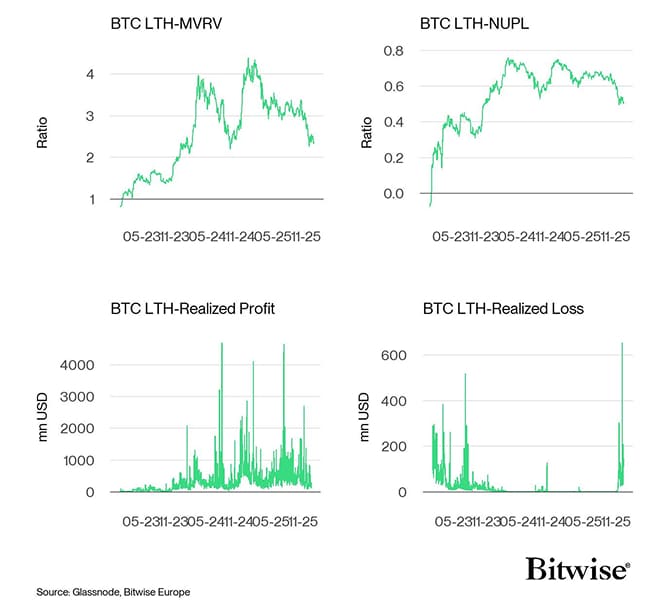
Meanwhile, long-term holders continued to distribute supply albeit at a slower pace which also helped to stabilise market prices. In this context, long-term holders are defined as investors with a holding period of more than 155 days which tend to be more sophisticated investors.
Besides, valuation metrics such as MVRV and the Bitcoin Yardstick revisited levels last seen during the 2022 cycle lows, historically consistent with medium-term buying opportunities rather than sustained drawdowns.
Derivatives positioning also played a critical role in December. A large options expiry removed dealer hedging pressure, allowing price discovery to resume. At the same time, technical indicators like the Relative Strength Index (RSI) signalled exhaustion of the corrective phase, with momentum measures reaching their most oversold levels since the 2022 low and longer-term moving averages beginning to stabilize. These developments suggest that downside momentum was increasingly constrained, rather than accelerating.
From a structural point-of-view, the traditional four-year cycle framework continues to lose relevance as institutional adoption and flows into bitcoin ETPs alter Bitcoin's market dynamics.
Rather than a discrete cycle peak, the evidence increasingly points to a prolonged expansion phase extending well beyond prior historical patterns. This is also one of our key outlook theses for 2026 which we have published here.
This view is reinforced by the emergence of a well-defined price floor in the $80,600–$85,000 range, supported by strong options positioning and “put-wall” defense, limiting downside risk.
Looking ahead, early-year institutional rebalancing dynamics coud support a potential renewed uptrend.
With equities and commodities appearing increasingly extended, portfolio reallocations into cryptoassets appear likely, particularly given bitcoin's relative underperformance despite improving macro conditions.
Taken together, December's price weakness appears less indicative of deteriorating fundamentals and more reflective of a late-stage shakeout, positioning Bitcoin for renewed upside as liquidity, positioning, and valuation realign.
Cross Asset Performance (YtD)
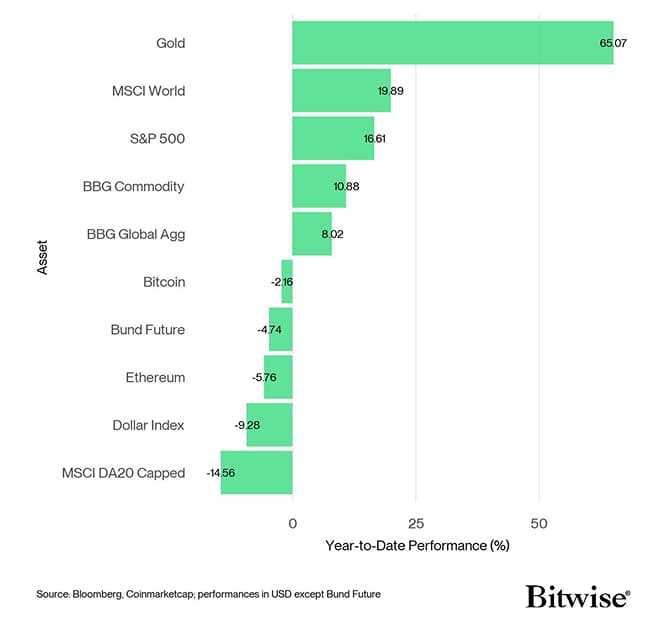 Source: Bloomberg, Coinmarketcap; performances in USD except Bund Future
Cross Asset Performance (MtD)
Source: Bloomberg, Coinmarketcap; performances in USD except Bund Future
Cross Asset Performance (MtD)
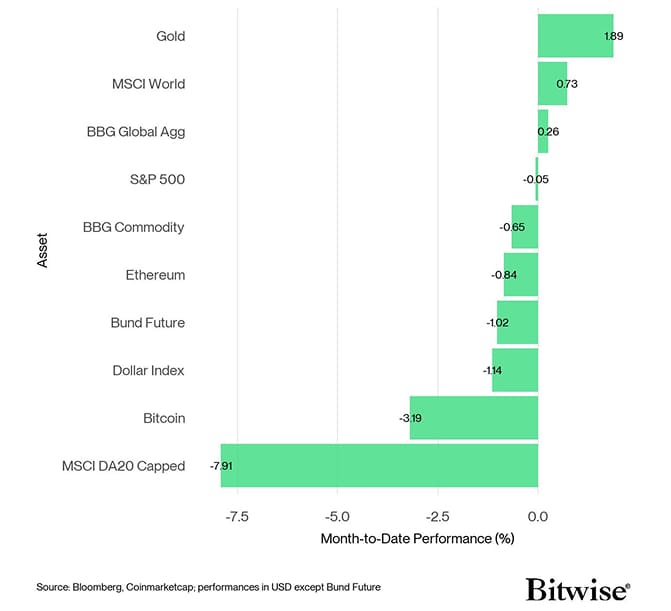 Source: Bloomberg, Coinmarketcap; performances in USD except Bund Future
Bottom Line: December's Bitcoin weakness reflects a late-stage shakeout rather than deteriorating fundamentals, occurring amid improving global liquidity, robust macro conditions, and clear cross-asset divergence. Valuation, positioning, and on-chain dynamics point to a historically rare mispricing, with downside increasingly constrained and risk-reward skewed decisively to the upside. As liquidity, institutional flows, and positioning realign, Bitcoin appears well positioned for renewed upside rather than trend exhaustion.
Bitwise Europe Product Performance Overview (%)
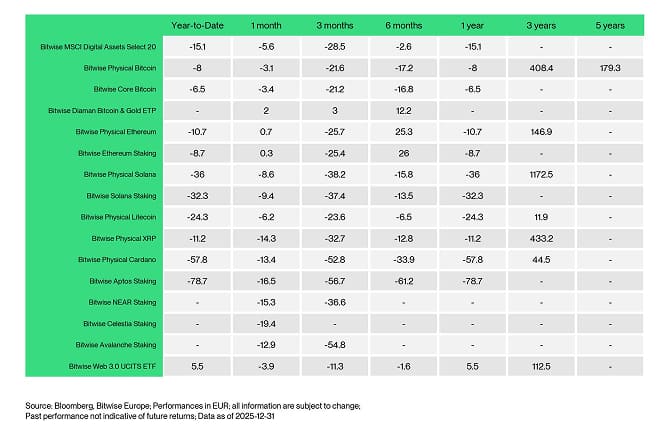 Source: Bloomberg, Bitwise Europe; Performances in EUR; all information are subject to change; past performance not indicative of future returns; Data as of 2025-12-31
Macro Environment
One of our key macro theses remains that global growth could remain robust in 2026. This is based on the rationale that the global number of (net) rate cuts implies a continued expansion in key forward-looking leading indicators like Philly Fed Future Actity or Sentix Global Expectations as shown in the following chart:
Central bank rate cuts continue to support a renewed business cycle upturn well into 2026
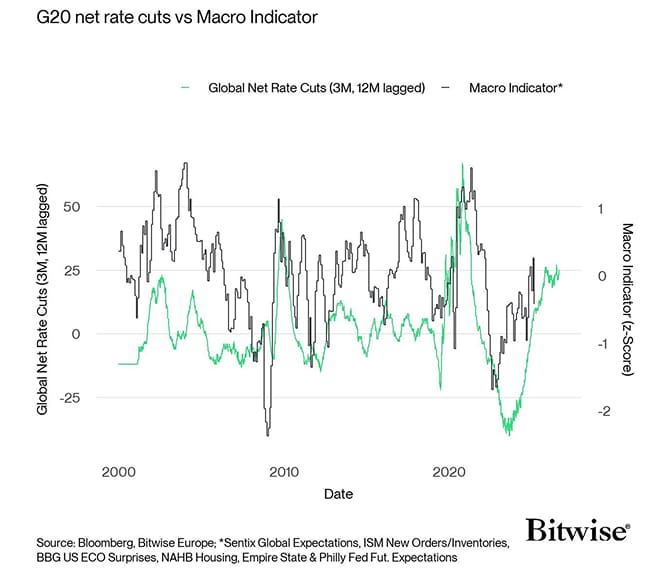
This scenario is becoming even likelier with continued rate cuts by the Fed in 2026. At the time of writing, Fed Funds Futures price in 2 additional rate cuts in 2026 which is likely a rather conservative estimate considering a high likelihood for a more dovish Fed board and gouvernor going forward.
Based on the latest Polymarket odds, Kevin Hassett and Kevin Warsh are the most likely candidates for the Fed chair in May 2026 – both candidates have made positive comments on Bitcoin specifically.
A more dovish FOMC increases the likelihood of structural weakness in the US Dollar which tends to be a positive tailwind for bitcoin as well. It is widely-known that a weak Dollar is warranted by the current Trump administration.
More rate cuts will continue to fuel higher liquidity growth in the US via a steeper yield curve which bodes well for scarce cryptoassets like bitcoin.
Recent steepening signals increasing liquidity growth
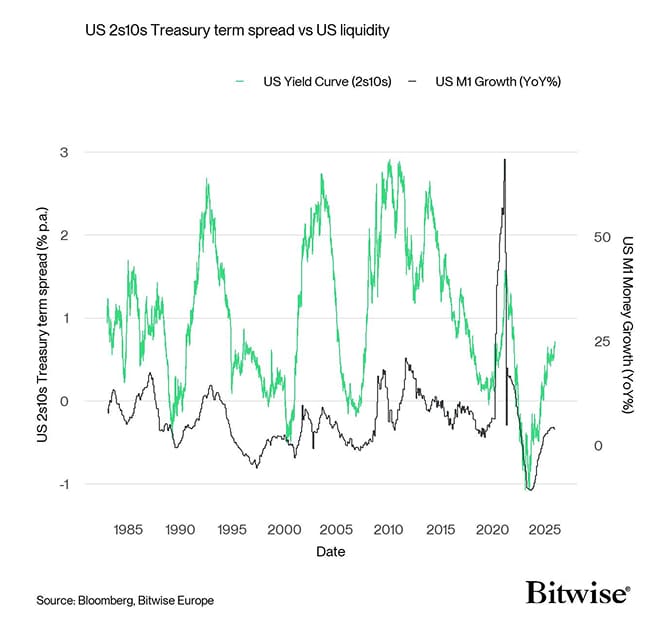
In our view, bitcoin continues to be a usefu indicator for global money supply expansion and the latest undershoot of BTC to global money supply suggests a potential valuation gap as outlined in our previous Bitcoin Macro Investor report. Meanwhile, global money supply growth continues to accelerate:
Bitcoin's performance tends to be tightly correlated with global liquidity growth
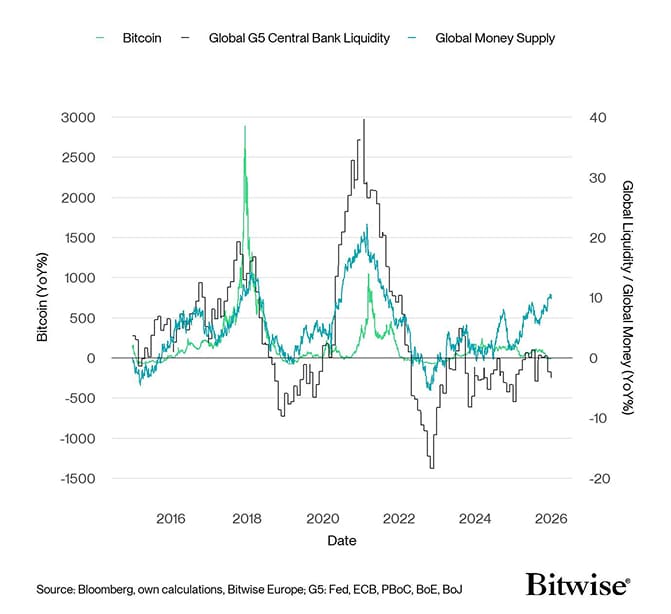
What is more is that bitcoin continues to underprice/undershoot the prevailing macro outlook as highlighted by the following chart. The degree of underpricing is as negative as during the FTX collapse (2022) or the Covid recession (2020).
Bitcoin is underpricing growth expectations by leading macro indicators
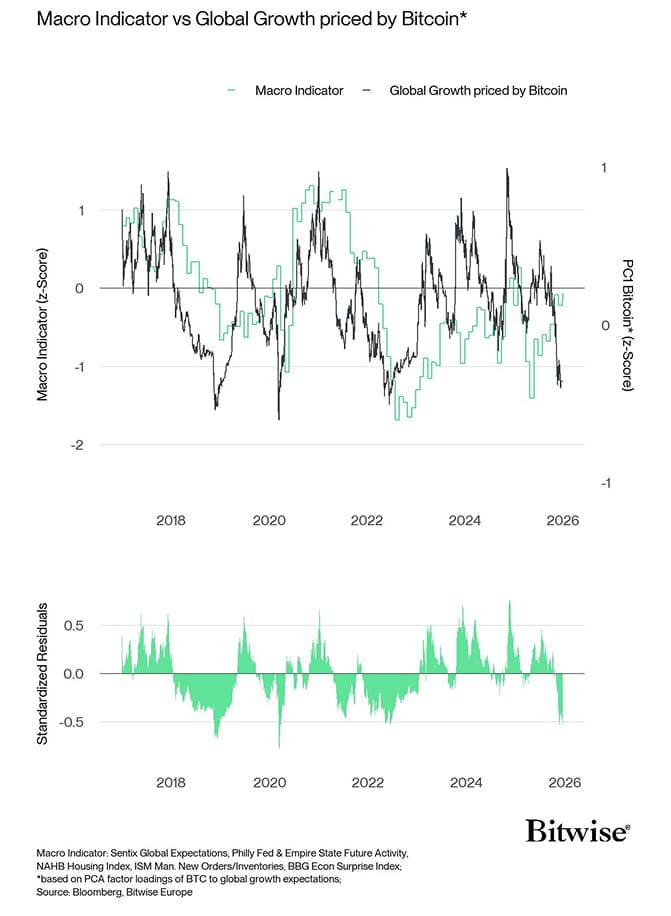
In this context, it is important to underscore that we don't anticipate a US recession in 2026. To the contrary, based on the forward-looking indicators there are signs that growth could potentially accelerate well into 2026.
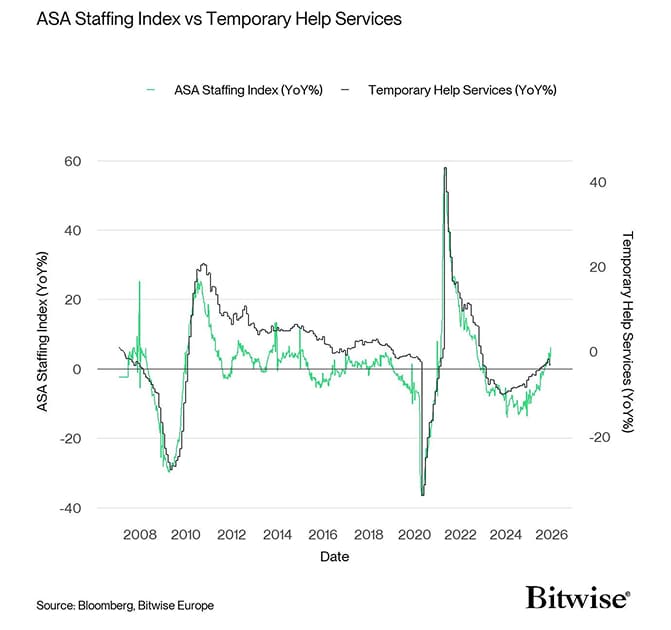
Even leading labour market indicators such as ASA Staffing Index or temporary help services employment are showing signs of re-accelerating employment growth in the US.
Leading empoyment indicators signal an improving labour market
Besides, leading employment indicators among small businesses such as the NFIB Hiring Plans Index have increased to the highest level in 2025 so far.
One of our key macro theses for 2026 is that economic growth will most likely surprise to the upside which would spur positive “animal spirits” and a renewed “risk-on environment”.
This should bode well for risky assets like bitcoin and should rather be a headwind for safe-haven assets like gold. Such a risk-on environment is likely going to spur a capital rotation from gold to bitcoin as highlighted in one of our previous Bitcoin Macro Investor reports as well.
Hypothetically speaking, it is worth noting that bitcoin could already double in price with only a minor capital rotation from gold (approximately ~5% of gold's market cap).
The US business cycle has probably a lot of “runway” for expansion based on the ISM Manufacturing Index. The Index has been signalling a contraction for more than 3 years already – it's longest streak on record.
However, this skews the macro set-up for bitcoin in 2026 positively to the upside as improvements in the ISM Manufacturing Index are historically associated with significant Bitcoin bull runs.
A positive wild card in the context of an improving US economy and labour market could be a return of retail investors to bitcoin and the wider crypto market. Throughout the majority of this bull cycle - which started in 2023 - retail investors have been largely absent from the crypto markets.
Retail has been largely absent during this bull cycle
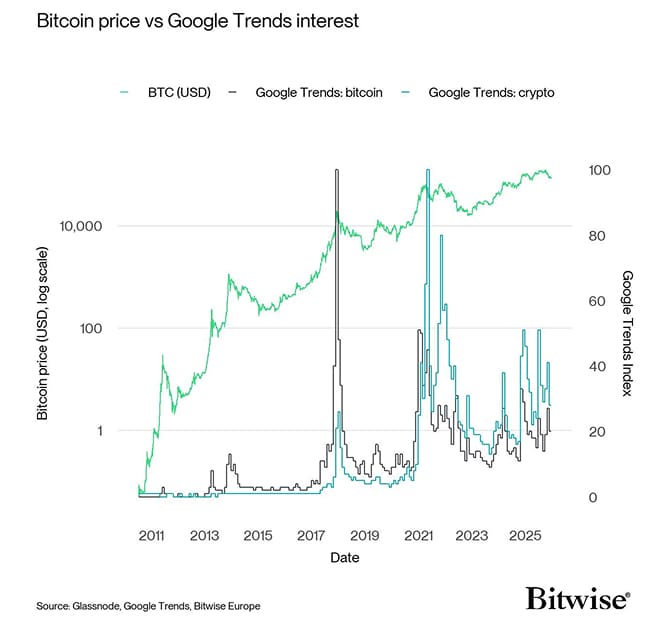
This cycle has been mostly driven by growing institutional adoption, most notably ETFs and treasury companies. However, once the US labour market and consumer sentiment improves, we should see a revival in US retail interest in crypto.
The reason is that both overall US consumer sentiment and crypto market sentiment are highly correlated.
What is more is that both sentiment indicators are currently depressed implying that there is asymmetric upside potential in both consumer and crypto sentiment. In this context, it is quite striking that bitcoin still managed to avoid a full-blown bear market although consumer sentiment is as depressed as during 2022. This speaks volumes in terms of the amount of buying by institutional investors this year.
Increasing US consumer confidence could lift crypto sentiment as well
This thesis will become increasingly likely if the Trump administration manages to distribute $2,000 stimulus cheques to low-income Americans which could be further fuelled by additional tax cuts planned in the ‘Big Beautiful Bill'.
In general, we expect the following events to materialise as oulined in our top 10 outlook for 2026 which we have just published recently. Amongst others we expect:
- Bitcoin may deviate from the four-year cycle and set new all-time highs.
- Volatility in Bitcoin could moderate relative to certain equities, and its correlation with broader equity markets may decline.
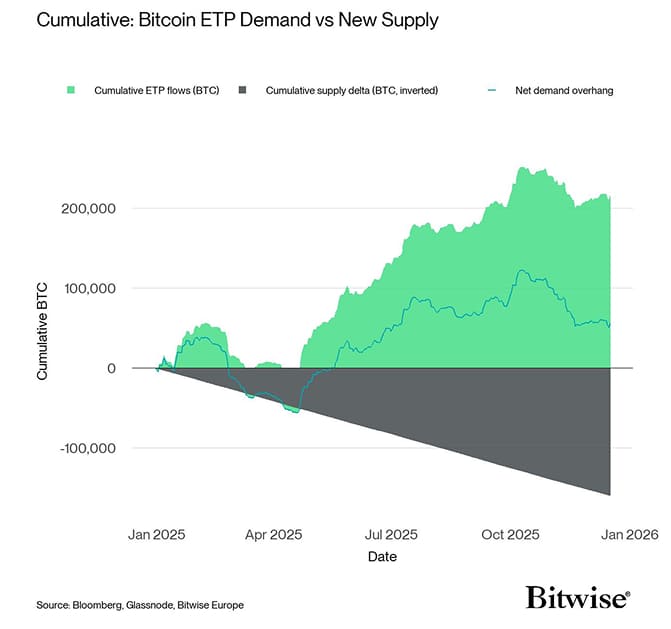
- Institutional demand through ETFs is expected to remain strong and could absorb a substantial portion of new Bitcoin supply
Once long-term holder selling of bitcoin dissipates, we should see a steady recovery in Bitcoin's price. A key reason is that ETF flows from major wirehouses, the internal ETF greenlighting by Vanguard, increasing allocations to crypto ETFs in 401ks and other defined-contribution plans are yet to be expected in 2026.
In 2025, global bitcoin ETPs already managed to absorb more than the new supply of bitcoins. We expect this to continue which should provide a structural bid for bitcoin in 2026.
Global bitcoin ETPs have absorbed more than the new supply
Bottom Line: We expect global growth to remain robust in 2026, supported by further rate cuts, improving forward-looking indicators, and a re-acceleration in the US business cycle without a recession. This macro backdrop, combined with rising global liquidity, a structurally weaker US dollar, and accelerating institutional demand, implies that bitcoin remains materially underpriced and well positioned for a renewed risk-on phase and higher prices in 2026.
On-Chain Developments
A Collapse in Sentiment
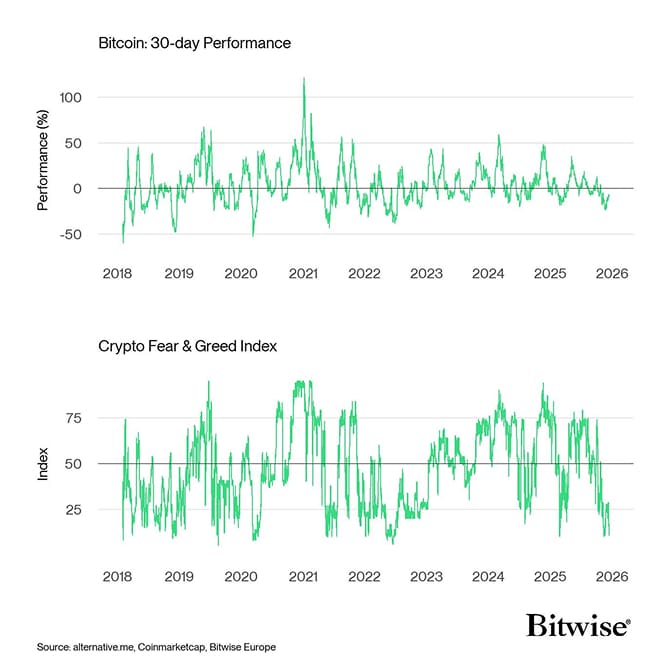
Since October 2025, Bitcoin has remained in a persistent downtrend, declining from an all-time high of $126k to a local low of $80.5k, marking the deepest correction of the cycle. Unlike prior macro stress events this year, the current drawdown exhibits a more pronounced deterioration in investor sentiment across both technical and on-chain measures.
This shift is clearly reflected in the Fear and Greed Index, which has remained anchored in extreme fear. Over the past 90 days, more than 40 trading days have registered extreme fear readings, a duration and intensity more consistent with historical bottoming formations such as the 2018 crash, the March 2020 COVID shock, and the 2021 great miner migration. Collectively, this suggests the current contraction represents a materially different regime than previous cycle stress events, characterised by deeper sentiment damage and a more protracted reset in investor psychology.
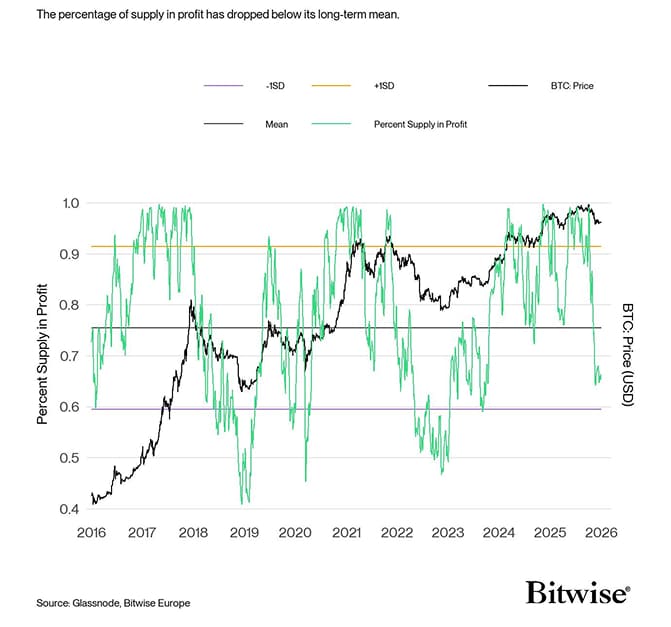
Another measure we can assess this thesis from is through the Percent Supply in Profit metric. This is a binary measure which clarifies if a coin is “in profit” or “in loss”. Notably, the percentage of coins in a position of profit has reached its lowest reading since October 2023, with 65.4% of the supply in profit.
Furthermore, the metric has decisively crashed beneath its long-term average, meaningfully diverging from the structure set across previous stress events such as the yen-carry unwind and the trump tariff tantrum, which both found support at this level.
Bitcoin: Percent Supply in Profit
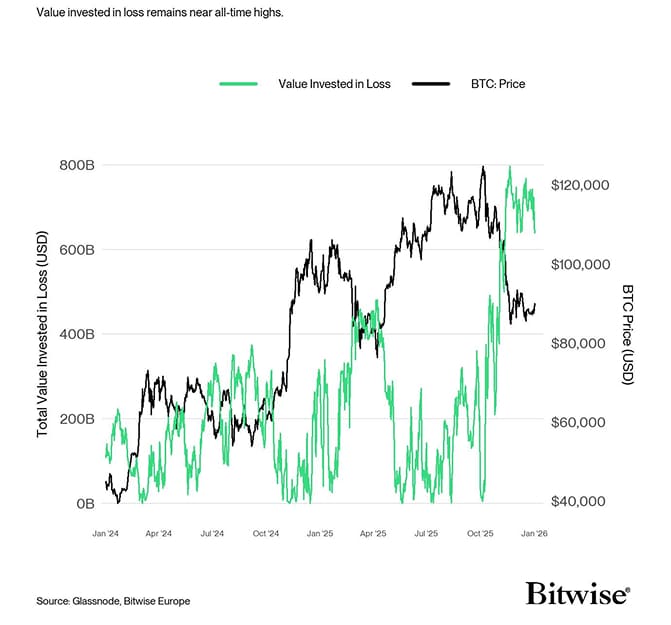
Moving to the value market participants have directly invested, around $737bn of this is now underwater, and is amongst the largest on record. From a percentage perspective, it is the largest since September 2023, further underscoring the challenging conditions investors are experiencing.
Value Invested in Loss
Following on, we can assess the total paper losses held across these underwater coins. However, as the size of the market increases cycle upon cycle, the absolute size of unrealized losses naturally expands. Meanwhile, the depths of the contractions Bitcoin experiences are exhibiting diminishing returns as the asset matures. Thus, to normalize for these effects, we can assess the unrealized losses held in BTC terms, as well as relative to the percentage decline from the all-time high.
On this basis, the unrealised loss per percentage point of drawdown has reached its highest level since the FTX collapse, reinforcing the view that this correction reflects a materially deeper dislocation in market structure and sentiment than earlier stress events this cycle. However, we must note that the magnitude remains much less pronounced than previous cycle bottoms.
Unrealised Loss (BTC) per Percent Drawdown
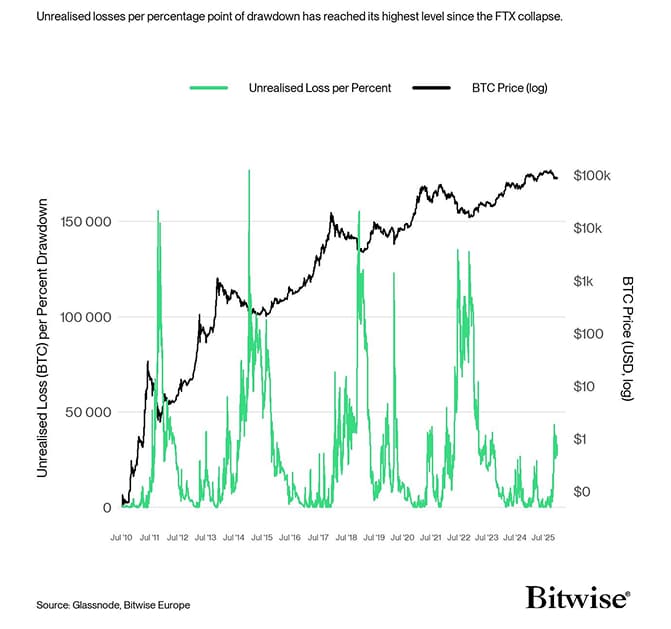
Across both technical and on-chain measures, market structure has deteriorated, breaking below levels that previously acted as support during earlier macro stress events. This deviation highlights a pronounced erosion in investor confidence and underscores that the current correction is structurally more severe than prior pullbacks within the cycle.
Spending Behaviour
In the above section, we examined the current investor conditions and identified a clear shift in sentiment. To compliment this, we can now analyse how investors have actively responded to this changing market environment through their spending behaviour.
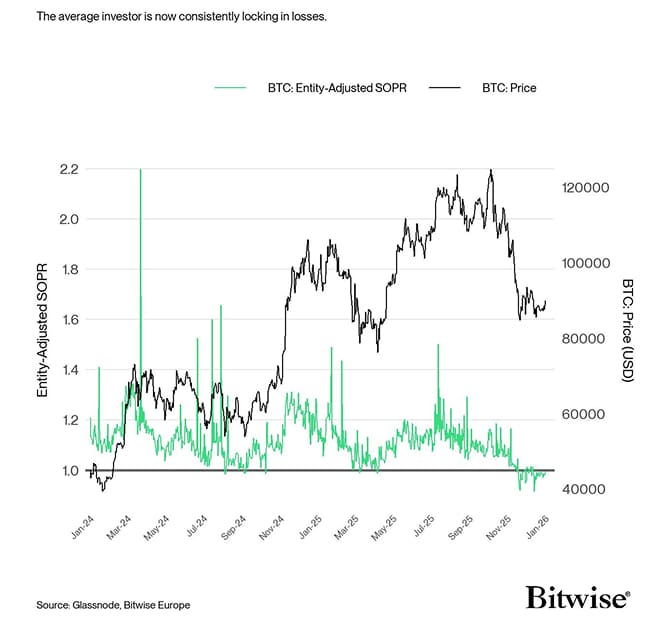
The SOPR metric allows us to uate the magnitude of profit or loss being locked in across the network and directly assess how wider market participants are responding to their changing financial conditions.
Interestingly, the SOPR metric has turned persistently negative for the first time this cycle, indicating that investors are consistently locking in losses on average, day after day. This behaviour signals a clear shift in spending regime, suggesting investors are struggling across the current market climate, where capitulation has become widespread and market participants are increasingly using relief rallies and returns to breakeven around the 1.0 level as opportunities to exit positions.
Entity-Adjusted SOPR
We can add further granularity to this assessment by separating spending behaviour between Long-Term Holders (LTHs), who represent mature, tenured and largely price-insensitive investors, and Short-Term Holders (STHs), who more closely reflect new demand and are significantly more sensitive to price fluctuations.
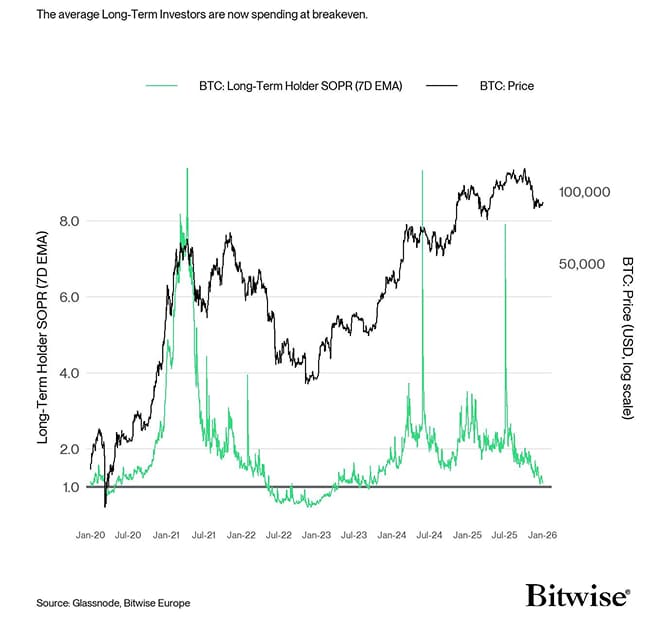
Focusing first on the LTH cohort, their spending behaviour is now returning towards the neutral 1.0 level for the first time since September 2023, signalling a broad reset and a complete detox in their profitable spending cycle. Historically, a return to LTH breakeven spending tends to occur only after a substantial amount of structural damage has already been absorbed by the market, marking a late-stage phase of distribution.
Long-Term Holder SOPR (7D EMA)
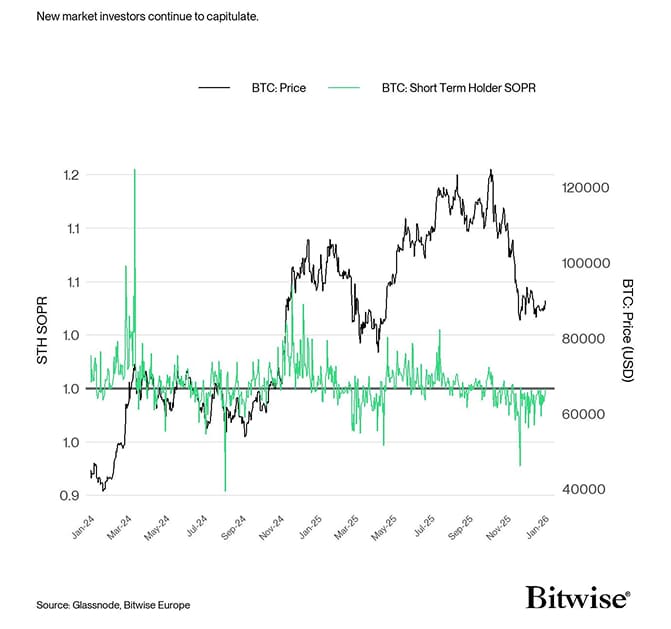
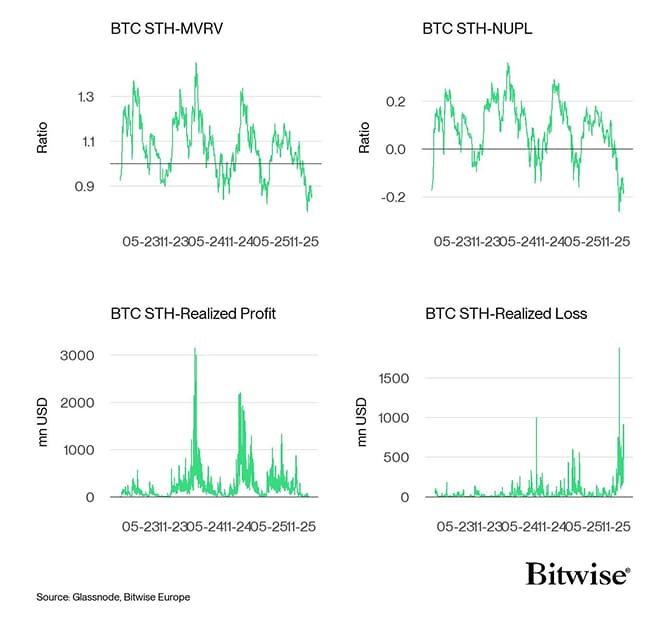
Turning to the STH cohort, we observe that these newer investors are now consistently locking in losses. The persistence of this loss-taking regime indicates that new investors remain under sustained pressure, highlighting continued capitulation. Additionally, the retests of the 1.0 breakeven level suggest unresolved stress across the current market environment. It would be a constructive development to see this metric decisively stabilise above the breakeven level.
Short-Term Holder SOPR
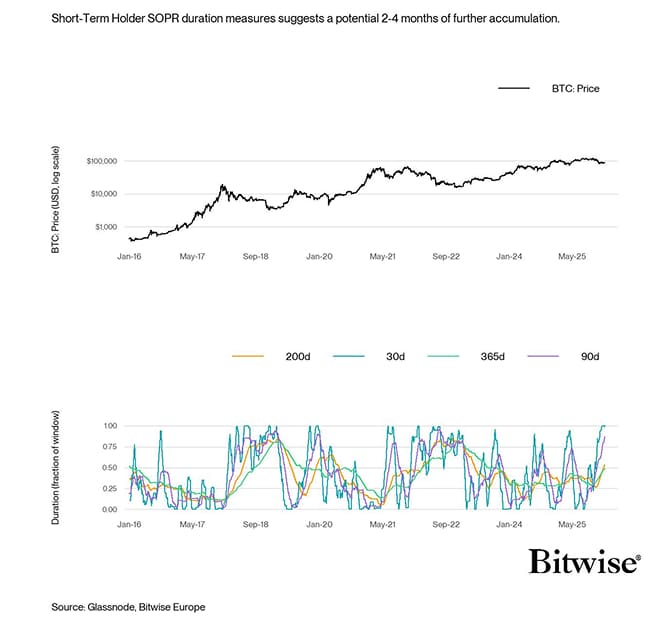
The consistency of negative SOPR readings indicate that the market has transitioned into a loss-dominated environment. To quantify the duration of this regime, we examine the share of days with negative STH-SOPR prints across rolling 30-day, 90-day, 200-day, and 365-day windows.
The shorter horizons show acute stress, with the 30-day and 90-day measures sitting in the 93rd and 85th percentiles respectively, signalling that recent investor behaviour is overwhelmingly characterised by loss realisation.
In contrast, the longer-duration measures remain more moderate but are trending higher, with negative SOPR days reaching 99 out of 200 and 172 out of 365. Historically, these longer windows have tended to peak around 160 days for the 200-day measure and near 285 days for the annual window.
This divergence suggests that while local capitulation is well advanced, the broader market has not yet completed a full behavioural reset. As such, through this lens, an additional two to four months of consolidation and accumulation may be required to establish a durable market foundation.
STH Negative SOPR Duration
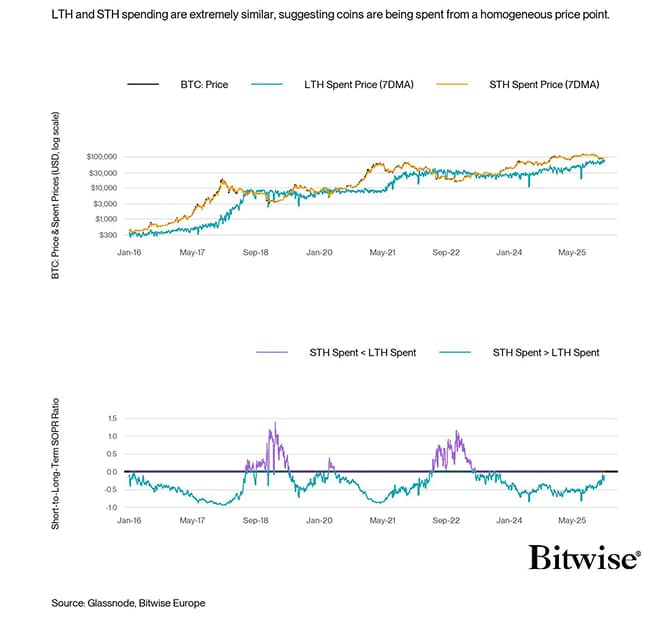
Comparing the STH and LTH SOPR, an interesting market dynamic is occurring. As of current, LTH and STH spending are extremely similar, suggesting coins are being spent from a homogeneous price point. This convergence is atypical given the very different time horizons and behavioural profiles of these investor groups and signals that a large portion of investor exuberance has largely been reset.
Notably, this dynamic typically emerges deep into market contractions, suggesting we are already some ways into a bottoming formation. Nevertheless, the current cycle continues to show notable resilience relative to prior episodes. The 2015 cycle saw a collapse from $1,150 to $480 (−58%), the 2018 cycle fell from $20k to $6.3k (−68%), and the 2022 cycle declined from $67.6k to $28.9k (−57%). By comparison, the current cycle has retraced from $126k to $87k (−31%), underscoring a materially more contained drawdown despite similarly depressed sentiment conditions.
BTC:Short-to-Long-Term SOPR Ratio
Hammering out a Bottom
Having established that investor sentiment and behaviour have shifted materially relative to earlier contractions this cycle, we now put forward the case highlighting the large-scale coin redistribution occurring from weaker to stronger hands as a bottoming process takes shape.
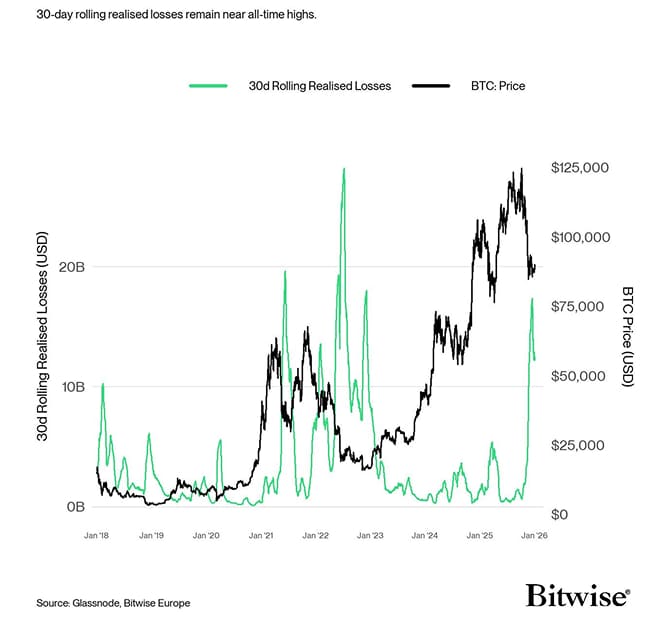
The most immediate signpost of this mechanism is the elevated level of loss realisation occurring on-chain. Over the past 30 days, realised losses have totalled approximately $12.6bn, a magnitude exceeded on only 191 trading days in Bitcoin's history. While this degree of capitulation presents short-term headwinds for price, it is a necessary condition for durable market floors, facilitating the transfer of supply from lower-conviction holders to higher-conviction investors.
While the bulk of realised losses continue to originate from the Short-Term Holder cohort (78%), a notable 22% are now being realised by Long-Term Holders. Examining this more closely, these LTH losses are entirely concentrated in coins aged between 6 months to 2 years, indicating they mainly stem from investors who accumulated during the topping formation rather than from deeply convicted holders.
Historically, sustained loss realisation by Long-Term Holders tends to emerge later in the cycle. Therefore, it can be considered a constructive sign to see single-cycle long-term holders flushed out and transferring coins to investors who identify value within the range.
30d Rolling Realised Losses
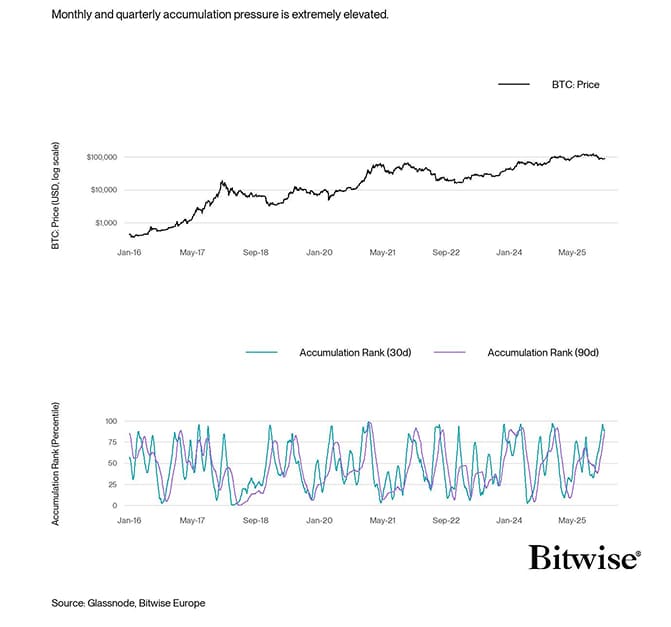
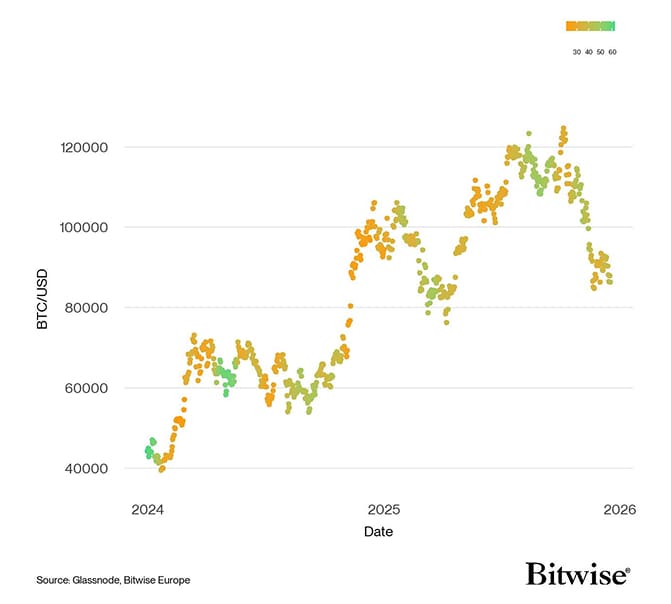
Another way to gauge the intensity of investor accumulation is through the Accumulation Trend Score, which measures the degree to which wallets are actively increasing their holdings.
When assessing the 30-day and 90-day sums of this measure, the 30-day Accumulation Trend Score sits in the 89th percentile, indicating aggressive and widespread accumulation as new investors step into market weakness. Supportively, the 90-day reading remains closer to the 87th percentile, suggesting both short-term and quarterly accumulation pressure remains strong.
BTC Accumulation Percentiles
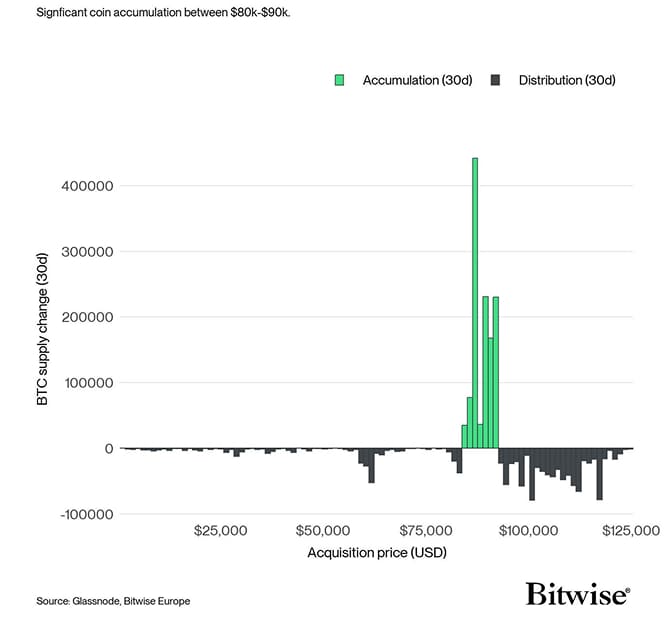
Finally, we examine the UTXO Realized Price Distribution (URPD), which maps the on-chain volume profile by identifying the price levels at which coins last transacted. By comparing the current distribution to that of one month ago, we can pinpoint where accumulation and distribution have recently occurred.
Notably, a substantial increase in coin concentration is visible across the $82k to $93k range, reinforcing the elevated accumulation pressure highlighted by the Accumulation Trend Score. While a Coinbase wallet migration accounts for a substantial portion of the spike near $82k, the broader growth in supply held across this region suggests genuine and sustained demand, supporting the view that this price range is being actively absorbed by investors.
BTC: 30d Supply Change
Market Navigation
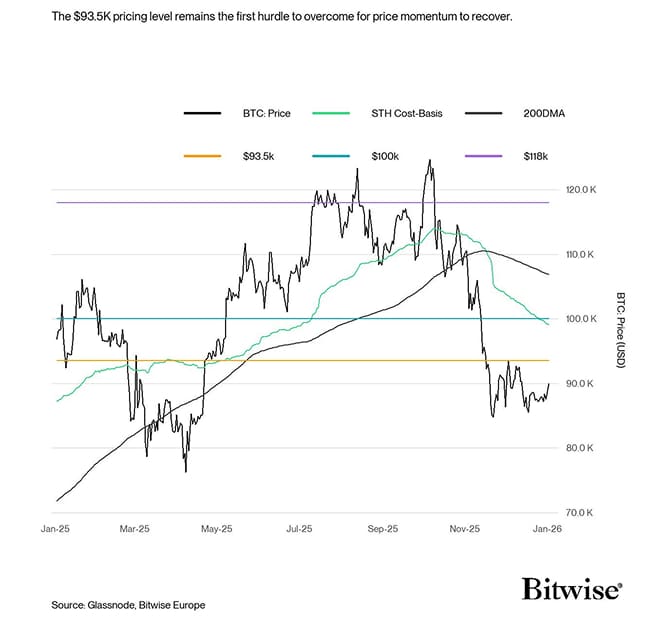
With market sentiment damaged and spending behaviour turning decisively risk-off, we draw on a combination of technical, on-chain, and psychological thresholds to identify early and compounding signs of recovery from this regime.
- The $93.5k level marks the lower boundary of a dense on-chain supply cluster spanning $93.5k to $118k and coincides with the yearly open. Persistent rejection at this level highlights its importance, with a decisive reclaim representing the first meaningful signal of improving market strength.
- The $100k level remains a critical psychological threshold, while also aligning with the Short-Term Holder cost basis, which has historically separated local bullish and bearish regimes. A sustained move above this level would substantially improve momentum.
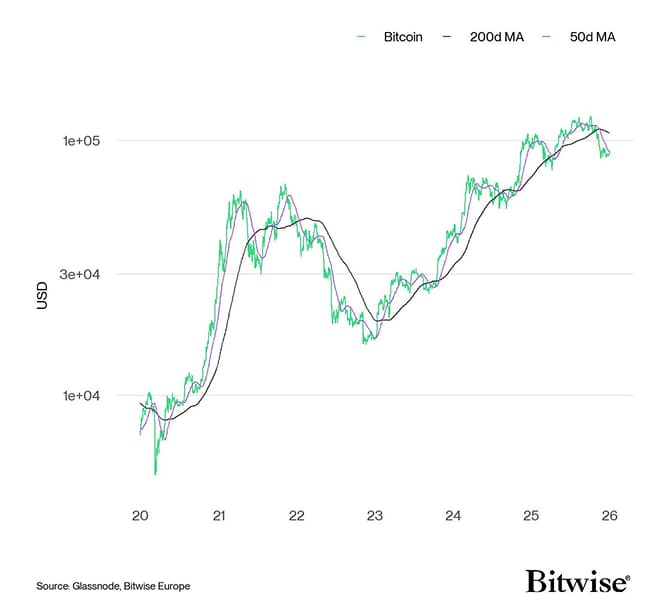
- The 200-day moving average, currently near $108k, serves as a widely referenced trend gauge and often defines the transition between longer-term expansion and contraction.
- Finally, the $118k level represents the upper boundary of the dense supply zone. A sustained breakout above this region would signal a strong recovery in market structure and increase the probability of a retest of the $126k all-time high.
While directional forecasting remains inherently uncertain in such conditions, these levels represent the primary hurdles on the path to recovery, with each successive reclaim in pricing level signalling a compounding improvement in market confidence and structural strength.
Local Pricing Levels
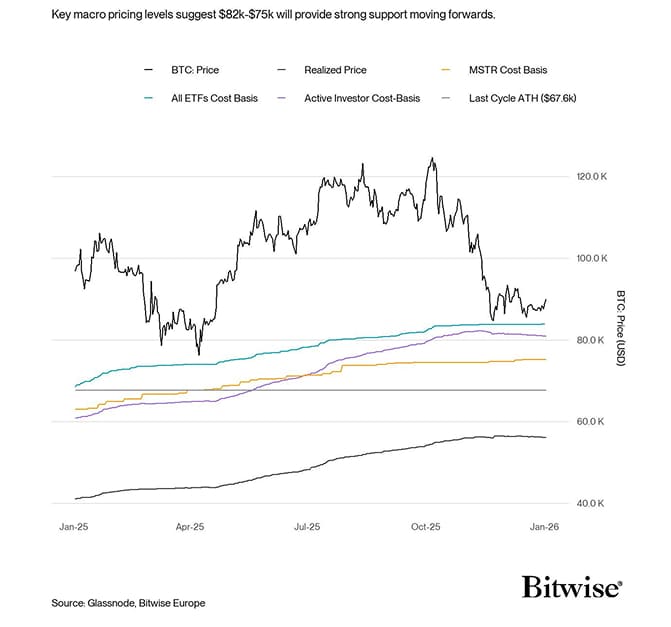
Zooming out, we assess macro pricing levels to identify the highest probability zones for a market bottom. Our base case centres on the confluence between the True Market Mean, which represents the average active investor's purchase price, the ETF average cost basis, and the MSTR cost basis. Together, these metrics point to the $75k–$82k range as the most likely bottoming zone.
However, it is prudent to consider alternative outcomes. In a tail-risk scenario, the 2021 all-time high and the Realised Price, which reflects the aggregate purchase price of all coins including inactive supply, form a secondary support band in the $58k–$67k range. We consider this possibility a very low likelihood but assume strong support to be found in this region if this eventualises.
Macro Pricing Levels
Bottom Line: Bottoming formations are a process, not an event, marked by a meaningful shift in investor sentiment toward loss-taking as assets transfer from weaker to higher-conviction holders. While this creates near-term headwinds, it is a necessary condition for a sustainable bottom, and our duration-based metrics suggest the process may take an additional 2–4 months, probabilistically. Notably, the market is entering this phase from a structurally stronger position than prior cycles, with robust recent accumulation indicating perceived value at current levels and key price levels remaining critical to assess progress toward recovery.
Bottom Line
- Performance: December’s Bitcoin weakness reflects a late-stage shakeout rather than deteriorating fundamentals, occurring amid improving global liquidity, robust macro conditions, and clear cross-asset divergence. Valuation, positioning, and on-chain dynamics point to a historically rare mispricing, with downside increasingly constrained and risk-reward skewed decisively to the upside. As liquidity, institutional flows, and positioning realign, Bitcoin appears well positioned for renewed upside rather than trend exhaustion.
- Macro: We expect global growth to remain robust in 2026, supported by further rate cuts, improving forward-looking indicators, and a re-acceleration in the US business cycle without a recession. This macro backdrop, combined with rising global liquidity, a structurally weaker US dollar, and accelerating institutional demand, implies that bitcoin remains materially underpriced and well positioned for a renewed risk-on phase and higher prices in 2026.
- On-Chain: Bottoming formations are a process, not an event, marked by a meaningful shift in investor sentiment toward loss-taking as assets transfer from weaker to higher-conviction holders. While this creates near-term headwinds, it is a necessary condition for a sustainable bottom, and our duration-based metrics suggest the process may take an additional 2–4 months, probabilistically. Notably, the market is entering this phase from a structurally stronger position than prior cycles, with robust recent accumulation indicating perceived value at current levels and key price levels remaining critical to assess progress toward recovery.
Appendix
Cryptoasset Market Overview
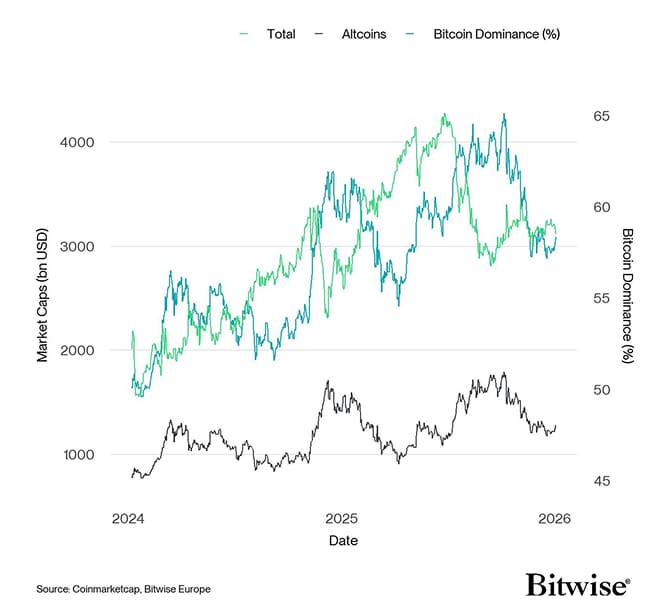
Global Cryptoasset Market Caps
 Source: Glassnode, Bitwise Europe
Bitcoin Performance
Source: Glassnode, Bitwise Europe
Bitcoin Performance
 Source: Glassnode, Bitwise Europe
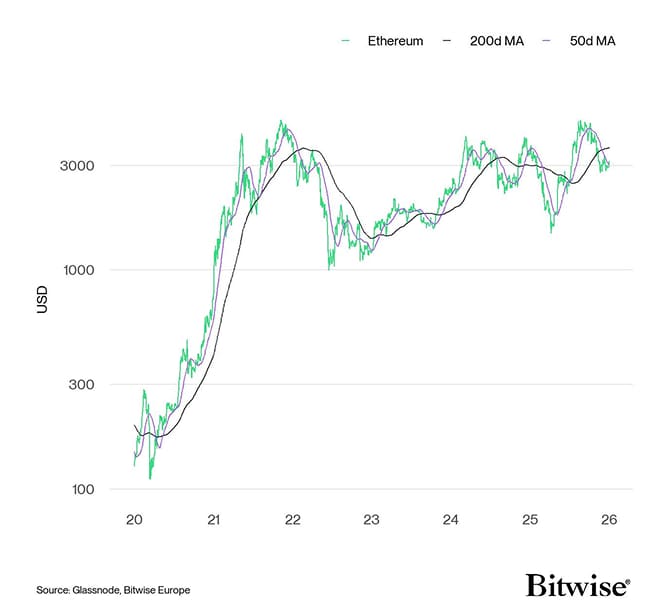
Ethereum Performance
Source: Glassnode, Bitwise Europe
Ethereum Performance
 Source: Glassnode, Bitwise Europe
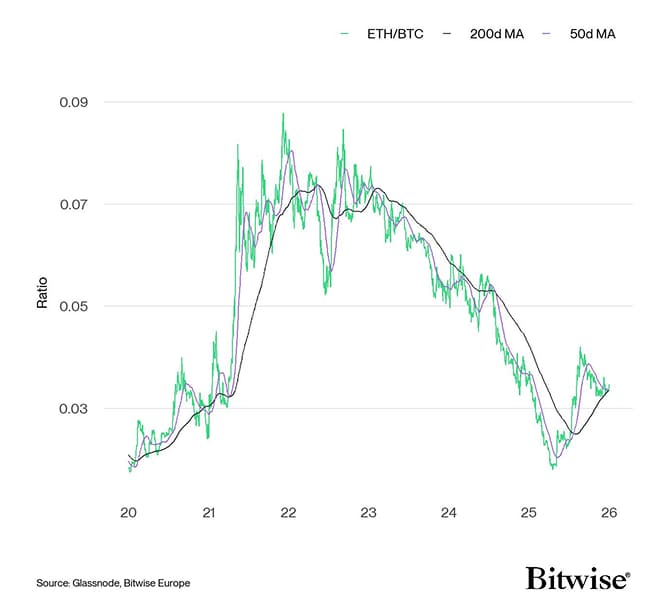
Ethereum vs Bitcoin Relative Performance
Source: Glassnode, Bitwise Europe
Ethereum vs Bitcoin Relative Performance
 Source: Glassnode, Bitwise Europe
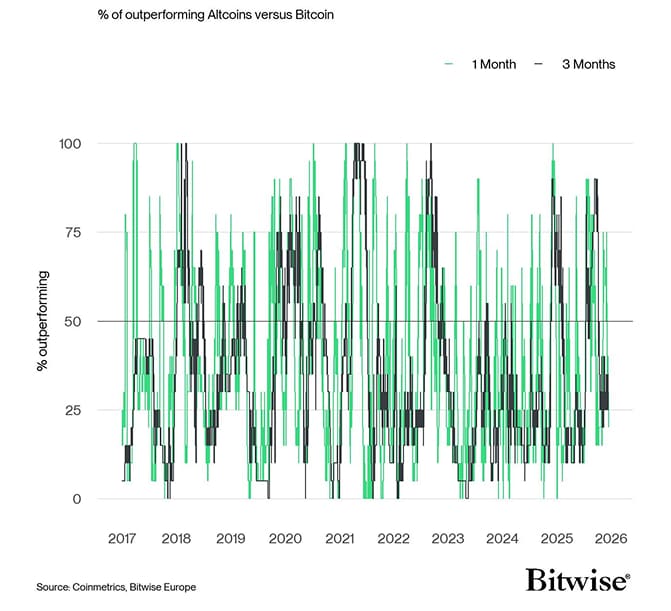
Altseason Index
Source: Glassnode, Bitwise Europe
Altseason Index
 Source: Coinmetrics, Bitwise Europe
Bitcoin vs Crypto Dispersion Index
Source: Coinmetrics, Bitwise Europe
Bitcoin vs Crypto Dispersion Index
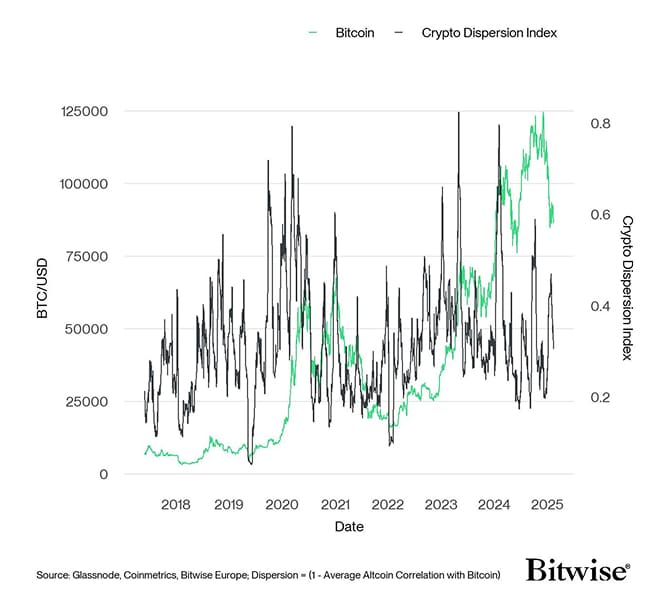 Source: Glassnode, Coinmetrics, Bitwise Europe; Despersion = (1 - Average Altcoin Correlation with Bitcoin)
Cryptoassets & Macroeconomy
Macro Factor Pricing
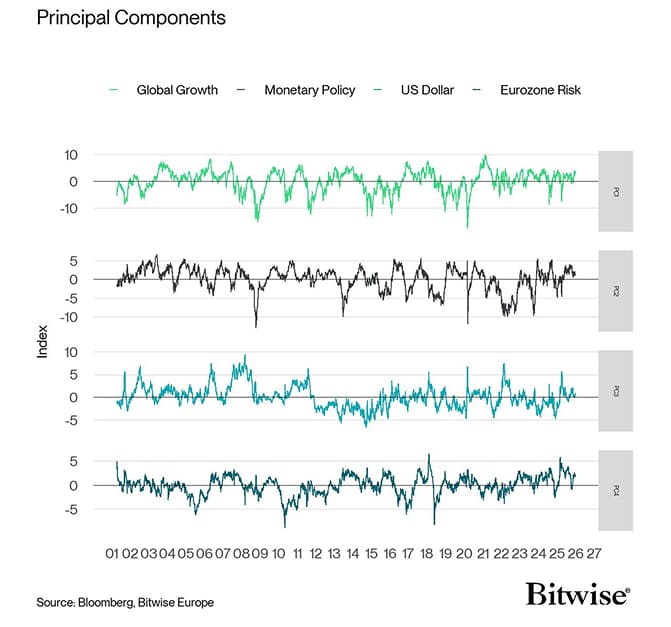 Source: Bloomberg, Bitwise Europe
How much of Bitcoin's performance can be explained by macro factors?
Source: Bloomberg, Bitwise Europe
How much of Bitcoin's performance can be explained by macro factors?
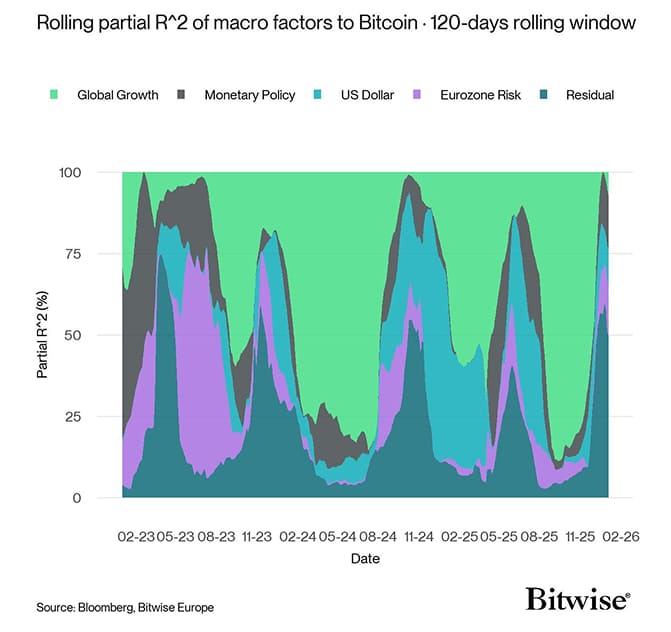 Source: Bloomberg, Bitwise Europe
Cryptoassets & Multiasset Portfolios
Multiasset Performance with Bitcoin (BTC)
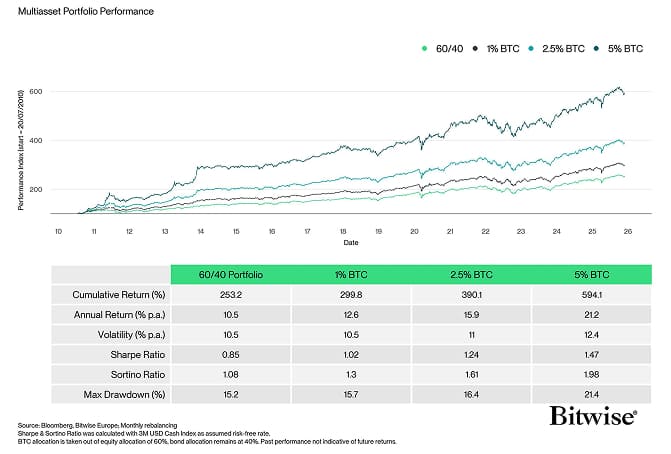 Source: Bloomberg, Bitwise Europe; Monthly rebalancing; Sharpe Ratio was calculated with 3M USD Cash Index as assumed risk-free rate; BTC allocation is taken out of equity allocation of 60%, bond allocation remains at 40%; Past performance not indicative of future returns.
Rolling correlation: S&P 500
Source: Bloomberg, Bitwise Europe; Monthly rebalancing; Sharpe Ratio was calculated with 3M USD Cash Index as assumed risk-free rate; BTC allocation is taken out of equity allocation of 60%, bond allocation remains at 40%; Past performance not indicative of future returns.
Rolling correlation: S&P 500
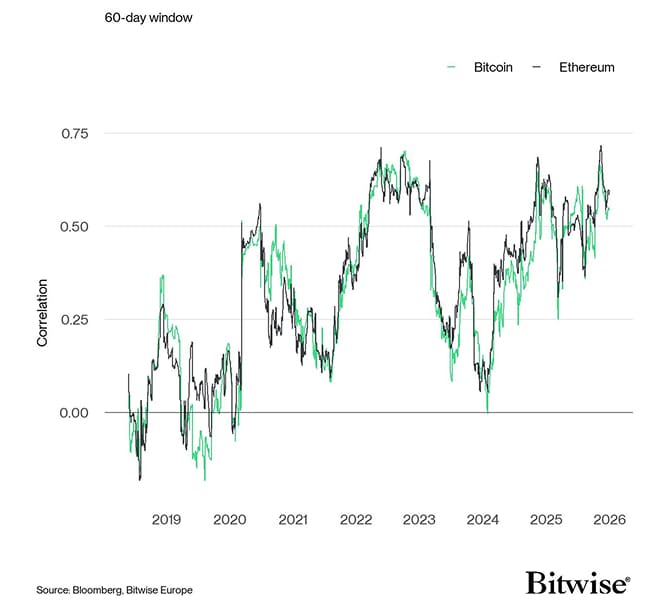 Source: Bloomberg, Bitwise Europe
Rolling correlation: Bund Future
Source: Bloomberg, Bitwise Europe
Rolling correlation: Bund Future
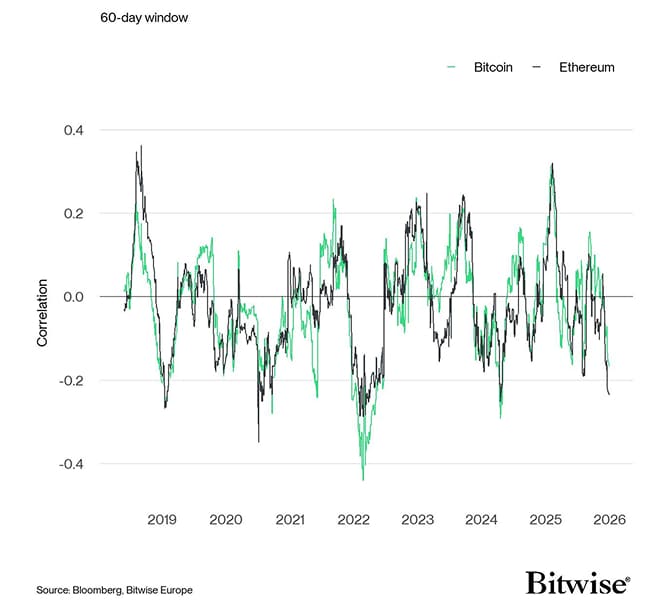 Source: Bloomberg, Bitwise Europe
Rolling correlation: Gold
Source: Bloomberg, Bitwise Europe
Rolling correlation: Gold
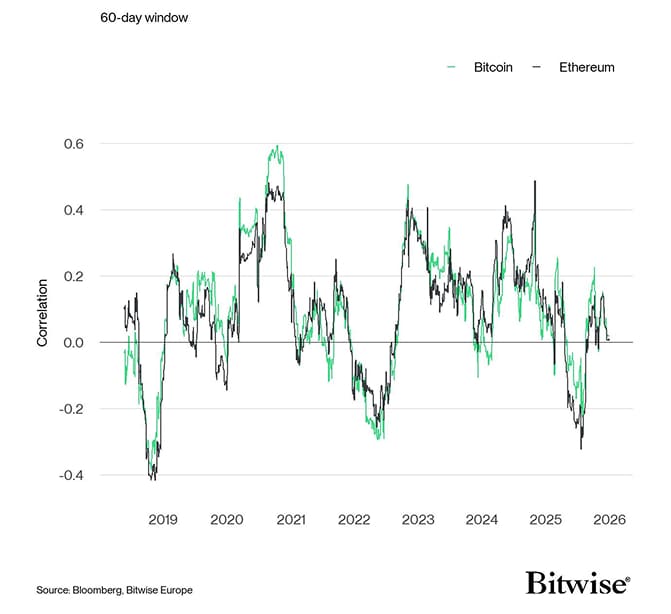 Source: Bloomberg, Bitwise Europe
Rolling correlation: Dollar Index (DXY)
Source: Bloomberg, Bitwise Europe
Rolling correlation: Dollar Index (DXY)
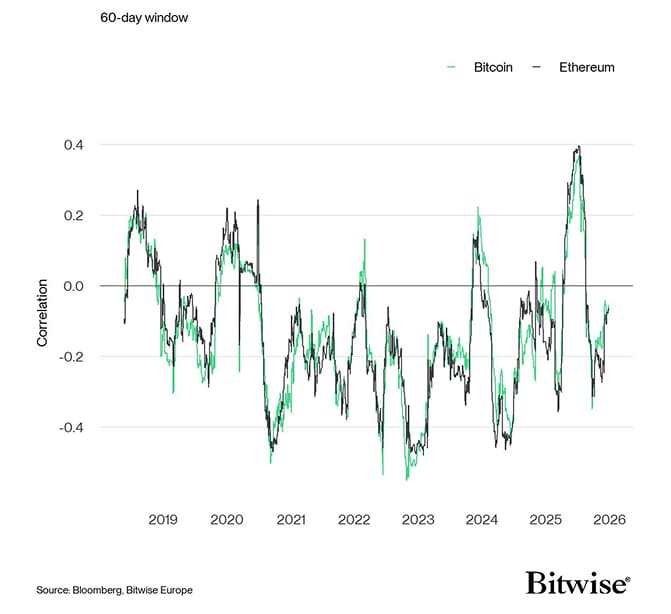 Source: Bloomberg, Bitwise Europe
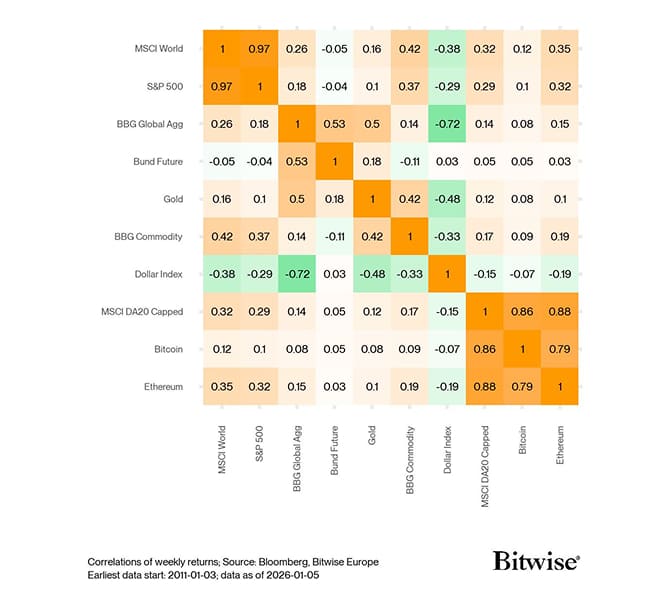
Cross Asset Correlation Matrix
Source: Bloomberg, Bitwise Europe
Cross Asset Correlation Matrix
Cryptoasset Valuations
Bitcoin: Price vs Composite Valuation Indicator
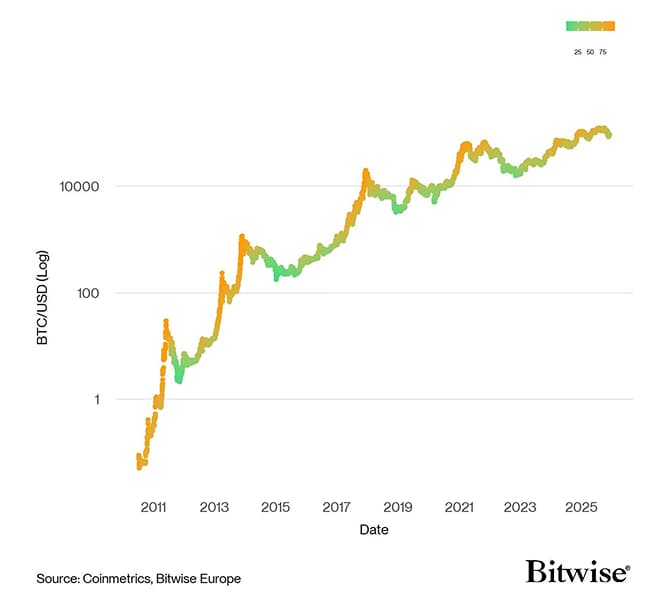 Source: Coinmetrics, Bitwise Europe
Bitcoin: Composite Valuation Indicator
Source: Coinmetrics, Bitwise Europe
Bitcoin: Composite Valuation Indicator
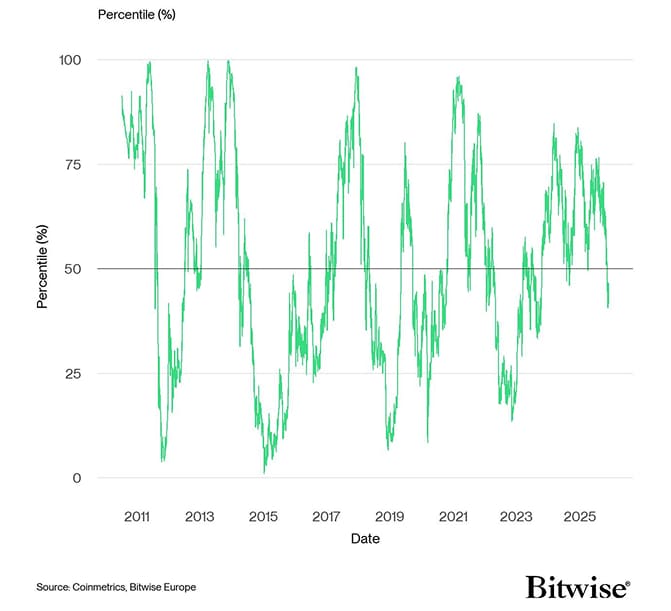 Source: Coinmetrics, Bitwise Europe
Bitcoin: Valuation Metrics
Source: Coinmetrics, Bitwise Europe
Bitcoin: Valuation Metrics
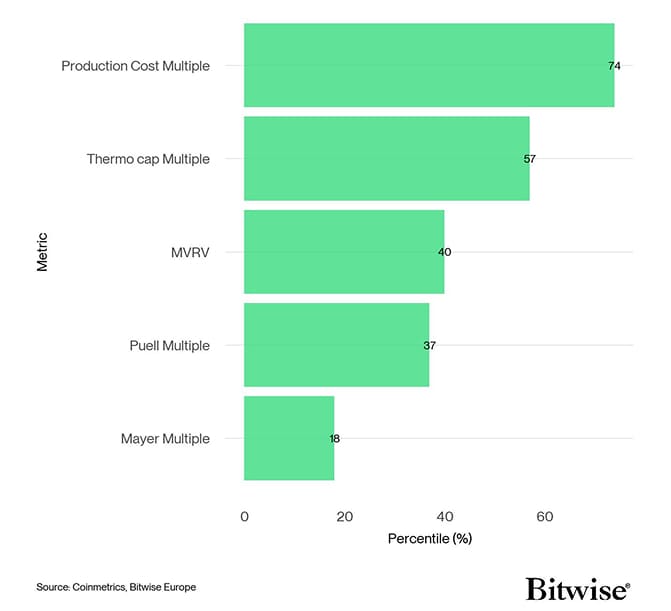 Source: Coinmetrics, Bitwise Europe
On-Chain Fundamentals
Bitcoin: Closing Price
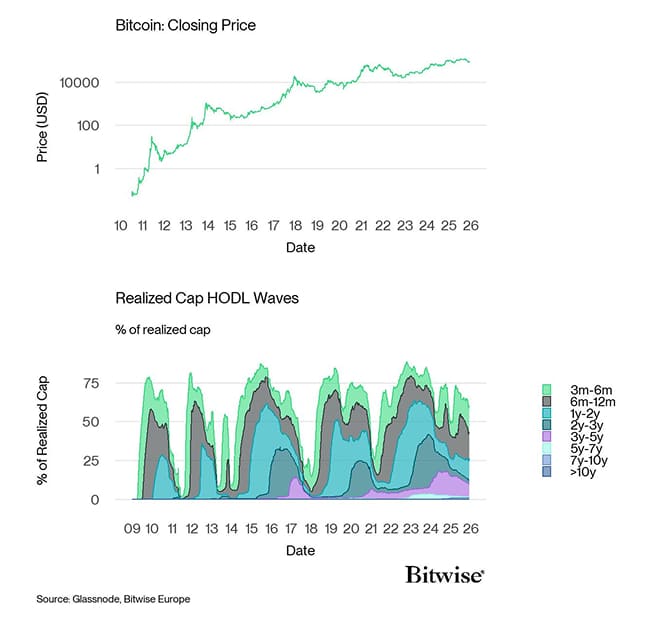 Source: Glassnode
Bitcoin's supply scarcity is more pronounsed that during the last cycle
Source: Glassnode
Bitcoin's supply scarcity is more pronounsed that during the last cycle
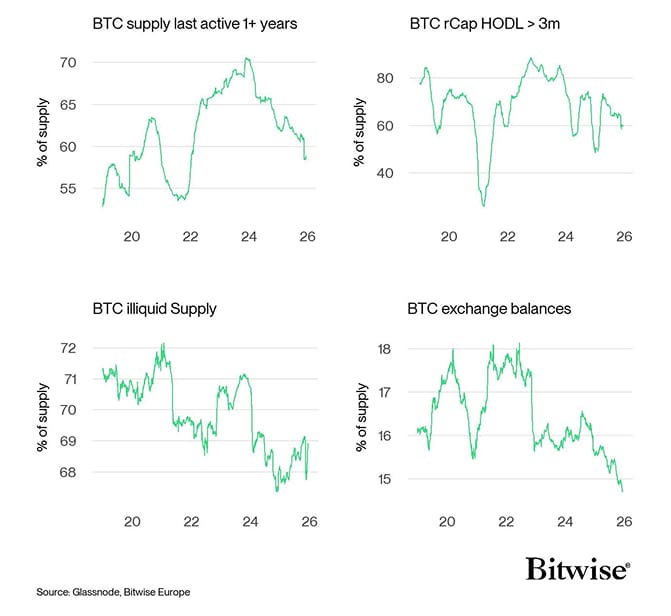 Source: Glassnode, Bitwise Europe
Bitcoin Long-term Holder (LTH) Dashboard
Source: Glassnode, Bitwise Europe
Bitcoin Long-term Holder (LTH) Dashboard
 Source: Glassnode, Bitwise Europe
Bitcoin Short-term Holder (STH) Dashboard
Source: Glassnode, Bitwise Europe
Bitcoin Short-term Holder (STH) Dashboard
 Source: Glassnode, Bitwise Europe
Bitcoin: Price vs Average Accumulatio Score
Source: Glassnode, Bitwise Europe
Bitcoin: Price vs Average Accumulatio Score
 Source: Glassnode, Bitwise Europe
Bitcoin Accumulation Score
Source: Glassnode, Bitwise Europe
Bitcoin Accumulation Score
 Source: Glassnode, Bitwise Europe
Bitcoin: Post-Halving Performance
Source: Glassnode, Bitwise Europe
Bitcoin: Post-Halving Performance
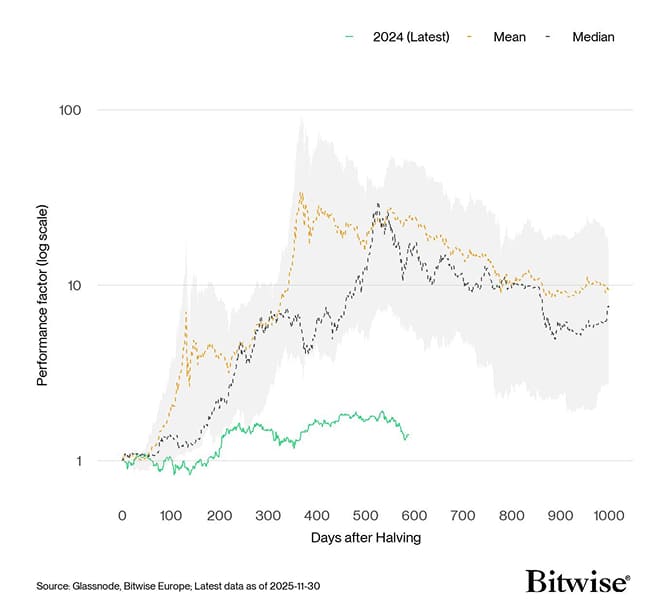 Source: Glassnode, Bitwise Europe; Results based on the previous Halvings in 2012, 2016, and 2020
Bitcoin: Steady increase in scarcity will provide a tailwind for price appreciations
Source: Glassnode, Bitwise Europe; Results based on the previous Halvings in 2012, 2016, and 2020
Bitcoin: Steady increase in scarcity will provide a tailwind for price appreciations
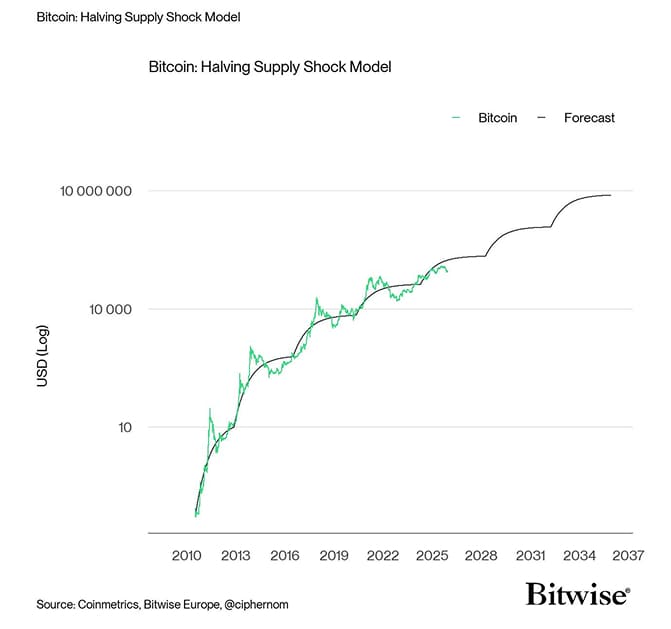 Source: Coinmetrics, Bitwise Europe; @ciphernom
Important Information
This publication constitutes a marketing communication and is provided for informational purposes only. It does not constitute investment advice, a personal recommendation, or an offer or solicitation to buy or sell any financial instrument.
This document (which may take the form of a presentation, press release, social media post, blog article, broadcast communication or similar instrument – collectively referred to as a “Document”) is issued by Bitwise Europe GmbH (“BEU” or the “Issuer”) and has been prepared in accordance with applicable laws and regulations, including those relating to financial promotions.
Bitwise Europe GmbH, incorporated under the laws of Germany, is the issuer of the Exchange Traded Products (“ETPs”) referenced in this Document under a base prospectus and the applicable final terms, as supplemented from time to time, approved by the German Federal Financial Supervisory Authority (BaFin). The approval of the prospectus by BaFin relates solely to the completeness, coherence and comprehensibility of the prospectus in accordance with the Prospectus Regulation and does not constitute an endorsement, recommendation or assessment of the merits of the products.
The market analyses, views and scenarios presented reflect the assessment as of the date of publication and are based on information considered reliable. However, no representation or warranty is made as to their accuracy or completeness. Forward-looking statements involve risks and uncertainties and are not guarantees of future performance. Past performance is not a reliable indicator of future results.
Capital at risk. Cryptoassets are highly volatile and involve a high degree of risk. The value of investments in cryptoassets and crypto-linked ETPs may fluctuate significantly, and investors may lose part or all of their invested capital. No capital protection or guaranteed compensation mechanism applies in respect of market losses.
Any investment decision should be made solely on the basis of the relevant base prospectus, the applicable final terms and the key information document, in particular the section entitled “Risk Warning”. The base prospectus, final terms and additional risk information are available at: www.bitwiseinvestments.eu
Access to certain documents may require self-certification regarding your jurisdiction and investor status and may be subject to additional disclaimers and important information.
For further details, please refer to the full disclaimer available at: www.bitwiseinvestments.eu/disclaimer