This report is for professional investors and information purposes only. Persons without professional investment experience should not rely on it. Not investment advice or a personal recommendation. Cryptoassets are high risk and volatile and you may lose all capital invested. See full risk information at the end of this document.
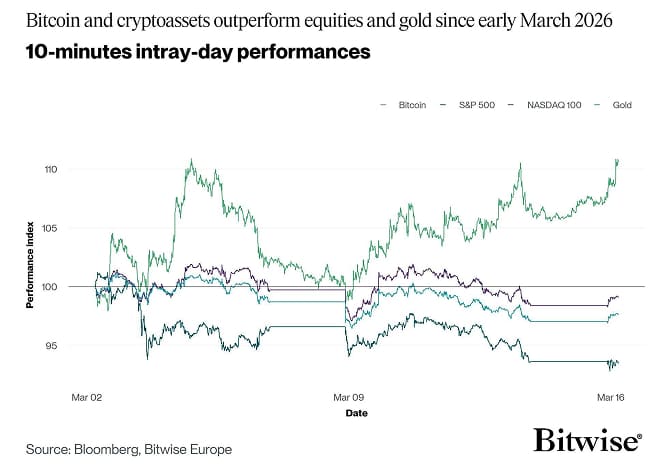
- Performance: Bitcoin and other major cryptoassets have begun to outperform traditional assets such as US equities and gold since early March. While this may signal an early rotation from safe-haven assets into risk assets, tighter financial conditions and rising yields could still lead to elevated volatility in the near term.
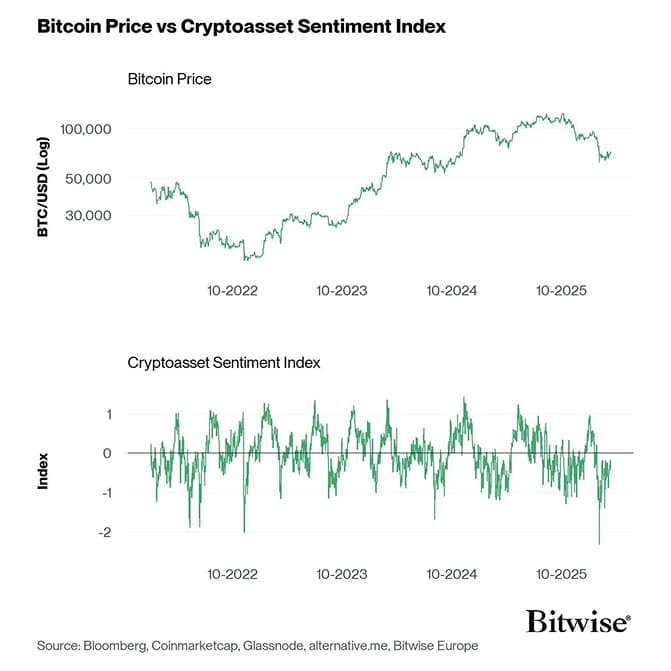
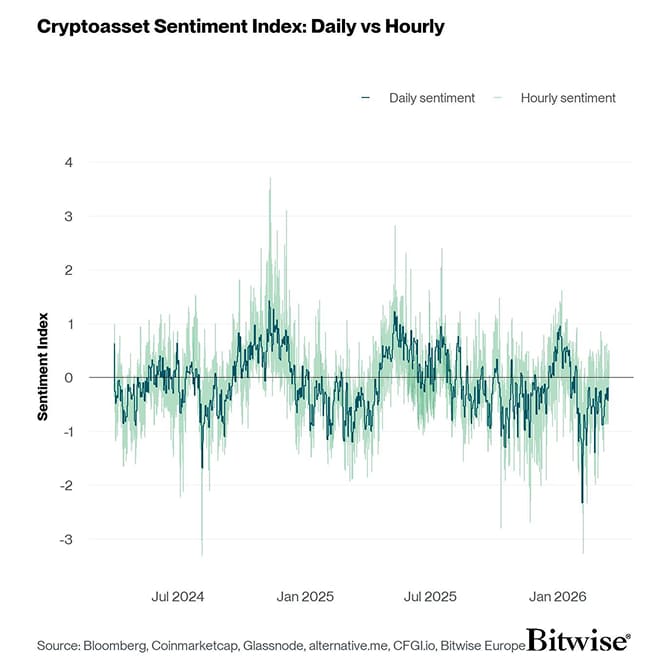
- Sentiment: The latest Cryptoasset Sentiment Index increased slightly but continues to indicate slightly bearish sentiment, suggesting investors remain cautious amid geopolitical and macro uncertainty.
- Chart-of-the-Week: This week’s chart shows cryptoassets outperforming US equities and gold since early March. Historically, gold performance has tended to lead bitcoin by around 4–7 months, which may imply potential support for bitcoin going forward.
Chart of the Week
Rotation starting? Cryptoassets outperform on rising inflation expectations
 Source: Bloomberg, Bitwise Europe
Performance
Geopolitical risks currently remain the dominant force shaping the market environment.
Our historical analyses indicate that such episodes are typically short-lived, with bitcoin often delivering above-average returns after periods of heightened geopolitical tension as highlighted in one of our previous Crypto Market Compass reports.
That said, geopolitical risks have already reached their highest level since 9/11, while the present oil supply shock caused by the closure of the Strait of Hormuz is the largest on record. Consequently, these developments could weigh on bitcoin and other cryptoassets for a longer period, particularly against the backdrop of ongoing de-dollarisation.
It is also important to note that the rise in commodities initially stemmed from a classic surge in Chinese demand as highlighted in our latest Bitcoin Macro Investor report - the latest geopolitical tensions have merely layered an additional supply shock on top.
From a macro perspective, periods of global reflation have historically coincided with bitcoin bull markets (see our chart-of-the-month here ). These phases also tend to align with expansions in the ISM Manufacturing Index. Rising market-based inflation expectations have historically correlated with positive bitcoin performance (though this relationship is not guaranteed to persist and may reverse under different macroeconomic conditions) especially since the Covid period as highlighted here as well.
In fact, bitcoin and other major cryptoassets have started to outperform traditional assets like US equities and gold since the beginning of March (Chart-of-the-week).
This may represent an early sign of a potential rotation, especially from stretched safe-haven assets like gold into more risky assets like bitcoin, though alternative explanations for recent price movements remain equally plausible, including temporary volatility patterns or isolated liquidity events. This would align well with the historical performance patterns seen during periods of rising economic activity and inflation expectations described above. Historically speaking, gold performances tend to lead bitcoin performances by 4-7 months as highlighted here.
However, higher inflation expectations also contribute to tighter financial conditions through rising bond yields, which in turn restrain money supply growth and may act as a headwind for bitcoin and other cryptoassets going forward. This dynamic is likely to result in elevated volatility until markets fully absorb the impact of higher energy prices and bond yields.
Signs of tightening financial conditions are already visible in the underperformance of private credit and leveraged loans. Bitcoin's recent weakness could be an early signal of this shift, as the asset often acts as a “canary in the macro coal mine.”
In fact, rates markets have already priced out a whole Fed rate cut in March compared to expectations per the end of February. Rising rate hike expectations could cause additional volatility for cryptoassets that rather tend to benefit from loosening monetary policy. This is a risk worth watching over the coming weeks.
Nonetheless, bitcoin is currently trading at what our proprietary macro fair value model estimates to be the largest ‘macro discount' on record as highlighted here. The implication is that, even if a global recession were to materialise, it appears that much of this risk may already be reflected in bitcoin's price, thereby somewhat limiting downside risks at current levels, however further price declines remain possible regardless of current valuation metrics.
At the same time, demand from global bitcoin ETPs and treasury companies has begun to recover, with these buyers now absorbing more than the daily issuance of new supply.
According to our estimates based on Bloomberg data, global bitcoin ETPs likely purchased around 11.2k BTC last week.
In addition, Michael Saylor's Strategy alone has likely acquired approximately 11k BTC via at-the-market issuances of STRC securities alone according to estimates by strc.live. Strategy has most likely also issued additional common stock MSTR at-the-market as observed in previous weeks that could even exceed the proceeds via STRC issuances. That means that Strategy alone most likely absorbed at least 3.5 times the new supply of bitcoins last week. This appears to be providing a significant support for bitcoin right now.
Cross Asset Performance (Week-to-Date)
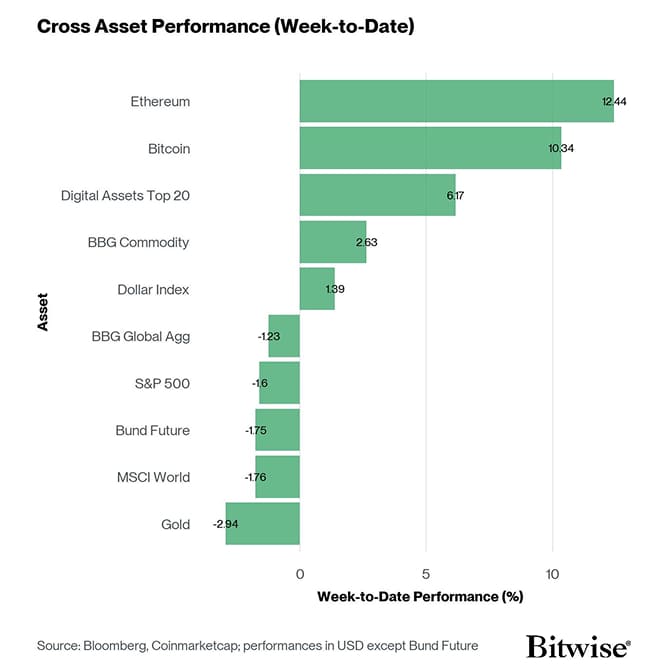 Source: Bloomberg, Coinmarketcap; performances in USD exept Bund Future
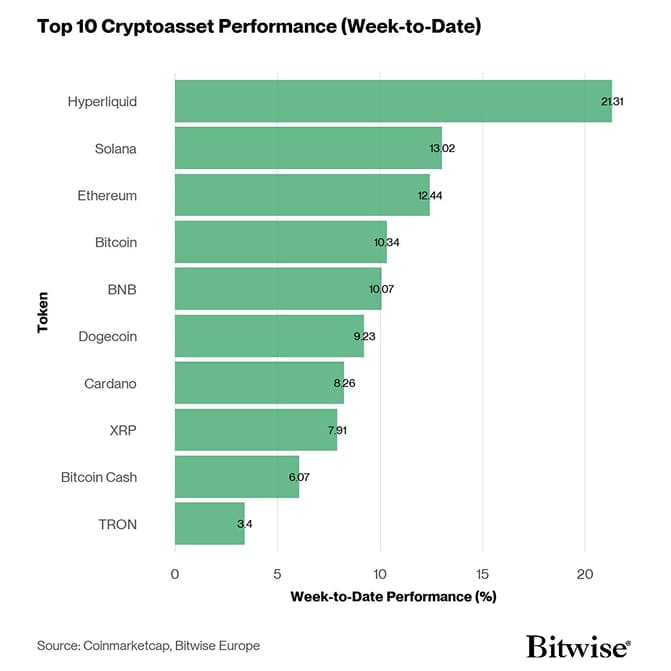
Top 10 Cryptoasset Performance (Week-to-Date)
Source: Bloomberg, Coinmarketcap; performances in USD exept Bund Future
Top 10 Cryptoasset Performance (Week-to-Date)
 Source: Coinmarketcap
In general, among the top 10 crypto assets Hyperliquid, Solana, and Ethereum were the relative outperformers.
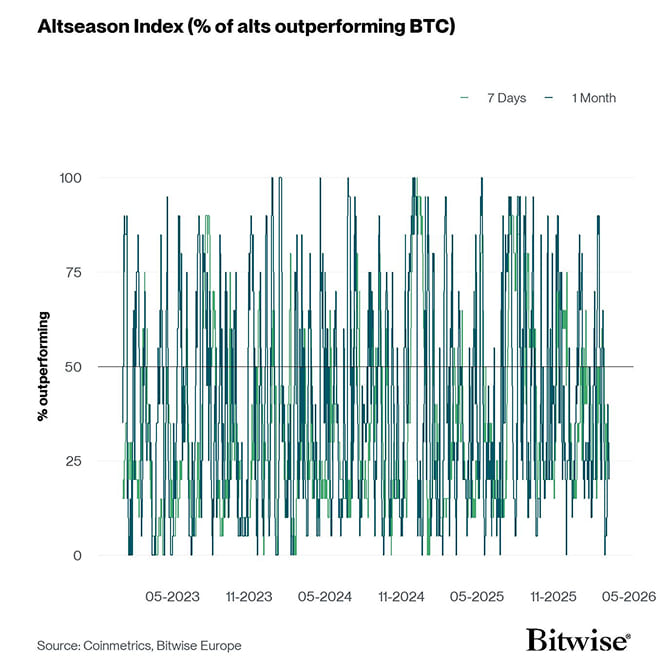
Overall, altcoin outperformance vis-à-vis bitcoin increased somewhat last week, with 20% of our tracked altcoins managing to outperform bitcoin on a weekly basis. Ethereum also outperformed bitcoin last week.
Sentiment
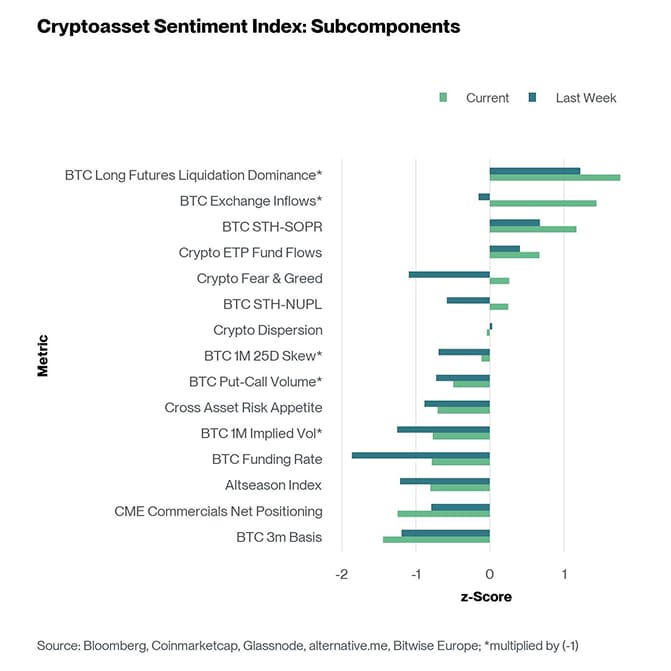
Our in-house “Cryptoasset Sentiment Index” still signals negative sentiment although this has significantly improved week over week. While crypto has outperformed this week, investor positioning remains cautious by our measure. Historically, some periods of depressed sentiment accompanied by improving trend have preceded risk appetite recoveries.
At the moment, 6 out of 15 indicators are above their short-term trend.
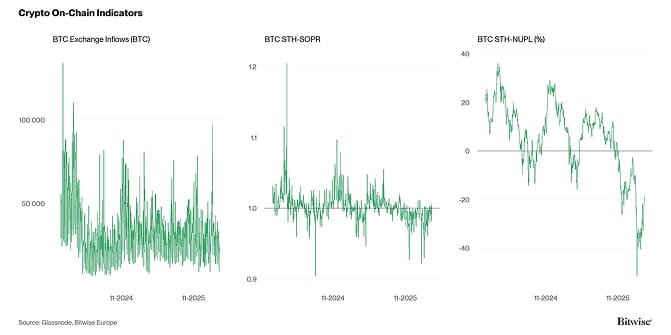
Last week, the BTC Exchange Inflows, BTC STH SOPR, BTC STH-NUPL, BTC Long Futures Liquidations, Crypto Fund Flows, and Crypto Fear and Greed showed positive momentum.
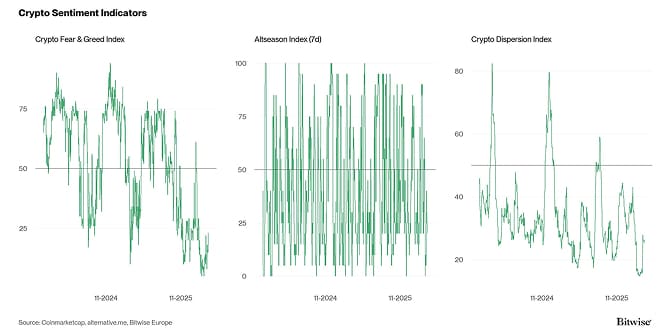
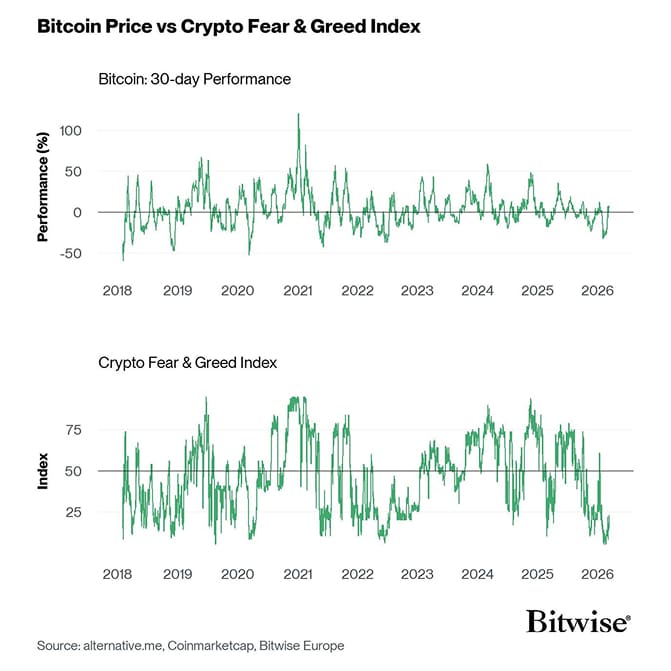
The Crypto Fear & Greed Index continues to signal an “extreme fear” level of sentiment as of this morning, although it currently sits at the highest level since the end of January. February experienced two of the lowest three readings on record.
Performance dispersion among cryptoassets decreased slightly last week from 0.27 to 0.26. When dispersion is decreasing, it may indicate that the market appears to be driven by a less diverse set of narratives which, in our analysis, has historically been associated with periods of decreasing risk appetite in prior market cycles. However, this week's almost flat dispersion is not incongruent with increasing sentiment, rather its suggesting strength is concentrated in the large-cap crypto assets.
Altcoin outperformance vis-à-vis Bitcoin increased somewhat last week, with 20% of our tracked altcoins in the index. This may be partially explained by the increase in sentiment, and stronger fund flows.
In general, increasing altcoin outperformance may be a sign of increasing risk appetite within cryptoasset markets.
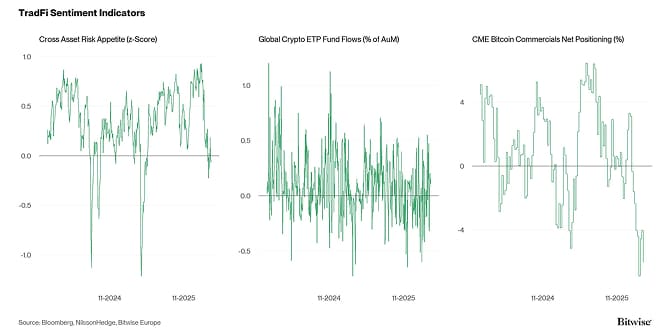
Sentiment in traditional financial markets as measured by our in-house measure of Cross Asset Risk Appetite (CARA) increased to -0.05 over the past week which is signalling less negative sentiment in traditional financial markets.
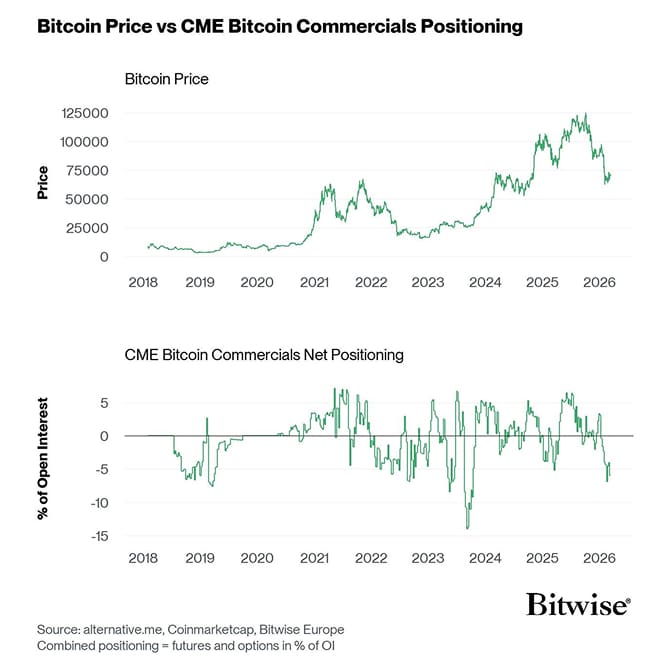
CME Bitcoin Commercials Net Positioning, which shows the difference between long and short CME Bitcoin futures contracts declined from –4.03 to –5.97. This suggests institutions continue to be biased toward selling futures as the outlook for BTC is possibly skewed to the downside, as BTC stays range bound.
Fund Flows
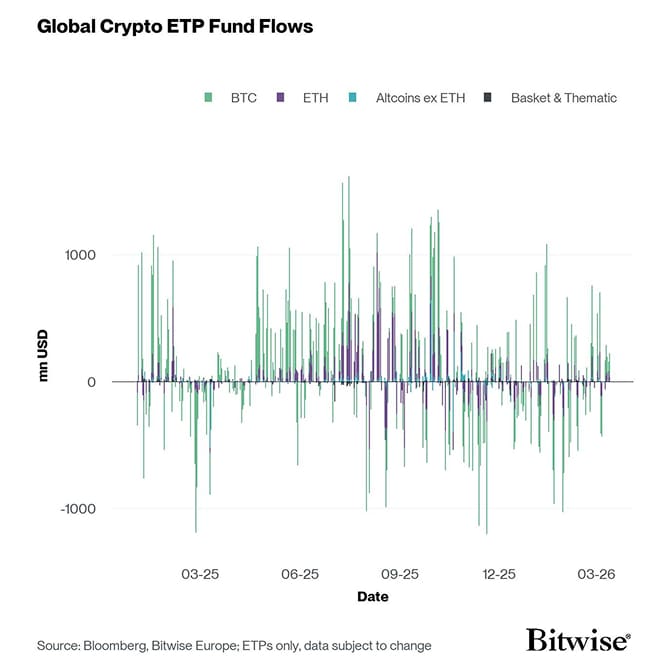
Global crypto ETPs saw net inflows last week across all Bitcoin, Ethereum, Altcoins Ex-Ethereum, and basket and thematic products.
Global crypto ETPs saw around +963.8 mn USD in weekly net inflows across all types of cryptoassets, after +594.9 mn USD in net inflows the previous week.
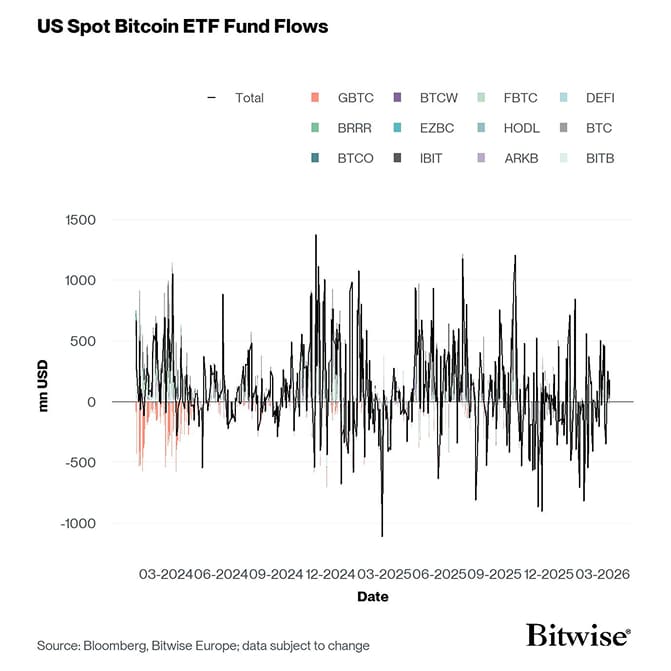
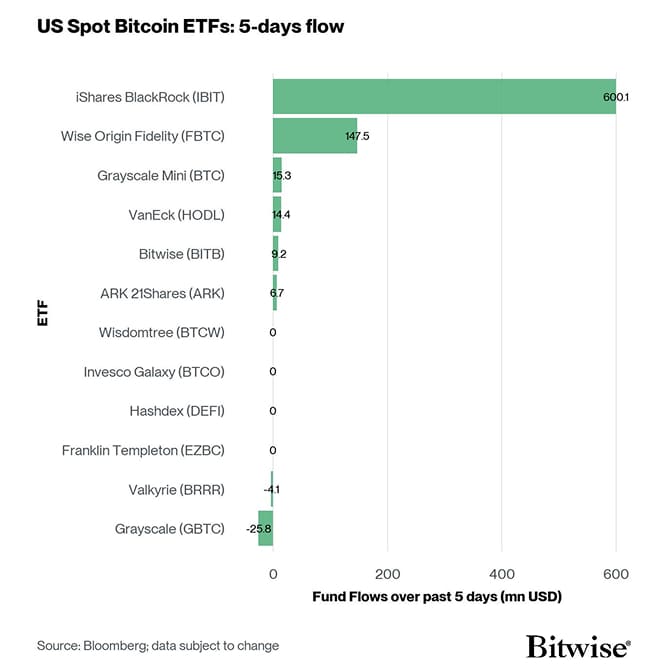
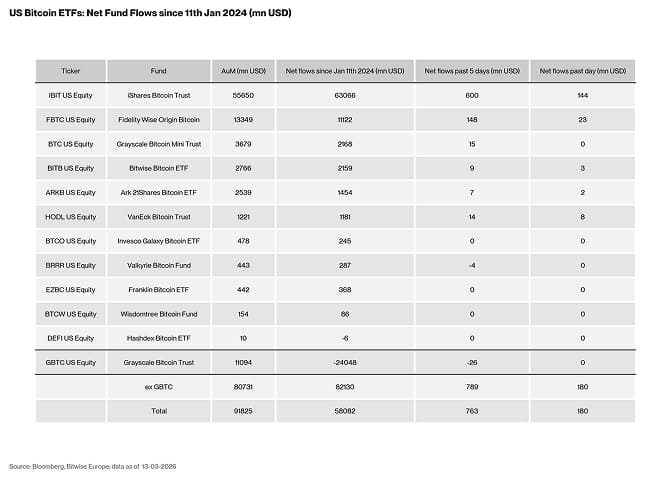
Global Bitcoin ETPs have experienced net inflows totalling +788.3 mn USD last week, of which +763.2 mn USD in net inflows were related to US spot Bitcoin ETFs.
The Bitwise Bitcoin ETF (BITB) in the US experienced net inflows, totalling +9.2 mn USD last week.
In Europe, the Bitwise Physical Bitcoin ETP (BTCE) experienced net outflows equivalent to –2.3 mn USD, whereas the Bitwise Core Bitcoin ETP (BTC1) experienced net inflows of +5.5 mn USD.
The Grayscale Bitcoin Trust (GBTC) posted net outflows of –25.8 mn USD and the iShares Bitcoin Trust (IBIT) experienced net inflows of around +600.1 mn USD last week.
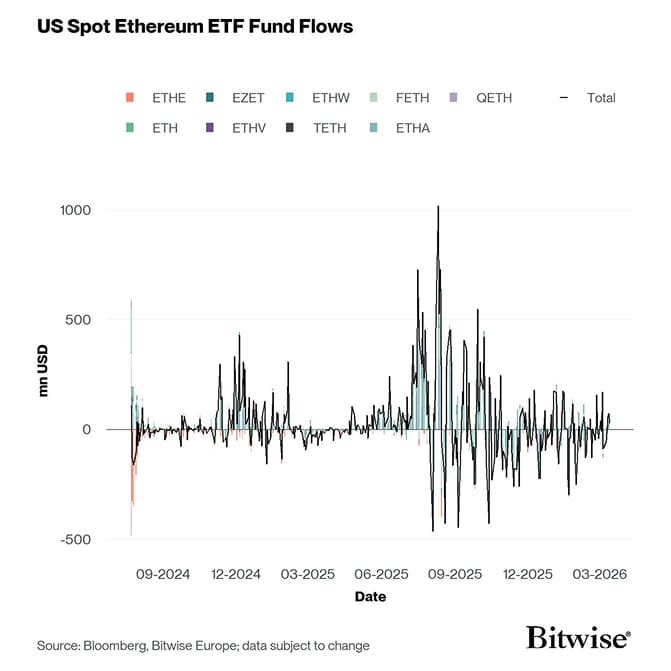
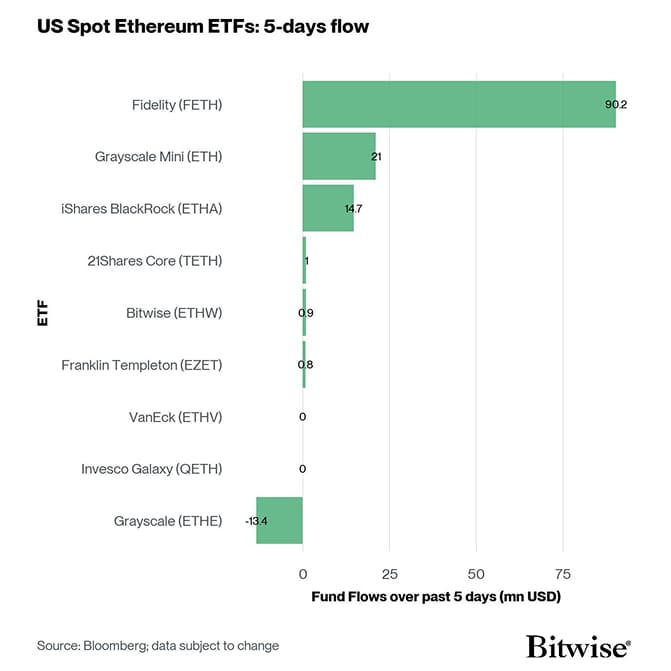
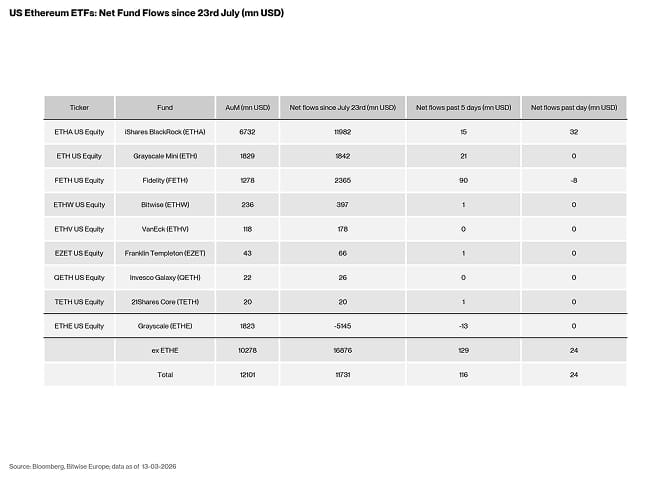
Meanwhile, global Ethereum ETPs also experienced +160.3 mn USD in net inflows last week, of which US spot Ethereum ETFs recorded net inflows of around +115.2 mn USD on aggregate.
The Grayscale Ethereum Trust (ETHE) posted net outflows of -13.4 mn USD, alongside the iShares Ethereum Trust (ETHA) that experienced +14.7 mn USD of net inflows.
The Bitwise Ethereum ETF (ETHW) in the US has posted net inflows of +0.9 mn USD.
In Europe, the Bitwise Physical Ethereum ETP (ZETH) saw minor net inflows of +1.1 mn USD, as the Bitwise Ethereum Staking ETP (ET32) saw +2.5 mn USD of net inflows.
Altcoin ETPs ex Ethereum experienced net inflows of +11 mn USD last week.
Thematic & basket crypto ETPs posted net inflows of +4.3 mn USD on aggregate last week. The Bitwise MSCI Digital Assets Select 20 ETP (DA20) experienced no net inflows last week of +/-0.0 mn USD on aggregate.
On-Chain Data
Bitcoin continues to experience elevated local volatility, opening the week near $66k, rallying to $74k, and currently trading around $72k at the time of writing.
The market has now posted seven consecutive positive daily closes, a streak last seen in April 2025. Such occurrences remain uncommon, with only 57 comparable instances historically recorded, underscoring the strength of the recent momentum impulse.
Exchange-side sell pressure flipped positive for the first time in a month, with the intraday spot buy–sell imbalance closing near +$166mn (vs –$835mn the prior week). However, aggregate exchange inflows and outflows contracted to $3.2bn from $4.5bn, marking the lowest activity level since October 2024.
This divergence suggests that, despite the recent price recovery, overall market participation remains subdued, with investors continuing to adopt a broadly defensive posture amid elevated macro uncertainty.
Aggregate investor stress remains elevated, although early signs of moderation are emerging. The value of invested capital held at a loss is estimated at ~$773bn (~71% of Realised Cap), while unrealised losses across underwater supply sit near –$210bn. While the recent rally has alleviated some unrealised pressure, the persistence of a large underwater cohort continues to weigh on sentiment and still somewhat contributes to a fragile market structure.
The elevated unrealised pressure across market participants continues to translate into realised losses. Spending activity among the average investor, new entrants and more mature cohorts remains loss-dominant, indicating that distribution at a loss is occurring across all investor groups. Net realised losses currently stand near -$456mn, although the pace of loss-taking has begun to moderate.
From a technical perspective, the prevailing market bounds remain broadly unchanged, defined by the cycle low near $60k and the $80k region from which the recent contraction accelerated. Notably, price has remained contained within this range since the 31st of January, reinforcing its importance as the dominant trading structure.
The Short-Term Holder cost basis, representing the average acquisition price of newer market participants, continues to decline, currently sitting near $84k. Historically, this level has acted as a key delineator between local bullish and bearish conditions. In conjunction with the True Market Mean at $78k, these price zones have historically served as important thresholds to be reclaimed and held in order for positive momentum to re-establish.
Between $70k and $80k, the on-chain volume profile remains relatively sparse, indicating limited coin transfer activity as price moved rapidly through this region during the downturn. Zones characterised by low supply density are typically easier for price to traverse, as fewer investors hold supply within the range. In contrast, dense supply clusters tend to create higher sensitivity to price fluctuations, as a larger cohort of investors becomes directly impacted by marginal moves.
Overall, Bitcoin has staged a short-term recovery posting seven consecutive days of positive performance, a relatively rare occurrence historically, as price advanced from the mid-$60k region toward local highs near $74k. Despite this improvement in directional strength, broader market structure continues to reflect a range-bound regime between $60k and $80k, with repeated rejections in the mid-$70k region reinforcing the importance of overhead resistance.
Futures, Options & Perpetuals
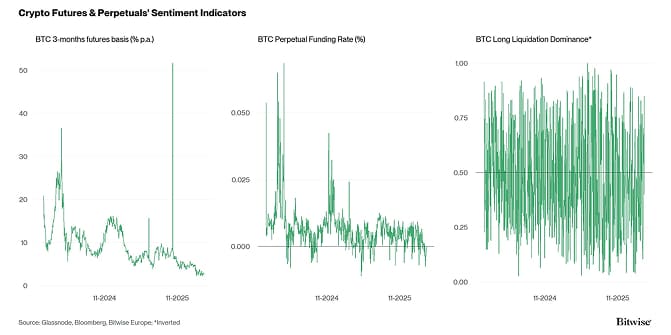
Over the past week, BTC perpetual futures open interest declined by approximately -14.3k BTC, while CME futures open interest increased by around +4.8k BTC, suggesting a modest uptick in institutional positioning. Aggregate futures liquidations across all assets remained elevated, though below the prior week's levels, with the majority of forced closures occurring on short positions as price trended higher. In total, liquidations reached roughly $1.6bn over the week (vs. $2.6bn previously).
However, from a positioning perspective, open interest has continued to build around the $74k region over the past two weeks, closely tracking the recent local high. This growing concentration highlights $74k as a key trigger level, where a sustained breakout could force the liquidation of outstanding short positions, potentially accelerating price toward the upper bound of the broader range. On the downside, incremental open interest accumulation around $62.5k further reinforces the significance of the $60k region as structural support within the prevailing range regime.
Perpetual funding rates (7-day moving average) have remained in negative territory, suggesting that futures positioning continues to tilt toward downside expectations. This now marks the second consecutive week of persistently negative funding, the longest such stretch since the Trump-tariff shock. Historically, extended periods of negative funding have coincided with phases of leverage compression and broader sentiment resets. As excess positioning is gradually cleared, these dynamics can help lay the groundwork for improved market stability.
In parallel, the BTC 3-month annualised basis remains depressed at 2.7%. At present, basis remains well below prevailing US Treasury bill yields, highlighting acute risk aversion and subdued demand for leveraged long exposure among market participants.
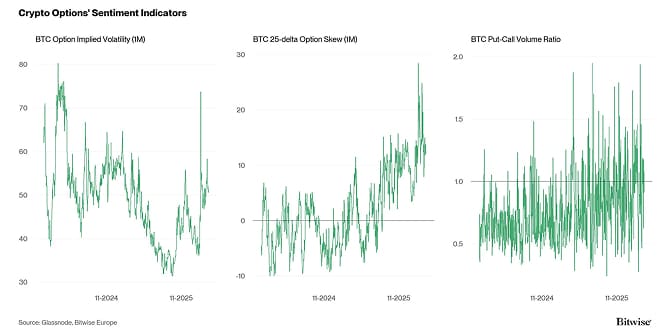
Turning to options markets, BTC options open interest declined modestly by approximately 22.6k BTC, bringing total open interest to 483.3k BTC. Notably, the Deribit put-to-call open interest ratio continued to ease, falling from 0.70 to 0.68. This marks a meaningful moderation in put dominance over the past two weeks, with the ratio having reached as high as 0.84 on 28 February. The equivalent measure across IBIT options remained broadly unchanged at 0.66 by week's end. Taken together, these dynamics suggest demand for downside protection is beginning to soften following the recent improvement in price performance.
The 25-delta skew compressed further across the term structure this week, pointing to a continued softening in demand for downside protection in both short- and medium-dated maturities. Nevertheless, skew levels remain elevated in absolute terms, suggesting that while hedging pressure is easing on the margin, investor positioning still reflects a broadly defensive bias.
Total GEX (7-day moving average) has declined materially from $4.5bn to $2.6bn. Although aggregate gamma exposure remains deeply negative, indicating dealers are still structurally short convexity, the reduction in magnitude suggests the intensity of volatility amplification may be beginning to ease.
The bulk of negative gamma is clustered around the $75k strike, implying that dealer hedging flows may turn into spot buying pressure above this level. Notably, both futures and options highlight $74-$75k as an important price level.
Bottom Line
- Performance: Bitcoin and other major cryptoassets have begun to outperform traditional assets such as US equities and gold since early March. While this may signal an early rotation from safe-haven assets into risk assets, tighter financial conditions and rising yields could still lead to elevated volatility in the near term.
- Sentiment: The latest Cryptoasset Sentiment Index increased slightly but continues to indicate slightly bearish sentiment, suggesting investors remain cautious amid geopolitical and macro uncertainty.
- Chart-of-the-Week: This week’s chart shows cryptoassets outperforming US equities and gold since early March. Historically, gold performance has tended to lead bitcoin by around 4–7 months, which may imply potential support for bitcoin going forward.
Appendix
Bitcoin Price vs Cryptoasset Sentiment Index
 Source: Bloomberg, Coinmarketcap, Glassnode, NilssonHedge, alternative.me, Bitwise Europe
Cryptoasset Sentiment Index: Subcomponents
Source: Bloomberg, Coinmarketcap, Glassnode, NilssonHedge, alternative.me, Bitwise Europe
Cryptoasset Sentiment Index: Subcomponents
 Source: Bloomberg, Coinmarketcap, Glassnode, NilssonHedge, alternative.me, Bitwise Europe; *multiplied by (-1)
TradFi Sentiment Indicators
Source: Bloomberg, Coinmarketcap, Glassnode, NilssonHedge, alternative.me, Bitwise Europe; *multiplied by (-1)
TradFi Sentiment Indicators
 Source: Bloomberg, NilssonHedge, Bitwise Europe
Crypto Sentiment Indicators
Source: Bloomberg, NilssonHedge, Bitwise Europe
Crypto Sentiment Indicators
 Source: Coinmarketcap, alternative.me, Bitwise Europe
Crypto Options' Sentiment Indicators
Source: Coinmarketcap, alternative.me, Bitwise Europe
Crypto Options' Sentiment Indicators
 Source: Glassnode, Bitwise Europe
Crypto Futures & Perpetuals' Sentiment Indicators
Source: Glassnode, Bitwise Europe
Crypto Futures & Perpetuals' Sentiment Indicators
 Source: Glassnode, Bitwise Europe; *Inverted
Crypto On-Chain Indicators
Source: Glassnode, Bitwise Europe; *Inverted
Crypto On-Chain Indicators
 Source: Glassnode, Bitwise Europe
Bitcoin vs Crypto Fear & Greed Index
Source: Glassnode, Bitwise Europe
Bitcoin vs Crypto Fear & Greed Index
 Source: alternative.me, Coinmarketcap, Bitwise Europe
Cryptoasset Sentiment Index: Daily vs Hourly
Source: alternative.me, Coinmarketcap, Bitwise Europe
Cryptoasset Sentiment Index: Daily vs Hourly
 Source: Bloomberg, Coinmarketcap, Glassnode, NilssonHedge, alternative.me, CFGI.io, Bitwise Europe
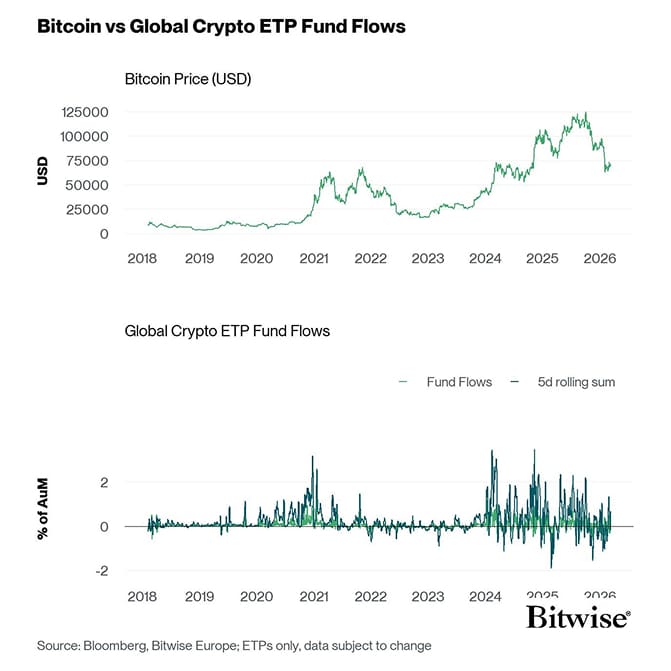
Bitcoin vs Global Crypto ETP Fund Flows
Source: Bloomberg, Coinmarketcap, Glassnode, NilssonHedge, alternative.me, CFGI.io, Bitwise Europe
Bitcoin vs Global Crypto ETP Fund Flows
 Source: Bloomberg, Bitwise Europe; ETPs only, data subject to change
Global Crypto ETP Fund Flows
Source: Bloomberg, Bitwise Europe; ETPs only, data subject to change
Global Crypto ETP Fund Flows
 Source: Bloomberg, Bitwise Europe; ETPs only; data subject to change
US Spot Bitcoin ETF Fund Flows
Source: Bloomberg, Bitwise Europe; ETPs only; data subject to change
US Spot Bitcoin ETF Fund Flows
 Source: Bloomberg, Bitwise Europe; data subject to change
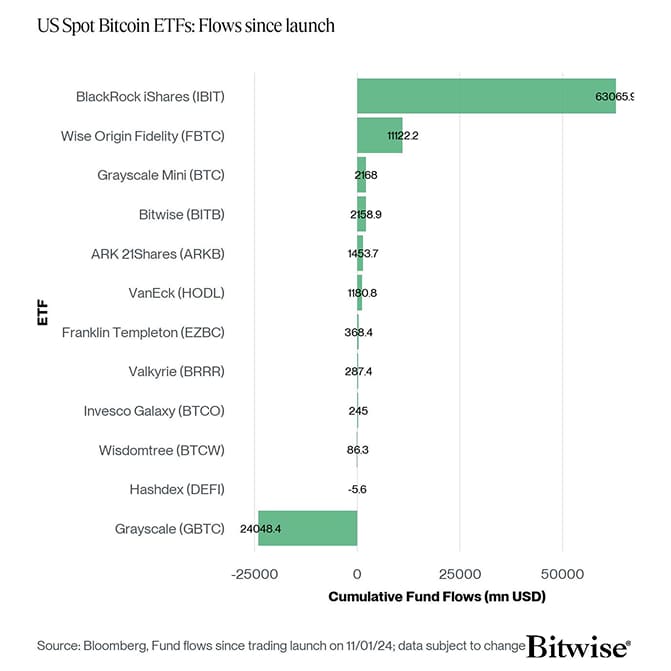
US Spot Bitcoin ETFs: Flows since launch
Source: Bloomberg, Bitwise Europe; data subject to change
US Spot Bitcoin ETFs: Flows since launch
 Source: Bloomberg, Fund flows since traiding launch on 11/01/24; data subject to change
US Spot Bitcoin ETFs: 5-days flow
Source: Bloomberg, Fund flows since traiding launch on 11/01/24; data subject to change
US Spot Bitcoin ETFs: 5-days flow
 Source: Bloomber; data subject to change
US Bitcoin ETFs: Net Fund Flows since 11th Jan mn USD
Source: Bloomber; data subject to change
US Bitcoin ETFs: Net Fund Flows since 11th Jan mn USD
 Source: Bloomberg, Bitwise Europe; data as of 13-03-2026
US Spot Ethereum ETF Fund Flows
Source: Bloomberg, Bitwise Europe; data as of 13-03-2026
US Spot Ethereum ETF Fund Flows
 Source: Bloomberg, Bitwise Europe; data subject to change
US Spot Ethereum ETFs: Flows since launch (mn USD)
Source: Bloomberg, Bitwise Europe; data subject to change
US Spot Ethereum ETFs: Flows since launch (mn USD)
 Source: Bloomberg, Fund flows since trading launch on 23/07/24; data subject on change
US Spot Ethereum ETFs: 5-days flow
Source: Bloomberg, Fund flows since trading launch on 23/07/24; data subject on change
US Spot Ethereum ETFs: 5-days flow
 Source: Bloomberg; data subject on change
US Ethereum ETFs: Net Fund Flows since 23rd July (mn USD)
Source: Bloomberg; data subject on change
US Ethereum ETFs: Net Fund Flows since 23rd July (mn USD)
 Source: Bloomberg, Bitwise Europe; data as of 13-03-2026
Bitcoin Price vs CME Bitcoin Commercials Positioning
Source: Bloomberg, Bitwise Europe; data as of 13-03-2026
Bitcoin Price vs CME Bitcoin Commercials Positioning
 Source: alternative.me, Coinmarketcap, Bitwise Europe
Combined positioning = futures and options in % of Ol
Altseason Index (% of alts outperforming BTC)
 Source: Coinmetrics, Bitwise Europe
Bitcoin vs Crypto Dispersion Index
Source: Coinmetrics, Bitwise Europe
Bitcoin vs Crypto Dispersion Index
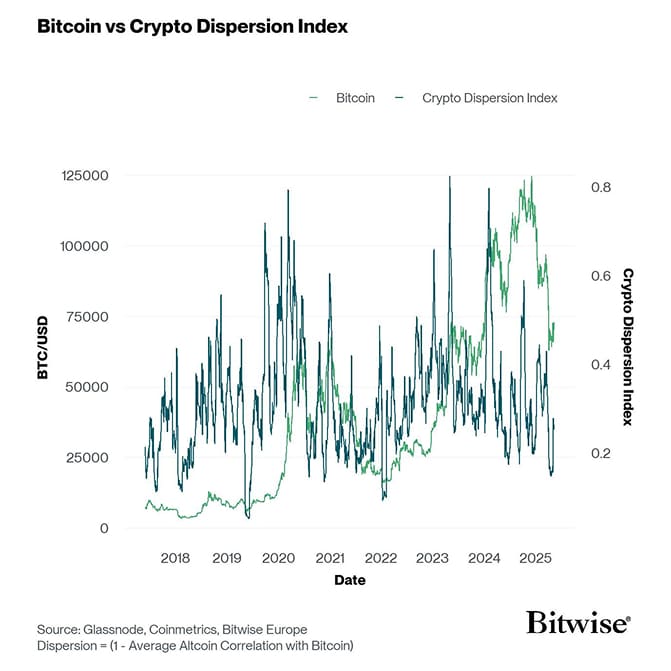 Source: Coinmarketcap, Bitwise Europe; Dispersion = (1 - Average Altcoin Correlation with Bitcoin)
Bitcoin Price vs Futures Basis Rate
Source: Coinmarketcap, Bitwise Europe; Dispersion = (1 - Average Altcoin Correlation with Bitcoin)
Bitcoin Price vs Futures Basis Rate
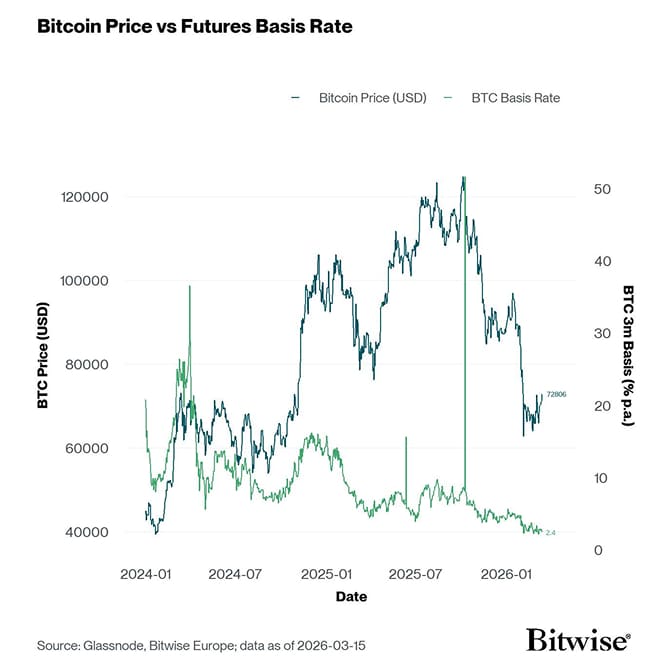 Source: Glassnode, Bitwise Europe; data as of 2026-03-15
Ethereum Price vs Futures Basis Rate
Source: Glassnode, Bitwise Europe; data as of 2026-03-15
Ethereum Price vs Futures Basis Rate
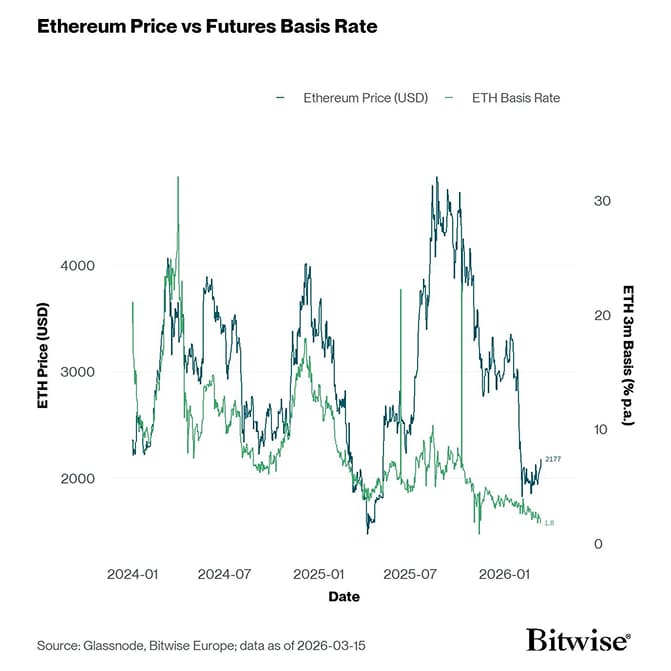 Source: Glassnode, Bitwise Europe; data as of 2026-03-15
BTC Net Exchange Volume by Size
Source: Glassnode, Bitwise Europe; data as of 2026-03-15
BTC Net Exchange Volume by Size
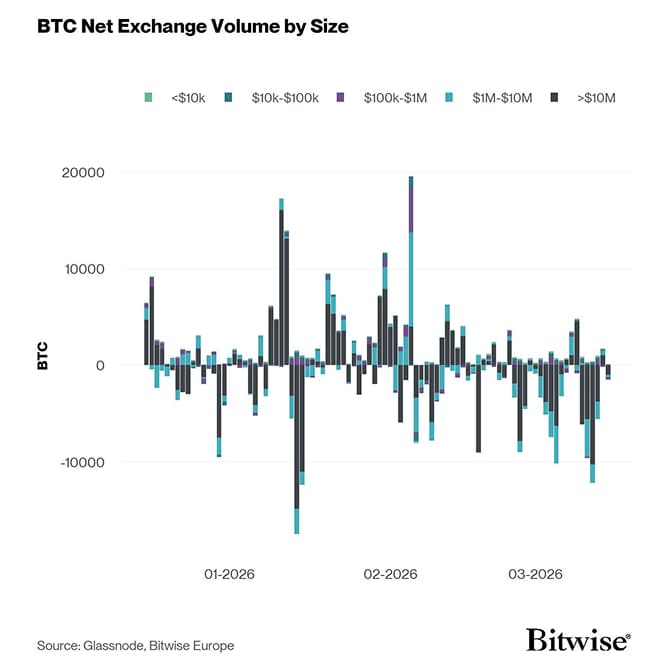 Source: Glassnode, Bitwise Europe
Important Information
This material is intended solely for professional investors and is not suitable for retail distribution and reliance. The information provided in this material is for illustrative, educational or information purposes only and does not constitute investment advice, a recommendation or solicitation of an offer to buy any product or to make any investment.
This document (which may be subject to change and may be in the form of a presentation, press release, social media post, blog post, broadcast communication or similar instrument – we refer to this category of communications generally as a “document” for purposes of this disclaimer) is issued by Bitwise Europe GmbH (“BEU” or “the Issuer”). This document has been prepared in accordance with applicable laws and regulations (including those relating to financial promotions).
Bitwise Europe GmbH, incorporated under the laws of Germany, is the issuer of Exchange Traded Products (“ETPs”) described in this document under a base prospectus and final terms, which may be supplemented from time to time, and which are approved by BaFin. If you are considering investing in products issued by BEU you should check with independent financial adviser, your broker or bank that such products are available in your jurisdiction and suitable for your investment profile. A decision to invest any amount in an ETPs offered by BEU should take into consideration your specific circumstances after seeking independent investment, tax and legal advice.
Capital at risk. Cryptoassets are high-risk and volatile. The value of investments in cryptoassets and crypto-linked ETPs may fall as well as rise, and investors may lose some or all of their invested capital. No investor protection or compensation scheme applies. Past performance is not a reliable indicator of future results. Forward-looking statements are not guarantees.
You should read the relevant base prospectus and final terms before investing and, in particular, the section entitled ‘Risk Factors' for further details of risks associated with an investment. The prospectuses, final terms and other documents relevant to BEU's ETPs are available under the “Resources” section at www.bitwiseinvestments.com. When visiting this website, you will need to self-certify as to your jurisdiction and investor type in order to access these documents, and in so doing you may be subject to other disclaimers and important information.
Important Analytical Limitations: The observations and analyses presented in this document are based on historical market patterns and data correlations which may not repeat or continue in future market conditions. Past correlations between capital flows and performance metrics are not indicative of future performance and should not be extrapolated as predictive indicators. Material downside risks remain present across all investment timeframes regardless of current undervaluation metrics or favorable technical indicators. All model outputs, fair value calculations, and quantitative assessments are subject to significant uncertainty and methodological limitations, and should not be relied upon as the sole basis for making investment decisions. Investors should conduct independent due diligence and consider multiple factors beyond the scope of this analysis.
Read the full disclaimer here: https://bitwiseinvestments.eu/disclaimer/