- Base’s growing USDC activity gives it flexibility, but staying anchored to Ethereum still makes the most economic and strategic sense at this point in time.
- A token spin-off looks less likely than some expect, but the potential valuation upside still makes the regulatory risk-reward trade-off requiring careful assessment.
- A token launch could provide governance and strengthen ecosystem value, whilst finding ways to monetise through USDC-based economics.
Introduction
Base, Coinbase's Layer 2, marked its first major expansion into DeFi. The aim was to extend the exchange's reach by bringing off-chain users on-chain while offering institutional-grade services to existing on-chain participants. Coinbase partnered with Optimism, also a L2, which operates a permissionless infrastructure stack open for shared development, governance and ecosystem funding. However, alignment weakened, and Base recently announced a move to its own stack to gain greater control over development. The timing has amplified speculation that it could eventually transition to a Layer 1, as the decision arrives amid broader shifts in Ethereum's scaling narrative.
Vitalik's perceived hardening towards L2s, emphasising that rollups must differentiate through application-layer innovation rather than rely on cheaper execution, marks a shift away from a previously L2-centric roadmap. This introduces strategic uncertainty that Base may be unwilling to tolerate, strengthening the case for greater independence.
But, in this Espresso, we argue that Ethereum currently represents an attractive arrangement for Base: security costs are low, interoperability is improving, and USDC transfer volumes remain resilient despite weaker ETH-denominated bridging. This progress also creates strategic optionality, giving Base credible leverage to exit or realign if conditions deteriorate.
The move away from the Optimism stack may mark an initial step towards a governance token launch. We also consider whether Base could integrate USDC as a gas asset, strengthening its positioning as an Ethereum L2 while reinforcing the structural flywheel between Circle, Base, and Coinbase.
The Rise of Base:
For Base to ever rationally consider a break from Ethereum, it must first demonstrate the ability to sustain independent growth and durable network effects. No execution environment abandons a dominant settlement layer unless doing so improves its long-term growth prospects and strengthens its own monetary gravity.
In this section, we examine the growth of Base, specifically stablecoin balances, transfer volumes, and non-zero addresses, to determine how capital is behaving on the chain relative to leading competitors.
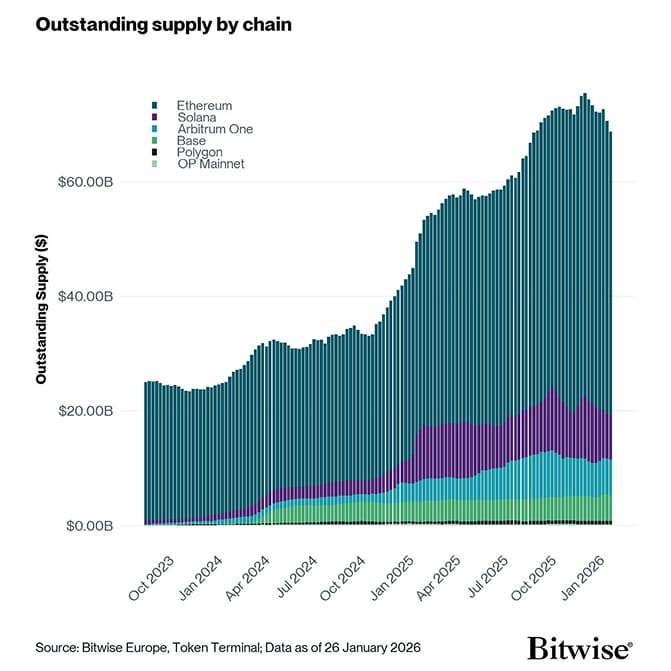
Starting with outstanding USDC supply, which provides a direct view of where stablecoin balances are held across chains, Ethereum continues to anchor the majority of supply at approximately $52.6bn, representing around 71% of tracked circulation (~$74.3bn total). Solana holds approximately $8.0bn (11%), followed by Arbitrum One at $6.2bn (8%) and Base at $4.7bn (6%).
Outstanding supply by chain
 Source: Bitwise Europe, Token Terminal; Data as of 26 January 2026
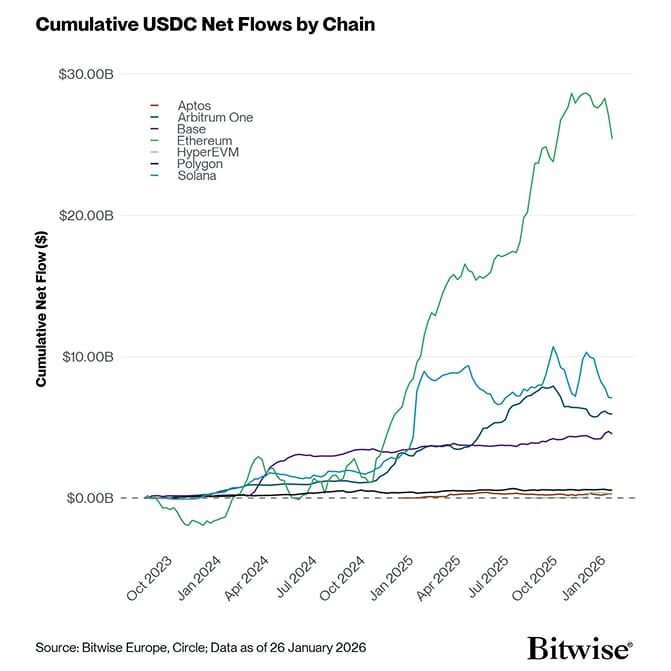
Net USDC issuance (minting minus burning) reflects where liquidity is accumulating, rather than where capital is merely transiting. This distinction matters because USDC is the dominant quote currency for DeFi on ETH, underpinning pricing, lending, leverage, and market-making. As a result, sustained changes in where USDC is issued and retained materially shape where on-chain financial activity can scale.
Since Base's launch, Ethereum has remained the dominant monetary root for USDC issuance. Cumulative net issuance continues to concentrate on L1, with Ethereum absorbing approximately $28.8bn USDC in net flows. This reflects Ethereum's role as the primary coordination and trust layer for stablecoin liquidity.
However, incremental issuance is no longer exclusive to Ethereum. Over the same period, Base has accumulated approximately $4.7bn USDC in net issuance, placing it alongside Solana ($4.3bn USDC) and ahead of other L1 or L2s including BNB Chain, Arbitrum One, and Polygon.
The pace and persistence of issuance growth on Base are notable, indicating that new USDC is increasingly being minted and retained on Base, rather than merely routed through it. This suggests a strong product–market fit as a venue for deploying and recycling dollar liquidity.
Cumulative USDC Net Flows by Chain
 Source: Bitwise Europe, Circle; Data as of 26 January 2026
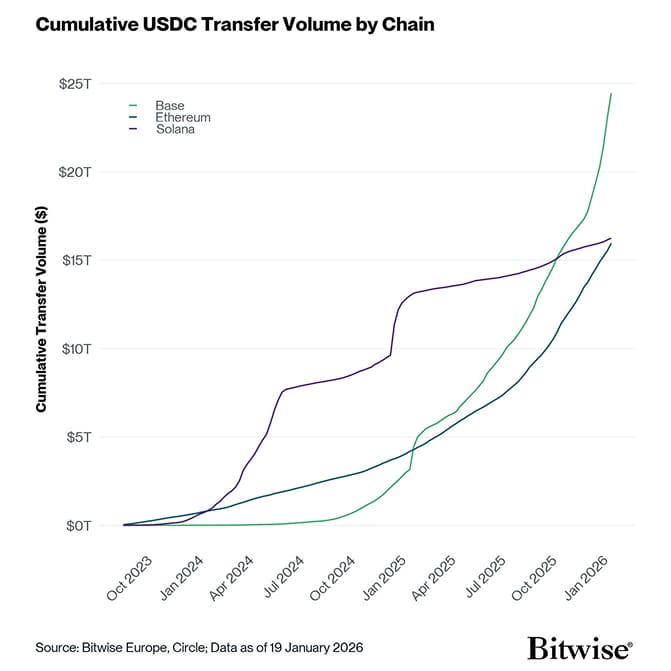
In addition, Base has rapidly emerged as a dominant execution layer for dollar-denominated value. Since launch, cumulative USDC transfer volume on Base has reached approximately $23.0tn, surpassing both Ethereum ($15.5tn) and Solana ($16.1tn). This outperformance suggests capital is not just held on Base, but actively executed on it at scale.
Cumulative USDC Transfer Volume by Chain
 Source: Bitwise Europe, Circle; Data as of 19 January 2026
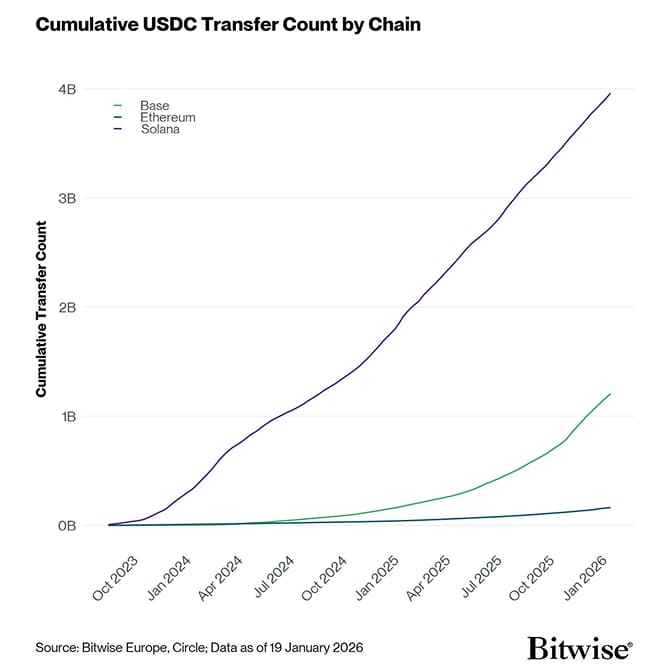
Transaction counts further clarify the nature of this activity. Over the same period, Solana leads in raw transaction volume with approximately 3.92bn USDC transfers, consistent with its role as a high-performant blockchain. Alternatively, Base has processed 1.17bn transfers, exceeding Ethereum by more than 7x.
This highlights a functional split in roles. Solana concentrates high-frequency, low-value transfers as a scalable execution and settlement layer, while Base combines substantial throughput with materially higher value per transfer as an Ethereum-aligned execution layer. In this structure, Base is increasingly absorbing dollar-denominated activity that would historically have cleared directly on Ethereum L1.
Cumulative USDC Transfer Count by Chain
 Source: Bitwise Europe, Circle; Data as of 19 January 2026
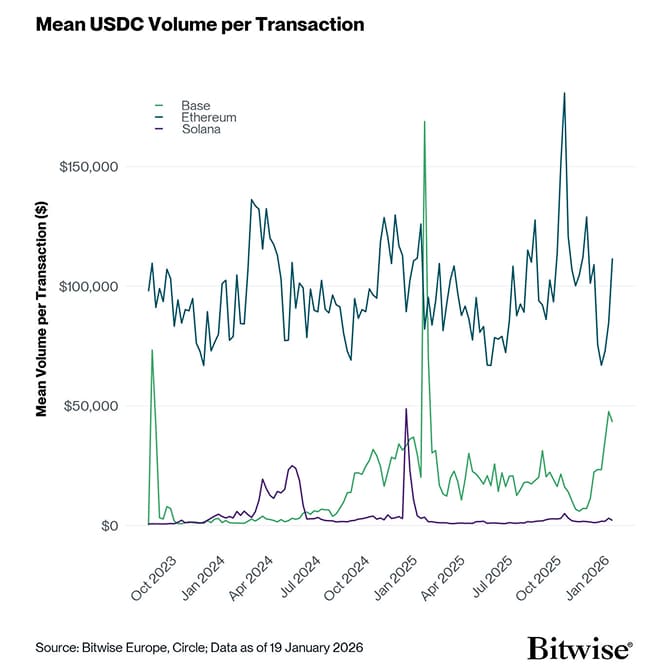
Furthermore, we can directly assess the mean USDC transfer size, which provides additional context by capturing the economic weight per execution event, rather than activity frequency. Ethereum records the highest mean transfer size at approximately $84.9k per transaction, reinforcing its role as the primary high-value settlement layer where larger balances continue to clear despite higher execution costs. Solana, by contrast, averages approximately $3.0k, reflecting smaller, more granular transfers associated with retail and programmatic use cases.
Base occupies an increasingly important middle ground. With a current mean transfer size of approximately $47.6k, Base now executes transactions of materially higher economic weight than Solana while remaining significantly more cost-efficient than Ethereum. The gradual increase in mean transfer size suggests a shift in user composition, with the activity on Base becoming more capital-weighted over time.
Mean USDC Volume per Transaction
 Source: Bitwise Europe, Circle; Data as of 19 January 2026
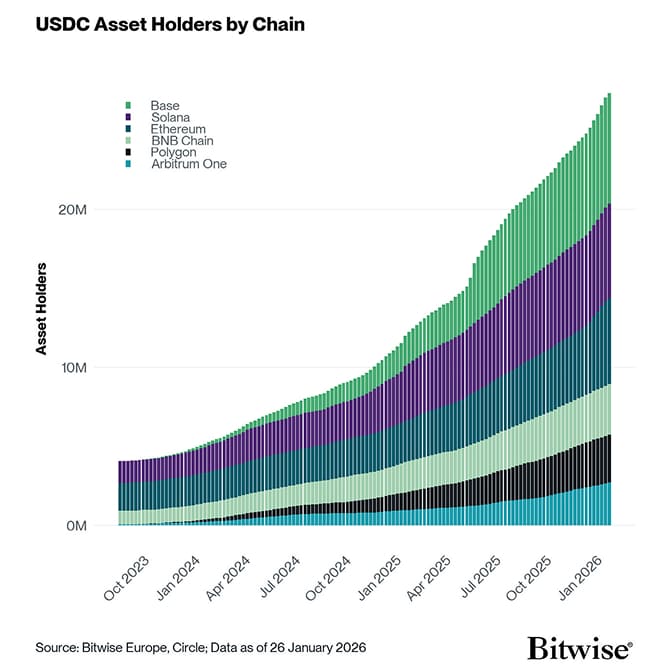
Additionally, USDC asset holder distribution adds another dimension to Base's footprint. Base now accounts for approximately 6.95mn USDC holders, surpassing Solana (5.9mn) and Ethereum (5.3mn). This places Base at the center of USDC usage across potential unique users, indicating that adoption is occurring across multiple dimensions.
USDC Asset Holders by Chain
 Source: Bitwise Europe, Circle; Data as of 26 January 2026
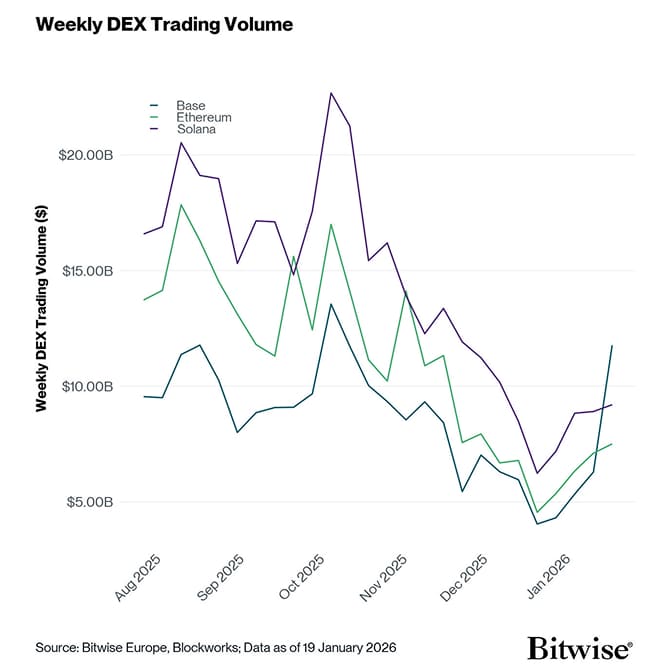
DEX trading volume provides a secondary signal of whether on-chain liquidity is supporting ongoing economic activity, rather than remaining idle. While DEX volumes are cyclical, cumulative volume helps distinguish short-lived bursts of activity from sustained usage over time.
Since its launch, Solana leads in cumulative DEX trading volume at approximately $2.01tn, followed by Ethereum at $1.44tn. Over the same period, Base has accumulated approximately $0.61tn ($610bn) in trading volume.
Over the past six months, which is more reflective of recent market structure, Base has consistently trailed slightly in total weekly volumes but still processes a meaningful $5–10B per week. Nevertheless, Base has recently surpassed both Ethereum and Solana in weekly volume, a significant milestone given its much shorter operating history. This performance underscores Base's emergence as a meaningful venue for on-chain trading activity.
Weekly DEX Trading Volume
 Source: Bitwise Europe, Blockworks; Data as of 19 January 2026
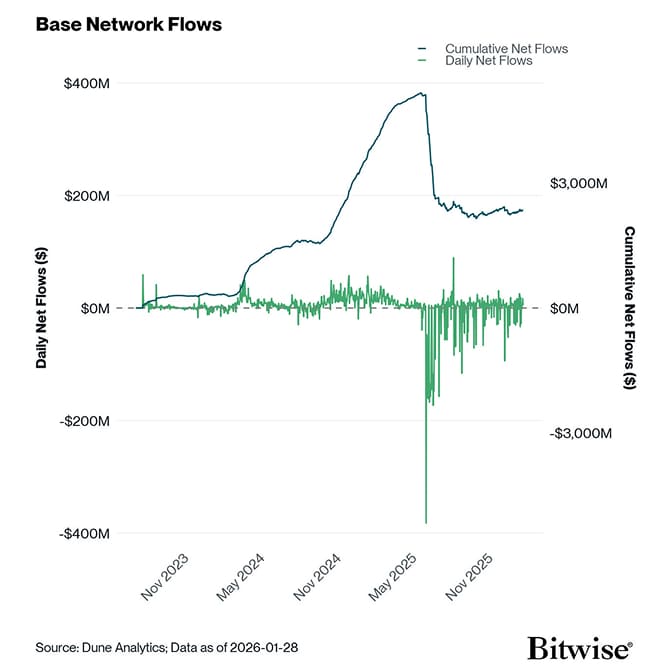
It is clear that a significant share of Base's on-chain liquidity has originated from Ethereum itself. With current DeFi TVL of $4.92 bn and cumulative net inflows from Ethereum of $2.35 bn, Ethereum appears to be a major source of this liquidity, accounting for roughly 40%. Over time, this growth is underpinned by the second-highest median net inflows of around $4.5 mm daily which has accumulated into the largest positive total net flows among its Layer 2 peers, reinforcing Base's position as the leading destination for capital inflows in both scale and consistency.
Yet, the cumulative flows tell a different story. Since inception, Base has experienced significant inflows from Ethereum. However, a mass exodus event occurred with significant capital flight back to Ethereum after the memecoin boom imploded in mid 2025. Following on, Base is now finding its equilibrium with little positive net flows in the last 6 months, suggesting the present level of liquidity is enough to sustain internal economic momentum.
Base Network Flows
 Source: Bitwise Europe, Token Terminal; Data as of 26 January 2026
Collectively, these metrics indicate that Base is developing internally sustained economic momentum. USDC balances are accumulating on-chain, settlement activity is scaling, and transfer sizes are becoming more capital-weighted. Holder growth suggests this activity is broad-based rather than concentrated. While Ethereum remains the primary monetary anchor, Base is increasingly able to attract and retain dollar-denominated activity alongside its Ethereum settlement relationship.
Does L2 Make Economic Sense
As outlined above, Base's scale provides strategic flexibility. However, any shift away from a Layer 2 structure would require careful assessment of economic trade-offs and long-term incentive alignment. This section uates the economic feasibility of a potential Layer 1 transition.
A primary consideration is the rent paid to Ethereum for settlement and security. Following Fusaka, blob pricing is set at one sixteenth of the execution fee or the market blob price, whichever is higher. By linking blob costs to execution gas, this mechanism raises the effective fee floor and increases the minimum cost of settling on Ethereum.
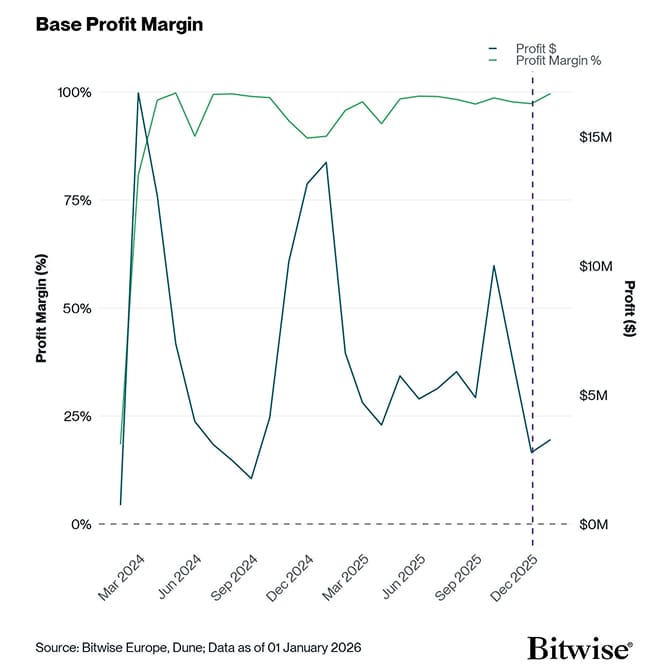
Despite this, Layer 2 margins have improved since Fusaka. Mean margins rose from 90% to 98%, and median margins from 97% to 99%. This likely reflects more predictable fee dynamics, enabling better sequencing optimisation and transaction pricing. Gains from user-fee optimisation have therefore outweighed higher floor costs.
Costs should decline further due to a Fusaka change allowing blob gas limit increases without hard forks. As blob supply expands, greater capacity should reduce per-blob costs through standard supply and demand dynamics, supporting margin expansion over time.
At present, this remains favourable for Base staying anchored to Ethereum. Settlement rent is low, more predictable, and economically manageable, limiting near-term incentives to seek alternatives. However, Ethereum's history suggests costs may not remain stable indefinitely. If settlement rent were to rise materially or become more volatile, it could become contentious, particularly for high-throughput execution layers such as Base, where marginal cost sensitivity is inherently higher.
Base Profit Margin
 Source: Bitwise Europe, Dune; Data as of 01 January 2026
Potential Pathways:
Having established that remaining anchored to Ethereum is currently the economically optimal path for Base, this section examines the strategic levers available to further monetize and extend its growth trajectory.
The Reasoning Behind Base's Transition Announcement:
All OP Stack-aligned Layer 2s remit a portion of their revenue to the Optimism Collective in exchange for inclusion in the framework. The Base protocol captures roughly 90 percent of all sequencer revenue generated by Optimism-aligned L2s, and pays roughly 74 percent of total rent paid by all Layer 2s in the ecosystem to the Collective. Despite this outsized economic contribution, Base controls only 9 percent of governance voting power, a consequence of the original OP token distribution cap. This created a clear and structural misalignment of incentives that triggered a divergence from the OP Stack.
Launching a Token:
Base is now one of the largest execution environments in crypto, yet remains one of the few major L2s without a native token. This was a deliberate choice at launch. By avoiding token issuance, Coinbase reduced regulatory risk and sidestepped the governance and incentive complexities that accompany tokenised networks.
That stance appears to be beginning to soften. Recent comments from Coinbase leadership suggest alternatives are being explored, reflecting the rapid growth of Base and its increasing similarity, in economic terms, to tokenised networks. Base now ranks among the top Layer 2s by stablecoin balances, transfer volume, and active users, and is competitive with standalone Layer 1s such as BNB Chain and Solana across several key metrics.
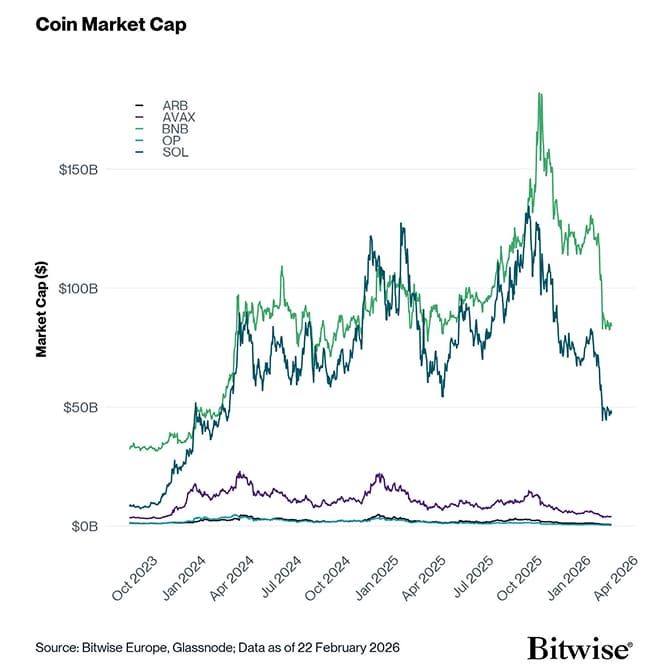
As Base's economic footprint has expanded, the absence of a token appears less philosophical and more strategic. Using comparable networks as a directional reference, any discussion of a hypothetical Base token could imply a wide valuation band, though it is rather speculative and should not be treated as guidance. Current Layer 2 tokens such as Arbitrum and Optimism cluster below ~$1bn, while standalone execution environments span a much broader range, from roughly ~$4bn for Avalanche to ~$45bn for Solana and over ~$80bn for BNB. This dispersion highlights how market perception shifts between L2 and L1 positioning can materially alter valuation regimes. Notably, L1 valuations have historically ranked well above L2s, posing a clear trade-off between potential valuation upside and regulatory attack surface.
Importantly, this range is illustrative rather than predictive, and should be viewed as an indication of the scale of value Base could intermediate, and the magnitude of the strategic decision Coinbase would face if it chose to formalise that value through token issuance.
Coin Market Cap
 Source: Bitwise Europe, Glassnode; Data as of 28 January 2026
However, above all, Coinbase's fiduciary duty guides its decisions. Expanding the regulatory attack surface could weigh on shareholder value. More subtly, if Base were to significantly outperform and a token became the primary growth vehicle, capital could rotate from COIN into the token, potentially weakening the equity narrative even if fundamentals remained robust. This consideration could weigh on the chances of launching a token.
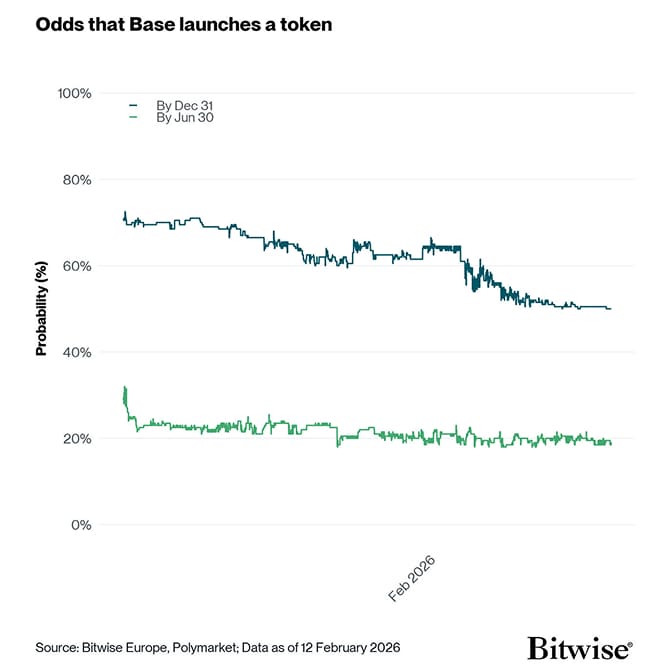
Moreover, prediction markets currently assign roughly a 49% probability to Base launching a token by year-end, with about a 20% probability priced for the end of H1. Notably, the recent deterioration in broader market conditions has coincided with a decline in year-end odds, implying that participants view macro and price environments as important determinants of the launch timing. By contrast, the H1 contract has largely flattened despite continued price weakness.
This should be treated with caution given the low trading volumes. It should be noted that prediction markets are unregulated betting platforms and no demonstrated analytical or predictive validity. They reflect speculative sentiment rather than informed probability assessment and should not be relied upon for investment or strategic decisions.
Odds that Base launches a token
 Source: Bitwise Europe, Polymarket; Data as of 12 February 2026
USDC as Economic Gas
One available option for Coinbase is to position USD Coin as the effective gas of Base, delivering monetary control without requiring protocol sovereignty. Base remains mechanically bound to Ethereum. Execution, data availability, and final settlement are paid in ETH at the L1 boundary, preserving Ethereum security guarantees and neutrality. This reliance is limited to settlement rather than shaping how users and applications operate day to day on Base.
Existing paymaster designs let users pay gas in USDC, but ETH remains the underlying pricing unit cleared per transaction. The model proposed here instead treats USDC as the unit of account for gas, with ETH required only for periodic settlement.
Within Base, fees, balances, application revenues, and broader activity can be denominated in USDC, with the sequencer periodically converting a portion into ETH to cover Ethereum settlement costs. Ethereum continues to provide security and finality, while Base operates in a stable dollar unit. Value that would otherwise leak through continual ETH purchases instead circulates internally across users, applications, liquidity pools, and sequencer revenues.
The implications are significant. Dollar-denominated gas allows Base to offer predictable transaction costs and smooth or subsidise fees in dollar terms while absorbing ETH volatility at the sequencer, keeping user balances in USDC and supporting higher transaction activity. It also allows Base to retain more of the value generated by its own activity. Under ETH gas, users repeatedly acquire and spend ETH, exporting value to the settlement layer. Under USDC gas, fees circulate within the Base economy, with only the required settlement margin converted into ETH. This keeps capital working inside the chain rather than leaking out.
Operating in USDC also aligns Base more closely with institutional and consumer finance. Fiat on ramps are simpler, costs are easier to account for, and users need not manage ETH to interact with applications. USDC becomes the default medium of use, while ETH recedes into a backend settlement cost. The result is a hybrid structure. Base remains anchored to Ethereum for trust while gaining freedom to shape its own economic growth. Over time, this allows Base to function less like a dependent execution layer and more like a self contained financial platform that relies on Ethereum for settlement rather than direction.
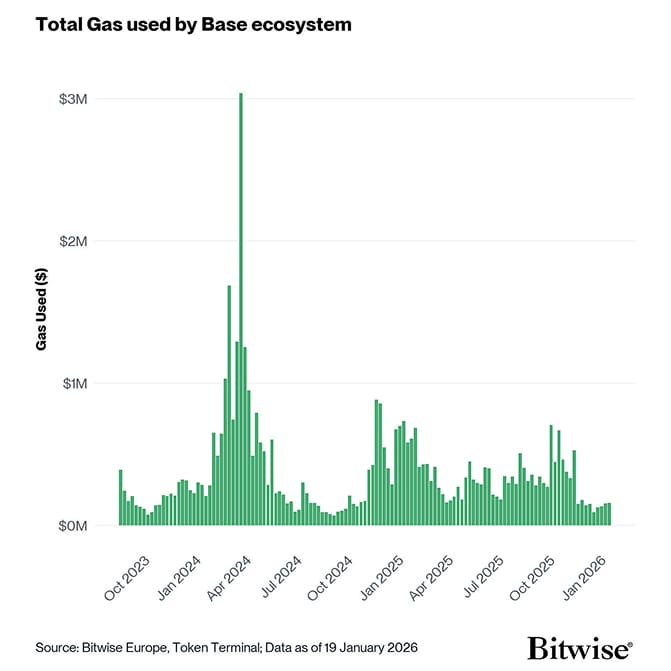
Empirically, this distinction is already emerging. Since launch, Base has processed tens of millions of dollars in gas denominated activity, with recent weekly usage in the hundreds of thousands. As volume scales, gas denomination increasingly determines where economic velocity compounds. In an ETH denominated model, value is repeatedly exported to the settlement layer. In a USDC denominated model, value circulates within the execution environment, with only the settlement margin converting outward. Over time, this structural difference may influence where economic value accumulates.
Total Gas used by Base ecosystem
 Source: Bitwise Europe, Token Terminal; Data as of 19 January 2026
The Base–Coinbase–Circle Triumvirate:
The strategic flexibility of Base cannot be understood in isolation from its relationship with Coinbase and Circle. While not vertically integrated, these entities form an economically aligned stack spanning user access, monetary issuance, and execution infrastructure. Within the broader landscape of Ethereum-aligned execution environments, such multi-layer alignment remains relatively uncommon and meaningfully expands Base's long-term strategic optionality.
- Coinbase anchors distribution through a major regulated fiat on-ramp, custody infrastructure, and operation of the Base sequencer, giving visibility into user flows and influence over onboarding and liquidity routing. This creates strong first-touch distribution gravity versus L2s reliant on third-party exchanges and bridges, without guaranteeing capital retention.
- Circle anchors the monetary layer via USDC issuance and redemption, which functions as Base's dominant unit of account in practice. While not protocol-enforced, USDC underpins value storage, transfers, and pricing, giving Base access to deep liquidity and a scalable, institutionally legible monetary foundation.
- Base sits between these layers as the execution environment, while inheriting security and settlement from Ethereum. Fiat can enter via Coinbase, convert to USDC, and circulate within Base as part of a dollar-denominated economic gravity well, where capital tends to remain and recycle locally, with only the necessary portion converting into ETH for settlement rather than continuously exiting the system.
That latent flexibility is what gives Base structural differentiation over most L2s. Among major crypto stacks, the closest historical comparison is the alignment between Binance and BNB Chain, where distribution, execution, and ecosystem incentives were tightly coupled. However, Base's alignment is structurally different. Rather than relying on a native token-centric economy, it is anchored around a widely used external stable monetary layer, creating a distribution–money–execution stack that remains relatively uncommon among Ethereum-aligned L2s and difficult to replicate.
Regulation
From a regulatory perspective, remaining anchored to a decentralised settlement layer materially reduces risk compared with operating as a sovereign, centrally controlled Layer 1. If Base were structured as an independent L1 with a clearly identifiable corporate operator, it would present a far larger target for regulatory scrutiny. By contrast, building on Ethereum enables it to position itself as infrastructure within a recognised decentralised ecosystem, rather than as the issuer or controller of a new financial system.
This distinction is important in a climate that is currently more supportive of decentralised infrastructure than new token launches or vertically integrated networks. Nonetheless, crypto regulation remains volatile across jurisdictions and administrations. Alignment with a decentralised settlement layer therefore reduces present risk while preserving strategic flexibility, allowing structural or token decisions to be deferred until legal frameworks are clearer.
Conclusion:
Base's growth in USDC-denominated on-chain activity despite a reduction of ETH net inflows suggest further development is possible with a reduced reliance on Ethereum.
While a move to Layer 1 is unlikely, maintaining optionality is prudent should settlement conditions deteriorate or the value proposition for L2s becomes increasingly unclear stemming from Vitalik's recent comments.
Even so, Base remains better suited as a Layer 2 as of current, benefiting from low Ethereum settlement costs, high profit margins, and insulation from direct regulatory pressure.
The recent split from the OP-stack may precede the launch of a governance token to expand value capture beyond transaction fees, while deeper USDC integration for gas could enhance user experience without sacrificing Ethereum's security and settlement advantages.
Bottom Line
- Base's growing USDC activity gives it flexibility, but staying anchored to Ethereum still makes the most economic and strategic sense at this point in time.
- A token spin-off looks less likely than some expect, but the potential valuation upside still makes the regulatory risk-reward trade-off requiring careful assessment.
- A token launch could provide governance and strengthen ecosystem value, whilst finding ways to monetise through USDC-based economics.
Important information:
This material is provided for informational and educational purposes only and does not constitute investment advice, a personal recommendation, or an offer or solicitation to buy or sell any financial instrument.
This material is intended solely for professional investors as defined under applicable financial services regulations in the UK and EU. It should not be distributed to or relied upon by retail investors in any jurisdiction. This material is not directed to, and should not be accessed by, persons located in the United States, Canada or other jurisdictions where distribution would be unlawful. It is the responsibility of any person accessing this material to ensure compliance with applicable local laws and regulations.
RISK WARNING: Crypto assets are highly volatile and speculative. Investment in crypto assets carries risk of total capital loss. Regulatory frameworks remain uncertain and subject to change. Past performance and network metrics do not predict future results.
This document contains references to prediction markets (unregulated betting platforms with no analytical validity) and hypothetical token valuation scenarios. These are included for contextual purposes only and should not be relied upon for investment or strategic decisions. Base does not currently have a native token. Any discussion of potential token launch, valuation, or timing is purely hypothetical. No inference should be drawn about likelihood, timing, or value of any potential token launch.