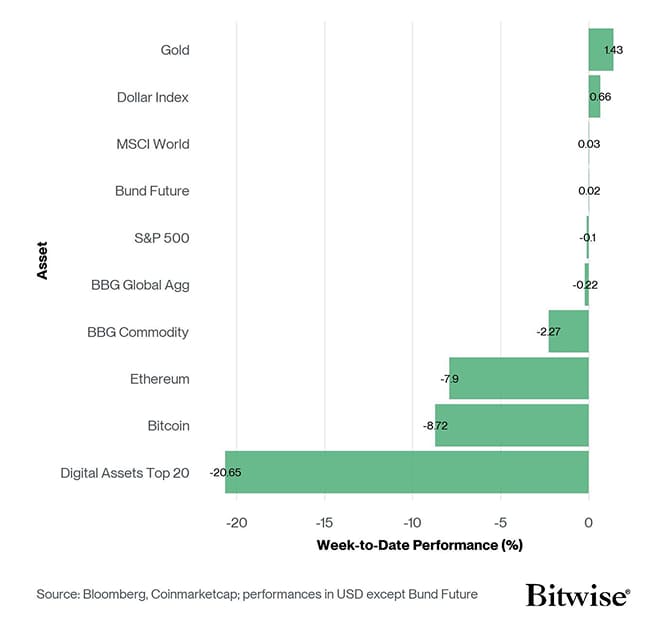
- Crypto markets experienced one of the largest single-day drawdowns on record, driven by cyclical profit-taking, capital rotation away from crypto, and broader macro risk-off conditions, although altcoins broadly outperformed bitcoin over the week.
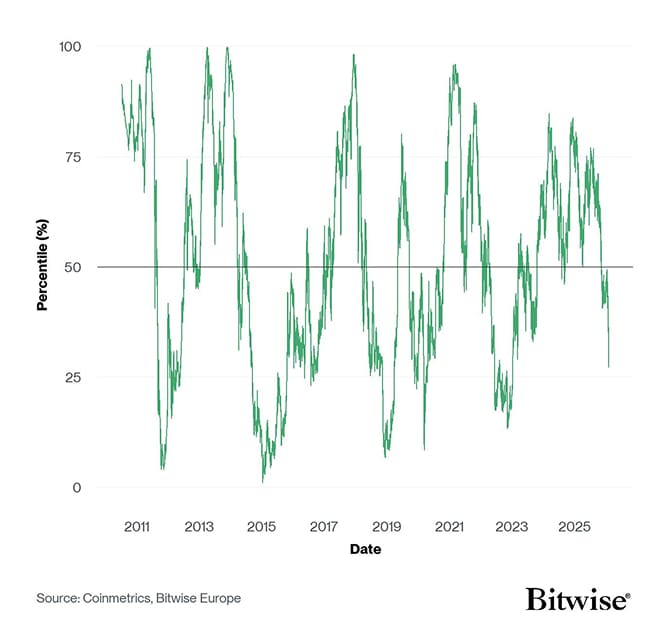
- Chart-of-the-Week: Across a broad set of valuation indicators, current levels fall roughly within the 27% percentile of historical observations, indicating valuations below historical averages relative to past cycles. Historically speaking, past cyclical bottoms have seen valuation indicators slightly below the 20% percentile mark, based on this particular indicator.
- Contrarian signals are building: the Cryptoasset Sentiment Index has fallen to its most bearish level since the FTX collapse, while improving global liquidity dynamics and reflation indicators point to a potentially supportive macro backdrop over the medium term.
Chart of the Week
Bitcoin: Composite Valuation Indicator
Performance
Last week, crypto markets saw one of their most historic 1-day declines on record. Crypto markets fell mainly due to cyclical profit-taking and capital rotation away from crypto, compounded by macro risk-off conditions and specific shocks (policy uncertainty, leverage liquidations, and emerging technology concerns) that collectively pressured prices.
In fact, there have been many reasons for the most recent pullback some of which we have identified in our latest CIO Memo as well. We have also published a post-mortem of the most recent crash in crypto markets that you can read here.
However, following this significant capitulation event, several remarks are in order:
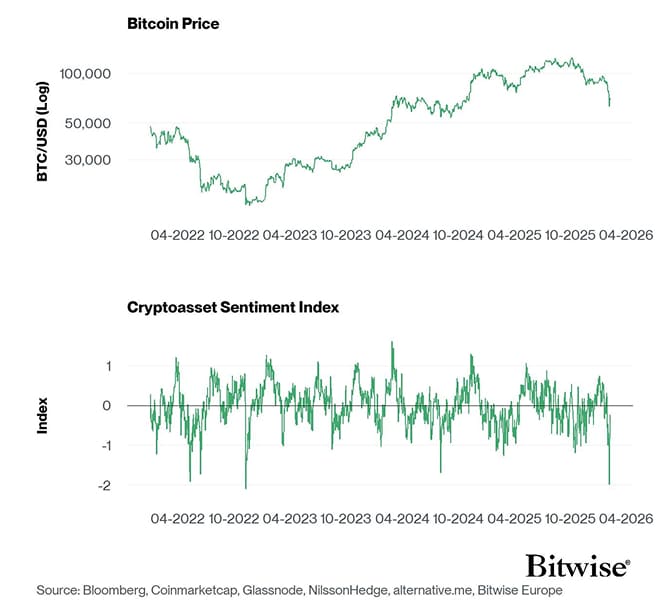
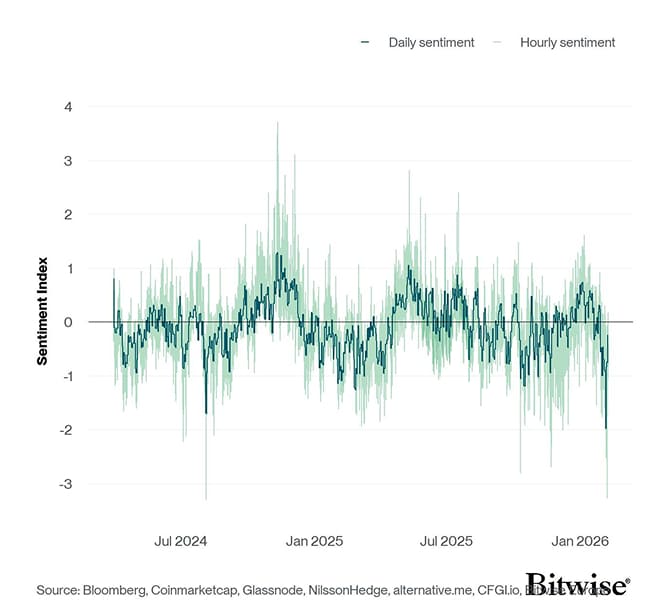
First, regarding sentiment: our in-house Cryptoasset Sentiment Index is currently indicating the most bearish market sentiment observed since the FTX collapse in November 2022. This represents an historically extreme level of pessimism. Such conditions have typically coincided with tactical market bottoms, which has historically been associated with tactical market bottoms and subsequent relief rallies.
Second, on valuations: Bitcoin valuations are approaching historically low levels. The MVRV Z-Score has declined to its lowest level since early 2023, when BTC traded near the $25k range. Across a broad set of valuation indicators, current levels fall roughly within the 27% percentile of historical observations, indicating valuations below historical averages relative to past cycles (Chart-of-the-Week). Historically speaking, past cyclical bottoms have seen valuation indicators slightly below the 20% percentile mark, based on this particular indicator.
Third, from a macroeconomic perspective, the broader environment remains supportive in our assessment. Global money supply growth continues to accelerate, driven primarily by expansion in both Chinese and US liquidity measures.
The ongoing steepening of the US yield curve further implies continued monetary expansion rather than tightening. The recent downside surprise in US job openings should be interpreted cautiously given its lagging nature relative to forward-looking indicators such as the ISM Manufacturing Index, which has recently reached multi-year highs.
That said, the recent rise in the VIX alongside weakness in the IT software sector points to a short-term tightening of US financial conditions, warranting close monitoring.
More broadly, the sustained strength in gold prices and other commodity prices appears consistent with easing global financial conditions - largely originating from China - and may signal the emergence of a reflationary macro regime. Reflationary regimes have historically been associated with bitcoin performance, as outlined in our latest Bitcoin Macro Investor report.
Historically, such conditions have provided a tailwind for Bitcoin and other cryptoassets with an approximate six-month lag. In this context, Bitcoin valuations appear compressed relative to historical averages , effectively discounting a deep US recession scenario that we currently view as unlikely
Fourth, in terms of technical price levels: Bitcoin recently found support around the $60k range, where several major support indicators converge, including the aggregate realised price (cost basis) and the 200-week moving average. Historically, Bitcoin has not materially breached these levels during prior bear market cycles.
Finally, our new proprietary bottom-probability model suggests that the market is approaching a cyclical trough, although confirmation of a definitive bottom is not yet evident. Market bottoms typically form through a process rather than a single event.
Nonetheless, the current combination of extreme bearish sentiment, deeply discounted valuations, and a generally constructive macro backdrop presents a different risk-reward profile than recent periods.
This environment may therefore offer an attractive opportunity to begin repositioning portfolios for 2026 and gradually recalibrating exposure to cryptoassets.
Cross Asset Performance (Week-to-Date)
 Source: Bloomberg, Coinmarketcap; performances in USD exept Bund Future
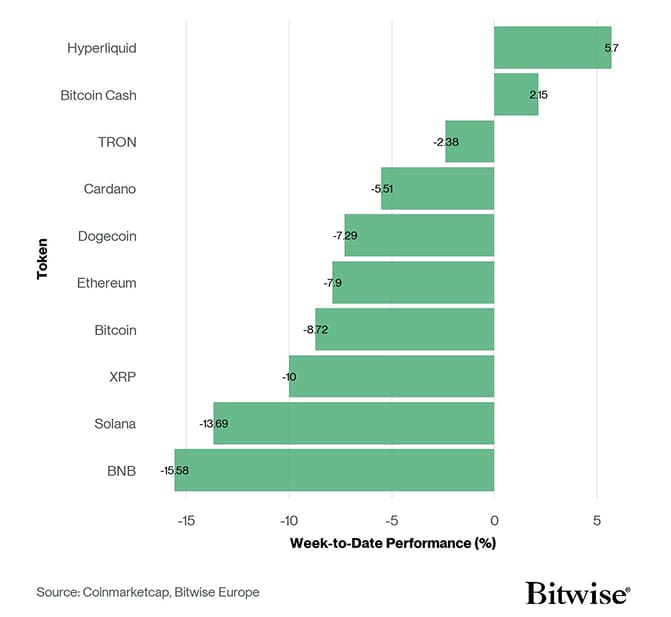
Top 10 Cryptoasset Performance (Week-to-Date)
Source: Bloomberg, Coinmarketcap; performances in USD exept Bund Future
Top 10 Cryptoasset Performance (Week-to-Date)
 Source: Coinmarketcap
Sentiment
In general, among the top 10 crypto assets Hyperliquid, Bitcoin Cash, and TRON were the relative outperformers.
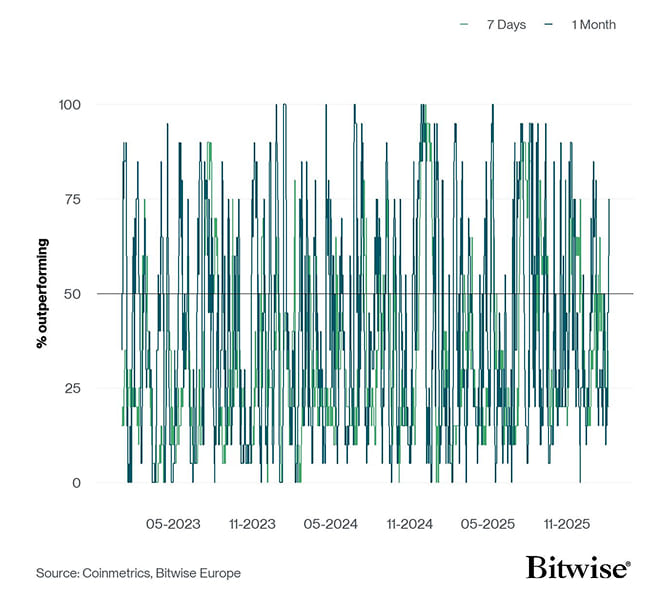
Overall, altcoin outperformance vis-à-vis bitcoin has increased last week, with 75% of our tracked altcoins managing to outperform bitcoin on a weekly basis. Ethereum also outperformed bitcoin last week.
Sentiment
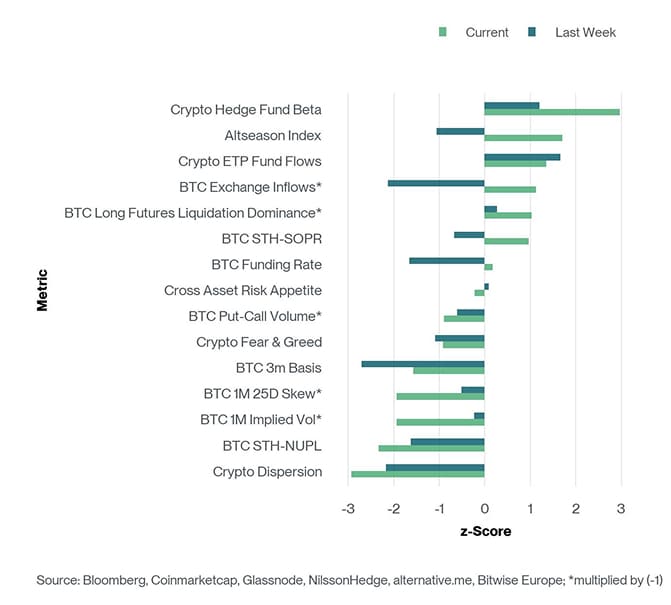
Our in-house “Cryptoasset Sentiment Index” is currently signalling a bearish sentiment, struggling to recover after declining to the lowest level since the FTX collapse in November 2022 on 5th February.
At the moment, 7 out of 15 indicators are above their short-term trend.
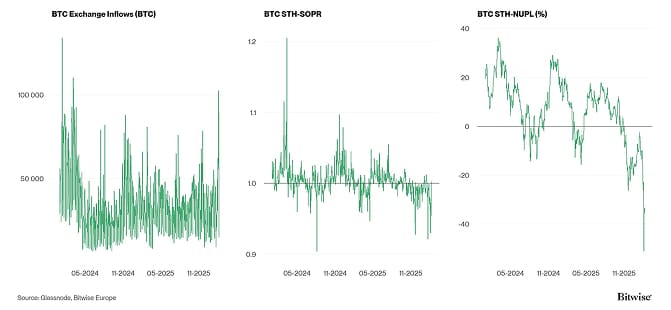
Last week, only the BTC Hedge Fund Beta, Altseason Index, Crypto ETP Fund Flows, BTC Exchange Inflows, BTC Long Futures Liquidations Dominance, BTC STH SOPR, and BTC Funding Rate showed positive momentum.
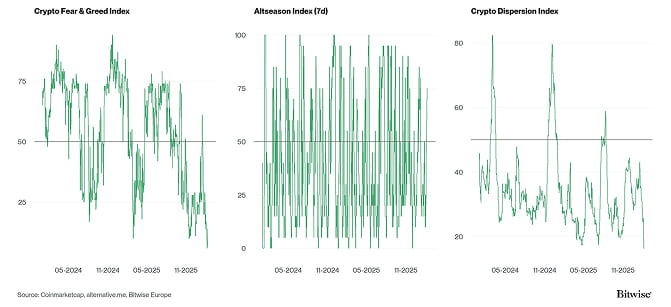
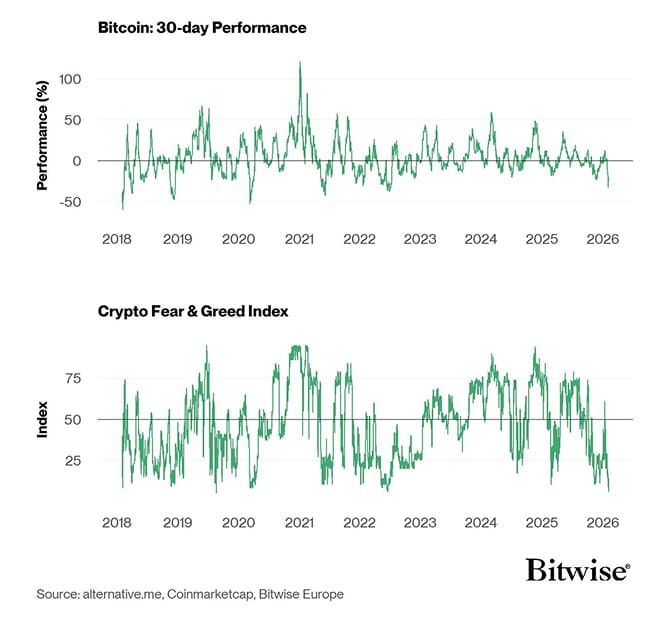
The Crypto Fear & Greed Index signals a “extreme fear” level of sentiment as of this morning. The index spent the whole month of November and December in either “fear” or “extreme fear” territory although turned to “Greed” briefly early in the third calendar week of January. February has consistently been in “Extreme Fear” so far.
Performance dispersion among cryptoassets declined last week from 0.25 to 0.16. When dispersion is high, it may mean that the market appears to be driven by a more diverse set of narratives which tends to be a sign of increasing risk appetite.
Altcoin outperformance vis-à-vis Bitcoin increased significantly last week, with around 75% of our tracked altcoins. Ethereum outperformed Bitcoin.
In general, increasing (decreasing) altcoin outperformance tends to be a sign of increasing (decreasing) risk appetite within cryptoasset markets.
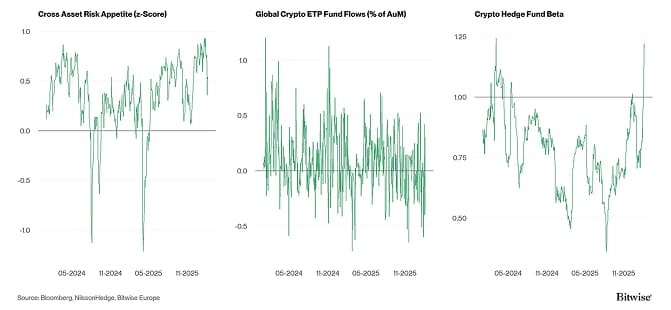
Sentiment in traditional financial markets as measured by our in-house measure of Cross Asset Risk Appetite (CARA) decreased to 0.52. This is a notable divergence between TradFi and crypto asset sentiment that should be continued to watch closely.
Fund Flows
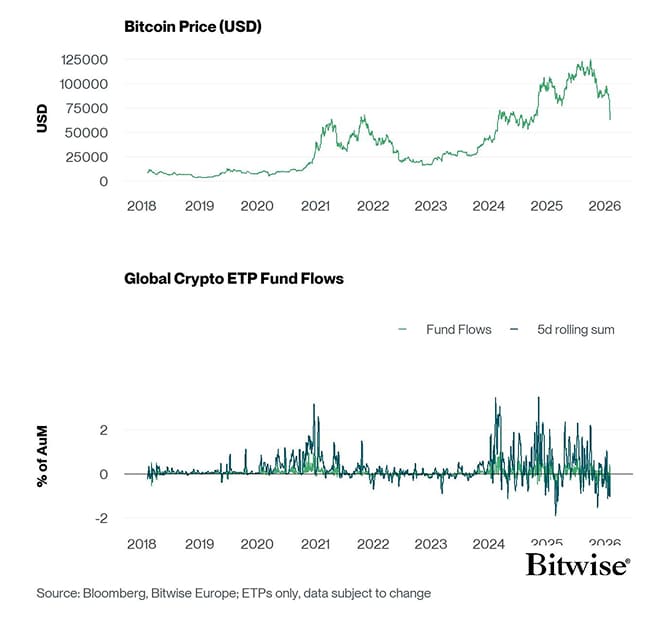
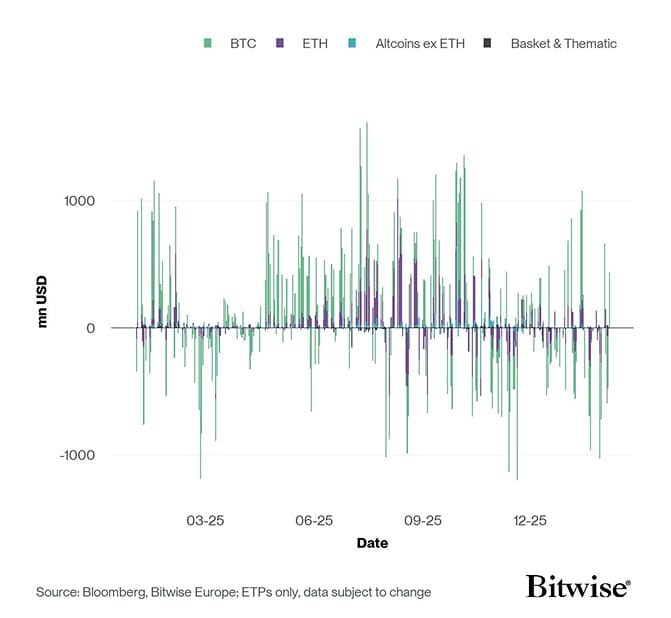
Global crypto ETPs saw small total net outflows last week across Bitcoin and Altcoin Ex-Ethereum products, although Ethereum, and basket and thematic products saw slight net inflows.
Global crypto ETPs saw around -26 mn USD in weekly net outflows across all types of cryptoassets, after - 1725.4 mn USD in net outflows the previous week.
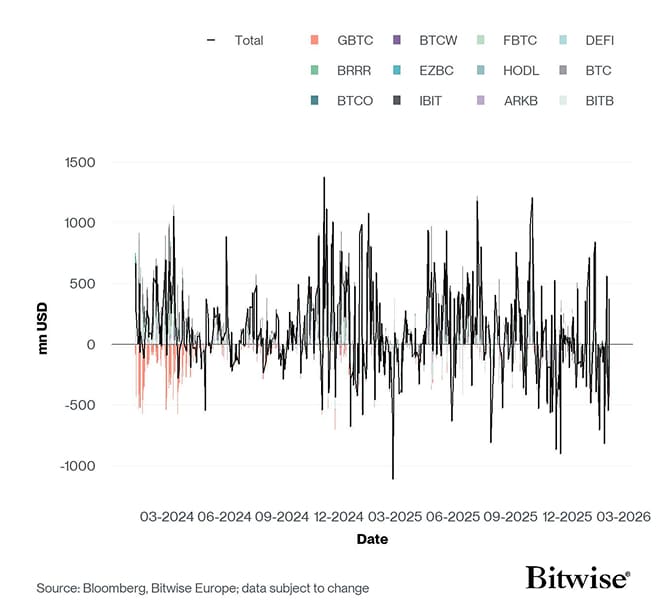
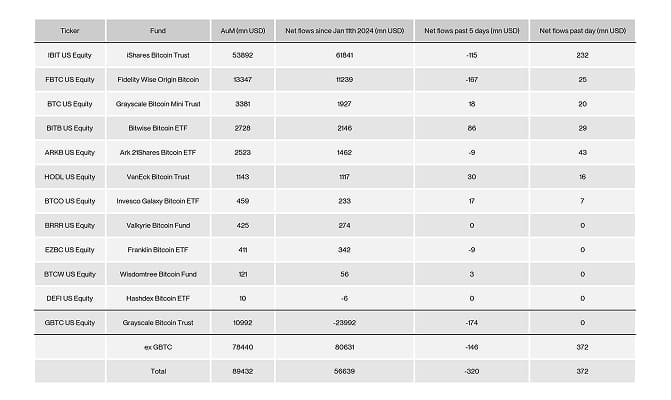
Global Bitcoin ETPs have experienced net outflows totalling -74 mn USD last week, of which –318.1 mn USD in net outflows were related to US spot Bitcoin ETFs.
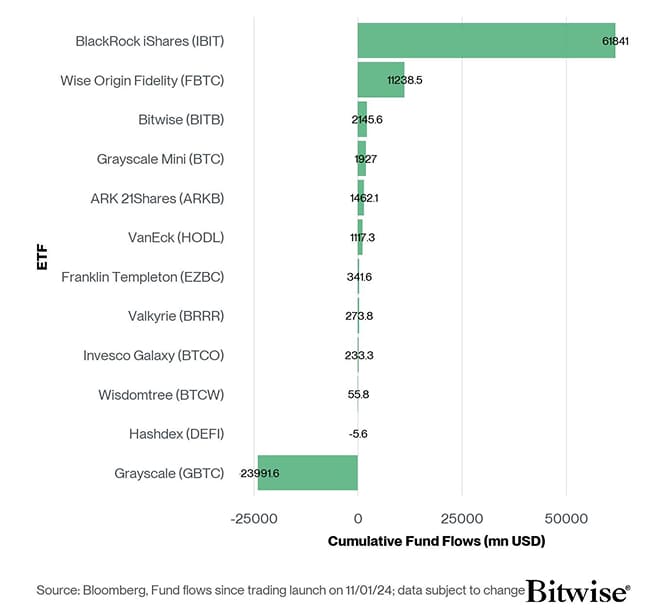
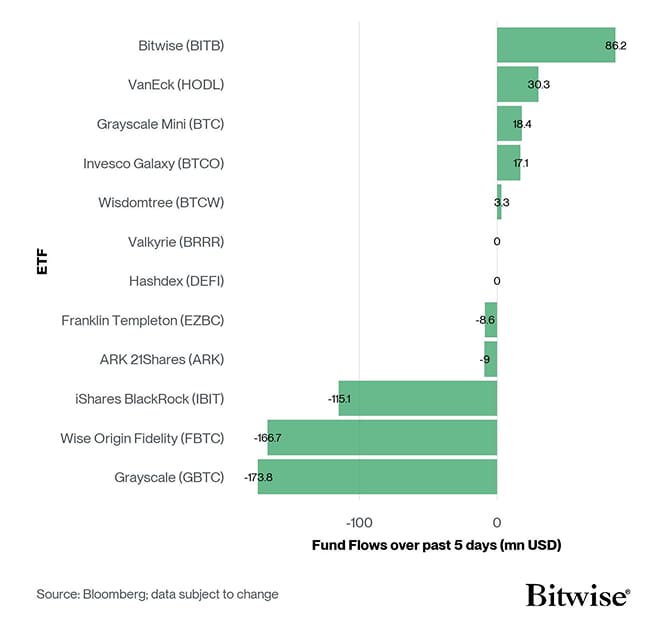
The Bitwise Bitcoin ETF (BITB) in the US experienced net inflows, totalling +86.2 mn USD last week.
In Europe, the Bitwise Physical Bitcoin ETP (BTCE) experienced net outflows equivalent to -6.3 mn USD, whereas the Bitwise Core Bitcoin ETP (BTC1) experienced net inflows of +4.6 mn USD.
The Grayscale Bitcoin Trust (GBTC) posted net outflows of –173.8 mn USD and the iShares Bitcoin Trust (IBIT) experienced net outflows of around –115.1 mn USD last week.
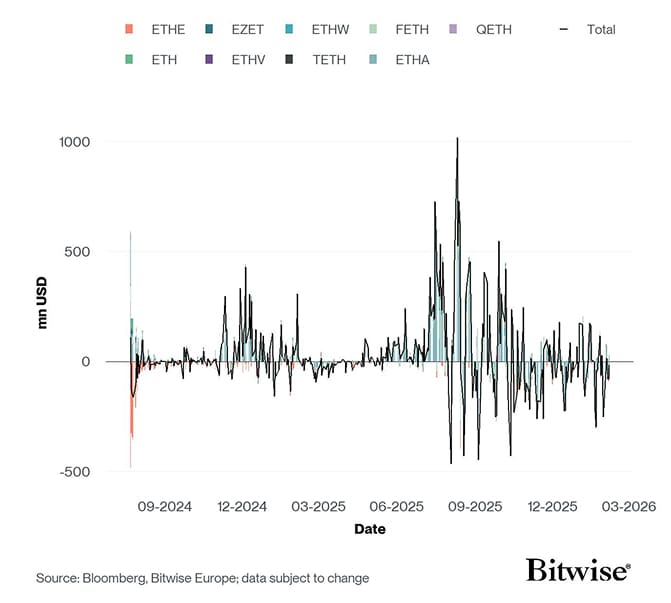
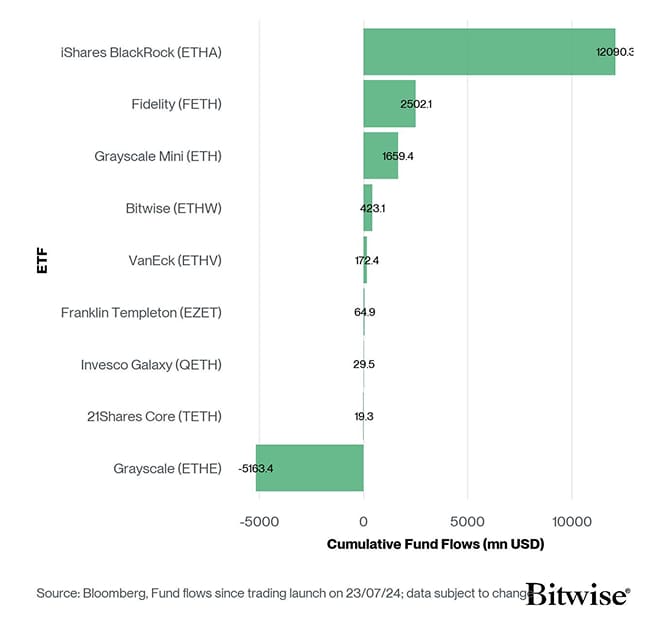
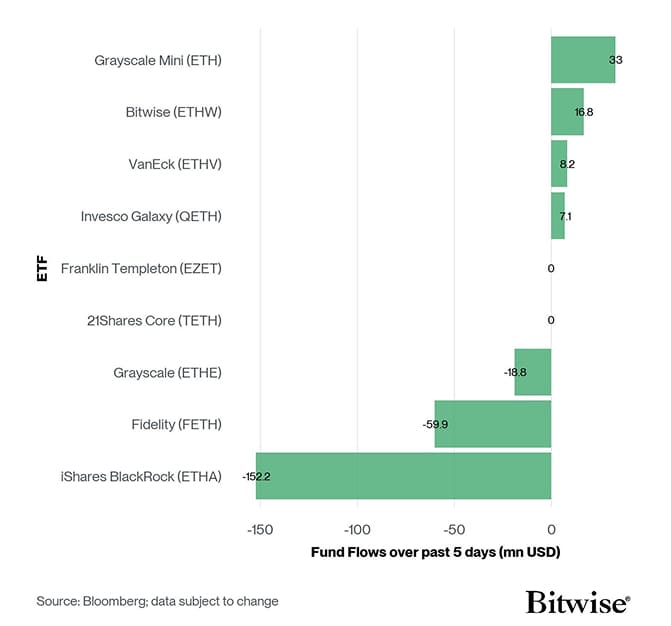
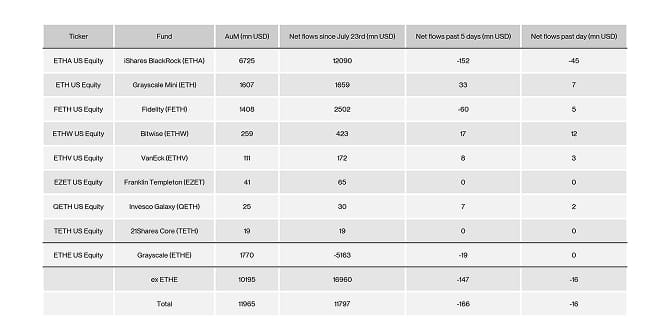
Meanwhile, global Ethereum ETPs also experienced +16.6 mn USD in net inflows last week, of which US spot Ethereum ETFs recorded net outflows of around –165.8 mn USD on aggregate.
The Grayscale Ethereum Trust (ETHE) posted net outflows of –18.8 mn USD, alongside the iShares Ethereum Trust (ETHA) that also experienced –152.2 mn USD of net outflows.
The Bitwise Ethereum ETF (ETHW) in the US has posted net inflows of +16.8 mn USD.
In Europe, the Bitwise Physical Ethereum ETP (ZETH) saw minor net inflows of +2.7 mn USD, as the Bitwise Ethereum Staking ETP (ET32) saw -0.2 mn of net outflows.
Altcoin ETPs ex Ethereum experienced net outflows of -23.2 mn USD last week.
Thematic & basket crypto ETPs posted net inflows of +54.5 mn USD on aggregate last week. The Bitwise MSCI Digital Assets Select 20 ETP (DA20) experienced net inflows last week of +0.4 mn USD on aggregate.
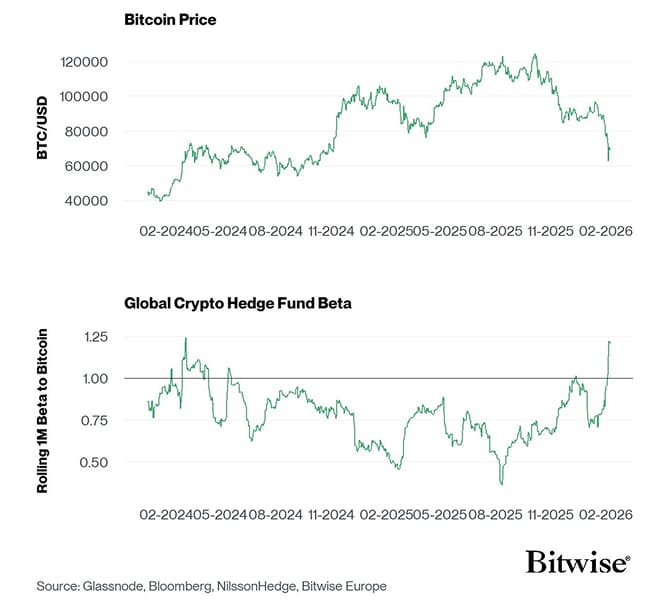
Global crypto hedge funds exposure to Bitcoin increased last week. The 20-days rolling beta of global crypto hedge funds' performance to Bitcoin climbed from 0.96 to 1.21 per yesterday's close – the highest reading in 2 years which implies a very significant increase in market exposure by global crypto hedge funds.
On-Chain Data
Bitcoin price action deteriorated sharply last week, with the market registering a cycle low near $60k. This move forced spot prices decisively below the 2021 all-time high, returning the market into the 2024 consolidation range. In USD terms, the drawdown marked the largest nominal decline on record, followed shortly by the largest single-day relief rally observed to date. Together, these extremes highlight an elevated degree of market fragility, with price increasingly sensitive to marginal flows.
Sell-side pressure across exchanges intensified during the drawdown, with aggregate spot order flow declining to its most negative level on record. Intraday spot buying minus selling reached a trough of approximately –$4.7B, underscoring the severity and velocity of the sell-off.
The magnitude of the contraction, combined with depressed sentiment, has culminated in the largest capitulation event in Bitcoin's history. Across the drawdown, investors realised approximately $3.4B in losses, surpassing the $2.7B realised during the FTX collapse. While Short-Term Holders remain the dominant source of realised losses (~74%), Long-Term Holder losses have begun to rise (~26%), behaviour historically associated with the deepest phase of cyclical drawdowns.
The market is now attempting to establish support in the $70k region. This zone represents a key technical confluence, aligning with the $70k–$80k volume gap, the prior cycle all-time high near $69k, and the upper boundary of the 2024 consolidation range. The $75k–$81k band, where the True Market Mean, Strategy cost basis, and US Spot ETF cost basis converge, remains the critical resistance zone to reclaim, and a prerequisite for any sustained recovery.
Despite the scale of the recent capitulation, this move may not yet represent a terminal market low. During prior deleveraging events, including the 3AC and FTX collapses, the market first experienced a primary drawdown, characterised by larger losses, aggressive leverage unwinds, and widespread forced selling. This was followed by a secondary leg lower, where prices revisited downside levels, but with diminishing loss magnitude and reduced sell-side intensity.
In last week's edition, we noted that a loss of the $75k level would shift focus toward the Realised Price (~$56k) and the 200-week moving average (~$58k), which together define the most probable region for terminal downside, consistent with historical full-capitulation regimes. Notably, the market has already traded to within $2k–$4k of these levels, suggesting a near-complete cyclical reset may already be underway.
Overall, the Bitcoin market has experienced one of the largest capitulation events on record, with price declining toward the Realised Price and 200-week moving average, levels that have coincided with all prior cyclical market bottoms. However, the market remains in a fragile state with further short-term volatility unable to be ruled out.
Futures, Options & Perpetuals
Over the past week, BTC perpetual futures open interest declined by approximately -9k BTC, while CME futures open interest increased by 8.4K BTC, signalling an uptick in institutional positioning.
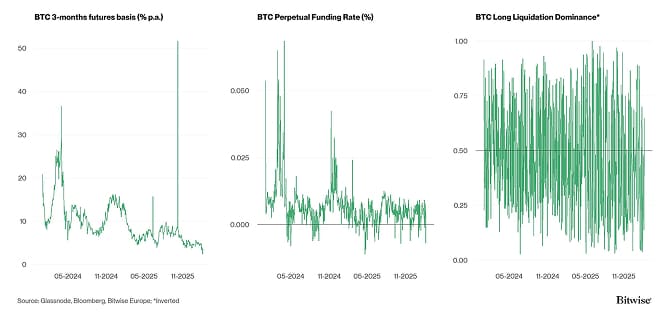
Across the collapse, long futures unwound, resulting in $1.84bn of long liquidations across all digital assets, the fourth largest on record.
From a positioning standpoint, open interest is beginning to rebuild around the $72K region, highlighting this level as a critical, bolstering the observation across on-chain and technical data.
Perpetual funding rates (7-day moving average) are declining but remain positive, suggesting a marginal long-bias persists amongst futures investors, highlighting a degree of exuberance remaining as investors attempt to catch falling knives. A constructive observation would be to see funding rates flip negative.
In parallel, the BTC 3-month annualised basis compressed further during the decline, falling to 2.3%, the third-lowest reading of the cycle. Such depressed basis levels are typically associated with risk-averse market conditions, reflecting reduced demand for leveraged long exposure.
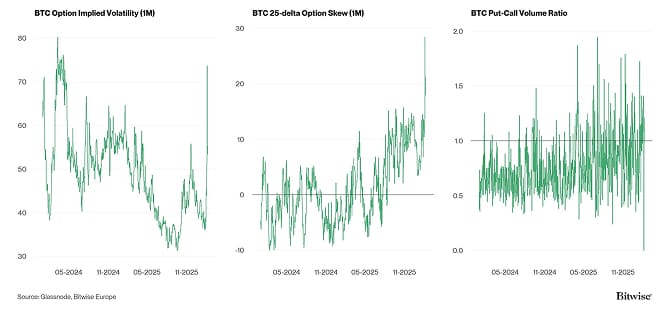
Turning to options markets, BTC options open interest expanded by approximately 58.6k BTC, lifting total open interest to around 412k BTC. Concurrently, the put-to-call open interest ratio on Deribit surged to 0.79, its highest level since May 2021, while the same ratio across IBIT options climbed to 0.63, marking its third-highest reading on record. Taken together, these dynamics indicate a rapid increase in demand for downside hedging, consistent with heightened risk aversion across derivatives markets.
Furthermore, the 25-delta skew rose sharply across all tenors, signalling increasing premiums for downside protection across both short- and medium-dated maturities. Notably, skew levels across all tenors climbed toward near all-time highs, underscoring the severity of the capitulation and suggesting a prior underpricing of downside volatility expectations within options markets.
Options dealer gamma positioning is predominantly negative across the $67k–$81k range, creating conditions where price movements are more readily amplified as dealer hedging flows reinforce directional momentum. This closely aligns with the $70k–$80k region highlighted by on-chain metrics as a zone of structural importance, reinforcing its role as an area of elevated price sensitivity and volatility.
Above this range, a larger concentration of positive gamma emerges around ~$85k-$90k, marking a structurally important resistance zone that would likely prove challenging to traverse without a material shift in underlying demand. Conversely, a smaller, isolated pocket of positive gamma near ~$65k may provide temporary downside stabilisation, but lacks the breadth typically associated with durable structural support.
Bottom Line
- Crypto markets experienced one of the largest single-day drawdowns on record, driven by cyclical profit-taking, capital rotation away from crypto, and broader macro risk-off conditions, although altcoins broadly outperformed bitcoin over the week.
- Chart-of-the-Week: Across a broad set of valuation indicators, current levels fall roughly within the 27% percentile of historical observations, indicating valuations below historical averages relative to past cycles. Historically speaking, past cyclical bottoms have seen valuation indicators slightly below the 20% percentile mark, based on this particular indicator.
- Contrarian signals are building: the Cryptoasset Sentiment Index has fallen to its most bearish level since the FTX collapse, while improving global liquidity dynamics and reflation indicators point to a potentially supportive macro backdrop over the medium term.
Appendix
Bitcoin Price vs Cryptoasset Sentiment Index
 Source: Bloomberg, Coinmarketcap, Glassnode, NilssonHedge, alternative.me, Bitwise Europe
Cryptoasset Sentiment Index
 Source: Bloomberg, Coinmarketcap, Glassnode, NilssonHedge, alternative.me, Bitwise Europe; *multiplied by (-1)
TradFi Sentiment Indicators
Source: Bloomberg, Coinmarketcap, Glassnode, NilssonHedge, alternative.me, Bitwise Europe; *multiplied by (-1)
TradFi Sentiment Indicators
 Source: Bloomberg, NilssonHedge, Bitwise Europe
Crypto Sentiment Indicators
Source: Bloomberg, NilssonHedge, Bitwise Europe
Crypto Sentiment Indicators
 Source: Coinmarketcap, alternative.me, Bitwise Europe
Crypto Options' Sentiment Indicators
Source: Coinmarketcap, alternative.me, Bitwise Europe
Crypto Options' Sentiment Indicators
 Source: Glassnode, Bitwise Europe
Crypto Futures & Perpetuals' Sentiment Indicators
Source: Glassnode, Bitwise Europe
Crypto Futures & Perpetuals' Sentiment Indicators
 Source: Glassnode, Bitwise Europe; *Inverted
Crypto On-Chain Indicators
Source: Glassnode, Bitwise Europe; *Inverted
Crypto On-Chain Indicators
 Source: Glassnode, Bitwise Europe
Bitcoin vs Crypto Fear & Greed Index
Source: Glassnode, Bitwise Europe
Bitcoin vs Crypto Fear & Greed Index
 Source: alternative.me, Coinmarketcap, Bitwise Europe
Cryptoasset Sentiment Index: Daily vs Hourly
Source: alternative.me, Coinmarketcap, Bitwise Europe
Cryptoasset Sentiment Index: Daily vs Hourly
 Source: Bloomberg, Coinmarketcap, Glassnode, NilssonHedge, alternative.me, CFGI.io, Bitwise Europe
Bitcoin vs Global Crypto ETP Fund Flows
Source: Bloomberg, Coinmarketcap, Glassnode, NilssonHedge, alternative.me, CFGI.io, Bitwise Europe
Bitcoin vs Global Crypto ETP Fund Flows
 Source: Bloomberg, Bitwise Europe; ETPs only, data subject to change
Global Crypto ETP Fund Flows
Source: Bloomberg, Bitwise Europe; ETPs only, data subject to change
Global Crypto ETP Fund Flows
 Source: Bloomberg, Bitwise Europe; ETPs only; data subject to change
US Spot Bitcoin ETF Fund Flows
Source: Bloomberg, Bitwise Europe; ETPs only; data subject to change
US Spot Bitcoin ETF Fund Flows
 Source: Bloomberg, Bitwise Europe; data subject to change
US Spot Bitcoin ETFs: Flows since launch
Source: Bloomberg, Bitwise Europe; data subject to change
US Spot Bitcoin ETFs: Flows since launch
 Source: Bloomberg, Fund flows since traiding launch on 11/01/24; data subject to change
US Spot Bitcoin ETFs: 5-days flow
Source: Bloomberg, Fund flows since traiding launch on 11/01/24; data subject to change
US Spot Bitcoin ETFs: 5-days flow
 Source: Bloomber; data subject to change
US Bitcoin ETFs: Net Fund Flows since 11th Jan mn USD
Source: Bloomber; data subject to change
US Bitcoin ETFs: Net Fund Flows since 11th Jan mn USD
 Source: Bloomberg, Bitwise Europe; data as of 06-02-2026
US Spot Ethereum ETF Fund Flows
Source: Bloomberg, Bitwise Europe; data as of 06-02-2026
US Spot Ethereum ETF Fund Flows
 Source: Bloomberg, Bitwise Europe; data subject to change
US Spot Ethereum ETFs: Flows since launch
Source: Bloomberg, Bitwise Europe; data subject to change
US Spot Ethereum ETFs: Flows since launch
 Source: Bloomberg, Fund flows since trading launch on 23/07/24; data subject on change
US Spot Ethereum ETFs: 5-days flow
Source: Bloomberg, Fund flows since trading launch on 23/07/24; data subject on change
US Spot Ethereum ETFs: 5-days flow
 Source: Bloomberg; data subject on change
US Ethereum ETFs: Net Fund Flows since 23rd July
Source: Bloomberg; data subject on change
US Ethereum ETFs: Net Fund Flows since 23rd July
 Source: Bloomberg, Bitwise Europe; data as of 06-02-2026
Bitcoin vs Crypto Hedge Fund Beta
Source: Bloomberg, Bitwise Europe; data as of 06-02-2026
Bitcoin vs Crypto Hedge Fund Beta
 Source: Glassnode, Bloomberg, NilssonHedge, Bitwise Europe
Altseason Index
Source: Glassnode, Bloomberg, NilssonHedge, Bitwise Europe
Altseason Index
 Source: Coinmetrics, Bitwise Europe
Bitcoin vs Crypto Dispersion Index
Source: Coinmetrics, Bitwise Europe
Bitcoin vs Crypto Dispersion Index
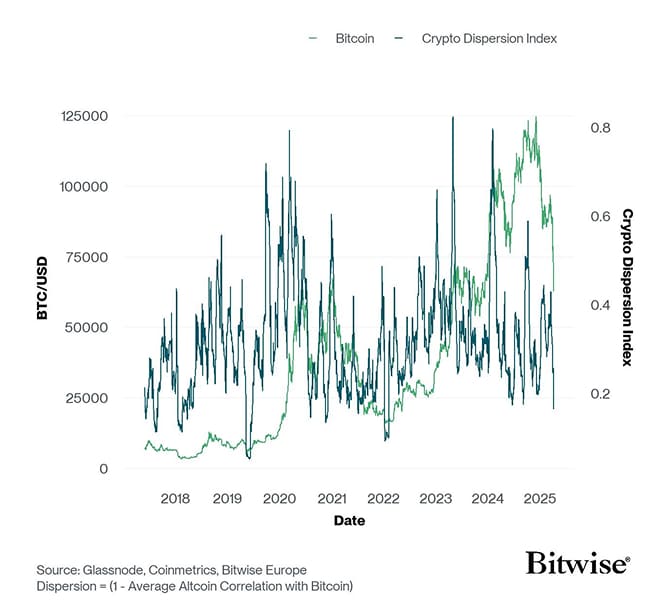 Source: Coinmarketcap, Bitwise Europe; Dispersion = (1 - Average Altcoin Correlation with Bitcoin)
Bitcoin Price vs Futures Basis Rate
Source: Coinmarketcap, Bitwise Europe; Dispersion = (1 - Average Altcoin Correlation with Bitcoin)
Bitcoin Price vs Futures Basis Rate
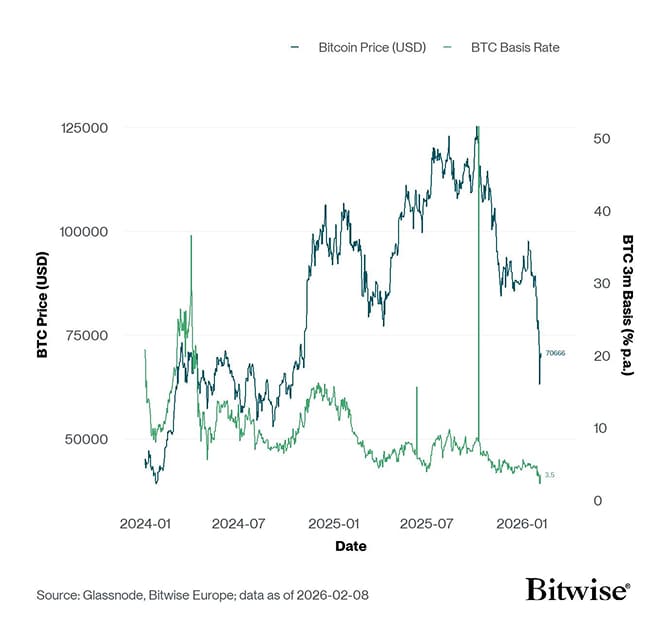 Source: Glassnode, Bitwise Europe; data as of 2026-02-08
Ethereum Price vs Futures Basis Rate
Source: Glassnode, Bitwise Europe; data as of 2026-02-08
Ethereum Price vs Futures Basis Rate
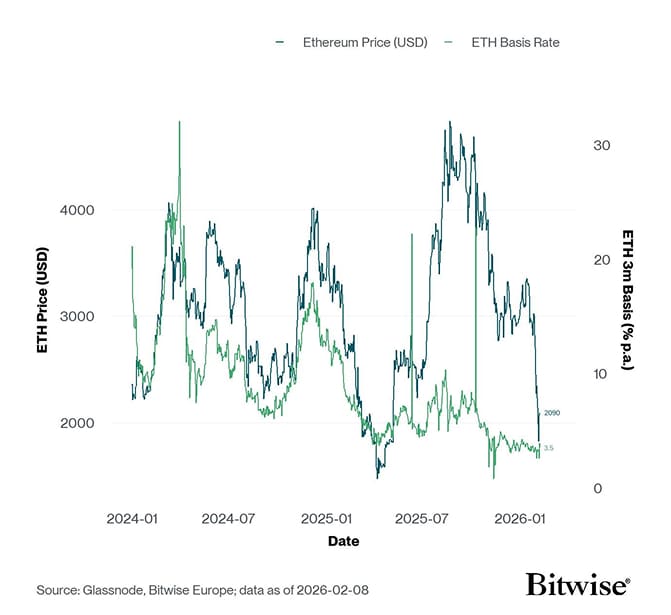 Source: Glassnode, Bitwise Europe; data as of 2026-02-08
BTC Net Exchange Volume by Size
Source: Glassnode, Bitwise Europe; data as of 2026-02-08
BTC Net Exchange Volume by Size
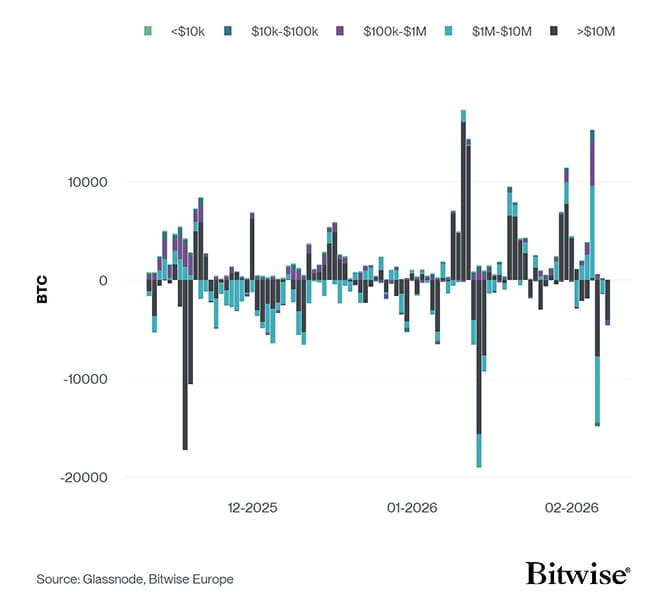 Source: Glassnode, Bitwise Europe
Important Information
This publication constitutes a marketing communication and is provided for informational purposes only. It does not constitute investment advice, a personal recommendation, or an offer or solicitation to buy or sell any financial instrument.
This document (which may take the form of a presentation, press release, social media post, blog article, broadcast communication or similar instrument – collectively referred to as a “Document”) is issued by Bitwise Europe GmbH (“BEU” or the “Issuer”) and has been prepared in accordance with applicable laws and regulations, including those relating to financial promotions.
Bitwise Europe GmbH, incorporated under the laws of Germany, is the issuer of the Exchange Traded Products (“ETPs”) referenced in this Document under a base prospectus and the applicable final terms, as supplemented from time to time, approved by the German Federal Financial Supervisory Authority (BaFin). The approval of the prospectus by BaFin relates solely to the completeness, coherence and comprehensibility of the prospectus in accordance with the Prospectus Regulation and does not constitute an endorsement, recommendation or assessment of the merits of the products.
The market analyses, views and scenarios presented reflect the assessment as of the date of publication and are based on information considered reliable. However, no representation or warranty is made as to their accuracy or completeness. Forward-looking statements involve risks and uncertainties and are not guarantees of future performance. Past performance is not a reliable indicator of future results.
Capital at risk. Cryptoassets are highly volatile and involve a high degree of risk. The value of investments in cryptoassets and crypto-linked ETPs may fluctuate significantly, and investors may lose part or all of their invested capital. No capital protection or guaranteed compensation mechanism applies in respect of market losses.
Any investment decision should be made solely on the basis of the relevant base prospectus, the applicable final terms and the key information document, in particular the section entitled “Risk Warning”. The base prospectus, final terms and additional risk information are available at: www.bitwiseinvestments.eu
Access to certain documents may require self-certification regarding your jurisdiction and investor status and may be subject to additional disclaimers and important information.
For further details, please refer to the full disclaimer available at: www.bitwiseinvestments.eu/disclaimer