This report is for professional investors and information purposes only. Persons without professional investment experience should not rely on it. Not investment advice or a personal recommendation. Cryptoassets are high risk and volatile and you may lose all capital invested. See full risk information at the end of this document.
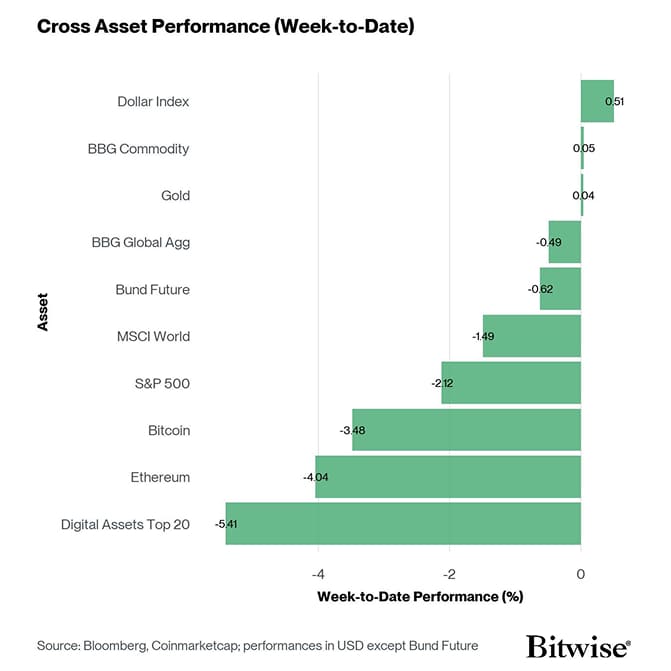
- Performance: Cryptoassets declined over the week amid broad-based de-risking. Furthermore, Equities also moved lower, with the S&P 500 extending its drawdown to five consecutive weeks. In addition, the US 10yr Treasury continue to sell-off as demand for USD liquidity continues to surge.
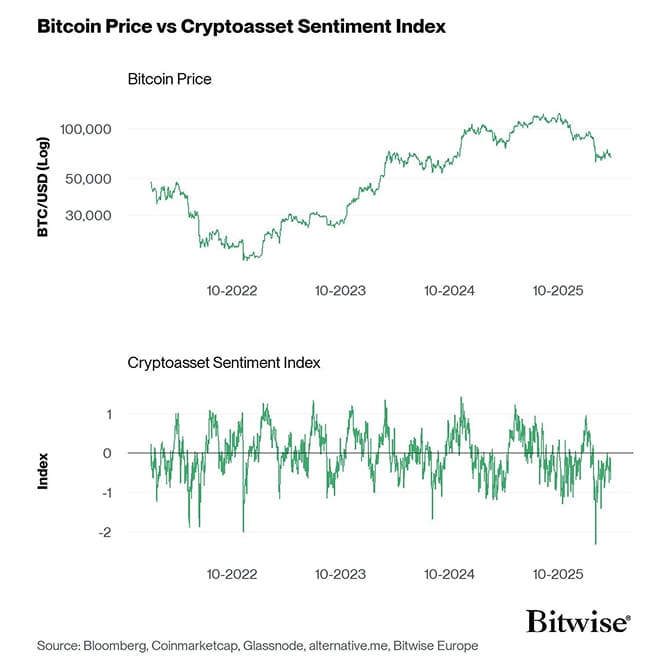
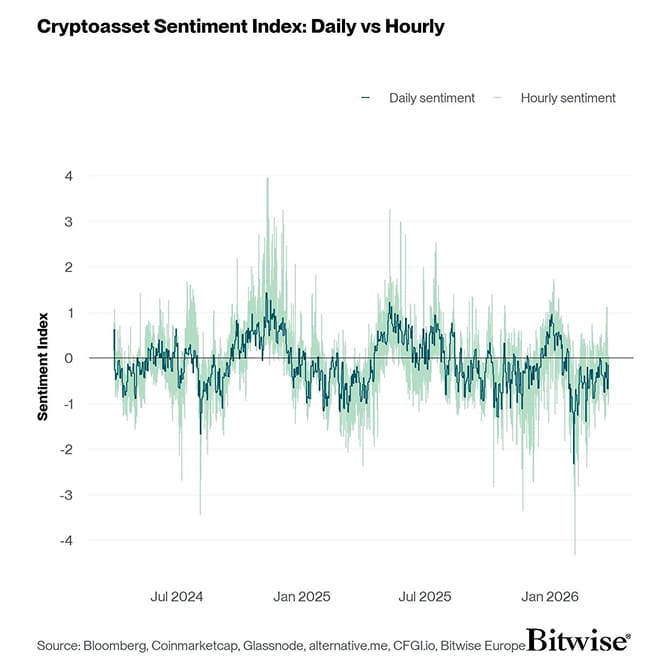
- Sentiment: Our in-house Cryptoasset Sentiment Index improved modestly but continues to signal a bearish bias, reflecting ongoing macro uncertainty, elevated energy prices, and tightening financial conditions.
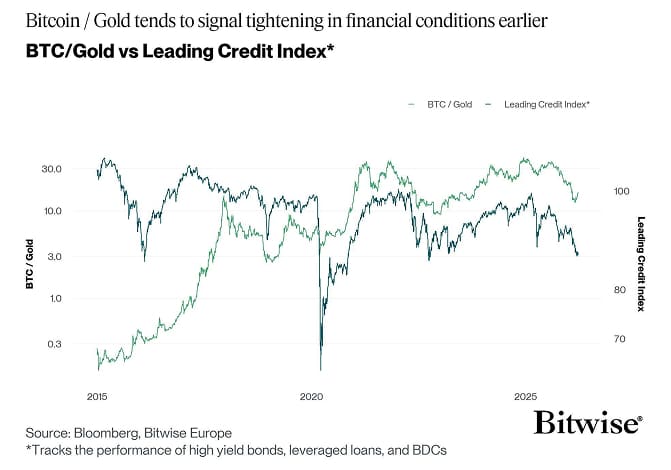
- Chart-of-the-week: Our Leading Credit Index continues to indicate tightening financial conditions, which remain a headwind for risk assets. However, a recent uptick in the BTC/Gold ratio, a metric that has historically led shifts in financial conditions, may point to early signs of improvement, although this trend remains in its infancy and uncertain.
Chart of the Week
Bitcoin/Gold tends to signal tightening in financial conditions earlier
 Source: Bloomberg, Bitwise Europe
*Tracks the performance of high yield bonds, leveraged loans, and BDCs
Performance
Geopolitical tensions remain elevated, with the conflict between the United States and Iran continuing to drive a highly volatile backdrop. The Strait of Hormuz continues to operate under severe disruption, with only limited tanker traffic transiting the passage. Supply dislocations, alongside damage to critical Gulf energy infrastructure have materially impaired global energy flows across both oil and LNG markets, contributing to a sharp increase in energy prices.
Energy represents a foundational input into modern economic activity, influencing key sectors such as transportation, manufacturing, agriculture and the semiconductor industry. The longer these disruptions persist, the more broadly the shock is likely to propagate through global supply chains.
Crucially, energy prices remain closely tied to inflation expectations. The recent surge has driven a meaningful repricing in monetary policy expectations, with previously anticipated Federal Reserve rate cuts largely reversing toward expectations of renewed tightening.
There are early indications that diplomatic efforts may be emerging, particularly from the Trump administration. However, Iranian officials have pushed back on several aspects of these claims, highlighting a divergence in public messaging. While both sides continue to engage through indirect channels, the situation appears characterised by a disconnect between public messaging and underlying negotiations.
Digital asset markets struggled over the week, with Bitcoin underperforming and closing the month on a weak footing. This softness extended across the broader digital asset complex. Major equities also declined, with the S&P 500 recording a -2.2% drop, marking its fifth consecutive negative week.
The US Treasury complex also continued to sell off, with yields rising across the curve as demand for USD liquidity increased amid financial stress. Gold experienced a similar dynamic, driven by a similar necessity for USDs, another signpost for tightening financial conditions.
Oil markets in particular remain elevated with Brent Crude around $106.1 and WTI near $98.7. The Brent–WTI spread (~$7) continues to signal global energy stress, though its recent narrowing suggests an improvement in the fragmentation of regional energy markets as well as partial easing of geopolitical risk premia. However, the relationship remains highly volatile in the current macro and geopolitical backdrop.
Notably, oil prices appear to be becoming less responsive to commentary from President Trump, suggesting markets are placing greater weight on realised supply disruptions than on public commentary.
Rising energy prices and tighter monetary policy expectations are already contributing to an increase in recession probabilities. Market-based indicators such as Kalshi and Polymarket currently price a 2026 recession at approximately 34% and 36%, respectively. Ongoing geopolitical uncertainty continues to increasingly weigh on the macroeconomic outlook.
However, the persistence of a sustained supply-side inflationary impulse will likely depend on continued disruption to flows through the Strait of Hormuz. More broadly, the current environment reflects a mix of competing inflationary and disinflationary forces, leaving the overall trajectory uncertain. On one hand, tightening financial conditions and potential demand destruction act as disinflationary pressures. On the other, structural forces such as near-shoring and the gradual fragmentation of U.S. naval dominance and the global free trade system introduce a more persistent inflationary bias.
As outlined in our previous Bitcoin Macro Investor report, Bitcoin appears to have already repriced meaningfully in response to tightening financial conditions, with the asset increasingly sensitive to shifts in liquidity. However, further downside across risk assets, particularly equities, has historically exerted additional pressure on digital assets, suggesting that volatility is likely to remain elevated, with downside risks still present.
Cross Asset Performance (Week-to-Date)
 Source: Bloomberg, Coinmarketcap; performances in USD exept Bund Future
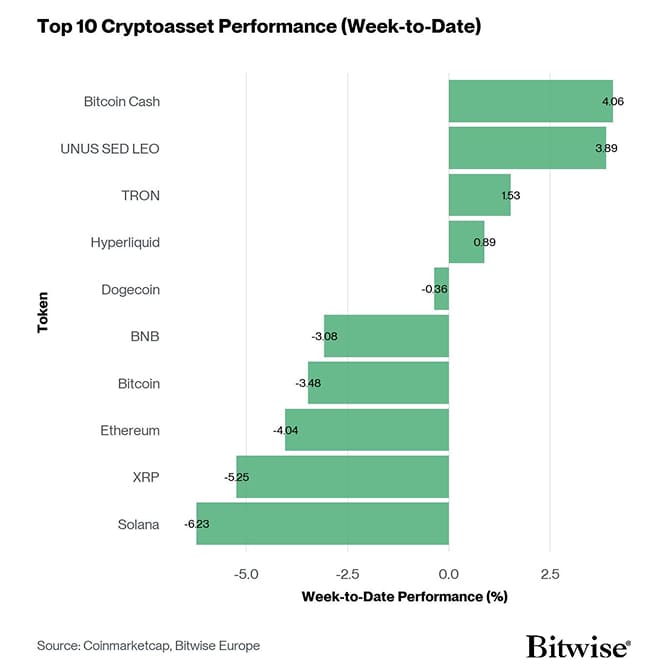
Top 10 Cryptoasset Performance (Week-to-Date)
Source: Bloomberg, Coinmarketcap; performances in USD exept Bund Future
Top 10 Cryptoasset Performance (Week-to-Date)
 Source: Coinmarketcap
In general, among the top 10 crypto assets TRON, Hyperliquid, Bitcoin Cash and LEO were the relative outperformers.
Sentiment
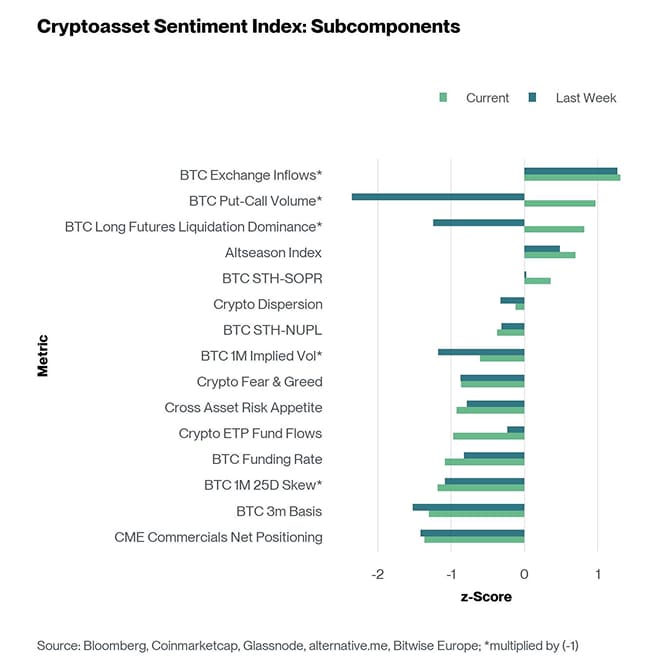
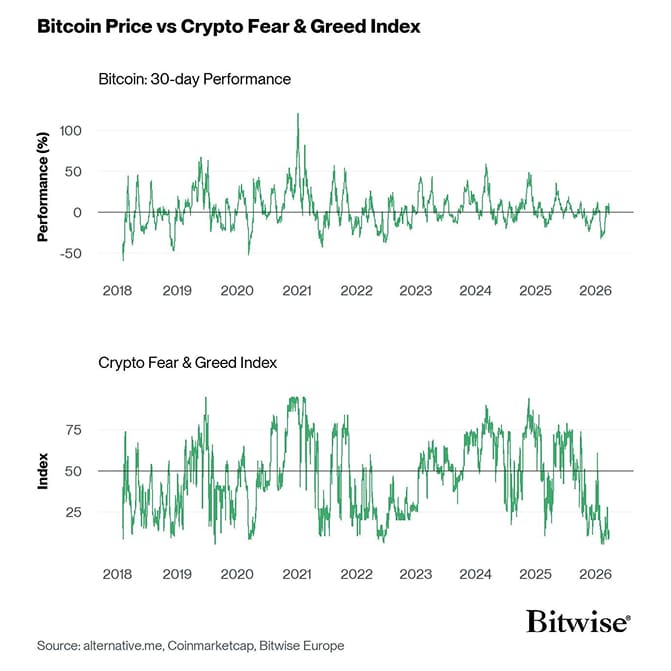
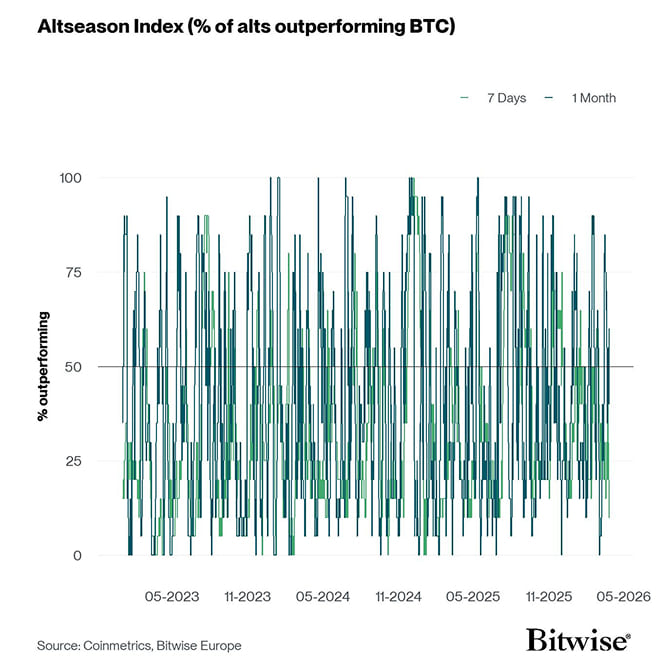
Our in-house “Cryptoasset Sentiment Index” improved marginally week-over-week yet still signals a bearish sentiment. This is in line with a depressed Crypto Fear and Greed Index, and our in-house Crypto Dispersion and Altseason indices which suggest broader uncertainty across the crypto complex.
At the moment, 5 out of 15 indicators are above their short-term trend.
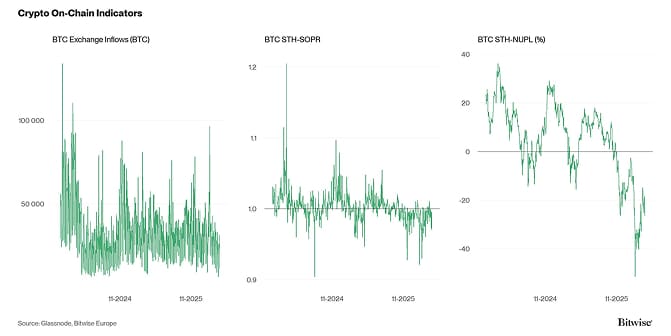
Last week, the BTC Exchange Inflows, BTC STH SOPR, Put/Call Volume, Long Futures Liquidation Dominance and Altseason Index showed positive momentum.
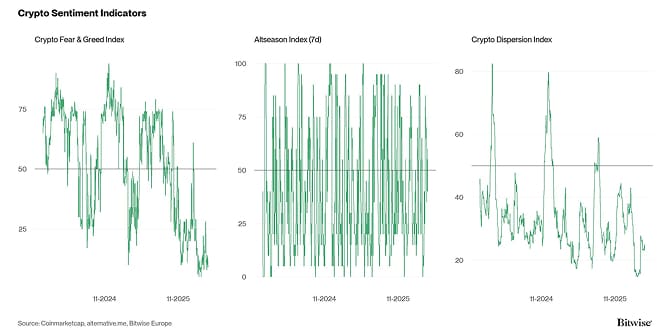
The Crypto Fear & Greed Index continues to signal an “extreme fear” level of sentiment as of this morning, with price action continuing to trend downwards.
Performance dispersion among cryptoassets increased slightly last week to 0.25. When dispersion is increases, it may indicate that the market appears to be driven by a more diverse set of narratives which, in our analysis, has historically been associated with periods of increasing risk appetite in prior market cycles. However, the increase remains modest at best.
Altcoin outperformance vis-à-vis Bitcoin remained flat across the week, with 60% of our tracked altcoins in the index.
In general, net neutral altcoin performance may be a sign of investor uncertainty across cryptoasset markets.
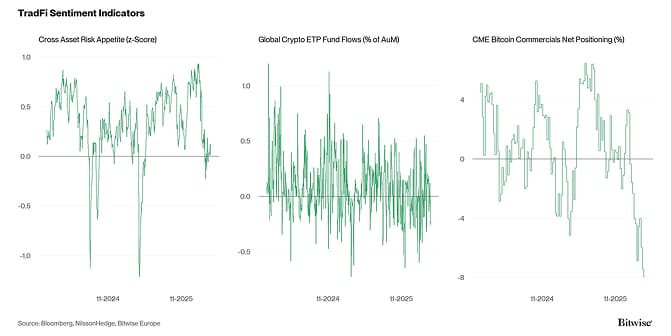
Sentiment in traditional financial markets as measured by our in-house measure of Cross Asset Risk Appetite (CARA) remained flat at 0.01 over the past week which is signalling uncertainty in traditional financial markets.
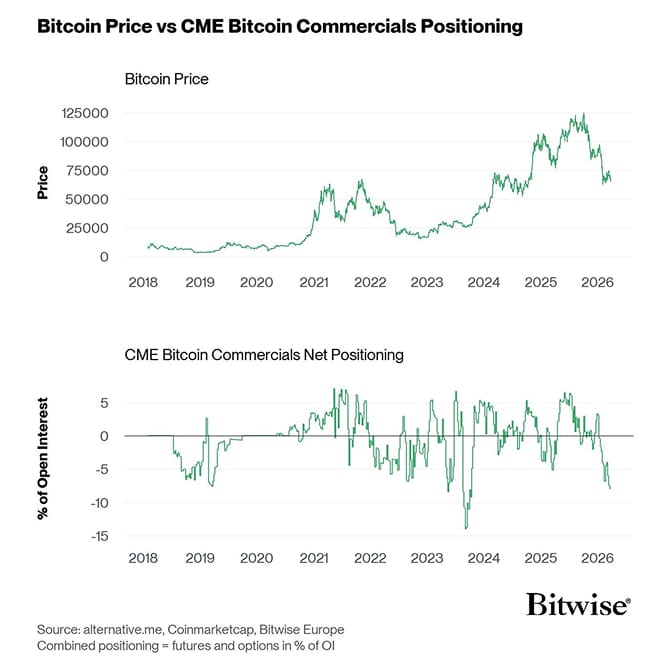
CME Bitcoin Commercials Net Positioning, which shows the difference between long and short CME Bitcoin futures contracts declined from –7.46 to –7.96. This suggests institutions were a contributing factor in the leg lower this week.
Fund Flows
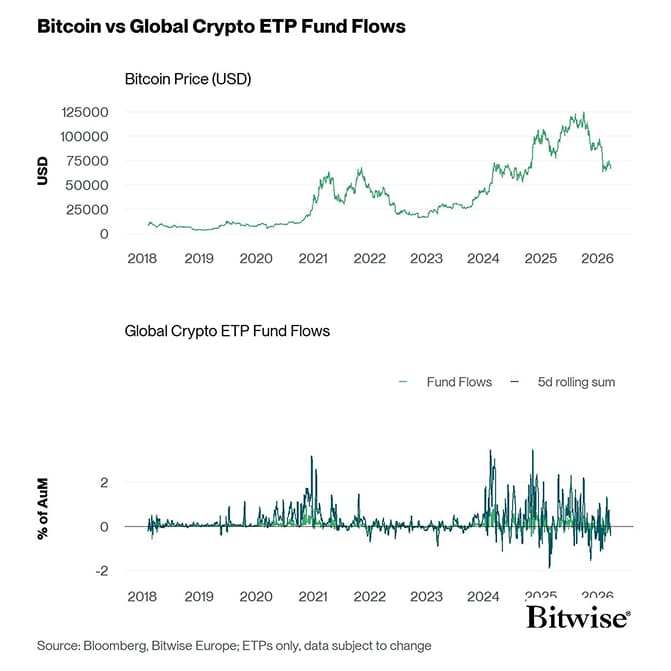
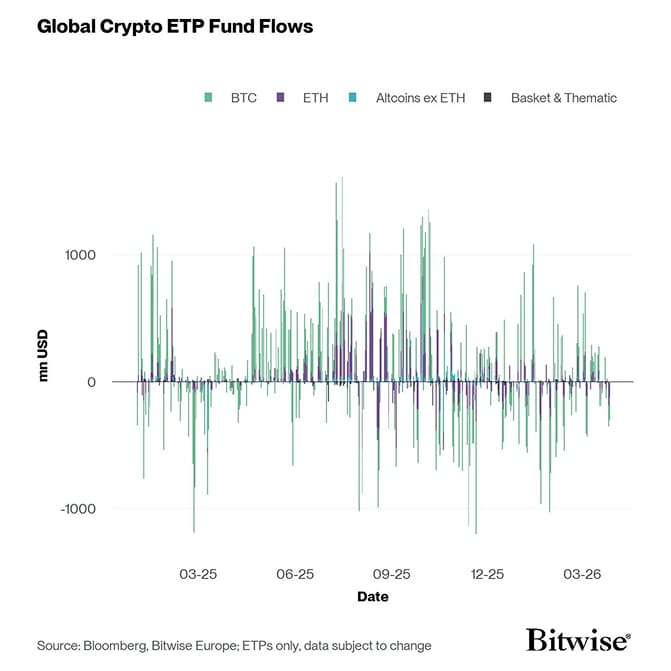
Global crypto ETPs saw large net outflows last week across all major sectors, including Bitcoin, Ethereum, Altcoins Ex-Ethereum products and Basket and Thematic products. This totalled a net outflow of -$605.3 mn.
Global crypto ETPs saw around -605.3 mn USD in weekly net outflows across all types of cryptoassets, after -2.8 mn USD in net outflows the previous week.
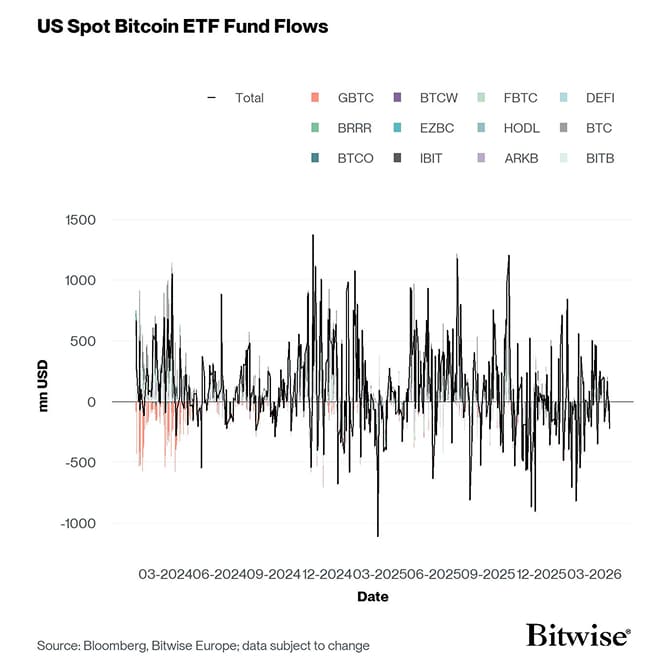
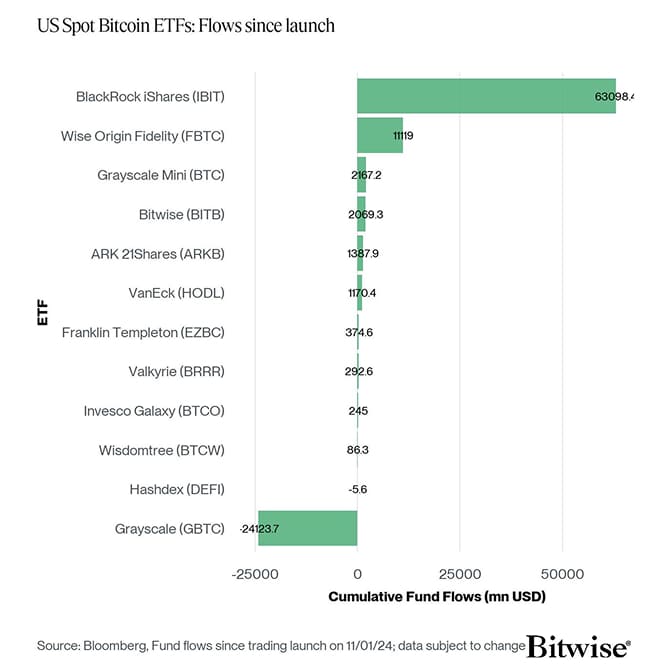
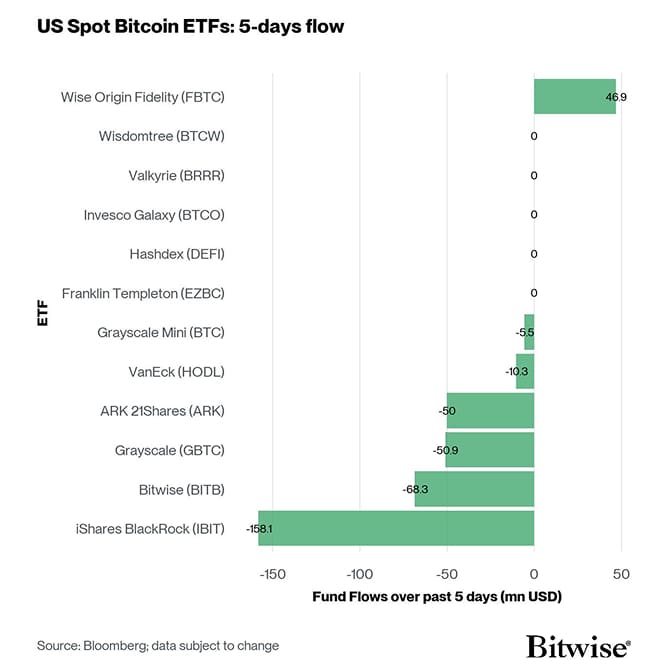
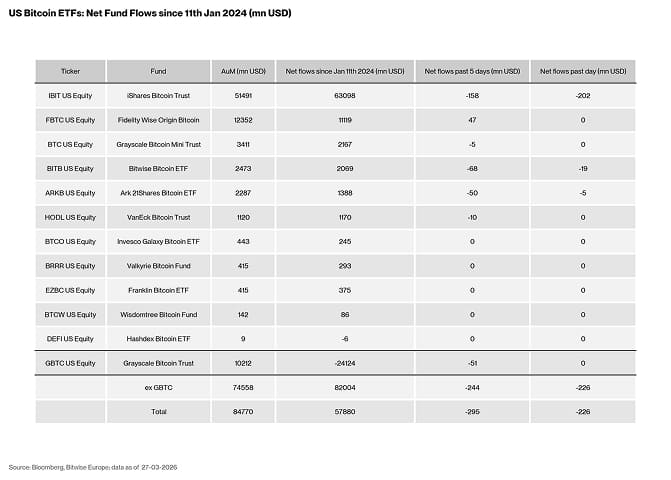
Global Bitcoin ETPs have experienced net outflows totalling -210.5 mn USD last week, of which -296.2 mn USD in outflows were related to US spot Bitcoin ETFs.
The Bitwise Bitcoin ETF (BITB) in the US experienced net outflows, totalling -68.3 mn USD last week.
In Europe, the Bitwise Physical Bitcoin ETP (BTCE) experienced net outflows equivalent to –2.7 mn USD, whereas the Bitwise Core Bitcoin ETP (BTC1) experienced net inflows of +0.5 mn USD.
The Grayscale Bitcoin Trust (GBTC) posted net outflows of –50.9 mn USD and the iShares Bitcoin Trust (IBIT) experienced net outflows of around -158.1 mn USD last week.
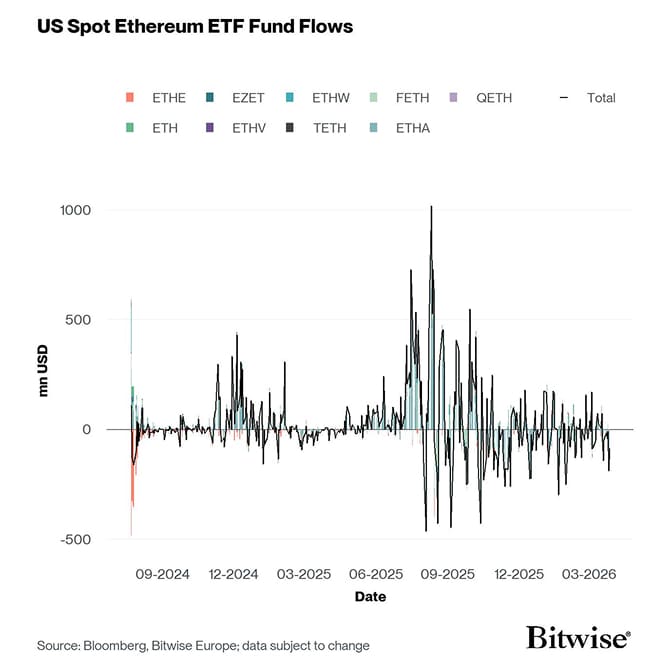
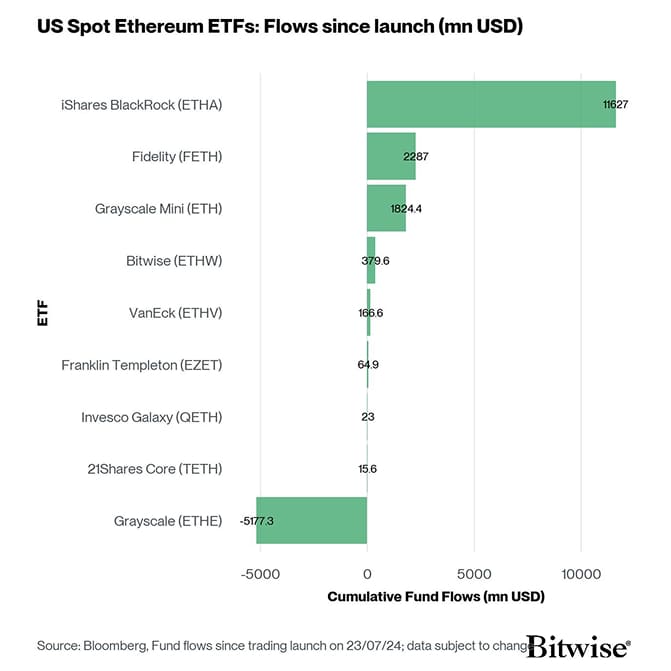
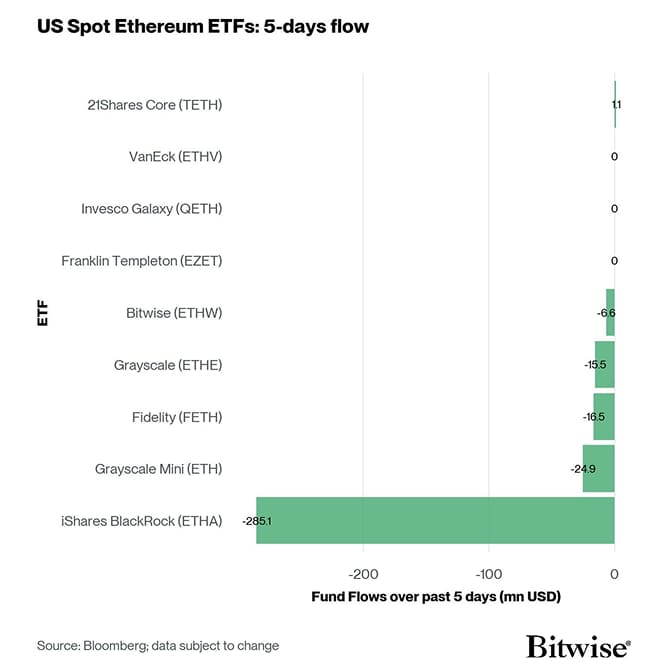
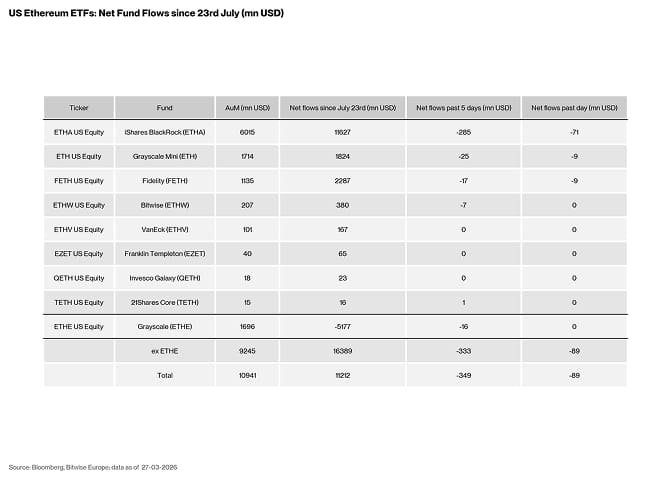
Meanwhile, global Ethereum ETPs also experienced -380.9 mn USD in net outflows last week, of which US spot Ethereum ETFs recorded net outflows of around -347.7 mn USD on aggregate.
The Grayscale Ethereum Trust (ETHE) posted net outflows of -15.5 mn USD, alongside the iShares Ethereum Trust (ETHA) that experienced -285.1 mn USD of net outflows.
The Bitwise Ethereum ETF (ETHW) in the US has posted net outflows of -6.6 mn USD.
In Europe, the Bitwise Physical Ethereum ETP (ZETH) experienced no net inflows last week of +/-0.0 mn USD, as the Bitwise Ethereum Staking ETP (ET32) saw +0.3 mn USD of net inflows.
Altcoin ETPs ex Ethereum experienced net outflows of -10.1 mn USD last week.
Thematic & basket crypto ETPs posted net outflows of -3.8 mn USD on aggregate last week. The Bitwise MSCI Digital Assets Select 20 ETP (DA20) experienced a net inflow of +0.1 mn.
On-Chain Data
After reaching a local high near $72k earlier this week, Bitcoin retraced toward $66k as the elevated uncertainty stemming from the US / Iran conflict continues to permeate through risk markets, creating a fragile and locally volatile environment.
Exchange Spot Volume Delta has turned modestly negative following a reversion toward equilibrium in the prior week. This continues to indicate a broadly balanced market, reinforcing prevailing uncertainty among participants. In parallel, aggregate exchange inflows and outflows declined to a new local low of $2.86bn, marking the lowest activity regime since October 2024. Taken together, these signals suggest investor participation remains subdued, with sentiment still broadly impaired.
Aggregate investor stress also remains elevated. The value of invested capital currently held at a loss is estimated near $870bn (80% of all invested dollars). This underscores that the majority of deployed capital remains in a position of loss, reflecting a highly damaged investor sentiment.
Nevertheless, Net Realised Profit/Loss continues to moderate despite ongoing balance sheet impairment, with net losses of approximately –$385mn. This suggests investors are gradually acclimatising to the prevailing range, with the initial move into this price zone having already triggered more substantial loss realisation. As a result, both profit- and loss-taking activity now appear relatively muted, underscoring constrained liquidity within the range. Historically, such conditions have tended to precede expansions in local volatility.
This is reflected in the Sell-Side Risk Ratio, which measures total realised profit and loss relative to Realised Cap (the net capital inflow committed to the asset). At present, the ratio has fallen to historically low levels, with only 4.8% of trading days recording a lower value. This reinforces the view that capital flows remain marginal, and that liquidity within the current range is constrained.
When assessing price compression across 30-, 60-, and 90-day windows, the 30-day measure sits in the 17th percentile, while the 60- and 90-day measures remain in the 44th and 41st percentiles, respectively. Bitcoin has historically not remained compressed for extended periods, with tighter price action often preceding increases in volatility. The fact that only the 30-day window reflects pronounced compression suggests that near-term volatility expectations may be elevated, while broader macro volatility remains more contained, consistent with choppy, range-bound conditions.
Bitcoin continues to dominate market structure. Correlations and beta across the altcoin complex have risen toward historical highs, indicating a single-factor environment driven primarily by Bitcoin. Nevertheless, broader macro forces remain the primary driver of global risk sentiment.
Key price levels remain unchanged. The cycle low near $60k continues to define structural downside support, while the $80k region marks the upper boundary from which the latest contraction accelerated. Price has remained confined within this range since 31 January, reinforcing its significance as the dominant trading regime.
Futures, Options & Perpetuals
Over the past week, BTC perpetual futures open interest increased by approximately +50.5k BTC, marking a much larger build than in the prior week, while CME futures open interest rose by a more modest +0.9k BTC. This suggests most of the new risk was added in crypto-native venues rather than through a broad increase in institutional participation. Aggregate futures liquidations across all assets remained elevated, though somewhat below the previous week’s level. In total, liquidations reached roughly $2.0bn over the week, versus $2.3bn previously.
Positioning remains heavily concentrated around the $67k region, where a large pocket of liquidity has formed. A move into this area could trigger a short squeeze, giving price a stronger push higher if that level is reached. Above that, $70k stands out as the next notable liquidity zone. On the downside, there is still a meaningful pocket of liquidity near $65k, which could draw price lower if momentum weakens.
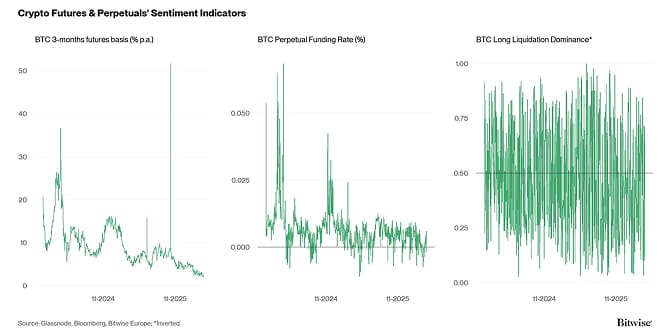
Perpetual funding rates, measured on a 7-day moving average, remained broadly flat through the week. Despite the sharp increase in open interest, this suggests the market has not moved decisively toward either aggressive long or short positioning, and that leverage has increased without a clear directional skew.
At the same time, the BTC 3-month annualised basis remains depressed at approximately 2.2%, slightly below last week’s already subdued 2.3%. Basis continues to sit well below prevailing short-term US Treasury bill yields, reinforcing the view that risk appetite remains restrained and that demand for leveraged long exposure is still muted.
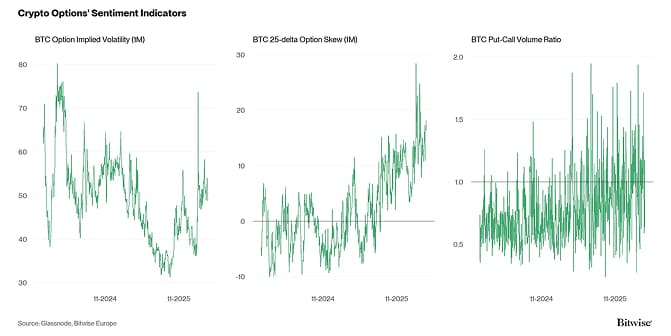
In options markets, BTC options open interest declined sharply by roughly -168.7k BTC, bringing total open interest down to 336.9k BTC. Much of that decline likely reflects the roll-off of the 28 March expiry. The Deribit put-to-call open interest ratio continued to ease, falling to 0.66, while the equivalent metric across IBIT options stood at 0.69 by week’s end.
Taken together, these moves point to a market where appetite for downside protection has moderated somewhat, though not enough to suggest a broad shift toward outright bullish positioning. The drop in options open interest appears to reflect a reset in positioning more than a strong change in underlying conviction.
The 25-delta skew moved higher across the curve over the week. This suggests options markets assigned a somewhat greater premium to downside protection than they did a week earlier. Because the move was visible across tenors rather than being confined to the front end, it appears to reflect a broader reassessment of downside risk rather than a hedge around a single near-term event.
Total GEX, on a 7-day moving average basis, increased further from $5.8bn to $6.2bn. This indicates that dealer positioning remains set up in a way that could reinforce market moves if price begins to trend. In practical terms, the higher reading suggests the market may be becoming more reactive to spot moves, with hedging flows more likely to add to volatility than dampen it.
Dealer gamma exposure also remains predominantly negative, with the bulk of negative gamma clustered around the $67k to $68k strikes and again near $74k. These levels line up closely with the main liquidity zones in perpetuals positioning, reinforcing their importance as areas where price could become more unstable. By contrast, positive gamma is concentrated around $61k to $62k, which could provide some stabilising effect if BTC trades lower, though that support sits well below current spot levels.
Bottom Line
- Performance: Cryptoassets declined over the week amid broad-based de-risking. Furthermore, Equities also moved lower, with the S&P 500 extending its drawdown to five consecutive weeks. In addition, the US 10yr Treasury continue to sell-off as demand for USD liquidity continues to surge.
- Sentiment: Our in-house Cryptoasset Sentiment Index improved modestly but continues to signal a bearish bias, reflecting ongoing macro uncertainty, elevated energy prices, and tightening financial conditions.
- Chart-of-the-week: Our Leading Credit Index continues to indicate tightening financial conditions, which remain a headwind for risk assets. However, a recent uptick in the BTC/Gold ratio, a metric that has historically led shifts in financial conditions, may point to early signs of improvement, although this trend remains in its infancy and uncertain.
Appendix
Bitcoin Price vs Cryptoasset Sentiment Index
 Source: Bloomberg, Coinmarketcap, Glassnode, NilssonHedge, alternative.me, Bitwise Europe
Cryptoasset Sentiment Index: Subcomponents
Source: Bloomberg, Coinmarketcap, Glassnode, NilssonHedge, alternative.me, Bitwise Europe
Cryptoasset Sentiment Index: Subcomponents
 Source: Bloomberg, Coinmarketcap, Glassnode, NilssonHedge, alternative.me, Bitwise Europe; *multiplied by (-1)
TradFi Sentiment Indicators
Source: Bloomberg, Coinmarketcap, Glassnode, NilssonHedge, alternative.me, Bitwise Europe; *multiplied by (-1)
TradFi Sentiment Indicators
 Source: Bloomberg, NilssonHedge, Bitwise Europe
Crypto Sentiment Indicators
Source: Bloomberg, NilssonHedge, Bitwise Europe
Crypto Sentiment Indicators
 Source: Coinmarketcap, alternative.me, Bitwise Europe
Crypto Options' Sentiment Indicators
Source: Coinmarketcap, alternative.me, Bitwise Europe
Crypto Options' Sentiment Indicators
 Source: Glassnode, Bitwise Europe
Crypto Futures & Perpetuals' Sentiment Indicators
Source: Glassnode, Bitwise Europe
Crypto Futures & Perpetuals' Sentiment Indicators
 Source: Glassnode, Bitwise Europe; *Inverted
Crypto On-Chain Indicators
Source: Glassnode, Bitwise Europe; *Inverted
Crypto On-Chain Indicators
 Source: Glassnode, Bitwise Europe
Bitcoin vs Crypto Fear & Greed Index
Source: Glassnode, Bitwise Europe
Bitcoin vs Crypto Fear & Greed Index
 Source: alternative.me, Coinmarketcap, Bitwise Europe
Cryptoasset Sentiment Index: Daily vs Hourly
Source: alternative.me, Coinmarketcap, Bitwise Europe
Cryptoasset Sentiment Index: Daily vs Hourly
 Source: Bloomberg, Coinmarketcap, Glassnode, NilssonHedge, alternative.me, CFGI.io, Bitwise Europe
Bitcoin vs Global Crypto ETP Fund Flows
Source: Bloomberg, Coinmarketcap, Glassnode, NilssonHedge, alternative.me, CFGI.io, Bitwise Europe
Bitcoin vs Global Crypto ETP Fund Flows
 Source: Bloomberg, Bitwise Europe; ETPs only, data subject to change
Global Crypto ETP Fund Flows
Source: Bloomberg, Bitwise Europe; ETPs only, data subject to change
Global Crypto ETP Fund Flows
 Source: Bloomberg, Bitwise Europe; ETPs only; data subject to change
US Spot Bitcoin ETF Fund Flows
Source: Bloomberg, Bitwise Europe; ETPs only; data subject to change
US Spot Bitcoin ETF Fund Flows
 Source: Bloomberg, Bitwise Europe; data subject to change
US Spot Bitcoin ETFs: Flows since launch
Source: Bloomberg, Bitwise Europe; data subject to change
US Spot Bitcoin ETFs: Flows since launch
 Source: Bloomberg, Fund flows since traiding launch on 11/01/24; data subject to change
US Spot Bitcoin ETFs: 5-days flow
Source: Bloomberg, Fund flows since traiding launch on 11/01/24; data subject to change
US Spot Bitcoin ETFs: 5-days flow
 Source: Bloomber; data subject to change
US Bitcoin ETFs: Net Fund Flows since 11th Jan mn USD
Source: Bloomber; data subject to change
US Bitcoin ETFs: Net Fund Flows since 11th Jan mn USD
 Source: Bloomberg, Bitwise Europe; data as of 27-03-2026
US Spot Ethereum ETF Fund Flows
Source: Bloomberg, Bitwise Europe; data as of 27-03-2026
US Spot Ethereum ETF Fund Flows
 Source: Bloomberg, Bitwise Europe; data subject to change
US Spot Ethereum ETFs: Flows since launch (mn USD)
Source: Bloomberg, Bitwise Europe; data subject to change
US Spot Ethereum ETFs: Flows since launch (mn USD)
 Source: Bloomberg, Fund flows since trading launch on 23/07/24; data subject on change
US Spot Ethereum ETFs: 5-days flow
Source: Bloomberg, Fund flows since trading launch on 23/07/24; data subject on change
US Spot Ethereum ETFs: 5-days flow
 Source: Bloomberg; data subject on change
US Ethereum ETFs: Net Fund Flows since 23rd July (mn USD)
Source: Bloomberg; data subject on change
US Ethereum ETFs: Net Fund Flows since 23rd July (mn USD)
 Source: Bloomberg, Bitwise Europe; data as of 27-03-2026
Bitcoin Price vs CME Bitcoin Commercials Positioning
Source: Bloomberg, Bitwise Europe; data as of 27-03-2026
Bitcoin Price vs CME Bitcoin Commercials Positioning
 Source: alternative.me, Coinmarketcap, Bitwise Europe
Combined positioning = futures and options in % of Ol
Altseason Index (% of alts outperforming BTC)
 Source: Coinmetrics, Bitwise Europe
Bitcoin vs Crypto Dispersion Index
Source: Coinmetrics, Bitwise Europe
Bitcoin vs Crypto Dispersion Index
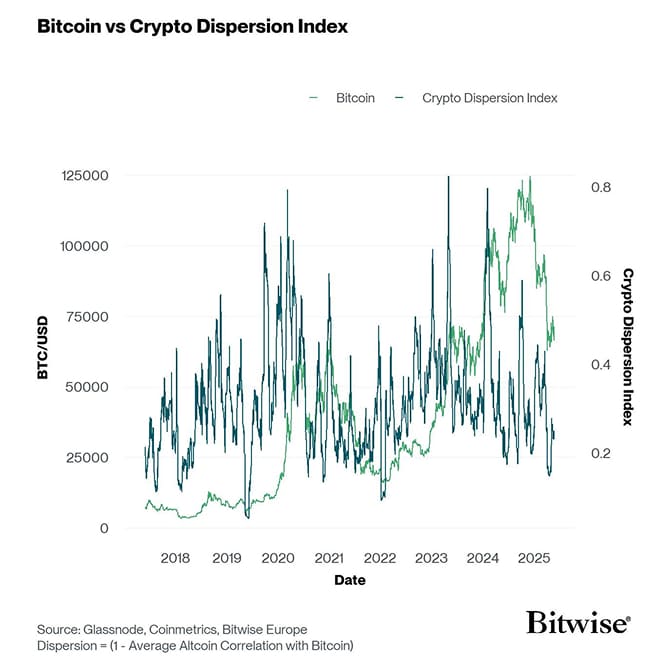 Source: Coinmarketcap, Bitwise Europe; Dispersion = (1 - Average Altcoin Correlation with Bitcoin)
Bitcoin Price vs Futures Basis Rate
Source: Coinmarketcap, Bitwise Europe; Dispersion = (1 - Average Altcoin Correlation with Bitcoin)
Bitcoin Price vs Futures Basis Rate
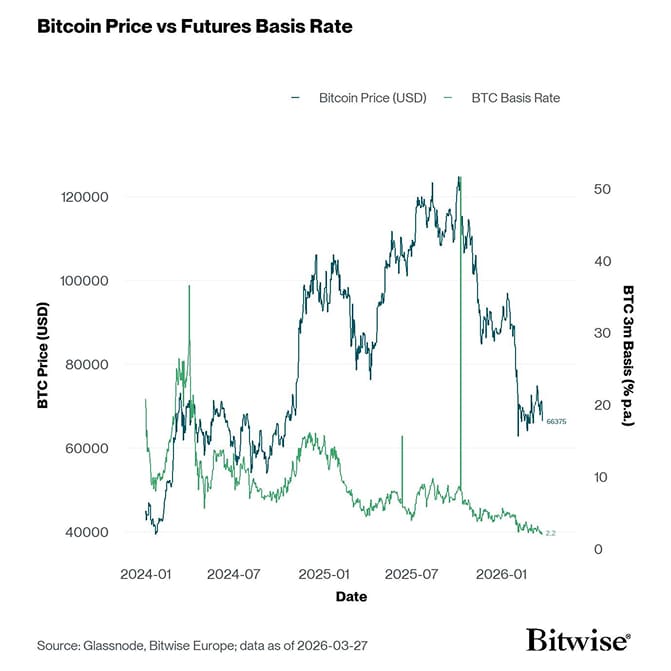 Source: Glassnode, Bitwise Europe; data as of 2026-03-27
Ethereum Price vs Futures Basis Rate
Source: Glassnode, Bitwise Europe; data as of 2026-03-27
Ethereum Price vs Futures Basis Rate
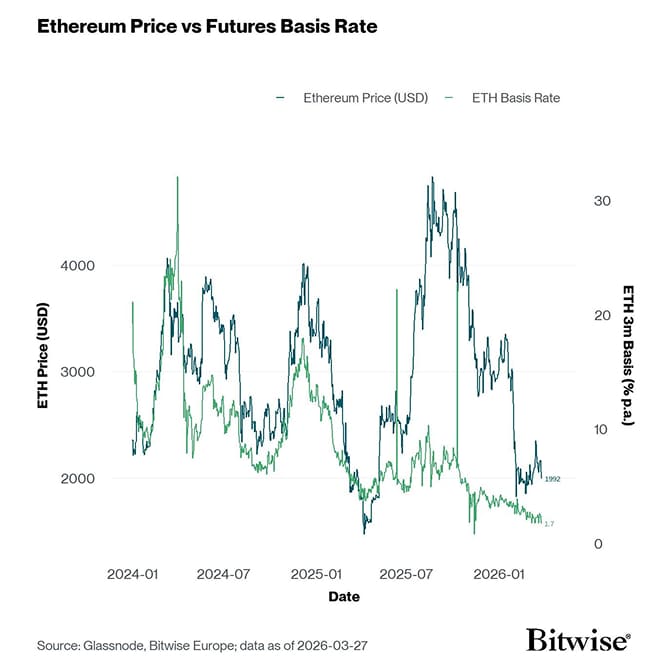 Source: Glassnode, Bitwise Europe; data as of 2026-03-27
BTC Net Exchange Volume by Size
Source: Glassnode, Bitwise Europe; data as of 2026-03-27
BTC Net Exchange Volume by Size
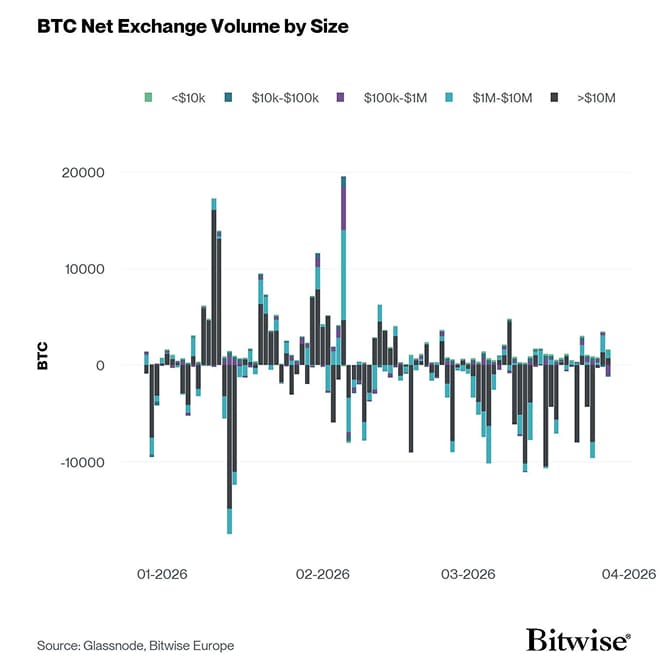 Source: Glassnode, Bitwise Europe
Important Information
This material is intended solely for professional investors and is not suitable for retail distribution and reliance.
The information provided in this material is for illustrative, educational or information purposes only and does not constitute investment advice, a recommendation or solicitation of an offer to buy any product or to make any investment.
This document (which may be subject to change and may be in the form of a presentation, press release, social media post, blog post, broadcast communication or similar instrument – we refer to this category of communications generally as a “document” for purposes of this disclaimer) is issued by Bitwise Europe GmbH (“BEU” or “the Issuer”). This document has been prepared in accordance with applicable laws and regulations (including those relating to financial promotions).
Bitwise Europe GmbH, incorporated under the laws of Germany, is the issuer of Exchange Traded Products (“ETPs”) described in this document under a base prospectus and final terms, which may be supplemented from time to time, and which are approved by BaFin. If you are considering investing in products issued by BEU you should check with independent financial adviser, your broker or bank that such products are available in your jurisdiction and suitable for your investment profile. A decision to invest any amount in an ETPs offered by BEU should take into consideration your specific circumstances after seeking independent investment, tax and legal advice.
Capital at risk. Cryptoassets are high-risk and volatile. The value of investments in cryptoassets and crypto-linked ETPs may fall as well as rise, and investors may lose some or all of their invested capital. No investor protection or compensation scheme applies. Past performance is not a reliable indicator of future results. Forward-looking statements are not guarantees.
You should read the relevant base prospectus and final terms before investing and, in particular, the section entitled ‘Risk Factors' for further details of risks associated with an investment. The prospectuses, final terms and other documents relevant to BEU's ETPs are available under the “Resources” section at www.bitwiseinvestments.com. When visiting this website, you will need to self-certify as to your jurisdiction and investor type in order to access these documents, and in so doing you may be subject to other disclaimers and important information.
Important Analytical Limitations: The observations and analyses presented in this document are based on historical market patterns and data correlations which may not repeat or continue in future market conditions. Past correlations between capital flows and performance metrics are not indicative of future performance and should not be extrapolated as predictive indicators. Material downside risks remain present across all investment timeframes regardless of current undervaluation metrics or favorable technical indicators. All model outputs, fair value calculations, and quantitative assessments are subject to significant uncertainty and methodological limitations, and should not be relied upon as the sole basis for making investment decisions. Investors should conduct independent due diligence and consider multiple factors beyond the scope of this analysis.
Read the full disclaimer here: https://bitwiseinvestments.eu/disclaimer/