This report is for professional investors and information purposes only. Persons without professional investment experience should not rely on it. Not investment advice or a personal recommendation. Cryptoassets are high risk and volatile and you may lose all capital invested. See full risk information here.
- Performance: Overall, following the market crash in early February, cryptoassets appear to be transitioning from capitulation toward a potential cyclical bottom, with historically depressed sentiment and valuations contrasting against gradually improving macro liquidity conditions. While near-term volatility and subdued institutional flows may persist, the medium-term risk-reward profile may present asymmetric characteristics to the upside, though such profiles can reverse quickly in volatile markets, pending clearer stabilisation in flows and macro uncertainty.
- Macro: Bitcoin continues to trade at one of the deepest macro discounts on record, diverging from growth, liquidity and long-term adoption trends despite leading indicators pointing toward renewed reflation. While short-term headwinds from tighter US financial conditions, stalled liquidity and quantum-related uncertainty remain, forward-looking policy expectations and the Chinese-led credit impulse suggest improving macro tailwinds ahead. As bitcoin re-enters a macro-dominant regime, sustained expansion in global growth indicators could act as a catalyst for mean reversion.
- On-Chain: The traditional 4-year cycle framework would imply roughly another 8 months before a cyclical floor is established. Notably, this expectation has become deeply embedded in investor consensus, largely because the recent market top conformed closely to the traditional 4-year cycle template, despite many analysts having previously argued that this cyclical structure had already broken down. As a result, the 8-month horizon now appears somewhat consensus-heavy. In contrast, several alternative duration analogues point toward a shorter 2–6 month bottoming window. This divergence raises the possibility that the traditional 4-year timing heuristic may be front-run, a plausible outcome given the degree to which it is broadly anticipated and incorporated into positioning.
Chart of the Month
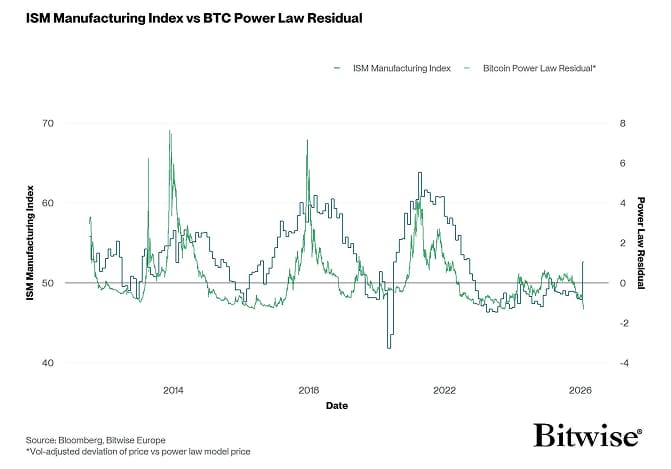
ISM Manufacturing Index vs BTC Power Law Residual
 Source: Bloomberg, Bitwise Europe
*Vol-adjusted deviation of price vs power law model price
Performance
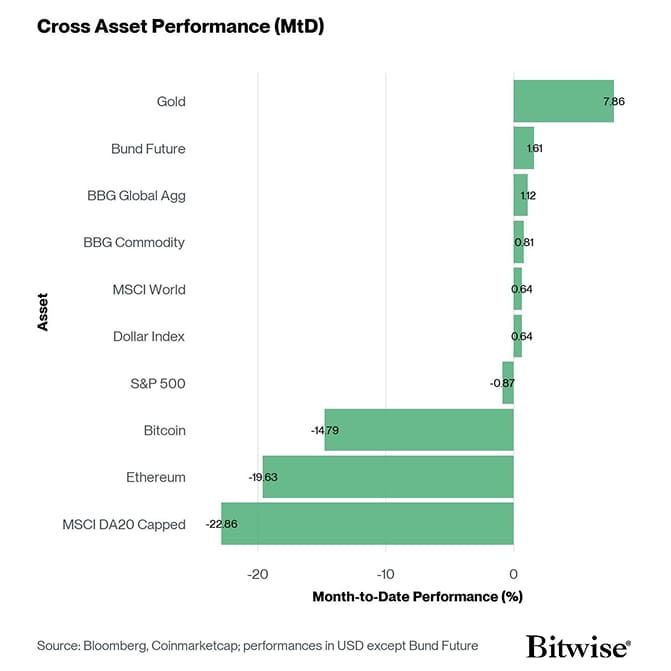
Over the past month, cryptoasset markets have remained under pressure, characterised by episodic volatility, subdued institutional flows, and elevated macro uncertainty. Price action was initially dominated by consolidation following one of the largest single-day drawdowns on record, with subsequent weeks marked by intermittent sell-offs driven primarily by leverage liquidations, ETP outflows, and broader risk-off sentiment across global markets.
A key macro narrative has been shifting monetary policy expectations. The nomination of Kevin Warsh to the Federal Reserve reinforced perceptions of a more hawkish policy stance, contributing to short-term volatility in cryptoassets. At the same time, rate-cut expectations have become increasingly bifurcated across the curve - more easing priced in near term, but less over the longer horizon - creating mixed signals for risk assets including bitcoin. Rising geopolitical risks, policy uncertainty, tightening financial conditions, and ongoing concerns around technological disruption (AI and quantum computing) have further weighed on investor sentiment.
Flows and positioning indicators continue to reflect this cautious backdrop. Crypto ETPs recorded persistent net outflows for much of the period, while CME futures positioning and institutional activity remained relatively subdued. Nonetheless, there are early indications that selling pressure from ETPs may be decelerating, and recent 13F filings suggest underlying institutional engagement remains more resilient than headline flows imply. Historically, such depressed positioning has often acted as a contrarian indicator once uncertainty begins to recede.
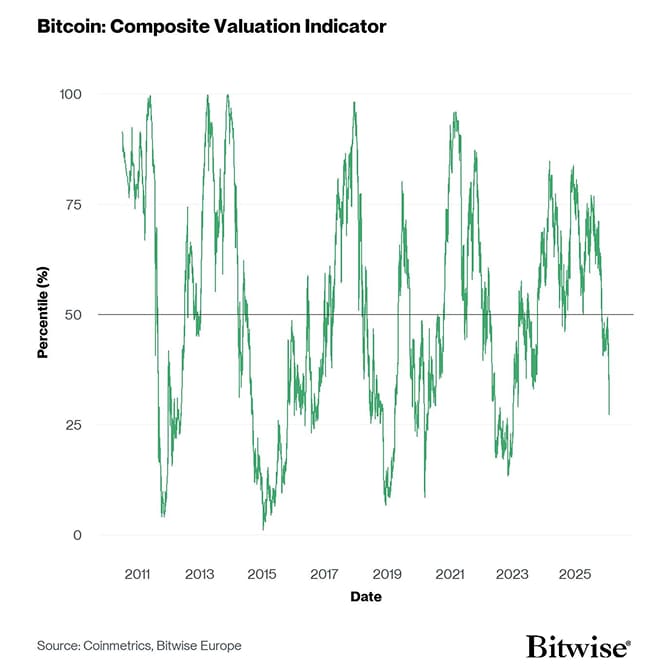
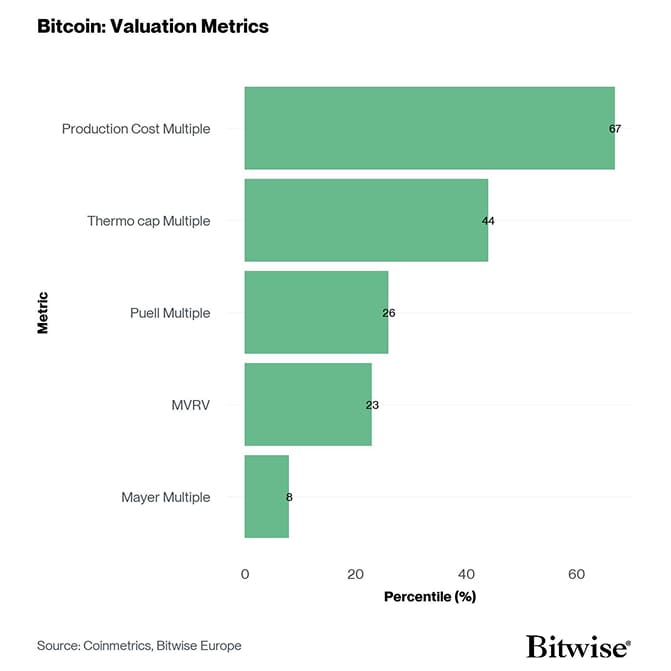
Sentiment and valuation metrics have moved into historically extreme territory. Our proprietary Cryptoasset Sentiment Index reached levels comparable to prior capitulation phases such as the FTX collapse, while traditional measures like the Fear & Greed Index printed near record lows. Concurrently, valuation indicators - including the MVRV Z-Score and broader composite valuation frameworks - have fallen into the lowest quartile of historical observations. Historically, similar constellations of sentiment and valuation extremes have coincided with cyclical trough formation, though typically via a gradual bottoming process rather than a single inflection point.
From a macro liquidity perspective, the backdrop remains more constructive than market pricing might suggest. Global money supply growth continues to expand, yield curves are steepening, and strength in commodities, particularly precious metals, is consistent with a potential reflationary regime emerging. Such environments have historically supported bitcoin and cryptoassets, albeit often with a lag. Improvements in leading indicators such as manufacturing PMIs could therefore act as a catalyst for renewed risk appetite later in the cycle.
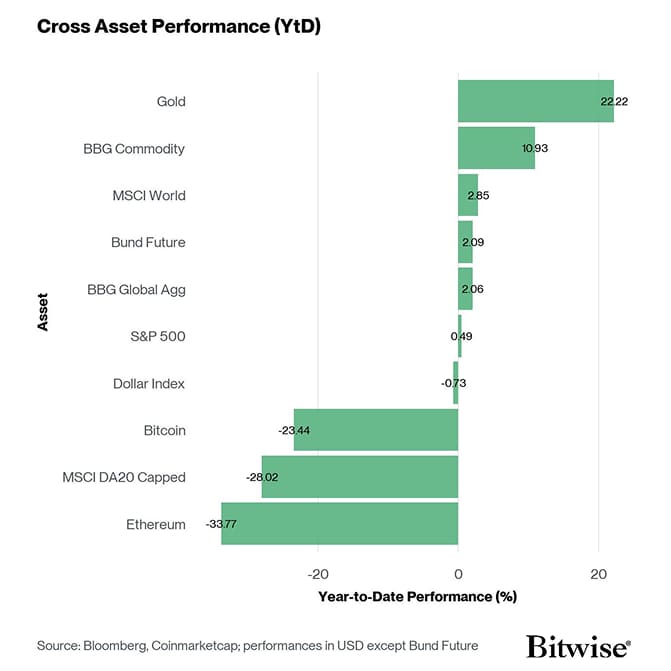
Technically, bitcoin has largely respected major long-term support zones around realised price levels and the 200-week moving average, although occasional breaches driven by liquidations have occurred. Institutional demand year-to-date - particularly via treasury accumulation and ETP holdings - has still broadly outpaced newly mined supply, despite a recent slowdown in marginal flows.
Overall, the current environment reflects a market in late-stage correction or early bottoming formation: sentiment remains depressed, valuations appear historically attractive, and macro liquidity signals are gradually improving, yet uncertainty and fragile flows continue to cap upside momentum in the near term. Taken together, this suggests an increasingly asymmetric medium-term risk-reward profile for bitcoin and other cryptoassets, while acknowledging that short-term volatility and consolidation risks persist.
Cross Asset Performance (MtD)
 Source: Bloomberg, Coinmarketcap; performances in USD except Bund Future
Cross Asset Performance (YtD)
Source: Bloomberg, Coinmarketcap; performances in USD except Bund Future
Cross Asset Performance (YtD)
 Source: Bloomberg, Coinmarketcap; performances in USD except Bund Future
Bottom Line: Overall, following the sharp market crash in early February, cryptoassets appear to be transitioning from capitulation toward a potential cyclical bottom, with historically depressed sentiment and valuations contrasting against gradually improving macro liquidity conditions. While near-term volatility and subdued institutional flows may persist, the medium-term risk-reward profile may present asymmetric characteristics to the upside, though such profiles can reverse quickly in volatile markets, pending clearer stabilisation in flows and macro uncertainty.
Macro Environment
One of our key theses remains that bitcoin trades at a historic ‘macro discount' based on forward-looking leading indicators. The same is true relative to gold which we have highlighted here as well.
We continue to observe significant discounts with respect to the growth outlook, especially relative to the ISM Manufacturing Index – despite the fact that the ISM Manufacturing Index has increased to a multiyear high in January 2026, bitcoin continues to exhibit a strong downside deviation to the trend implied by the power law (read: ‘long-term adoption trend').
ISM Manufacturing Index vs BTC Power Law Residual
Source: Bloomberg, Bitwise Europe
*Vol-adjusted deviation of price vs power law model price
Bitcoin has also continued to decouple from the upward trajectory of global money supply – the 1-year rolling correlation has recently turned slightly negative. In other words, global money supply has continued to rise while bitcoin declined.
Correlation: Global Money Supply vs Bitcoin
 Source: Bloomberg, Bitwise Europe; Correlation in logs
Some analysts have argued that this could be due to a potential ‘quantum discount' which somewhat impairs bitcoin's store-of-value properties. At the same time, this rationale implies that this discount may potentially resolve once quantum risks resolve as well, though the timeline and extent of any such resolution remain highly uncertain.
Based on the relative performance between Bitcoin (BTC) and Bitcoin Cash (BCH) since the beginning of Q4 2025 (‘peak quantum uncertainty'), you could argue that this quantum discount is at approximately ~30% at the moment. Note that both assets – BTC and BCH – are still vulnerable to quantum risks but BCH has an accelerated roadmap to become quantum-resistant.
However, the fact that the Bitcoin Improvement Proposal (BIP) 360 has just recently been added to the developer repository implies that there is some positive traction on the quantum front for BTC though.
BIP-360 proposes adding quantum-resistant address types and signature schemes to Bitcoin so the protocol remains secure against future quantum-computer attacks.
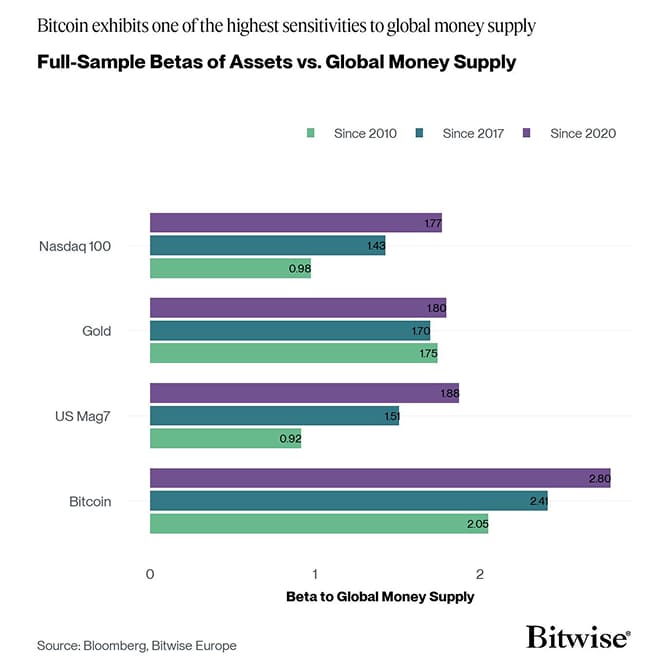
Despite the most recent decoupling of bitcoin from global money supply, it is worth noting that bitcoin has historically exhibited high sensitivity to global money supply expansion – exhibiting the highest monetary betas among any established scarce and liquid asset class like gold or US equities,
Bitcoin exhibits one of the highest sensitivities to global money supply
 Source: Bloomberg, Bitwise Europe
However, one could argue that this monetary beta / sensitivity to global money supply is somewhat impaired due to potential ‘quantum risks'.
Other analysts have pointed out that US financial conditions have tightened somewhat. In fact, US high yield credit spreads have continued to widen since the beginning of the year and the VIX has also spiked which may also explain the strong correlation between parts of the US equity market (e.g. software) and bitcoin as highlighted in one of our Crypto Market Compass reports.
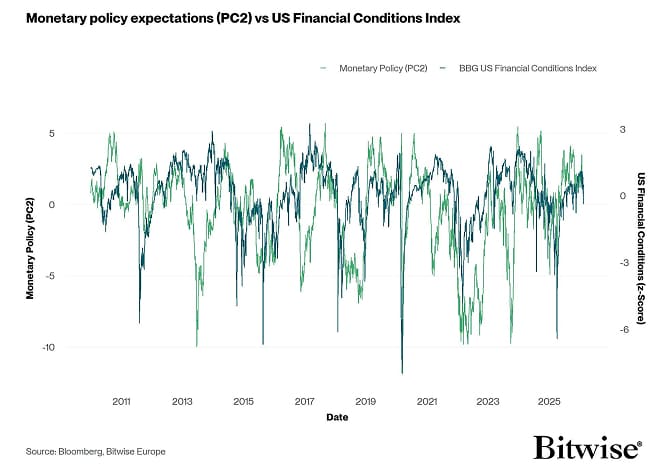
That being said, monetary policy expectations remain very favourable for now which still imply loosening financial conditions – this may continue to support the current economic recovery (in the ISM Manufacturing Index).
Monetary policy expectations tend to lead changes in financial conditions by 3-6 months. This implies that the latest tightening of financial conditions in the US is most likely short-lived.
Monetary policy expectations (PC2) vs US Financial Conditions Index
 Source: Bloomberg, Bitwise Europe
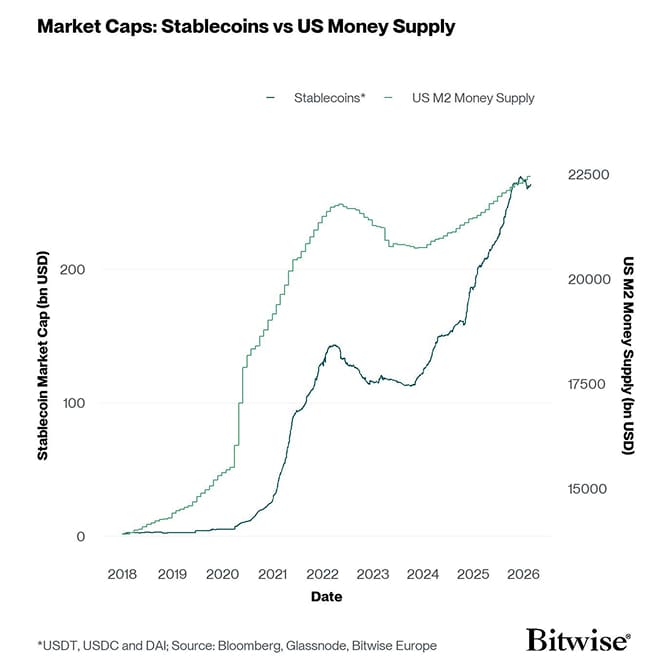
In contrast, US money supply growth has flatlined somewhat more recently while Fed net liquidity continues to stall which supports the bearish case. There has also been a slight decline in aggregate USD stablecoin market caps which imply an imminent decline in US money supply.
Market Caps: Stablecoins vs US Money Supply
 *USDT, USDC and DAl; Source: Bloomberg, Glassnode, Bitwise Europe
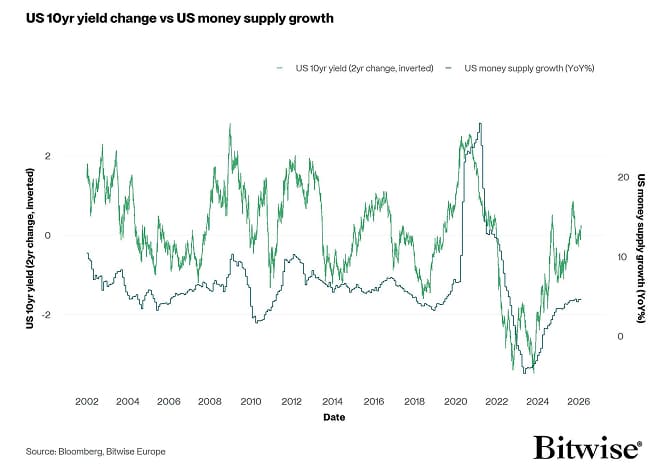
In fact, changes in USD stablecoin supply tend to be positively correlated with bitcoin's performance. However, the US yield curve (2s10s) continued to steepen and reached a multiyear high in February, which implies a continued expansion in M2 money supply growth. Other leading indicators based on US long-term bond yields also signal a continued expansion is US money supply growth:
US 10yr yield change vs US money supply growth
 Source: Bloomberg, Bitwise Europe
(This is also consistent with the observation made above about the ISM Manufacturing Index).
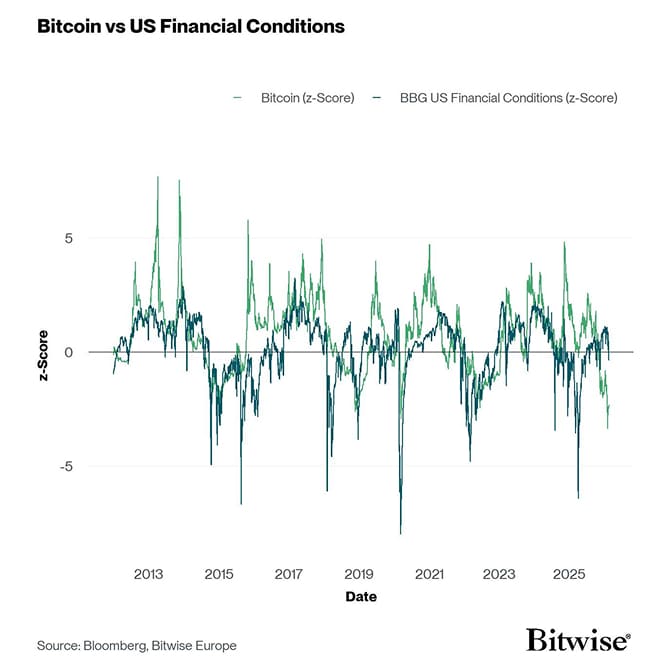
That being said, a material change in US financial conditions would most certainly be a headwind for bitcoin which tends to cycle with changes in (US) financial conditions.
Bitcoin vs US Financial Conditions
 Source: Bloomberg, Bitwise Europe
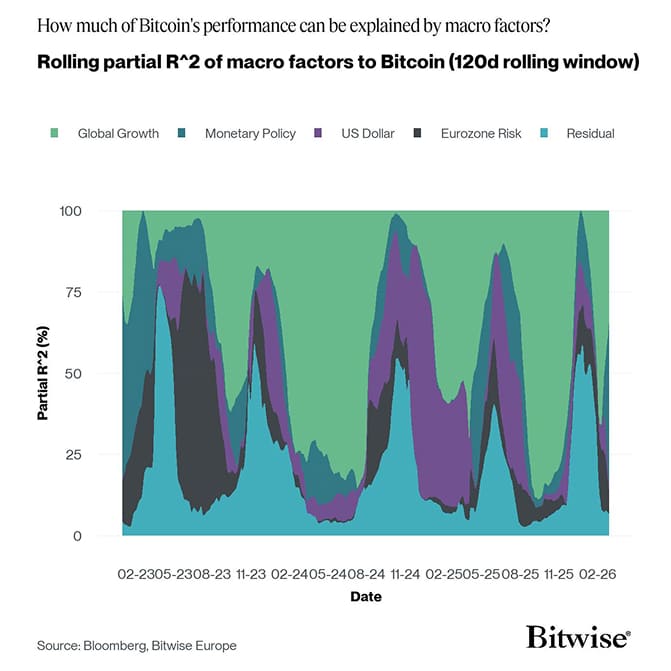
Our macro factor model implies that global growth expectations have become more dominant for bitcoin's performance while residual coin-specific factors have declined in relative importance:
How much of Bitcoin's performance can be explained by macro factors?
 Source: Bloomberg, Bitwise Europe
In other words, bitcoin has become more sensitive to the macro environment and is moving into a ‘macro-dominant' market regime again.
This also implies that continued expansion of the ISM Manufacturing Index could provide support for bitcoin.
It is worth noting that periods of ISM expansion have historically been associated with bitcoin bull markets (ISM contractions with bitcoin bear markets) as shown in the first chart above.
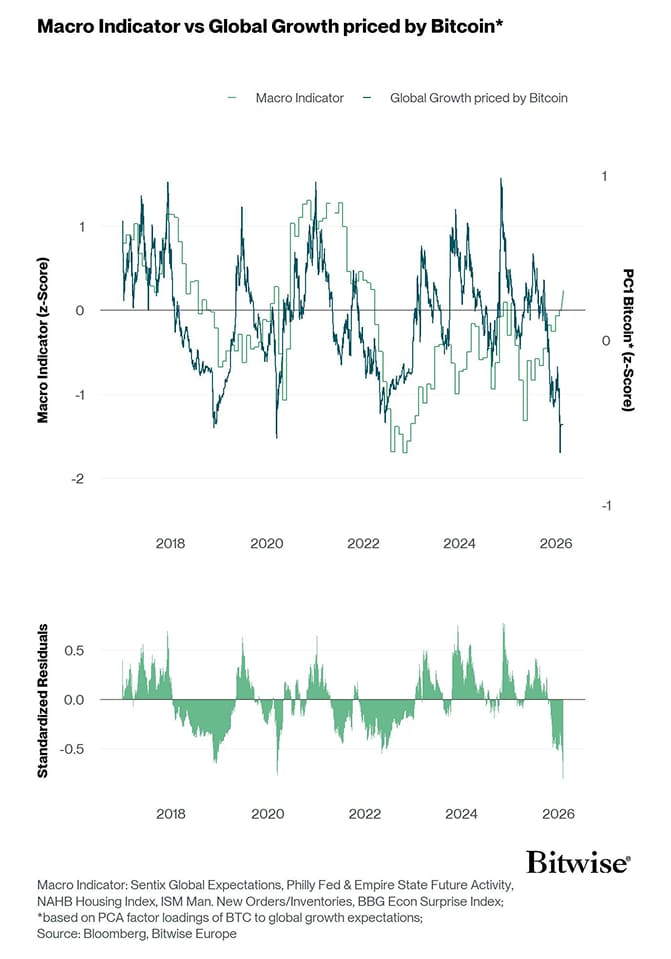
In the unlikely event that a US recession should still materialise, we still think that a significant weakness in macro expectations appears to be priced into bitcoin already.
Based on our own estimations, bitcoin continues to exhibit one of the strongest ‘macro discounts' on record.
Macro Indicator vs Global Growth priced by Bitcoin*
 Macro Indicator: Sentix Global Expectations, Philly Fed & Empire State Future Activity, NAHB Housing Index, ISM Man. New Orders/Inventories, BBG Econ Surprise Index;
*based on PCA factor loadings of BTC to global growth expectations;
Source: Bloomberg, Bitwise Europe
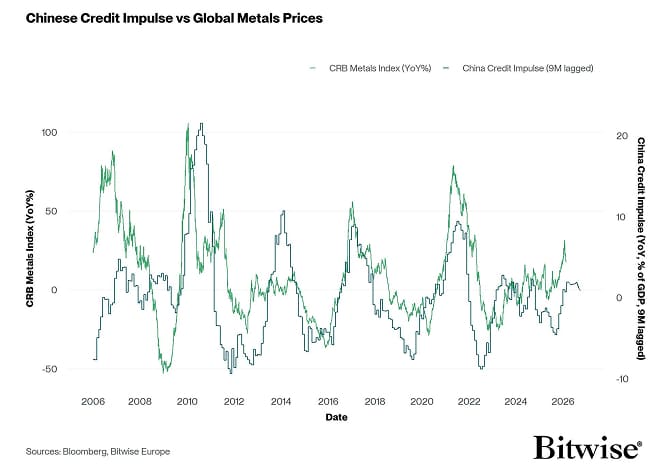
While there is an element of truth in the observation that US financial conditions have recently tightened at the margin, Chinese monetary policy has become significantly looser. The PBoC has injected a very significant amount of liquidity into the Chinese banking system more recently as well.
Our main thesis – as presented in the previous Bitcoin Macro Investor report – remains that the global reflationary impulse is emanating from China, not primarily from the US.
From our point-of-view, that's also one of the key reasons why we have seen the sharp rise in commodity prices, especially in precious metals. This has historically been a significant tailwind for the global economy as well.
Chinese Credit Impulse vs Global Metals Prices
 Sources: Bloomberg, Bitwise Europe
In general, the Chinese credit impulse should support industrial commodity prices – and by derivation the global economy – for the remainder of the year, based on an average lead time of around 9 months.
As highlighted in our previous Bitcoin Macro Investor report, periods of global reflation are historically associated with Bitcoin bull runs as well – periods of deflation with bitcoin bear markets.
Bottom Line: Bitcoin continues to trade at one of the deepest macro discounts on record, diverging from growth, liquidity and long-term adoption trends despite leading indicators pointing toward renewed reflation. While short-term headwinds from tighter US financial conditions, stalled liquidity and quantum-related uncertainty remain, forward-looking policy expectations and the Chinese-led credit impulse suggest improving macro tailwinds ahead. As bitcoin re-enters a macro-dominant regime, sustained expansion in global growth indicators may provide support for potential mean reversion.
On-Chain Developments
A Volatile Release
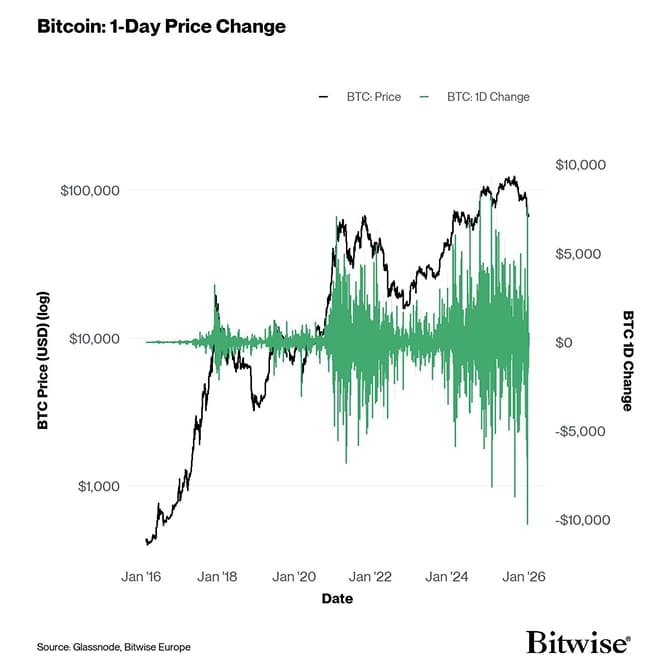
February has proven an exceptionally challenging month for Bitcoin and the broader digital asset complex. It has been characterised by outsized downside volatility and pervasive investor fear, with much of this stress culminating on the February 5th market dislocation.
As detailed in our post-mortem of the capitulation event, Bitcoin recorded the largest nominal daily price swing on record, with an intraday range of approximately $10.2k. The relief rally in the immediate aftermath ranked as the second largest, underscoring the extreme two-sided volatility that defined this episode.
Bitcoin: 1-Day Price Change
 Source: Glassnode, Bitwise Europe
Another lens through which to quantify the scale of the move is through the 7-day change across 1-month realized volatility, which highlights how abruptly market conditions have repriced over a short horizon. This recent episode registered the 109th (1.9%) largest expansion on record, highlighting the magnitude of the market dislocation.
Bitcoin: 1-Month Realised Volatility Weekly Percentage Change
_-_7d_Change_thumb.jpg "Realised Volatility (1M) - 7d Change") Source: Glassnode, Bitwise Europe
Source: Glassnode, Bitwise Europe
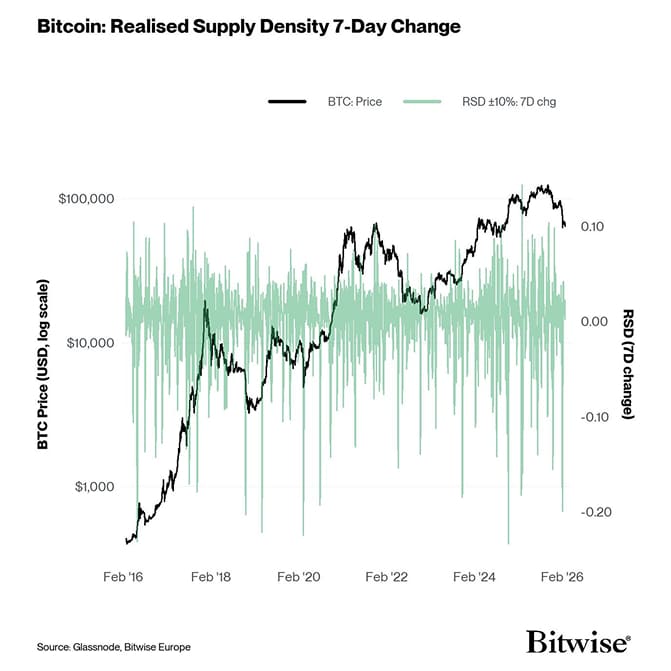
Furthermore, the Realized Supply Density metric suggests that much of the market's stored energy has now been discharged. This measure captures the share of circulating supply held within ±10% of the prevailing spot price and thus quantifies how much capital is positioned close enough to be impacted by relatively modest price fluctuations. When a large proportion of coins cluster near spot, even small price movements can influence a broad cohort of holders, elevating market sensitivity and sustaining volatile conditions.
Ahead of the sell-off, roughly 25% of circulating supply sat within this ±10% band. In the aftermath, this collapsed to just 5%, with only 19 trading days (0.3%) on record exhibiting a larger 7-day contraction. Metaphorically speaking, this configuration reflects a market that has expended a significant sum of energy, and most likely requires some time to replenish its reserves.
Bitcoin: Realised Supply Density 7-Day Change
 Source: Glassnode, Bitwise Europe
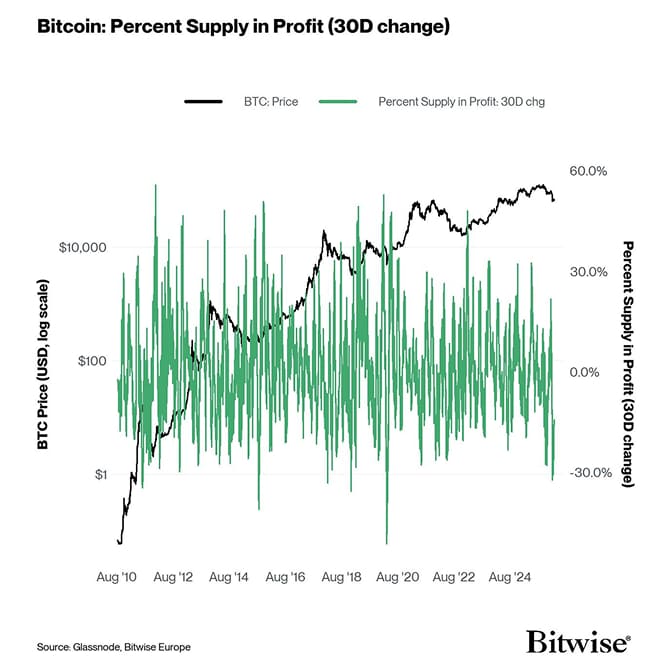
Finally, we evaluate the share of circulating supply that transitioned into a position of paper loss over the past month.
The percentage of supply in profit metric registered a sharp decline during the capitulation phase, with over 30% of the supply moving underwater, marking the 50th (0.8%) most severe monthly deterioration on record.
Such an abrupt compression in investor profitability showcases the scale of balance sheet damage incurred and aptly reflects the corresponding collapse in market sentiment.
Bitcoin: Percent Supply in Profit (30D change)
 Source: Glassnode, Bitwise Europe
Measuring Apathy
As highlighted in the section above, the market has now discharged a substantial amount of latent energy, with volatility expanding meaningfully. Markets characteristically oscillate between directional, momentum-driven trends, and ranging, consolidatory regimes that emerge once price has stretched materially from its previous baseline.
These ranging phases are typified by lateral price action, as supply is absorbed, coins are redistributed, and a new foundation of ownership and cost-basis is established.
Following a move of this magnitude, the balance of probabilities favours a period of rebuilding and range-bound trade.
While some indicators suggest potential bottoming formation, significant uncertainty remains and further downside cannot be ruled out with the market continuing to exhibit signs of fragility. This configuration leaves conditions susceptible to exogenous shocks and suggests a period of consolidation is likely required to rebuild market structure and positioning.
In this section, we turn to a suite of durational metrics to frame potential temporal bounds for the ongoing bottoming formation.
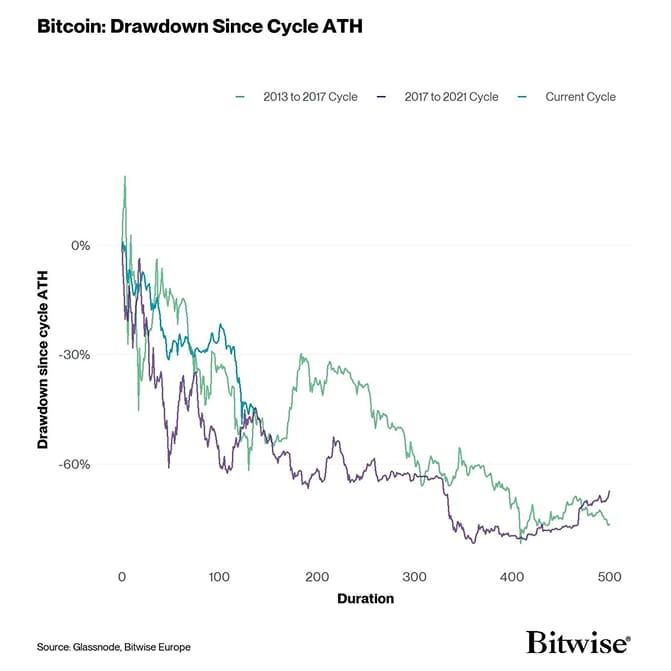
We begin with the most widely cited heuristic, the elapsed time between prior cycle peaks and their subsequent bear market floors. Historically, this interval has been on the order of 12/13 months, which on this basis would imply roughly another 8/9 months of bear market duration remaining.
Notably, this framework has attracted renewed confidence among analysts, largely because the recent market top adhered closely to the canonical 4-year cycle template, despite a prior consensus view that this structure had already broken down.
With sentiment now rotating back toward acceptance of the 4-year model, the ~8-month horizon has become the modal expectation. Such broad alignment, however, introduces a credible contrarian risk that the market may instead front-run this anticipated duration.
Bitcoin: Drawdown Since Cycle ATH
 Source: Glassnode, Bitwise Europe
Mechanically, bottoming formations can be understood as the progressive transfer of supply from price-sensitive investors, those unable or unwilling to withstand prolonged drawdown and volatility, to increasingly price-insensitive holders who perceive value at depressed levels. Over time, sustained accumulation coupled with sufficient duration acts to exhaust available sell-side pressure. What remains is a holder base materially less inclined to distribute at prevailing levels.
As liquid supply constricts, even modest increases in demand can become sufficient to influence price discovery, allowing the market to transition out of its accumulation range and into a renewed uptrend.
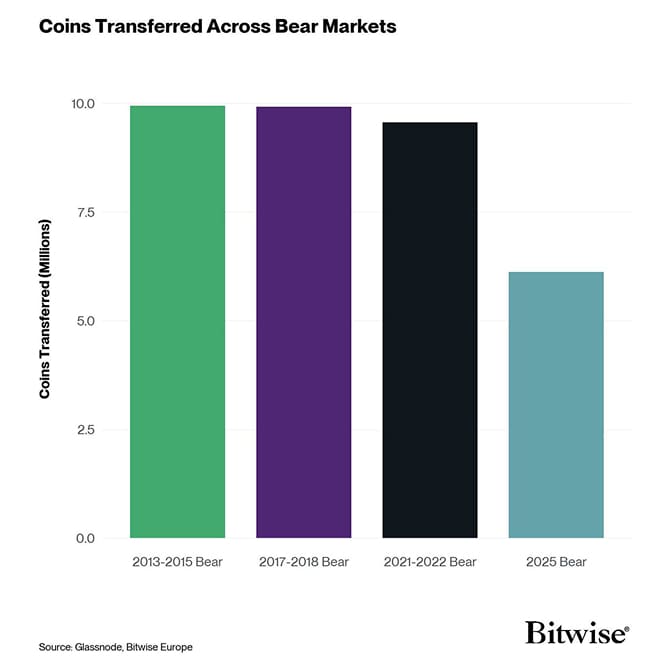
To model this redistribution process, we can estimate the volume of supply that has changed hands between prior cycle peaks and their corresponding bottom wicks. Across the last three bear markets, this transfer footprint has consistently fallen within a 9.6M to 9.9M BTC range. In the current drawdown, measured from the October 6th ATH, approximately 6.1M BTC has transferred to new owners.
Coins Transferred Across Bear Markets
 Source: Glassnode, Bitwise Europe
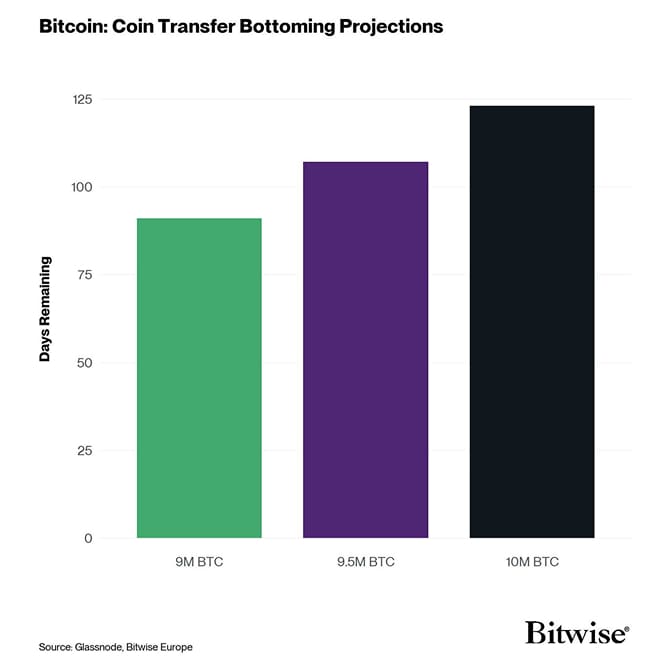
On this basis, we adopt 9.0M, 9.5M, and 10.0M BTC as reasonable target bands for the cumulative supply transferred into a potential cycle low. We can then translate these targets into the time domain by applying observed transfer velocities. The historical average transfer rate across prior bear markets sits around ~27k BTC/day, whilst the current cycle has tracked closer to ~47k BTC/day to date.
Using these as anchors, we construct a probability surface across a wider set of plausible transfer rates (20k, 25k, 35k, 47k, 60k BTC/day), apply empirical weighting to each scenario, and estimate the time required to reach the target transfer thresholds.
This framework produces an implied window of roughly ~3–4 months, consistent with a market that is already well advanced into a bottoming formation.
Bitcoin: Coin Transfer Bottoming Projections
 Source: Glassnode, Bitwise Europe
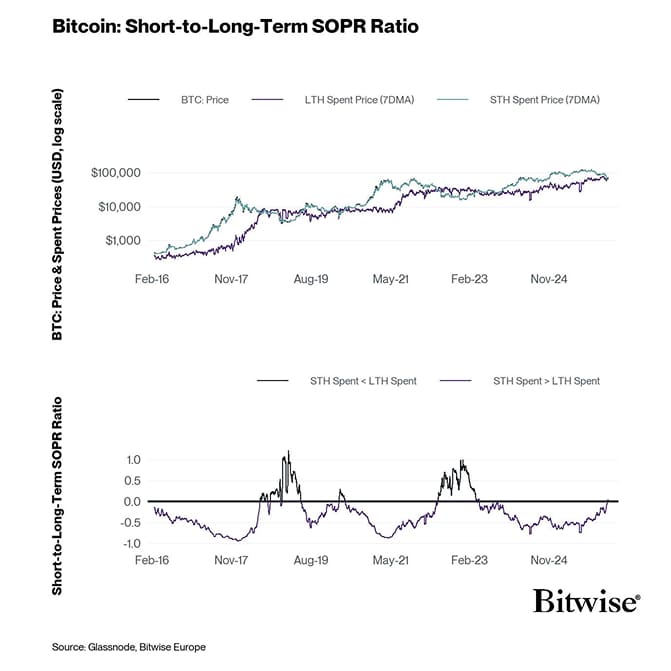
A further instructive lens is the relative spent price of Short- and Long-Term Holders, which compares the original acquisition cost of coins being spent by newer versus more mature investors. Note that, in this context, long-term holder refers to investors with a holding period of at least 155 days – short-term holders with a holding period of less than 155 days. Long-term holders tend to be more sophisticated investors.
This differential highlights which investor cohort is spending from a position of relative strength. Notably, across prior cycles, there emerges a phase where Short-Term Holder spending occurs at more favourable prices than that of their Long-Term Holder counterparts. This is a rare configuration.
As contraction forces price progressively lower, newer entrants accumulate coins at increasingly favourable cost-bases, and thus tend to spend from positions clustered close to the prevailing spot price. In contrast, Long-Term Holders who accumulated through the topping distribution migrate into loss and begin to realise these losses as capitulation pressures intensifies.
This inversion in cohort cost-basis dynamics has historically materialised deep within bear market drawdowns, implying the market is already well advanced into a bottoming process.
Precedent suggests that once this regime shift takes hold, a further ~3–6 months has typically been required for a durable cyclical floor to form.
Bitcoin: Short-to-Long-Term SOPR Ratio
 Source: Glassnode, Bitwise Europe
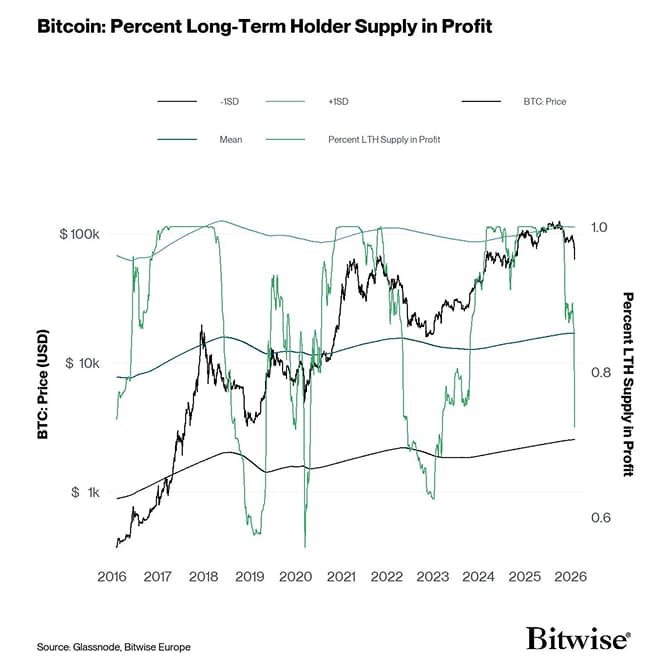
Focusing exclusively on the Long-Term Holder cohort, these investors tend to engage most actively at market extremes, such that their profitability profile can offer direct insight into late-stage cyclical conditions on either side of the market.
By evaluating the share of Long-Term Holder supply held in profit, and specifically instances where this metric compresses below its −1σ band, we observe consistent alignment with deep bear market regimes. At such junctures, a broad cross-section of the most conviction-driven investors are positioned underwater, a hallmark of late-stage capitulation.
Historically, the market has required a further ~2–4 months to establish a durable floor following this deviation.
Bitcoin: Percent Long-Term Holder Supply in Profit
 Source: Glassnode, Bitwise Europe
Market Navigation
Modelling bear market duration remains inherently uncertain. Historical precedent can help frame a set of plausible forward pathways, however, markets are under no obligation to adhere to prior cycle templates. As such, these duration ranges should be interpreted primarily as reference points derived from past cycles that provide contextual bounds for forward expectations, rather than deterministic forecasts.
Given these limitations, the temporal framework is best considered alongside key pricing levels. Observing how price responds around structurally significant thresholds adds an additional layer of context, enabling assessment of whether the current cycle is progressing in line with historical analogues or diverging toward a distinct market regime.
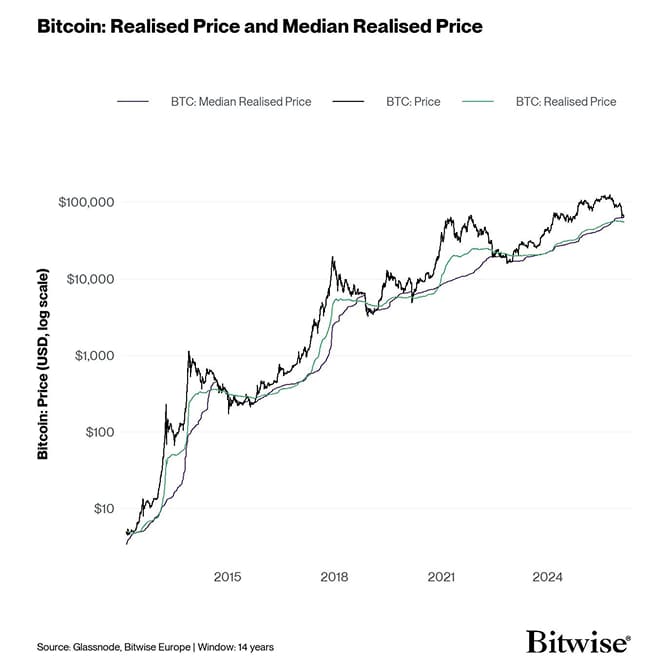
Following the contraction, we turn to a suite of key on-chain benchmarks to identify potential zones of terminal support. Foremost among these is the Realized Price ($55k), which approximates the average acquisition price across all investors. Complementing this is the Median Realized Price ($61k), which captures the acquisition price of the median investor, thereby incorporating both central statistical tendencies across the holder base.
Across prior market cycles, both measures have repeatedly functioned as structural support during late-stage bear markets, marking regions where aggregate and typical holder cost-basis converge with spot price, and where long-term investor demand has historically re-emerged.
Bitcoin: Realised Price and Median Realised Price
 Source: Glassnode, Bitwise Europe | Window: 14 years
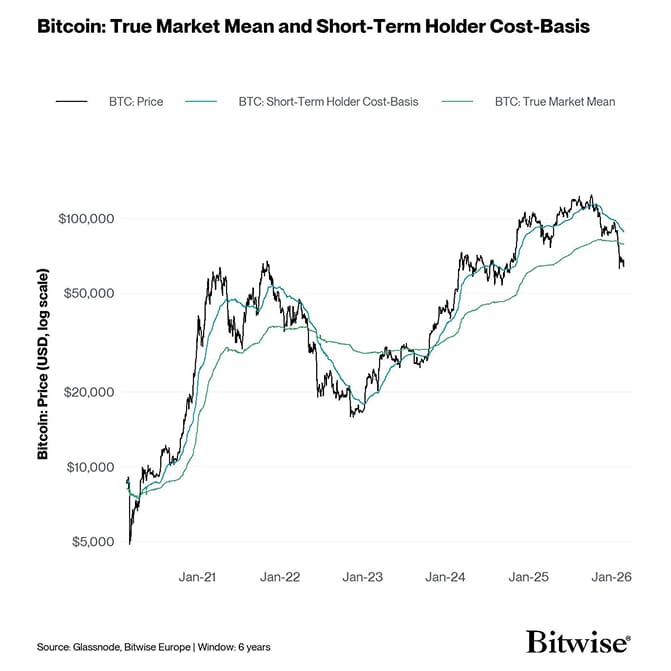
In addition, we can incorporate the True Market Mean, which estimates the average acquisition price of active investors by excluding supply deemed lost or dormant (e.g., early miner and Satoshi-era coins). This produces a more representative gauge of the positioning of economically relevant capital and can be interpreted as a threshold separating macro bullish and bearish regimes.
Alongside this, the Short-Term Holder Cost Basis (STH-CB) captures the average purchase price of newer market entrants and has historically delineated local bull–bear conditions as marginal demand oscillates around profitability. Taken together, these two benchmarks provide a paired macro–local framework through which to assess market structure via investor positioning.
At present, the True Market Mean resides at $78.8k, whilst the STH-CB sits at $89.2k. Historical precedent suggests these levels have marked regime transitions.
Bitcoin: True Market Mean and Short-Term Holder Cost-Basis
 Source: Glassnode, Bitwise Europe | Window: 6 years
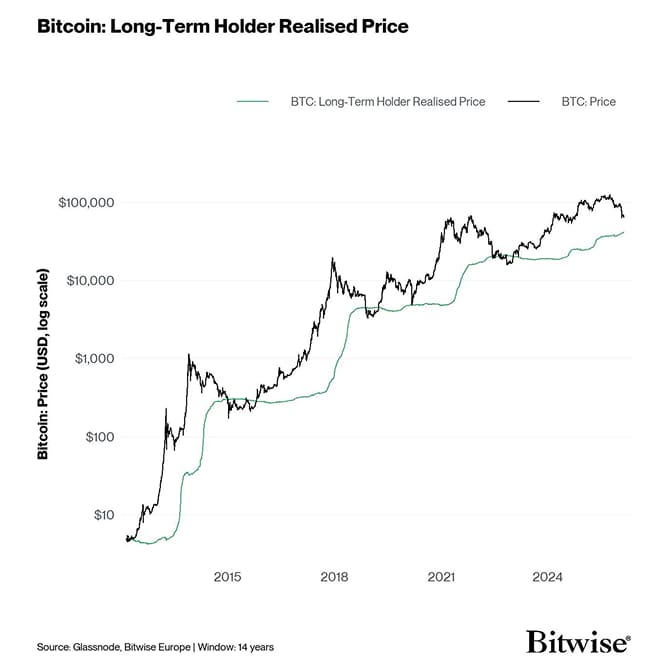
Finally, the Long-Term Holder Cost Basis captures the average acquisition price of mature investors, and currently resides at $40.8k. Notably, prior market cycles have ultimately established their cyclical floors below this level. Whilst there is no requirement for the current cycle to adhere to historical precedent, and our base case does not anticipate price revisiting these absolute depths, the level remains a meaningful structural reference for downside risk assessment.
However, we also observe that this cohort's cost-basis is rising rapidly, as coins accumulated through the latter stages of the topping formation continue to age into Long-Term Holder classification, mechanically lifting the average purchase price. Should the market undergo a further 2–6 months of consolidation, this maturation effect would be expected to drive the LTH cost-basis materially higher over the same horizon, bringing the cost-basis to closer alignment with the realized price.
Historically, periods where acquisition prices converge between the broader market and mature investors have preceded major bottoming formations. In the current instance, we expect convergence to occur via the Long-Term Holder cost basis rising toward the Realised Price, which is itself trending lower, rather than through spot price advancing to meet the Long-Term Holder cost basis at present levels.
Bitcoin: Long-Term Holder Realised Price
 Source: Glassnode, Bitwise Europe | Window: 14 years
Bottom Line: The traditional 4-year cycle framework would imply roughly another 8 months before a cyclical floor is established. Notably, this expectation has become deeply embedded in investor consensus, largely because the recent market top conformed closely to the traditional 4-year cycle template, despite many analysts having previously argued that this cyclical structure had already broken down.
As a result, the 8-month horizon now appears somewhat consensus-heavy. In contrast, several alternative duration analogues point toward a shorter 2–6 month bottoming window. This divergence raises the possibility that the traditional 4-year timing heuristic may be front-run, a plausible outcome given the degree to which it is broadly anticipated and incorporated into positioning.
Bottom Line
- Performance: Overall, following the market crash in early February, cryptoassets appear to be transitioning from capitulation toward a potential cyclical bottom, with historically depressed sentiment and valuations contrasting against gradually improving macro liquidity conditions. While near-term volatility and subdued institutional flows may persist, the medium-term risk-reward profile may present asymmetric characteristics to the upside, though such profiles can reverse quickly in volatile markets, pending clearer stabilisation in flows and macro uncertainty.
- Macro: Bitcoin continues to trade at one of the deepest macro discounts on record, diverging from growth, liquidity and long-term adoption trends despite leading indicators pointing toward renewed reflation. While short-term headwinds from tighter US financial conditions, stalled liquidity and quantum-related uncertainty remain, forward-looking policy expectations and the Chinese-led credit impulse suggest improving macro tailwinds ahead. As bitcoin re-enters a macro-dominant regime, sustained expansion in global growth indicators could act as a catalyst for mean reversion.
- On-Chain: The traditional 4-year cycle framework would imply roughly another 8 months before a cyclical floor is established. Notably, this expectation has become deeply embedded in investor consensus, largely because the recent market top conformed closely to the traditional 4-year cycle template, despite many analysts having previously argued that this cyclical structure had already broken down. As a result, the 8-month horizon now appears somewhat consensus-heavy. In contrast, several alternative duration analogues point toward a shorter 2–6 month bottoming window. This divergence raises the possibility that the traditional 4-year timing heuristic may be front-run, a plausible outcome given the degree to which it is broadly anticipated and incorporated into positioning.
Appendix
Cryptoasset Market Overview
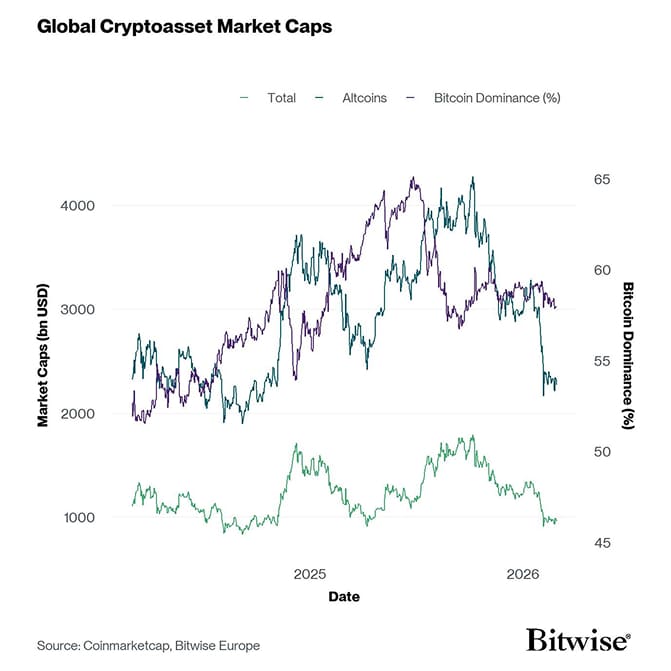
Global Cryptoasset Market Caps
 Source: Glassnode, Bitwise Europe
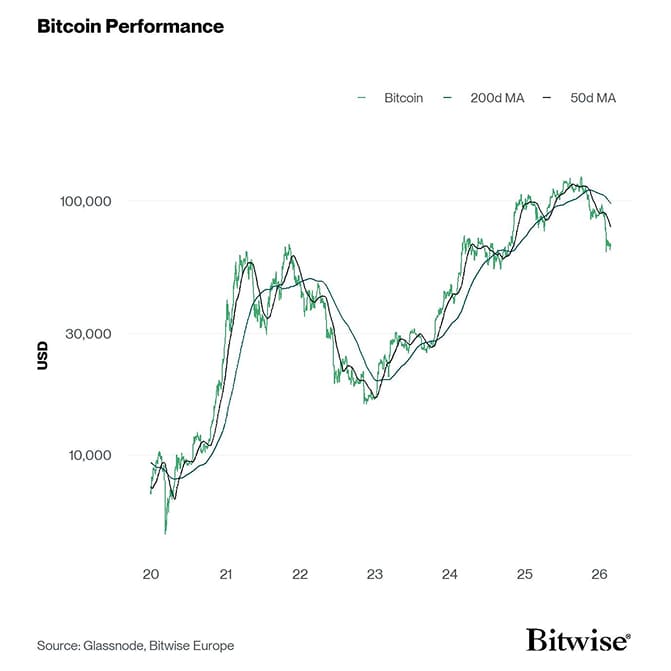
Bitcoin Performance
Source: Glassnode, Bitwise Europe
Bitcoin Performance
 Source: Glassnode, Bitwise Europe
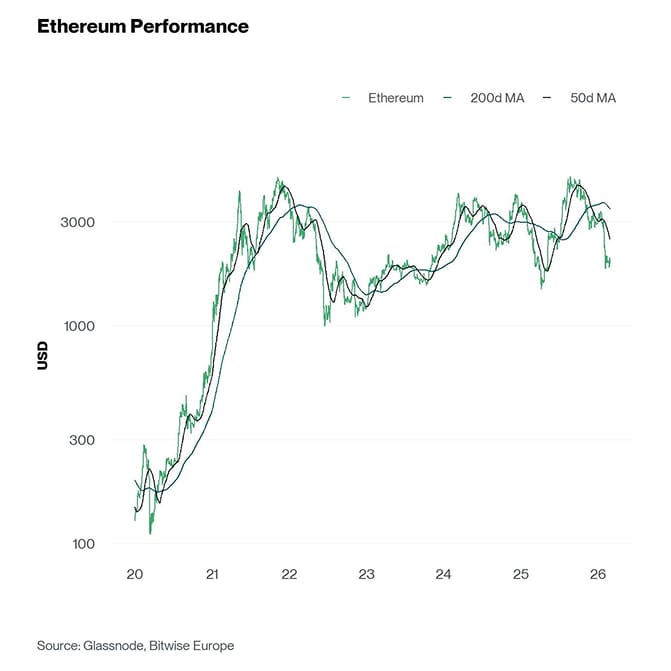
Ethereum Performance
Source: Glassnode, Bitwise Europe
Ethereum Performance
 Source: Glassnode, Bitwise Europe
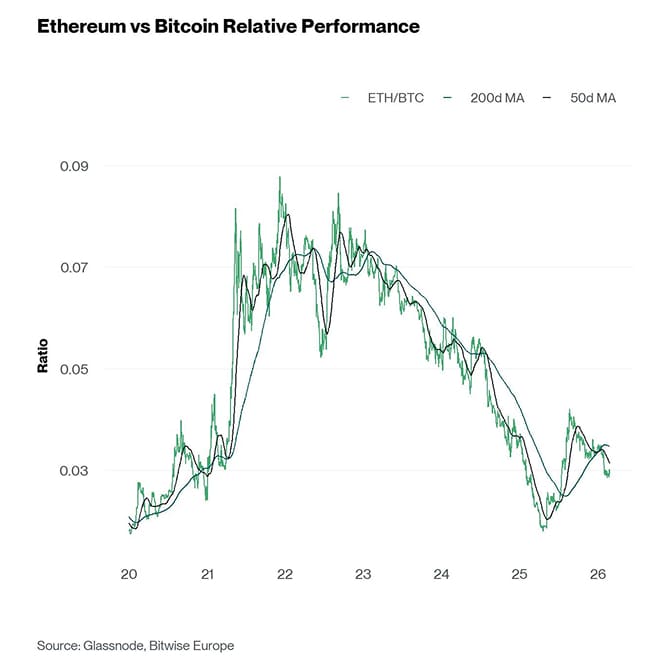
Ethereum vs Bitcoin Relative Performance
Source: Glassnode, Bitwise Europe
Ethereum vs Bitcoin Relative Performance
 Source: Glassnode, Bitwise Europe
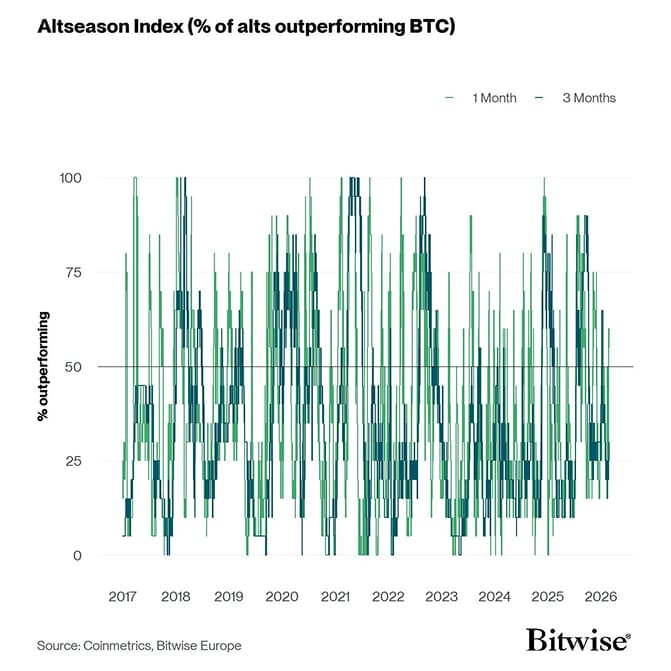
Altseason Index
Source: Glassnode, Bitwise Europe
Altseason Index
 Source: Coinmetrics, Bitwise Europe
Bitcoin vs Crypto Dispersion Index
Source: Coinmetrics, Bitwise Europe
Bitcoin vs Crypto Dispersion Index
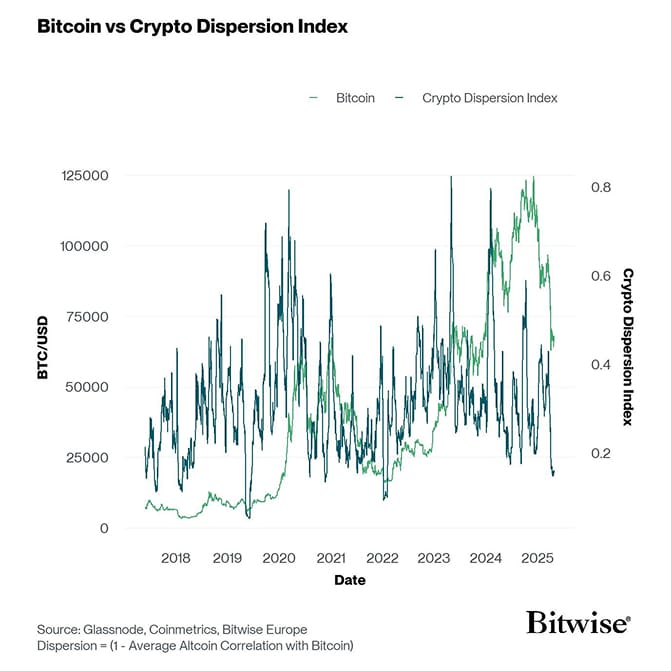 Source: Glassnode, Coinmetrics, Bitwise Europe; Despersion = (1 - Average Altcoin Correlation with Bitcoin)
Cryptoassets & Macroeconomy
Macro Factor Pricing
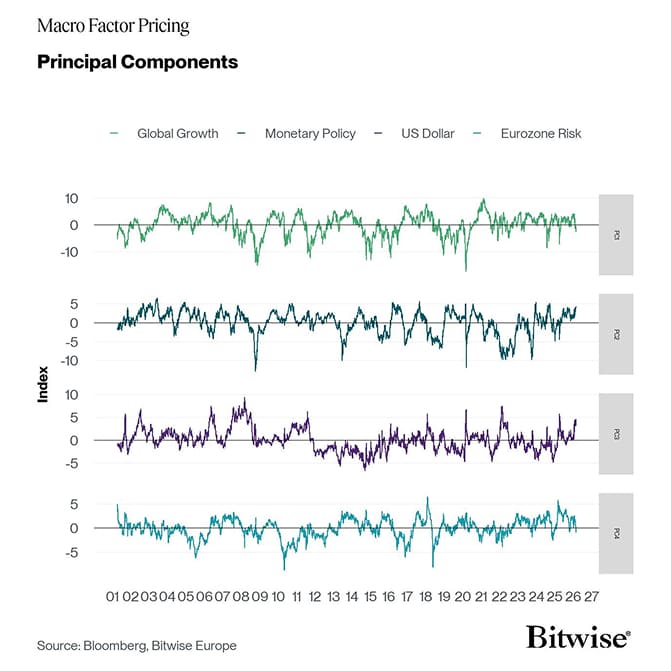 Source: Bloomberg, Bitwise Europe
How much of Bitcoin's performance can be explained by macro factors?
Source: Bloomberg, Bitwise Europe
Source: Bloomberg, Bitwise Europe
How much of Bitcoin's performance can be explained by macro factors?
Source: Bloomberg, Bitwise Europe
Cryptoassets & Multiasset Portfolios
Multiasset Performance with Bitcoin (BTC)
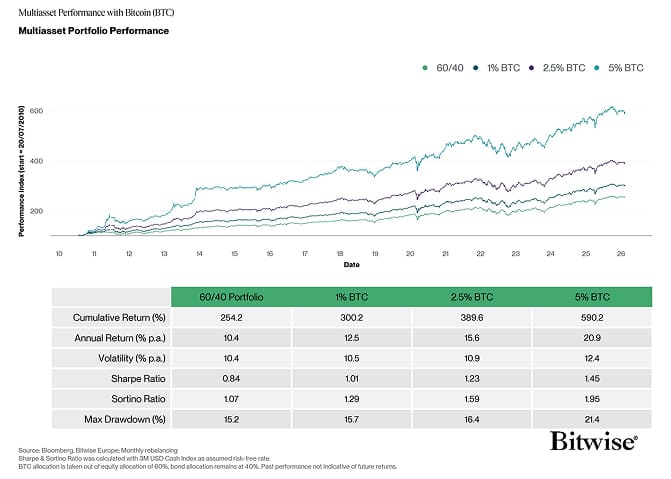 Source: Bloomberg, Bitwise Europe; Monthly rebalancing; Sharpe Ratio was calculated with 3M USD Cash Index as assumed risk-free rate; BTC allocation is taken out of equity allocation of 60%, bond allocation remains at 40%; Past performance not indicative of future returns.
Rolling correlation: S&P 500
Source: Bloomberg, Bitwise Europe; Monthly rebalancing; Sharpe Ratio was calculated with 3M USD Cash Index as assumed risk-free rate; BTC allocation is taken out of equity allocation of 60%, bond allocation remains at 40%; Past performance not indicative of future returns.
Rolling correlation: S&P 500
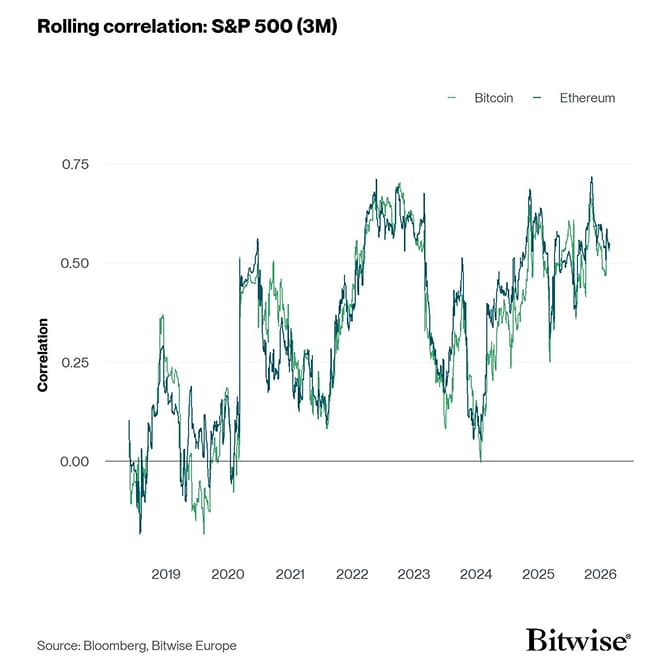 Source: Bloomberg, Bitwise Europe
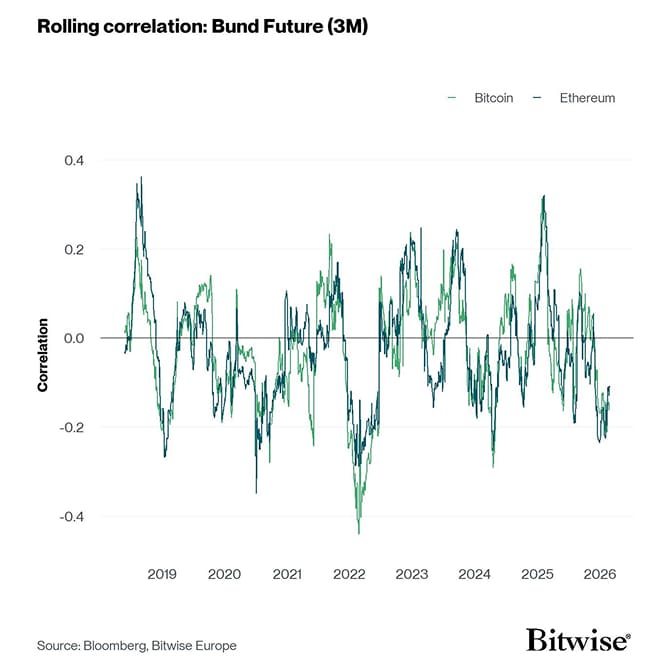
Rolling correlation: Bund Future
Source: Bloomberg, Bitwise Europe
Rolling correlation: Bund Future
 Source: Bloomberg, Bitwise Europe
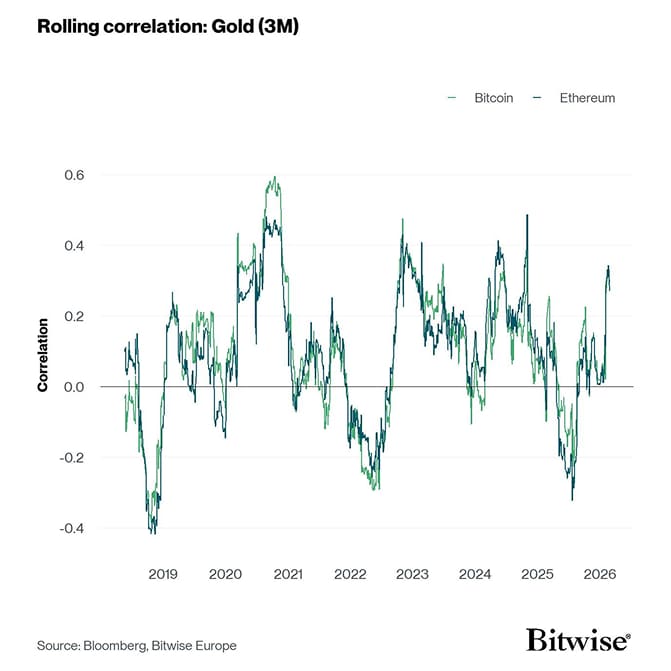
Rolling correlation: Gold
Source: Bloomberg, Bitwise Europe
Rolling correlation: Gold
 Source: Bloomberg, Bitwise Europe
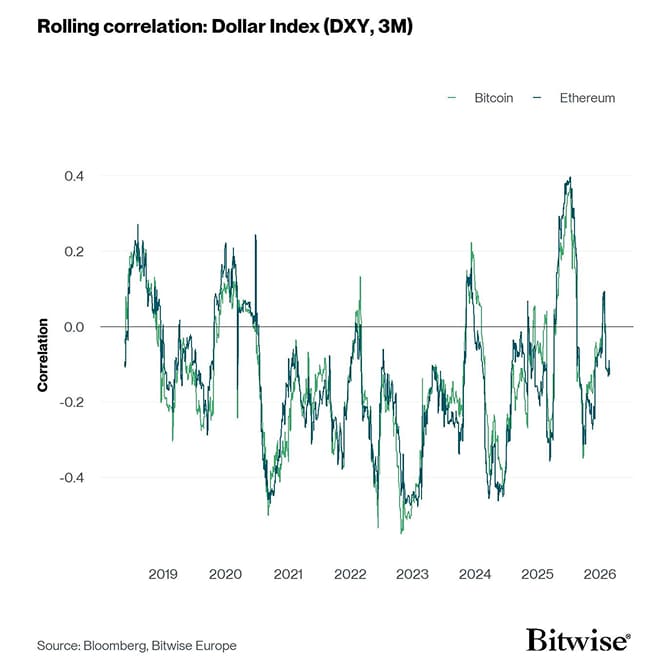
Rolling correlation: Dollar Index (DXY)
Source: Bloomberg, Bitwise Europe
Rolling correlation: Dollar Index (DXY)
 Source: Bloomberg, Bitwise Europe
Cross Asset Correlation Matrix
Source: Bloomberg, Bitwise Europe
Cross Asset Correlation Matrix
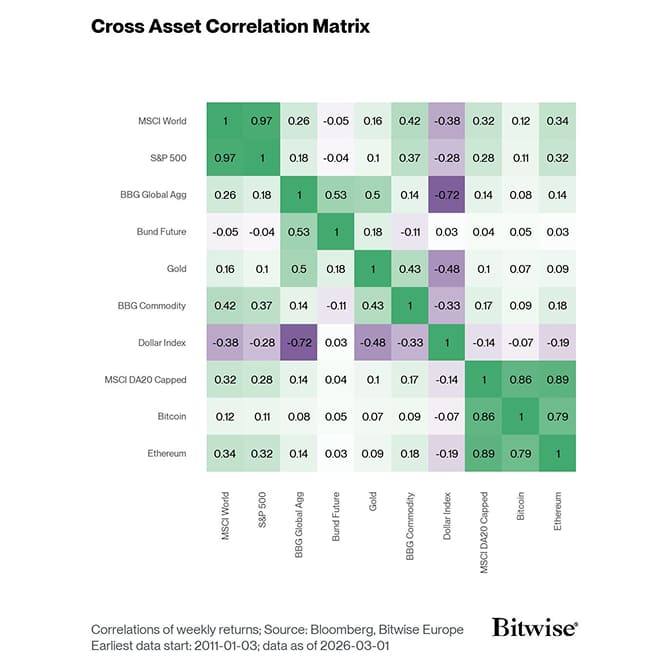 Correlations of weekly returns; Source: Bloomberg, Bitwise Europe
Earliest data start: 2011-01-03; data as of 2026-03-01
Cryptoasset Valuations
Bitcoin: Composite Valuation Indicator
 Source: Coinmetrics, Bitwise Europe
Bitcoin: Valuation Metrics
Source: Coinmetrics, Bitwise Europe
Bitcoin: Valuation Metrics
 Source: Coinmetrics, Bitwise Europe
On-Chain Fundamentals
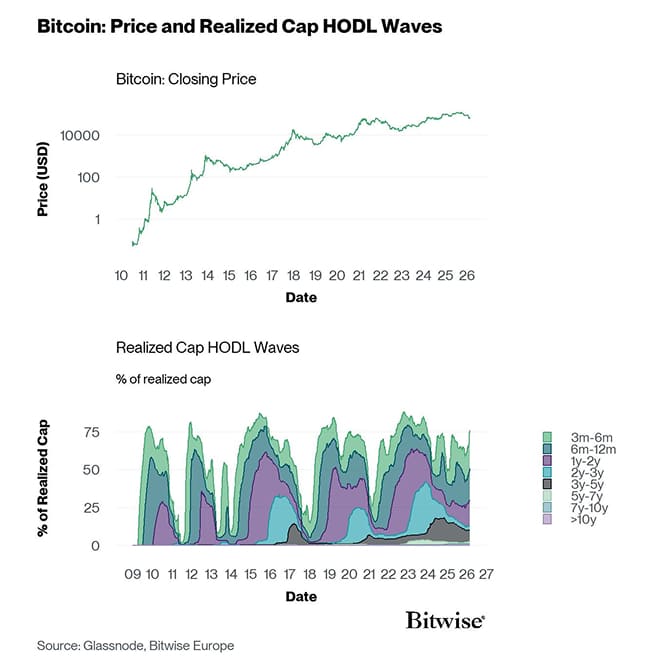
Bitcoin: Closing Price
 Source: Glassnode
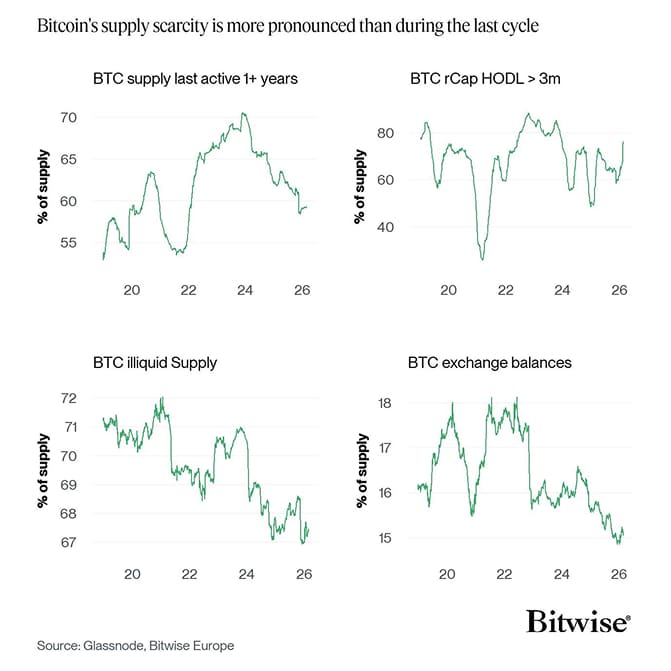
Bitcoin's supply scarcity is more pronounsed that during the last cycle
Source: Glassnode
Bitcoin's supply scarcity is more pronounsed that during the last cycle
 Source: Glassnode, Bitwise Europe
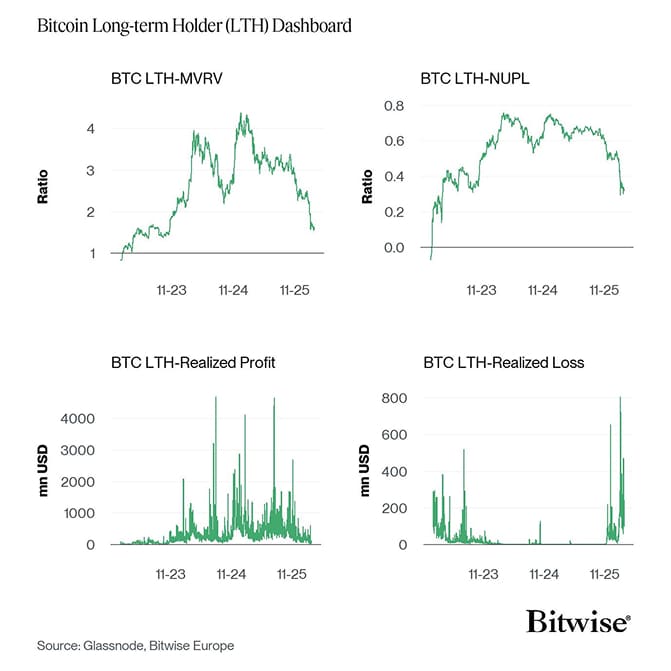
Bitcoin Long-term Holder (LTH) Dashboard
Source: Glassnode, Bitwise Europe
Bitcoin Long-term Holder (LTH) Dashboard
 Source: Glassnode, Bitwise Europe
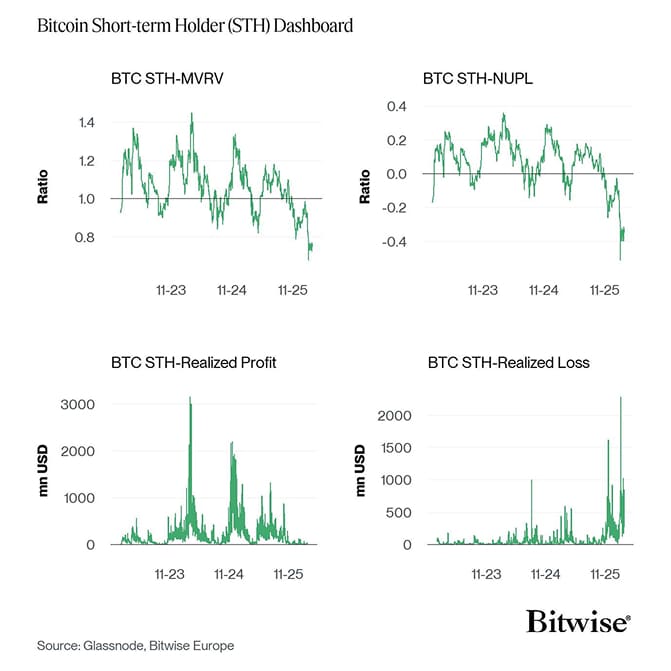
Bitcoin Short-term Holder (STH) Dashboard
Source: Glassnode, Bitwise Europe
Bitcoin Short-term Holder (STH) Dashboard
 Source: Glassnode, Bitwise Europe
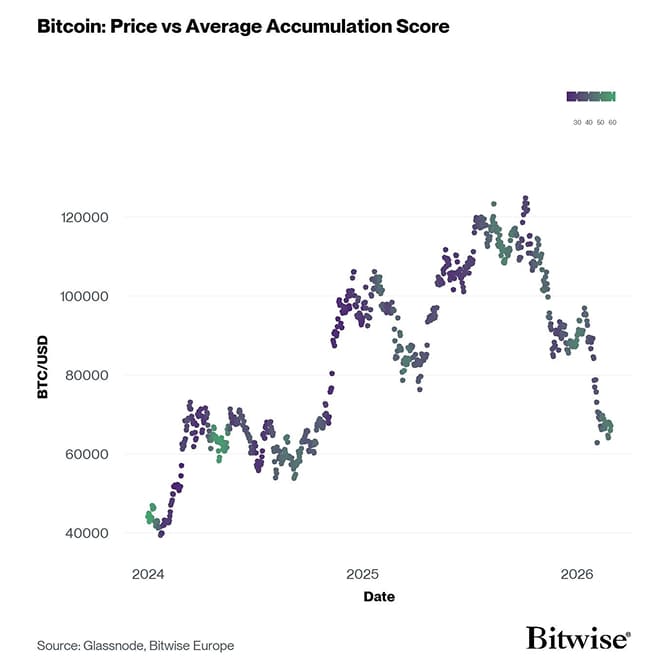
Bitcoin: Price vs Average Accumulatio Score
Source: Glassnode, Bitwise Europe
Bitcoin: Price vs Average Accumulatio Score
 Source: Glassnode, Bitwise Europe
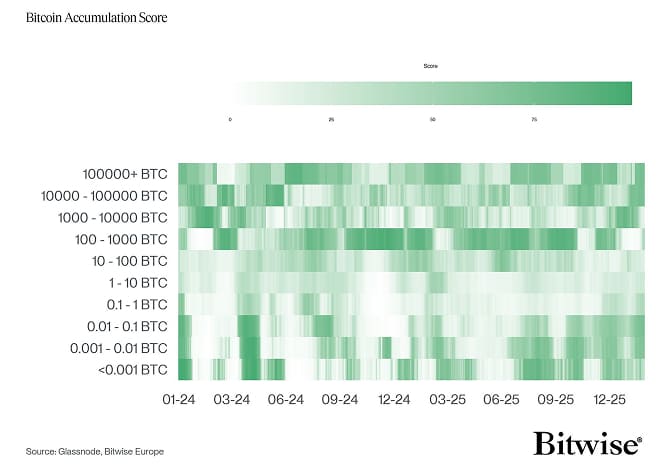
Bitcoin Accumulation Score
Source: Glassnode, Bitwise Europe
Bitcoin Accumulation Score
 Source: Glassnode, Bitwise Europe
Bitcoin: Steady increase in scarcity will provide a tailwind for price appreciations
Source: Glassnode, Bitwise Europe
Bitcoin: Steady increase in scarcity will provide a tailwind for price appreciations
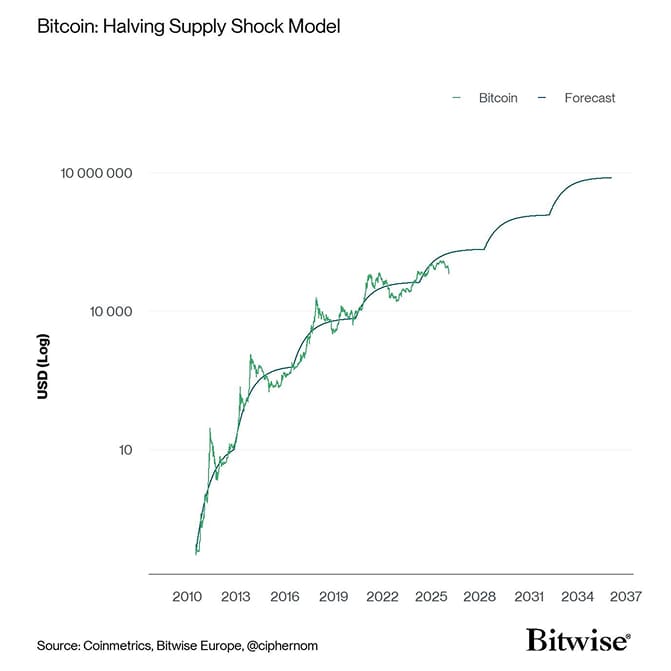 Source: Coinmetrics, Bitwise Europe; @ciphernom
Risk considerations: Bitcoin
Bitcoin is a volatile asset with a limited track record. Regulations surrounding bitcoin are evolving rapidly, institutional adoption is in its early days, and the underlying technology supporting bitcoin is relatively new. In addition, these and other factors make the process of forecasting future returns, correlations, and volatility in bitcoin inherently uncertain and subject to significant risks and potential errors.
The following are among the key risks to consider.
01 / Bitcoin's Limited Track Record
Bitcoin was developed in 2008–09 and began trading widely on public exchanges in 2010. The first institutional investment product offering exposure to bitcoin launched in 2014, and spot ETPs tied to bitcoin only launched in 2024.
The result of these relatively short time periods is that there is limited data to uate when forecasting the future returns, correlations, and volatility of bitcoin. There are additional risks that future returns may not bear a strong resemblance to the past given the changing nature of the bitcoin market, regulations, and other developments. Analysts studying bitcoin's historical returns can only examine its returns in the macroeconomic conditions that have existed since it launched, and future macroeconomic conditions may not resemble past conditions.
As a result of bitcoin's limited track record, investors should carefully consider bitcoin forecasts that rely heavily on historical data. While we have attempted to account for these risks in our analysis, the risks persist nonetheless.
02 / Risk of Total Loss of Capital
Bitcoin investments are highly speculative and carry substantial risk of total loss. Extreme price volatility, regulatory uncertainties, technological vulnerabilities, and evolving market infrastructure mean bitcoin's value could decline to zero under adverse scenarios. Investors should only allocate capital they can afford to lose entirely. Past performance does not guarantee future results. Bitcoin investments are not covered by the investor protection schemes. In the event of loss, theft, fraud, or insolvency of service providers, investors have no recourse to statutory compensation.
03 / Unregulated Market and Liquidity Risk
Bitcoin trades on exchanges with varying regulatory oversight and may experience periods of reduced liquidity, particularly during market stress. These markets may be susceptible to manipulation. Reduced liquidity can result in wider bid-ask spreads, difficulty executing trades, significant price slippage, and inability to exit positions. During extreme conditions, liquidity constraints may prevent exits or force sales at disadvantageous prices.
04/ Regulatory and Legislative Risk
The regulatory and legislative environment surrounding bitcoin is newer and less developed than it is for many other assets, and it is changing rapidly, both in the U. S. and abroad. Large and unexpected developments in bitcoin's regulatory and legislative standing in the U.S. or around the world could significantly change the outlook for bitcoin, either positively or negatively.
05/ Institutional, Corporate, and Government Adoption of Bitcoin Are New Trends
Bitcoin began as a predominantly retail-led asset. In recent years, institutions, corporations, and governments have begun to acquire bitcoin, and its future growth prospects rest heavily on continued adoption by these groups of investors. However, this is a relatively new development, and it's not certain that recent adoption trends will persist into the future.
06/ Technical and Quantum Risk
Bitcoin is a technology, and any technology comes with risk. For the bitcoin blockchain to function well, its underlying source code must be continually updated as the surrounding technological environment changes. There is a risk that bitcoin will not keep up with the times and face either technical challenges or competitive challenges if it fails to do so.
For instance, the core technology behind bitcoin and many bitcoin wallets could be at risk if there are rapid advances in quantum computing – technology that aims to process at exponentially higher rates than today's supercomputers. At some point in the future, the bitcoin blockchain will likely have to go through a major upgrade to quantum-resistant cryptography in order to allay risks in this space. Even if bitcoin succeeds at this upgrade – which is uncertain – individual wallets may be at risk if they do not transfer assets to quantum-resistant addresses. Failure to adequately adapt to quantum computing advances could expose the bitcoin blockchain and investments in bitcoin to risk.
Important Information
This document (which may take the form of a presentation, press release, social media post, blog article, broadcast communication or similar instrument – collectively referred to as a “Document”) is issued by Bitwise Europe GmbH (“BEU” or the “Issuer”) and has been prepared in accordance with applicable laws and regulations, including those relating to financial promotions.
For professional investors only. This Document is directed exclusively at persons with professional experience in matters relating to investments. Any investment activity to which it relates is available only to such persons and will be engaged in only with such persons. BEU does not conduct such activity with private individuals. Persons without professional experience in investment matters must not rely on this communication.
This Document constitutes a marketing communication and is provided for informational purposes only. It does not constitute investment advice, a personal recommendation, or an offer or solicitation to buy or sell any financial instrument.
BEU, incorporated under the laws of Germany, is the issuer of the Exchange Traded Products (“ETPs”) referenced in this Document under a base prospectus and the applicable final terms, as supplemented from time to time, approved by the German Federal Financial Supervisory Authority (BaFin). The approval of the prospectus by BaFin relates solely to the completeness, coherence and comprehensibility of the prospectus in accordance with the Prospectus Regulation and does not constitute an endorsement, recommendation or assessment of the merits of the products.
The market analyses, views and scenarios presented reflect the assessment as of the date of publication and are based on information considered reliable. However, no representation or warranty is made as to their accuracy or completeness. Forward-looking statements involve risks and uncertainties and are not guarantees of future performance. Past performance is not a reliable indicator of future results.
Capital at risk. Cryptoassets are highly volatile and involve a high degree of risk. The value of investments in cryptoassets and crypto-linked ETPs may fluctuate significantly, and investors may lose part or all of their invested capital. No capital protection or guaranteed compensation mechanism applies in respect of market losses.
Any investment decision should be made solely on the basis of the relevant base prospectus, the applicable final terms and the key information document, in particular the section entitled “Risk Warning”. The base prospectus, final terms and additional risk information are available at: www.bitwiseinvestments.eu
Access to certain documents may require self-certification regarding your jurisdiction and investor status and may be subject to additional disclaimers and important information.