- Cryptoassets sold off sharply amid ETP outflows and futures liquidations, while the nomination of a perceived Fed hawk drove short-term volatility despite mixed rate-cut expectations.
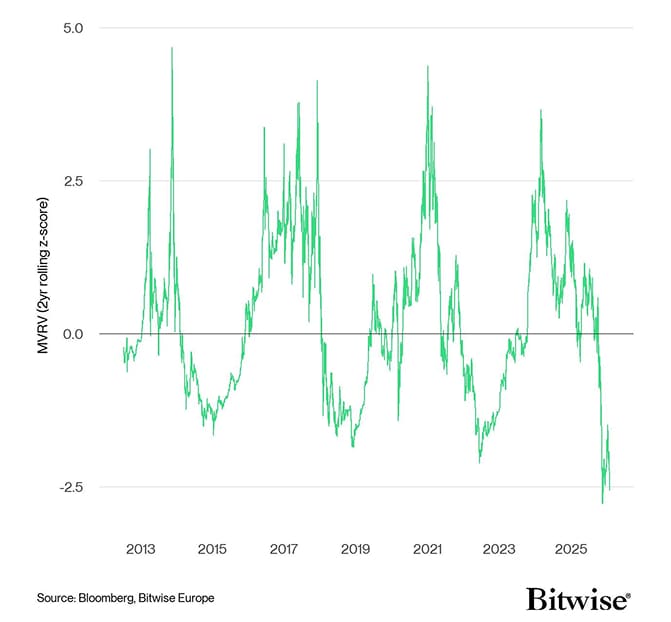
- Chart-of-the-Week: Bitcoin’s 2-year rolling MVRV z-score has fallen to the lowest level on record, signalling valuations that have historically been at low levels.
- Contrarian signals are aligning: sentiment has turned deeply bearish - with the Cryptoasset Sentiment Index declining to extreme levels - while reflation signals from precious metals and ISM trends point to an improving macro backdrop.
Chart of the Week
Bitcoin: MVRV (2yr rolling z-score)
Performance
Last week, cryptoassets sold off amid significant net outflows from ETPs and long futures liquidations which exacerbated the price correction. Some analysts attributed the sell-off to the nomination of Kevin Warsh as new governor of the Federal Reserve. He is generally seen as a monetary policy ‘hawk' which implies tighter monetary policy going forward which tends to be headwind for bitcoin and cryptoassets. Nonetheless, he has expressed favourable views regarding bitcoin as a ‘good policeman for policy' in the sense that bitcoin's price may provide a good signal if monetary or fiscal policy are too loose and policymakers should restrict (over)spending.
Following Warsh's nomination, Fed rate cut expectations have increased on the short end while they have declined at the long end.
In other words, the market expects more rate cuts from Warsh in the short-term but less over the long term, i.e. mixed expectations.
On the bright side, the latest correction has led to very attractive valuations for bitcoin – the 2-year rolling z-score of the Market-Value-to-Realized-Value (MVRV) ratio has declined to the lowest level ever recorded essentially signalling ‘fire-sale valuations' for bitcoin (Chart-of-the-week).
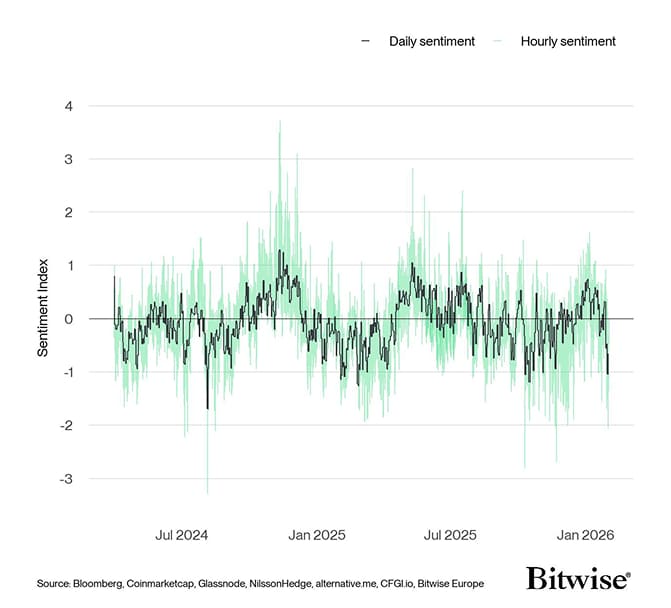
Besides, our Cryptoasset Sentiment Index has flashed a contrarian buying signal again with sentiment readings being as bearish as during the 10/10 liquidation crash.
So, both sentiment and valuation indicators are present valuation and sentiment levels that differ from historical averages with respect to cryptoassets at these prices. Moreover, we regard the most recent rally in (precious-)metals as a clear sign of a global reflation which should lift overall economic activity (ISM Manufacturing Index) and provide the potential catalyst for a renewed risk-on environment.
In general, upturns in the ISM Manufacturing Index are historically associated with bull runs in bitcoin and other cryptoassets.
In fact, today's ISM Manufacturing release may differ from consensus expectations as consensus expectations are relatively bearish (~48.5) while regional PMI indicators are signalling a reading above 50 already. This is consistent with the reacceleration in (precious-)metals prices which is signalling a global reflation.
In the short-term, there is a high probability that the price of bitcoin may snap back above $80k as the most recent sell-off has created one of the biggest CME futures price gaps on record. Historically speaking, more than 90% of bitcoin ‘CME gaps' have historically closed within the subsequent week of trading.
All in all, we think bearish sentiment, ‘fire sale valuations' combined with a global reflation scenario on the horizon may provide a asymmetric risk-reward set-up for bitcoin and other cryptoassets right now.
Cross Asset Performance (Week-to-Date)
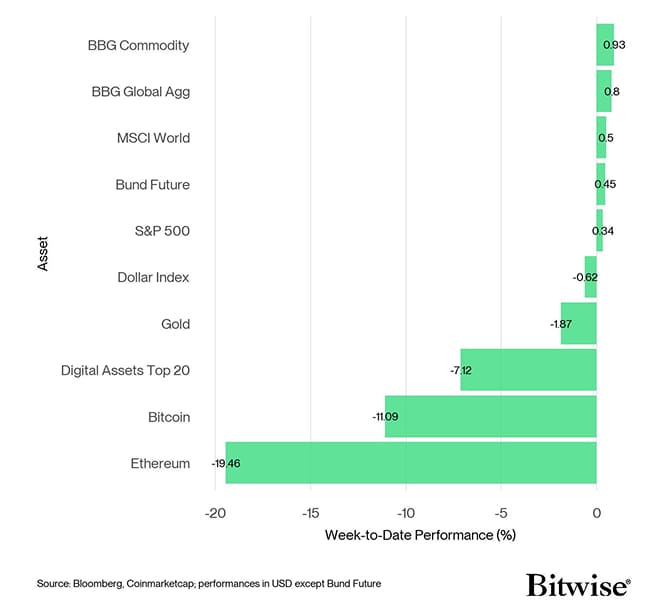 Source: Bloomberg, Coinmarketcap; performances in USD exept Bund Future
Top 10 Cryptoasset Performance (Week-to-Date)
Source: Bloomberg, Coinmarketcap; performances in USD exept Bund Future
Top 10 Cryptoasset Performance (Week-to-Date)
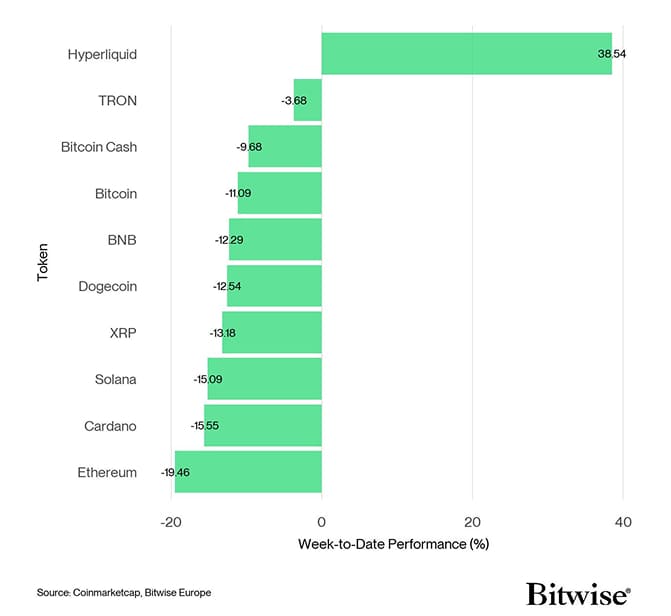 Source: Coinmarketcap
In general, among the top 10 crypto assets Hyperliquid, TRON, and Bitcoin Cash were the relative outperformers.
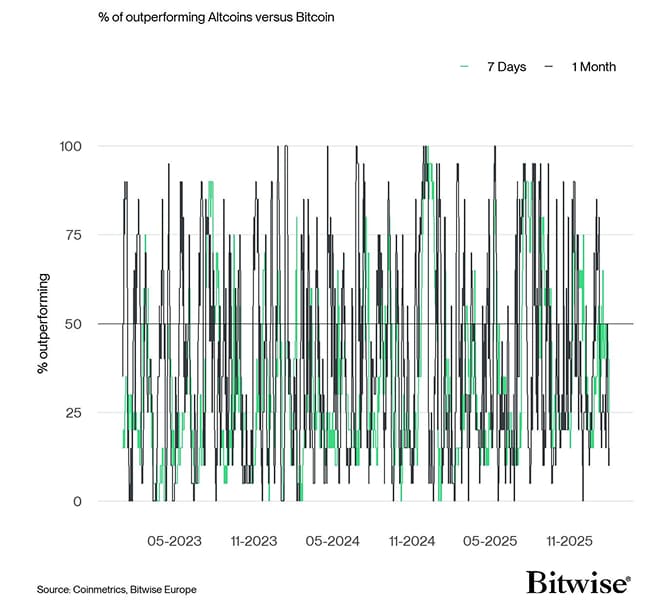
Overall, altcoin outperformance vis-à-vis bitcoin has decreased again last week, with 15% of our tracked altcoins managing to outperform bitcoin on a weekly basis. Ethereum also underperformed bitcoin last week.
Sentiment
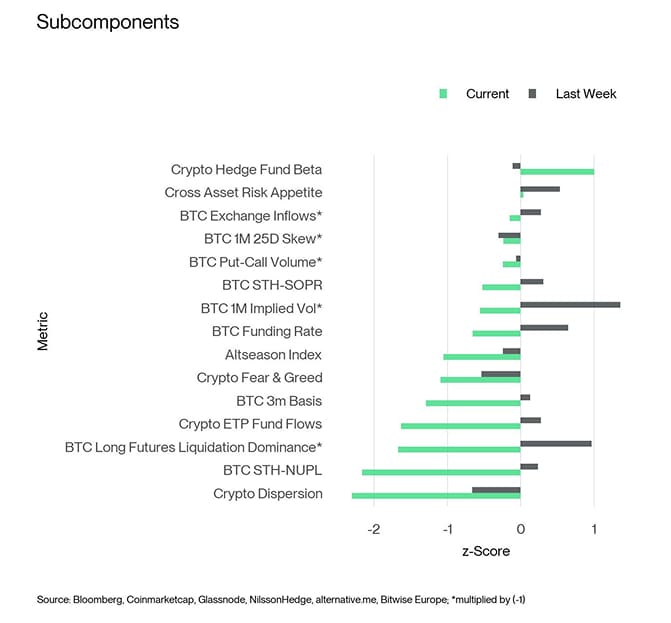
Our in-house “Cryptoasset Sentiment Index” has decreased significantly and is signalling a contrarian buying signal.
At the moment, 2 out of 15 indicators are above their short-term trend.
Last week, only the BTC Hedge Fund Beta, and Cross Asset Risk Appetite showed positive momentum.
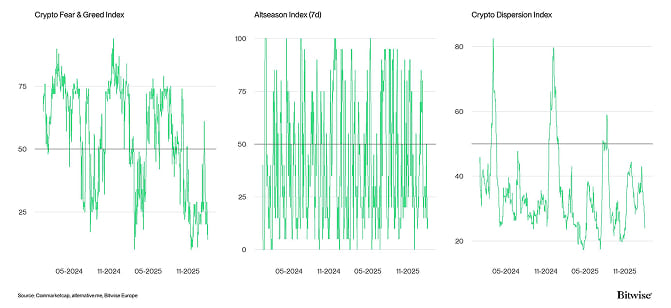
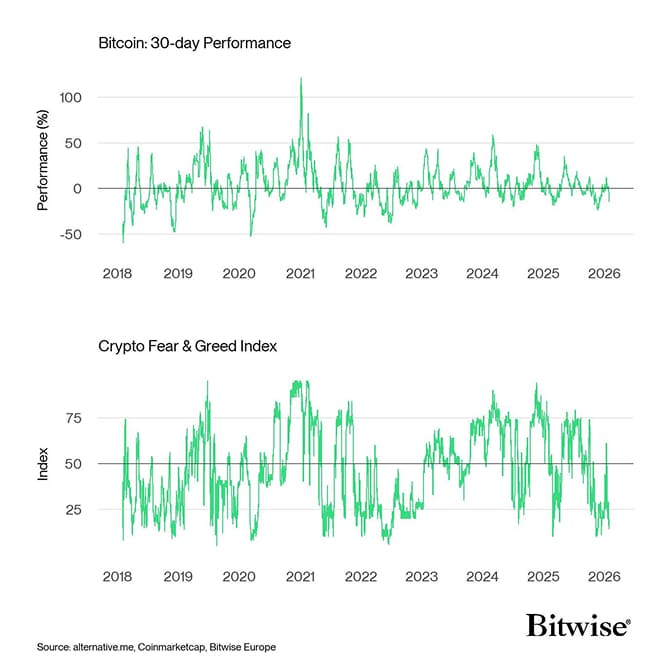
The Crypto Fear & Greed Index signals a “extreme fear” level of sentiment as of this morning. The index spent the whole month of November and December in either “fear” or “extreme fear” territory although turned to “Greed” briefly early in the third calendar week of January. February has consistently been in “Extreme Fear” so far.
Performance dispersion among cryptoassets decreased slightly last week from 0.31 to 0.24. When dispersion is high, it may mean that the market appears to be driven by a more diverse set of narratives which tends to be a sign of increasing risk appetite.
Altcoin outperformance vis-à-vis Bitcoin decreased last week, with around 15% of our tracked altcoins. Ethereum underperformed Bitcoin.
In general, increasing (decreasing) altcoin outperformance tends to be a sign of increasing (decreasing) risk appetite within cryptoasset markets.
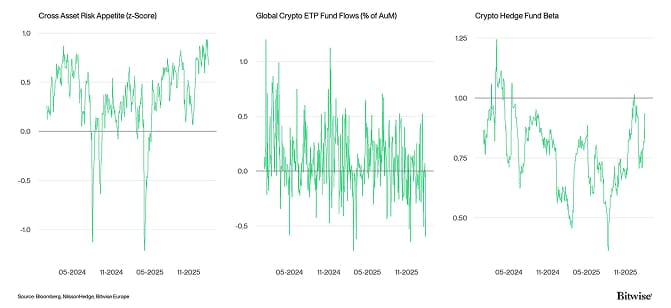
Sentiment in traditional financial markets as measured by our in-house measure of Cross Asset Risk Appetite (CARA) decreased to 0.68. This is a notable divergence between TradFi and crypto asset sentiment that should be continued to watch closely.
Fund Flows
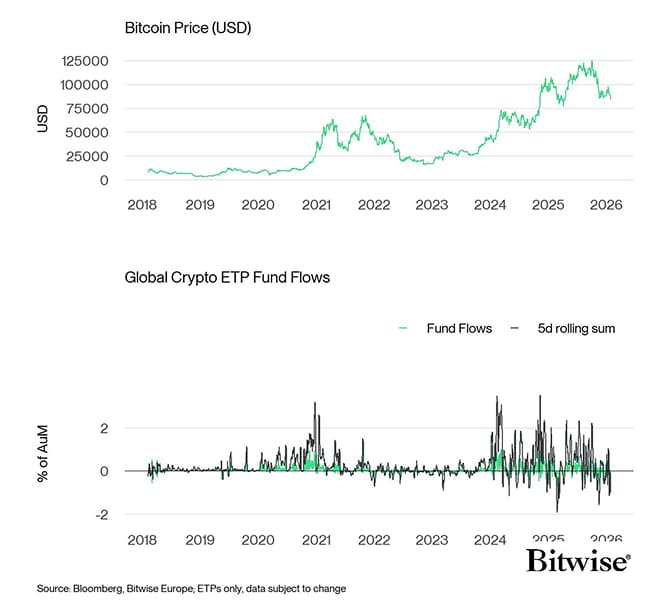
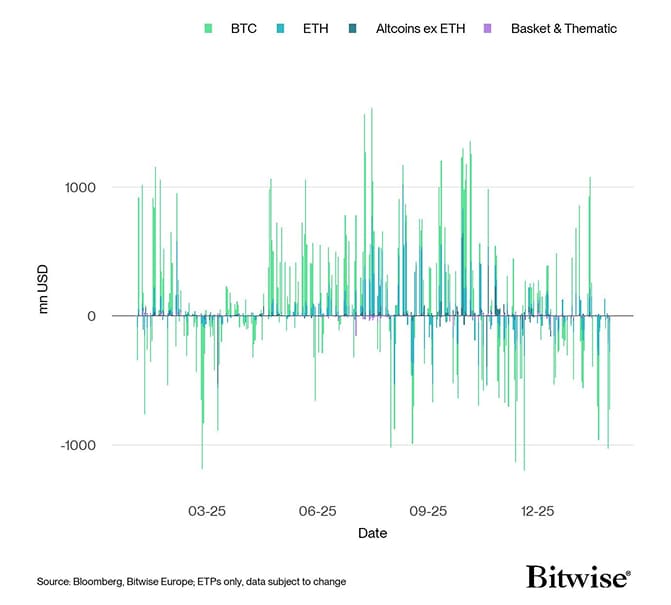
Global crypto ETPs saw large total net outflows last week across Bitcoin and Ethereum products, basket and thematic products and altcoins ex-ETH products.
Global crypto ETPs saw around -1725.4 mn USD in weekly net outflows across all types of cryptoassets, after -1811 mn USD in net outflows the previous week.
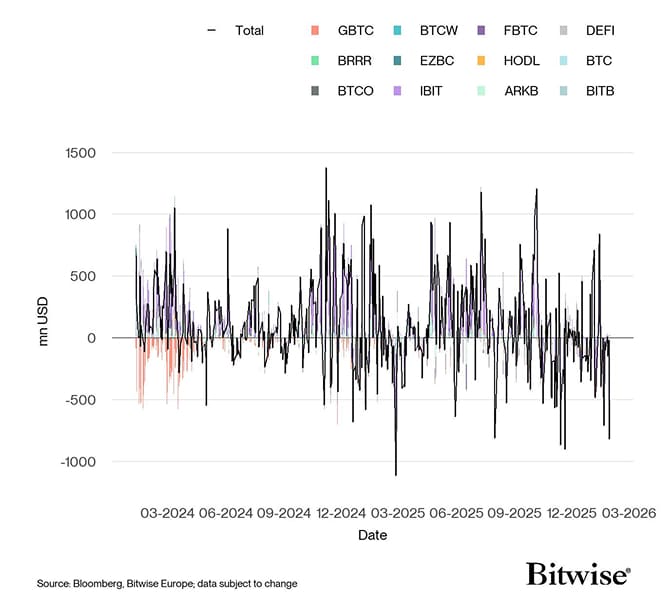
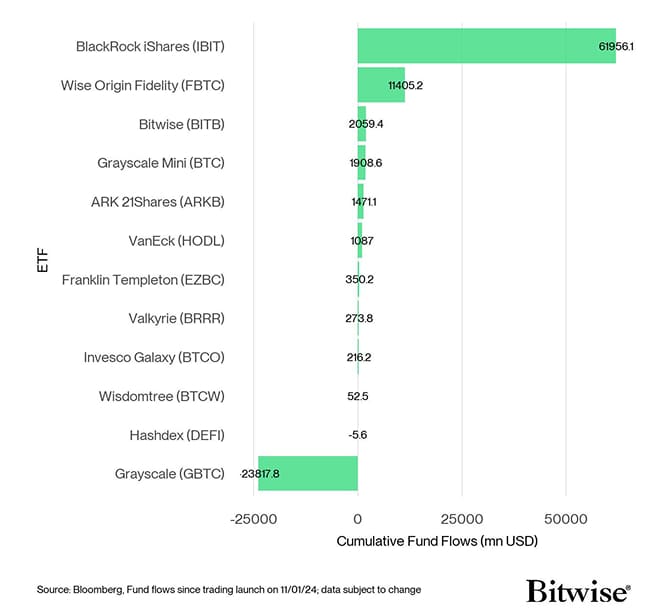
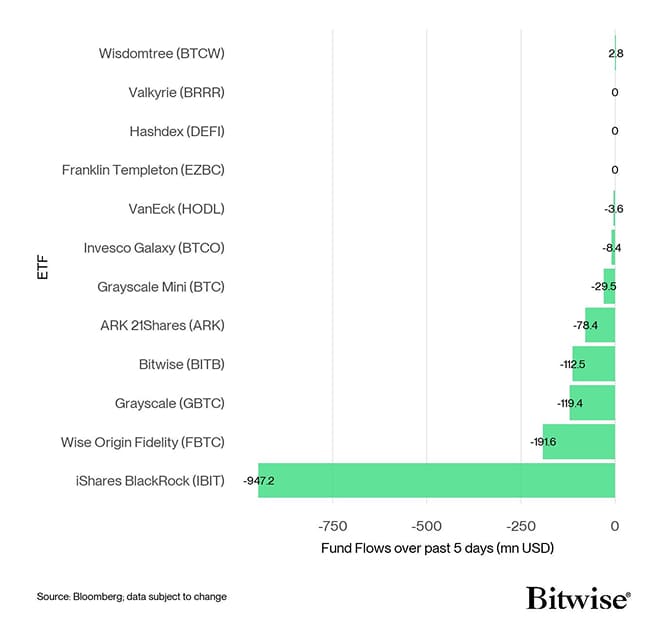
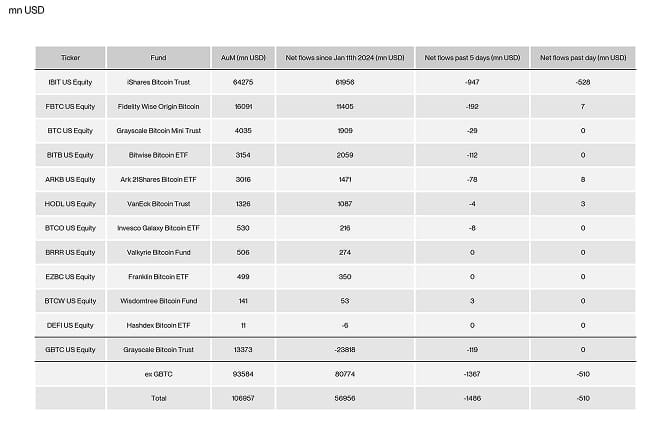
Global Bitcoin ETPs have experienced net outflows totalling -1346.4 mn USD last week, of which -1487.7 mn USD in net outflows were related to US spot Bitcoin ETFs.
The Bitwise Bitcoin ETF (BITB) in the US experienced net outflows, totalling -112.5 mn USD last week.
In Europe, the Bitwise Physical Bitcoin ETP (BTCE) experienced net outflows equivalent to -3.9 mn USD, whereas the Bitwise Core Bitcoin ETP (BTC1) experienced net outflows of -0.5 mn USD.
The Grayscale Bitcoin Trust (GBTC) posted net outflows of -119.4 mn USD and the iShares Bitcoin Trust (IBIT) experienced net outflows of around -947.2 mn USD last week.
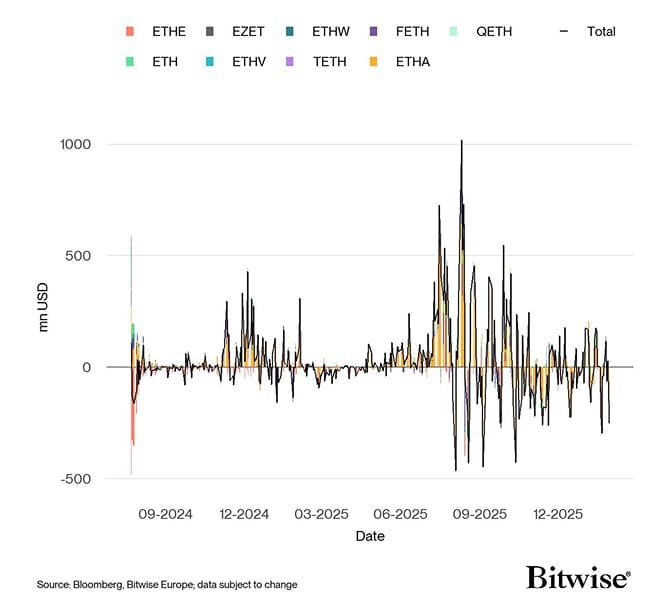
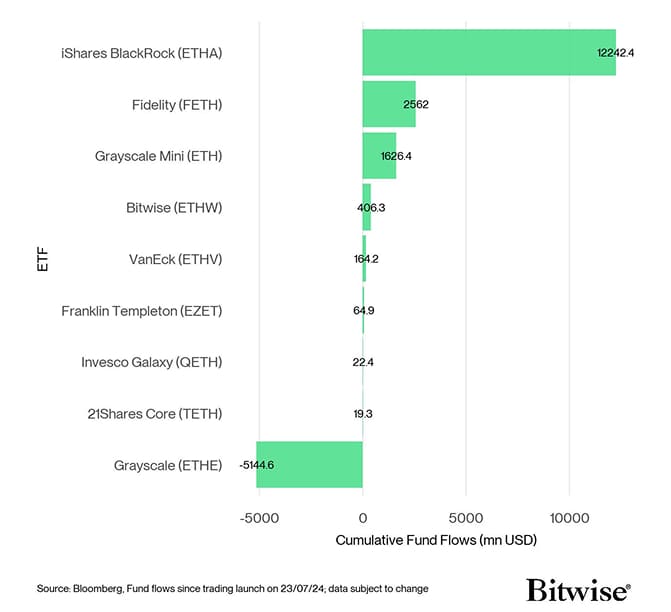
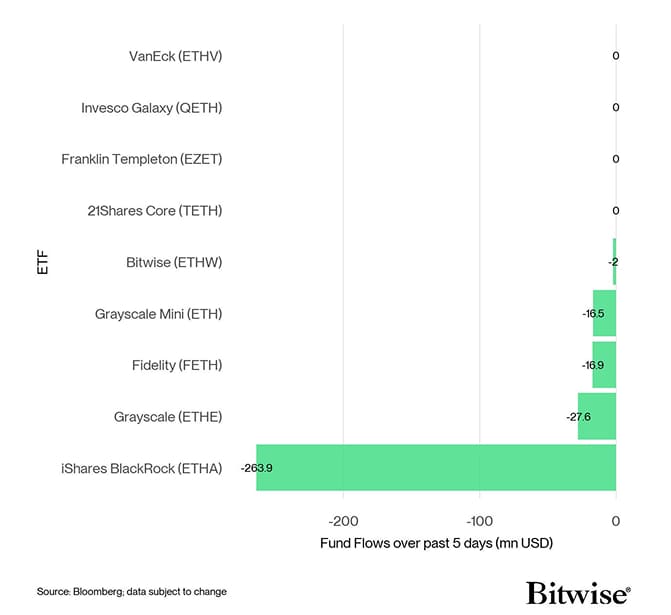
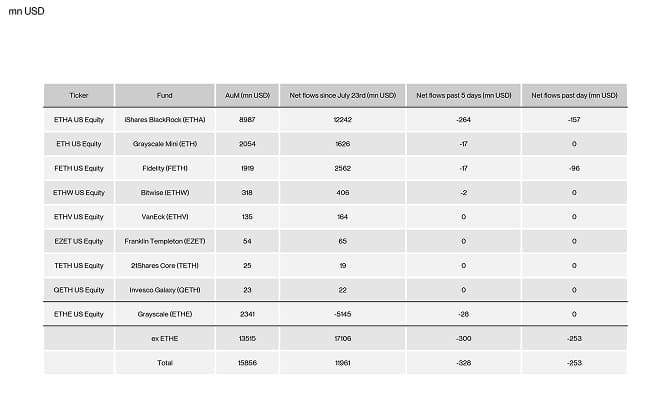
Meanwhile, global Ethereum ETPs also experienced -330.3 mn USD in net outflows last week, of which US spot Ethereum ETFs recorded net outflows of around -326.9 mn USD on aggregate.
The Grayscale Ethereum Trust (ETHE) posted net outflows of -27.6 mn USD, alongside the iShares Ethereum Trust (ETHA) that also experienced -263.9 mn USD of net outflows.
The Bitwise Ethereum ETF (ETHW) in the US has posted net outflows of -2 mn USD.
In Europe, the Bitwise Physical Ethereum ETP (ZETH) saw minor net outflows of -0.5 mn USD, as the Bitwise Ethereum Staking ETP (ET32) also saw +0.2 mn of net inflows.
Altcoin ETPs ex Ethereum experienced net outflows of -48 mn USD last week.
Thematic & basket crypto ETPs also posted net outflows of -0.5 mn USD on aggregate last week. The Bitwise MSCI Digital Assets Select 20 ETP (DA20) experienced net inflows last week of +0.4 mn USD on aggregate.
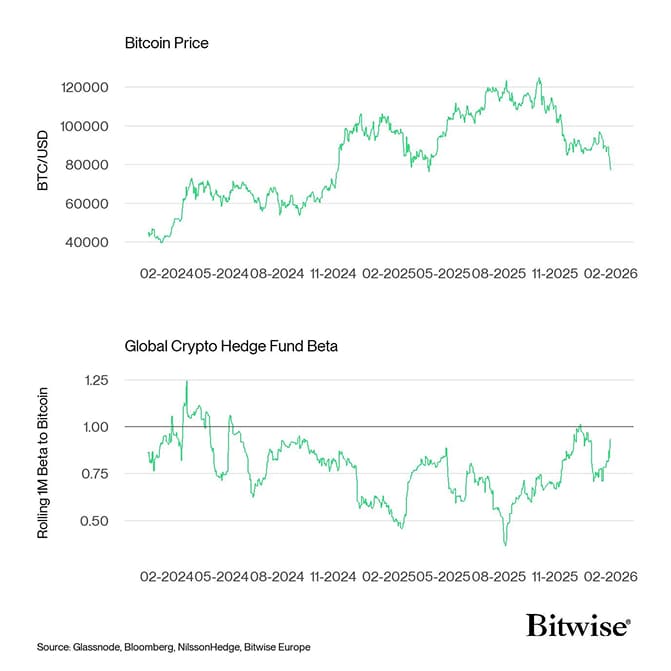
Global crypto hedge funds exposure to Bitcoin increased last week. The 20-days rolling beta of global crypto hedge funds' performance to Bitcoin climbed from 0.82 to 0.94 per yesterday's close.
On-Chain Data
Price action continues to deteriorate, with Bitcoin sliding to a low of $74.7K, decisively sweeping and extending below the November 2025 lows. This move reinforces the prevailing weekly downtrend and marks the largest drawdown from the cycle ATH at –38.4%. As a result, rolling quarterly performance has fallen to –28.9%, with only 12% of trading days recording worse three-month returns, underscoring the severity of the recent downside.
Bitcoin has entered an air-gapped region between $70K–$80K, where relatively few coins have historically changed hands. This is also evident technically, with the market spending only a limited amount of time trading within this range. Such zones are often revisited as price retests investor demand within sparsely traded regions. A constructive signal would be a sustained transfer of coins from weaker to stronger hands across this range.
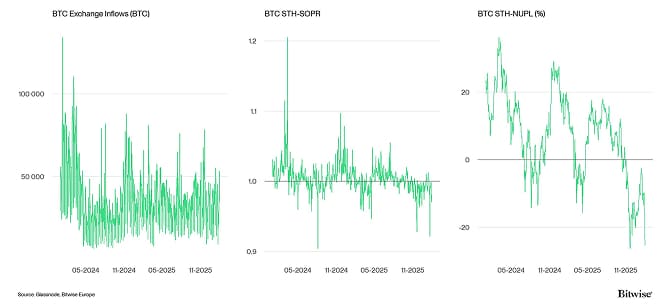
Sell-side pressure across exchanges has continued to intensify, with intraday spot buying minus selling reaching a trough of approximately –$2.1B, with only 1.8% of trading days recording larger USD-denominated sell pressure. This highlights the persistence of distribution under current conditions.
Investor stress has risen sharply. The value of capital held at a loss has surged to a new all-time high of approximately $873B, representing 78% of all invested capital, with only 20% of trading days seeing a greater share underwater. In parallel, unrealised losses across coins in loss have expanded to roughly –$175B, the largest since the FTX crisis, equating to around –$19.8K per coin.
Capitulation dynamics have intensified across the downturn, with realised losses peaking near $740M, placing the market in a loss-dominant regime where capital destruction exceeds new inflows. While Short-Term Holders remain the primary source of realised losses, Long-Term Holder losses are also rising, suggesting that higher-cost buyers from the past two years are beginning to capitulate, behaviour typically observed in deeply depressed market conditions.
Despite this uptick in loss realisation, losses remain relatively modest when scaled against the total dollar value invested in the asset. This implies that while capital destruction is material in absolute terms, it remains marginal relative to Bitcoin's overall capital base. As such, two interpretations emerge: either a full capitulation event has yet to occur, or investor loss-taking is beginning to exhaust even as price continues to contract.
In the search for support, a convergence of key structural cost bases, including the average investor purchase price, the Strategy treasury cost basis, and the U.S. spot Bitcoin ETF aggregate cost basis, forms a dense support cluster in the $82K–$75K range. This zone also overlaps with the previously identified $70K–$80K volume gap, reinforcing it as a critical area to defend and the base-case region for a market bottom to form.
In addition, the prior cycle all-time high near $69K and the 2024 consolidation zone bolster support at the edge of the range.
In the event of further contraction, the Realised Price ($56K) and the 200-week moving average ($58K) define the most probable region for terminal downside in a full capitulation scenario which we still deem very unlikely at this point though.
Importantly, a suite of on-chain and technical valuation metrics, including the AVIV Ratio, STH-MVRV, and the Mayer Multiple, suggest the market is becoming increasingly undervalued. This shift improves the risk-reward profile for new entrants and contributes to the formation of a rising demand floor.
Overall, the market remains precariously positioned, with investor stress continuing to build. Valuation metrics point to deep undervaluation, positioning the $70K–$80K range as a high-demand zone and the base-case region for a market bottom to form. However, $75K now represents the point of control within this range, and a decisive, sustained loss of this level would likely open the door to a further leg lower, with the Realised Price and 200-week moving average coming into focus as the final downside targets.
Futures, Options & Perpetuals
Over the past week, BTC perpetual futures open interest declined by approximately -10.5K BTC, while CME futures open interest dropped by –13.8K BTC, signalling a contraction in institutional positioning. This likely reflects an unwinding of cash-and-carry trades as price trades lower, contributing additional downward pressure on the market.
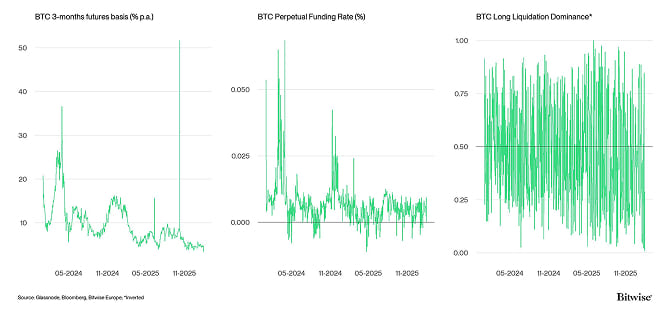
As price collapsed, long futures positioning was aggressively unwound, with consecutive days recording $901M, $1.25B, and $2.41B in long liquidations. Only three trading days have ever recorded a larger liquidation peak, underscoring the severity of the recent downturn.
From a positioning standpoint, short futures open interest is beginning to rebuild around the $91K level, while long positioning is accumulating closer to the $72K region, together defining loose bounds for the mid-term trading range.
Perpetual funding rates are declining but remain positive, suggesting a marginal long-bias persists amongst futures investors, highlighting a degree of exuberance remaining as investors attempt to catch falling knives. A constructive observation would be to see funding rates flip negative.
In parallel, the BTC 3-month annualised basis compressed further to just 3.4%, the lowest level since Oct 2023. In practice, such depressed basis levels are consistent with risk averse markets.
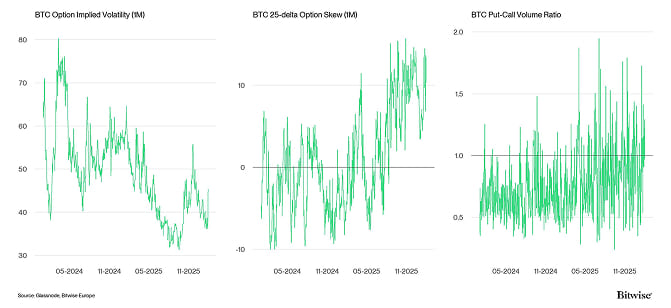
Turning to options markets, BTC options open interest declined by approximately –58.4K BTC into the January expiry, bringing total open interest down to around 321K BTC. At the same time, the put-to-call open interest ratio on Deribit surged from 0.72 to 0.77, its highest level since May 2021, while the same ratio across IBIT options climbed to 0.60, broadly in sync. Together, this suggests that while defensive positioning remains elevated, marginal demand for additional downside protection is rising fast.
Furthermore, the 25-delta skew continues to remain elevated, signalling rising premiums for downside protection across both short- and medium-dated horizons. Notably, the 1-week skew surged to 18%, one of the highest readings of the cycle, rivalling levels seen during the yen-carry unwind and ahead of the October deleveraging event, highlighting elevated near-term risk sensitivity.
Finally, options dealer gamma positioning is deeply negative across the majority of the $50K–$82K range, creating conditions where price movements are more likely to be amplified as dealer hedging flows reinforce momentum. In contrast, a pocket of positive gamma is concentrated around the $75K level, bolstering our observation as the $75k level as the next point of market control. Taken together, this structure points to elevated volatility conditions within this range. In addition, a large positive gamma node is present around $85K, marking a structurally important resistance level that would likely prove difficult to break without a meaningful shift in demand.
Bottom Line
- Cryptoassets sold off sharply amid ETP outflows and futures liquidations, while the nomination of a perceived Fed hawk drove short-term volatility despite mixed rate-cut expectations.
- Chart-of-the-Week: Bitcoin’s 2-year rolling MVRV z-score has fallen to the lowest level on record, signalling valuations that have historically been at low levels.
- Contrarian signals are aligning: sentiment has turned deeply bearish - with the Cryptoasset Sentiment Index declining to extreme levels - while reflation signals from precious metals and ISM trends point to an improving macro backdrop.
Appendix
Bitcoin Price vs Cryptoasset Sentiment Index
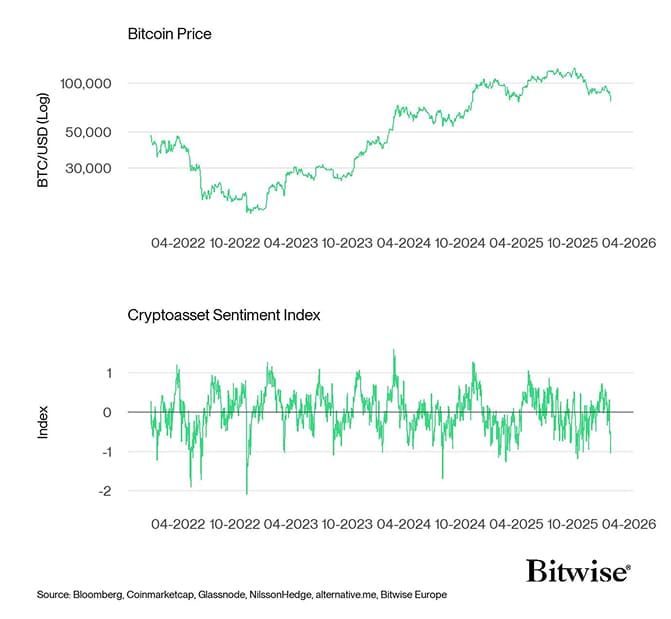 Source: Bloomberg, Coinmarketcap, Glassnode, NilssonHedge, alternative.me, Bitwise Europe
Cryptoasset Sentiment Index
Source: Bloomberg, Coinmarketcap, Glassnode, NilssonHedge, alternative.me, Bitwise Europe
Cryptoasset Sentiment Index
 Source: Bloomberg, Coinmarketcap, Glassnode, NilssonHedge, alternative.me, Bitwise Europe; *multiplied by (-1)
TradFi Sentiment Indicators
Source: Bloomberg, Coinmarketcap, Glassnode, NilssonHedge, alternative.me, Bitwise Europe; *multiplied by (-1)
TradFi Sentiment Indicators
 Source: Bloomberg, NilssonHedge, Bitwise Europe
Crypto Sentiment Indicators
Source: Bloomberg, NilssonHedge, Bitwise Europe
Crypto Sentiment Indicators
 Source: Coinmarketcap, alternative.me, Bitwise Europe
Crypto Options' Sentiment Indicators
Source: Coinmarketcap, alternative.me, Bitwise Europe
Crypto Options' Sentiment Indicators
 Source: Glassnode, Bitwise Europe
Crypto Futures & Perpetuals' Sentiment Indicators
Source: Glassnode, Bitwise Europe
Crypto Futures & Perpetuals' Sentiment Indicators
 Source: Glassnode, Bitwise Europe; *Inverted
Crypto On-Chain Indicators
Source: Glassnode, Bitwise Europe; *Inverted
Crypto On-Chain Indicators
 Source: Glassnode, Bitwise Europe
Bitcoin vs Crypto Fear & Greed Index
Source: Glassnode, Bitwise Europe
Bitcoin vs Crypto Fear & Greed Index
 Source: alternative.me, Coinmarketcap, Bitwise Europe
Cryptoasset Sentiment Index: Daily vs Hourly
Source: alternative.me, Coinmarketcap, Bitwise Europe
Cryptoasset Sentiment Index: Daily vs Hourly
 Source: Bloomberg, Coinmarketcap, Glassnode, NilssonHedge, alternative.me, CFGI.io, Bitwise Europe
Bitcoin vs Global Crypto ETP Fund Flows
Source: Bloomberg, Coinmarketcap, Glassnode, NilssonHedge, alternative.me, CFGI.io, Bitwise Europe
Bitcoin vs Global Crypto ETP Fund Flows
 Source: Bloomberg, Bitwise Europe; ETPs only, data subject to change
Global Crypto ETP Fund Flows
Source: Bloomberg, Bitwise Europe; ETPs only, data subject to change
Global Crypto ETP Fund Flows
 Source: Bloomberg, Bitwise Europe; ETPs only; data subject to change
US Spot Bitcoin ETF Fund Flows
Source: Bloomberg, Bitwise Europe; ETPs only; data subject to change
US Spot Bitcoin ETF Fund Flows
 Source: Bloomberg, Bitwise Europe; data subject to change
US Spot Bitcoin ETFs: Flows since launch
Source: Bloomberg, Bitwise Europe; data subject to change
US Spot Bitcoin ETFs: Flows since launch
 Source: Bloomberg, Fund flows since traiding launch on 11/01/24; data subject to change
US Spot Bitcoin ETFs: 5-days flow
Source: Bloomberg, Fund flows since traiding launch on 11/01/24; data subject to change
US Spot Bitcoin ETFs: 5-days flow
 Source: Bloomber; data subject to change
US Bitcoin ETFs: Net Fund Flows since 11th Jan mn USD
Source: Bloomber; data subject to change
US Bitcoin ETFs: Net Fund Flows since 11th Jan mn USD
 Source: Bloomberg, Bitwise Europe; data as of 30-01-2026
US Spot Ethereum ETF Fund Flows
Source: Bloomberg, Bitwise Europe; data as of 30-01-2026
US Spot Ethereum ETF Fund Flows
 Source: Bloomberg, Bitwise Europe; data subject to change
US Spot Ethereum ETFs: Flows since launch
Source: Bloomberg, Bitwise Europe; data subject to change
US Spot Ethereum ETFs: Flows since launch
 Source: Bloomberg, Fund flows since trading launch on 23/07/24; data subject on change
US Spot Ethereum ETFs: 5-days flow
Source: Bloomberg, Fund flows since trading launch on 23/07/24; data subject on change
US Spot Ethereum ETFs: 5-days flow
 Source: Bloomberg; data subject on change
US Ethereum ETFs: Net Fund Flows since 23rd July
Source: Bloomberg; data subject on change
US Ethereum ETFs: Net Fund Flows since 23rd July
 Source: Bloomberg, Bitwise Europe; data as of 30-01-2026
Bitcoin vs Crypto Hedge Fund Beta
Source: Bloomberg, Bitwise Europe; data as of 30-01-2026
Bitcoin vs Crypto Hedge Fund Beta
 Source: Glassnode, Bloomberg, NilssonHedge, Bitwise Europe
Altseason Index
Source: Glassnode, Bloomberg, NilssonHedge, Bitwise Europe
Altseason Index
 Source: Coinmetrics, Bitwise Europe
Bitcoin vs Crypto Dispersion Index
Source: Coinmetrics, Bitwise Europe
Bitcoin vs Crypto Dispersion Index
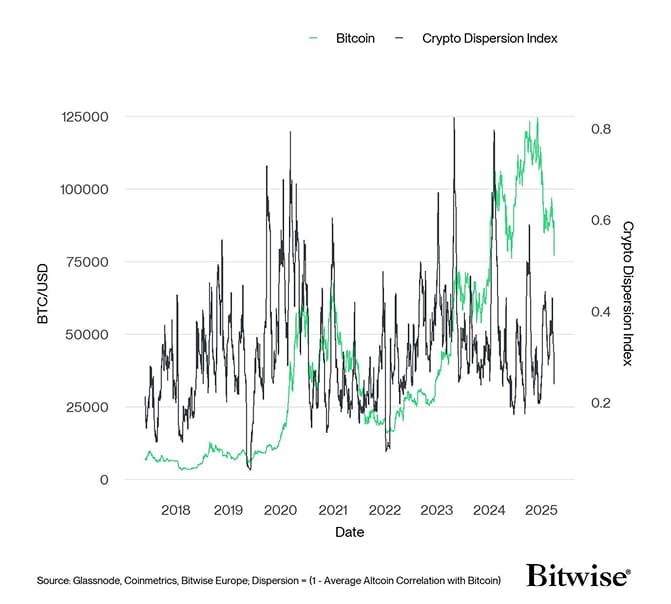 Source: Coinmarketcap, Bitwise Europe; Dispersion = (1 - Average Altcoin Correlation with Bitcoin)
Bitcoin Price vs Futures Basis Rate
Source: Coinmarketcap, Bitwise Europe; Dispersion = (1 - Average Altcoin Correlation with Bitcoin)
Bitcoin Price vs Futures Basis Rate
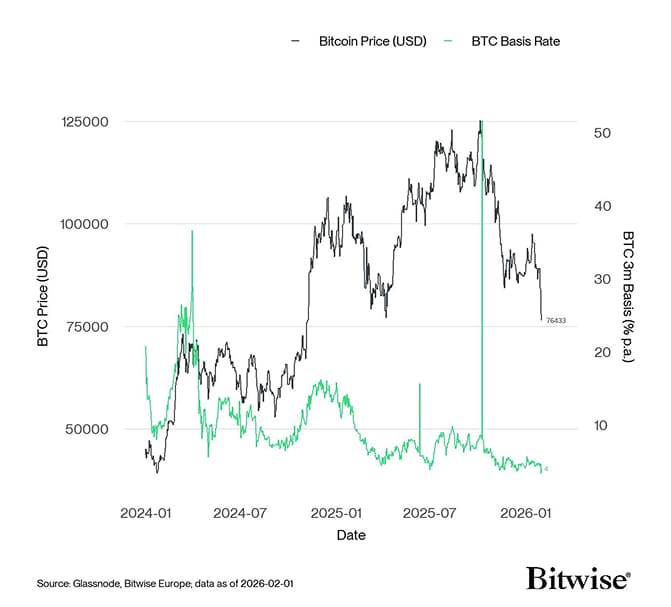 Source: Glassnode, Bitwise Europe; data as of 2026-02-01
Ethereum Price vs Futures Basis Rate
Source: Glassnode, Bitwise Europe; data as of 2026-02-01
Ethereum Price vs Futures Basis Rate
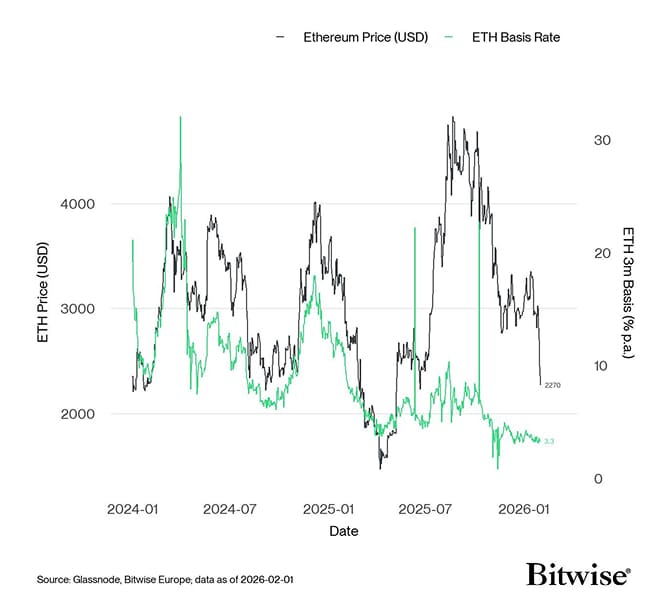 Source: Glassnode, Bitwise Europe; data as of 2026-02-01
BTC Net Exchange Volume by Size
Source: Glassnode, Bitwise Europe; data as of 2026-02-01
BTC Net Exchange Volume by Size
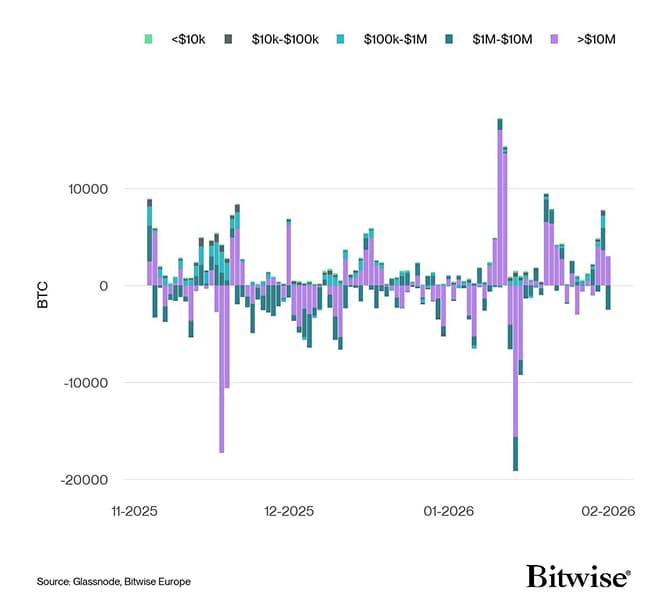 Source: Glassnode, Bitwise Europe
Important Information
This publication constitutes a marketing communication and is provided for informational purposes only. It does not constitute investment advice, a personal recommendation, or an offer or solicitation to buy or sell any financial instrument.
This document (which may take the form of a presentation, press release, social media post, blog article, broadcast communication or similar instrument – collectively referred to as a “Document”) is issued by Bitwise Europe GmbH (“BEU” or the “Issuer”) and has been prepared in accordance with applicable laws and regulations, including those relating to financial promotions.
Bitwise Europe GmbH, incorporated under the laws of Germany, is the issuer of the Exchange Traded Products (“ETPs”) referenced in this Document under a base prospectus and the applicable final terms, as supplemented from time to time, approved by the German Federal Financial Supervisory Authority (BaFin). The approval of the prospectus by BaFin relates solely to the completeness, coherence and comprehensibility of the prospectus in accordance with the Prospectus Regulation and does not constitute an endorsement, recommendation or assessment of the merits of the products.
The market analyses, views and scenarios presented reflect the assessment as of the date of publication and are based on information considered reliable. However, no representation or warranty is made as to their accuracy or completeness. Forward-looking statements involve risks and uncertainties and are not guarantees of future performance. Past performance is not a reliable indicator of future results.
Capital at risk. Cryptoassets are highly volatile and involve a high degree of risk. The value of investments in cryptoassets and crypto-linked ETPs may fluctuate significantly, and investors may lose part or all of their invested capital. No capital protection or guaranteed compensation mechanism applies in respect of market losses.
Any investment decision should be made solely on the basis of the relevant base prospectus, the applicable final terms and the key information document, in particular the section entitled “Risk Warning”. The base prospectus, final terms and additional risk information are available at: www.bitwiseinvestments.eu
Access to certain documents may require self-certification regarding your jurisdiction and investor status and may be subject to additional disclaimers and important information.
For further details, please refer to the full disclaimer available at: www.bitwiseinvestments.eu/disclaimer

 en
en  de
de  fr
fr  es
es