

Bitcoin vs. Gold: The Ultimate Hedge Against Inflation and Sovereign Debt?

Bitcoin vs. Gold: The Ultimate Hedge Against Inflation and Sovereign Debt? | Bitwise
En En It It De De
  • Rising Sovereign Debt and Inflation Concerns: The U.S. has reached a record-high public debt of $36 trillion (123% of GDP), with debt growth accelerating post-2020. This, coupled with increasing fiscal deficits and geopolitical tensions, raises inflation risks and erodes trust in traditional financial systems. As a result, investors are seeking alternative stores of value such as Gold or Bitcoin, moving away from U.S. Treasuries.
  • Bitcoin vs. Gold as Store-of-Value Assets: Bitcoin is increasingly seen as a "digital gold" due to its absolute scarcity (21 million max supply) and superior transferability compared to physical gold. While gold remains the primary safe-haven asset, Bitcoin’s technological advantages and adoption trends suggest it could challenge gold’s status over the long term.
  • Diversification and Portfolio Hedging: Gold remains a strong hedge against market downturns, while Bitcoin is more volatile but offers higher returns during recoveries. Bitcoin also has a lower correlation with U.S. Treasuries, making it a valuable diversification tool, particularly as a hedge against sovereign defaults. A balanced allocation between Bitcoin and gold can optimize risk-adjusted returns.

Macro regime

[Bitcoin is] no different than what gold represented over thousands of years. It is an asset class that protects you.

- Larry Fink

The “Nixon shock” of 1971 has left the world on a fiat standard after the US government decided to de-anchor the US Dollar from gold which established US Treasuries as the de facto reserve asset.

50+ years into this economic experiment, the world has seen a significant increase in inflation rates and multiple systemic banking crises with detrimental consequences to the stability of the global financial system.

US total public debt has just recently surpassed 36 trillion USD which amounts to around 123% of GDP – the highest level ever recorded.

Growth of US public debt is becoming increasingly unsustainable
US: Total Public Debt
Source: Bloomberg, Bitwise Europe

What is more is that the growth in US public debt appears to accelerate – since the beginning of September 2024, US total public debt has already grown by almost +1 trillion USD according to the latest data provided by Bloomberg. More specifically, total US public debt has been growing to the tune of 7.43% p.a. since April 2020 until today.

In addition, due to rising fiscal deficits, money supply growth rates have started to accelerate especially after the Covid crisis of 2020 necessitated an outsized fiscal and monetary response. However, this has led to a significant increase in inflation expectations and increases the risk of a high-inflation regime in the future.

US consumer inflation expectations are increasingly becoming unanchored
University of Michigan: Inflation Expectations
Source: Bloomberg, Bitwise Europe

Meanwhile, rising geopolitical tensions following the Russian invasion of Ukraine in 2022 and the freezing of Russian assets abroad, have led to a growing distrust in the established global monetary order and the safety of major sovereign bonds.

In general, rising geopolitical tensions also increase the likelihood of a high-inflation regime on account of a

  • Potential hike in import tariff rates that increase import price inflation,
  • Disruption in global supply-chains that is inflationary,
  • Increase in commodity prices that affect food and energy price inflation.

It is no surprise that investors are looking for alternative hard assets to diversify their investments, in particular out of US Treasuries.

Major foreign US Treasury holders have significantly reduced their holdings
UST Foreign Holders Data by Country
Source: Bloomberg, Bitwise Europe

Major foreign holders like China have been reducing their US Treasury holdings in favour of traditional stores-of-value like Gold. In fact, the percentage of gold in international reserves has reclaimed the 2nd rank among reserve assets and has already overtaken the Euro. Gold purchases by major central banks have just recently hit the highest amount since 1967.

Central banks have significantly increased their purchases of gold since Covid
Central Bank Net Gold Purchases
Source: Bloomberg, World Gold Council, Bitwise Europe

As a result, long-term US Treasury bonds have recorded their worst performance in history and are significantly underperforming Gold.

US long-term Treasury bonds are experiencing their worst performance in history US long-term Treasury bonds are experiencing their worst performance in history
Source: Bloomberg, Bitwise Europe; Past performance not indicative of future returns.

Meanwhile, Bitcoin is increasingly being adopted as an alternative store-of-value threatening to disrupt gold technologically over the long-term.

Central banks are officially looking to diversify their reserve assets into Bitcoin and the US and other countries are considering to establish a Strategic Bitcoin Reserve.

In fact, Bitcoin is already a 2 trillion USD asset which ranks it as the 7th most valuable single asset in the world – just between companies like Amazon and Saudi Aramco in terms of market cap. Bitcoin is often dubbed “digital gold” or “exponential gold” being caught between the exponential rise of technological adoption and absolute scarcity akin to gold.

But what is even special about Bitcoin?

Differences between Bitcoin and Gold

Bitcoin is gold with teleportation built in.

- Vijay Boyapati

Gold is considered to be a good store-of-value because it can maintain a high level of purchasing power over time.

Experts speak about "temporal transferability".

The reason is that gold is relatively scarce due to its energy-intensive production which results in a low supply growth rate over time (around +1.5% p.a.).

In contrast, fiat monies like the US Dollar or the Euro permanently lose purchasing power over time but can be used to transfer value across large distances which is cumbersome with physical gold and incurs high transaction costs.

Experts speak of "spatial transferability”.

Gold did not manage to be widely used as a medium-of-exchange after 1971 mainly on account of its limited spatial transferability, which is why fiat monies started to dominate our day-to-day lives.

Bitcoin has often been compared to gold due to its energy-intensive proof-of-work algorithm which verifies transactions and creates the new supply of bitcoins.

Bitcoin can be very volatile in the short term. However, due to its low supply growth rate (+0.8% p.a.) and absolute scarcity (max 21 million bitcoins), it is also considered to be a good store-of-value over long periods of time with an increasing purchasing power.
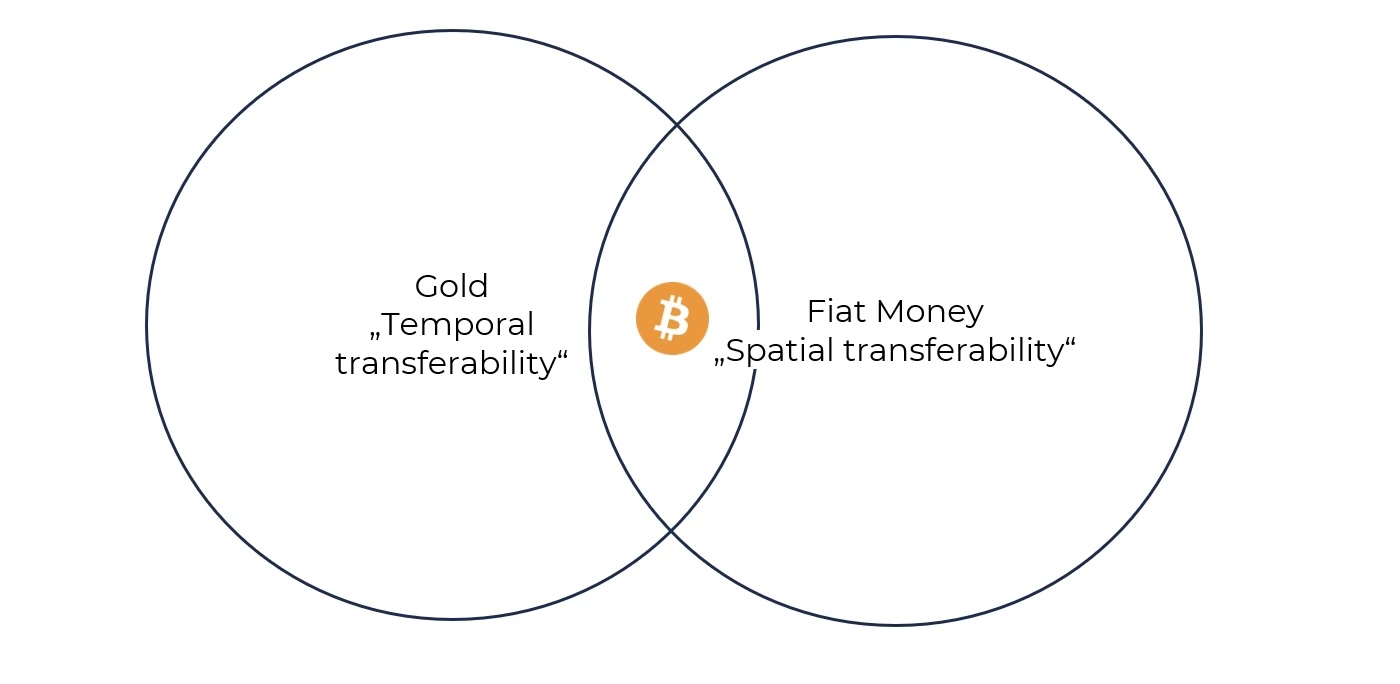
At the same time, due to its digital nature, and superior transferability, divisibility, and verifiability, Bitcoin also exhibits a high degree of spatial transferability like fiat monies.

In other words, Bitcoin combines the temporal transferability of gold with the spatial transferability of fiat monies.

Source: Bitwise Europe

Thus, due to its technological superiority, it is quite likely that Bitcoin could disrupt Gold over the long term. In fact, our official prediction is that Bitcoin could already reach gold’s market cap by the end of this decade.

That being said, over the short- to medium-term gold is likely to maintain its status as a the prime safe-haven asset while the ongoing adoption and changing character of Bitcoin makes it the closest contender for that status over the long term.

Bitcoin as an alternative hedge against sovereign default and inflation?

Government risk premia have been rising for major sovereign issuers like the US, UK, and France, as reflected in their increasing swap spreads. Consequently, investors are seeking alternative stores of value to hedge against counterparty risks.

Gold has traditionally served this purpose, with central banks still holding substantial reserves.

US long-Swap spreads have increased significantly signalling increasing sovereign risks
10-year sovereign swap spreads
Source: Bloomberg, Bitwise Europe.

Bitcoin presents a compelling digital alternative.

Unlike sovereign assets, Bitcoin operates on a decentralized, trust less network of nodes and miners that validate transactions and enforce consensus rules. This eliminates counterparty risk, as Bitcoin holdings are not intermediated by a central entity and remain resistant to censorship or confiscation.

Foss (2021) suggests that itcoin can act as "portfolio insurance" against sovereign bond defaults. Under a model linking Bitcoin’s value to the default risk of G20 sovereign bonds—currently valued at $69.1 trillion with an average 10-year default probability of 6.2%—Bitcoin's "fair value" could already be in the thousands per BTC. In an extreme scenario where all G20 bonds default, this model estimates a theoretical Bitcoin price of $3.5 million per BTC. These figures exclude unfunded liabilities, which could push valuations even higher. Read the detailed analysis here.

While large-scale sovereign defaults remain unlikely in the short term, historical patterns suggest they are not rare. Reinhart & Rogoff (2009) documented around 320 sovereign external debt defaults since 1800, with governments often inflating away domestic debt rather than defaulting outright.

Ahmed et al. (2024) provide further evidence of Bitcoin’s hedge properties, showing a correlation between rising sovereign default risk and increased crypto adoption in emerging markets. With its decentralized, counterparty risk-free nature and growing scarcity, Bitcoin remains a compelling hedge against sovereign financial instability.

Given Bitcoin’s supply growth of just 0.9% per year, it stands to benefit from both default scenarios and high-inflation environments.

In fact, we are seeing an increasing sensitivity of Bitcoin’s price to market-based US inflation expectations with an increasing level of scarcity.

Bitcoin is becoming increasingly sensitive to US inflation expectations with every additional Halving
Bitcoin vs US 2-year CPI Swaps
Source: Bloomberg, Bitwise Europe.

Therefore, it is also not surprising that Bitcoin tends to cycle with the ebbs and flows of global money supply expansion and contraction.

In fact, due to its absolute scarcity and low supply growth relative to fiat currencies, Bitcoin may be the best barometer for global monetary dilution that we have.

Bitcoin's performance tends to be tightly correlated with global money supply growth
Bitcoin vs Global Money Supply Growth
Source: Bloomberg, Bitwise Europe.

Bitcoin, Gold or Both?

Both assets have their advantages and disadvantages and the answer to that question may ultimately depend on your risk tolerance.

While small Bitcoin allocations can boost (risk-adjusted) portfolio returns significantly, gold allocations can reduce the overall risk profile of your multi-asset portfolio in terms of drawdown and volatility as highlighted here.

In terms of portfolio hedge, Gold continues to exhibit a very good hedge during risk-off market environments. In fact, on average, gold has shown a positive performance when the S&P 500 dropped by more than -2% in a single day as highlighted here.

In contrast, Bitcoin has generally shown a negative performance (-2.6%) during these adverse market environments while gold managed to provide a true downside hedge (+0.1%) with an average decline of the S&P 500 by -3.1% during these down days.
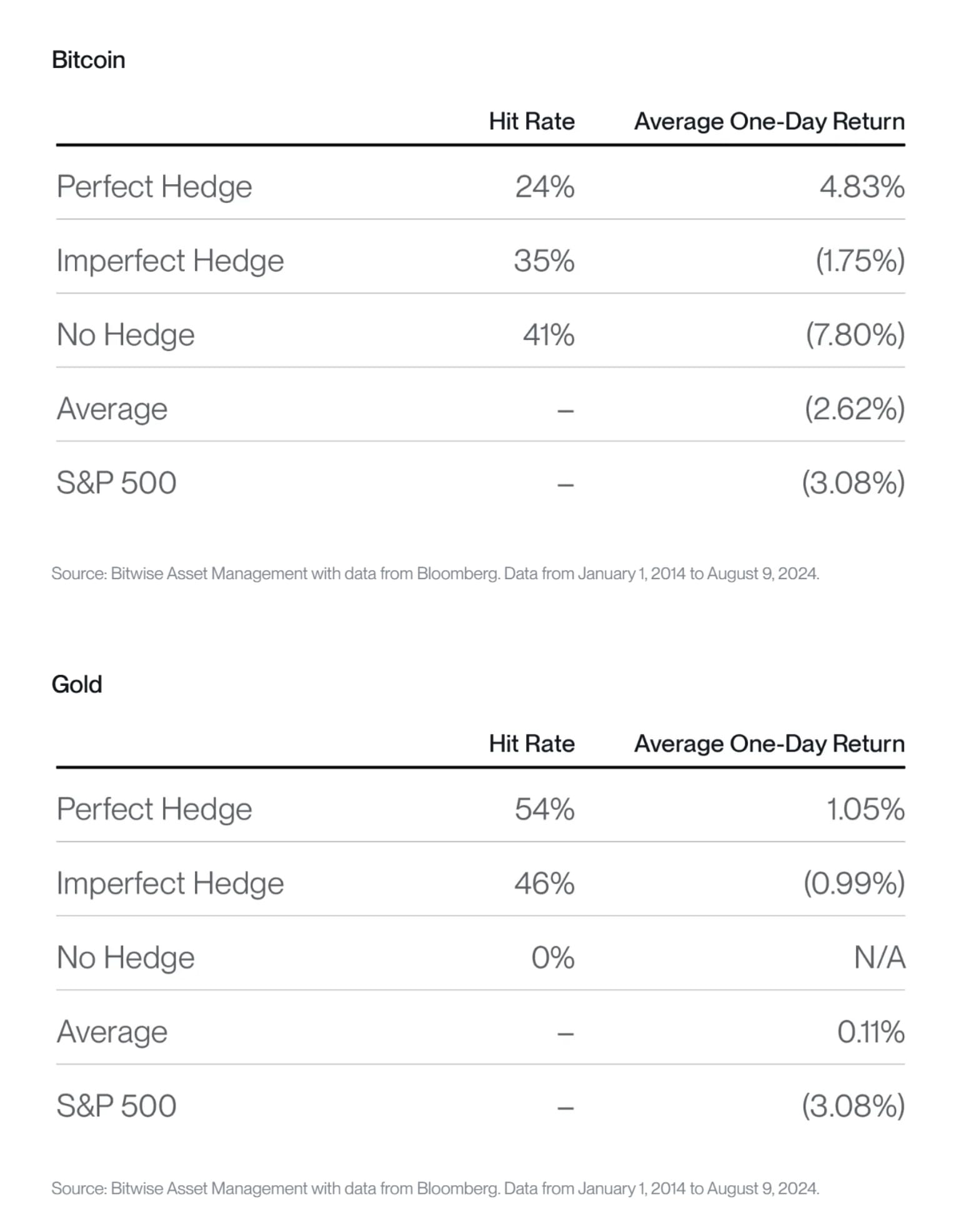
In other words, Bitcoin continues to be a “risky asset” in terms of market risks while gold can act as true downside hedge during adverse market conditions.

That being said, Bitcoin has recovered very strongly following historical US stock market corrections with an average performance of +189.6% after 1 year following larger stock market corrections. In contrast, gold has averaged only +7.9% after 1 year.
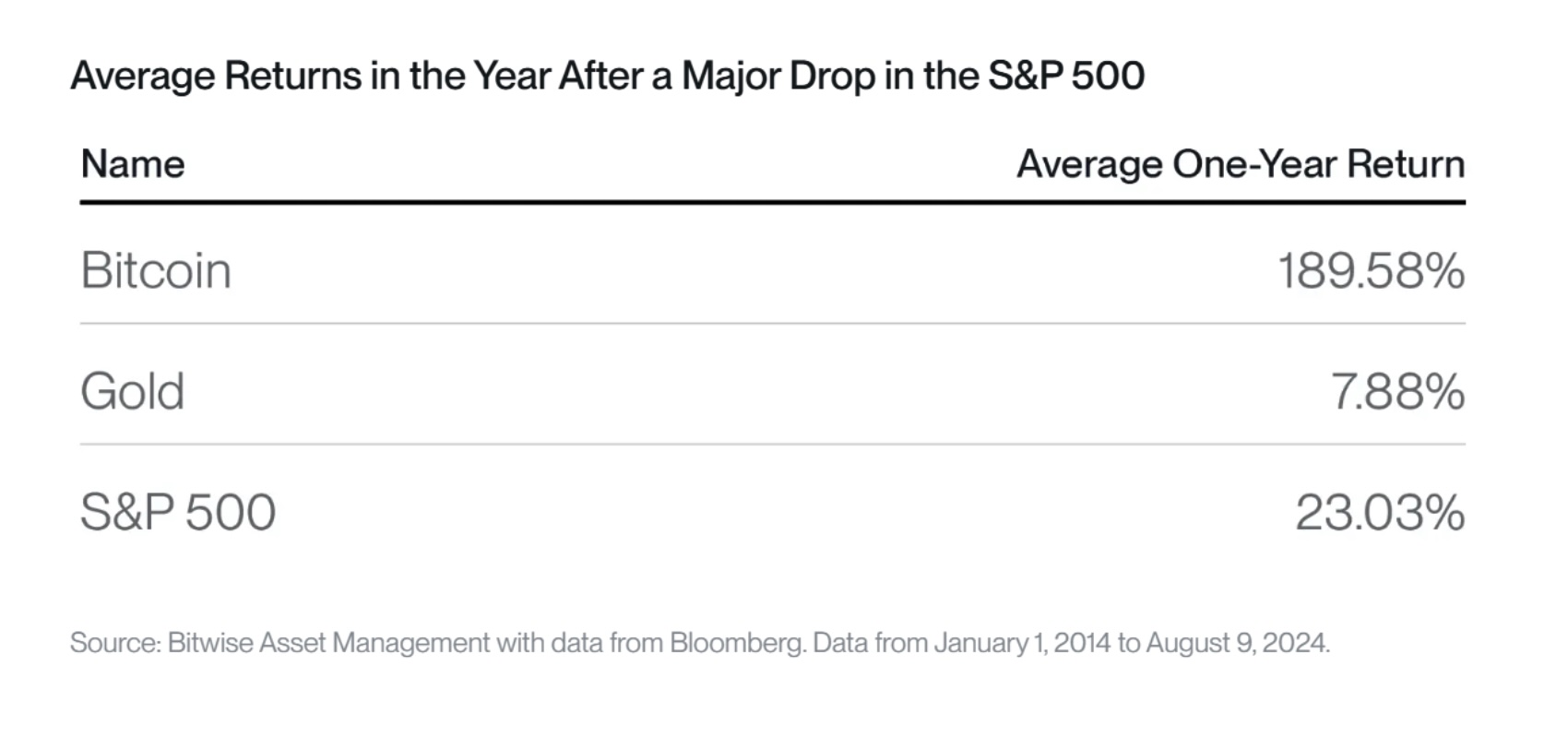
To put simply, Gold continues to be the better downside hedge but Bitcoin should be the preferred asset during recoveries.

Hence, a dynamic allocation strategy could be beneficial in this regard, both in the short-term (tactical allocations) and long-term (structural shifts from gold to Bitcoin).

That being said, there is an interesting diversification aspect about Bitcoin that is often disregarded in a broader portfolio context. Compared to gold, Bitcoin generally exhibits a significantly lower correlation to US Treasury bonds. This is both evident on a rolling basis and full-sample basis.

Rolling correlation: 10yr UST Future Rolling correlation: 10yr UST Future
Source: Bloomberg, Bitwise Europe
Cross Asset Correlation Matrix Cross Asset Correlation Matrix
Correlations of daily returns; Source: Bloomberg, Bitwise Europe
earliest data start: 2015-01-30; data as of 2025-02-28

In other words, while gold can offer a good hedge and diversification for the equity bucket within a multi-asset portfolio, Bitcoin offers more favourable diversification benefits for the bond bucket of the multi-asset portfolio.[1]

This is even more interesting in the context of Bitcoin representing a potential “portfolio insurance” against a sovereign default as outlined above.

However, there is a case to be made to own both assets within a portfolio. The bigger question is:

How to allocate between Bitcoin and Gold?

Common risk-budget strategies assign portfolio weights inversely to realized volatility, often using standard deviation as a key measure.

However, standard deviation fails to capture market directionality, meaning both rising and declining trends can have the same volatility despite differing investor perceptions.

The Ulcer Index, introduced by Martin Peter in 1987[2], measures drawdowns from previous highs, calculated as:

The Ulcer Index offers a clearer view of market trends. Though not academically recognized, it relates losses to recovery time, allowing for more dynamic and trend-sensitive portfolio construction compared to risk parity.

The Ulcer Index allows for a procyclical allocation over time. This allows for a dynamic allocation to both Bitcoin and Gold over time that mitigates tail risks but also allows investors to participate in strong trends.

Gold: 90d return vs Ulcer Index Gold: 90d return vs Ulcer Index
Source: Bloomberg, Diaman Partners, Bitwise Europe

The Ulcer Index is also applied in the risk-budgeting of the Damian Partner Bitcoin & Gold Index, effectively keeping realized volatility low while still capturing Bitcoin's high returns:

Hard assets like Bitcoin & Gold have significantly outperformed US equities
Performance: Bitcoin + Gold vs US equities
Source: Bloomberg, Bitwise Europe
A combined basket of Bitcoin & Gold can have relatively low volatility
Volatility: Bitcoin + Gold vs US equities
Source: Bloomberg, Bitwise Europe

That’s why an inclusion of Bitcoin and Gold can significantly boost risk-adjusted portfolio returns without jeopardizing the overall risk characteristics of the portfolio.

In fact, portfolio volatility and max drawdown remain almost unaffected by increasing allocations to our Bitcoin & Gold Index.

Multiasset Performance with Bitcoin & Gold (BTCG) Multiasset Performance with Bitcoin & Gold (BTCG)
Source: Bloomberg, Bitwise Europe; 60/40 = MSCI World/Bloomberg Global Aggregate; Quarterly rebalancing; Sharpe & Sortino Ratio was calculated with 3M USD Cash Index as assumed risk-free rate; TCG allocation is taken out of equity allocation of 60%, bond allocation remains at 40%; Past performance not indicative of future returns. BTCG = Damian Partners Bitcoin & Gold Index

[1] Besides, our quantitative analyses reveal that Bitcoin has also been a great hedge against gold drawdowns and vice versa which support the rationale of allocating to both assets in a portfolio.

[2] See Martin, P., & McCann, B. (1989). The investor's guide to Fidelity funds: Winning strategies for mutual fund investors. Wiley.

Bottom Line

  • Rising Sovereign Debt and Inflation Concerns: The U.S. has reached a record-high public debt of $36 trillion (123% of GDP), with debt growth accelerating post-2020. This, coupled with increasing fiscal deficits and geopolitical tensions, raises inflation risks and erodes trust in traditional financial systems. As a result, investors are seeking alternative stores of value such as Gold or Bitcoin, moving away from U.S. Treasuries.
  • Bitcoin vs. Gold as Store-of-Value Assets: Bitcoin is increasingly seen as a "digital gold" due to its absolute scarcity (21 million max supply) and superior transferability compared to physical gold. While gold remains the primary safe-haven asset, Bitcoin’s technological advantages and adoption trends suggest it could challenge gold’s status over the long term.
  • Diversification and Portfolio Hedging: Gold remains a strong hedge against market downturns, while Bitcoin is more volatile but offers higher returns during recoveries. Bitcoin also has a lower correlation with U.S. Treasuries, making it a valuable diversification tool, particularly as a hedge against sovereign defaults. A balanced allocation between Bitcoin and gold can optimize risk-adjusted returns.

Important Information

This publication constitutes a marketing communication and is provided for informational purposes only. It does not constitute investment advice, a personal recommendation, or an offer or solicitation to buy or sell any financial instrument.

This document (which may take the form of a presentation, press release, social media post, blog article, broadcast communication or similar instrument – collectively referred to as a “Document”) is issued by Bitwise Europe GmbH (“BEU” or the “Issuer”) and has been prepared in accordance with applicable laws and regulations, including those relating to financial promotions.

Bitwise Europe GmbH, incorporated under the laws of Germany, is the issuer of the Exchange Traded Products (“ETPs”) referenced in this Document under a base prospectus and the applicable final terms, as supplemented from time to time, approved by the German Federal Financial Supervisory Authority (BaFin). The approval of the prospectus by BaFin relates solely to the completeness, coherence and comprehensibility of the prospectus in accordance with the Prospectus Regulation and does not constitute an endorsement, recommendation or assessment of the merits of the products.

The market analyses, views and scenarios presented reflect the assessment as of the date of publication and are based on information considered reliable. However, no representation or warranty is made as to their accuracy or completeness. Forward-looking statements involve risks and uncertainties and are not guarantees of future performance. Past performance is not a reliable indicator of future results.

Capital at risk. Cryptoassets are highly volatile and involve a high degree of risk. The value of investments in cryptoassets and crypto-linked ETPs may fluctuate significantly, and investors may lose part or all of their invested capital. No capital protection or guaranteed compensation mechanism applies in respect of market losses.

Any investment decision should be made solely on the basis of the relevant base prospectus, the applicable final terms and the key information document, in particular the section entitled “Risk Warning”. The base prospectus, final terms and additional risk information are available at: www.bitwiseinvestments.eu

Access to certain documents may require self-certification regarding your jurisdiction and investor status and may be subject to additional disclaimers and important information.

For further details, please refer to the full disclaimer available at: www.bitwiseinvestments.eu/disclaimer

About Bitwise

Bitwise is one of the world’s leading crypto specialist asset managers. Thousands of financial advisors, family offices, and institutional investors across the globe have partnered with us to understand and access the opportunities in crypto. Since 2017, Bitwise has established a track record of excellence managing a broad suite of delta-one, index and active solutions across ETPs, ETFs, separately managed accounts, private funds, and hedge fund strategies, spanning both the U.S. and Europe.

Contact

General Inquiries europe@bitwiseinvestments.com
Institutional investors clients@bitwiseinvestments.com

Related articles you may like

Welcome to Bitwise

Select your location

Welcome to Bitwise

Confirm your location to help us deliver the site experience most relevant to you

Welcome to Bitwise

Confirm your location to help us deliver the site experience most relevant to you

Welcome to Bitwise

Confirm your location to help us deliver the site experience most relevant to you

  • English
  • Deutsch
  • Italiano
  • Français
  • Svenska
Country
  • English
  • Deutsch
  • Italiano
  • Français
  • Svenska
Country
Important Notice:
The distribution of the information and material on this website may be restricted by law in certain countries. None of the information is directed at, or is intended for distribution to, or use by, any person or entity in any jurisdiction (by virtue of nationality, place of residence, domicile or registered office) where publication, distribution or use of such information would be contrary to local law or regulation.
Important Notice:
You are about to access the Bitwise Asset Management website. Based on your location, clicking 'Proceed to US website' below will redirect you to the US-specific website.
Important Information – Please Read Before Proceeding

This website is operated by Bitwise Europe GmbH (“Bitwise”, “we”, “us”). The information on this website is intended for UK retail clients and other visitors in the United Kingdom. If you are not in the UK, local laws and rules may differ and the materials here may not be appropriate for you.

All content is provided for general information only. It does not constitute investment advice, tax or legal advice, an offer, or a solicitation to buy or sell any investment and must not be relied upon to make an investment decision. You should consider whether an investment is suitable for your circumstances and, where appropriate, seek independent professional advice.

Cryptoassets and crypto-linked products are high-risk. The FCA categorises retail crypto promotions as Restricted Mass Market Investments (RMMI). As such, additional prominence, risk-warning and risk-summary requirements apply to retail communications. You could lose all the money you invest.

Investments in cryptoassets or many crypto-linked products are generally not covered by the UK Financial Services Compensation Scheme (FSCS) or the Financial Ombudsman Service (FOS). You should not expect to be protected if something goes wrong.

Access to certain pages, features, or transactions may be subject to client categorisation and appropriateness assessments required by FCA rules. We may ask you to complete checks or declarations before you can proceed.

Where this website contains a retail financial promotion for crypto or other RMMIs, you will see the FCA-prescribed risk warning and a link (“Take 2 mins to learn more”) to the FCA risk summary presented in a pop-up or dedicated page. For convenience, you can access that summary here at any time.

Where performance is shown, past performance is not a reliable indicator of future results. Any projections, targets, or forward-looking statements are inherently uncertain and may not be realised. Fees and expenses reduce returns.

Returns may be reduced by fees, charges, spreads, and taxes. Tax treatment depends on individual circumstances and may change. Seek professional advice if unsure.

Where a prospectus (including any base or supplemental prospectus) or KID/PRIIPs KIID or equivalent is provided, it is regulatory disclosure, not marketing. Those documents are generally outside the UK financial-promotion restriction.

In line with FCA rules for high-risk investments, we do not offer incentives to invest (e.g., refer-a-friend bonuses, monetary/non-monetary perks) in relation to retail crypto promotions.

External links are provided for convenience only. We do not control and are not responsible for third-party websites or their content. We take reasonable care to ensure accuracy but do not guarantee completeness, timeliness, or availability of the website or its contents; information may change without notice.

Our products or services may not be available in all jurisdictions or to all investors. Access may be restricted by law. You are responsible for understanding and complying with applicable laws and regulations.

For queries or complaints, contact: clients@bitwiseinvestments.com | Additional contact and legal information is available in our Terms of Website Use and Privacy Notice.

Copyright & trademarks © 2025 Bitwise. All rights reserved. Product names, logos and brands are property of their respective owners

Avis Important

Les produits d’investissement domiciliés en Europe et présentés sur ce site sont des Exchange Traded Commodities (« ETC »), instruments financiers considérés comme des titres de créances complexes par l'Autorité des Marchés Financiers, présentant des risques difficilement compréhensibles par le grand public. À ce titre, leur distribution en France répond à des règles spécifiques. Il relève de la responsabilité des intermédiaires et investisseurs professionnels souhaitant offrir des ETCs à leurs clients de s'assurer que leur distribution auxdits clients est réalisée dans le respect de la réglementation française.

Important Information

The information provided in this advertising material is for informative purposes only and does not constitute investment advice, a recommendation or solicitation to conclude a transaction.

This website and all documentation and other information provided on or via it (all together this “website”) is issued by Bitwise Europe GmbH (“BEU” or the “Issuer”). This website is provided for illustrative, educational and information purposes only and may be subject to change.

Where this website constitutes an advertisement within the meaning of Article 22 of Regulation (EU) 2017/1129, as amended (the “Prospectus Regulation”) or Regulation 3 of the Public Offers and Admissions to Trading Regulations 2024, and the relevant offer or admission to trading is subject to an obligation to draw up a prospectus, the applicable prospectus has been or will be published and is or will be available in the Resources section of the Bitwise Europe website at bitwiseinvestments.eu/resources/.

Bitwise Europe GmbH, Thurn- und Taxis-Platz 6, 60313 Frankfurt am Main, Germany, registered with the commercial register of the local court of Frankfurt am Main under HRB 116604, is the issuer of Exchange Traded Products (“ETPs”) described in this website under an applicable base prospectus approved by BaFin, or, where applicable, another competent authority, as supplemented from time to time, and the applicable final terms. Final terms are published and filed with the relevant competent authority in accordance with applicable law and are not subject to approval. The relevant product documentation identifies the competent authority that approved the applicable prospectus.

Approval of a prospectus means that the competent authority has scrutinised it against the applicable standards of completeness, comprehensibility and consistency, and it does not constitute an endorsement or recommendation of the Issuer or the ETPs. If you are considering investing in products issued by BEU you should check with your broker or bank that such products are available in your jurisdiction and suitable for your investment profile. A decision to invest any amount in an ETP offered by BEU should take into consideration your specific circumstances after seeking independent investment, tax and legal advice.

You should read the relevant base prospectus, any supplements and the applicable final terms before investing and, in particular, the section entitled “Risk Factors” for further details of the risks associated with an investment. Where required, you should also read the key information document under Regulation (EU) No 1286/2014 (PRIIPs), the product summary under the Consumer Composite Investments (Designated Activities) Regulations 2024 or the equivalent product disclosure applicable in your jurisdiction. The prospectuses, supplements, final terms, key information documents and other regulatory documents relevant to BEU’s ETPs are available electronically and free of charge in the “Resources” section of the Bitwise Europe website at bitwiseinvestments.eu/resources/.

Access to those documents is not conditional on completion of a registration process, on any country or investor-type selection, on acceptance of the Terms of Website Use or of any disclaimer limiting legal liability, or on payment of a fee, in accordance with Article 21(4) of the Prospectus Regulation or the FCA Handbook, Prospectus Rules. Warnings specifying the jurisdictions in which an offer or an admission to trading is being made may be displayed in connection with certain content and are not disclaimers limiting legal liability.

Any country or investor-type selection used on this website determines which marketing content may be displayed. It does not itself constitute a formal regulatory client classification, an assessment of appropriateness or suitability, confirmation of legal eligibility to invest, or investment advice.

If You Are in the UK, US, or Canada

Information contained in this website does not constitute, and under no circumstances is to be construed as, an offer to sell or a solicitation of an offer to buy securities, or any other step in furtherance of a public offering, in the United States or Canada, or any state, province or territory thereof, where neither the Issuer nor its products are authorised or registered for distribution or sale and where no prospectus of the Issuer has been filed with any securities regulator. Neither this website nor information in it should be taken, transmitted or distributed (directly or indirectly) into the United States.

In the UK, this website is provided for information purposes only, and is in any event provided in accordance with the exemption to the requirement, set out under section 21 of the Financial Services and Markets Act 2000, that communications relating to invitations or inducements to engage in investment activity be approved by a person authorized by the Financial Conduct Authority. As such, this website is directed only at persons who fall within a relevant exemption to the restriction on financial promotions as set out in the Financial Services and Markets Act 2000 (Financial Promotion) Order 2005, such as: investment professionals (Article 19); high net worth individuals (being individuals who have an annual income of at least £100,000 and / or net assets of at least £250,000) (Article 48); high net worth companies, unincorporated associations etc. (Article 49); sophisticated investors (being individuals with a current appropriate certificate stating that they are sufficiently knowledgeable to understand the risks associated with this investment) (Article 50); self-certified sophisticated investors (being individuals who have: worked in the past two years in a professional capacity in the private equity sector or in the provision of finance for small and medium enterprises; been a director of a company turning over at least £1 million annually in the last two years; made two or more investments in an unlisted company in the last two years; or been a member of a network or syndicate of business angels for more than six months) (Article 50A); and associations of high net worth or sophisticated investors (Article 51).

Persons who do not fall within a relevant exemption should not access, or otherwise rely or act on this website, rather they should instead proceed to the Private Investor version of the website. By accessing this website, you confirm that you fall within a relevant exemption.  Neither the Issuer nor its products are authorised or regulated by the UK Financial Conduct Authority, and the content of this promotion has not been approved by an authorised person within the meaning of the Financial Services and Markets Act 2000. Reliance on this promotion for the purpose of engaging in any investment activity may expose an individual to a significant risk of losing all of the property or other assets invested. For further information or any other enquiry regarding the matters to which this website relates, you may contact us at eu-legal@bitwiseinvestments.com.

Publications & Social Media Disclosure

Social media communications, including posts on LinkedIn and X, (all together “Social Media”) may constitute advertisements, financial promotions, investment recommendations within the meaning of Regulation (EU) No 596/2014, the Financial Services and Markets Act 2000 or other regulated communications depending on their content and the jurisdiction in which they are communicated. Unless expressly stated otherwise, they are not intended to constitute investment advice or a personal recommendation.

BEU makes all reasonable efforts to ensure that the information contained in documents and on Social Media is accurate and reliable; however, errors may occur. To the extent permitted by applicable law, documents and materials available on Social Media are provided without any express or implied warranties as to accuracy, validity, timeliness or completeness. Nothing in this paragraph excludes or limits any statutory or regulatory responsibility or liability that cannot lawfully be excluded or limited, including obligations applicable to advertisements or financial promotions and liability relating to a prospectus or other regulatory disclosure.

Unless expressly endorsed or adopted by Bitwise Europe, comments expressed by members of the online community represent those persons’ own views and are not endorsed by Bitwise Europe.

Risks of ETPs & Cryptocurrencies

An investment in an ETP backed by one or more cryptocurrencies, such as those issued by BEU, is dependent on the performance of the underlying cryptocurrency, less costs, but it is not expected to match the performance of the underlying asset precisely. Investing in ETPs also involves numerous risks including general market risks relating to underlying, adverse price movements, currency, liquidity, operational, legal and regulatory risks and investors should be prepared to lose some or all of the amount invested.

ETPs backed by cryptocurrencies are highly volatile assets and performance is unpredictable. Past performance is not a reliable indicator of future performance. The market price of ETPs will vary and they do not offer a fixed income. The value of any ETP may be affected by exchange rates and the price movement of its underlying cryptocurrency(ies). This website may contain forward looking statements including statements regarding Bitwise Europe’s belief or current expectations with regards to the performance of certain asset classes. Forward looking statements are subject to certain risks, uncertainties and assumptions, and there can be no assurance that such statements will be accurate and actual results could differ materially from those indicated. You must not place reliance on forward-looking statements or any other similar information contained in this website.

Cryptocurrencies are highly volatile and are known for their extreme and rapid fluctuations in prices. While there may be potential for significant gains, you are at risk of losing part or all of your entire capital invested. The price of cryptocurrencies can fluctuate widely and, for example, may be impacted by global and regional political, economic or financial events, regulatory events or statements by regulators, investment trading, hedging or other activities by a wide range of market participants, forks in underlying protocols, disruptions to the infrastructure or means by which crypto assets are produced, distributed, stored and traded. Characteristics of cryptocurrencies and divergence of applicable regulatory standards create the potential for market abuse. The price of cryptocurrencies may also change due to shifting investor confidence in future outlook of the asset class.

For a detailed overview of risks associated with cryptocurrencies and specifically associated with BEU’s products, please refer to the prospectus and final terms, which are available in the “Resources” section of the Bitwise Europe website at bitwiseinvestments.eu/resources/. You should only invest if you are capable of understanding and evaluating the risks involved. If you are in doubt as to whether an investment is appropriate for you, you should consult an authorised person who specialises in advising on investments including crypto-backed ETPs.

Avis Important

Les produits présentés sur ce site internet ne sont ni destinés à être distribués, ni accessibles aux investisseurs non-professionnels résidant en France. Toute information figurant sur ce site est fournie à titre informatif uniquement. Pour toute information complémentaire, veuillez contacter votre conseiller financier ou votre intermédiaire habituel.