- Performance: Crypto markets remained under pressure last week due to escalating geopolitical tensions in the Middle East, culminating in US and Israeli strikes against Iran over the weekend. Bitcoin briefly recovered above $69k, supported by the strongest net inflows into global Bitcoin ETPs since early January, but prices weakened again as risk sentiment deteriorated. Cryptoassets often face short-term selling during geopolitical shocks - especially over weekends when traditional markets are closed and crypto remains tradable.
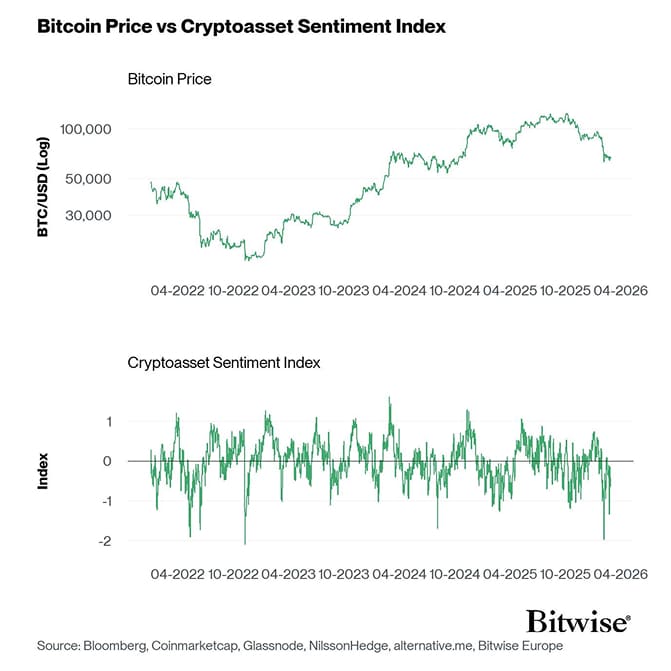
- Cryptoasset Sentiment Index: Market sentiment remained slightly bearish last week, reflecting ongoing geopolitical uncertainty and Bitcoin’s continued decoupling from the upward trend in global money supply. Despite macro conditions that could become supportive - such as reflationary pressures from rising energy and commodity prices - investor positioning has not yet fully shifted to a bullish stance.
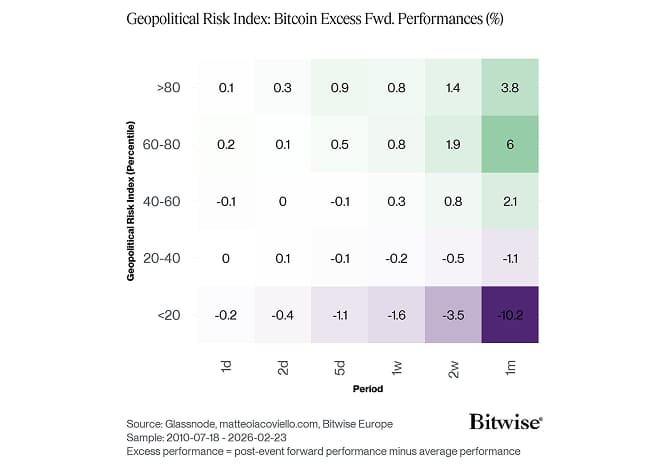
- Chart-of-the-week: Historical analysis using the Geopolitical Risk Index shows that when geopolitical risks reach the top 20% of observations, Bitcoin tends to experience short-term weakness but above-average performance over the following month. As geopolitical risks typically mean-revert, the macro response - higher fiscal spending and monetary expansion - has historically created a positively skewed medium-term risk-reward profile for Bitcoin after major geopolitical shocks.
Chart of the Week
Geopolitical Risk Index: Bitcoin Excess Fwd. Performances (%)
 Source: Glassnode, matteoiacoviello.com, Bitwise Europe
Sample: 2010-07-18-2026-02-23
Excess performance = post-event forward performance minus average performance
Performance
Last week, crypto markets continued to be under pressure due to elevated geopolitical risks in the Middle East. Bitcoin came under renewed pressure over the weekend when the US and Israel started military strikes against Iran on Saturday.
Before these strikes, global bitcoin ETPs experienced their strongest net inflows since early January in a sign of returning risk appetite when bitcoin traded slightly above $69k again.
In general, it is quite typical for cryptoassets to come under pressure amid rising geopolitical risks especially over a weekend as cryptoassets remain one of the few assets that investors can sell (and buy) over the weekend when traditional financial markets are closed.
That being said, elevated geopolitical risks were historically associated with positive above-average performances for bitcoin over the following months (Chart-of-the-week).
The table shown above divides the Geopolitical Risk Index into percentile buckets and analyses bitcoin's (excess) performance after a certain value of the Geopolitical Risk Index has been observed. For instance, The >80 bucket represents the top 20% of the highest levels of geopolitical risks based on the Geopolitical Risk Index.
Although bitcoin tends to trade lower in the short-term, geopolitical risks usually tend to mean-revert and decline to lower levels, which tends to provide a renewed tailwind over the medium- to long term. This historical pattern has shown that the risk-reward has been positively skewed to the upside after major geopolitical risk events, although downside risks may remain in the short-term. There is no guarantee this pattern will repeat.
One hypothesis for this performance pattern is that armed conflicts tend to increase fiscal expenditures significantly, which may support bitcoin as a hedge against the resulting fiscal expenditures and monetary inflation.
Geopolitical risks are already being priced into commodity prices such as energy markets. Tokenized oil prices that track both WTI and Brent are reported to be trading close to 80 USD/Bbl over the weekend – implying almost a 10% mark-up on Friday closing prices. These tokenized markets may have limited liquidity, and pricing may not be representative of broader oil market conditions. A structural increase in energy prices could also add to the inflation pressures as other commodity prices such as precious and industrial metals have already repriced sharply higher.
Our thesis remains that this is largely driven by a renewed Chinese monetary expansion but the increase in geopolitical risks is adding an additional factor – more details will be provided in our latest Bitcoin Macro Investor report which will be published today as well.
If past reflation cycles are any guide, this may provide a potential macro tailwind for bitcoin and other major cryptoassets for the remainder of 2026. , though past patterns are not reliable indicators of future outcomes.
However, bitcoin's relationship to global money supply still needs to reassert itself as bitcoin continues to be somewhat decoupled from the recent trajectory of global money supply – which continues to make new all-time highs almost every day.
One hypothesis to resolve this is that the resolution of perceived quantum computing concerns, relating to the theoretical future capability of quantum computers to compromise Bitcoin's cryptographic security, could potentially contribute to renewed correlation with global money supply.
Apart from that, AI fears have somewhat dissipated as recent high-frequency indicators for US software job postings show that there is no significant deceleration in US software sector hirings. To the contrary, job postings data compiled by Indeed imply a renewed acceleration in US sector software hiring.
This week, market attention may turn to major economic releases such as the ISM Manufacturing Index release for February 2026. Regional purchase manager surveys have mostly surprised to the upside in February, which may suggest another positive surprise for the ISM Manufacturing Index.
In general, among the top 10 crypto assets TRON, Bitcoin Cash, and BNB were the relative outperformers.
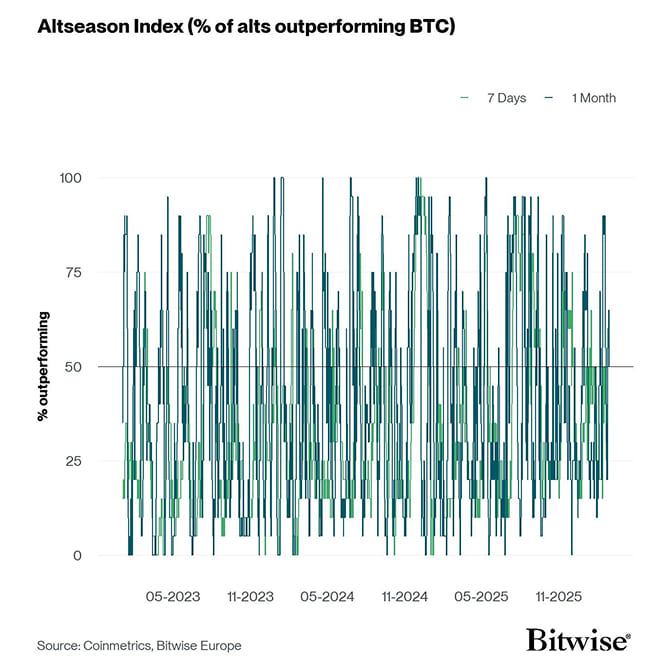
Overall, altcoin outperformance vis-à-vis bitcoin has increased somewhat last week, with 65% of our tracked altcoins managing to outperform bitcoin on a weekly basis. Ethereum also managed to outperform bitcoin last week.
Sentiment
Our in-house “Cryptoasset Sentiment Index” is currently signalling a negative sentiment that has improved week over week but slightly worsened in the latter half of the week, which may be partially attributable to market reaction to the Iran bombings.
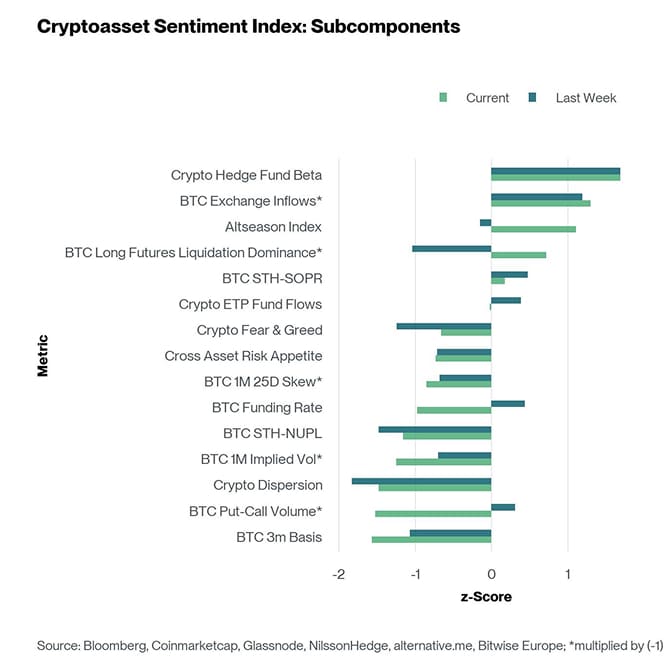
At the moment, 5 out of 15 indicators are above their short-term trend.
Last week, only the BTC Hedge Fund Beta, Altseason Index, BTC Exchange Inflows, BTC STH SOPR, and BTC Long Futures Liquidation Dominance showed positive momentum.
The Crypto Fear & Greed Index continues to signal an “extreme fear” level of sentiment as of this morning but has bounced after posting its second and third (5/100) lowest readings ever, within February alone.
Performance dispersion among cryptoassets increased slightly last week from 0.15 to 0.16. When dispersion is low, it may indicate that the market appears to be driven by a less diverse set of narratives which, in our analysis, has historically been associated with periods of decreasing risk appetite in prior market cycles.
Altcoin outperformance vis-à-vis Bitcoin increased significantly last week, with 65% of our tracked altcoins in the index. This may be partially explained by the slight bounce in sentiment and performance dispersion.
In general, increasing altcoin outperformance may be a sign of increasing risk appetite within cryptoasset markets.
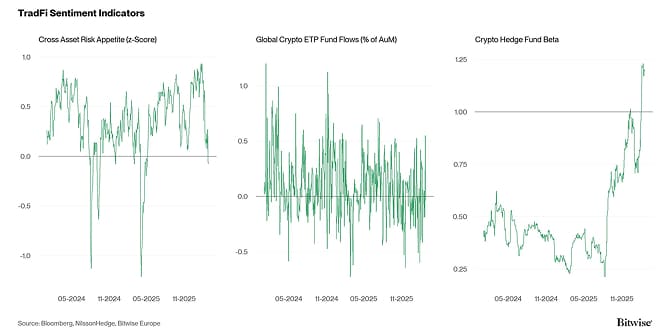
Sentiment in traditional financial markets as measured by our in-house measure of Cross Asset Risk Appetite (CARA) decreased to -0.07. This decline in traditional finance (TradFi) sentiment may have contributed to suppressed crypto sentiment last week and may have limited the potential for a rebound in narrative or sentiment.
Fund Flows
Global crypto ETPs saw relatively large total net inflows last week across all Bitcoin, Ethereum, Altcoins Ex-Ethereum, and basket and thematic products.
Global crypto ETPs saw around +1039.6 mn USD in weekly net inflows across all types of cryptoassets, after –390.8 mn USD in net outflows the previous week.
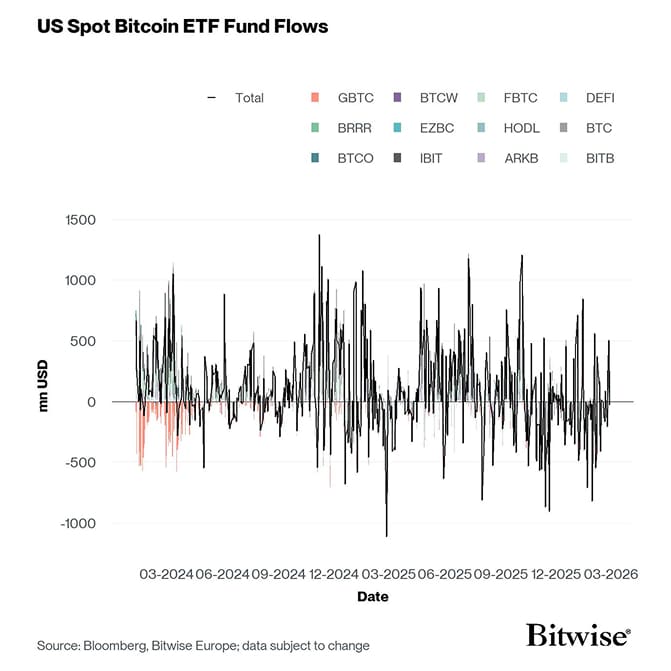
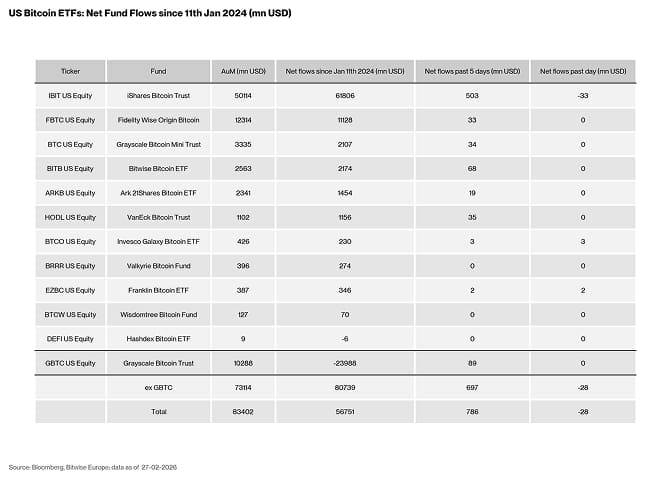
Global Bitcoin ETPs have experienced net inflows totalling +881.4 mn USD last week, of which +787.3 mn USD in net inflows were related to US spot Bitcoin ETFs.
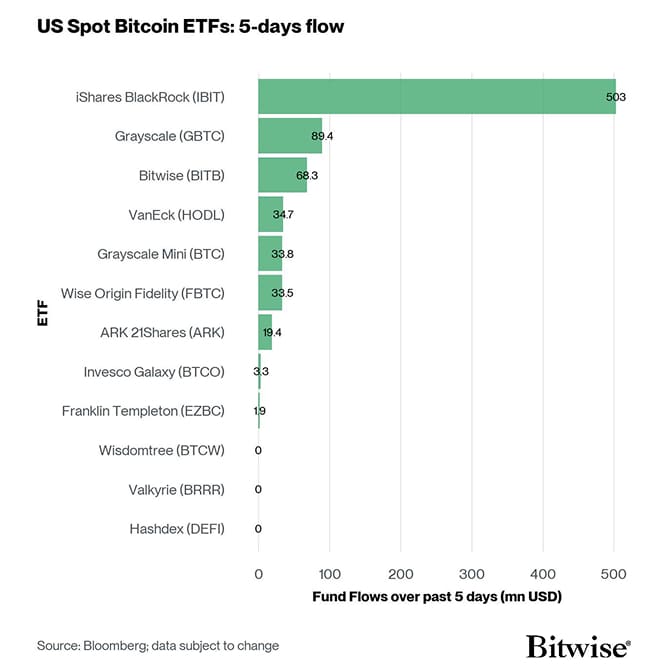
The Bitwise Bitcoin ETF (BITB) in the US experienced net inflows, totalling +68.3 mn USD last week.
In Europe, the Bitwise Physical Bitcoin ETP (BTCE) experienced net inflows equivalent to +0.5 mn USD, whereas the Bitwise Core Bitcoin ETP (BTC1) experienced net inflows of +1.4 mn USD.
The Grayscale Bitcoin Trust (GBTC) posted net inflows of +89.4 mn USD and the iShares Bitcoin Trust (IBIT) experienced net inflows of around +503 mn USD last week.
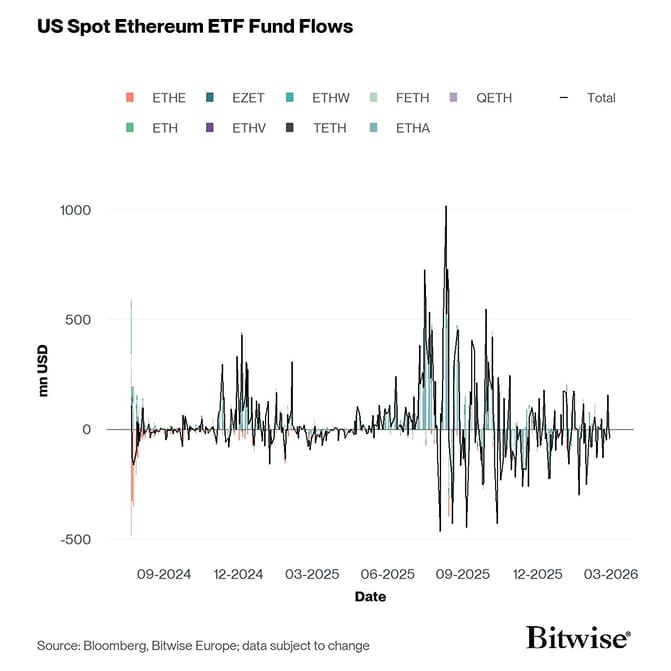
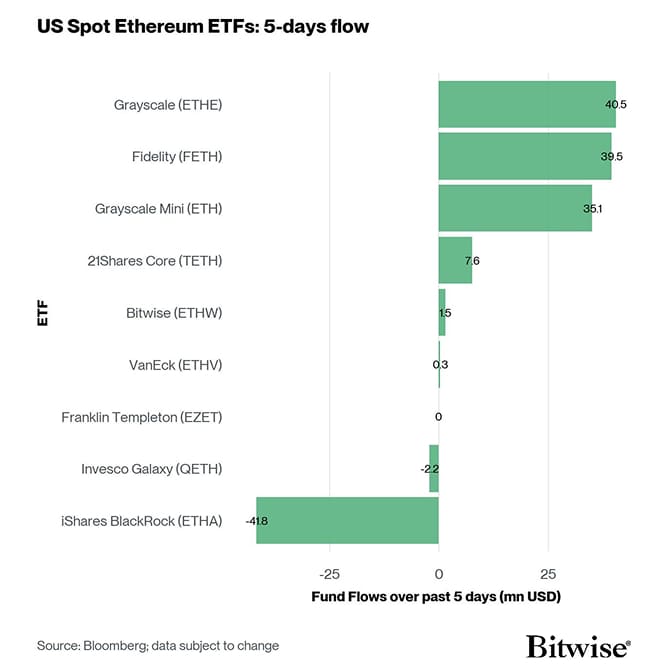
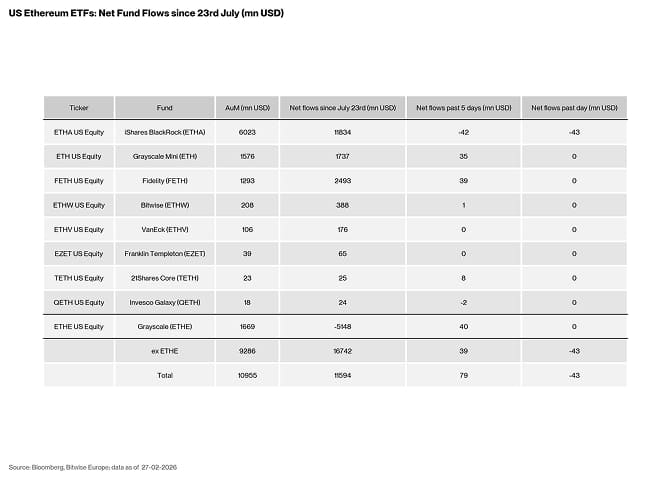
Meanwhile, global Ethereum ETPs also experienced +113.9 mn USD in net inflows last week, of which US spot Ethereum ETFs recorded net inflows of around +80.5 mn USD on aggregate.
The Grayscale Ethereum Trust (ETHE) posted net inflows of +40.5 mn USD, alongside the iShares Ethereum Trust (ETHA) that experienced -41.5 mn USD of net outflows.
The Bitwise Ethereum ETF (ETHW) in the US has posted net inflows of +1.5 mn USD.
In Europe, the Bitwise Physical Ethereum ETP (ZETH) saw minor net inflows of +0.5 mn USD, as the Bitwise Ethereum Staking ETP (ET32) saw +1.8 mn USD of net inflows.
Altcoin ETPs ex Ethereum experienced net inflows of +41.3 mn USD last week.
Thematic & basket crypto ETPs posted net inflows of +3 mn USD on aggregate last week. The Bitwise MSCI Digital Assets Select 20 ETP (DA20) experienced net inflows last week of +0.4 mn USD on aggregate.
On-Chain Data
Bitcoin remains rangebound, printing a weekly high of $69.4k before selling off to $63.3k amid the onset of the US–Iran engagement. Following the mission's conclusion, price rebounded to $67.7k, capping a notably volatile period. Despite these swings, net displacement remains modest, with structure still lateral.
The $63k region continues to act as a key pivot. Both recent corrective moves have tested and held this level, while the Feb 05 capitulation event marked only a brief deviation below. A sustained loss of $63k would materially weaken the current range structure and bring cycle lows back into consideration.
Exchange-side sell pressure continued to ease despite the geopolitical shock. Intraday spot buy–sell imbalance closed near –$617mn (vs –$1.1bn prior), while aggregate exchange inflows and outflows softened to $3.7bn on the week. This ranks among the lowest activity regimes since the post–Trump tariff overhang, signalling subdued participation and a broadly defensive investor posture amid elevated macro uncertainty.
Aggregate investor stress remains elevated and largely unchanged. The share of invested capital held at a loss is estimated at ~$854bn (~78% of Realised Cap), with unrealised losses across underwater supply near –$251bn. These conditions continue to reflect a fragile market structure, where a substantial cohort of investors remains under financial pressure.
Profit and loss realisation continues to trend toward equilibrium, with net realised loss contracting to –$327mn. This moderation is notable given persistently high investor stress, indicating the magnitude of loss-taking is diminishing. The divergence suggests participants are acclimatising to the prevailing range, with fewer investors capitulating at current levels despite sustained unrealised drawdowns. This shift implies the market may require a local move to either side to unlock sidelined liquidity and re-engage activity.
On a macro timescale, a substantial share of volatility appears to have been expended during the recent contraction phase. One-month realised volatility has expanded to levels seen around the initial $70k ATH, the Trump-tariff shock, and the yen-carry unwind. Each episode preceded extended consolidation as markets transitioned into absorption and re-accumulation.
The recurrence of similar volatility conditions today suggests that sideways conditions appear most consistent with current volatility regimes, absent a fresh exogenous catalyst capable of re-expanding volatility.
Turning to key on-chain price levels, the dominant macro range continues to be bounded by the Realised Price at $54k and the True Market Mean at $79k. The $79k region remains particularly notable, having served as structural support throughout the initial Nov-2025 contraction before ultimately failing during the Feb-05 drawdown.
Within this broader structure, the $70k region continues to act as a formidable overhead barrier, with multiple recent attempts failing to secure acceptance above. This level effectively serves as the local point of control for the current range, with sustained positioning relative to $70k offering a clear read on near-term bullish versus bearish market conditions.
Overall, the market remains confined to a broad on-chain range between the Realised Price at $54k and the True Market Mean at $79k. Investor stress is still elevated, with substantial unrealised losses weighing on sentiment, yet realised loss-taking continues to diminish, suggesting liquidity within the range is becoming exhausted as participants acclimatise to current levels. This combination appears to reflect a fragile but defensive regime, where active sell pressure is waning even as latent stress persists, leaving the market sensitive to exogenous macro or geopolitical catalysts in either direction as uncertainty remains elevated.
Futures, Options & Perpetuals
Over the past week, BTC perpetual futures open interest declined by approximately –16.2k BTC, while CME futures open interest fell by –12.2k BTC, signalling a notable contraction in institutional positioning. In parallel, aggregate futures liquidations across all assets remained broadly stable at $1.07bn over the week (vs. $1.01bn prior). This may suggest leverage clearing within the prevailing range regime, with choppy, range-bound price action contributing to position unwinds.
From a positioning perspective, significant open interest clusters are forming around $70k–$71k, reinforcing the role of the $70k region as the midpoint and control level of the prevailing range. Additional open interest is also building near $62.5k, highlighting the growing prominence of the $63k level as an initial support zone.
Perpetual funding rates (7-day moving average) have declined week-on-week yet remain positive, indicating a marginal but still-persistent long bias among futures traders. A historically constructive signal has been a sustained shift into negative funding, reflecting a deeper leverage reset and reduced long crowding.
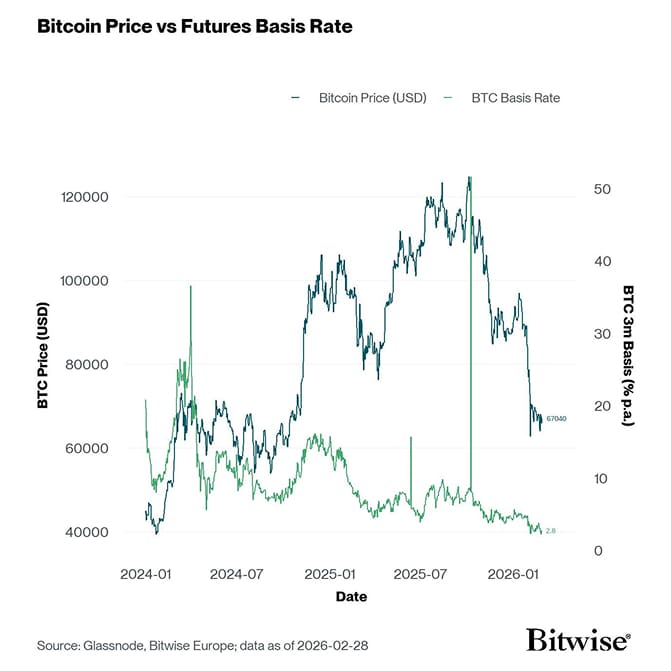
In parallel, the BTC 3-month annualised basis remains depressed and has continued to compress, declining from 3.4% to 2.7%. At present, basis remains well below prevailing US Treasury bill yields, highlighting risk-averse sentiment and subdued demand for leveraged long exposure among market participants.
Turning to options markets, BTC options open interest declined by approximately –53.1k BTC into the monthly expiry, bringing total open interest to 424k BTC. Concurrently, the Deribit put-to-call open interest ratio rose to 0.81, its highest level since May 2021. The equivalent measure across IBIT options reached an all-time high of 0.71 before moderating slightly to 0.68 by week's end. Taken together, these dynamics indicate accelerating demand for downside protection into rising geopolitical uncertainty, with both Deribit and IBIT put–call ratios remaining at elevated levels.
The 25-delta skew remained broadly unchanged over the week yet continues to sit at elevated levels. This indicates persistent demand for downside protection across both short- and medium-dated maturities as the market remains confined within a narrow range.
Aggregate put and call premiums, both paid and received, surged to around $91mn, up from $38mn the prior week. This level rivals major cycle inflection points, including the $70k, $100k and $126k ATH breakouts, as well as stress episodes such as the Trump-tariff shock, yen-carry unwind, and the $80k and $60k drawdowns. Put premium accounted for nearly 66% of total premium flow, underscoring a substantial increase in demand for downside protection.
Options dealer gamma positioning remains predominantly negative across the $54k–$78k range, broadly mirroring the macro trading range of $54k–$79k. This implies dealer hedging flows across this zone may amplify directional price moves, increasing local volatility. The most pronounced negative gamma nodes persist around $60k–$62k and near $75k, representing price levels where hedging sensitivity is greatest.
Notably, substantial positive gamma concentrations emerge across $80k–$90k, reinforcing the importance of the $80k region as a key reclaim threshold for risk-on momentum. These positive gamma nodes represent zones where dealer hedging flows act counter to price direction, selling into rallies and buying into dips, thereby dampening volatility and reinforcing resistance around this region.
In parallel, total GEX (7-day moving average) has increased from $3.9bn to $4.9bn. At present, only 114 of 2,184 trading days (5.2%) have recorded a more deeply negative total GEX, highlighting the extremity of current short-gamma conditions. Such deeply negative aggregate gamma indicates dealers are structurally short convexity, a configuration that has historically coincided with amplified price swings and volatility clustering.
Bottom Line
- Performance: Crypto markets remained under pressure last week due to escalating geopolitical tensions in the Middle East, culminating in US and Israeli strikes against Iran over the weekend. Bitcoin briefly recovered above $69k, supported by the strongest net inflows into global Bitcoin ETPs since early January, but prices weakened again as risk sentiment deteriorated. Cryptoassets often face short-term selling during geopolitical shocks - especially over weekends when traditional markets are closed and crypto remains tradable.
- Cryptoasset Sentiment Index: Market sentiment remained slightly bearish last week, reflecting ongoing geopolitical uncertainty and Bitcoin’s continued decoupling from the upward trend in global money supply. Despite macro conditions that could become supportive - such as reflationary pressures from rising energy and commodity prices - investor positioning has not yet fully shifted to a bullish stance.
- Chart-of-the-week: Historical analysis using the Geopolitical Risk Index shows that when geopolitical risks reach the top 20% of observations, Bitcoin tends to experience short-term weakness but above-average performance over the following month. As geopolitical risks typically mean-revert, the macro response - higher fiscal spending and monetary expansion - has historically created a positively skewed medium-term risk-reward profile for Bitcoin after major geopolitical shocks.
Appendix
Bitcoin Price vs Cryptoasset Sentiment Index
 Source: Bloomberg, Coinmarketcap, Glassnode, NilssonHedge, alternative.me, Bitwise Europe
Cryptoasset Sentiment Index: Subcomponents
Source: Bloomberg, Coinmarketcap, Glassnode, NilssonHedge, alternative.me, Bitwise Europe
Cryptoasset Sentiment Index: Subcomponents
 Source: Bloomberg, Coinmarketcap, Glassnode, NilssonHedge, alternative.me, Bitwise Europe; *multiplied by (-1)
TradFi Sentiment Indicators
Source: Bloomberg, Coinmarketcap, Glassnode, NilssonHedge, alternative.me, Bitwise Europe; *multiplied by (-1)
TradFi Sentiment Indicators
 Source: Bloomberg, NilssonHedge, Bitwise Europe
Crypto Sentiment Indicators
Source: Bloomberg, NilssonHedge, Bitwise Europe
Crypto Sentiment Indicators
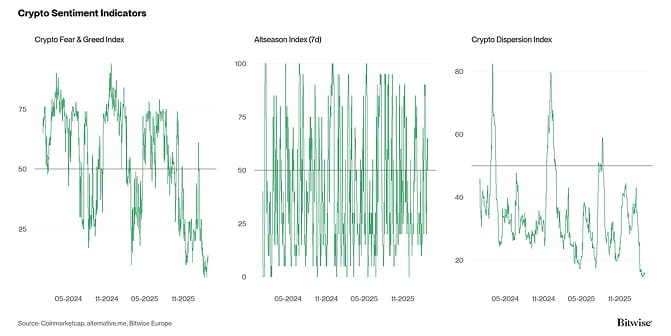 Source: Coinmarketcap, alternative.me, Bitwise Europe
Crypto Options' Sentiment Indicators
Source: Coinmarketcap, alternative.me, Bitwise Europe
Crypto Options' Sentiment Indicators
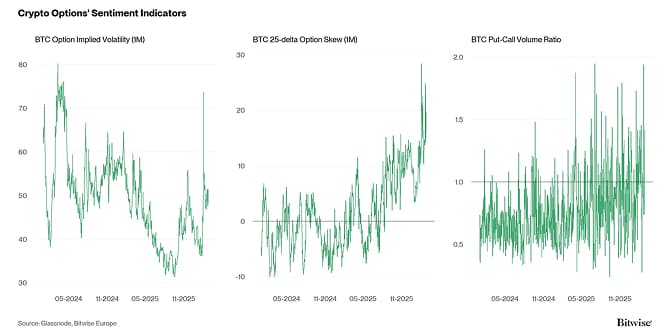 Source: Glassnode, Bitwise Europe
Crypto Futures & Perpetuals' Sentiment Indicators
Source: Glassnode, Bitwise Europe
Crypto Futures & Perpetuals' Sentiment Indicators
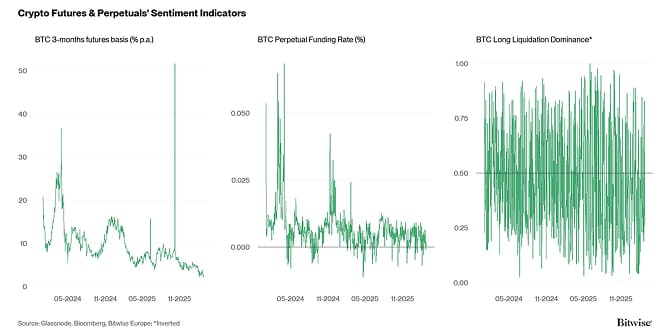 Source: Glassnode, Bitwise Europe; *Inverted
Crypto On-Chain Indicators
Source: Glassnode, Bitwise Europe; *Inverted
Crypto On-Chain Indicators
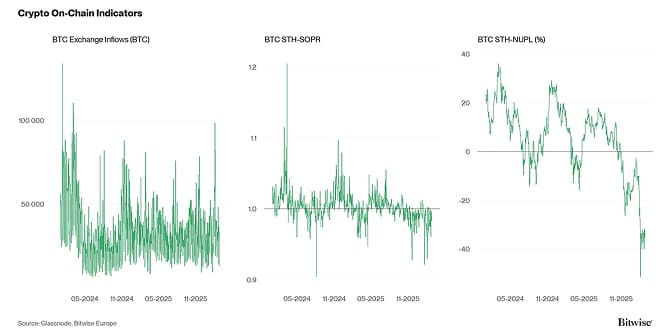 Source: Glassnode, Bitwise Europe
Bitcoin vs Crypto Fear & Greed Index
Source: Glassnode, Bitwise Europe
Bitcoin vs Crypto Fear & Greed Index
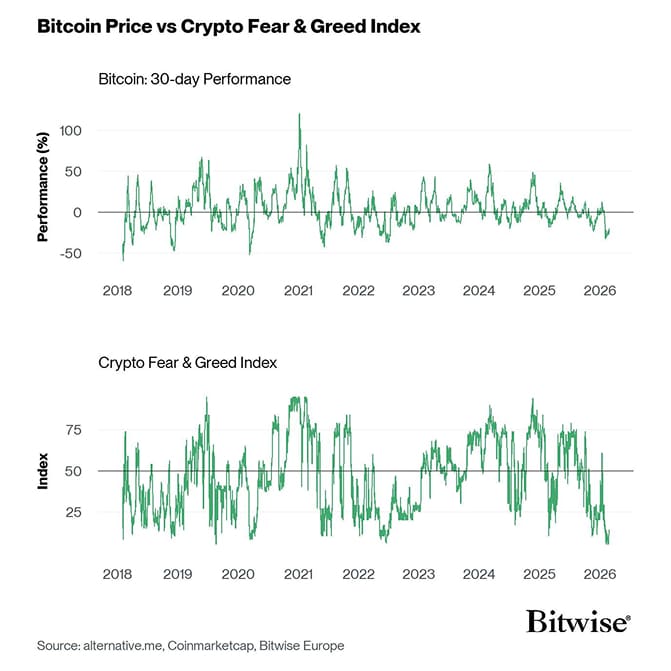 Source: alternative.me, Coinmarketcap, Bitwise Europe
Cryptoasset Sentiment Index: Daily vs Hourly
Source: alternative.me, Coinmarketcap, Bitwise Europe
Cryptoasset Sentiment Index: Daily vs Hourly
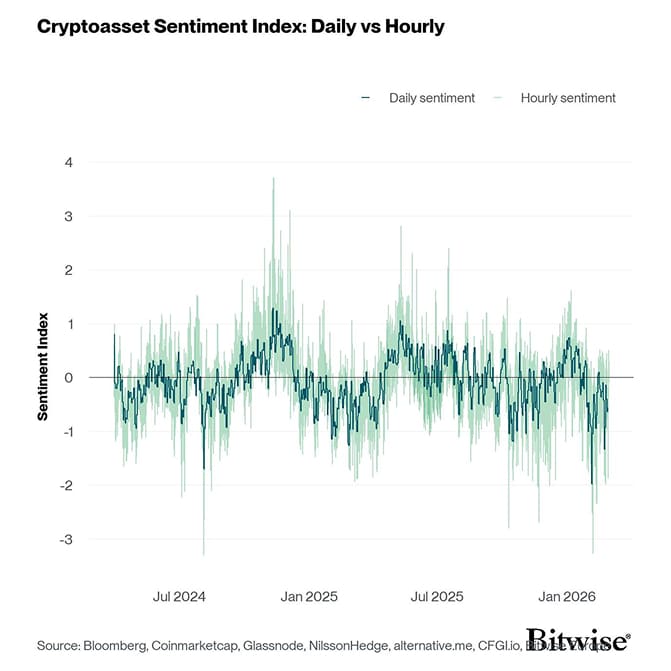 Source: Bloomberg, Coinmarketcap, Glassnode, NilssonHedge, alternative.me, CFGI.io, Bitwise Europe
Bitcoin vs Global Crypto ETP Fund Flows
Source: Bloomberg, Coinmarketcap, Glassnode, NilssonHedge, alternative.me, CFGI.io, Bitwise Europe
Bitcoin vs Global Crypto ETP Fund Flows
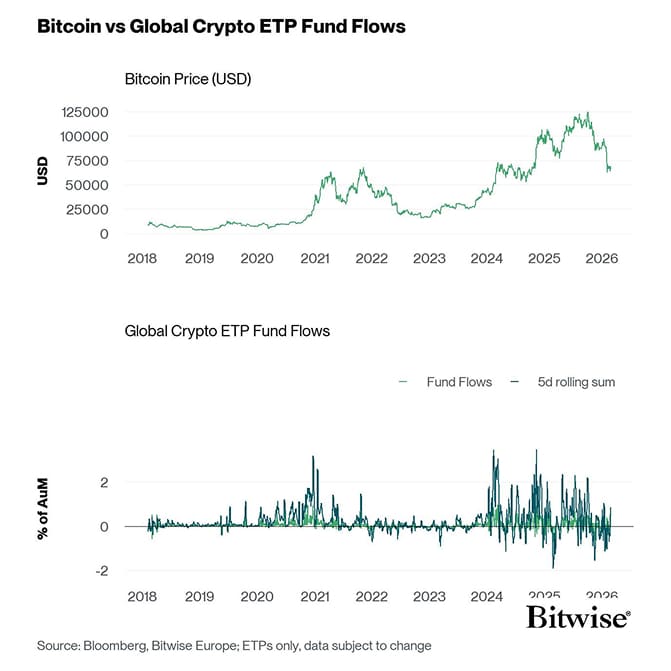 Source: Bloomberg, Bitwise Europe; ETPs only, data subject to change
Global Crypto ETP Fund Flows
Source: Bloomberg, Bitwise Europe; ETPs only, data subject to change
Global Crypto ETP Fund Flows
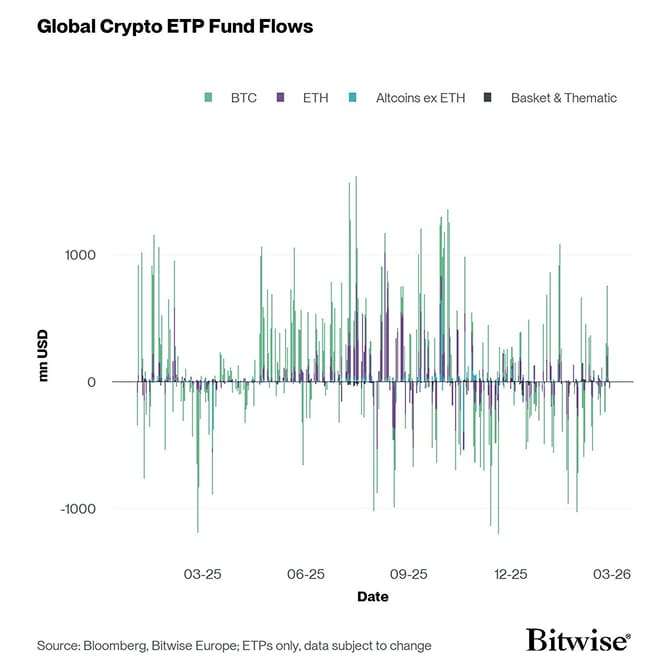 Source: Bloomberg, Bitwise Europe; ETPs only; data subject to change
US Spot Bitcoin ETF Fund Flows
Source: Bloomberg, Bitwise Europe; ETPs only; data subject to change
US Spot Bitcoin ETF Fund Flows
 Source: Bloomberg, Bitwise Europe; data subject to change
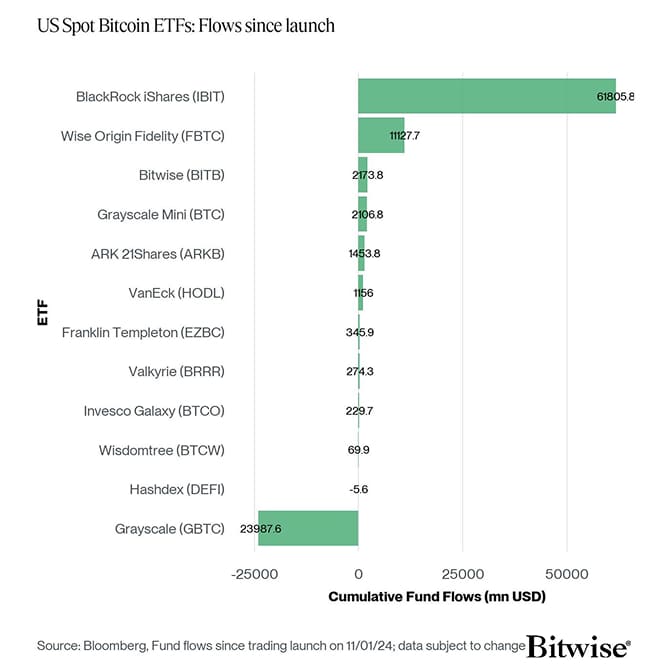
US Spot Bitcoin ETFs: Flows since launch
Source: Bloomberg, Bitwise Europe; data subject to change
US Spot Bitcoin ETFs: Flows since launch
 Source: Bloomberg, Fund flows since traiding launch on 11/01/24; data subject to change
US Spot Bitcoin ETFs: 5-days flow
Source: Bloomberg, Fund flows since traiding launch on 11/01/24; data subject to change
US Spot Bitcoin ETFs: 5-days flow
 Source: Bloomber; data subject to change
US Bitcoin ETFs: Net Fund Flows since 11th Jan mn USD
Source: Bloomber; data subject to change
US Bitcoin ETFs: Net Fund Flows since 11th Jan mn USD
 Source: Bloomberg, Bitwise Europe; data as of 27-02-2026
US Spot Ethereum ETF Fund Flows
Source: Bloomberg, Bitwise Europe; data as of 27-02-2026
US Spot Ethereum ETF Fund Flows
 Source: Bloomberg, Bitwise Europe; data subject to change
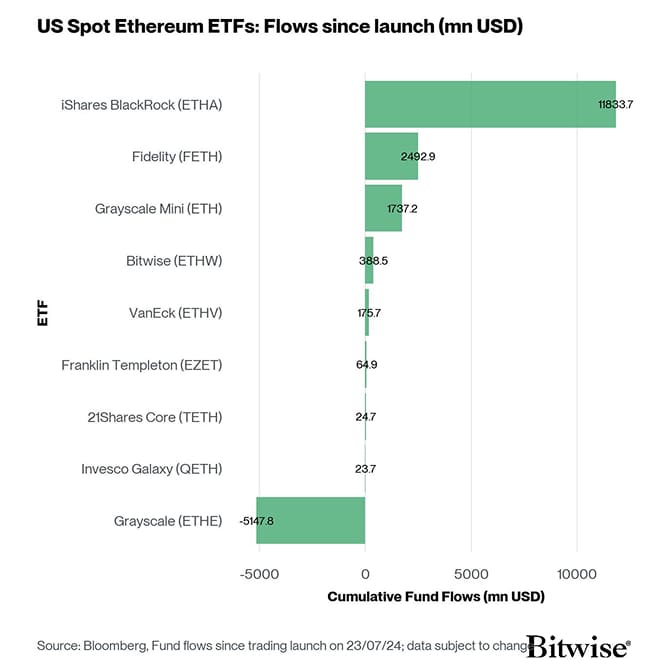
US Spot Ethereum ETFs: Flows since launch (mn USD)
Source: Bloomberg, Bitwise Europe; data subject to change
US Spot Ethereum ETFs: Flows since launch (mn USD)
 Source: Bloomberg, Fund flows since trading launch on 23/07/24; data subject on change
US Spot Ethereum ETFs: 5-days flow
Source: Bloomberg, Fund flows since trading launch on 23/07/24; data subject on change
US Spot Ethereum ETFs: 5-days flow
 Source: Bloomberg; data subject on change
US Ethereum ETFs: Net Fund Flows since 23rd July (mn USD)
Source: Bloomberg; data subject on change
US Ethereum ETFs: Net Fund Flows since 23rd July (mn USD)
 Source: Bloomberg, Bitwise Europe; data as of 27-02-2026
Bitcoin vs Crypto Hedge Fund Beta
Source: Bloomberg, Bitwise Europe; data as of 27-02-2026
Bitcoin vs Crypto Hedge Fund Beta
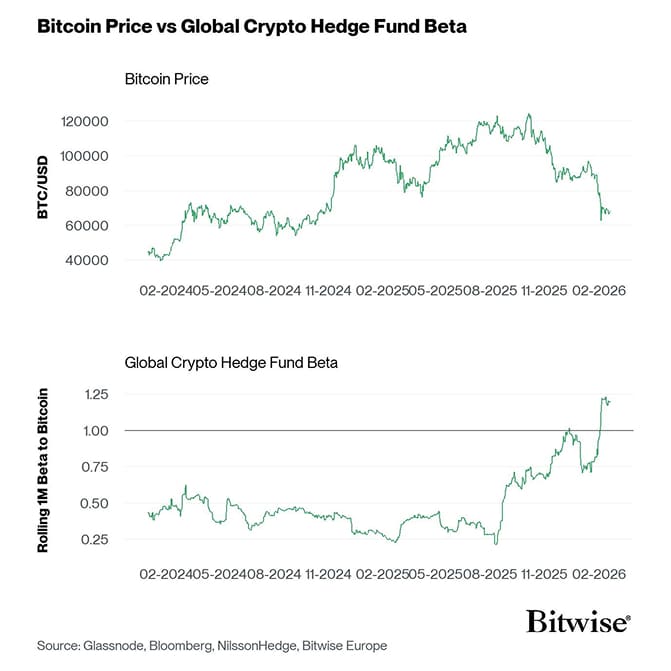 Source: Glassnode, Bloomberg, NilssonHedge, Bitwise Europe
Altseason Index (% of alts outperforming BTC)
Source: Glassnode, Bloomberg, NilssonHedge, Bitwise Europe
Altseason Index (% of alts outperforming BTC)
 Source: Coinmetrics, Bitwise Europe
Bitcoin vs Crypto Dispersion Index
Source: Coinmetrics, Bitwise Europe
Bitcoin vs Crypto Dispersion Index
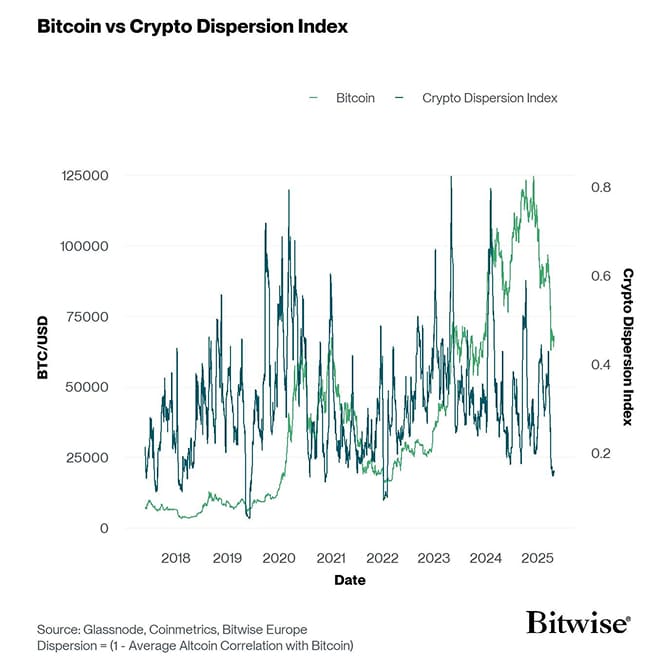 Source: Coinmarketcap, Bitwise Europe; Dispersion = (1 - Average Altcoin Correlation with Bitcoin)
Bitcoin Price vs Futures Basis Rate
Source: Coinmarketcap, Bitwise Europe; Dispersion = (1 - Average Altcoin Correlation with Bitcoin)
Bitcoin Price vs Futures Basis Rate
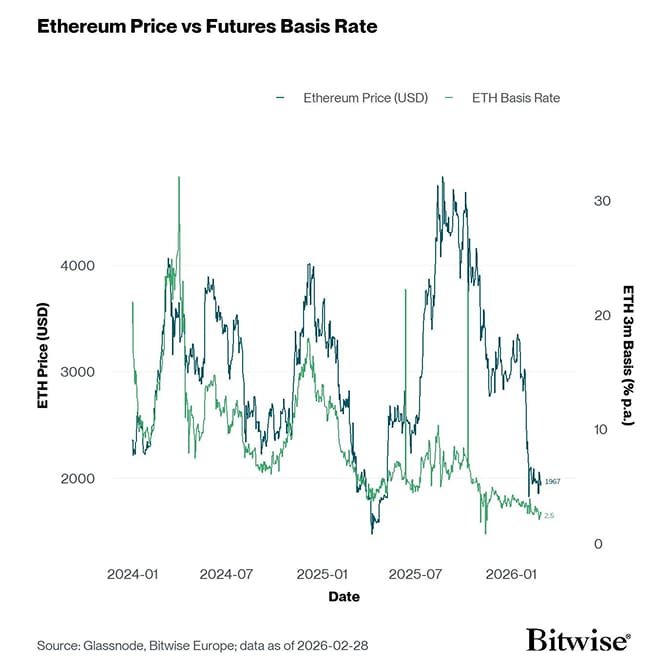
 Source: Glassnode, Bitwise Europe; data as of 2026-02-28
Ethereum Price vs Futures Basis Rate
Source: Glassnode, Bitwise Europe; data as of 2026-02-28
Ethereum Price vs Futures Basis Rate
 Source: Glassnode, Bitwise Europe; data as of 2026-02-28
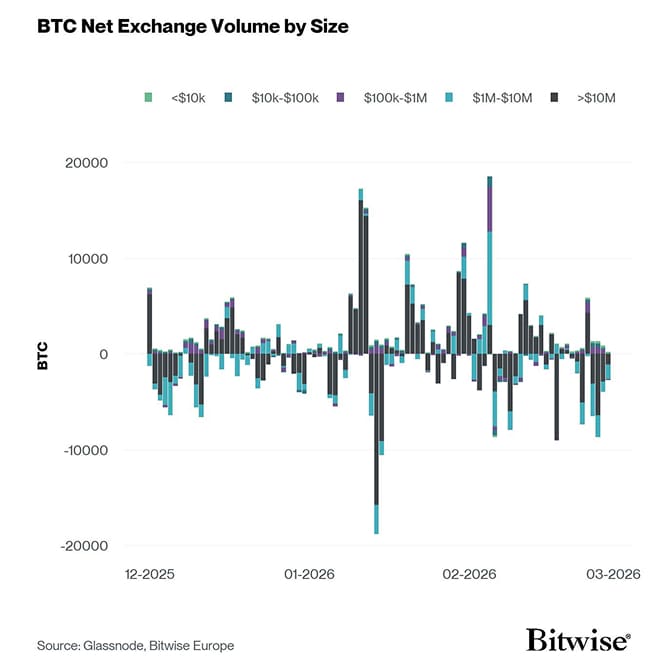
BTC Net Exchange Volume by Size
Source: Glassnode, Bitwise Europe; data as of 2026-02-28
BTC Net Exchange Volume by Size
 Source: Glassnode, Bitwise Europe
Important Information
This material is intended solely for professional investors and is not suitable for retail distribution.
The information provided in this material is for illustrative, educational or information purposes only and does not constitute investment advice, a recommendation or solicitation of an offer to buy any product or to make any investment.
This document (which may be subject to change and may be in the form of a presentation, press release, social media post, blog post, broadcast communication or similar instrument – we refer to this category of communications generally as a “document” for purposes of this disclaimer) is issued by Bitwise Europe GmbH (“BEU” or “the Issuer”). This document has been prepared in accordance with applicable laws and regulations (including those relating to financial promotions).
Bitwise Europe GmbH, incorporated under the laws of Germany, is the issuer of Exchange Traded Products (“ETPs”) described in this document under a base prospectus and final terms, which may be supplemented from time to time, and which are approved by BaFin. If you are considering investing in products issued by BEU you should check with independent financial adviser, your broker or bank that such products are available in your jurisdiction and suitable for your investment profile. A decision to invest any amount in an ETPs offered by BEU should take into consideration your specific circumstances after seeking independent investment, tax and legal advice.
Capital at risk. Cryptoassets are high-risk and volatile. The value of investments in cryptoassets and crypto-linked ETPs may fall as well as rise, and investors may lose some or all of their invested capital. No investor protection or compensation scheme applies. Past performance is not a reliable indicator of future results. Forward-looking statements are not guarantees.
You should read the relevant base prospectus and final terms before investing and, in particular, the section entitled ‘Risk Factors' for further details of risks associated with an investment. The prospectuses, final terms and other documents relevant to BEU's ETPs are available under the “Resources” section at www.bitwiseinvestments.com. When visiting this website, you will need to self-certify as to your jurisdiction and investor type in order to access these documents, and in so doing you may be subject to other disclaimers and important information.
Important Analytical Limitations: The observations and analyses presented in this document are based on historical market patterns and data correlations which may not repeat or continue in future market conditions. Past correlations between capital flows and performance metrics are not indicative of future performance and should not be extrapolated as predictive indicators. Material downside risks remain present across all investment timeframes regardless of current undervaluation metrics or favorable technical indicators. All model outputs, fair value calculations, and quantitative assessments are subject to significant uncertainty and methodological limitations, and should not be relied upon as the sole basis for making investment decisions. Investors should conduct independent due diligence and consider multiple factors beyond the scope of this analysis.
Read the full disclaimer here: https://bitwiseinvestments.eu/disclaimer/