- Cryptocurrencies began December showing signs of renewed resilience. After last week’s modest rebound that lifted Bitcoin back above $90,000, the market is entering the month with improving momentum, even as Bitcoin closed November down 16.7%.
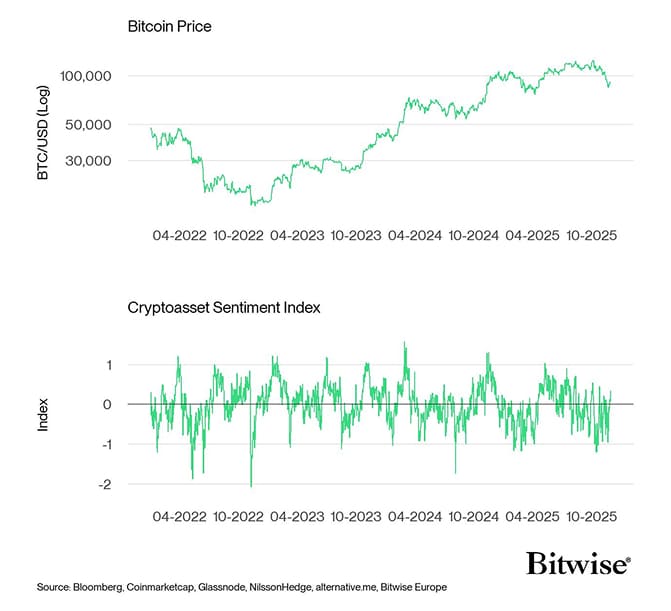
- Our in-house “Cryptoasset Sentiment Index” has reversed higher from oversold levels last week and now signals neutral sentiment again.
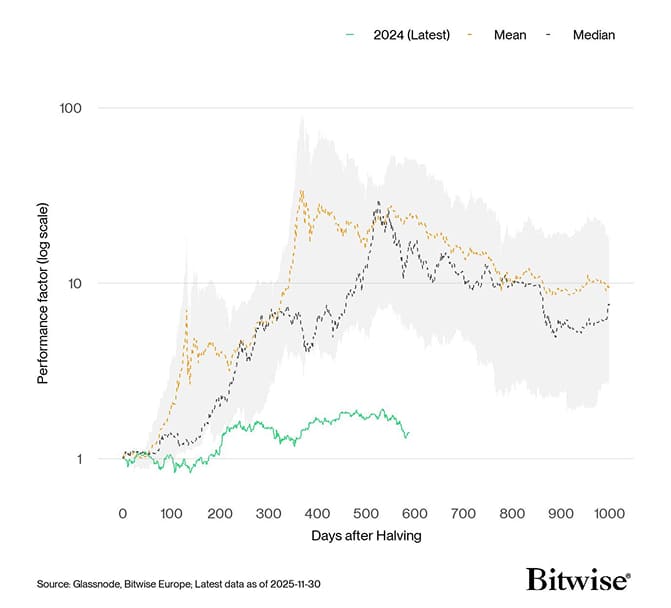
- Chart of the Week: Although our base case is that bitcoin won’t follow the classical 4-year post-Halving performance pattern this time, it is worth noting that bitcoin has been following this pattern almost to a T so far. The median post-Halving price of bitcoin topped out 525 days after the Halving (~1.5 years later) – this cycle, bitcoin has reached a new all-time high 534 days after the latest Halving in April 2024.
Chart of the Week
Bitcoin: Post-Halving Performance
Performance
Cryptocurrencies opened December under renewed pressure. Bitcoin briefly dropped 6% to below $86,000 in early Asian trading, while Ether slipped more than 7% to around $2,800. Other major tokens, including Solana, mirrored the risk-off move.
The market remains fragile after a protracted correction that began in early October, when roughly $19 billion in leveraged positions were unwound shortly after Bitcoin's record high of around $126k. Despite a modest recovery and positive performance last week that pushed Bitcoin back above $90,000, the asset still lost 16.7% in November.
The very latest sell-off appears to be caused by a mixture of bearish news flow in Asia. Firstly, the People's Bank of China once again exhibited a hawkish tone towards cryptoassets. Secondly, the extreme rise in Japanese sovereign bond yields is pressuring the BoJ to raise interest rates which is weighing on market sentiment. Lastly, the latest downside move was exacerbated by forced liquidations of leveraged long positions via bitcoin (perpetual) futures.
Besides, the market remains somewhat concerned about the risk that major treasury companies like Strategy Inc. (MSTR) could start selling bitcoins as most mNAVs are trading below 1. The rationale is that it might make sense from a corporate finance perspective to sell bitcoins to buy back own shares to realise an arbitrage profit. However, the risk and concerns are that the treasury companies could create a negative “doom loop” of declining mNAVs / share prices and declining bitcoin prices.
Although our base case is that bitcoin won't follow the classical 4-year post-Halving performance pattern this time, it is worth noting that bitcoin has been following this pattern almost to the T so far (Chart-of-the-Week). The median post-Halving price of bitcoin topped out 525 days after the Halving (~1.5 years later) – this cycle, bitcoin has reached a new all-time high 534 days after the latest Halving in April 2024.
One of the key reasons why we don't think the classical Halving pattern (especially the subsequent long-lasting bear market) won't repeat is that institutional demand via global bitcoin treasury companies and bitcoin ETPs has outweighed the Halving-induced supply deficit by a factor of more than 7 times in 2025!
Simply put, Bitcoin miners don't play such an important role anymore compared to previous cycles. Bitcoin has essentially evolved from a supply-driven market to a demand-driven market.
From a structural perspective, this demand should continue to grow steadily due to rising adoption by individuals, corporations, asset managers, and nation-states.
From a cyclical perspective, we expect classical macro factors such as global growth expectations or monetary policy to play an increasingly larger role for bitcoin's demand as Bitcoin becomes increasingly more integrated into the traditional financial system. In this context, bitcoin has become particularly more sensitive to changes in global growth expectations which have recently declined. So, it is not surprising that bitcoin has been trading lower as well.
On the bright side, bitcoin's growth pricing is already as pessimistic as during the Covid crash in 2020 or FTX blow-up in 2022 as highlighted here.
Bitcoin is already pricing in a recessionary growth environment which implies that a lot of bad news has already been discounted in bitcoin and that downside risks also appear to be limited from a contrarian point-of-view.
At the same time, the preceding monetary easing by major central banks worldwide implies that forward-looking indicators should continue to stay positive over the next 6-9 months which should also support risk appetite for bitcoin and cryptoassets.
(More details will be provided in our upcoming monthly Bitcoin Macro Investor report which we will publish today).
Cross Asset Performance (Week-to-Date)
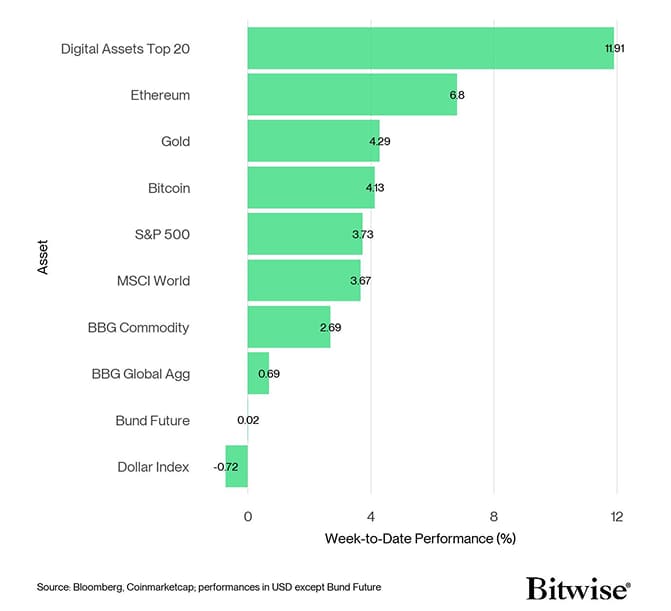 Source: Bloomberg, Coinmarketcap; performances in USD exept Bund Future
Top 10 Cryptoasset Performance (Week-to-Date)
Source: Bloomberg, Coinmarketcap; performances in USD exept Bund Future
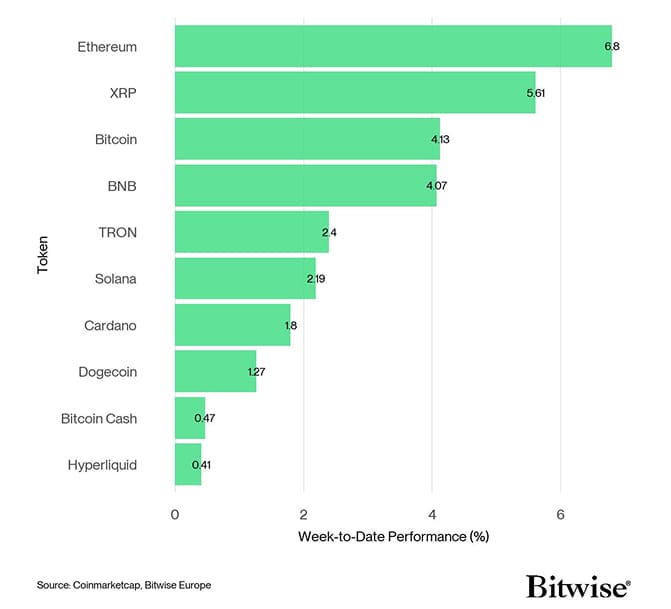
Top 10 Cryptoasset Performance (Week-to-Date)
 Source: Coinmarketcap
In general, among the top 10 crypto assets Ethereum, XRP, and Bitcoin were the relative outperformers.
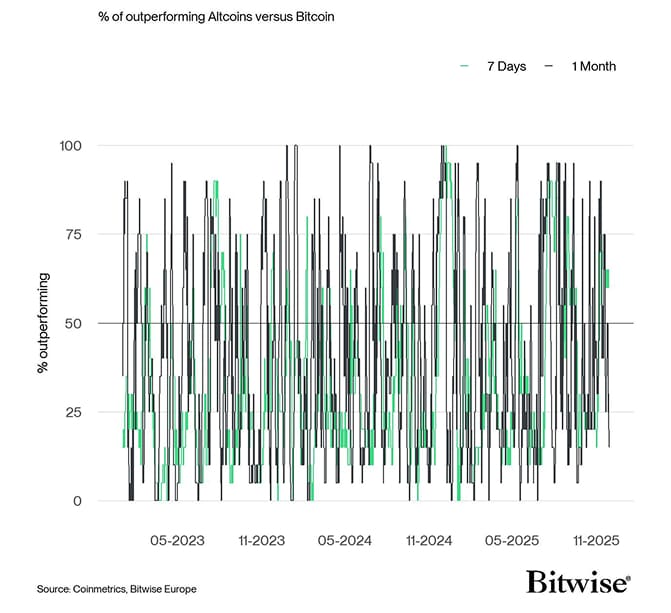
Overall, altcoin outperformance vis-à-vis bitcoin remained low last week, with only 15% of our tracked altcoins managing to outperform bitcoin on a weekly basis. However, Ethereum outperformed bitcoin last week.
Sentiment
Our in-house “Cryptoasset Sentiment Index” has reversed higher from oversold levels last week and now signals neutral sentiment again.
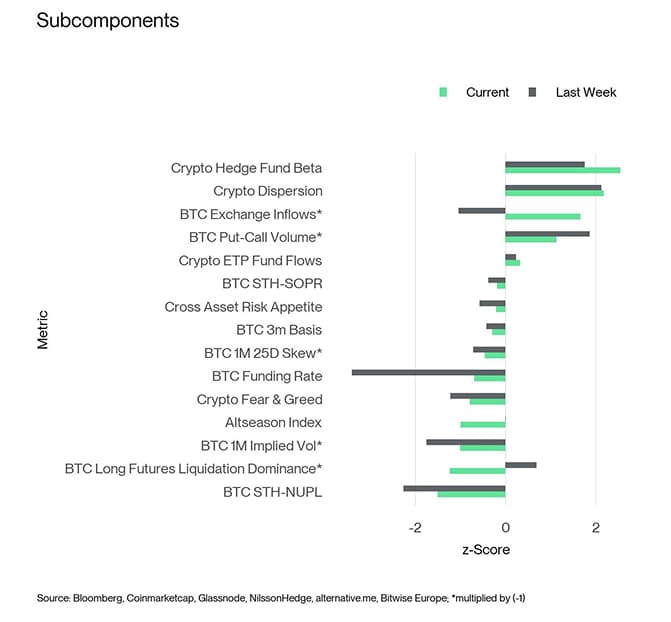
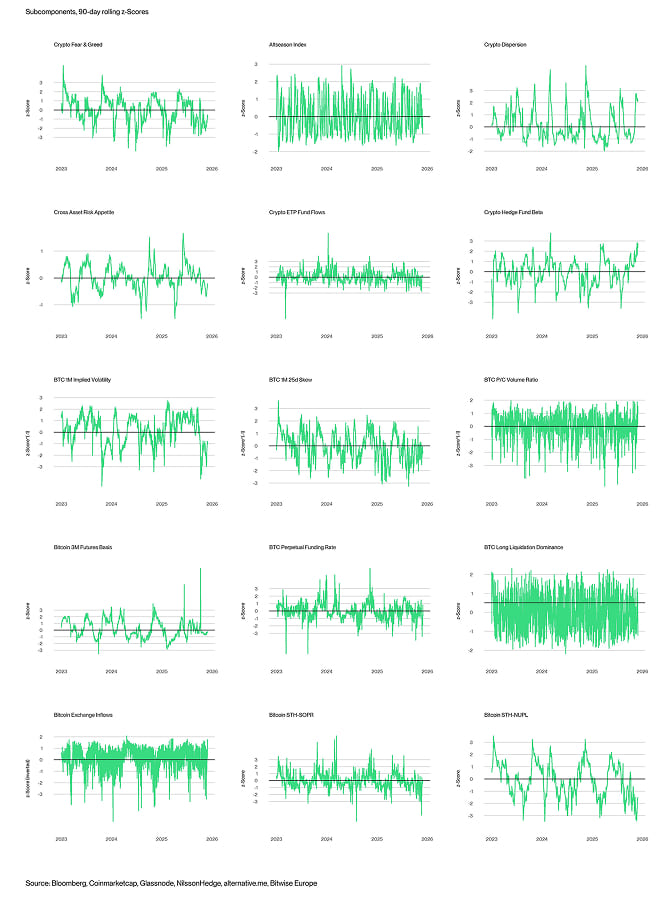
At the moment, 5 out of 15 indicators are above their short-term trend.
Last week, the Crypto Dispersion Index, the Hedge Fund Beta, BTC Put-Call Volume, BTC Exchange Inflows and Crypto ETP Fund Flows metrics showed positive momentum.
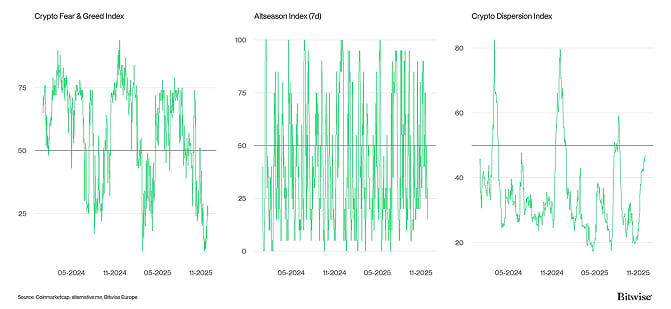
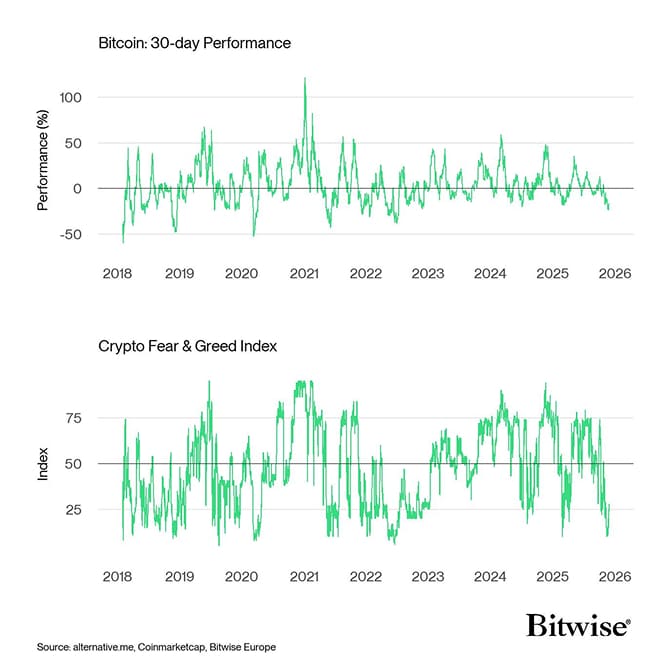
The Crypto Fear & Greed Index currently signals a “extreme fear” level of sentiment as of this morning. The index has spent the whole month of November in either “fear” or “extreme fear” territory so far. This tends to be a contrarian signal in our view.
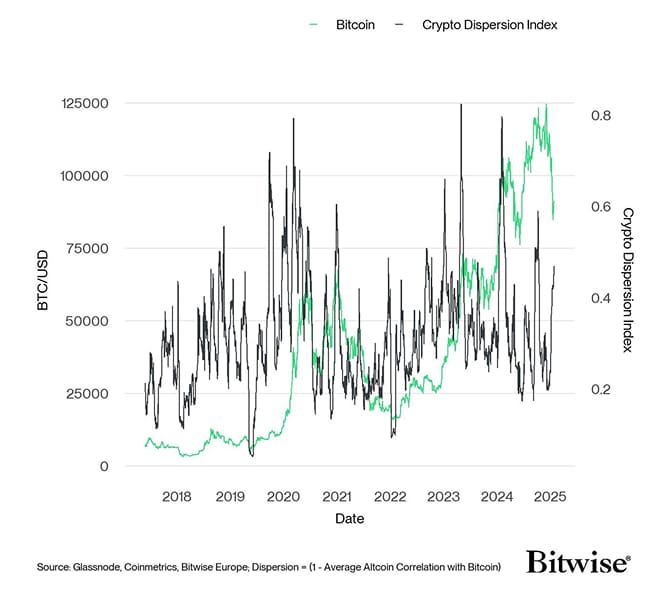
Performance dispersion among cryptoassets trended slightly up last week as cryptoassets traded in line with bitcoin. When dispersion is evident, it means that the market appears to be driven by a more diverse set of narratives which tends to be a sign of increasing risk appetite.
Altcoin outperformance vis-à-vis Bitcoin decreased significantly last week, from 40% to 15% of our tracked altcoins outperforming Bitcoin on a weekly basis. Despite this decline, Ethereum was one of the few to outperform Bitcoin.
In general, increasing (decreasing) altcoin outperformance tends to be a sign of increasing (decreasing) risk appetite within cryptoasset markets and the latest altcoin outperformance still signals increasing risk appetite at the moment.
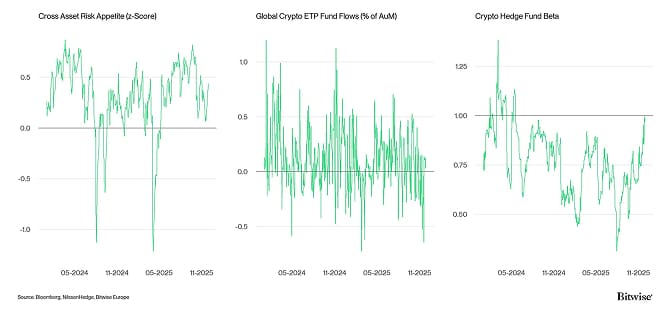
Sentiment in traditional financial markets as measured by our in-house measure of Cross Asset Risk Appetite (CARA) increased, moving from 0.2 to 0.44. This is a notable divergence between TradFi and crypto asset sentiment that should be watched closely.
Fund Flows
Global crypto ETPs saw positive net inflows last week, after the last few weeks of excessive outflows flashing a contrarian signal.
Global crypto ETPs saw around +904.9 mn USD in weekly net inflows across all types of cryptoassets, after -1962.1 mn USD in net outflows the previous week, and -1864.3 mn USD in net outflows the week prior, as well.
Global Bitcoin ETPs experienced net inflows totalling +494.8 mn USD last week, of which +70 mn USD in net inflows were related to US spot Bitcoin ETFs.
The Bitwise Bitcoin ETF (BITB) in the US experienced net outflows, totalling -18.1 mn USD last week.
In Europe, the Bitwise Physical Bitcoin ETP (BTCE) experienced net inflows equivalent to +7 mn USD, as the Bitwise Core Bitcoin ETP (BTC1) also experienced net inflows of +9.9 mn USD.
The Grayscale Bitcoin Trust (GBTC) has posted net inflows of +16.3 mn USD whilst the iShares Bitcoin Trust (IBIT) experienced net outflows of around –137 mn USD last week.
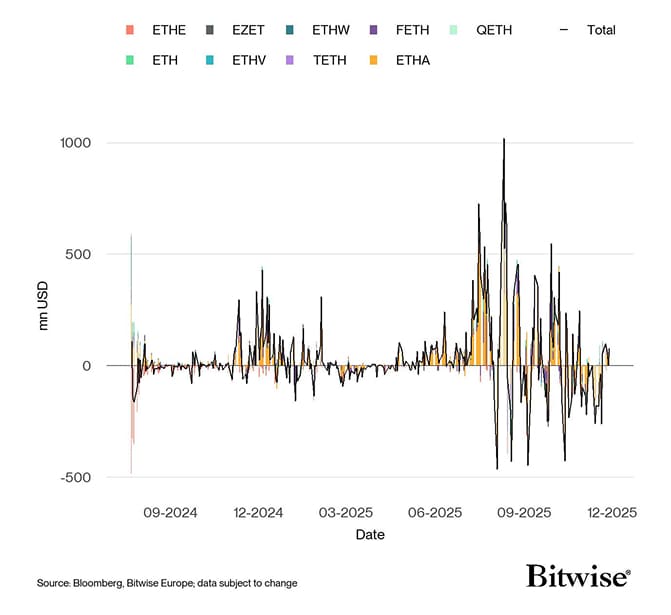
Flows into global Ethereum ETPs also experienced net inflows last week, with around +337.7 mn USD into ETP products.
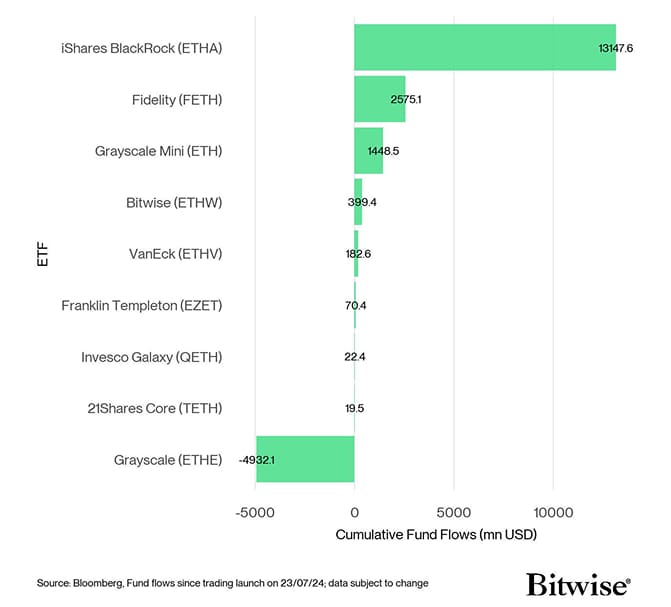
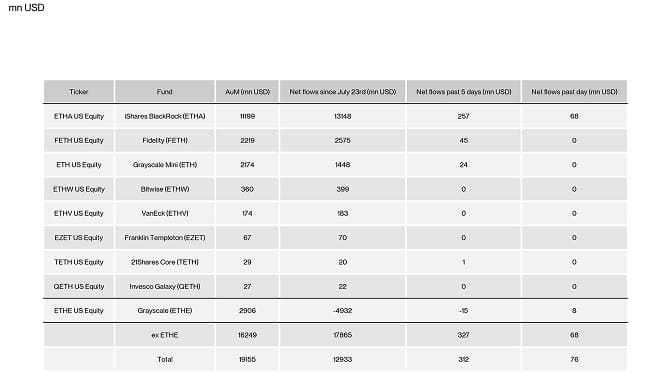
US spot Ethereum ETFs, also recorded net inflows of around +312.6 mn USD on aggregate. Whilst the Grayscale Ethereum Trust (ETHE) posted net outflows of -15.1 mn USD.
Whereas the Bitwise Ethereum ETF (ETHW) in the US posted minor net inflows of +0.1 mn USD.
In Europe, the Bitwise Physical Ethereum ETP (ZETH) saw minor net inflows of +2.6 mn USD as the Bitwise Ethereum Staking ETP (ET32) also saw net inflows of +0.3 mn USD.
Altcoin ETPs ex Ethereum experienced net inflows of +31.5mn USD last week driven mostly by strong inflows into US Solana ETFs. Solana recorded nearly a full month of consecutive inflows from its launch on 28 October, with the first day of outflows not occurring until the 26th of November.
Thematic & basket crypto ETPs posted net inflows of +40.9 mn USD on aggregate last week. The Bitwise MSCI Digital Assets Select 20 ETP (DA20) has experienced no net inflows (+/-0.0 mn USD) on aggregate.
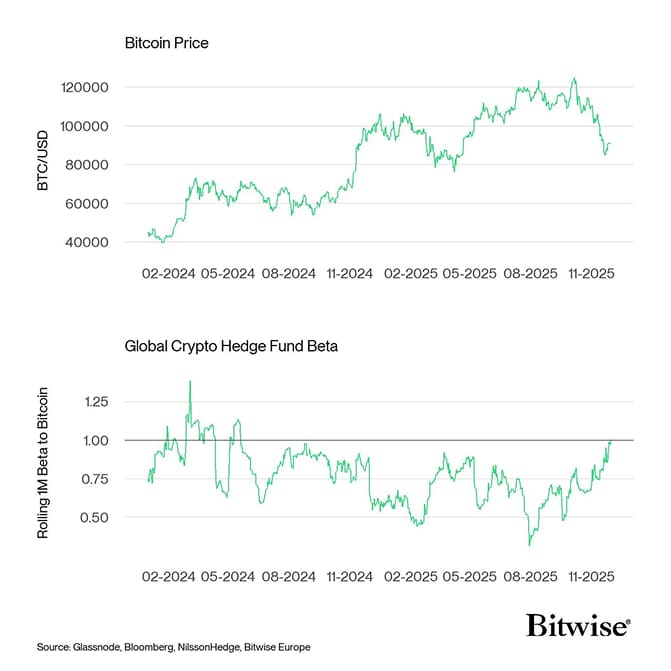
Global crypto hedge funds exposure to Bitcoin continued to increase last week. The 20-days rolling beta of global crypto hedge funds' performance to Bitcoin increased to 1.0 per yesterday's close, up from 0.86 from the week before.
On-Chain Data
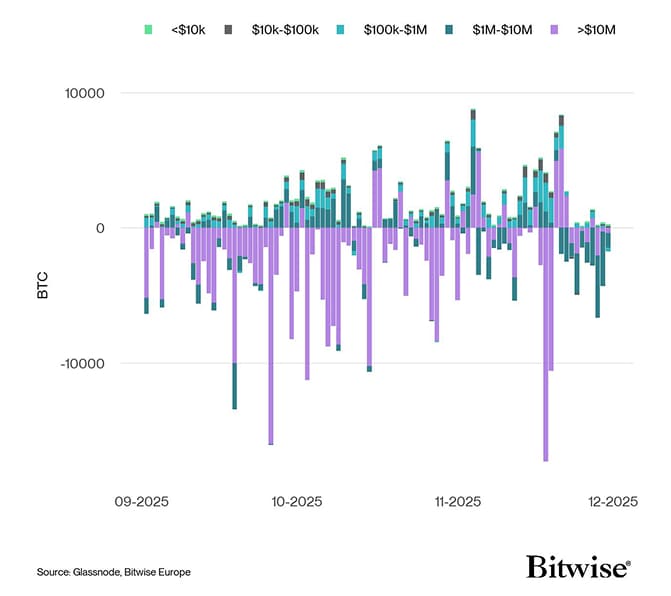
Following the largest wave of sell-side pressure across exchanges, totalling -$4.1bn during the contraction to $82k, the first signs of meaningful buy-side strength have begun to emerge.
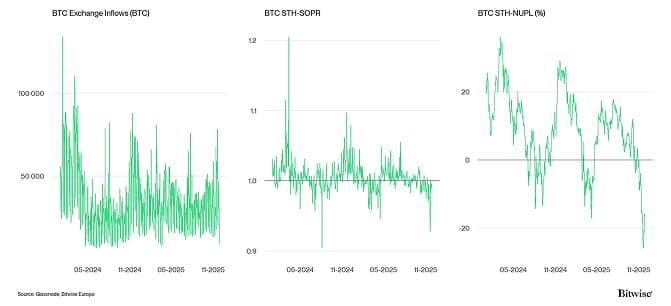
Intraday spot buying minus selling closed the week at approximately +$425mn, with the weekly high reaching +$1.2bn, the largest observed value since April 2025. In addition, on-chain profit taking has collapsed to just $300mn per day, indicating that de-risking behaviour among profitable investors has largely subsided at these price levels.
Additionally, the Accumulation Trend Score, which tracks changes in supply held across wallets of all sizes, indicates that large-scale accumulation is underway, reflecting the presence of a robust buy-side and growing investor confidence despite recent market volatility.
A significant portion of market investors remain under pressure, with 33% of the circulating supply still in a position of loss. However, unrealised losses held by these coins have begun to moderate, improving from a low of -$150bn at the peak of the contraction to around -$100bn today. This remains elevated and continues to underscore market risk moving forward, yet the improvement itself is a constructive development and suggests that some of the acute stress in investor portfolios is beginning to ease.
The $93.5k level remains a critical threshold to reclaim, as it marks the lower boundary of a dense on-chain volume cluster where a significant concentration of supply last changed hands. A sustained recovery and hold above this level would suggest first signs of a meaningful improvement in market structure. Failure to break through the $93.5k level would bring the $82k-$75k price range back into consideration, where the average investor purchasing price, the MSTR cost basis and also the IBIT ETF cost basis reside.
Looking ahead, if the market can decisively reclaim the $93.5k level, the next key areas of interest sit at the $100k psychological threshold, the Short-Term Holder cost basis at $104.2k and the 200-day moving average at $109.8k. Each successive level reclaimed would signal a growing degree of market confidence, as these thresholds represent increasingly meaningful layers of resistance that, once broken, would indicate a strengthening recovery in market structure.
Futures, Options & Perpetuals
Over the past week, BTC perpetual futures open interest declined by -24.5.8k BTC across all exchanges, while CME futures open interest contracted by a further -8.6k BTC, indicating a continued reduction in institutional positioning. In aggregate, total open interest remains relatively subdued compared to recent months, suggesting that the futures market is not the primary driver of current price action.
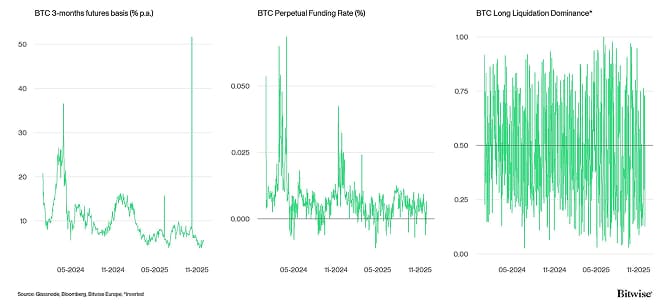
BTC perpetual funding rates have reset to a neutral level, indicating a meaningful moderation in investor risk appetite. This is a constructive development, as funding has normalised even while the market continues to grind higher, suggesting a healthier and more balanced positioning across derivatives markets.
In general, when the funding rate is positive (negative), long (short) positions periodically pay short (long) positions, which is indicative of bullish (bearish) sentiment.
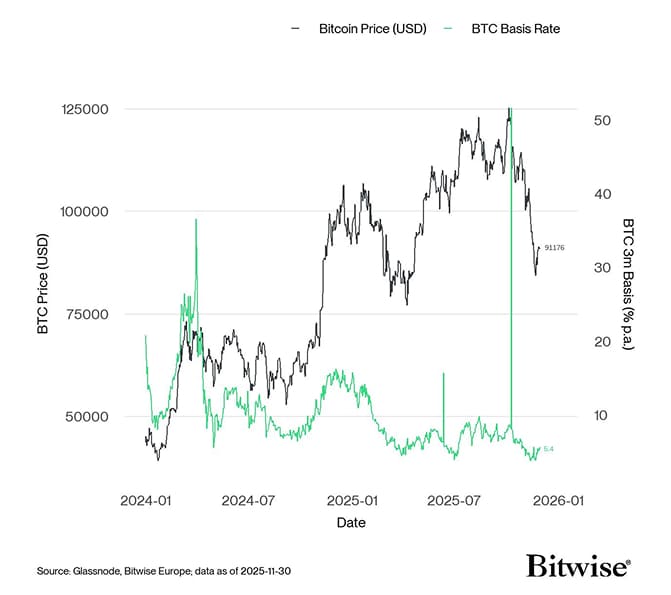
The BTC 3-month annualised basis has begun to reverse its recent downtrend, rising to 5.5% per annum when averaged across major futures venues. This marks an early sign of stabilising forward demand, indicating that derivatives traders are gradually rebuilding confidence as spot conditions improve.
Large open interest positions have accumulated around the $94k level, adding confluence to the observation that $93.5k remains a critical threshold for further constructive price action. This area is likely to be highly sensitive, with short traders defending their positions. Should price break above this level with conviction, an upside liquidation cascade into the $97k region becomes a probable outcome.
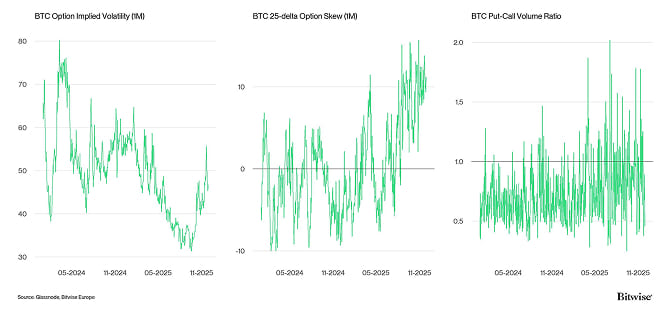
BTC options open interest has declined by -75.8k BTC, driven by a combination of end-of-month expiry and the unwinding of put positions. In addition, the put-to-call open interest ratio has contracted sharply from 0.65 to 0.54, with only 18 trading days in history recording a larger 7-day reduction. This suggests that appetite for downside protection has reversed materially, reflecting a notable shift in investor sentiment toward a more neutral or constructive positioning.
This shift is further reflected in the 25-delta skew. Both the 1-week and 1-month tenors saw a notable decline across the week, signalling a sharp fade in near-term hedging demand. However, the 1-month and 3-month tenors remain relatively stable, suggesting that while short-term risk perception has eased, investors continue to account for medium-term uncertainty.
Bottom Line
- Cryptocurrencies began December showing signs of renewed resilience. After last week’s modest rebound that lifted Bitcoin back above $90,000, the market is entering the month with improving momentum, even as Bitcoin closed November down 16.7%.
- Our in-house “Cryptoasset Sentiment Index” has reversed higher from oversold levels last week and now signals neutral sentiment again.
- Chart of the Week: Although our base case is that bitcoin won’t follow the classical 4-year post-Halving performance pattern this time, it is worth noting that bitcoin has been following this pattern almost to a T so far. The median post-Halving price of bitcoin topped out 525 days after the Halving (~1.5 years later) – this cycle, bitcoin has reached a new all-time high 534 days after the latest Halving in April 2024.
Appendix
Bitcoin Price vs Cryptoasset Sentiment Index
 Source: Bloomberg, Coinmarketcap, Glassnode, NilssonHedge, alternative.me, Bitwise Europe
Cryptoasset Sentiment Index
Source: Bloomberg, Coinmarketcap, Glassnode, NilssonHedge, alternative.me, Bitwise Europe
Cryptoasset Sentiment Index
 Source: Bloomberg, Coinmarketcap, Glassnode, NilssonHedge, alternative.me, Bitwise Europe; *multiplied by (-1)
Cryptoasset Sentiment Index
Source: Bloomberg, Coinmarketcap, Glassnode, NilssonHedge, alternative.me, Bitwise Europe; *multiplied by (-1)
Cryptoasset Sentiment Index
 Source: Bloomberg, Coinmarketcap, Glassnode, NilssonHedge, alternative.me, Bitwise Europe
TradFi Sentiment Indicators
Source: Bloomberg, Coinmarketcap, Glassnode, NilssonHedge, alternative.me, Bitwise Europe
TradFi Sentiment Indicators
 Source: Bloomberg, NilssonHedge, Bitwise Europe
Crypto Sentiment Indicators
Source: Bloomberg, NilssonHedge, Bitwise Europe
Crypto Sentiment Indicators
 Source: Coinmarketcap, alternative.me, Bitwise Europe
Crypto Options' Sentiment Indicators
Source: Coinmarketcap, alternative.me, Bitwise Europe
Crypto Options' Sentiment Indicators
 Source: Glassnode, Bitwise Europe
Crypto Futures & Perpetuals' Sentiment Indicators
Source: Glassnode, Bitwise Europe
Crypto Futures & Perpetuals' Sentiment Indicators
 Source: Glassnode, Bitwise Europe; *Inverted
Crypto On-Chain Indicators
Source: Glassnode, Bitwise Europe; *Inverted
Crypto On-Chain Indicators
 Source: Glassnode, Bitwise Europe
Bitcoin vs Crypto Fear & Greed Index
Source: Glassnode, Bitwise Europe
Bitcoin vs Crypto Fear & Greed Index
 Source: alternative.me, Coinmarketcap, Bitwise Europe
Cryptoasset Sentiment Index: Daily vs Hourly
Source: alternative.me, Coinmarketcap, Bitwise Europe
Cryptoasset Sentiment Index: Daily vs Hourly
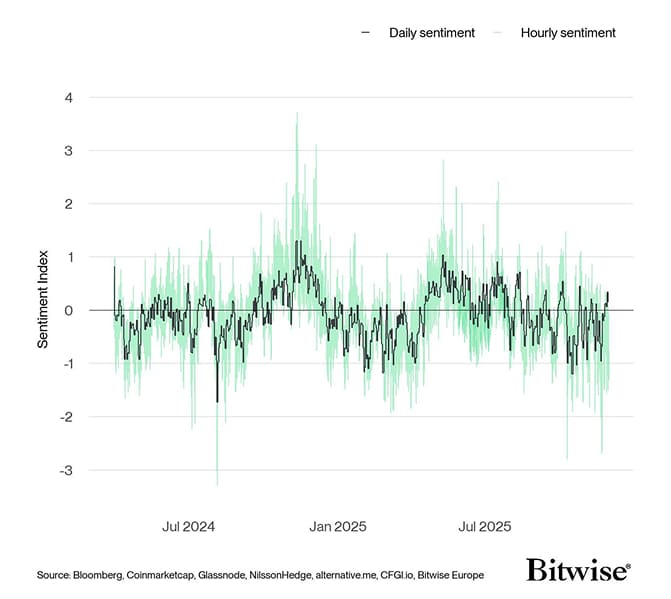 Source: Bloomberg, Coinmarketcap, Glassnode, NilssonHedge, alternative.me, CFGI.io, Bitwise Europe
Bitcoin vs Global Crypto ETP Fund Flows
Source: Bloomberg, Coinmarketcap, Glassnode, NilssonHedge, alternative.me, CFGI.io, Bitwise Europe
Bitcoin vs Global Crypto ETP Fund Flows
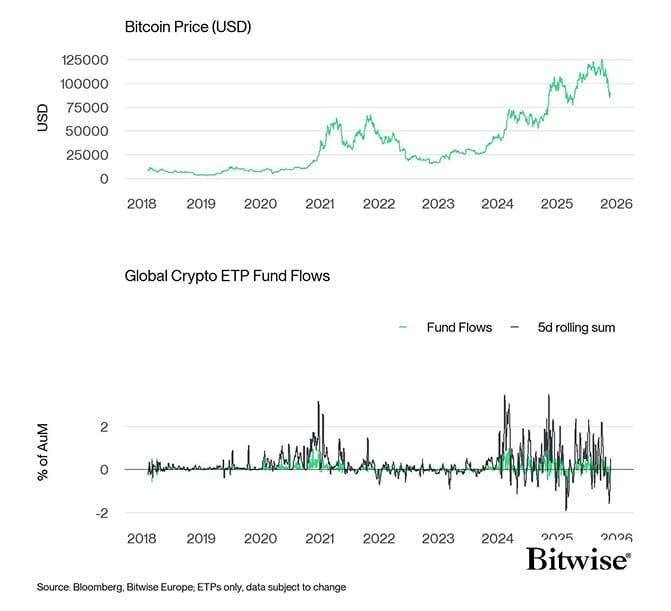 Source: Bloomberg, Bitwise Europe; ETPs only, data subject to change
Global Crypto ETP Fund Flows
Source: Bloomberg, Bitwise Europe; ETPs only, data subject to change
Global Crypto ETP Fund Flows
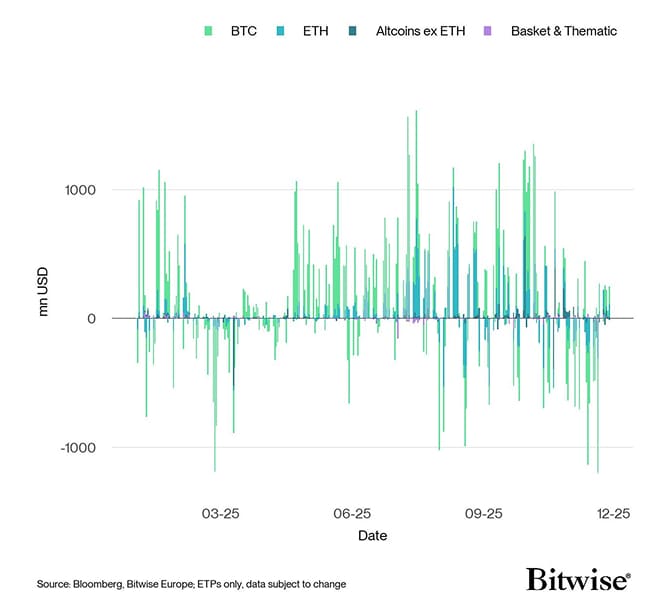 Source: Bloomberg, Bitwise Europe; ETPs only; data subject to change
US Spot Bitcoin ETF Fund Flows
Source: Bloomberg, Bitwise Europe; ETPs only; data subject to change
US Spot Bitcoin ETF Fund Flows
 Source: Bloomberg, Bitwise Europe; data subject to change
US Spot Bitcoin ETFs: Flows since launch
Source: Bloomberg, Bitwise Europe; data subject to change
US Spot Bitcoin ETFs: Flows since launch
 Source: Bloomberg, Fund flows since traiding launch on 11/01/24; data subject to change
US Spot Bitcoin ETFs: 5-days flow
Source: Bloomberg, Fund flows since traiding launch on 11/01/24; data subject to change
US Spot Bitcoin ETFs: 5-days flow
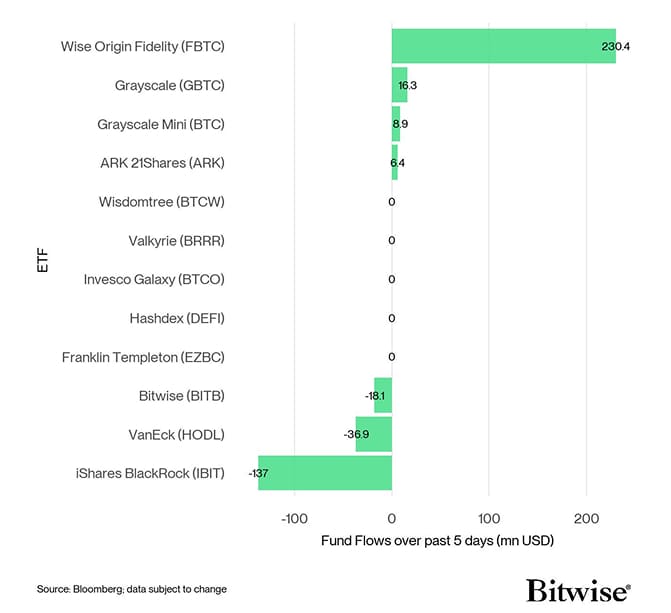 Source: Bloomber; data subject to change
US Bitcoin ETFs: Net Fund Flows since 11th Jan mn USD
Source: Bloomber; data subject to change
US Bitcoin ETFs: Net Fund Flows since 11th Jan mn USD
 Source: Bloomberg, Bitwise Europe; data as of 28-11-2025
US Spot Ethereum ETF Fund Flows
Source: Bloomberg, Bitwise Europe; data as of 28-11-2025
US Spot Ethereum ETF Fund Flows
 Source: Bloomberg, Bitwise Europe; data subject to change
US Spot Ethereum ETFs: Flows since launch
Source: Bloomberg, Bitwise Europe; data subject to change
US Spot Ethereum ETFs: Flows since launch
 Source: Bloomberg, Fund flows since trading launch on 23/07/24; data subject on change
US Spot Ethereum ETFs: 5-days flow
Source: Bloomberg, Fund flows since trading launch on 23/07/24; data subject on change
US Spot Ethereum ETFs: 5-days flow
 Source: Bloomberg; data subject on change
US Ethereum ETFs: Net Fund Flows since 23rd July
Source: Bloomberg; data subject on change
US Ethereum ETFs: Net Fund Flows since 23rd July
 Source: Bloomberg, Bitwise Europe; data as of 28-11-2025
Bitcoin vs Crypto Hedge Fund Beta
Source: Bloomberg, Bitwise Europe; data as of 28-11-2025
Bitcoin vs Crypto Hedge Fund Beta
 Source: Glassnode, Bloomberg, NilssonHedge, Bitwise Europe
Altseason Index
Source: Glassnode, Bloomberg, NilssonHedge, Bitwise Europe
Altseason Index
 Source: Coinmetrics, Bitwise Europe
Bitcoin vs Crypto Dispersion Index
Source: Coinmetrics, Bitwise Europe
Bitcoin vs Crypto Dispersion Index
 Source: Coinmarketcap, Bitwise Europe; Dispersion = (1 - Average Altcoin Correlation with Bitcoin)
Bitcoin Price vs Futures Basis Rate
Source: Coinmarketcap, Bitwise Europe; Dispersion = (1 - Average Altcoin Correlation with Bitcoin)
Bitcoin Price vs Futures Basis Rate
 Source: Glassnode, Bitwise Europe; data as of 2025-11-30
Ethereum Price vs Futures Basis Rate
Source: Glassnode, Bitwise Europe; data as of 2025-11-30
Ethereum Price vs Futures Basis Rate
 Source: Glassnode, Bitwise Europe; data as of 2025-11-30
BTC Net Exchange Volume by Size
Source: Glassnode, Bitwise Europe; data as of 2025-11-30
BTC Net Exchange Volume by Size
 Source: Glassnode, Bitwise Europe
Important Information
This publication constitutes a marketing communication and is provided for informational purposes only. It does not constitute investment advice, a personal recommendation, or an offer or solicitation to buy or sell any financial instrument.
This document (which may take the form of a presentation, press release, social media post, blog article, broadcast communication or similar instrument – collectively referred to as a “Document”) is issued by Bitwise Europe GmbH (“BEU” or the “Issuer”) and has been prepared in accordance with applicable laws and regulations, including those relating to financial promotions.
Bitwise Europe GmbH, incorporated under the laws of Germany, is the issuer of the Exchange Traded Products (“ETPs”) referenced in this Document under a base prospectus and the applicable final terms, as supplemented from time to time, approved by the German Federal Financial Supervisory Authority (BaFin). The approval of the prospectus by BaFin relates solely to the completeness, coherence and comprehensibility of the prospectus in accordance with the Prospectus Regulation and does not constitute an endorsement, recommendation or assessment of the merits of the products.
The market analyses, views and scenarios presented reflect the assessment as of the date of publication and are based on information considered reliable. However, no representation or warranty is made as to their accuracy or completeness. Forward-looking statements involve risks and uncertainties and are not guarantees of future performance. Past performance is not a reliable indicator of future results.
Capital at risk. Cryptoassets are highly volatile and involve a high degree of risk. The value of investments in cryptoassets and crypto-linked ETPs may fluctuate significantly, and investors may lose part or all of their invested capital. No capital protection or guaranteed compensation mechanism applies in respect of market losses.
Any investment decision should be made solely on the basis of the relevant base prospectus, the applicable final terms and the key information document, in particular the section entitled “Risk Warning”. The base prospectus, final terms and additional risk information are available at: www.bitwiseinvestments.eu
Access to certain documents may require self-certification regarding your jurisdiction and investor status and may be subject to additional disclaimers and important information.
For further details, please refer to the full disclaimer available at: www.bitwiseinvestments.eu/disclaimer

 en
en  de
de  it
it  fr
fr  es
es