- Cryptoassets underperformed traditional markets last week as institutional bitcoin demand weakened, driven by ETP outflows and elevated miner supply.
- Chart-of-the-Week: Long-term holder selling is declining materially, and our Cryptoasset Sentiment Index has reverted back to neutral, signaling fading on-chain headwinds but cautious market positioning.
- Macro tailwinds are building as Fed balance sheet expansion points to de facto QE, while subdued trading activity suggests investors are awaiting a new catalyst.
Chart of the Week
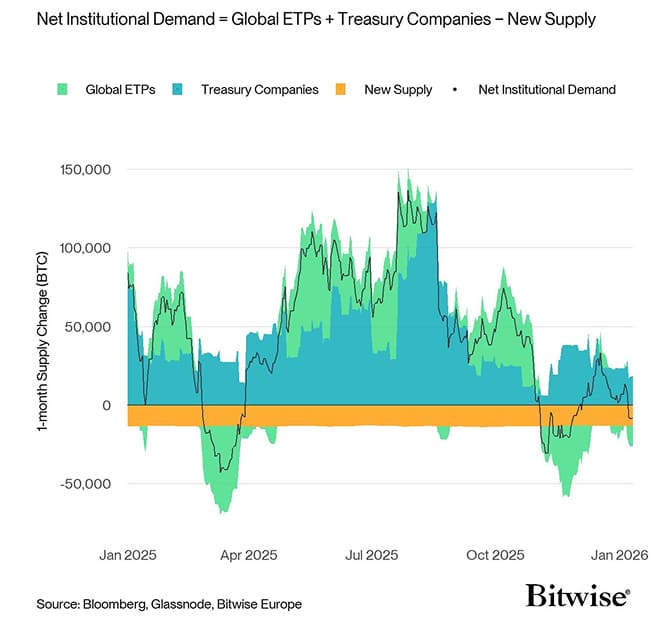
Institutional Flows vs. New Supply (1-month change)
Performance
Last week, cryptoassets underperformed major traditional assets due to a renewed deceleration in institutional bitcoin demand.
Although Bitcoin treasury companies have bought +18,567 BTC over the past month, global bitcoin ETPs have experienced net outflows of -13,211 BTC on a monthly basis despite the strong start in early 2026. The new supply of bitcoins has also increased by 13,312 BTC in the same period which puts the net institutional demand number at -7,957 BTC over the past 30 days (Chart-of-the-week).
In fact, bitcoin miners have distributed an elevated supply of bitcoins last week which has also weighed on bitcoin's performance. It is worth noting that elevated supply distributions by bitcoin miners is quite typical near market bottoms.
On the bright side, the latest tweet by Michael Saylor suggests that MSTR has continued to accumulate bitcoins last week.
We also expect positive flows into global Bitcoin ETPs to reassert themselves over the coming weeks due to a renewed rise in risk appetite.
In general, we expect that ETPs will purchase more than 100% of the new supply of Bitcoin (and Ethereum and Solana) in 2026 as institutional demand accelerates. Read the full predictions here .
Moreover, we are seeing a decline in supply distribution by long-term holders. Note that this has been a key on-chain headwind in Q4 2025. According to the latest data provided by Glassnode, long-term holders have distributed -109k BTC over the past 30 days – up from -309k BTC in mid-December. Note that in this context long-term holder refers to an investor with a holding period of more than 155 days – these tend to be rather sophisticated investors.
So, the degree of long-term holder selling is gradually declining which implies that a key headwind for the market is fading.
Nonetheless, overall market activity has been rather low in January so far in terms of spot and derivatives trading volumes. It seems as if the market is waiting for a new catalyst.
From our point-of-view, a key catalyst to watch are the developments around Fed independence which could signal a significant easing in monetary policy.
Late Sunday, the Federal Reserve disclosed that U.S. federal prosecutors have initiated a criminal investigation into Chair Jay Powell. The inquiry relates to the central bank's $2.5bn headquarters renovation and statements Powell made before the Senate banking committee last summer concerning the project.
The development marks a significant intensification of President Donald Trump's prolonged efforts to pressure the Fed chair. In a recorded response , Powell stated that he holds strong respect for the rule of law and accountability, emphasizing that no individual is above legal scrutiny. However, he also asserted that the administration's actions appear to be a pretext aimed at undermining the Federal Reserve's independence.
The initial reaction of financial markets has been a weaker Dollar, new all-time highs in gold, and also an instant jump in the price of bitcoin.
However, at the time of writing, Polymarket odds only signal a small probability that Jerome Powell could be ousted as Fed Chair before his official term ends in May 2026.
Independent of these developments, Federal Reserve assets have already been increasing again which point to a return of de facto Quantitative Easing (“QE”) by the Fed – a clear macro tailwind for bitcoin and other cryptoassets.
It is worth highlighting that bitcoin continues to underprice the current degree of easing in financial conditions, the level of global money supply and the overall growth outlook in 2026. Once risk appetite returns, we could see a significant catch-up of bitcoin to the upside as outlined in our latest Bitcoin Macro Investor report as well.
Cross Asset Performance (Week-to-Date)
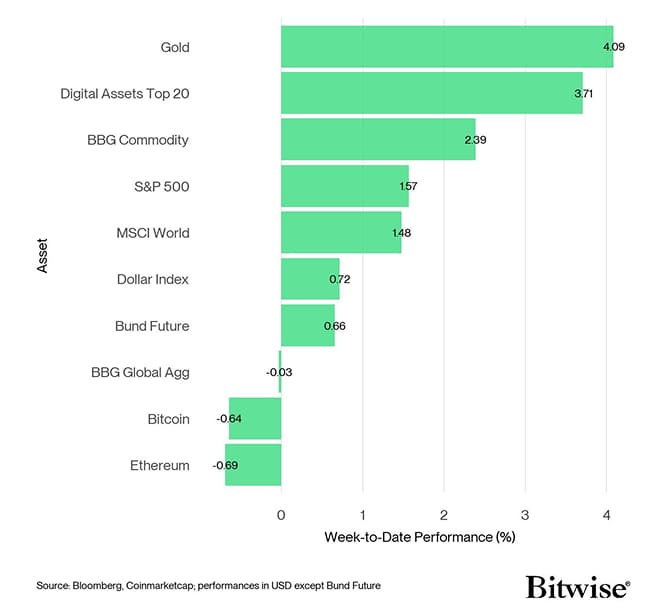 Source: Bloomberg, Coinmarketcap; performances in USD exept Bund Future
Top 10 Cryptoasset Performance (Week-to-Date)
Source: Bloomberg, Coinmarketcap; performances in USD exept Bund Future
Top 10 Cryptoasset Performance (Week-to-Date)
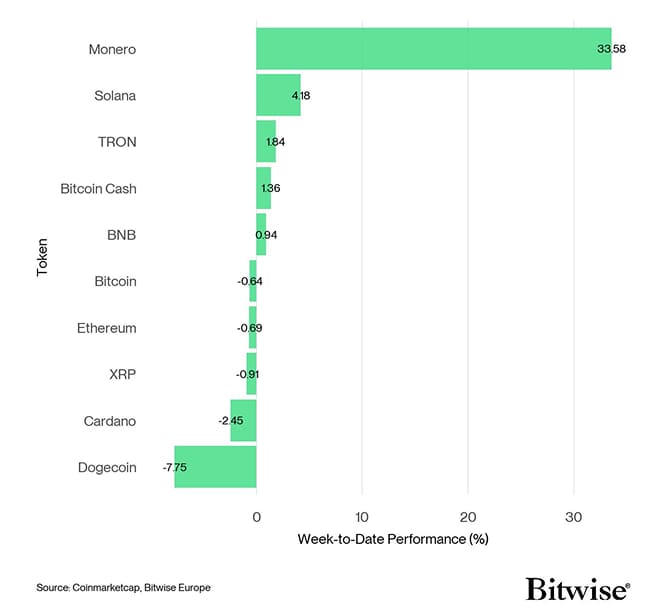 Source: Coinmarketcap
In general, among the top 10 crypto assets Monero, Solana, and TRON were the relative outperformers.
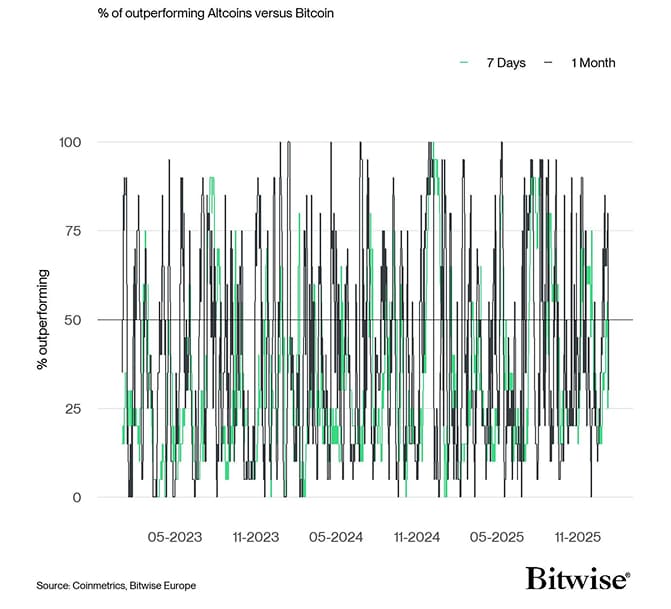
Overall, altcoin outperformance vis-à-vis bitcoin decreased last week, with 30% of our tracked altcoins managing to outperform bitcoin on a weekly basis. Ethereum also slightly underperformed bitcoin last week.
Sentiment
Our in-house “Cryptoasset Sentiment Index” has decreased compared to last week, briefly flipping negative on Thursday, although has been increasing since.
At the moment, 10 out of 15 indicators are above their short-term trend.
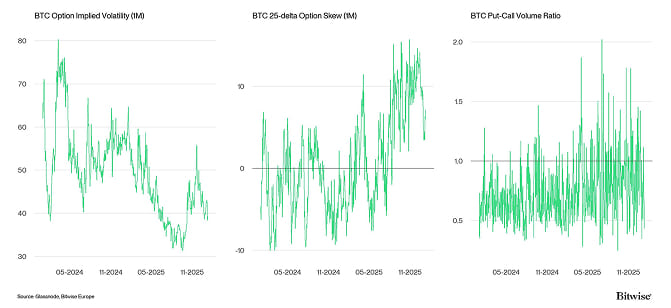
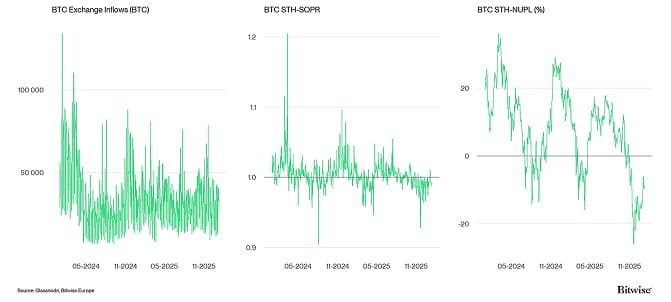
Last week, the BTC 1M 25D Skew, BTC Long Futures Liquidation Dominance, BTC Exchange Inflows, BTC Put-Call Volume, Crypto Dispersion, Crypto Fear and Greed, BTC 1M Implied Vol, Cross Asset Risk Appetite, BTC Funding Rate, BTC STH-NUPL metrics all showed positive momentum.
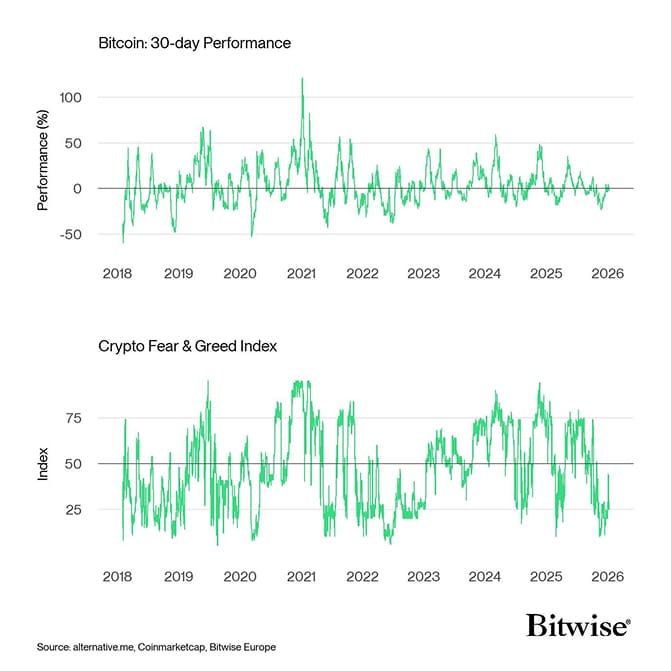
The Crypto Fear & Greed Index signals a “fear” level of sentiment as of this morning. The index has spent the whole month of November and December in either “fear” or “extreme fear” territory.
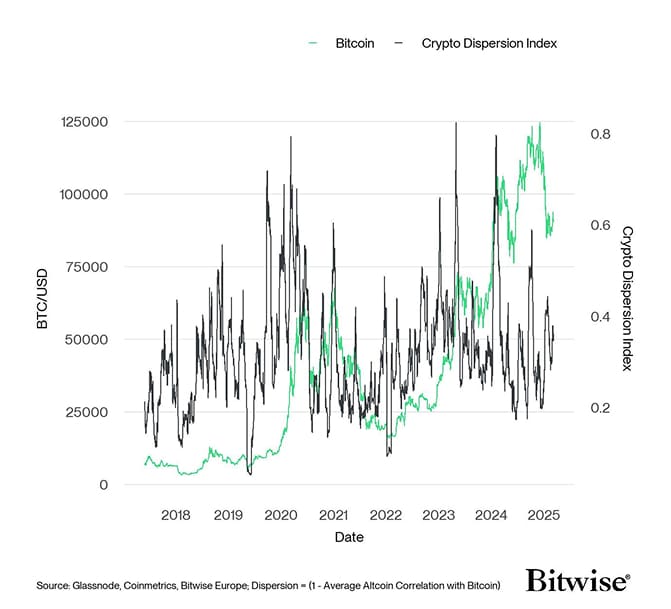
Performance dispersion among cryptoassets decreased slightly last week from 0.38 to 0.36. When dispersion is high, it means that the market appears to be driven by a more diverse set of narratives which tends to be a sign of increasing risk appetite.
Altcoin outperformance vis-à-vis Bitcoin decreased significantly last week, with around 30% of our tracked altcoins. Ethereum underperformed Bitcoin by 5bps on a weekly basis.
In general, increasing (decreasing) altcoin outperformance tends to be a sign of increasing (decreasing) risk appetite within cryptoasset markets and the latest altcoin underperformance still signals decreasing risk appetite at the moment.
Sentiment in traditional financial markets as measured by our in-house measure of Cross Asset Risk Appetite (CARA) increased slightly to 0.89. This is a notable divergence between TradFi and crypto asset sentiment that should be continued to watch closely.
Fund Flows
Global crypto ETPs saw large total net outflows last week, mainly in Bitcoin and Ethereum products. Although altcoins ex-ETH experienced sustained demand.
Global crypto ETPs saw around -554.1 mn USD in weekly net outflows across all types of cryptoassets, after +553.6 mn USD in net inflows the previous week.
Global Bitcoin ETPs have experienced net outflows totalling –425.3 mn USD last week, of which -666.4 mn USD in net outflows were related to US spot Bitcoin ETFs.
The Bitwise Bitcoin ETF (BITB) in the US experienced net outflows, totalling –3.5 mn USD last week.
In Europe, the Bitwise Physical Bitcoin ETP (BTCE) experienced net inflows equivalent to +0.2 mn USD, whereas the Bitwise Core Bitcoin ETP (BTC1) experienced net outflows of –0.2 mn USD.
The Grayscale Bitcoin Trust (GBTC) posted net outflows of -171.8 mn USD and the iShares Bitcoin Trust (IBIT) experienced net inflows of around +25.9 mn USD last week.
Meanwhile, global Ethereum ETPs also experienced –122.1 mn USD in net outflows last week, of which US spot Ethereum ETFs recorded net outflows of around –68.6 mn USD on aggregate.
The Grayscale Ethereum Trust (ETHE) posted net outflows of –145.5 mn USD, whereas the iShares Ethereum Trust (ETHA) experienced +103.6 mn USD of net inflows.
The Bitwise Ethereum ETF (ETHW) in the US has posted net inflows of +9.9 mn USD.
In Europe, the Bitwise Physical Ethereum ETP (ZETH) saw minor net inflows of +1.5 mn USD while the Bitwise Ethereum Staking ETP (ET32) saw +1.8 mn of net inflows.
Altcoin ETPs ex Ethereum experienced net inflows of +22.9 mn USD last week.
Thematic & basket crypto ETPs also posted net outflows of –29.6 mn USD on aggregate last week. The Bitwise MSCI Digital Assets Select 20 ETP (DA20) experienced negligible net flows last week of +/- 0.0 mn USD on aggregate.
Global crypto hedge funds exposure to Bitcoin decreased slightly last week. The 20-days rolling beta of global crypto hedge funds' performance to Bitcoin dropped from 0.66 to 0.64 per yesterday's close.
On-Chain Data
Sell-side dominance across exchanges reversed this week, shifting back to net buy-side pressure with Intraday spot buying minus selling closing the week at approximately +$257M, recovering sharply from –$475M the prior week.
In parallel, aggregate exchange inflow and outflow volumes rose from $5.34B to $6.47B, marking a second consecutive weekly increase in speculative activity. Despite this uptick, the total volume moving into and out of centralised exchanges remain just below the yearly average of $6.51B, suggesting overall investor risk appetite is still relatively subdued, but showing signs of recovery.
Additionally, aggregated spot volumes traded across centralised exchange products have also remain depressed at approximately $26B, well below the yearly average of $40B. This further bolsters the thesis of waning investor engagement, contributing to a continued contraction in overall market liquidity.
The broader lethargy in investor speculation is reflected in the stationary behaviour of Bitcoin dominance. Over the past 30 days, BTC dominance has increased by just 0.12%, indicating that capital flows have largely round-tripped, with only marginal rotation across the digital asset risk curve.
On-chain profit-taking has ticked higher but remains muted at approximately $253M per day, extending a multi-week stretch of historically low readings relative to the past two years. Meanwhile, loss realization continues to cool, averaging around $267M per day, bringing realized profits and losses into near balance. This equilibrium between profit-taking and loss realization suggests growing investor exhaustion and indecision, with market forces increasingly neutralised, conditions that often precede the establishment of a new directional trend.
This growing indecision is increasingly reflected in price behaviour. Bitcoin continues to coil within a tight range, repeatedly failing to sustain acceptance above the $93.5K level. Each rejection from this threshold has resulted in progressively shallower drawdowns, signalling a compression in volatility. Price action rarely remains static for extended periods, and prolonged phases of consolidation and quiet typically precede an expansion in volatility, increasing the likelihood of a decisive move ahead.
By examining the percentage spread between the 30-day high and low, we can quantify the degree of price compression and infer forward volatility expectations. Currently, just 7.3% of trading days have exhibited tighter ranges, underscoring how tightly coiled price has become on a monthly horizon.
This view is reinforced by the Sell-Side Risk Ratio, which offers a robust lens for uating the intensity of profit and loss realization across the market. By normalising realised profit and loss against the Realised Cap, the metric measures how far investors are willing to transact away from their aggregate cost basis. Currently, the Sell-Side Risk Ratio remains near historically low levels, signalling a growing reluctance among investors to realise gains or losses at prevailing prices. This suggests liquidity is increasingly constrained, and that a displacement in price is likely required to incentivise renewed market participation.
Additionally, the Realised Supply Density metric which captures the share of supply held within a ±10% band around the spot price remains elevated with roughly 23% of circulating supply clustered in this narrow range and the metric now breaking above its +1σ threshold. Through this lens market sensitivity remains heightened, implying that even modest price fluctuations could impact a large cohort of holders and amplify moves.
Ultimately, the contraction in trading volumes, the tightening of price and supply dynamics, and the balance between profit and loss realization suggest the market has entered a state of equilibrium. This period of relative rest reflects suppressed activity and participation, conditions which are historically conducive to a subsequent expansion in market volatility.
With volatility expectations elevated, key market levels come into focus for navigation. The $93.5K region continues to act as the primary point of control. A failure to reclaim and hold this level would shift attention toward the $82K–$75K zone, where several structurally significant cost bases converge, including the average investor purchase price, the Strategy treasury cost basis, and the U.S. spot Bitcoin ETF aggregate cost basis.
Conversely, a decisive and sustained acceptance above $93.5K would signal improving market momentum, placing the Short-Term Holder cost basis near $99K into view, closely aligned with the psychologically important $100K threshold.
Futures, Options & Perpetuals
Over the past week, BTC perpetual futures open interest declined by -3.4k BTC across all exchanges, while CME futures open interest increased meaningfully by +11.9k BTC, indicating a large uptick in institutional positioning. In aggregate, total open interest has experienced an uptick, but overall remains relatively subdued compared to recent months, suggesting that the futures market is not the primary driver of current price action.
Furthermore, the Top Asset Leverage Ratio, which tracks the aggregate open interest across major assets (BTC, ETH, SOL, DOGE, and XRP) as a percentage of their market cap has remained largely flat and unrecovered since the October 2025 deleveraging event. This indicates that leverage has yet to meaningfully rebuild, reinforcing the view that current market conditions are predominantly spot-driven rather than derivative-led.
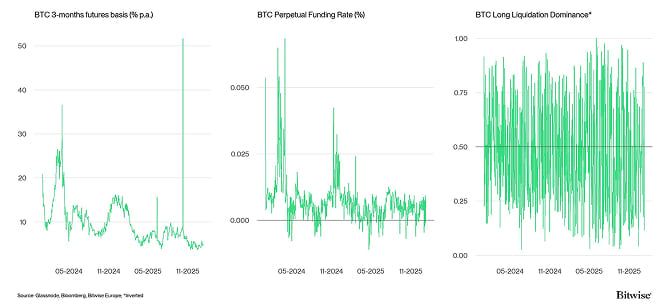
BTC perpetual funding rates have also remained sideways week-over-week, suggesting a stagnation in long-side positioning among traders. Notably, funding levels remain well below those seen in previous months, reinforcing the view that derivatives positioning is no longer the dominant force driving market dynamics.
In general, when the funding rate is positive (negative), long (short) positions periodically pay short (long) positions, which is indicative of bullish (bearish) sentiment.
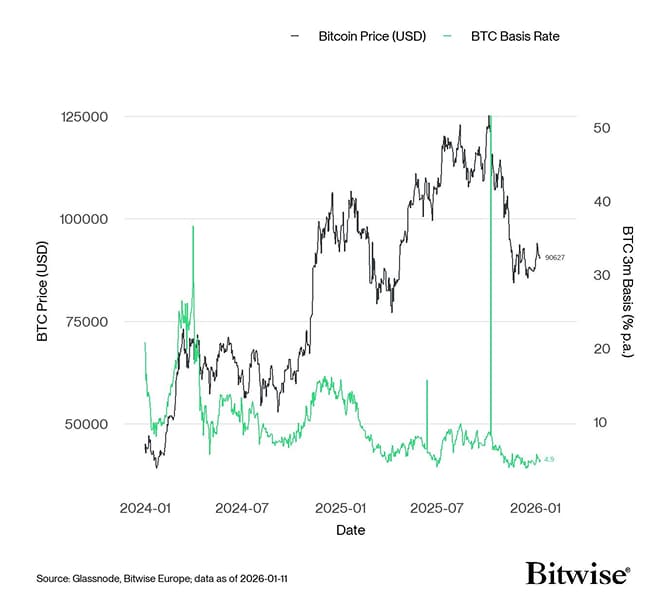
The BTC 3-month annualised basis also remained largely flat, moving from 4.8% to just 4.9%, one of the lowest readings across the last 2 years.
Open interest remains elevated at the $89k level, highlighting this as an area critical to hold. This area is likely to be highly sensitive, with long traders attempting to defend their positions.
BTC options open interest expanded by +34.7K BTC over the week, signalling renewed positioning in the derivatives market. The put-to-call open interest ratio remains elevated at 0.76, persisting after the sharp increase surrounding the largest call option expiry over the Christmas period.
At the same time, the 25-delta skew has risen across all tenors, indicating a growing premium for downside protection. Together, these dynamics suggest that while positioning is building, hedging demand is increasing, reflecting a more cautious stance among options participants.
Bottom Line
- Cryptoassets underperformed traditional markets last week as institutional bitcoin demand weakened, driven by ETP outflows and elevated miner supply.
- Chart-of-the-Week: Long-term holder selling is declining materially, and our Cryptoasset Sentiment Index has reverted back to neutral, signaling fading on-chain headwinds but cautious market positioning.
- Macro tailwinds are building as Fed balance sheet expansion points to de facto QE, while subdued trading activity suggests investors are awaiting a new catalyst.
Appendix
Bitcoin Price vs Cryptoasset Sentiment Index
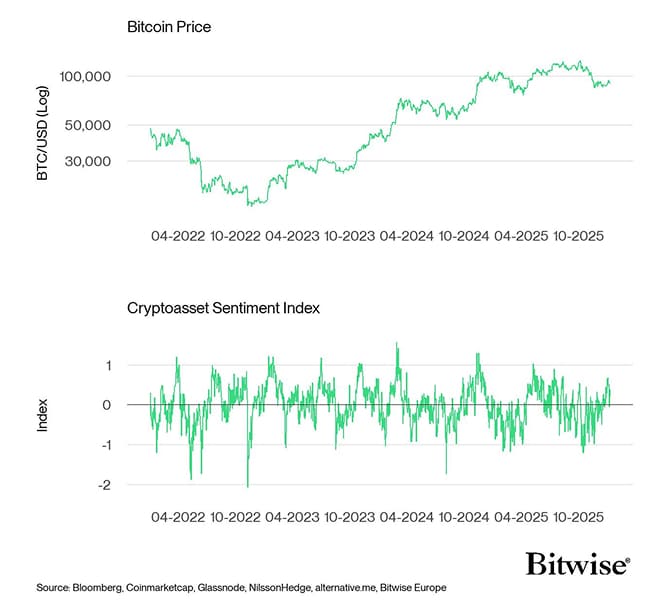 Source: Bloomberg, Coinmarketcap, Glassnode, NilssonHedge, alternative.me, Bitwise Europe
Cryptoasset Sentiment Index
Source: Bloomberg, Coinmarketcap, Glassnode, NilssonHedge, alternative.me, Bitwise Europe
Cryptoasset Sentiment Index
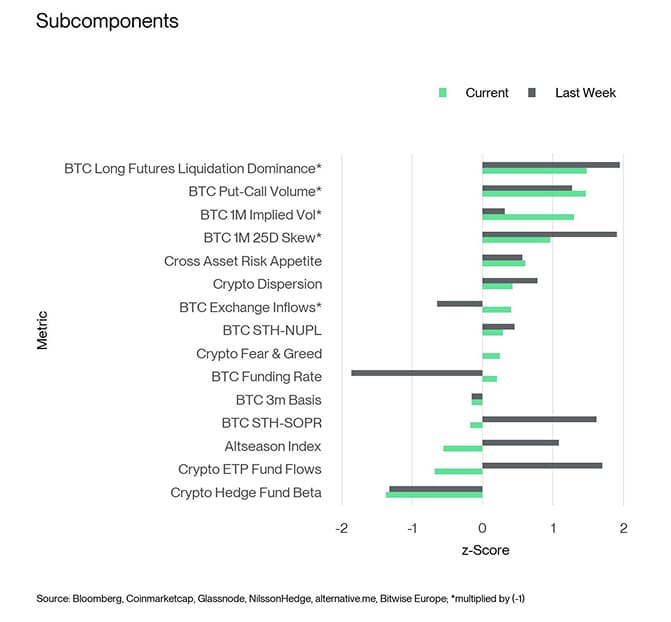 Source: Bloomberg, Coinmarketcap, Glassnode, NilssonHedge, alternative.me, Bitwise Europe; *multiplied by (-1)
Cryptoasset Sentiment Index
Source: Bloomberg, Coinmarketcap, Glassnode, NilssonHedge, alternative.me, Bitwise Europe; *multiplied by (-1)
Cryptoasset Sentiment Index
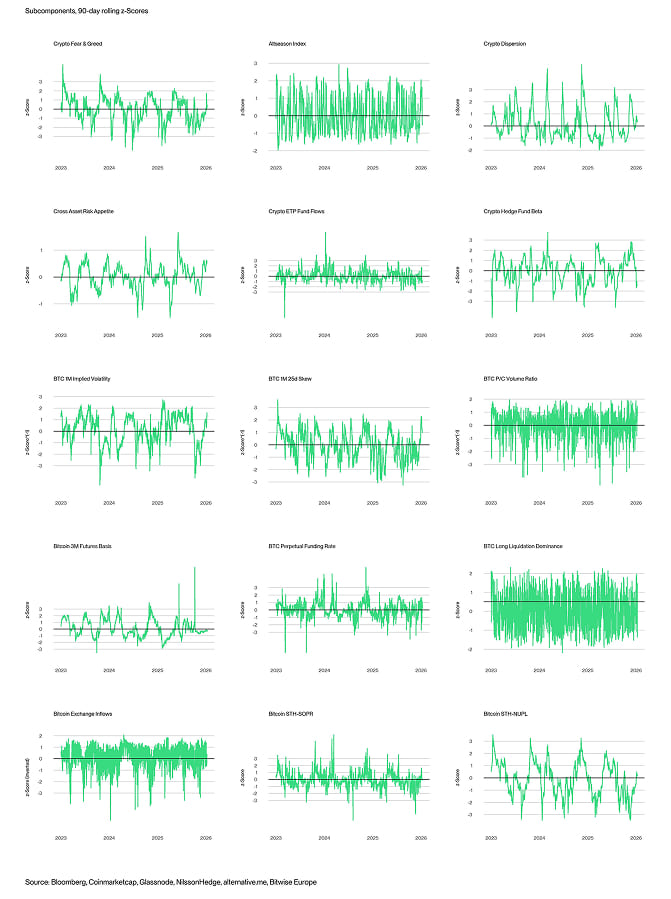 Source: Bloomberg, Coinmarketcap, Glassnode, NilssonHedge, alternative.me, Bitwise Europe
TradFi Sentiment Indicators
Source: Bloomberg, Coinmarketcap, Glassnode, NilssonHedge, alternative.me, Bitwise Europe
TradFi Sentiment Indicators
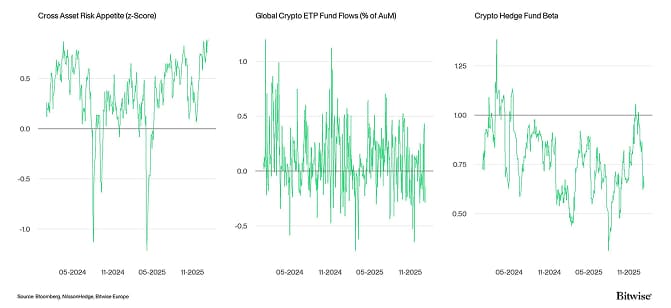 Source: Bloomberg, NilssonHedge, Bitwise Europe
Crypto Sentiment Indicators
Source: Bloomberg, NilssonHedge, Bitwise Europe
Crypto Sentiment Indicators
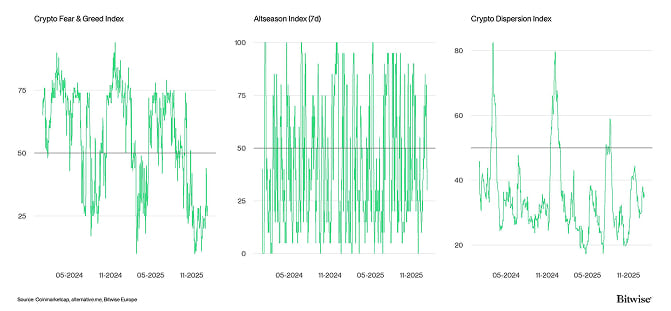 Source: Coinmarketcap, alternative.me, Bitwise Europe
Crypto Options' Sentiment Indicators
Source: Coinmarketcap, alternative.me, Bitwise Europe
Crypto Options' Sentiment Indicators
 Source: Glassnode, Bitwise Europe
Crypto Futures & Perpetuals' Sentiment Indicators
Source: Glassnode, Bitwise Europe
Crypto Futures & Perpetuals' Sentiment Indicators
 Source: Glassnode, Bitwise Europe; *Inverted
Crypto On-Chain Indicators
Source: Glassnode, Bitwise Europe; *Inverted
Crypto On-Chain Indicators
 Source: Glassnode, Bitwise Europe
Bitcoin vs Crypto Fear & Greed Index
Source: Glassnode, Bitwise Europe
Bitcoin vs Crypto Fear & Greed Index
 Source: alternative.me, Coinmarketcap, Bitwise Europe
Cryptoasset Sentiment Index: Daily vs Hourly
Source: alternative.me, Coinmarketcap, Bitwise Europe
Cryptoasset Sentiment Index: Daily vs Hourly
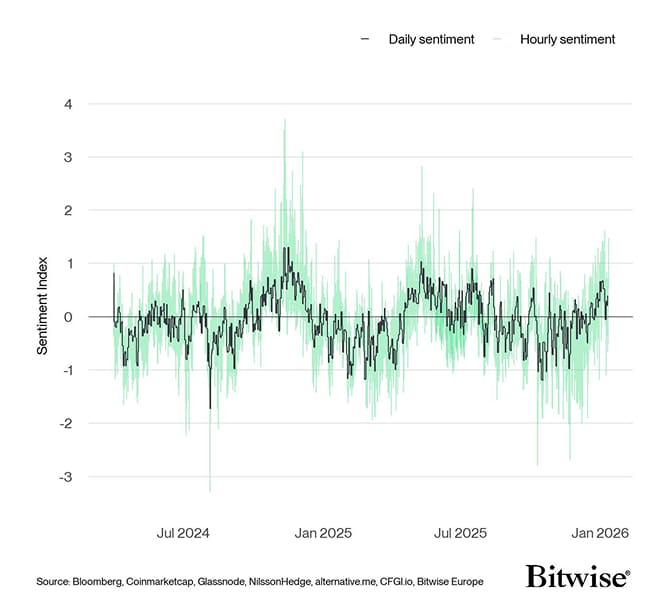 Source: Bloomberg, Coinmarketcap, Glassnode, NilssonHedge, alternative.me, CFGI.io, Bitwise Europe
Bitcoin vs Global Crypto ETP Fund Flows
Source: Bloomberg, Coinmarketcap, Glassnode, NilssonHedge, alternative.me, CFGI.io, Bitwise Europe
Bitcoin vs Global Crypto ETP Fund Flows
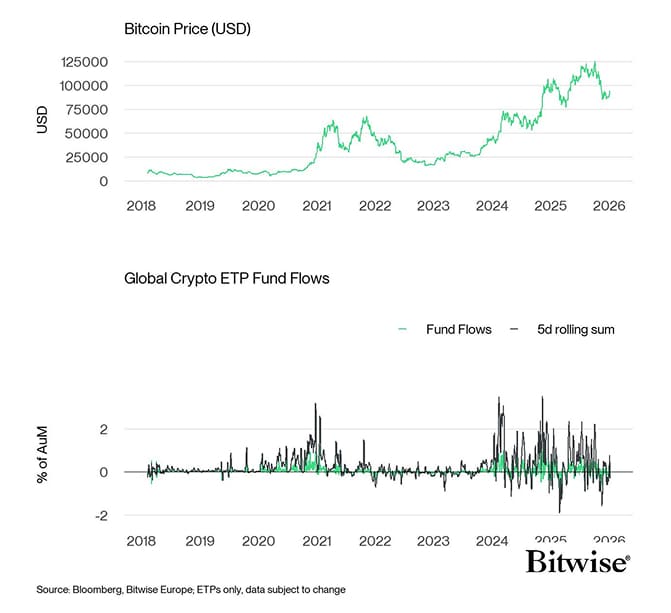 Source: Bloomberg, Bitwise Europe; ETPs only, data subject to change
Global Crypto ETP Fund Flows
Source: Bloomberg, Bitwise Europe; ETPs only, data subject to change
Global Crypto ETP Fund Flows
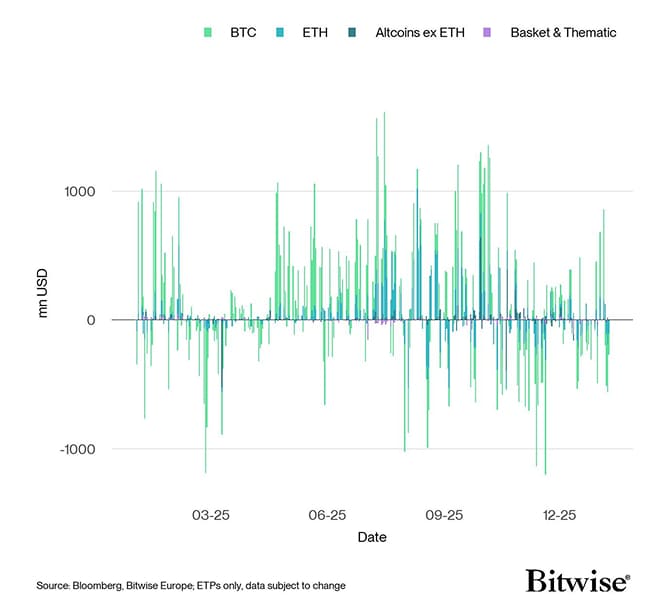 Source: Bloomberg, Bitwise Europe; ETPs only; data subject to change
US Spot Bitcoin ETF Fund Flows
Source: Bloomberg, Bitwise Europe; ETPs only; data subject to change
US Spot Bitcoin ETF Fund Flows
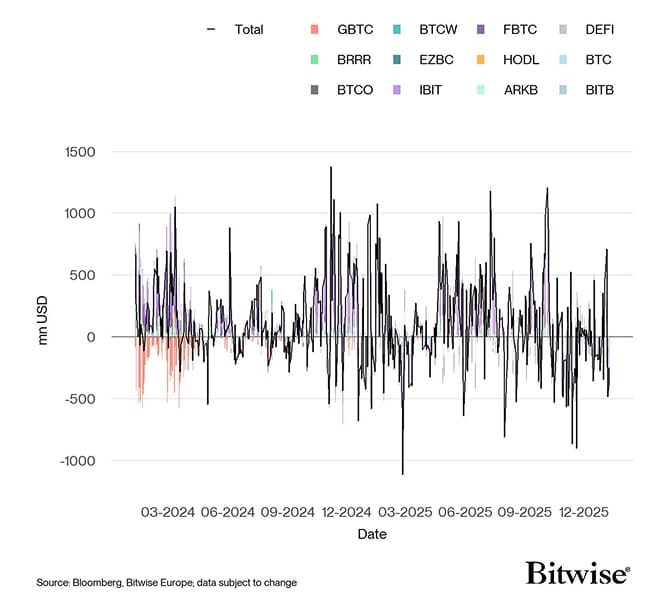 Source: Bloomberg, Bitwise Europe; data subject to change
US Spot Bitcoin ETFs: Flows since launch
Source: Bloomberg, Bitwise Europe; data subject to change
US Spot Bitcoin ETFs: Flows since launch
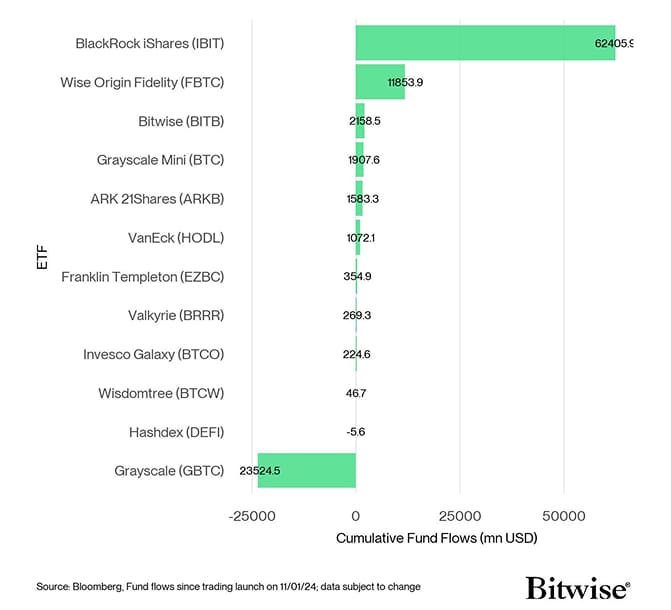 Source: Bloomberg, Fund flows since traiding launch on 11/01/24; data subject to change
US Spot Bitcoin ETFs: 5-days flow
Source: Bloomberg, Fund flows since traiding launch on 11/01/24; data subject to change
US Spot Bitcoin ETFs: 5-days flow
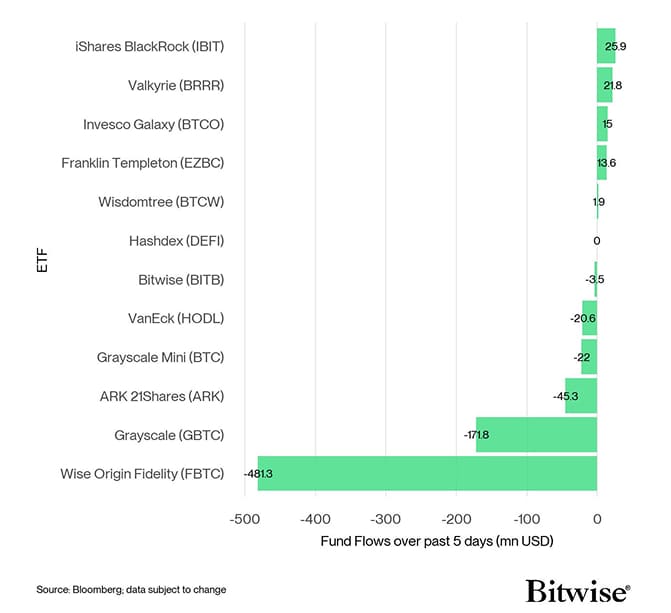 Source: Bloomber; data subject to change
US Bitcoin ETFs: Net Fund Flows since 11th Jan mn USD
Source: Bloomber; data subject to change
US Bitcoin ETFs: Net Fund Flows since 11th Jan mn USD
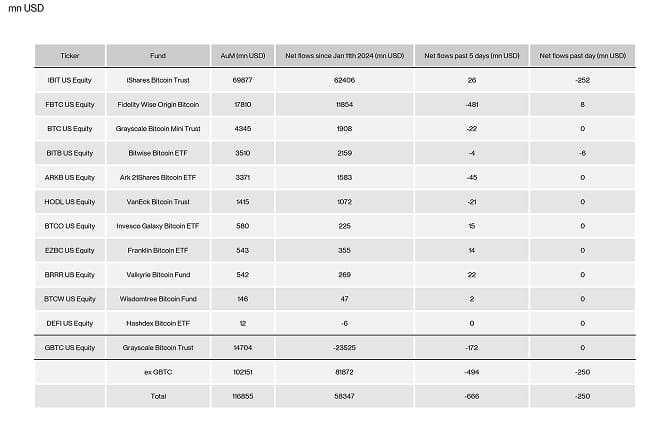 Source: Bloomberg, Bitwise Europe; data as of 09-01-2026
US Spot Ethereum ETF Fund Flows
Source: Bloomberg, Bitwise Europe; data as of 09-01-2026
US Spot Ethereum ETF Fund Flows
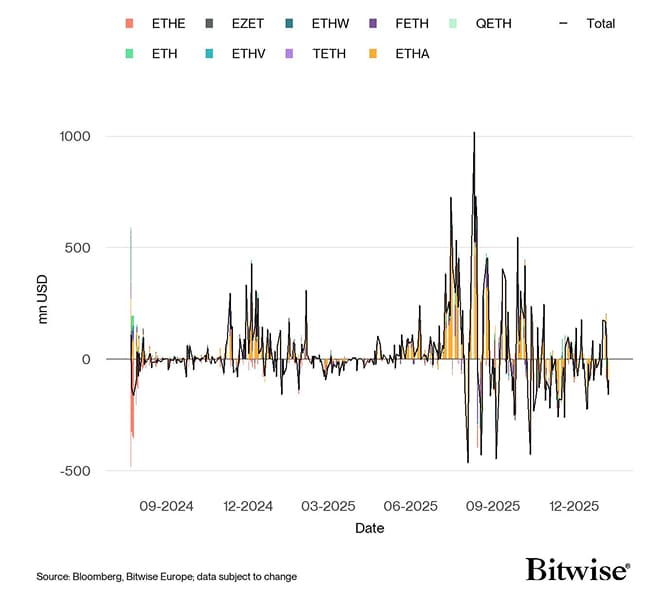 Source: Bloomberg, Bitwise Europe; data subject to change
US Spot Ethereum ETFs: Flows since launch
Source: Bloomberg, Bitwise Europe; data subject to change
US Spot Ethereum ETFs: Flows since launch
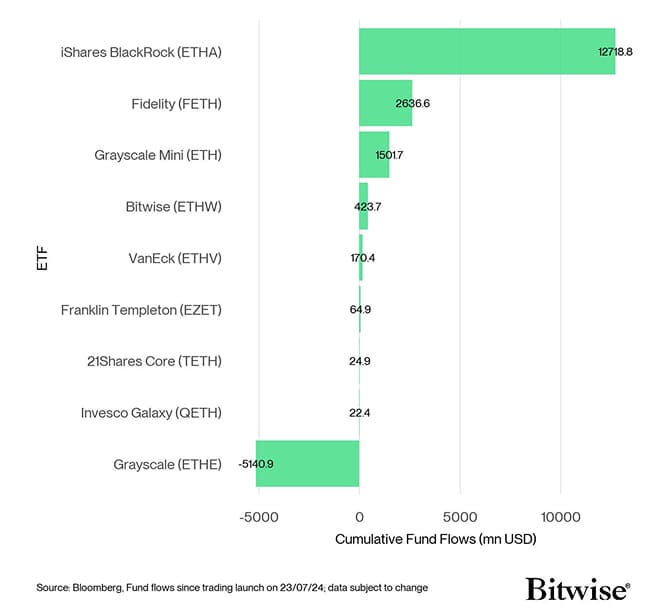 Source: Bloomberg, Fund flows since trading launch on 23/07/24; data subject on change
US Spot Ethereum ETFs: 5-days flow
Source: Bloomberg, Fund flows since trading launch on 23/07/24; data subject on change
US Spot Ethereum ETFs: 5-days flow
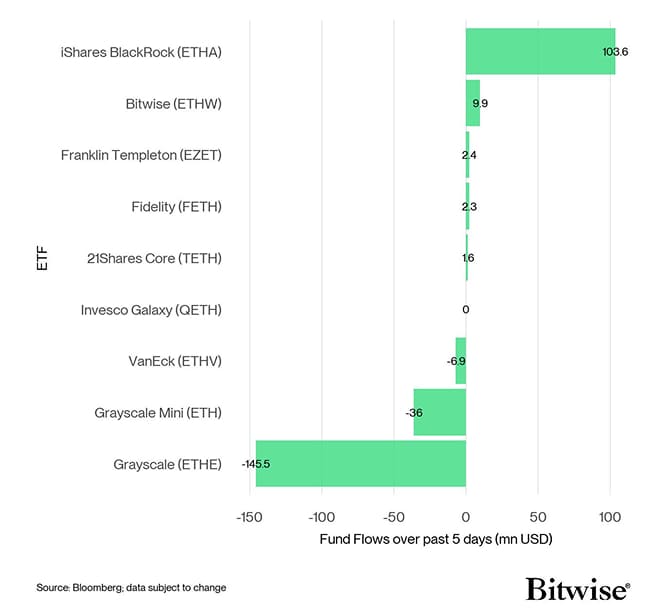 Source: Bloomberg; data subject on change
US Ethereum ETFs: Net Fund Flows since 23rd July
Source: Bloomberg; data subject on change
US Ethereum ETFs: Net Fund Flows since 23rd July
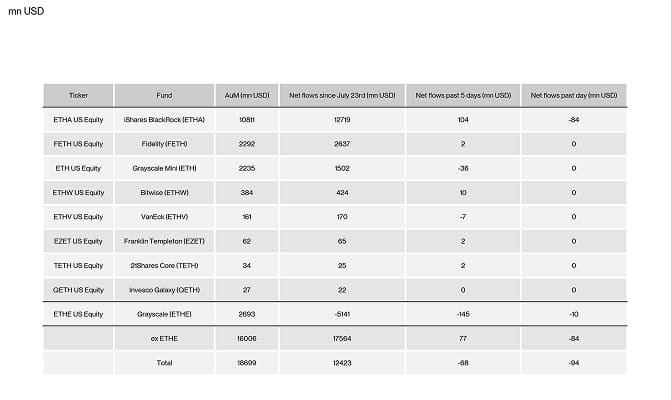 Source: Bloomberg, Bitwise Europe; data as of 09-01-2026
Bitcoin vs Crypto Hedge Fund Beta
Source: Bloomberg, Bitwise Europe; data as of 09-01-2026
Bitcoin vs Crypto Hedge Fund Beta
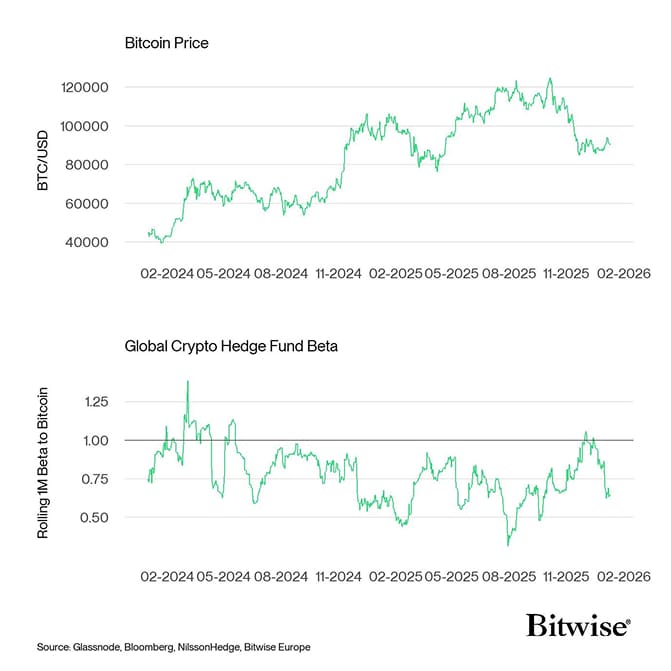 Source: Glassnode, Bloomberg, NilssonHedge, Bitwise Europe
Altseason Index
Source: Glassnode, Bloomberg, NilssonHedge, Bitwise Europe
Altseason Index
 Source: Coinmetrics, Bitwise Europe
Bitcoin vs Crypto Dispersion Index
Source: Coinmetrics, Bitwise Europe
Bitcoin vs Crypto Dispersion Index
 Source: Coinmarketcap, Bitwise Europe; Dispersion = (1 - Average Altcoin Correlation with Bitcoin)
Bitcoin Price vs Futures Basis Rate
Source: Coinmarketcap, Bitwise Europe; Dispersion = (1 - Average Altcoin Correlation with Bitcoin)
Bitcoin Price vs Futures Basis Rate
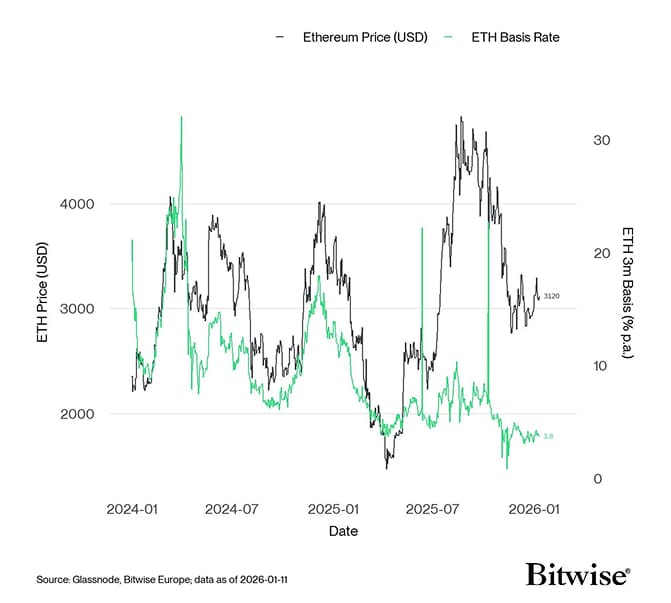
 Source: Glassnode, Bitwise Europe; data as of 2026-01-11
Ethereum Price vs Futures Basis Rate
Source: Glassnode, Bitwise Europe; data as of 2026-01-11
Ethereum Price vs Futures Basis Rate
 Source: Glassnode, Bitwise Europe; data as of 2026-01-11
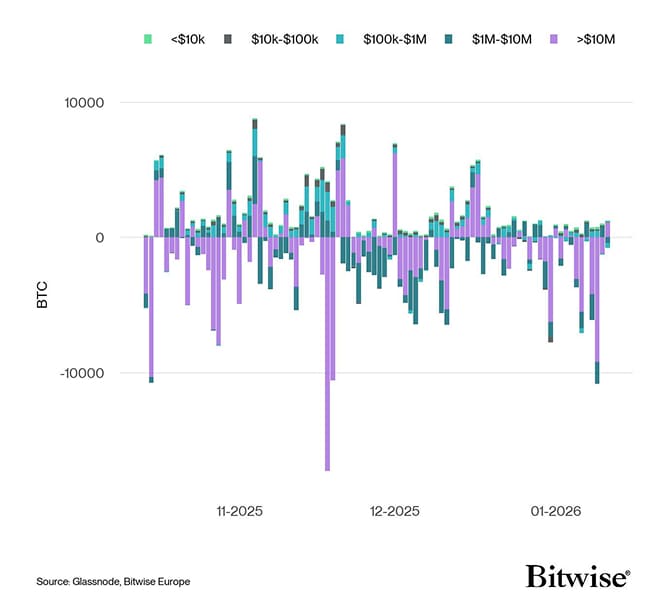
BTC Net Exchange Volume by Size
Source: Glassnode, Bitwise Europe; data as of 2026-01-11
BTC Net Exchange Volume by Size
 Source: Glassnode, Bitwise Europe
Important Information
This publication constitutes a marketing communication and is provided for informational purposes only. It does not constitute investment advice, a personal recommendation, or an offer or solicitation to buy or sell any financial instrument.
This document (which may take the form of a presentation, press release, social media post, blog article, broadcast communication or similar instrument – collectively referred to as a “Document”) is issued by Bitwise Europe GmbH (“BEU” or the “Issuer”) and has been prepared in accordance with applicable laws and regulations, including those relating to financial promotions.
Bitwise Europe GmbH, incorporated under the laws of Germany, is the issuer of the Exchange Traded Products (“ETPs”) referenced in this Document under a base prospectus and the applicable final terms, as supplemented from time to time, approved by the German Federal Financial Supervisory Authority (BaFin). The approval of the prospectus by BaFin relates solely to the completeness, coherence and comprehensibility of the prospectus in accordance with the Prospectus Regulation and does not constitute an endorsement, recommendation or assessment of the merits of the products.
The market analyses, views and scenarios presented reflect the assessment as of the date of publication and are based on information considered reliable. However, no representation or warranty is made as to their accuracy or completeness. Forward-looking statements involve risks and uncertainties and are not guarantees of future performance. Past performance is not a reliable indicator of future results.
Capital at risk. Cryptoassets are highly volatile and involve a high degree of risk. The value of investments in cryptoassets and crypto-linked ETPs may fluctuate significantly, and investors may lose part or all of their invested capital. No capital protection or guaranteed compensation mechanism applies in respect of market losses.
Any investment decision should be made solely on the basis of the relevant base prospectus, the applicable final terms and the key information document, in particular the section entitled “Risk Warning”. The base prospectus, final terms and additional risk information are available at: www.bitwiseinvestments.eu
Access to certain documents may require self-certification regarding your jurisdiction and investor status and may be subject to additional disclaimers and important information.
For further details, please refer to the full disclaimer available at: www.bitwiseinvestments.eu/disclaimer

 en
en  de
de  it
it  fr
fr  es
es