- Cryptoassets lagged broader markets amid elevated geopolitical uncertainty, while precious metals signalled a clear flight-to-safety on renewed Greenland annexation headlines and rising Polymarket odds.
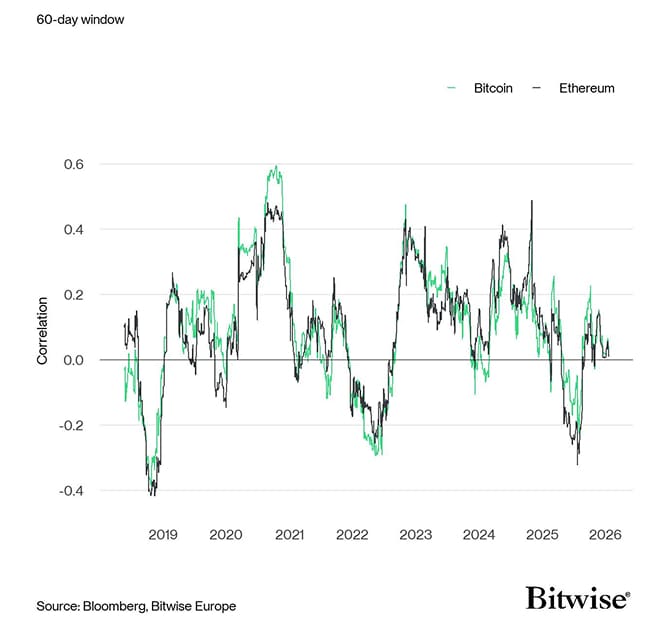
- Chart-of-the-Week: Rolling 3-month correlations show major cryptoassets remain broadly uncorrelated with gold, even as the bitcoin–gold performance divergence has widened materially.
- Relative-value signals are flashing: the BTC/Gold ratio is near -2 standard deviations versus global money supply (levels last seen in 2015), while the Cryptoasset Sentiment Index has turned slightly bearish.
Chart of the Week
Rolling correlation: Gold
Performance
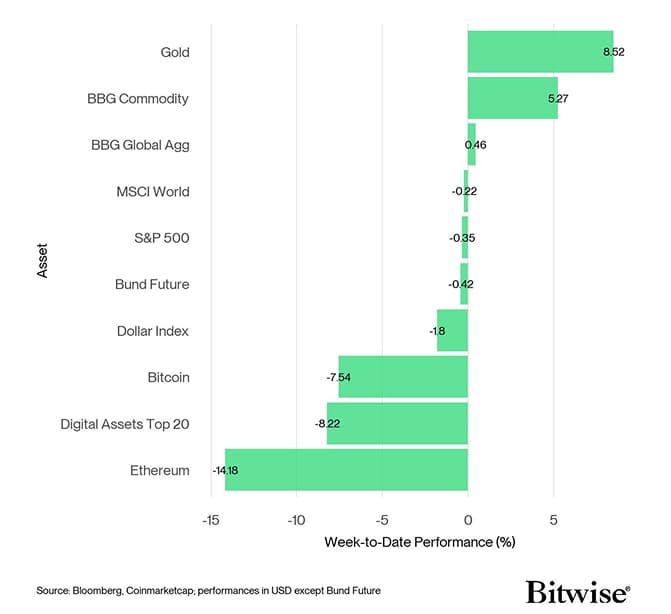
Last week, cryptoassets struggled to outperform other assets due to elevated geopolitical uncertainty. Precious metals continued to signal a flight-to-safety as both the US president and the White House made peculiar posts about a potential annexation of Greenland via their official Twitter accounts.
In fact, Polymarket odds for the US to acquire parts of Greenland in 2026 have risen above 30% last week – one of the highest levels since inception. Trump has also reiterated the United States' interest in Greenland during a recent speech at the World Economic Forum in Davos.
Though not mentioned by Trump specifically, the rationale behind annexing (parts of) Greenland mostly centres around national security reasons as well as access to critical rare earth minerals.
The rally in precious metals and especially the significant divergence between bitcoin's and gold's performance remain the ‘elephant in the room' from a market's perspective.
In general, rolling correlations between major cryptoassets and gold imply rather uncorrelated performances over the past 3 months (Chart-of-the-Week).
In this context, we have highlighted bitcoin's significant “mispricing” relative to the level of global money supply and also relative to gold in one of our previous Bitcoin Macro Investor reports as well. We are still observing a historic level of under-pricing between bitcoin and gold – the BTC/Gold-ratio is already at -2 standard deviations relative to global money supply – a level of under-pricing last seen in 2015. Therefore, we continue to think that there is very significant relative value in bitcoin vis-à-vis gold.
Besides, relative Google search trends for precious metals like gold and silver also imply that the latest rally is somewhat stretched.
That being said, precious metals have also been rallying due to renewed weakness in the US Dollar – the Dollar Index (DXY) fell to cycle lows again last week. In this context, it is worth highlighting that a new high-frequency indicator for the US Dollar's share in international foreign currency reserves is declining faster than previously anticipated. The latest available data already imply a share of only 40%, down from 60% in the early 2000s. It is no surprise that Bridgewater's Ray Dalio already speaks about ‘the end of the existing monetary order'. Meanwhile, both the Japanese Ministry of Finance and the US Federal Reserve have signalled to intervene into FX markets in order to stabilise the Yen-Dollar exchange rate. The only comment worth making in this context is that higher JGB yields are increasingly incentivising a repatriation of capital from overseas markets back to Japan as the relative yield pick-up of overseas bonds is declining. Based on the latest available data per end of 2024, Japanese investors hold around 342 trillion JPY in US assets alone.
In the context of the rally in precious metals and a depreciation of the US Dollar, it is worth noting that high-frequency indicators for inflation in the US do not signal an imminent rise in domestic CPI inflation. To the contrary, the daily inflation index published by Truflation even signals a significant deceleration in inflation dynamics in the US. That means that the rise in precious metals is so far rather related to flight-to-safety rather than a reflection of imminent inflation fears.
As far as US monetary policy is concerned, a swiftly declining inflation rate implies that the Fed will maintain its easing bias at least until May 2026 – when a new (likely dovish) Fed chair will take over.
Based on the latest data provided by Polymarket, Blackrock's Rick Rieder is now the main contender for the next Fed chair with almost a 50% chance. He is generally regarded as a monetary policy ‘dove' which implies ongoing easing if he was nominated as next Fed chair.
He has also made positive remarks with respect to bitcoin in the past. Thus, his nomination would most certainly be bullish for bitcoin and other cryptoassets.
Cross Asset Performance (Week-to-Date)
 Source: Bloomberg, Coinmarketcap; performances in USD exept Bund Future
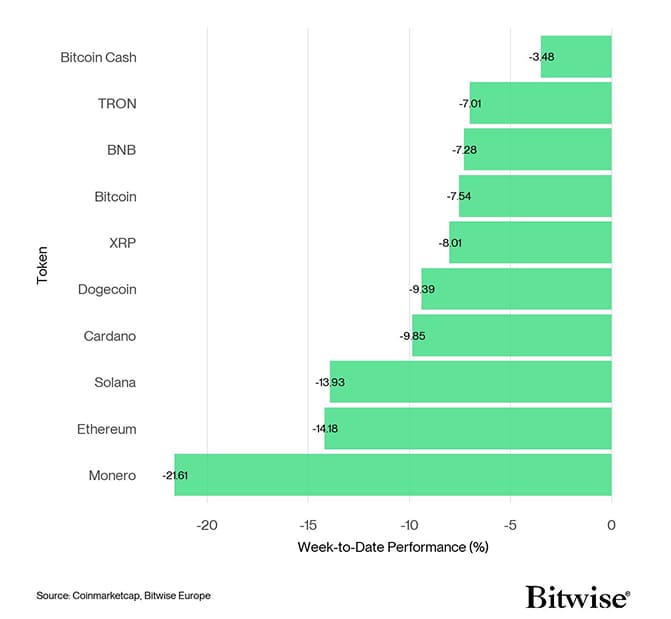
Top 10 Cryptoasset Performance (Week-to-Date)
Source: Bloomberg, Coinmarketcap; performances in USD exept Bund Future
Top 10 Cryptoasset Performance (Week-to-Date)
 Source: Coinmarketcap
In general, among the top 10 crypto assets Bitcoin Cash, TRON, and BNB were the relative outperformers.
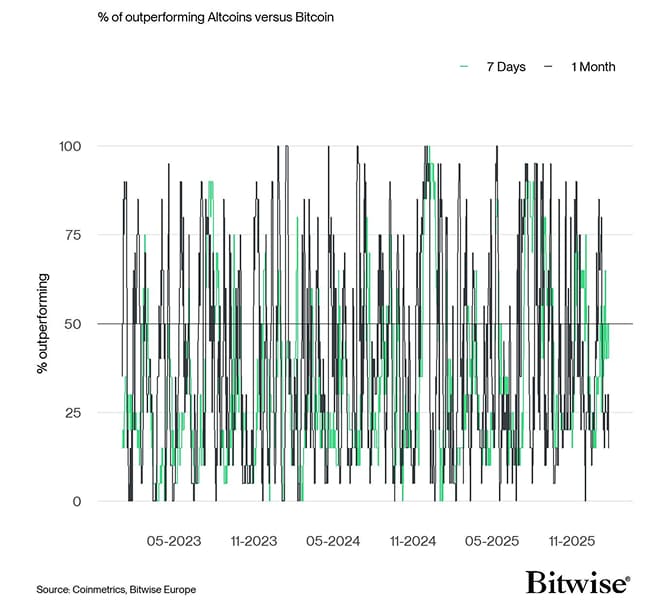
Overall, altcoin outperformance vis-à-vis bitcoin has decreased again last week, with 30% of our tracked altcoins managing to outperform bitcoin on a weekly basis. Ethereum also underperformed bitcoin last week.
Sentiment
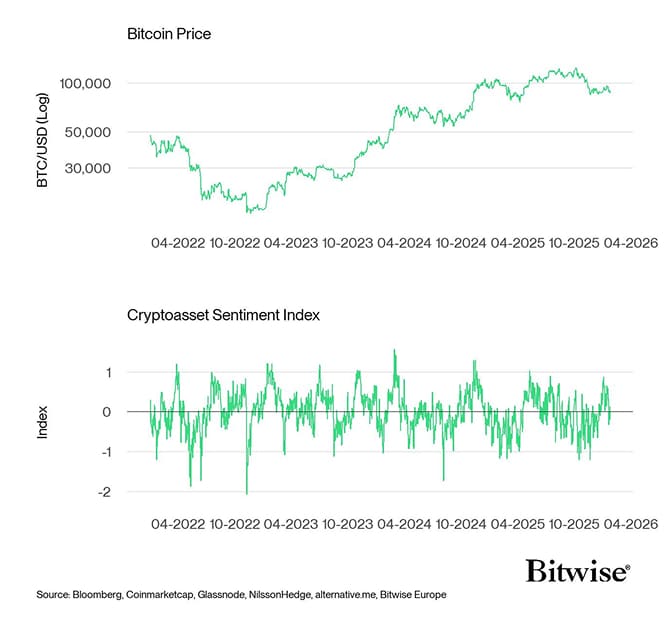
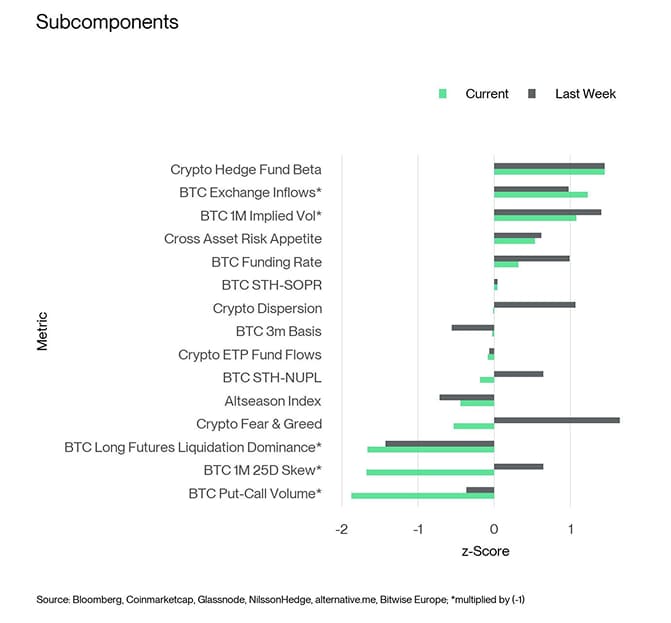
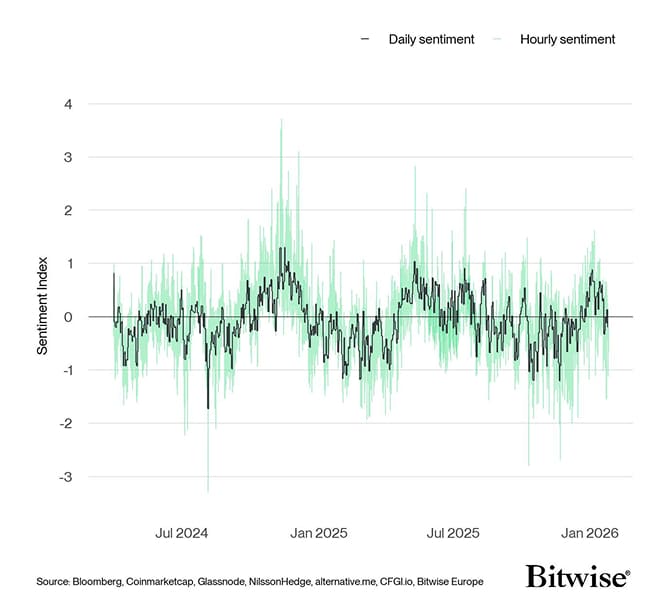
Our in-house “Cryptoasset Sentiment Index” decreased significantly compared to last week. Starting last Monday in positive territory, sentiment then dipped sharply and stayed negative for most of the rest of the week.
At the moment, 6 out of 15 indicators are above their short-term trend.
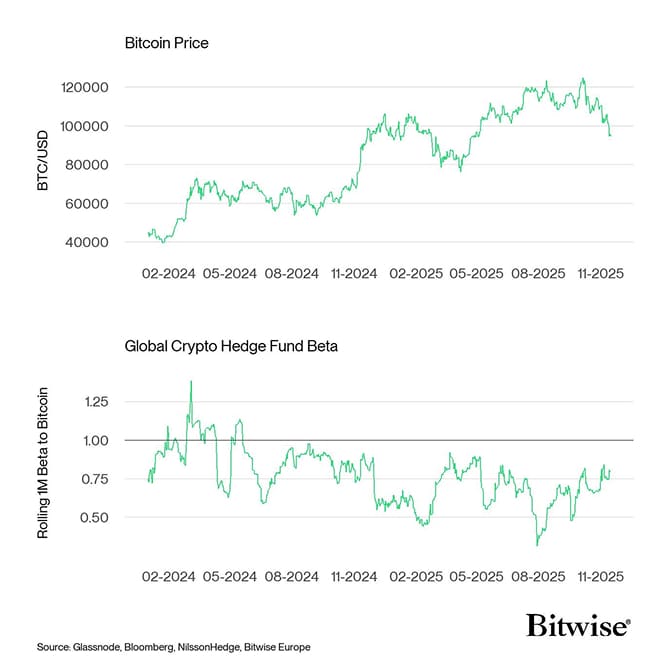
Last week, the BTC Exchange Inflows, BTC 1M Implied Vol, BTC Hedge Fund Beta, Cross Asset Risk Appetite, BTC STH-SOPR, and BTC Funding Rate metrics all showed positive momentum.
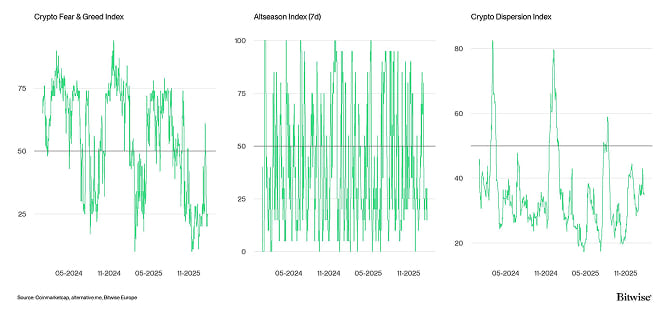
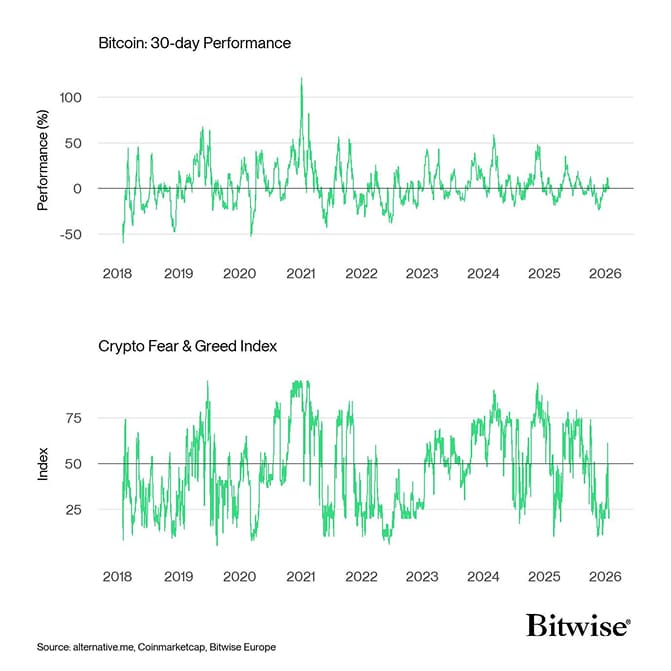
The Crypto Fear & Greed Index signals a “extreme fear” level of sentiment as of this morning. The index spent the whole month of November and December in either “fear” or “extreme fear” territory although turned to “Greed” briefly early in the third calendar week of January before slipping back down to “Fear”.
Performance dispersion among cryptoassets decreased slightly last week from 0.41 to 0.35. When dispersion is high, it means that the market appears to be driven by a more diverse set of narratives which tends to be a sign of increasing risk appetite.
Altcoin outperformance vis-à-vis Bitcoin increased last week, with around 30% of our tracked altcoins. Ethereum underperformed Bitcoin.
In general, increasing (decreasing) altcoin outperformance tends to be a sign of increasing (decreasing) risk appetite within cryptoasset markets.
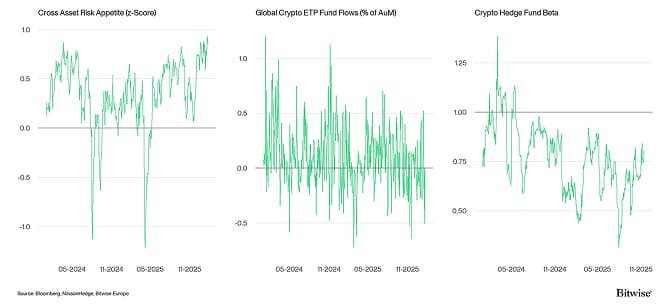
Sentiment in traditional financial markets as measured by our in-house measure of Cross Asset Risk Appetite (CARA) increased to 0.85. This is a notable divergence between TradFi and crypto asset sentiment that should be continued to watch closely.
Fund Flows
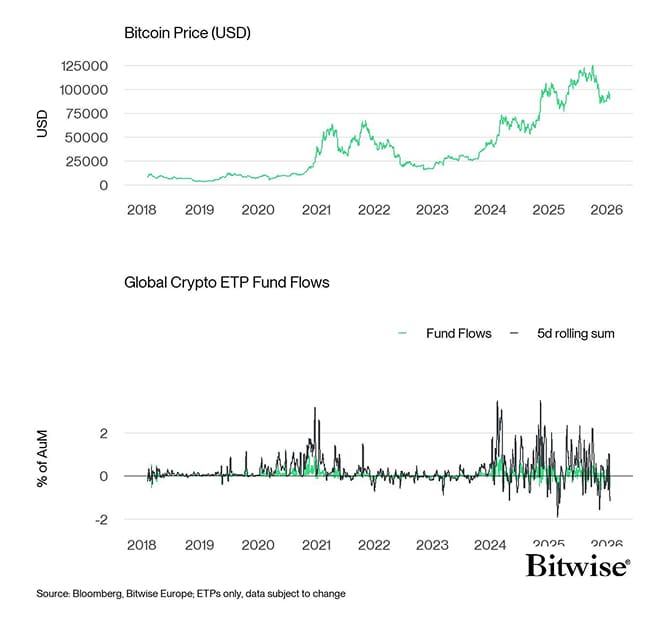
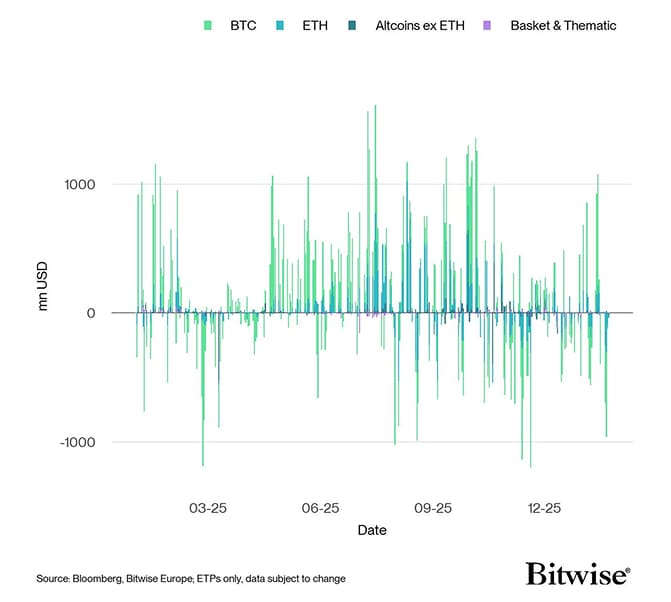
Global crypto ETPs saw large total net outflows last week across Bitcoin, Ethereum, and basket and thematic products. Whereas Altcoin Ex-ETH products saw slight net inflows.
Global crypto ETPs saw around -1811 mn USD in weekly net outflows across all types of cryptoassets, after +2019.9 mn USD in net inflows the previous week.
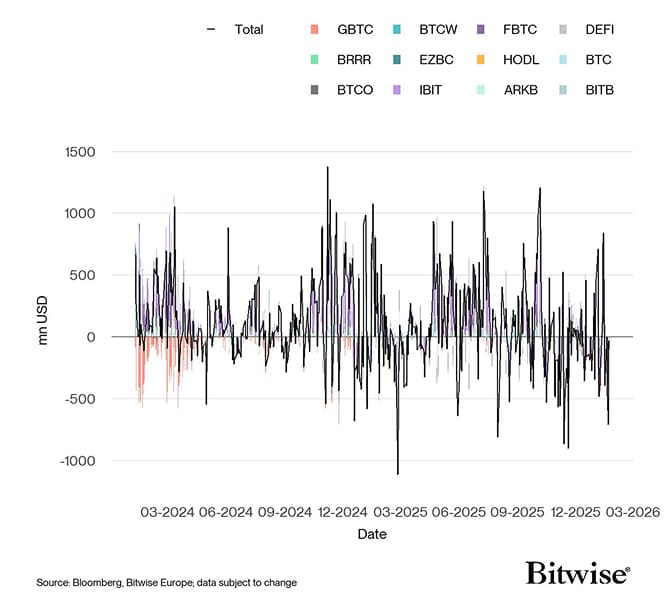
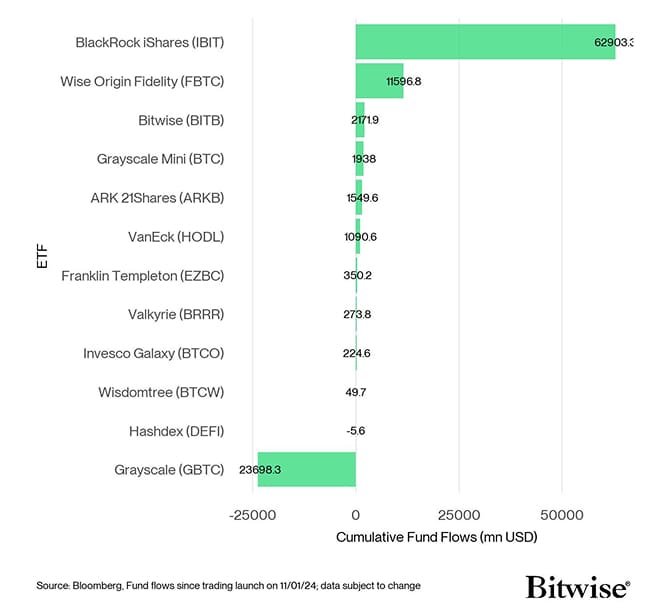
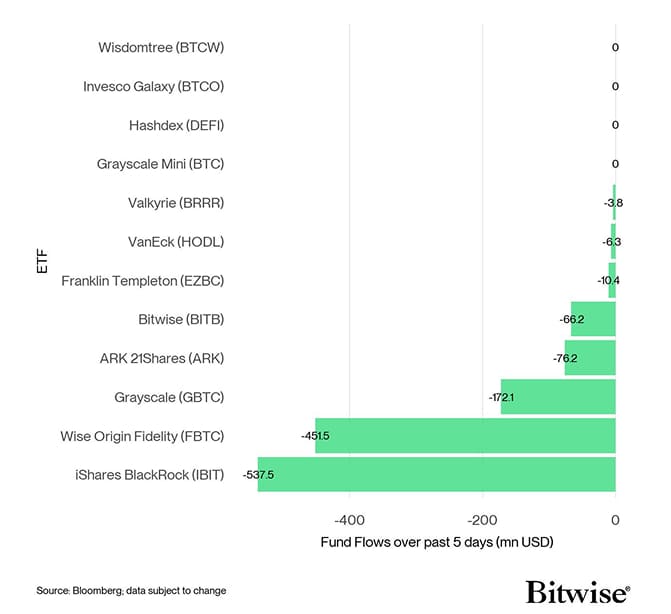
Global Bitcoin ETPs have experienced net outflows totalling -1128 mn USD last week, of which -1324 mn USD in net outflows were related to US spot Bitcoin ETFs.
The Bitwise Bitcoin ETF (BITB) in the US experienced net outflows, totalling -66.2 mn USD last week.
In Europe, the Bitwise Physical Bitcoin ETP (BTCE) experienced net outflows equivalent to -3.6 mn USD, whereas the Bitwise Core Bitcoin ETP (BTC1) experienced minor net inflows of +1.4 mn USD.
The Grayscale Bitcoin Trust (GBTC) posted net outflows of -172.1 mn USD and the iShares Bitcoin Trust (IBIT) experienced net outflows of around -537.5 mn USD last week.
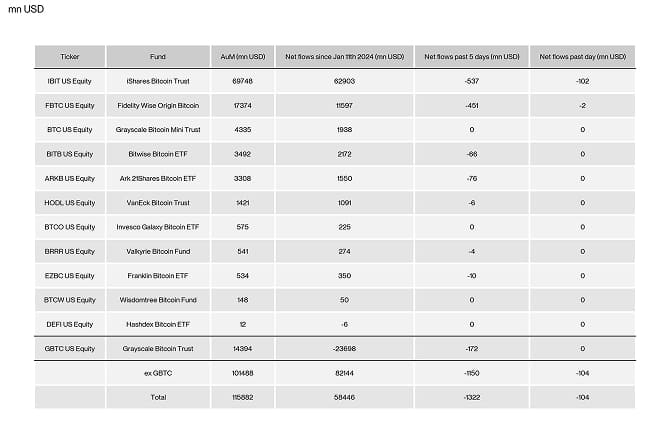
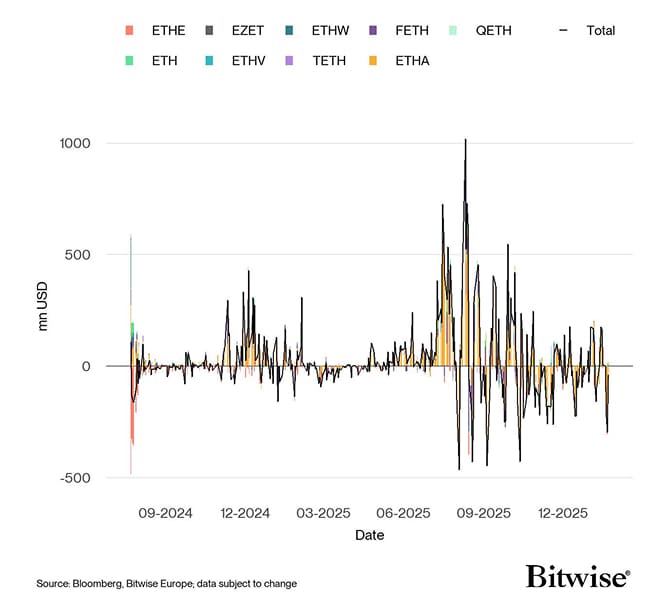
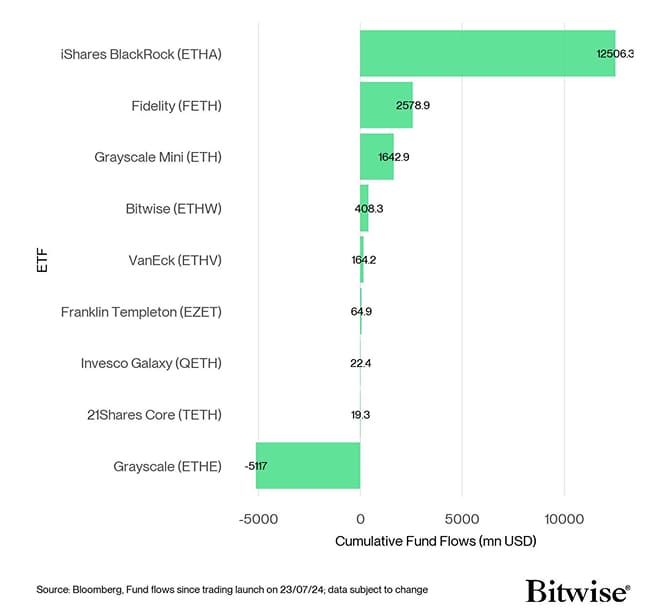
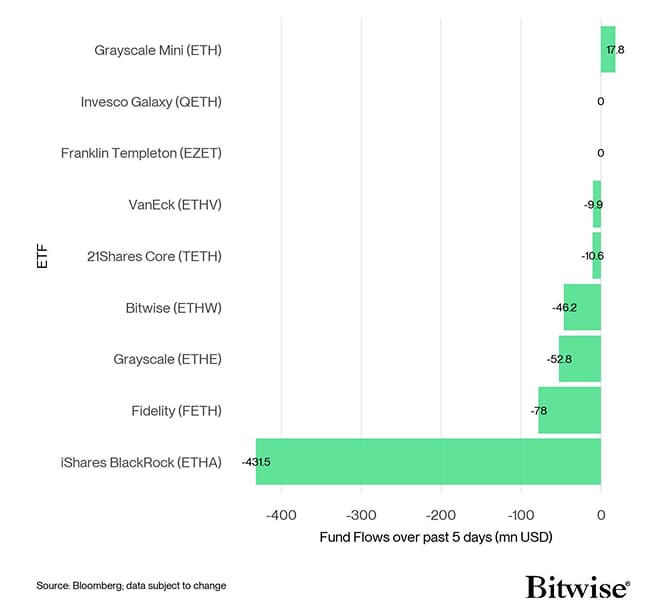
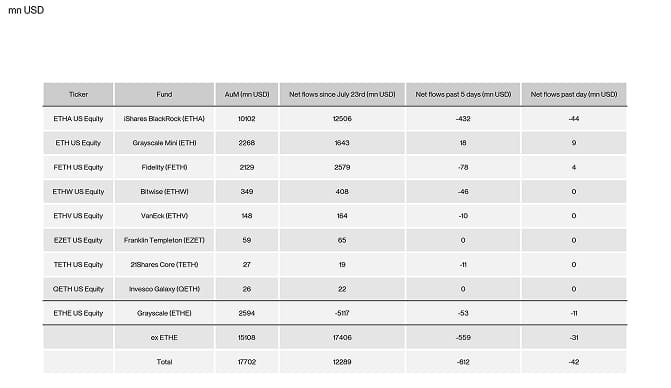
Meanwhile, global Ethereum ETPs also experienced -675.2 mn USD in net outflows last week, of which US spot Ethereum ETFs recorded net outflows of around -611.2 mn USD on aggregate.
The Grayscale Ethereum Trust (ETHE) posted net outflows of -52.8 mn USD, alongside the iShares Ethereum Trust (ETHA) that also experienced -431.5 mn USD of net outflows.
The Bitwise Ethereum ETF (ETHW) in the US has posted net outflows of -46.2 mn USD.
In Europe, the Bitwise Physical Ethereum ETP (ZETH) saw minor net outflows of -0.5 mn USD, as the Bitwise Ethereum Staking ETP (ET32) also saw +1.7 mn of net inflows.
Altcoin ETPs ex Ethereum experienced net inflows of +0.4 mn USD last week.
Thematic & basket crypto ETPs also posted net outflows of -8.2 mn USD on aggregate last week. The Bitwise MSCI Digital Assets Select 20 ETP (DA20) experienced negligible net inflows last week of +/- 0.0 mn USD on aggregate.
On-Chain Data
Following the first meaningful display of strength since the November collapse, price was rejected at the Short-Term Holder (STH) cost basis near $98.3K. The subsequent loss of momentum triggered a sharp reversal, with price breaking back below the $93.5K point of control and sliding toward the $86.2K region. A decisive and sustained reclaim of $93.5K would help preserve broader market structure, however, prolonged acceptance below this level may increasingly be interpreted as a sign of deteriorating market strength.
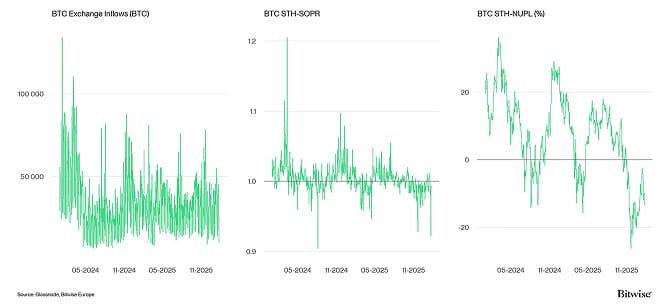
Notably, the previously strong buy-side impulse has reversed, flipping decisively back to sell-side dominance. Intraday spot buying minus selling closed the week at approximately –$1.2B, a sharp swing from the +$1.8B peak recorded the prior week. This rapid deterioration in demand conditions underscores the prevailing malaise in investor sentiment. In parallel, aggregate exchange inflow and outflow volumes declined sharply from $6.9B to $4.7B, falling back below the yearly average of $6.5B.
On the downside, the percentage of supply in profit has fallen to 67.2%, marking a clear rejection from its long-term mean of 75.4%, a level that has historically acted as a key inflection point for sentiment. This confluence of rejection from both the STH cost basis and the long-term profitability midpoint suggests investor confidence remains impaired, likely reflecting lingering damage from recent volatility and drawdowns.
Despite this local turbulence, profit and loss realization has converged back toward equilibrium. Realized profits of approximately $229M have been largely offset by $221M in realized losses, leaving a marginal net profit of just $8M. This balance indicates the market has entered a state of relative rest, with directional conviction subdued and the broader trend unresolved.
Losses have been disproportionately borne by newer participants. Of the $221M in realized losses, $182M were attributed to the Short-Term Holder cohort. Despite the relatively low loss taking, the STH-SOPR declined to 0.92, implying the average short-term participant realized an 8% loss per transaction. Such severe percentage losses are historically rare, with only 104 of 5,970 trading days (1.7%) recording a larger average loss, highlighting the intensity of capitulation among recent entrants.
With profit and loss realization remaining marginal, the Sell-Side Risk Ratio provides a useful lens for assessing investor engagement. By normalizing realized profits and losses against the network's Realized Cap, the metric captures how far investors are willing to transact away from their aggregate acquisition prices. At present, the Sell-Side Risk Ratio sits near historically depressed levels, with only 176 of 5,660 observations (3.1%) recording lower values. This signals an extreme reluctance to engage at current prices, suggesting liquidity is constrained and that a material price displacement may be required to re-engage participation.
Taken together, the rejection from the Short-Term Holder cost basis and the decline in profitable supply relative to its long-term mean indicate investor confidence has yet to fully recover. This is most clearly reflected in the STH-SOPR, where aggregate losses remain moderate, but the loss multiple is elevated, suggesting that investors who capitulated did so at meaningful discounts after prematurely chasing strength.
The lack of sustained profit and loss realization within the current range points to rising investor fatigue and increasingly constrained liquidity. As such, a meaningful price displacement appears necessary to re-engage participation. To the upside, the Short-Term Holder cost basis near $98K remains the key level that must be decisively reclaimed to restore momentum and control.
Futures, Options & Perpetuals
Over the past week, BTC perpetual futures open interest increased by approximately +16.3K BTC across exchanges, while CME futures open interest also increased by +2K BTC, indicating a modest uptick in institutional positioning. At a macro level, total open interest has continued to contract and remains subdued relative to recent months, suggesting futures markets are not currently the primary driver of broader price action.
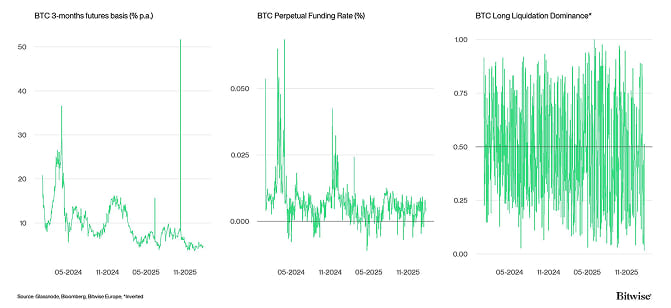
That said, as price moved lower, long futures positioning was aggressively unwound, with approximately $783M in long liquidations recorded across the week. While overall market conditions remain predominantly spot-driven, pockets of crowded derivatives positioning have materially amplified recent price movements. This dynamic mirrors behaviour observed among Short-Term Holders, where newer participants appear to have chased upside momentum, reflecting poor timing and a degree of desperation among recent entrants.
From a positioning standpoint, short futures open interest is beginning to rebuild around the $93.5K, $96K, and $98K levels, while long positioning is accumulating closer to the $87K region. The clustering of open interest around $93.5K and $98K closely aligns with both the Short-Term Holder cost basis and the $93.5K point of control highlighted throughout this note, reinforcing the sensitivity of these levels and the importance of a decisive reclaim in restoring market structure.
Perpetual funding rates ticked modestly higher week over week, signalling a small buildup of long exposure into the decline. However, when detrended using the median funding rate, funding remains slightly negative, reinforcing the absence of aggressive leveraged longs and pointing to broadly cautious positioning.
In parallel, the BTC 3-month annualised basis compressed further to 4.8%, repeatedly marking some of the lowest levels observed over the past two years. This reflects subdued market exuberance and a diminished term premium, consistent with constrained risk appetite and limited demand for leveraged long exposure.
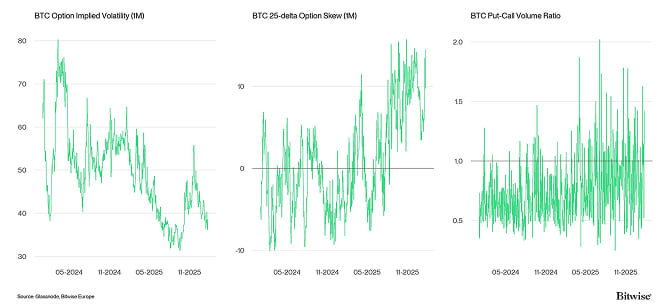
Turning to options markets, BTC options open interest increased by approximately +29.6K BTC, lifting total open interest to around 390K BTC as positioning continued to rebuild. The put-to-call open interest ratio on Deribit declined from 0.74 to 0.71, while the same ratio across IBIT options eased to 0.56, broadly in sync. Together, this suggests that while defensive positioning remains elevated, marginal demand for additional downside protection is beginning to ease.
However, this moderation is contrasted by developments in skew. The 25-delta skew has risen across all tenors, signalling an increasing premium for downside protection across both short- and medium-dated horizons. Notably, the 1-week skew surged to 17.9%, one of the highest readings of the cycle, rivalling levels seen during the yen-carry unwind and ahead of the October deleveraging event, highlighting elevated near-term risk sensitivity.
Finally, options dealer gamma positioning is deeply negative across the $80K–$94K range, creating conditions where price movements are more likely to be amplified as dealer hedging flows reinforce momentum. In contrast, a substantial pocket of positive gamma is concentrated around the $90K level, which may act as a local stabiliser, dampening volatility and encouraging mean reversion should price trade back into this zone. Taken together, this structure points to elevated volatility away from $90K, with consolidation more likely near this level and increasingly erratic price behaviour as the market trades further from it.
Overall, derivatives markets appear to closely mirror on-chain conditions, reflecting restrained and fragmented positioning rather than speculative excess. Options dealer gamma positioning identifies $90K as a local equilibrium, aligning with the balance in on-chain profit and loss flows. Meanwhile, futures open interest clustered around $93.5K and $98K converges with the point of control and Short-Term Holder cost basis, reinforcing these levels as structurally sensitive. Together, this confluence suggests volatility is likely to increase as price moves away from equilibrium, consistent with the historically low Sell-Side Risk Ratio.
Bottom Line
- Cryptoassets lagged broader markets amid elevated geopolitical uncertainty, while precious metals signalled a clear flight-to-safety on renewed Greenland annexation headlines and rising Polymarket odds.
- Chart-of-the-Week: Rolling 3-month correlations show major cryptoassets remain broadly uncorrelated with gold, even as the bitcoin–gold performance divergence has widened materially.
- Relative-value signals are flashing: the BTC/Gold ratio is near -2 standard deviations versus global money supply (levels last seen in 2015), while the Cryptoasset Sentiment Index has turned slightly bearish.
Appendix
Bitcoin Price vs Cryptoasset Sentiment Index
 Source: Bloomberg, Coinmarketcap, Glassnode, NilssonHedge, alternative.me, Bitwise Europe
Cryptoasset Sentiment Index
Source: Bloomberg, Coinmarketcap, Glassnode, NilssonHedge, alternative.me, Bitwise Europe
Cryptoasset Sentiment Index
 Source: Bloomberg, Coinmarketcap, Glassnode, NilssonHedge, alternative.me, Bitwise Europe; *multiplied by (-1)
TradFi Sentiment Indicators
Source: Bloomberg, Coinmarketcap, Glassnode, NilssonHedge, alternative.me, Bitwise Europe; *multiplied by (-1)
TradFi Sentiment Indicators
 Source: Bloomberg, NilssonHedge, Bitwise Europe
Crypto Sentiment Indicators
Source: Bloomberg, NilssonHedge, Bitwise Europe
Crypto Sentiment Indicators
 Source: Coinmarketcap, alternative.me, Bitwise Europe
Crypto Options' Sentiment Indicators
Source: Coinmarketcap, alternative.me, Bitwise Europe
Crypto Options' Sentiment Indicators
 Source: Glassnode, Bitwise Europe
Crypto Futures & Perpetuals' Sentiment Indicators
Source: Glassnode, Bitwise Europe
Crypto Futures & Perpetuals' Sentiment Indicators
 Source: Glassnode, Bitwise Europe; *Inverted
Crypto On-Chain Indicators
Source: Glassnode, Bitwise Europe; *Inverted
Crypto On-Chain Indicators
 Source: Glassnode, Bitwise Europe
Bitcoin vs Crypto Fear & Greed Index
Source: Glassnode, Bitwise Europe
Bitcoin vs Crypto Fear & Greed Index
 Source: alternative.me, Coinmarketcap, Bitwise Europe
Cryptoasset Sentiment Index: Daily vs Hourly
Source: alternative.me, Coinmarketcap, Bitwise Europe
Cryptoasset Sentiment Index: Daily vs Hourly
 Source: Bloomberg, Coinmarketcap, Glassnode, NilssonHedge, alternative.me, CFGI.io, Bitwise Europe
Bitcoin vs Global Crypto ETP Fund Flows
Source: Bloomberg, Coinmarketcap, Glassnode, NilssonHedge, alternative.me, CFGI.io, Bitwise Europe
Bitcoin vs Global Crypto ETP Fund Flows
 Source: Bloomberg, Bitwise Europe; ETPs only, data subject to change
Global Crypto ETP Fund Flows
Source: Bloomberg, Bitwise Europe; ETPs only, data subject to change
Global Crypto ETP Fund Flows
 Source: Bloomberg, Bitwise Europe; ETPs only; data subject to change
US Spot Bitcoin ETF Fund Flows
Source: Bloomberg, Bitwise Europe; ETPs only; data subject to change
US Spot Bitcoin ETF Fund Flows
 Source: Bloomberg, Bitwise Europe; data subject to change
US Spot Bitcoin ETFs: Flows since launch
Source: Bloomberg, Bitwise Europe; data subject to change
US Spot Bitcoin ETFs: Flows since launch
 Source: Bloomberg, Fund flows since traiding launch on 11/01/24; data subject to change
US Spot Bitcoin ETFs: 5-days flow
Source: Bloomberg, Fund flows since traiding launch on 11/01/24; data subject to change
US Spot Bitcoin ETFs: 5-days flow
 Source: Bloomber; data subject to change
US Bitcoin ETFs: Net Fund Flows since 11th Jan mn USD
Source: Bloomber; data subject to change
US Bitcoin ETFs: Net Fund Flows since 11th Jan mn USD
 Source: Bloomberg, Bitwise Europe; data as of 23-01-2026
US Spot Ethereum ETF Fund Flows
Source: Bloomberg, Bitwise Europe; data as of 23-01-2026
US Spot Ethereum ETF Fund Flows
 Source: Bloomberg, Bitwise Europe; data subject to change
US Spot Ethereum ETFs: Flows since launch
Source: Bloomberg, Bitwise Europe; data subject to change
US Spot Ethereum ETFs: Flows since launch
 Source: Bloomberg, Fund flows since trading launch on 23/07/24; data subject on change
US Spot Ethereum ETFs: 5-days flow
Source: Bloomberg, Fund flows since trading launch on 23/07/24; data subject on change
US Spot Ethereum ETFs: 5-days flow
 Source: Bloomberg; data subject on change
US Ethereum ETFs: Net Fund Flows since 23rd July
Source: Bloomberg; data subject on change
US Ethereum ETFs: Net Fund Flows since 23rd July
 Source: Bloomberg, Bitwise Europe; data as of 23-01-2026
Bitcoin vs Crypto Hedge Fund Beta
Source: Bloomberg, Bitwise Europe; data as of 23-01-2026
Bitcoin vs Crypto Hedge Fund Beta
 Source: Glassnode, Bloomberg, NilssonHedge, Bitwise Europe
Altseason Index
Source: Glassnode, Bloomberg, NilssonHedge, Bitwise Europe
Altseason Index
 Source: Coinmetrics, Bitwise Europe
Bitcoin vs Crypto Dispersion Index
Source: Coinmetrics, Bitwise Europe
Bitcoin vs Crypto Dispersion Index
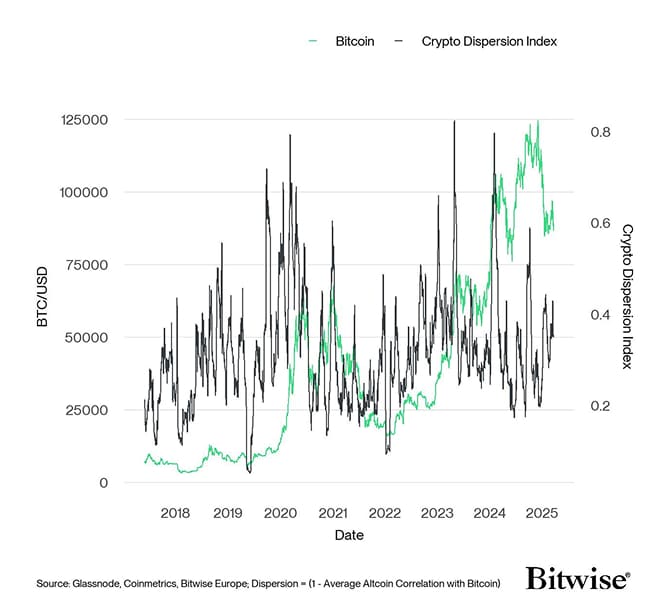 Source: Coinmarketcap, Bitwise Europe; Dispersion = (1 - Average Altcoin Correlation with Bitcoin)
Bitcoin Price vs Futures Basis Rate
Source: Coinmarketcap, Bitwise Europe; Dispersion = (1 - Average Altcoin Correlation with Bitcoin)
Bitcoin Price vs Futures Basis Rate
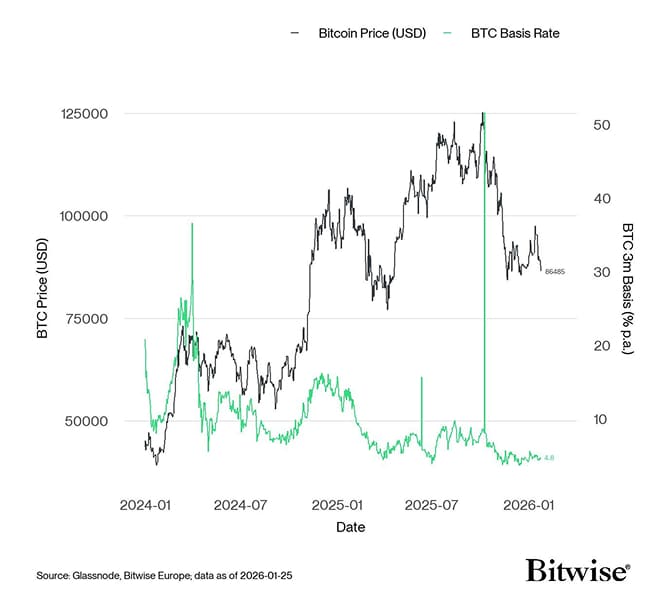 Source: Glassnode, Bitwise Europe; data as of 2026-01-25
Ethereum Price vs Futures Basis Rate
Source: Glassnode, Bitwise Europe; data as of 2026-01-25
Ethereum Price vs Futures Basis Rate
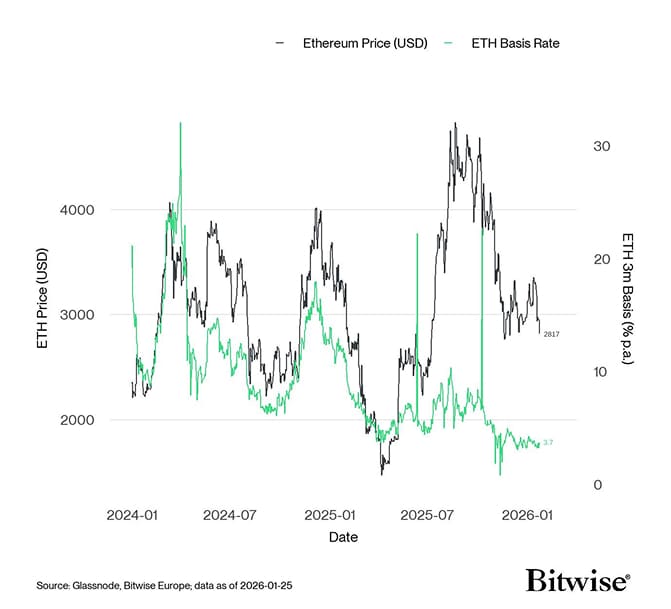 Source: Glassnode, Bitwise Europe; data as of 2026-01-25
BTC Net Exchange Volume by Size
Source: Glassnode, Bitwise Europe; data as of 2026-01-25
BTC Net Exchange Volume by Size
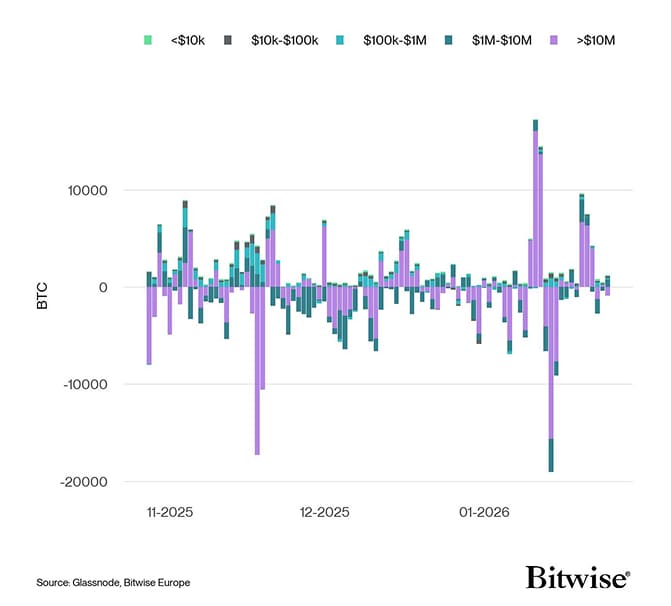 Source: Glassnode, Bitwise Europe
Important Information
This publication constitutes a marketing communication and is provided for informational purposes only. It does not constitute investment advice, a personal recommendation, or an offer or solicitation to buy or sell any financial instrument.
This document (which may take the form of a presentation, press release, social media post, blog article, broadcast communication or similar instrument – collectively referred to as a “Document”) is issued by Bitwise Europe GmbH (“BEU” or the “Issuer”) and has been prepared in accordance with applicable laws and regulations, including those relating to financial promotions.
Bitwise Europe GmbH, incorporated under the laws of Germany, is the issuer of the Exchange Traded Products (“ETPs”) referenced in this Document under a base prospectus and the applicable final terms, as supplemented from time to time, approved by the German Federal Financial Supervisory Authority (BaFin). The approval of the prospectus by BaFin relates solely to the completeness, coherence and comprehensibility of the prospectus in accordance with the Prospectus Regulation and does not constitute an endorsement, recommendation or assessment of the merits of the products.
The market analyses, views and scenarios presented reflect the assessment as of the date of publication and are based on information considered reliable. However, no representation or warranty is made as to their accuracy or completeness. Forward-looking statements involve risks and uncertainties and are not guarantees of future performance. Past performance is not a reliable indicator of future results.
Capital at risk. Cryptoassets are highly volatile and involve a high degree of risk. The value of investments in cryptoassets and crypto-linked ETPs may fluctuate significantly, and investors may lose part or all of their invested capital. No capital protection or guaranteed compensation mechanism applies in respect of market losses.
Any investment decision should be made solely on the basis of the relevant base prospectus, the applicable final terms and the key information document, in particular the section entitled “Risk Warning”. The base prospectus, final terms and additional risk information are available at: www.bitwiseinvestments.eu
Access to certain documents may require self-certification regarding your jurisdiction and investor status and may be subject to additional disclaimers and important information.
For further details, please refer to the full disclaimer available at: www.bitwiseinvestments.eu/disclaimer

 en
en  de
de  fr
fr  es
es