This report is for professional investors and information purposes only. Persons without professional investment experience should not rely on it. Not investment advice or a personal recommendation. Cryptoassets are high risk and volatile and you may lose all capital invested. See full risk information at the end of this document.
- Performance: Cryptoassets underperformed alongside gold amid broad de-risking, though downside may be partially capped as bitcoin already reflects recession risks; institutional demand trends remain a notable market data point.
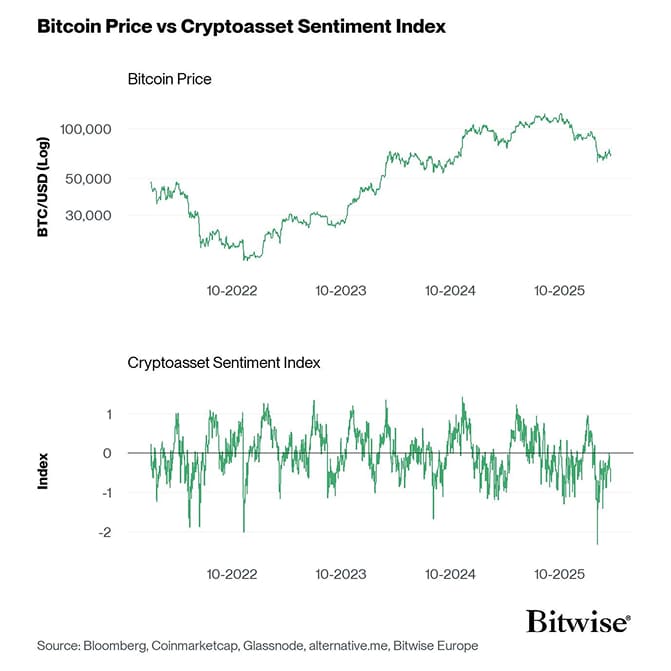
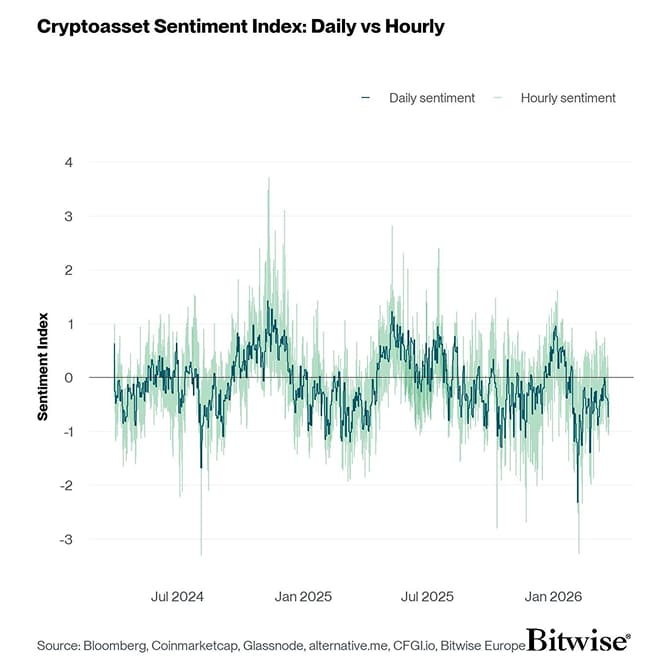
- Sentiment: Our in-house Cryptoasset Sentiment Index deteriorated further and now signals renewed bearish sentiment, reflecting macro uncertainty, rising energy prices, and tightening financial conditions.
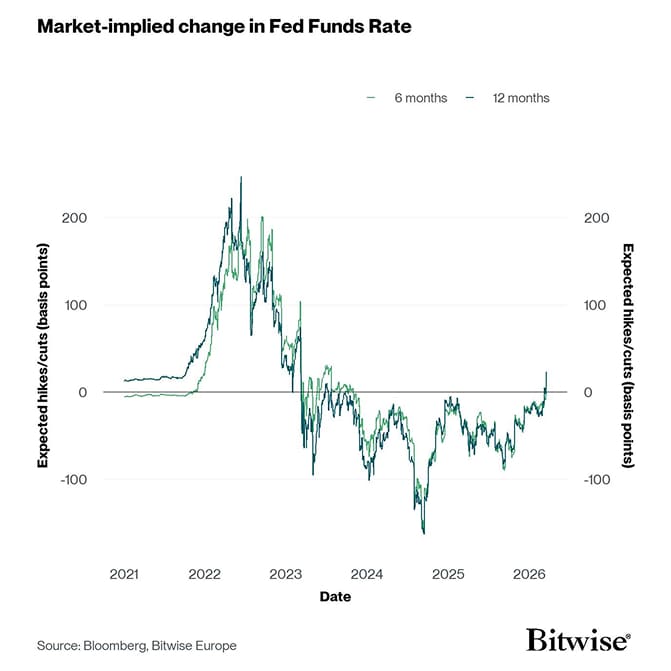
- Chart-of-the-week: Rates markets have sharply repriced expectations - from ~2.5 cuts to potential rate hikes in 2026 - highlighting a material shift toward tighter monetary policy driven by persistent inflation and energy shocks.
Chart of the Week
Market-implied change in Fed Funds Rate
 Source: Bloomberg, Bitwise Europe
Performance
Financial markets and crypto markets continue to be dominated by geopolitical developments in the Middle East.
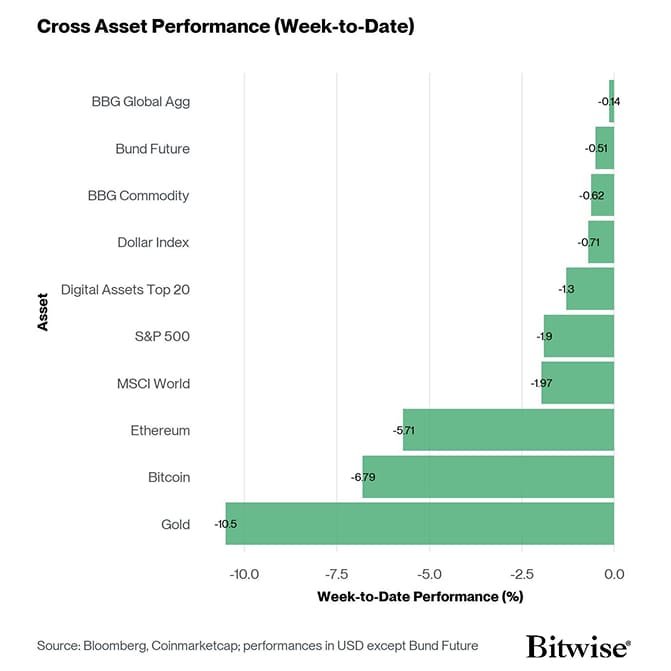
Last week, bitcoin and other major cryptoassets continued to underperform alongside other major assets like US equities and even gold. Gold had its worst weekly performance since 1983 in what looks like a general de-risking investor behaviour across assets.
The epicentre of the current turmoil continues to be crude oil prices that kept grinding higher last week as the situation in the Strait of Hormuz and the ensuing energy supply crunch continued to be unresolved. At the time of writing this report on Monday morning, no crude oil tankers are officially passing the strait based on real-time shipping data provided by Bloomberg.
In this context, the FOMC meeting last week was rather uneventful. The Fed left rates steady at 3.5% to 3.75%, with no significant change in forward guidance - just a continued data-dependent stance and slightly fewer expected cuts this year.
Although official inflation forecasts got bumped up – PCE inflation to 2.7% for 2026 - thanks to tariffs and the recent oil price spike from Middle East disruptions, Powell called the energy hit mostly transitory and expects core inflation to ease as goods inflation cools. All in all, the Fed remains patient, watching energy closely, but not panicking – their long-term 2% target stays anchored.
Meanwhile, rates markets have already started to price in the possibility of rate hikes due to higher energy prices and inflation that could force the Fed to tighten monetary policy later in the year. In fact, rates markets used to price in around 2.5 rate cuts until Dec 2026 in February. Now, they have started to price in rate hikes in 2026 for the first time since mid-2023 (Chart-of-the-week).
One of the key drivers is inflation data. Last week, US producer price inflation data came in significantly above consensus expectations – chances are that inflation data will continue to surprise to the upside over the coming months due to the rise in energy prices which could lead to a further repricing in rate hike expectations.
Although the Fed has not communicated any rate hikes whatsoever, this repricing in monetary policy expectations is effectively tightening financial conditions already which is weighing on traditional financial markets and cryptoassets alike.
At the time of writing this report, Fed Funds Futures are already pricing in a 52% chance of a 25 basis point Fed rate hike by the end of 2026. For other major currencies, rates markets have repriced even more aggressively. Rates markets are currently anticipating both the ECB and Bank of England to hike rates 3 times in 2026, respectively.
Rising energy prices and tighter monetary policy expectations are already increasing recession probabilities. For instance, according to the latest betting odds by Kalshi, a recession in the US is predicted to occur in 2026 with a 37% probability. Economists surveyed by the Wall Street Journal expect that a sustained oil price at around $138 could potentially trigger a recession.
In fact, sharp increases in real (i.e. inflation-adjusted) oil prices have historically been a reliable indicator for US recessions. The latest spike in real oil prices already ranks among the 4th largest on record comparable to spikes in 1974, 1990, and 2008.
To put short, the longer the closure of the strait and energy crisis prevail, the higher the likelihood of a recession due to higher inflation, reduced consumer and business spending, and prospects for tighter monetary policy.
That being said, as outlined in our previous Bitcoin Macro Investor report, we believe that a lot of 'bad news' already appears to be reflected in bitcoin's price, although markets will likely remain very volatile and downside risks remain in the short term. Based on this quantitative model, our analysis suggests bitcoin may have partially priced in recession risks following a -50% drawdown, though downside risks remain and this assessment is subject to considerable uncertainty.
Meanwhile, institutional demand for bitcoin via ETPs and treasury companies has been reaccelerating despite the continued geopolitical uncertainty. More specifically, institutions (global bitcoin ETPs and treasury companies) have purchased 77.0k BTC over the past 30 days while bitcoin's new supply has only increased by 13.1k BTC. Put differently, institutions have bought approximately 5.9 times the new supply of bitcoins. All else equal, this institutional demand pattern may provide support for bitcoin, though demand flows can reverse and do not guarantee price stability.
Cross Asset Performance (Week-to-Date)
 Source: Bloomberg, Coinmarketcap; performances in USD exept Bund Future
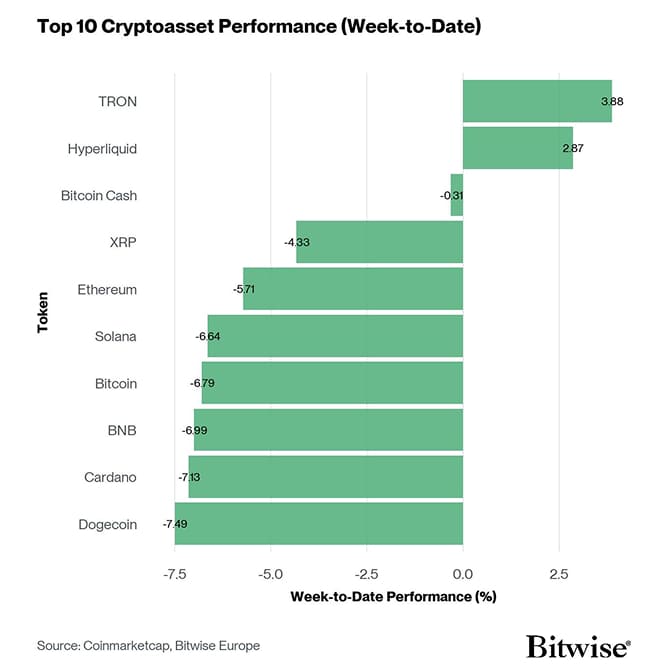
Top 10 Cryptoasset Performance (Week-to-Date)
Source: Bloomberg, Coinmarketcap; performances in USD exept Bund Future
Top 10 Cryptoasset Performance (Week-to-Date)
 Source: Coinmarketcap
In general, among the top 10 crypto assets TRON, Hyperliquid, and Bitcoin Cash were the relative outperformers.
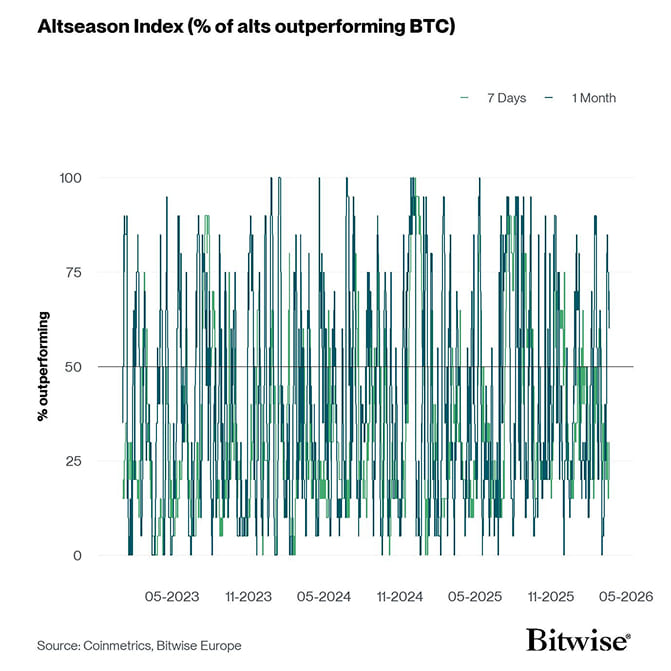
Overall, altcoin outperformance vis-à-vis bitcoin decreased slightly last week but still remained relatively high, with 60% of our tracked altcoins managing to outperform bitcoin on a weekly basis. Ethereum also outperformed bitcoin on a relative basis last week.
Sentiment
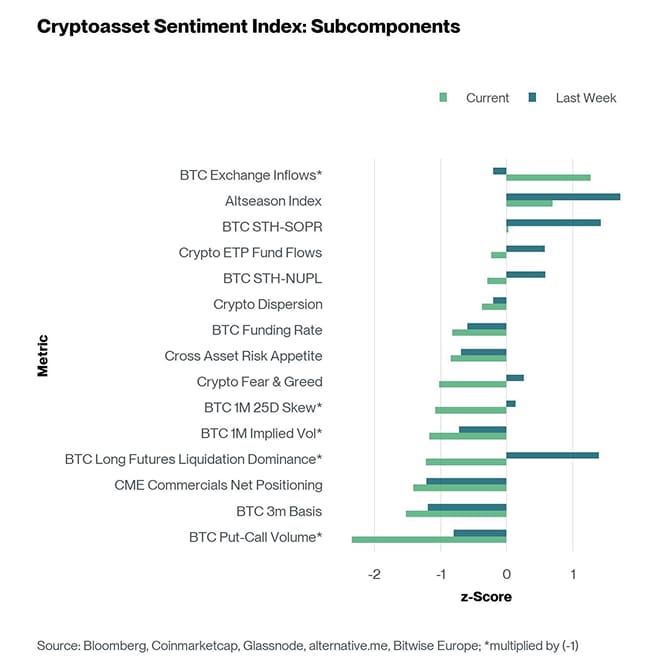
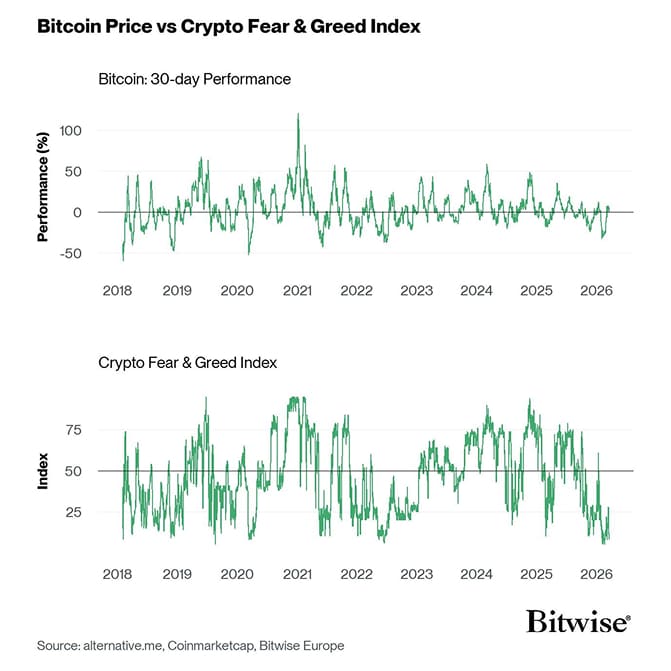
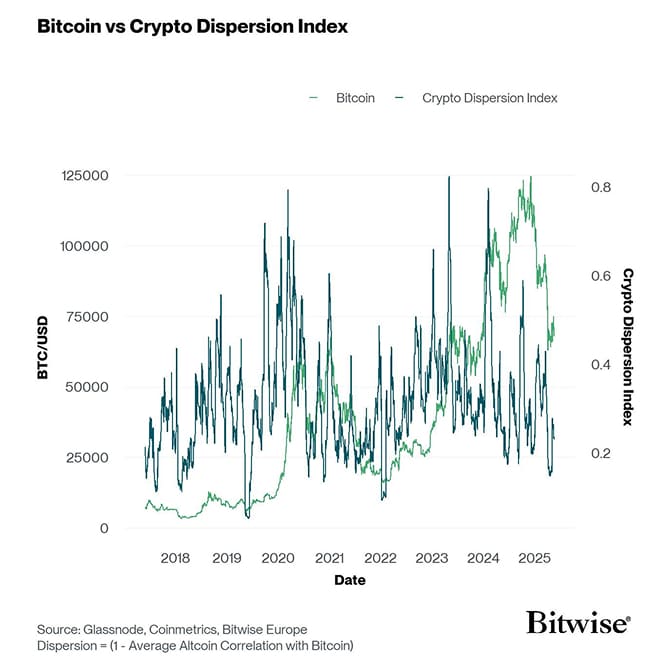
Our in-house “Cryptoasset Sentiment Index” deteriorated last week and currently signals a bearish sentiment again. This is in line with a declining Crypto Fear and Greed Index, and our in-house Crypto Dispersion and Altseason indices which suggest broader weakness across the crypto complex.
At the moment, 3 out of 15 indicators are above their short-term trend.
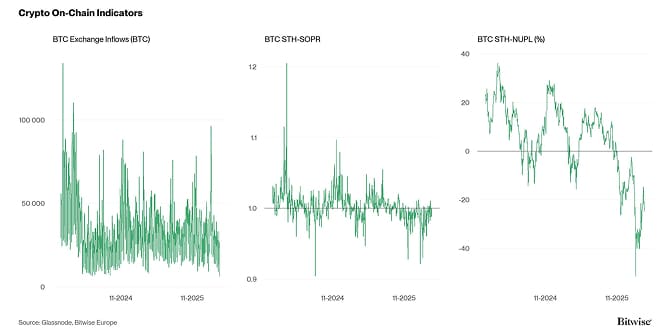
Last week, the BTC Exchange Inflows, BTC STH SOPR, and Altseason Index showed positive momentum.
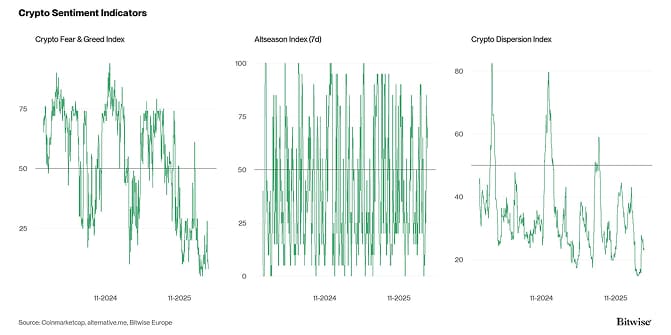
The Crypto Fear & Greed Index continues to signal an “extreme fear” level of sentiment as of this morning, having reversed two weeks of sentiment gains, hitting its second lowest level in a month.
Performance dispersion among cryptoassets decreased slightly last week to 0.23. When dispersion is decreasing, it may indicate that the market appears to be driven by a less diverse set of narratives which, in our analysis, has historically been associated with periods of decreasing risk appetite in prior market cycles.
Altcoin outperformance vis-à-vis Bitcoin decreased somewhat last week, with 60% of our tracked altcoins in the index. Although still relatively high, the decline suggests increasing BTC strength versus its Altcoin peers.
In general, decreasing altcoin outperformance may be a sign of decreasing risk appetite within cryptoasset markets.
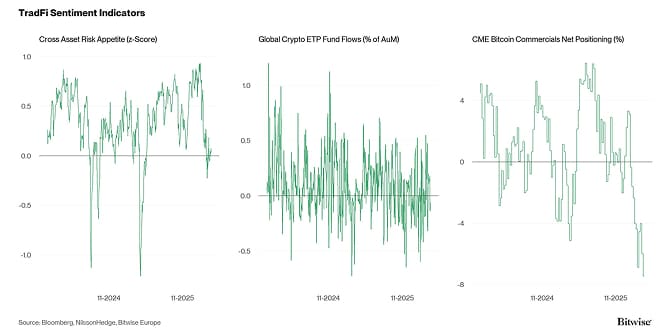
Sentiment in traditional financial markets as measured by our in-house measure of Cross Asset Risk Appetite (CARA) increased to 0.07 from negative territory over the past week which is signalling positive sentiment in traditional financial markets. This divergence from BTC and crypto sentiment and price action suggests crypto assets were overextended amidst this uncertain market environment, following recent weeks outperformance.
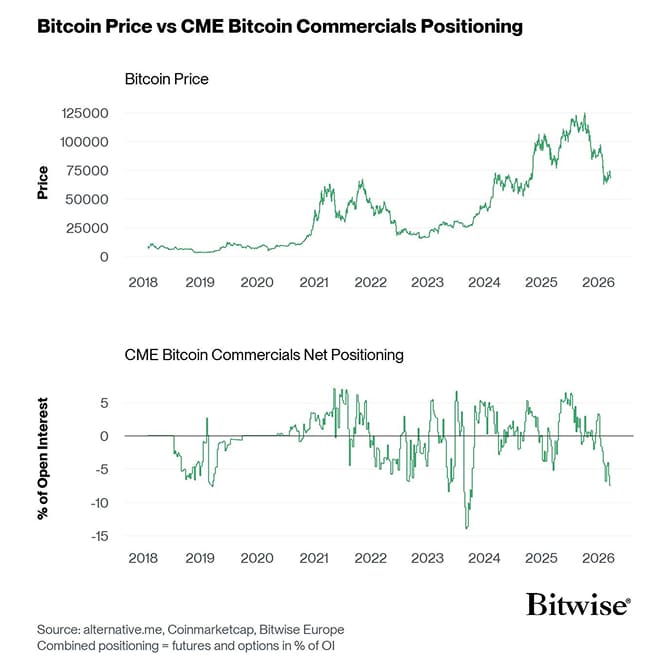
CME Bitcoin Commercials Net Positioning, which shows the difference between long and short CME Bitcoin futures contracts declined from –5.97 to –7.46. This suggests institutions led the leg lower this week. However, this level is the most negative it's been since late 2023 potentially acting as a contrarian indicator if these positions unwind.
Fund Flows
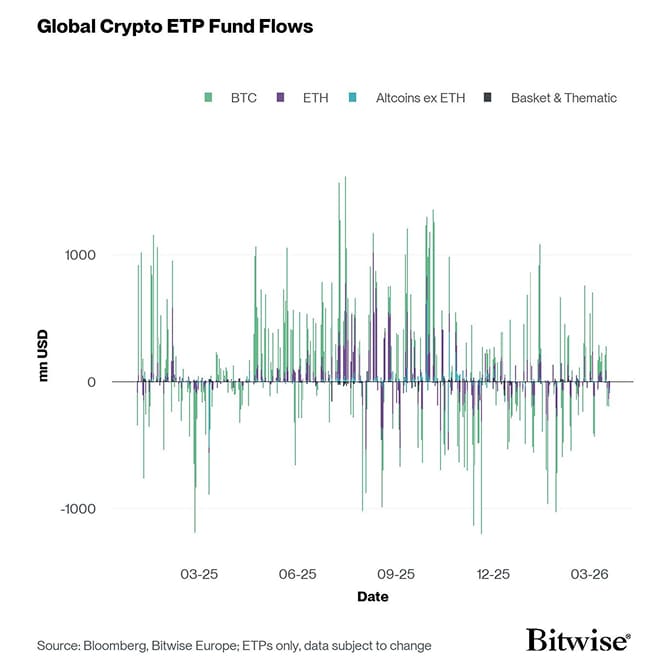
Global crypto ETPs saw net inflows last week across Bitcoin and Altcoins Ex-Ethereum products. But saw net outflows across Ethereum, and Basket and Thematic products.
Global crypto ETPs saw around -2.8 mn USD in weekly net outflows across all types of cryptoassets, after +963.8 mn USD in net inflows the previous week.
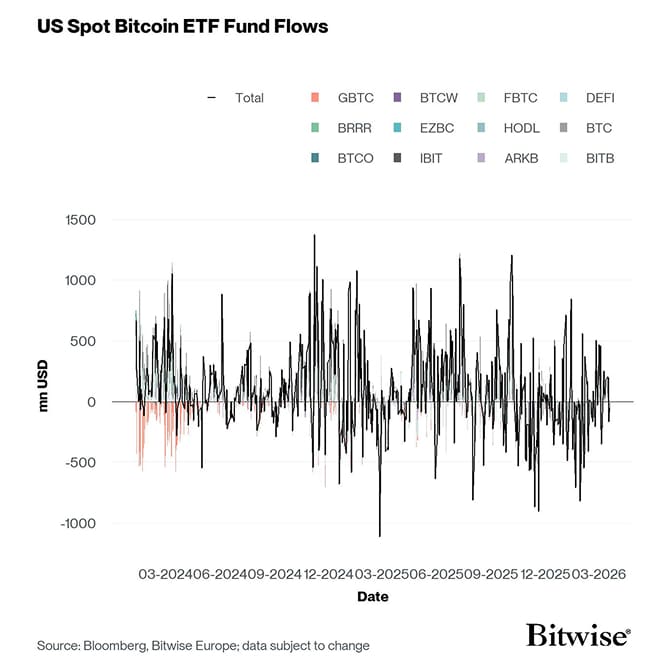
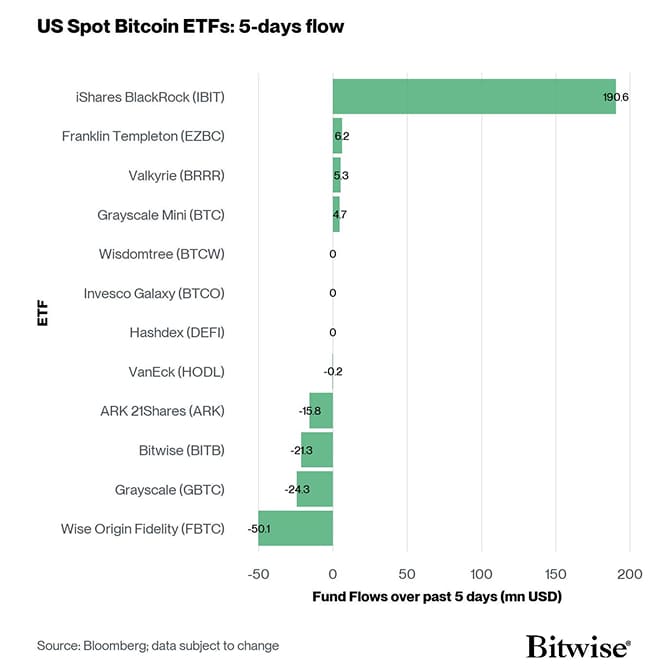
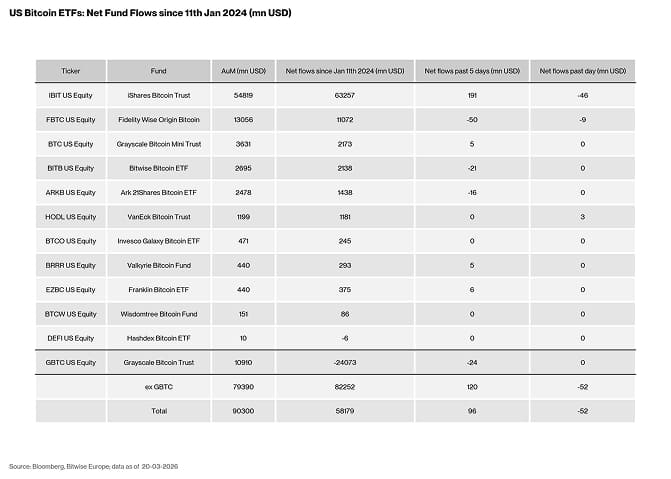
Global Bitcoin ETPs have experienced net inflows totalling +152.2 mn USD last week, of which +95.2 mn USD in net inflows were related to US spot Bitcoin ETFs.
The Bitwise Bitcoin ETF (BITB) in the US experienced net outflows, totalling -21.3 mn USD last week.
In Europe, the Bitwise Physical Bitcoin ETP (BTCE) experienced net outflows equivalent to –0.8 mn USD, whereas the Bitwise Core Bitcoin ETP (BTC1) experienced net inflows of +2.2 mn USD.
The Grayscale Bitcoin Trust (GBTC) posted net outflows of –24.3 mn USD and the iShares Bitcoin Trust (IBIT) experienced net inflows of around +190.6 mn USD last week.
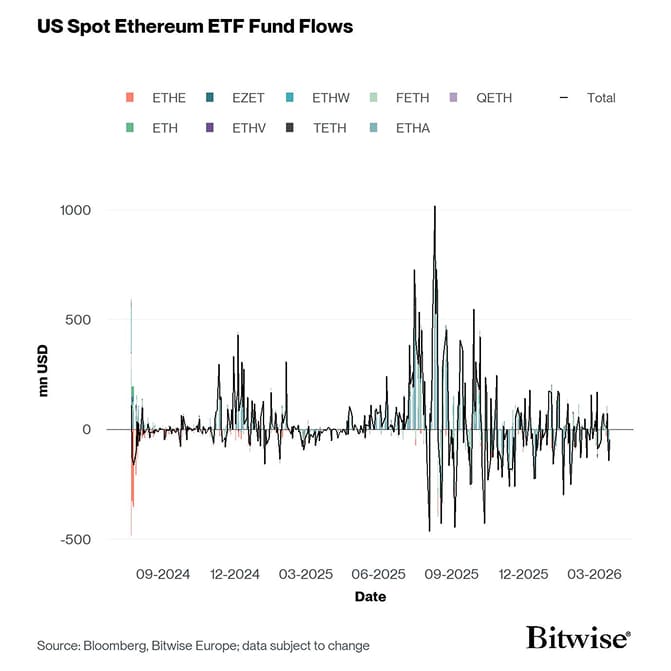
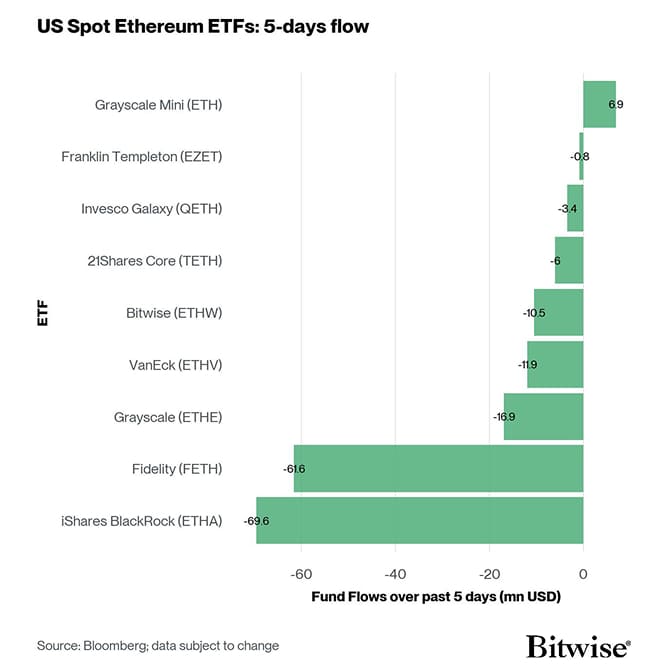
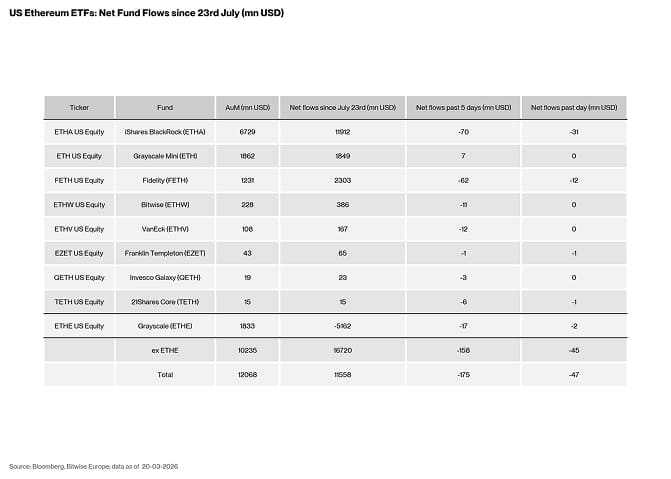
Meanwhile, global Ethereum ETPs also experienced -176.1 mn USD in net outflows last week, of which US spot Ethereum ETFs recorded net outflows of around -173.8 mn USD on aggregate.
The Grayscale Ethereum Trust (ETHE) posted net outflows of -16.9 mn USD, alongside the iShares Ethereum Trust (ETHA) that experienced -69.6 mn USD of net outflows.
The Bitwise Ethereum ETF (ETHW) in the US has posted net outflows of -10.5 mn USD.
In Europe, the Bitwise Physical Ethereum ETP (ZETH) saw minor net outflows of -0.9 mn USD, as the Bitwise Ethereum Staking ETP (ET32) saw +2.3 mn USD of net inflows.
Altcoin ETPs ex Ethereum experienced net inflows of +26.1 mn USD last week.
Thematic & basket crypto ETPs posted net outflows of -5 mn USD on aggregate last week. The Bitwise MSCI Digital Assets Select 20 ETP (DA20) experienced no net inflows last week of +/-0.0 mn USD on aggregate.
On-Chain Data
After reaching a local high near $76k earlier this week, Bitcoin retraced toward $68.5k amid escalating geopolitical tensions between the US and Iran. The resulting rise in macro uncertainty contributed to a broader shift toward risk aversion across digital asset markets.
Despite the pullback, daily market structure continues to reflect a sequence of higher highs and higher lows since the start of the month, indicating a gradual improvement in underlying momentum. That said, prevailing market fragility and persistent geopolitical overhang leave this trend severely vulnerable to disruption.
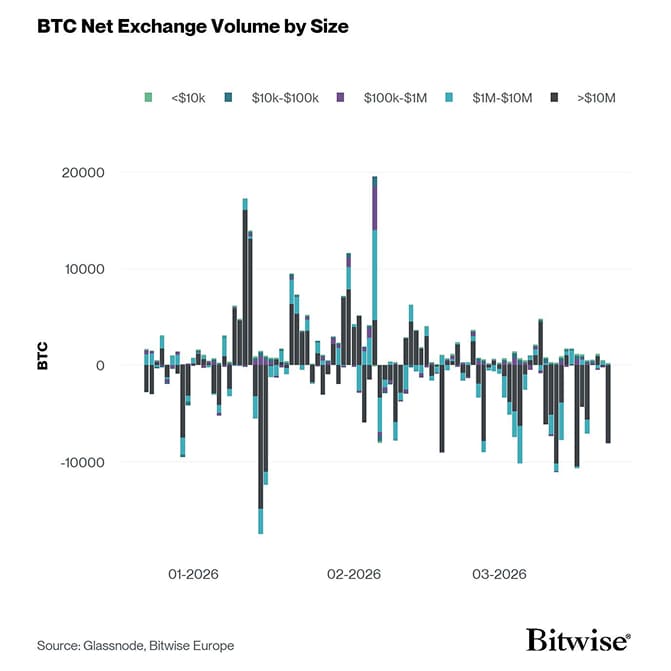
Exchange Spot Volume Delta has reverted toward neutral following a notable increase in buy-side pressure earlier in the week. This points to a continued balance between buyers and sellers, reinforcing the prevailing uncertainty among market participants. In parallel, aggregate exchange inflows and outflows have contracted to approximately $3.2bn, marking the lowest activity regime since October 2024. Taken together, these signals suggest investor participation remains subdued and sentiment broadly impaired.
Aggregate investor stress also remains elevated. The value of invested capital currently held at a loss is estimated near $829bn (~76% of Realised Cap). Notably, a comparable share of capital was underwater at the end of January 2026, when spot price traded materially higher near $82.2k versus ~$68.5k today. This indicates that loss-bearing supply has continued to distribute over recent months, implying a gradual improvement in the aggregate investor balance sheet as weaker holders exit and stronger hands absorb supply.
Despite substantial unrealised losses across the investor base, Net Realised Profit/Loss continues to moderate, contracting to approximately –$245mn, a marked improvement from the –$1.3bn recorded during the February 5 capitulation. This dynamic reflects persistently low but stable profit-taking alongside a gradual decline in realised losses as investors adapt to the current price regime. A similar compression is evident across exchange flow activity, suggesting both investor engagement and liquidity are consolidating within this range, conditions that have historically preceded expansions in local volatility.
Altcoin market capitalisation has also stabilised following the recent drawdown. Total market cap, currently near $473bn, has remained broadly unchanged over the past six weeks and is now oscillating tightly around its long-term mean near $465bn. This reinforces the view that forward expectations remain highly uncertain, with several key market indicators reverting toward equilibrium. Such dispersion in market consensus can contribute to episodic volatility as price searches for directional resolution.
Key price levels remain unchanged. The cycle low near $60k continues to define structural downside support, while the $80k region marks the upper boundary from which the latest contraction accelerated. Price has remained confined within this range since 31 January, reinforcing its significance as the dominant trading regime.
Futures, Options & Perpetuals
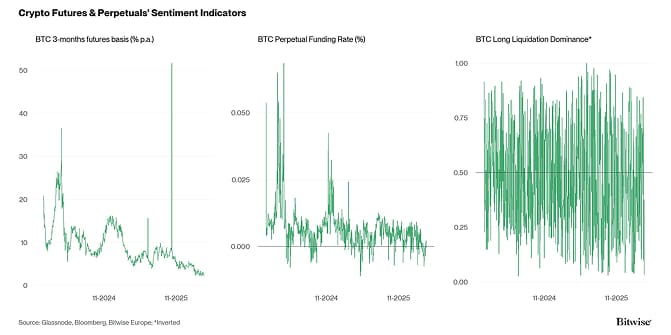
Over the past week, BTC perpetual futures open interest increased by approximately +4.8k BTC, while CME futures open interest rose by around +3.6k BTC, signalling a modest uptick in institutional positioning. Aggregate futures liquidations across all assets remained elevated, although below the extremes observed the prior week. Short liquidations dominated early in the period as price rallied, before long liquidations became more prent into the latter stages as momentum faded. In total, liquidations reached roughly $2.3bn over the week (vs. $1.6bn previously).
Positioning continues to build around the $68k region, broadly in line with prevailing spot levels. A decisive break below this zone could increase the risk of a long squeeze, potentially accelerating downside momentum. On the upside, residual pockets of open interest remain concentrated near $76k, with a substantial share of leverage in the $74k-$75k range already cleared during the recent upward move.
Perpetual funding rates (7-day moving average) have also normalised toward equilibrium, indicating increasingly balanced futures positioning. This reflects broader synchronisation across on-chain, spot and derivatives markets, with several directional indicators converging toward their respective midpoints.
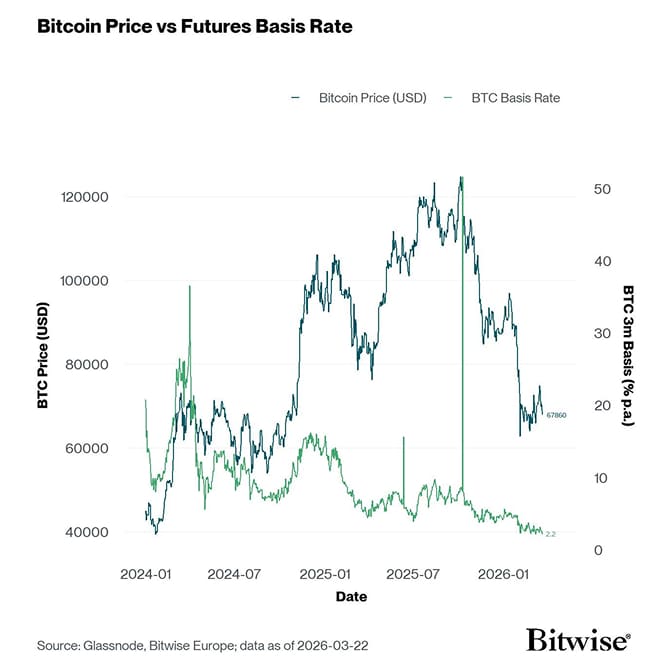
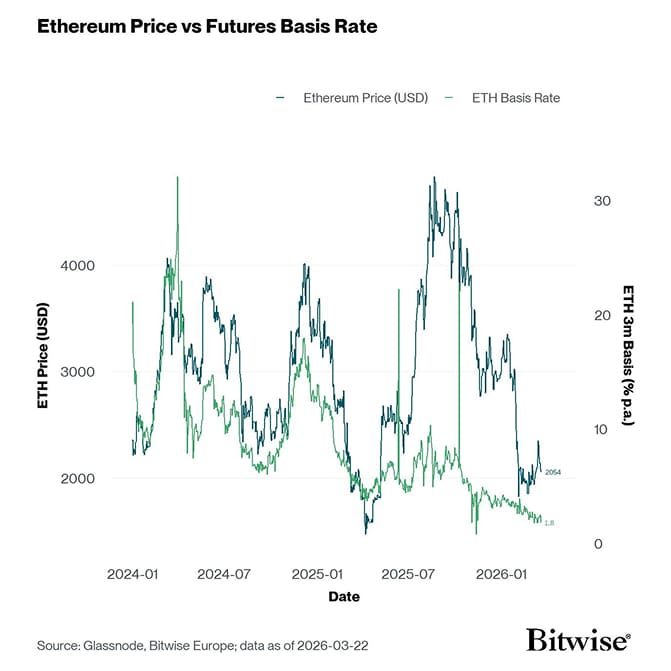
At the same time, the BTC 3-month annualised basis remains depressed at approximately 2.3%. Basis continues to trade well below prevailing short-term US Treasury bill yield, highlighting persistent risk aversion and muted demand for long exposure.
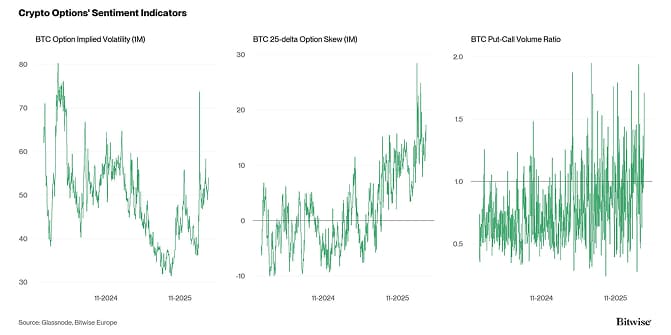
In options markets, BTC options open interest declined modestly by roughly -18.5k BTC, bringing total open interest to 505.6k BTC. The Deribit put-to-call open interest ratio continued to ease, falling to 0.67, while the equivalent metric across IBIT options also edged lower to 0.65 by week's end.
Collectively, these developments suggest demand for downside protection is beginning to soften. Notably, positioning across both venues is now approaching parity, a relatively rare configuration that points to increasing alignment between crypto-native and institutional options participants.
The 25-delta skew firmed across all tenors during the week, indicating a modest increase in demand for downside hedging across both short- and medium-dated maturities as price weakened. Nevertheless, skew levels remain broadly within the range observed over the past month, suggesting no material shift in overall skew richness.
Total GEX (7-day moving average) has risen sharply from $2.6bn to $5.8bn. This suggests dealers remain structurally short convexity, implying that the potential for volatility amplification may be increasing.
Dealer gamma exposure also remains predominantly negative across the $50k-$79k range. Notable negative gamma nodes persist near $60k, $68k and $75k, highlighting these regions as potential zones of heightened price sensitivity. Conversely, pockets of positive gamma are observed near $66k-$67k and around $71k, which may provide short-term stabilising effects should price trade within these levels.
Bottom Line
- Performance: Cryptoassets underperformed alongside gold amid broad de-risking, though downside may be partially capped as bitcoin already reflects recession risks; institutional demand remains a key supportive factor to watch.
- Sentiment: Our in-house Cryptoasset Sentiment Index deteriorated further and now signals renewed bearish sentiment, reflecting macro uncertainty, rising energy prices, and tightening financial conditions.
- Chart-of-the-week: Rates markets have sharply repriced expectations - from ~2.5 cuts to potential rate hikes in 2026 - highlighting a material shift toward tighter monetary policy driven by persistent inflation and energy shocks.
Appendix
Bitcoin Price vs Cryptoasset Sentiment Index
 Source: Bloomberg, Coinmarketcap, Glassnode, NilssonHedge, alternative.me, Bitwise Europe
Cryptoasset Sentiment Index: Subcomponents
Source: Bloomberg, Coinmarketcap, Glassnode, NilssonHedge, alternative.me, Bitwise Europe
Cryptoasset Sentiment Index: Subcomponents
 Source: Bloomberg, Coinmarketcap, Glassnode, NilssonHedge, alternative.me, Bitwise Europe; *multiplied by (-1)
TradFi Sentiment Indicators
Source: Bloomberg, Coinmarketcap, Glassnode, NilssonHedge, alternative.me, Bitwise Europe; *multiplied by (-1)
TradFi Sentiment Indicators
 Source: Bloomberg, NilssonHedge, Bitwise Europe
Crypto Sentiment Indicators
Source: Bloomberg, NilssonHedge, Bitwise Europe
Crypto Sentiment Indicators
 Source: Coinmarketcap, alternative.me, Bitwise Europe
Crypto Options' Sentiment Indicators
Source: Coinmarketcap, alternative.me, Bitwise Europe
Crypto Options' Sentiment Indicators
 Source: Glassnode, Bitwise Europe
Crypto Futures & Perpetuals' Sentiment Indicators
Source: Glassnode, Bitwise Europe
Crypto Futures & Perpetuals' Sentiment Indicators
 Source: Glassnode, Bitwise Europe; *Inverted
Crypto On-Chain Indicators
Source: Glassnode, Bitwise Europe; *Inverted
Crypto On-Chain Indicators
 Source: Glassnode, Bitwise Europe
Bitcoin vs Crypto Fear & Greed Index
Source: Glassnode, Bitwise Europe
Bitcoin vs Crypto Fear & Greed Index
 Source: alternative.me, Coinmarketcap, Bitwise Europe
Cryptoasset Sentiment Index: Daily vs Hourly
Source: alternative.me, Coinmarketcap, Bitwise Europe
Cryptoasset Sentiment Index: Daily vs Hourly
 Source: Bloomberg, Coinmarketcap, Glassnode, NilssonHedge, alternative.me, CFGI.io, Bitwise Europe
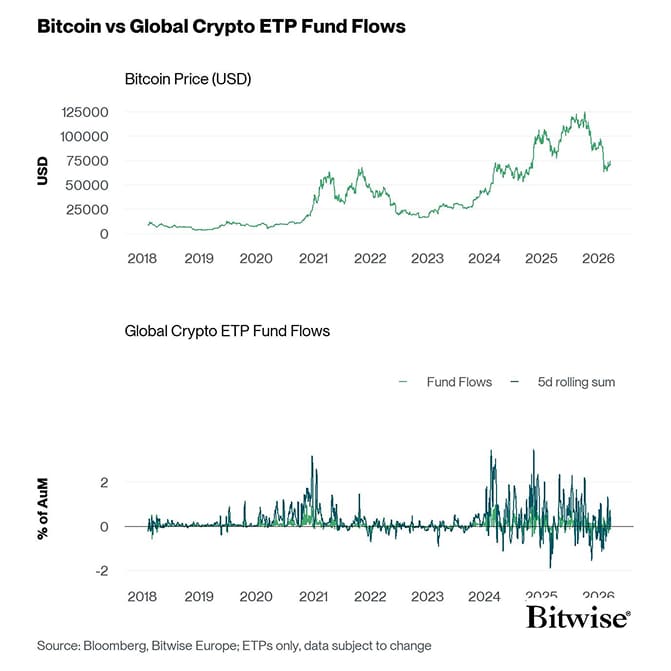
Bitcoin vs Global Crypto ETP Fund Flows
Source: Bloomberg, Coinmarketcap, Glassnode, NilssonHedge, alternative.me, CFGI.io, Bitwise Europe
Bitcoin vs Global Crypto ETP Fund Flows
 Source: Bloomberg, Bitwise Europe; ETPs only, data subject to change
Global Crypto ETP Fund Flows
Source: Bloomberg, Bitwise Europe; ETPs only, data subject to change
Global Crypto ETP Fund Flows
 Source: Bloomberg, Bitwise Europe; ETPs only; data subject to change
US Spot Bitcoin ETF Fund Flows
Source: Bloomberg, Bitwise Europe; ETPs only; data subject to change
US Spot Bitcoin ETF Fund Flows
 Source: Bloomberg, Bitwise Europe; data subject to change
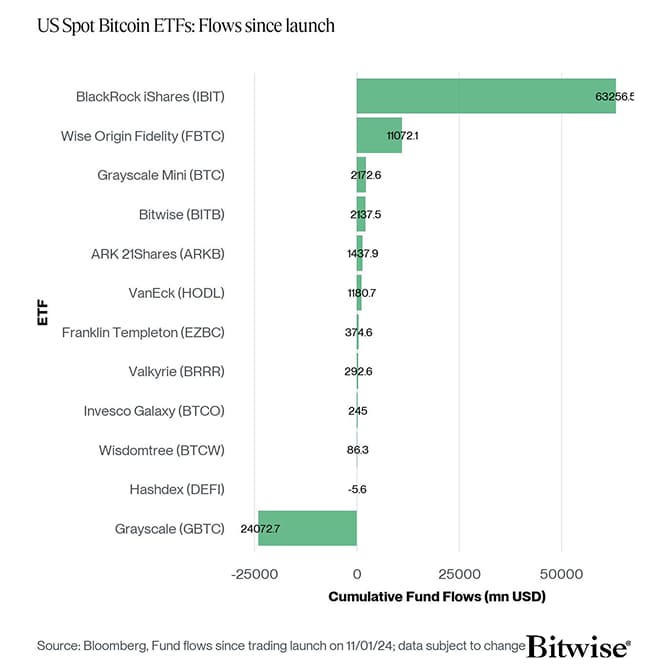
US Spot Bitcoin ETFs: Flows since launch
Source: Bloomberg, Bitwise Europe; data subject to change
US Spot Bitcoin ETFs: Flows since launch
 Source: Bloomberg, Fund flows since traiding launch on 11/01/24; data subject to change
US Spot Bitcoin ETFs: 5-days flow
Source: Bloomberg, Fund flows since traiding launch on 11/01/24; data subject to change
US Spot Bitcoin ETFs: 5-days flow
 Source: Bloomber; data subject to change
US Bitcoin ETFs: Net Fund Flows since 11th Jan mn USD
Source: Bloomber; data subject to change
US Bitcoin ETFs: Net Fund Flows since 11th Jan mn USD
 Source: Bloomberg, Bitwise Europe; data as of 20-03-2026
US Spot Ethereum ETF Fund Flows
Source: Bloomberg, Bitwise Europe; data as of 20-03-2026
US Spot Ethereum ETF Fund Flows
 Source: Bloomberg, Bitwise Europe; data subject to change
US Spot Ethereum ETFs: Flows since launch (mn USD)
Source: Bloomberg, Bitwise Europe; data subject to change
US Spot Ethereum ETFs: Flows since launch (mn USD)
 Source: Bloomberg, Fund flows since trading launch on 23/07/24; data subject on change
US Spot Ethereum ETFs: 5-days flow
Source: Bloomberg, Fund flows since trading launch on 23/07/24; data subject on change
US Spot Ethereum ETFs: 5-days flow
 Source: Bloomberg; data subject on change
US Ethereum ETFs: Net Fund Flows since 23rd July (mn USD)
Source: Bloomberg; data subject on change
US Ethereum ETFs: Net Fund Flows since 23rd July (mn USD)
 Source: Bloomberg, Bitwise Europe; data as of 20-03-2026
Bitcoin Price vs CME Bitcoin Commercials Positioning
Source: Bloomberg, Bitwise Europe; data as of 20-03-2026
Bitcoin Price vs CME Bitcoin Commercials Positioning
 Source: alternative.me, Coinmarketcap, Bitwise Europe
Combined positioning = futures and options in % of Ol
Altseason Index (% of alts outperforming BTC)
 Source: Coinmetrics, Bitwise Europe
Bitcoin vs Crypto Dispersion Index
Source: Coinmetrics, Bitwise Europe
Bitcoin vs Crypto Dispersion Index
 Source: Coinmarketcap, Bitwise Europe; Dispersion = (1 - Average Altcoin Correlation with Bitcoin)
Bitcoin Price vs Futures Basis Rate
Source: Coinmarketcap, Bitwise Europe; Dispersion = (1 - Average Altcoin Correlation with Bitcoin)
Bitcoin Price vs Futures Basis Rate
 Source: Glassnode, Bitwise Europe; data as of 2026-03-22
Ethereum Price vs Futures Basis Rate
Source: Glassnode, Bitwise Europe; data as of 2026-03-22
Ethereum Price vs Futures Basis Rate
 Source: Glassnode, Bitwise Europe; data as of 2026-03-22
BTC Net Exchange Volume by Size
Source: Glassnode, Bitwise Europe; data as of 2026-03-22
BTC Net Exchange Volume by Size
 Source: Glassnode, Bitwise Europe
Important Information
This material is intended solely for professional investors and is not suitable for retail distribution and reliance.
The information provided in this material is for illustrative, educational or information purposes only and does not constitute investment advice, a recommendation or solicitation of an offer to buy any product or to make any investment.
This document (which may be subject to change and may be in the form of a presentation, press release, social media post, blog post, broadcast communication or similar instrument – we refer to this category of communications generally as a “document” for purposes of this disclaimer) is issued by Bitwise Europe GmbH (“BEU” or “the Issuer”). This document has been prepared in accordance with applicable laws and regulations (including those relating to financial promotions).
Bitwise Europe GmbH, incorporated under the laws of Germany, is the issuer of Exchange Traded Products (“ETPs”) described in this document under a base prospectus and final terms, which may be supplemented from time to time, and which are approved by BaFin. If you are considering investing in products issued by BEU you should check with independent financial adviser, your broker or bank that such products are available in your jurisdiction and suitable for your investment profile. A decision to invest any amount in an ETPs offered by BEU should take into consideration your specific circumstances after seeking independent investment, tax and legal advice.
Capital at risk. Cryptoassets are high-risk and volatile. The value of investments in cryptoassets and crypto-linked ETPs may fall as well as rise, and investors may lose some or all of their invested capital. No investor protection or compensation scheme applies. Past performance is not a reliable indicator of future results. Forward-looking statements are not guarantees.
You should read the relevant base prospectus and final terms before investing and, in particular, the section entitled ‘Risk Factors' for further details of risks associated with an investment. The prospectuses, final terms and other documents relevant to BEU's ETPs are available under the “Resources” section at www.bitwiseinvestments.com. When visiting this website, you will need to self-certify as to your jurisdiction and investor type in order to access these documents, and in so doing you may be subject to other disclaimers and important information.
Important Analytical Limitations: The observations and analyses presented in this document are based on historical market patterns and data correlations which may not repeat or continue in future market conditions. Past correlations between capital flows and performance metrics are not indicative of future performance and should not be extrapolated as predictive indicators. Material downside risks remain present across all investment timeframes regardless of current undervaluation metrics or favorable technical indicators. All model outputs, fair value calculations, and quantitative assessments are subject to significant uncertainty and methodological limitations, and should not be relied upon as the sole basis for making investment decisions. Investors should conduct independent due diligence and consider multiple factors beyond the scope of this analysis.
Read the full disclaimer here: /disclaimer/