- Performance: Cryptoasset prices stabilised last week following one of the sharpest single-day drawdowns on record, with altcoins broadly outperforming bitcoin on a weekly basis despite ongoing ETF outflows and lingering downside risks around the ~$60k BTC level.
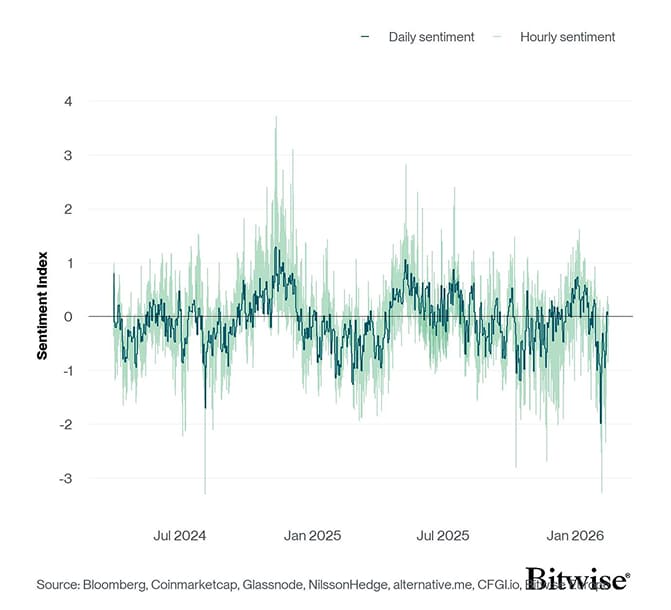
- Cryptoasset Sentiment Index: Our in-house Cryptoasset Sentiment Index has rebounded from its recent lows (the weakest since the FTX aftermath) and is now signalling broadly neutral sentiment - historically associated with contrarian positioning, though this does not constitute evidence of a completed cycle bottom.
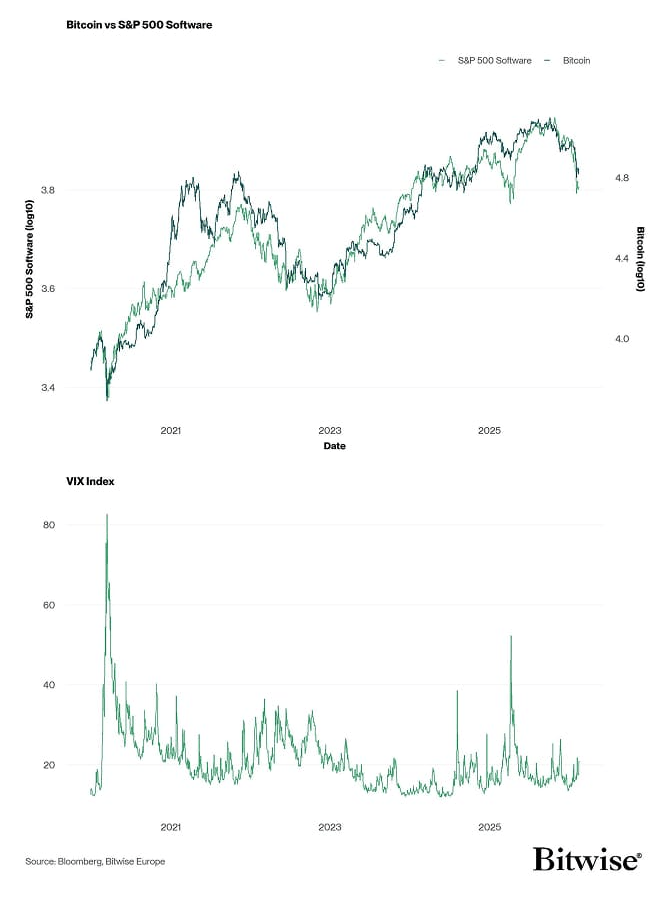
- Chart-of-the-week: Gradual tightening in US financial conditions - reflected in rising VIX levels, wider high-yield spreads and pressure on high-valuation tech equities - remains an important macro factor to monitor as it continues to shape risk appetite across crypto markets.
Chart of the Week
Weakness in software equities & bitcoin likely reflects tightening in financial conditions
Performance
Last week, cryptoasset prices stabilised after one of their most historic 1-day declines on record. A key concern for most investors is whether a cyclical bottom has been reached or whether there is still more downside left in the market.
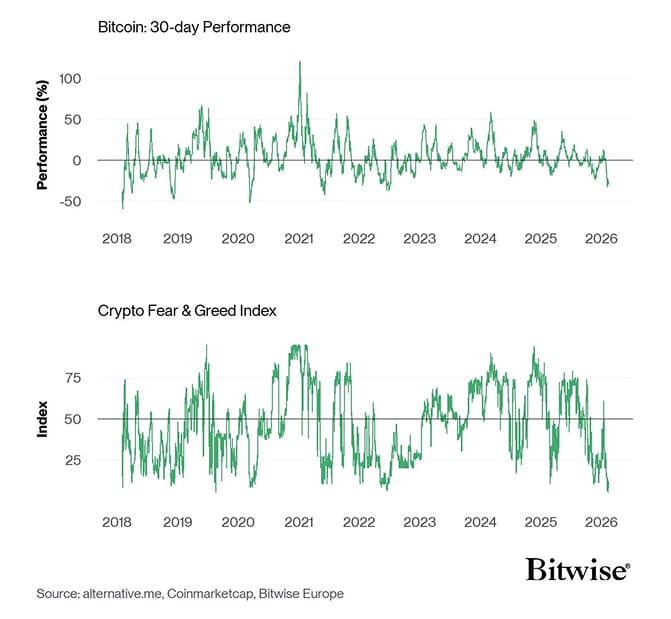
Indicators such as the Crypto Fear & Greed Index have seen record low readings which have historically marked cycle bottoms in the past. In fact, the Crypto Fear & Greed Index reached a level 5 last week – the second lowest reading on record. In this context, it is worth reiterating that our inhouse Cryptoasset Sentiment Index had reached the lowest level since the FTX collapse on the 5th of February 2026.
Besides, some analysts have been pointing towards the fact that previous bear market bottoms saw a convergence between on-chain supply in profit and loss. However, we have only briefly touched 50% in profit/loss during the 5/2 crash so far which implies that there is still a risk that bitcoin could breach the previous lows around $60k.
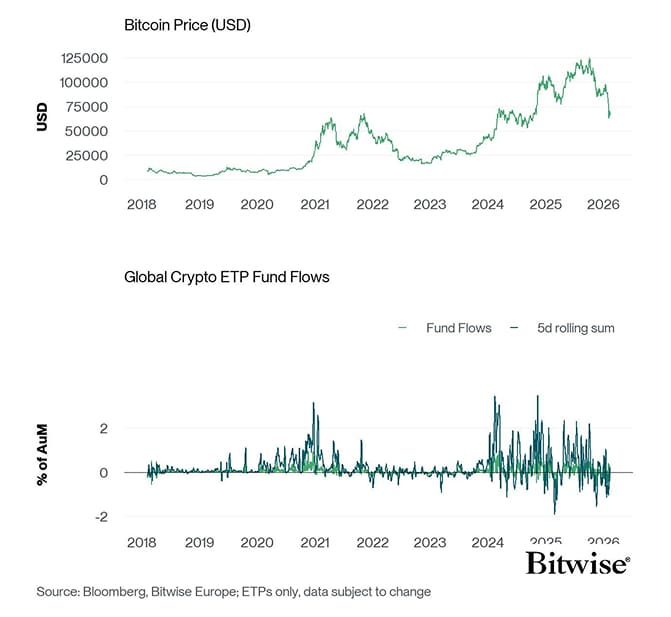
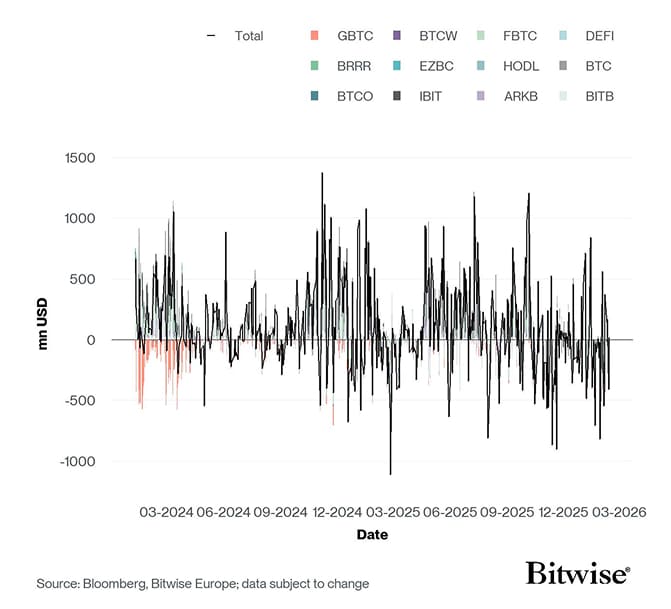
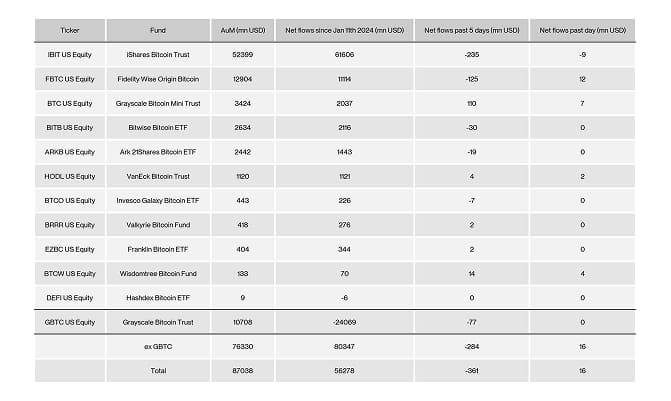
Bears tend to point out that institutional capital flows into bitcoin and other major cryptoassets have slowed down significantly since November. In fact, last week saw continued net outflows from US spot bitcoin ETFs of around -$361 mn. Nonetheless, it is worth highlighting that net outflows have also decelerated over the past 2 weeks already which implies declining selling pressure from ETPs.
Parts of the recent rise in risk aversion could be related to some tightening in US financial conditions which could also explain the recent pressure on US software equities that tend to exhibit high valuation multiples and, thus, are more vulnerable to tightening in financial conditions (Chart-of-the-week). Both the VIX and US high yield spreads have been grinding higher since the beginning of the year. The worries around significant software industry disruption by AI have certainly delivered a strong downside catalyst as well. In general, this gradual tightening in US financial conditions is worth monitoring over the coming weeks.
Ongoing worries around the risks posed by quantum computing have also continued to weigh on crypto market sentiment with a new research paper suggesting an accelerated timeline for ‘QDay' – the day when quantum computing becomes a threat to bitcoin and other cryptoassets. At the same time, last week also saw Bitcoin Improvement Proposal (BIP) 360 being merged into the official Bitcoin BIPs repository, aiming to strengthen Bitcoin against quantum. Significant progress on the quantum front could potentially have very significant performance implications for bitcoin.
Apart from that, it is also worth highlighting that institutional demand for bitcoin (via treasury companies and global bitcoin ETPs) has been positive year-to-date so far and has even outweighed new supply in 2026.
According to our calculations, institutions (treasury companies and ETPs) have bought 27.3k BTC while miners minted an additional 19.1k BTC in 2026 so far.
That being said, it is also worth highlighting that institutional demand has been held up mostly by Strategy (MSTR) who have acquired around 42.1k BTC this year. Recent activity suggests continued purchasing patterns, although such activity may change at any time. To the contrary – the recent STRC price action implies that they have probably managed to purchase more than 1,000 BTC last week just via the issuance of new STRC preferred stocks alone.
That being said, valuations are, historically speaking, in the lowest quarter of observations across a wide range of indicators as highlighted in our previous Crypto Market Compass report. Our valuation indicator has reached 27% which implies that 26% of observed valuation indicators have been lower in the past.
The general news flow has somewhat improved last week with the announcement that the Brazilian congress has officially introduced a bill to establish a strategic bitcoin reserve and buy up to 1M BTC (~5% of the supply). We think that this bill has a low probability to pass the Brazilian congress but could have a very high impact if passed.
Cross Asset Performance (Week-to-Date)
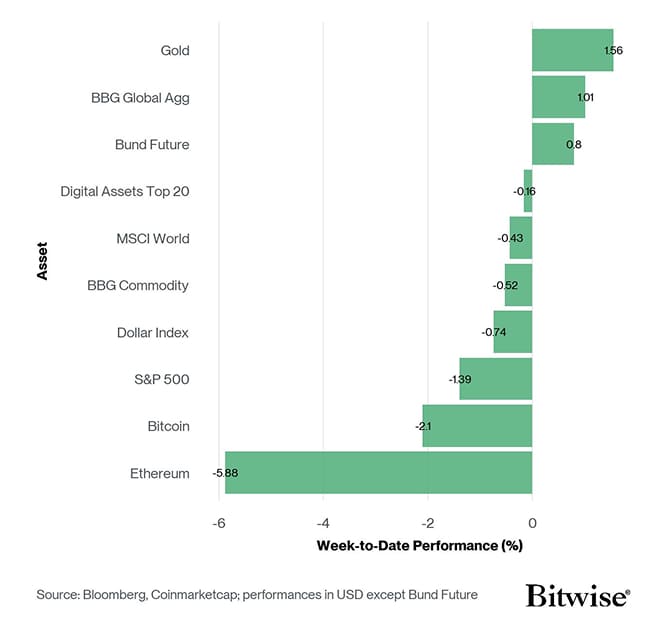 Source: Bloomberg, Coinmarketcap; performances in USD exept Bund Future
Top 10 Cryptoasset Performance (Week-to-Date)
Source: Bloomberg, Coinmarketcap; performances in USD exept Bund Future
Top 10 Cryptoasset Performance (Week-to-Date)
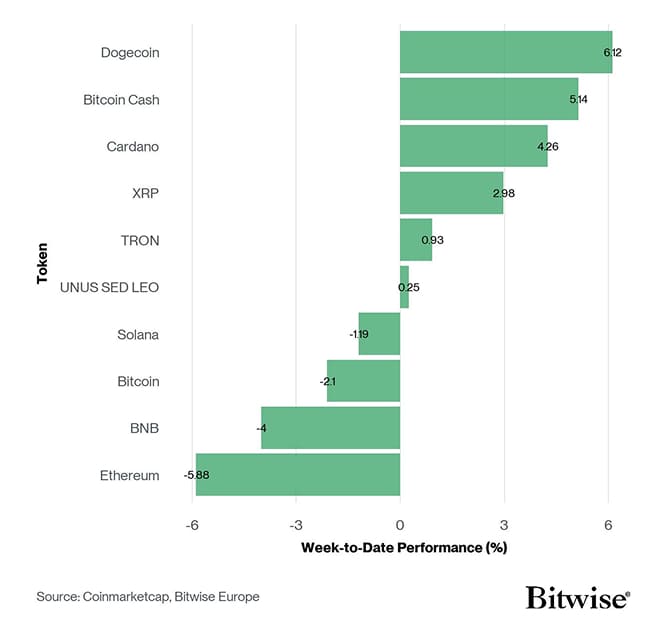 Source: Coinmarketcap
In general, among the top 10 crypto assets Dogecoin, Bitcoin Cash, and Cardano were the relative outperformers.
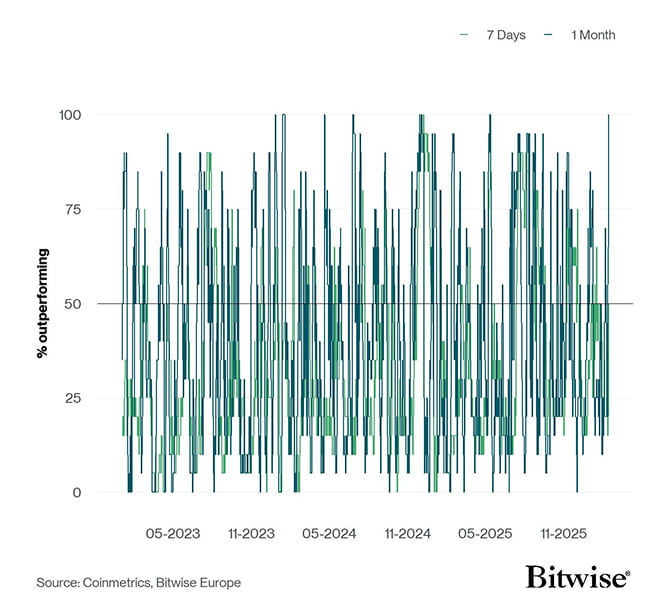
Overall, altcoin outperformance vis-à-vis bitcoin has increased last week, with 90% of our tracked altcoins managing to outperform bitcoin on a weekly basis. However, Ethereum underperformed bitcoin last week.
Sentiment
Our in-house “Cryptoasset Sentiment Index” is currently signalling a neutral sentiment, an improvement from deeply negative sentiment mid-week last week.
At the moment, 8 out of 15 indicators are above their short-term trend.
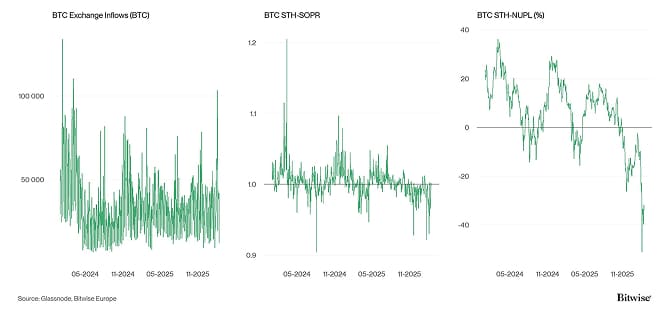
Last week, only the BTC Hedge Fund Beta, Altseason Index, BTC Put-Call Volume, BTC Exchange Inflows, BTC STH SOPR, BTC Funding Rate, 1M 25D Skew, Crypto Fund Flows showed positive momentum.
The Crypto Fear & Greed Index continues to signal an “extreme fear” level of sentiment as of this morning. The index spent the whole month of November and December in either “fear” or “extreme fear” territory although turned to “Greed” briefly early in the third calendar week of January. February has consistently been in “Extreme Fear” so far.
Performance dispersion among cryptoassets declined slightly last week from 0.17 to 0.15. When dispersion is high, it may indicate that the market appears to be driven by a more diverse set of narratives which has historically been associated with periods of increasing risk appetite.
Altcoin outperformance vis-à-vis Bitcoin increased significantly last week, with 90% of our tracked altcoins in the index. Ethereum underperformed Bitcoin though.
In general, increasing (decreasing) altcoin outperformance may be a sign of increasing (decreasing) risk appetite within cryptoasset markets.
Sentiment in traditional financial markets as measured by our in-house measure of Cross Asset Risk Appetite (CARA) decreased to 0.16. The decline in tradfi sentiment is also consistent with the observed decline in the Cryptoasset Sentiment Index more recently.
Fund Flows
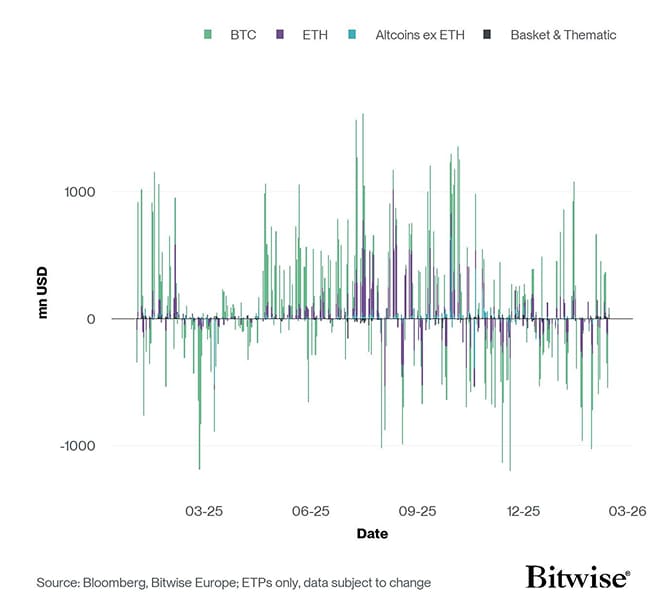
Global crypto ETPs saw small total net outflows last week across Bitcoin and Ethereum products, although Ex-Ethereum, and basket and thematic products saw slight net inflows.
Global crypto ETPs saw around –92.5 mn USD in weekly net outflows across all types of cryptoassets, after -26 mn USD in net outflows the previous week.
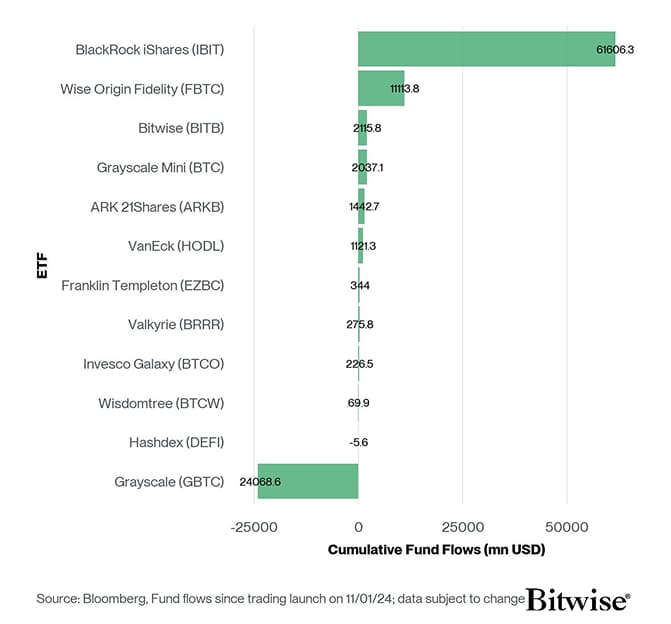
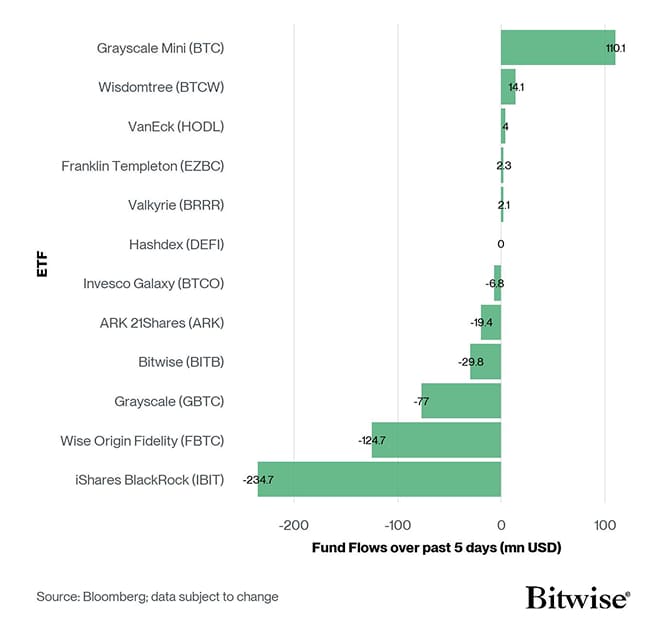
Global Bitcoin ETPs have experienced net outflows totalling -75.8 mn USD last week, of which –359.9 mn USD in net outflows were related to US spot Bitcoin ETFs.
The Bitwise Bitcoin ETF (BITB) in the US experienced net outflows, totalling –29.8 mn USD last week.
In Europe, the Bitwise Physical Bitcoin ETP (BTCE) experienced net inflows equivalent to +4.5 mn USD, whereas the Bitwise Core Bitcoin ETP (BTC1) experienced net inflows of +6.2 mn USD.
The Grayscale Bitcoin Trust (GBTC) posted net outflows of –77 mn USD and the iShares Bitcoin Trust (IBIT) experienced net outflows of around –234.7 mn USD last week.
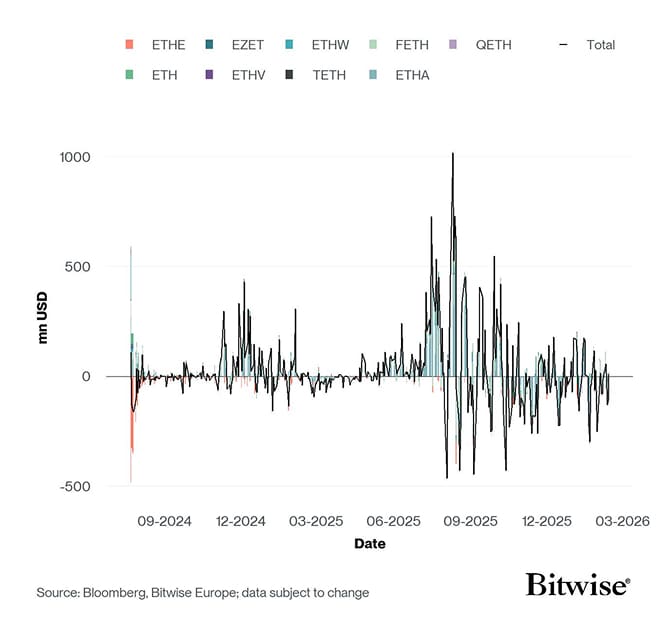
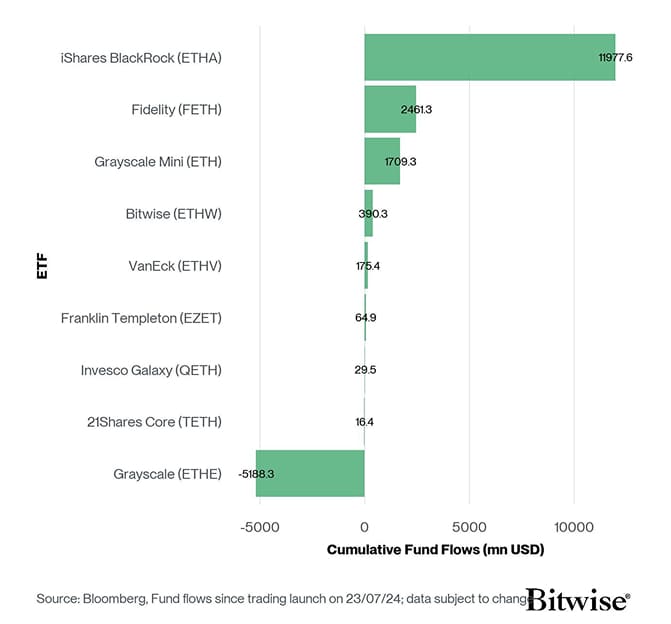
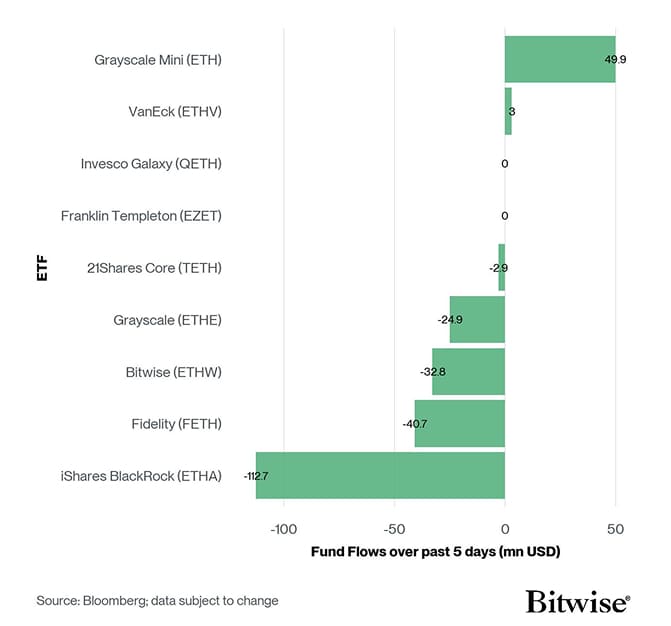
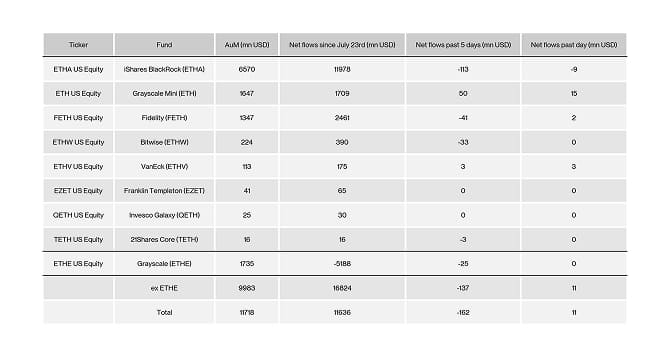
Meanwhile, global Ethereum ETPs also experienced –88.8 mn USD in net outflows last week, of which US spot Ethereum ETFs recorded net outflows of around –161.1 mn USD on aggregate.
The Grayscale Ethereum Trust (ETHE) posted net outflows of –24.9 mn USD, alongside the iShares Ethereum Trust (ETHA) that also experienced –112.7 mn USD of net outflows.
The Bitwise Ethereum ETF (ETHW) in the US has posted net outflows of –32.8 mn USD.
In Europe, the Bitwise Physical Ethereum ETP (ZETH) saw minor net inflows of +1.1 mn USD, as the Bitwise Ethereum Staking ETP (ET32) saw +0.1 mn of net inflows.
Altcoin ETPs ex Ethereum experienced net inflows of +10.2 mn USD last week.
Thematic & basket crypto ETPs posted net inflows of +62 mn USD on aggregate last week. The Bitwise MSCI Digital Assets Select 20 ETP (DA20) experienced net inflows last week of +0.5 mn USD on aggregate.
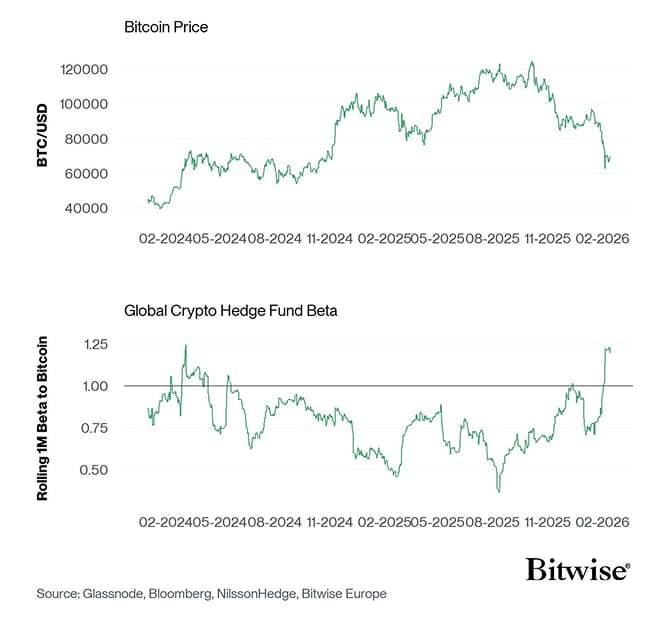
Global crypto hedge funds exposure to Bitcoin slightly decreased last week. The 20-days rolling beta of global crypto hedge funds' performance to Bitcoin dropped from 1.21 to 1.19. A reduction from the highest reading in 2 years which still implies a very significant increase in market exposure by global crypto hedge funds.
On-Chain Data
Following last week's capitulation to a cycle low near $60k, Bitcoin has staged a relief rally, with price recovering into the $70k region. The preceding drawdown registered the largest nominal decline on record, followed shortly by the largest single-day relief rally to date, underscoring the scale of recent volatility and an elevated sensitivity of price to marginal flows.
Exchange sell pressure has since moderated across the rebound, with intraday spot buying minus selling closing the week near –$1.3bn. This normalization suggests the market is approaching a short-term equilibrium, indicating the current price region is emerging as a structurally important inflection zone.
Despite the bounce, aggregate investor stress remains historically elevated. The value of capital held at a loss is estimated at $853bn (78% of invested capital), while unrealized losses across underwater supply remain near –$298B, just shy of the largest overhang observed to date.
The Long-Term Holder Spent Output Profit Ratio (LTH-SOPR) has also turned negative for the first time since 2023, indicating mature investors are, on aggregate, distributing at a loss. Historically, this configuration appears deep into bear regimes, when even relatively price-insensitive cohorts capitulate. The majority of realized losses originate from 6m–2y coin age bands, suggesting buyers accumulated across the topping formation are exiting.
From a price action perspective, the market is now attempting to reclaim the $70k region, which has recently flipped into resistance. This zone represents a key confluence, aligning with the $70k–$80k volume gap, the prior cycle all-time high near $69k, and the upper boundary of the 2024 consolidation range.
Net realized profit and loss has reverted toward breakeven in the aftermath of the recent shock, suggesting a temporary pause in directional conviction. The rebalancing of profit- and loss-taking flows around $70k reinforces this level as a near-term inflection point for local momentum.
When assessing upside momentum, $70k remains the first critical threshold to reclaim. Beyond this, the True Market Mean at $79k and the Short-Term Holder Cost Basis at $91k define the next major resistance zones. A sustained break and hold above these levels would suggest a local trend reversal alongside improving conditions for a broader macro recovery. However, the market currently remains some distance from these targets.
With sentiment still depressed and the market in a fragile recovery phase following the recent shock, further downside risk cannot be excluded. As previously outlined, the Realised Price ($56k) and the 200-week moving average ($58k) has historically defined terminal downside regions.
Overall, investor sentiment remains impaired, with even the average Long-Term Holder now realising losses on spent coins. Shocks of this magnitude typically require time for market structure to repair. Presently, $70k remains firm resistance, making the market's reaction here critical for assessing local structural repair. On the downside, $56k–$58k remains the primary reference zone for potential terminal support.
Futures, Options & Perpetuals
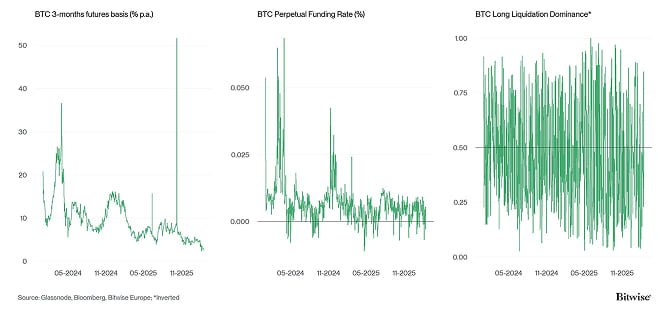
Over the past week, BTC perpetual futures open interest declined by approximately -10.9k BTC, while CME futures open interest decreased by -705 BTC, signalling a slight downtick in institutional positioning. In addition, futures liquidations across all assets have moderated to $2.07bn across the week, down from $5.8bn last week. This suggests a substantial share of excess leverage has been cleared within the current price zone, leaving spot-driven flows as the dominant market driver.
From a positioning perspective, a large cluster of open interest is concentrated around the $98k region, marking this level as a key macro upside checkpoint. Open interest is also beginning to rebuild across the $70k–$72k range, reinforcing on-chain observations that this zone remains critical for local momentum.
Perpetual funding rates (7-day moving average) have continued to decline week-on-week but remain positive, indicating a marginal long bias persists among futures traders. A more constructive signal would be a sustained flip into negative funding, reflecting deeper leverage reset and reduced long crowding.
In parallel, the BTC 3-month annualized basis remains depressed, hovering near 3%, one of the lowest readings of the cycle. Such subdued basis levels are typically associated with risk-averse market conditions, reflecting reduced demand for leveraged long exposure.
Turning to options markets, BTC options open interest declined by approximately –16.3k BTC over the week, bringing total open interest to 435k BTC. Concurrently, the Deribit put-to-call open interest ratio remained elevated at 0.77, while the equivalent measure across IBIT options held near 0.63, its seventh-highest reading on record. Taken together, these dynamics suggest demand for downside protection remains robust, leaving the market positioned defensively in the aftermath of the crash.
Interestingly, 25-delta skew moderated across all tenors following last week's surge, signalling some easing in the premium for downside protection across both short- and medium-dated maturities as the market acclimatizes to lower price levels. Even so, skew remains elevated relative to the rest of the cycle, underscoring the severity of the recent crash and its lasting impact on investor positioning.
Options dealer gamma positioning is also beginning to ease. While negative gamma still dominates across the $62k–$74k range, maintaining conditions where dealer hedging flows can amplify directional price moves, pockets of positive gamma are emerging near $66k, $71k, and $75k. This configuration highlights $71k and $75k as potential upside resistance zones and $66k as near-term support, levels broadly respected by price action over the past week.
Bottom Line
- Performance: Cryptoasset prices stabilised last week following one of the sharpest single-day drawdowns on record, with altcoins broadly outperforming bitcoin on a weekly basis despite ongoing ETF outflows and lingering downside risks around the ~$60k BTC level.
- Cryptoasset Sentiment Index: Our in-house Cryptoasset Sentiment Index has rebounded from its recent lows (the weakest since the FTX aftermath) and is now signalling broadly neutral sentiment - historically associated with a contrarian backdrop, though not yet definitive evidence of a completed cycle bottom.
- Chart-of-the-week: Gradual tightening in US financial conditions - reflected in rising VIX levels, wider high-yield spreads and pressure on high-valuation tech equities - remains an important macro factor to monitor as it continues to shape risk appetite across crypto markets.
Appendix
Bitcoin Price vs Cryptoasset Sentiment Index
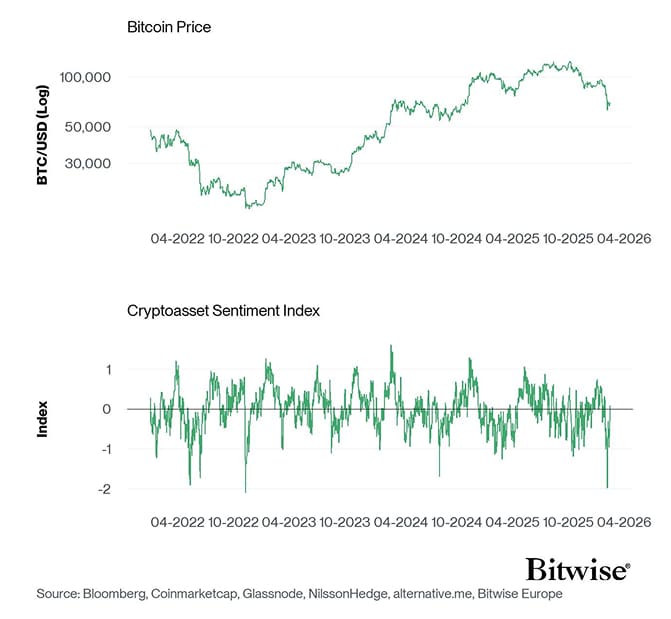 Source: Bloomberg, Coinmarketcap, Glassnode, NilssonHedge, alternative.me, Bitwise Europe
Cryptoasset Sentiment Index
Source: Bloomberg, Coinmarketcap, Glassnode, NilssonHedge, alternative.me, Bitwise Europe
Cryptoasset Sentiment Index
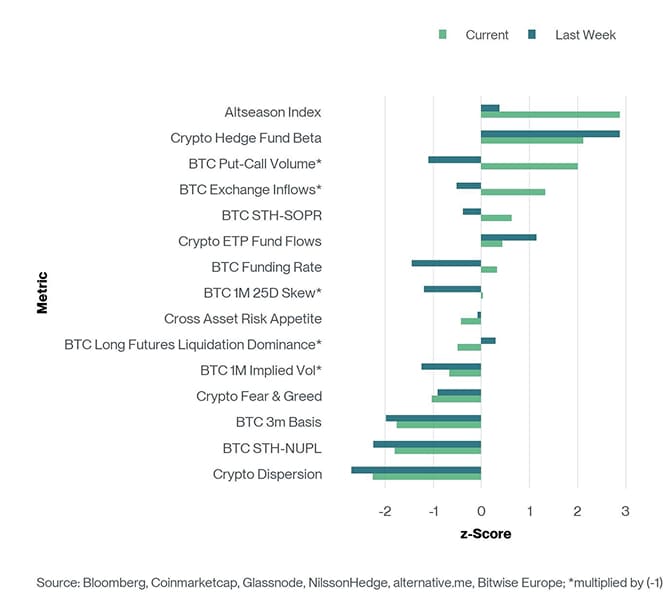 Source: Bloomberg, Coinmarketcap, Glassnode, NilssonHedge, alternative.me, Bitwise Europe; *multiplied by (-1)
TradFi Sentiment Indicators
Source: Bloomberg, Coinmarketcap, Glassnode, NilssonHedge, alternative.me, Bitwise Europe; *multiplied by (-1)
TradFi Sentiment Indicators
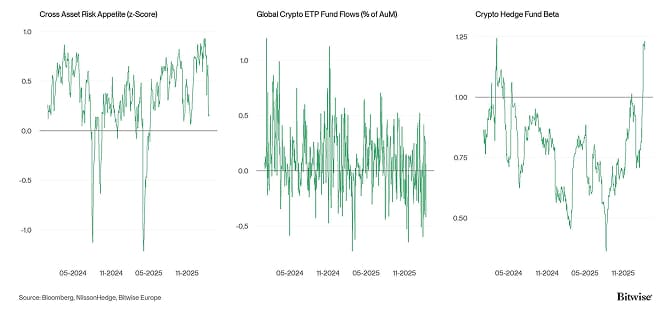 Source: Bloomberg, NilssonHedge, Bitwise Europe
Crypto Sentiment Indicators
Source: Bloomberg, NilssonHedge, Bitwise Europe
Crypto Sentiment Indicators
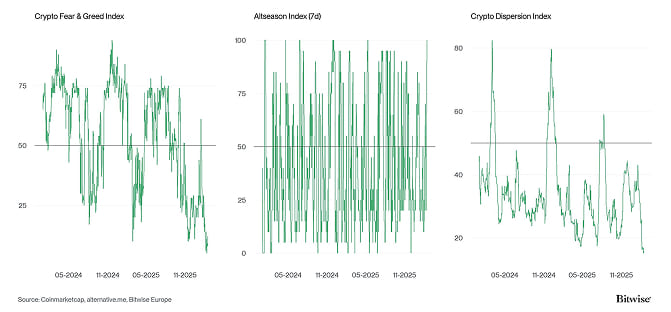 Source: Coinmarketcap, alternative.me, Bitwise Europe
Crypto Options' Sentiment Indicators
Source: Coinmarketcap, alternative.me, Bitwise Europe
Crypto Options' Sentiment Indicators
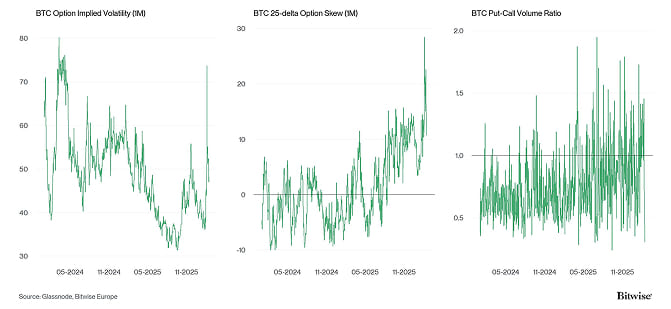 Source: Glassnode, Bitwise Europe
Crypto Futures & Perpetuals' Sentiment Indicators
Source: Glassnode, Bitwise Europe
Crypto Futures & Perpetuals' Sentiment Indicators
 Source: Glassnode, Bitwise Europe; *Inverted
Crypto On-Chain Indicators
Source: Glassnode, Bitwise Europe; *Inverted
Crypto On-Chain Indicators
 Source: Glassnode, Bitwise Europe
Bitcoin vs Crypto Fear & Greed Index
Source: Glassnode, Bitwise Europe
Bitcoin vs Crypto Fear & Greed Index
 Source: alternative.me, Coinmarketcap, Bitwise Europe
Cryptoasset Sentiment Index: Daily vs Hourly
Source: alternative.me, Coinmarketcap, Bitwise Europe
Cryptoasset Sentiment Index: Daily vs Hourly
 Source: Bloomberg, Coinmarketcap, Glassnode, NilssonHedge, alternative.me, CFGI.io, Bitwise Europe
Bitcoin vs Global Crypto ETP Fund Flows
Source: Bloomberg, Coinmarketcap, Glassnode, NilssonHedge, alternative.me, CFGI.io, Bitwise Europe
Bitcoin vs Global Crypto ETP Fund Flows
 Source: Bloomberg, Bitwise Europe; ETPs only, data subject to change
Global Crypto ETP Fund Flows
Source: Bloomberg, Bitwise Europe; ETPs only, data subject to change
Global Crypto ETP Fund Flows
 Source: Bloomberg, Bitwise Europe; ETPs only; data subject to change
US Spot Bitcoin ETF Fund Flows
Source: Bloomberg, Bitwise Europe; ETPs only; data subject to change
US Spot Bitcoin ETF Fund Flows
 Source: Bloomberg, Bitwise Europe; data subject to change
US Spot Bitcoin ETFs: Flows since launch
Source: Bloomberg, Bitwise Europe; data subject to change
US Spot Bitcoin ETFs: Flows since launch
 Source: Bloomberg, Fund flows since traiding launch on 11/01/24; data subject to change
US Spot Bitcoin ETFs: 5-days flow
Source: Bloomberg, Fund flows since traiding launch on 11/01/24; data subject to change
US Spot Bitcoin ETFs: 5-days flow
 Source: Bloomber; data subject to change
US Bitcoin ETFs: Net Fund Flows since 11th Jan mn USD
Source: Bloomber; data subject to change
US Bitcoin ETFs: Net Fund Flows since 11th Jan mn USD
 Source: Bloomberg, Bitwise Europe; data as of 13-02-2026
US Spot Ethereum ETF Fund Flows
Source: Bloomberg, Bitwise Europe; data as of 13-02-2026
US Spot Ethereum ETF Fund Flows
 Source: Bloomberg, Bitwise Europe; data subject to change
US Spot Ethereum ETFs: Flows since launch
Source: Bloomberg, Bitwise Europe; data subject to change
US Spot Ethereum ETFs: Flows since launch
 Source: Bloomberg, Fund flows since trading launch on 23/07/24; data subject on change
US Spot Ethereum ETFs: 5-days flow
Source: Bloomberg, Fund flows since trading launch on 23/07/24; data subject on change
US Spot Ethereum ETFs: 5-days flow
 Source: Bloomberg; data subject on change
US Ethereum ETFs: Net Fund Flows since 23rd July
Source: Bloomberg; data subject on change
US Ethereum ETFs: Net Fund Flows since 23rd July
 Source: Bloomberg, Bitwise Europe; data as of 13-02-2026
Bitcoin vs Crypto Hedge Fund Beta
Source: Bloomberg, Bitwise Europe; data as of 13-02-2026
Bitcoin vs Crypto Hedge Fund Beta
 Source: Glassnode, Bloomberg, NilssonHedge, Bitwise Europe
Altseason Index
Source: Glassnode, Bloomberg, NilssonHedge, Bitwise Europe
Altseason Index
 Source: Coinmetrics, Bitwise Europe
Bitcoin vs Crypto Dispersion Index
Source: Coinmetrics, Bitwise Europe
Bitcoin vs Crypto Dispersion Index
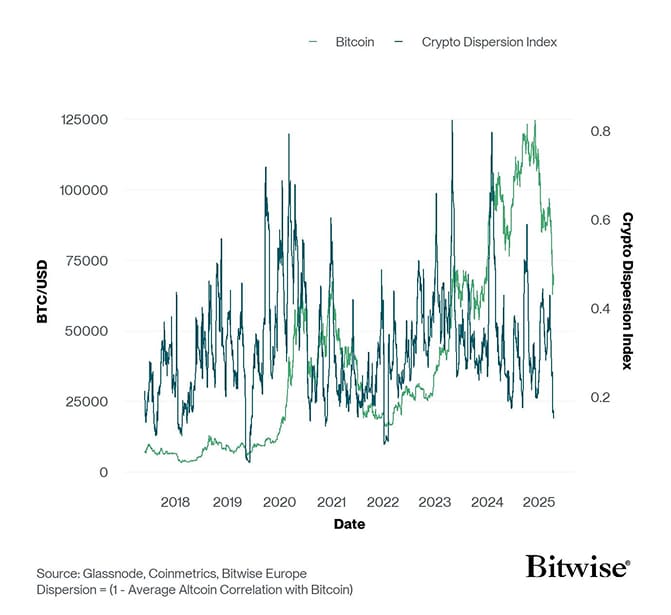 Source: Coinmarketcap, Bitwise Europe; Dispersion = (1 - Average Altcoin Correlation with Bitcoin)
Bitcoin Price vs Futures Basis Rate
Source: Coinmarketcap, Bitwise Europe; Dispersion = (1 - Average Altcoin Correlation with Bitcoin)
Bitcoin Price vs Futures Basis Rate
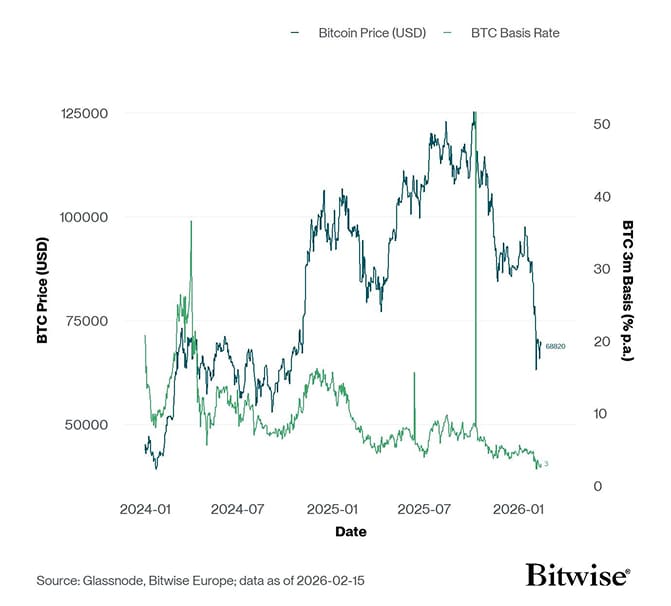 Source: Glassnode, Bitwise Europe; data as of 2026-02-15
Ethereum Price vs Futures Basis Rate
Source: Glassnode, Bitwise Europe; data as of 2026-02-15
Ethereum Price vs Futures Basis Rate
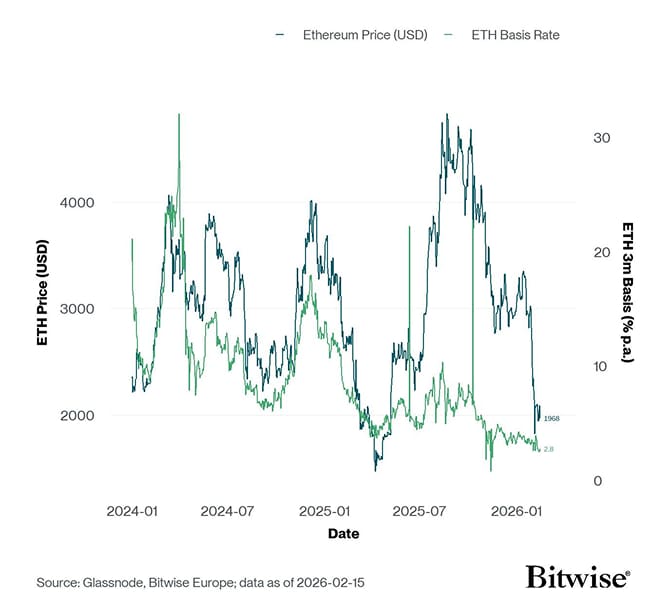 Source: Glassnode, Bitwise Europe; data as of 2026-02-15
BTC Net Exchange Volume by Size
Source: Glassnode, Bitwise Europe; data as of 2026-02-15
BTC Net Exchange Volume by Size
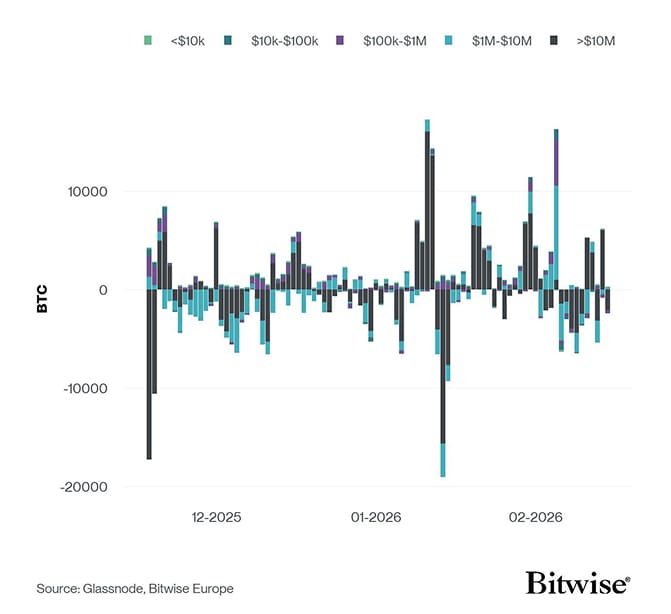 Source: Glassnode, Bitwise Europe
Important Information
This publication constitutes a marketing communication and is provided for informational purposes only. It does not constitute investment advice, a personal recommendation, or an offer or solicitation to buy or sell any financial instrument.
This document (which may take the form of a presentation, press release, social media post, blog article, broadcast communication or similar instrument – collectively referred to as a “Document”) is issued by Bitwise Europe GmbH (“BEU” or the “Issuer”) and has been prepared in accordance with applicable laws and regulations, including those relating to financial promotions.
Bitwise Europe GmbH, incorporated under the laws of Germany, is the issuer of the Exchange Traded Products (“ETPs”) referenced in this Document under a base prospectus and the applicable final terms, as supplemented from time to time, approved by the German Federal Financial Supervisory Authority (BaFin). The approval of the prospectus by BaFin relates solely to the completeness, coherence and comprehensibility of the prospectus in accordance with the Prospectus Regulation and does not constitute an endorsement, recommendation or assessment of the merits of the products.
The market analyses, views and scenarios presented reflect the assessment as of the date of publication and are based on information considered reliable. However, no representation or warranty is made as to their accuracy or completeness. Forward-looking statements involve risks and uncertainties and are not guarantees of future performance. Past performance is not a reliable indicator of future results.
Capital at risk. Cryptoassets are highly volatile and involve a high degree of risk. The value of investments in cryptoassets and crypto-linked ETPs may fluctuate significantly, and investors may lose part or all of their invested capital. No capital protection or guaranteed compensation mechanism applies in respect of market losses.
Any investment decision should be made solely on the basis of the relevant base prospectus, the applicable final terms and the key information document, in particular the section entitled “Risk Warning”. The base prospectus, final terms and additional risk information are available at: www.bitwiseinvestments.eu
Access to certain documents may require self-certification regarding your jurisdiction and investor status and may be subject to additional disclaimers and important information.
For further details, please refer to the full disclaimer available at: www.bitwiseinvestments.eu/disclaimer

 en
en  de
de  it
it  fr
fr  es
es