- Last week, major cryptoassets outperformed traditional assets amid rising geopolitical risks but many traditional markets were mostly closed over the holidays and over weekend when the Venezuelan regime change took place.
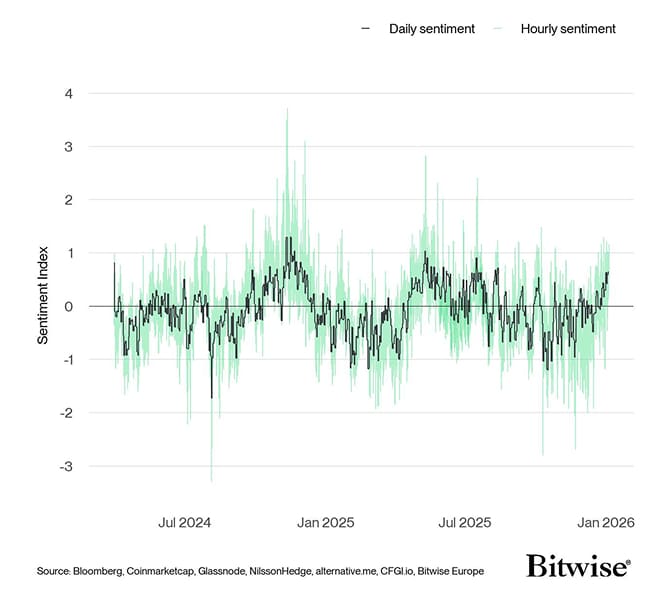
- Our in-house “Cryptoasset Sentiment Index” has shown sing of recovery and is currently indicating a positivemarket sentiment.
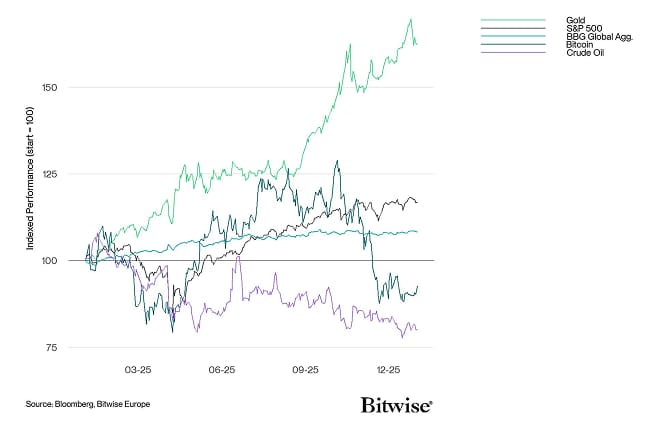
- Chart-of-the-Week: Long-term holder selling in combination with the major liquidation event on the 10th of October have led to a significant decoupling of bitcoin from the ”debasement trade” in 2025. We think that positive macro tailwinds will most likely lead to a catch-up of bitcoin to gold and other major assets, and a gradual correction of this mispricing in 2026.
Chart of the Week
Indexed Performance in 2025
Performance
Last week, major cryptoassets outperformed traditional assets amid rising geopolitical risks but many traditional markets were mostly closed over the holidays and over weekend when the Venezuelan regime change took place.
Despite elevated geopolitical risks related to recent developments involving Venezuela, bitcoin and broader crypto markets have remained relatively resilient. Historically, such geopolitical events tend to have only short-term impacts on cryptoasset performance, and we do not anticipate any prolonged effect on bitcoin or other digital assets.
It is worth noting that some reports suggest the Venezuelan government may hold significant bitcoin reserves. While the exact figures are uncertain, any potential changes in these holdings could influence market dynamics. However, there is no indication of such developments at this time.
On a positive note, it appears as if risk appetite is returning to crypto markets. Net flows into global cryptoasset ETPs over the past 5 trading days have been positive again and our inhouse Cryptoasset Sentiment Index is also signalling a bullish market sentiment as well.
Some analysts have attributed the recent recovery in prices to less selling pressure stemming from a decline in tax loss harvesting after the 31st of December.
That being said, as highlighted in our latest Bitcoin Macro Investor report, our general hypothesis is that bitcoin remains largely mispriced relative to the macro outlook in 2026, global money supply, and other major assets like gold.
Long-term holder selling in combination with the major liquidation event on the 10th of October have led to a significant decoupling of bitcoin from the ”debasement trade” in 2025 (Chart-of-the-week). We think that positive macro tailwinds will most likely lead to a catch-up of bitcoin to gold and other major assets, and a gradual correction of this mispricing in 2026.
Note that in this context, long-term holders are defined as bitcoin investors with a holding period of more than 155 days which tend to be rather sophisticated investors.
In fact, our quantitative analyses imply that the recent underperformance of bitcoin was largely driven by coin-specific factors (read: Long-term holder selling) and not so much macro factors.
The implication is that once these coin-specific headwinds subside, bitcoin may align more closely to borader positive macro trends.
As highlighted in one of our previous Bitcoin Macro Investor reports, bitcoin effectively prices in a recession (which will most likely not materialise in 2026).
In general, we think that 2026 will be a more positive year due to a combination of tailwinds which we have recently outlined in our top 10 predictions for 2026. Amongst other things, we expect bitcoin ETFs to continue to soak up all the newly mined supply which will create a pervasive supply deficit in 2026.
In general, we expect 2026 to be the year where institutional demand for cryptoassets starts to accelerate and where historical performance patterns (caused by the Halving) become obsolete.
This will likely propel bitcoin and other cryptoassets further into the mainstream.
Cross Asset Performance (Week-to-Date)
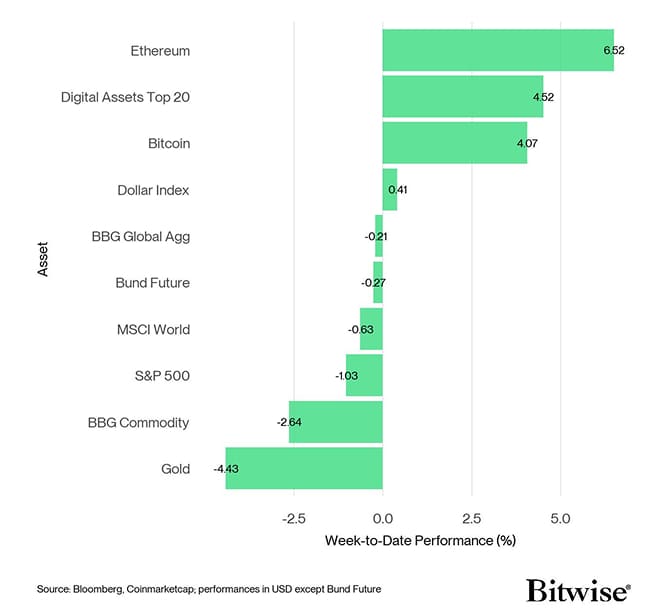 Source: Bloomberg, Coinmarketcap; performances in USD exept Bund Future
Top 10 Cryptoasset Performance (Week-to-Date)
Source: Bloomberg, Coinmarketcap; performances in USD exept Bund Future
Top 10 Cryptoasset Performance (Week-to-Date)
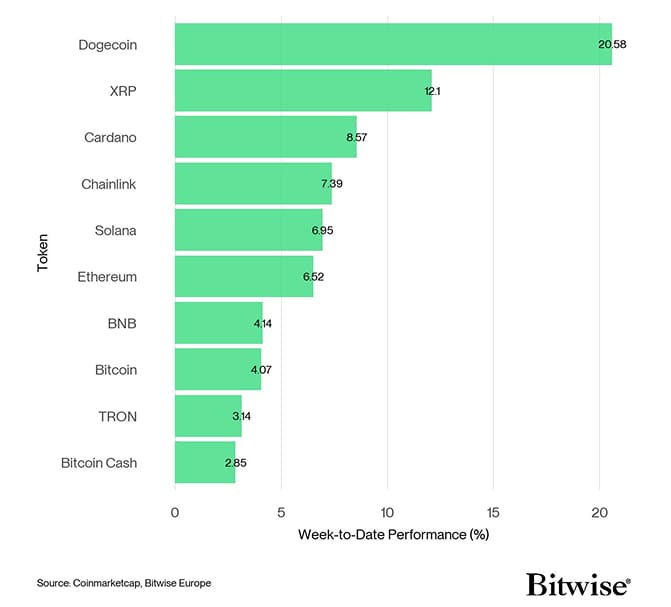 Source: Coinmarketcap
In general, among the top 10 crypto assets Dogecoin, XRP, and Cardano were the relative outperformers.
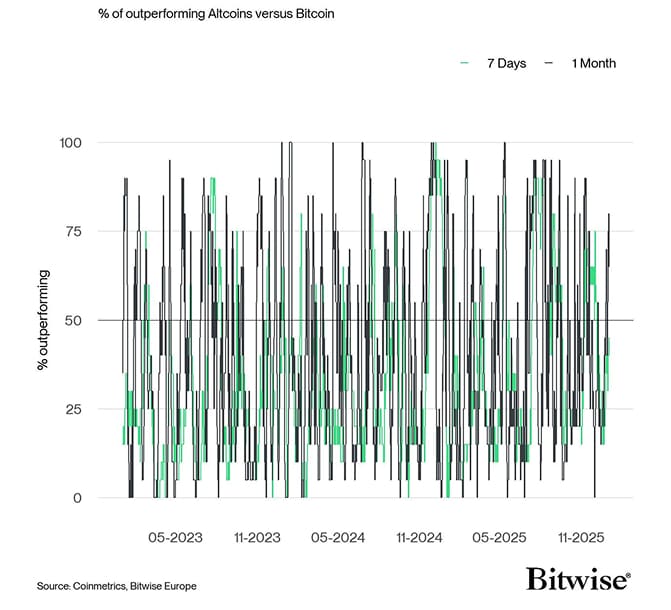
Overall, altcoin outperformance vis-à-vis bitcoin increased last week, with 70% of our tracked altcoins managing to outperform bitcoin on a weekly basis. Ethereum also outperformed bitcoin last week.
Sentiment
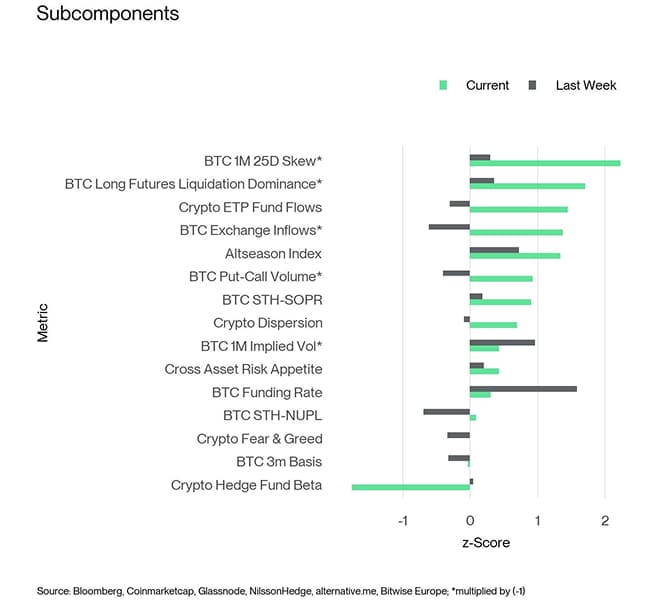
Our in-house “Cryptoasset Sentiment Index” has increased significantly compared to last week and is now signalling a bullish level of sentiment.
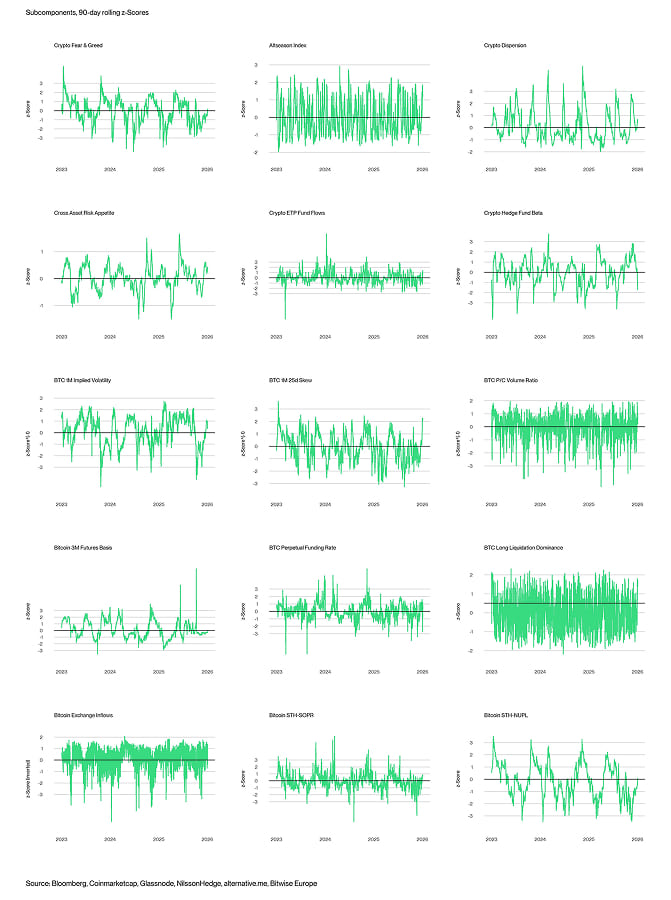
At the moment, 12 out of 15 indicators are above their short-term trend.
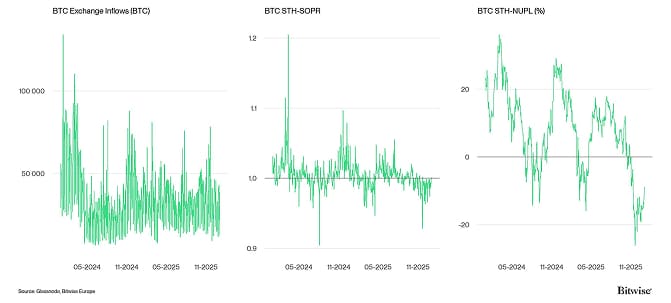
Last week, the BTC 1M 25D Skew, BTC Long Futures Liquidation Dominance, Crypto ETP Fund Flows, BTC Exchange Inflows, Altseason Index, BTC Put-Call Volume, BTC STH-SOPR, Crypto Dispersion, BTC 1M Implied Vol, Cross Asset Risk Appetite, BTC Funding Rate, BTC STH-NUPL metrics all showed positive momentum.
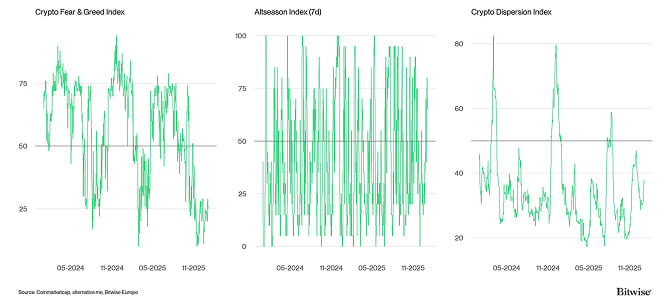
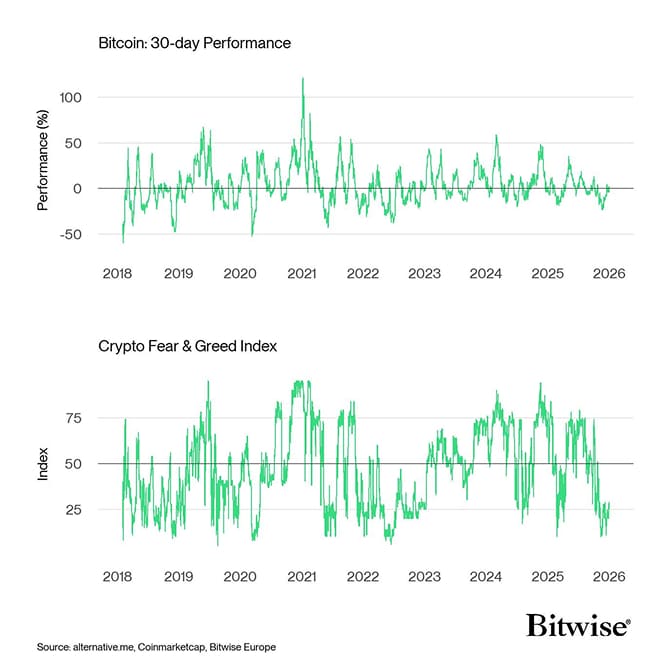
The Crypto Fear & Greed Index signals a “fear” level of sentiment as of this morning. The index has spent the whole month of November and December, so far, in either “fear” or “extreme fear” territory.
Performance dispersion among cryptoassets increased last week from 0.31 to 0.38. When dispersion is high, it means that the market appears to be driven by a more diverse set of narratives which tends to be a sign of increasing risk appetite.
Altcoin outperformance vis-à-vis Bitcoin increased last week, with around 70% of our tracked altcoins, including Ethereum, managing to outperform Bitcoin on a weekly basis.
In general, increasing (decreasing) altcoin outperformance tends to be a sign of increasing (decreasing) risk appetite within cryptoasset markets and the latest altcoin underperformance still signals decreasing risk appetite at the moment.
Sentiment in traditional financial markets as measured by our in-house measure of Cross Asset Risk Appetite (CARA) increased slightly to 0.71. This is a notable divergence between TradFi and crypto asset sentiment that should be continued to watch closely.
Fund Flows
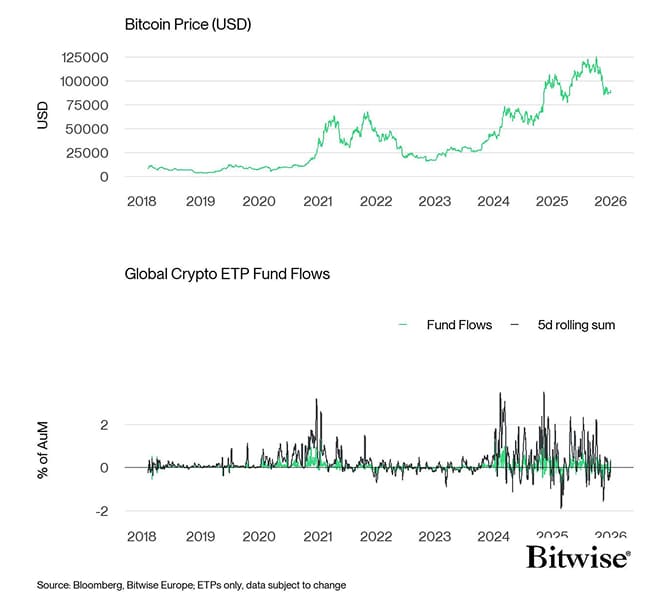
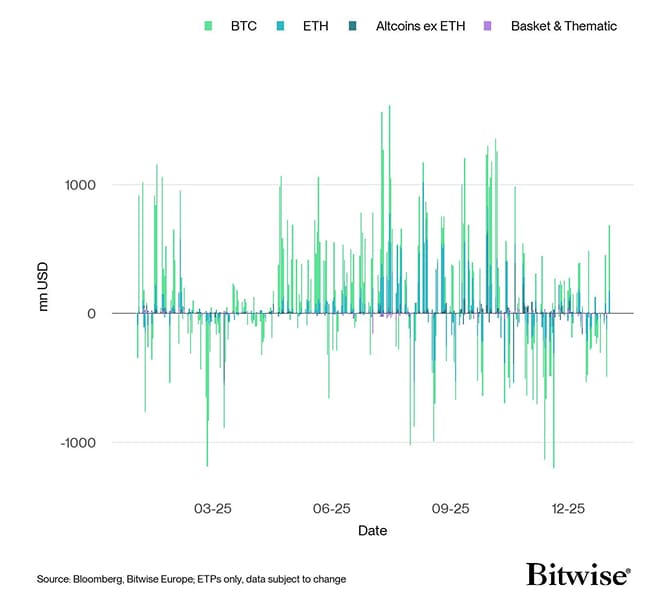
Global crypto ETPs saw large total net inflows last week, mainly in Bitcoin and Ethereum products, with altcoin demand lagging behind.
Global crypto ETPs saw around +553.6 mn USD in weekly net inflows across all types of cryptoassets.
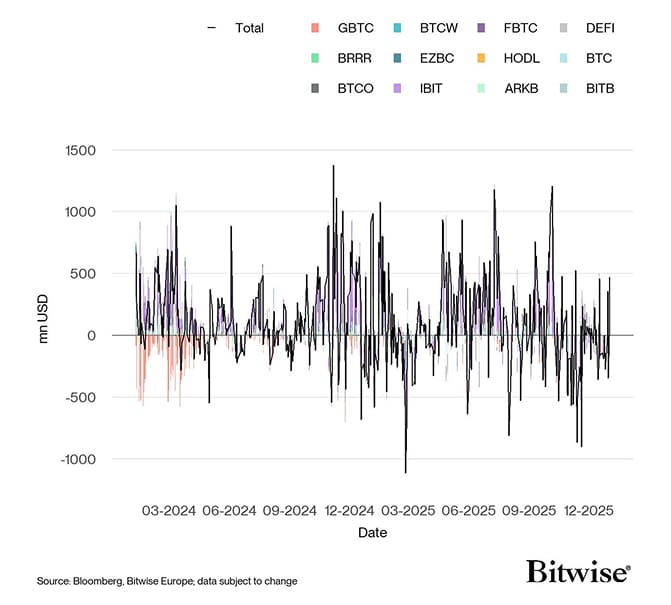
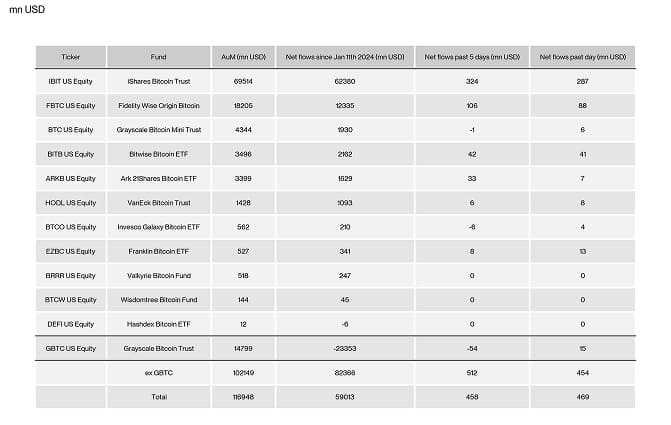
Global Bitcoin ETPs have continued to experience net inflows totalling +494.8 mn USD last week, of which +458.8 mn USD in net inflows were related to US spot Bitcoin ETFs.
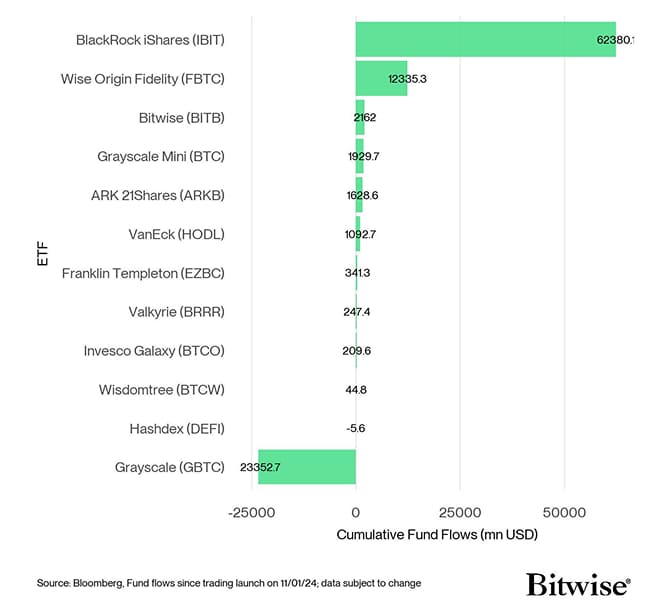
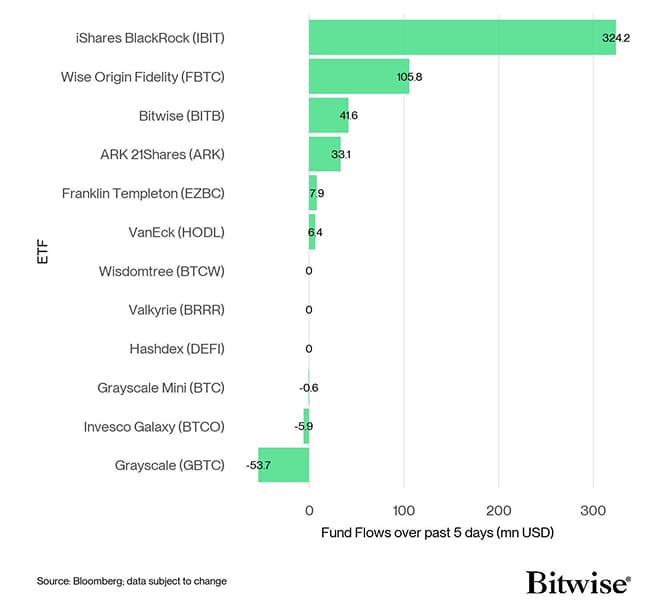
The Bitwise Bitcoin ETF (BITB) in the US experienced net inflows, totalling +41.6 mn USD last week.
In Europe, the Bitwise Physical Bitcoin ETP (BTCE) experienced net outflows equivalent to –6.1 mn USD, as the Bitwise Core Bitcoin ETP (BTC1) experienced net inflows of +0.9 mn USD.
The Grayscale Bitcoin Trust (GBTC) posted net outflows of -53.7 mn USD and the iShares Bitcoin Trust (IBIT) experienced net inflows of around +324.2 mn USD last week.
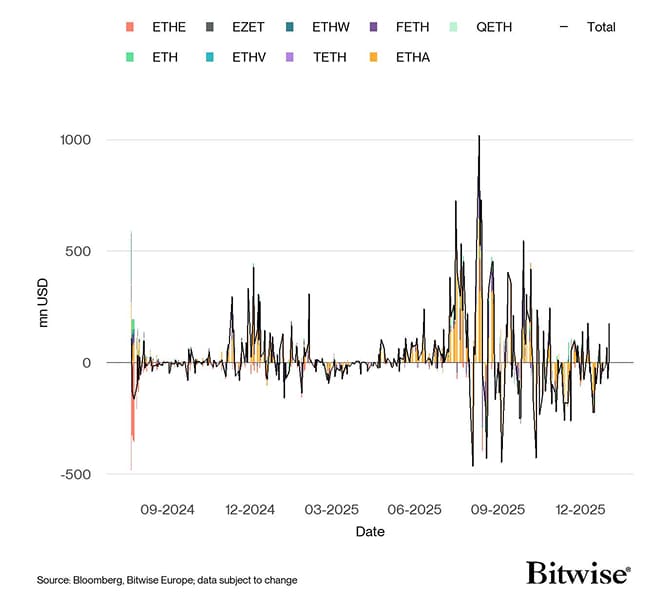
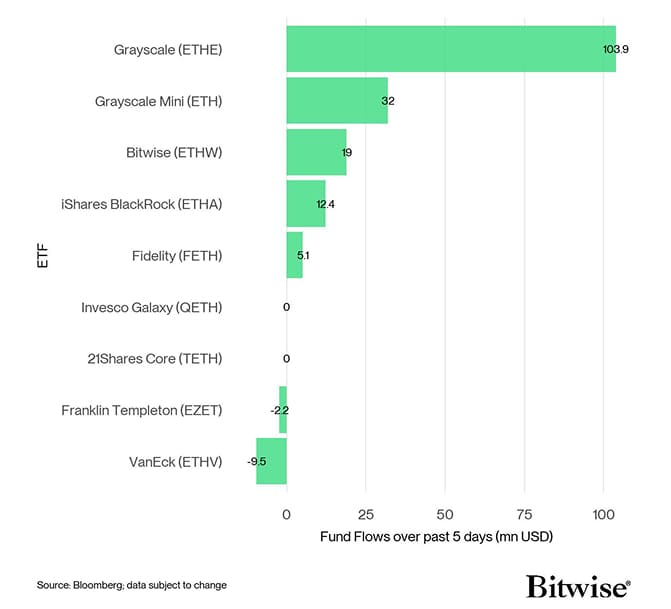
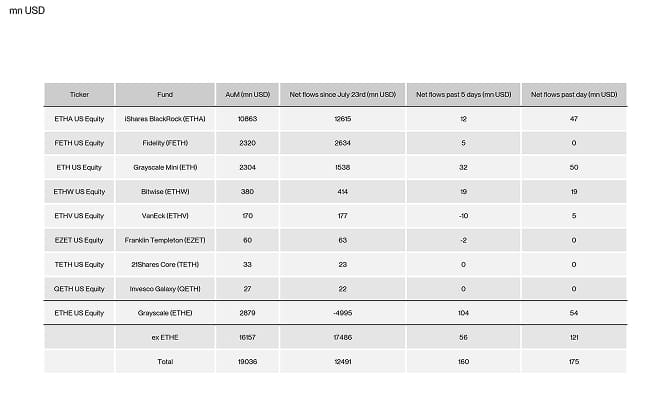
Meanwhile, global Ethereum ETPs also experienced +120.7 mn USD in net inflows last week, of which US spot Ethereum ETFs recorded net inflows of around +160.6 mn USD on aggregate.
The Grayscale Ethereum Trust (ETHE) posted net inflows of +103.9 mn USD.
The Bitwise Ethereum ETF (ETHW) in the US has posted net inflows of +19 mn USD.
In Europe, the Bitwise Physical Ethereum ETP (ZETH) saw minor net outflows of -1.6 mn USD while the Bitwise Ethereum Staking ETP (ET32) saw +0.3 mn of net inflows.
Altcoin ETPs ex Ethereum experienced net outflows of -39 mn USD last week.
Thematic & basket crypto ETPs also posted net outflows of -22.9 mn USD on aggregate last week. The Bitwise MSCI Digital Assets Select 20 ETP (DA20) has experienced slight net inflows last week of +0.2 mn USD on aggregate.
Global crypto hedge funds exposure to Bitcoin decreased last week. The 20-days rolling beta of global crypto hedge funds' performance to Bitcoin dropped from 0.83 to 0.61 per yesterday's close.
On-Chain Data
Sell-side pressure across exchanges continues to ease, with intraday spot buying minus selling closing the week at approximately –$361mn, improving from –$1.2bn the prior week. At the same time, combined inflow and outflow volumes across centralised exchanges have risen from $4.2bn to $5.5bn, pointing to a modest increase in speculative activity. However, exchange volumes remain subdued relative to the past year, indicating that overall investor engagement is still relatively muted despite the recent uptick.
Market sentiment remains fragile with 29% of the supply in loss. This corresponds to $620bn of invested value that is an underwater position. In total, the losses held across these coins amount to -$93bn, or -$16k per coin, which remains historically elevated, but have eased across the past month.
This assessment is further supported by the Fear and Greed Index, which has remained anchored in Extreme Fear for much of the past two months. More recently, the index has improved modestly into the Fear range, mirroring the gradual improvement observed across on-chain conditions. This alignment suggests that sentiment indicators and on-chain metrics are currently moving in phase, reflecting a tentative stabilisation in market psychology.
On-chain profit taking has collapsed to just $152mn per day, marking one of the lowest readings of the past two years. In contrast, realised losses remain elevated at around $332mn per day, indicating the market is firmly in a loss-driven regime characterised by capital outflows. This suggests that de-risking by profitable investors has largely been exhausted at current price levels, while capitulation has become the dominant behaviour among market participants. Although this dynamic can create near-term headwinds, the transfer of coins from weaker to stronger hands remains a necessary condition for the formation of durable market bottoms.
Notably, from an on-chain perspective, volatility expectations have substantially risen.
The Sell-Side Risk Ratio provides a useful lens for assessing the intensity of profit and loss realisation across the market. By comparing realised profit and loss to the size of the network via the Realised Cap, the metric captures how far from their acquisition prices investors are willing to transact. At present, the Sell-Side Risk Ratio sits at historically low levels, indicating that investors are largely unwilling to engage at current prices and that the market likely needs to move to unlock liquidity.
Complementing this, the Realised Supply Density metric points to a build-up of market tension as price continues to compress. This measure captures the share of supply held within a ±10% band around the spot price. With roughly 23% of circulating supply clustered in this narrow range and the metric now breaking above its +1σ threshold. Therefore, through this lens market sensitivity has increased, implying that even modest price moves could impact a large cohort of holders and sustain elevated volatility conditions.
Price is once again attempting to reclaim the $93.5k level, which we have consistently highlighted as a critical threshold for restoring market momentum. Previous moves above this region have been short lived and quickly rejected, reinforcing its role as a key resistance zone. As such, a decisive and sustained breakout above $93.5k would mark one of the first meaningful signals that a broader market recovery is beginning to take hold.
However, a rejection of the level could bring the $82k-$75k region into consideration, where the average investor purchasing price, the MSTR cost basis and the US spot Bitcoin ETF cost basis reside. The top of the range is the Short-Term Holder Cost-Basis at $99k, aligning with the $100k psychological level. Presently, the $93.5k level remains the point of control for the range, sharing significant confluence with the yearly open.
Futures, Options & Perpetuals
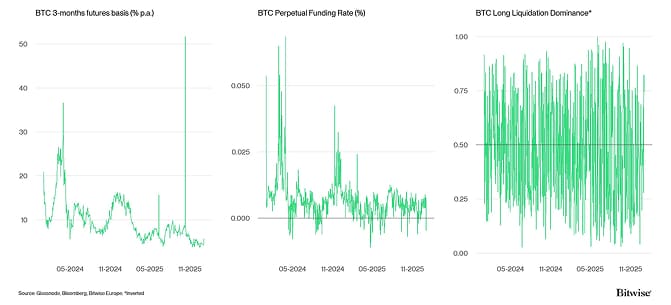
Over the past week, BTC perpetual futures open interest increased by +11.7k BTC across all exchanges, while CME futures open interest increased by +4.6k BTC, indicating a slight uptick in institutional positioning. In aggregate, total open interest remains relatively subdued compared to recent months, suggesting that the futures market is not the primary driver of current price action.
BTC perpetual funding rates have shown signs of modest recovery, indicating a gradual build-up in long-side positioning among traders. However, funding levels remain well below those seen in previous months, reinforcing the view that derivatives positioning is no longer the dominant force driving market dynamics.
In general, when the funding rate is positive (negative), long (short) positions periodically pay short (long) positions, which is indicative of bullish (bearish) sentiment.
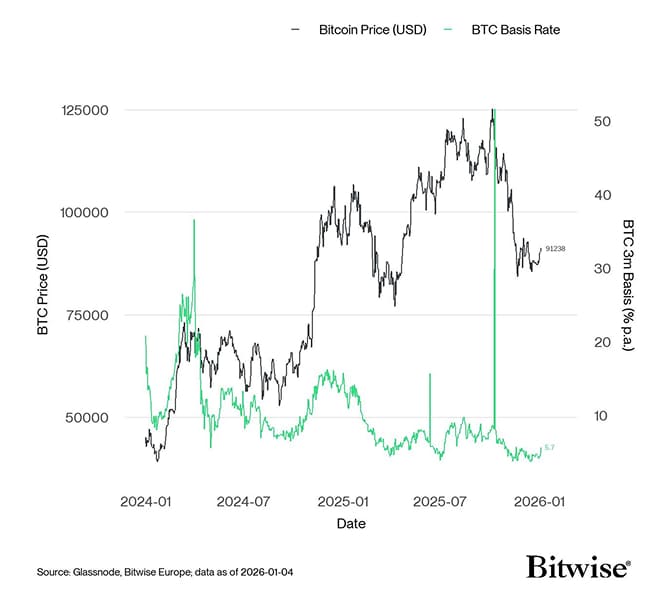
The BTC 3-month annualised basis remained largely flat at 4.8%, one of the lowest readings across the last 2 years. Furthermore, the lack of significant movement here reinforces the notion that derivatives positioning is relatively muted.
Open interest remains elevated at the $92k level, adding confluence to the observation that $93.5k remains a critical threshold for further constructive price action. This area is likely to be highly sensitive, with short traders defending their positions. In contrast, substantial open interest is also visible at the $86k level, providing a gauge for our local trading range and points of interest.
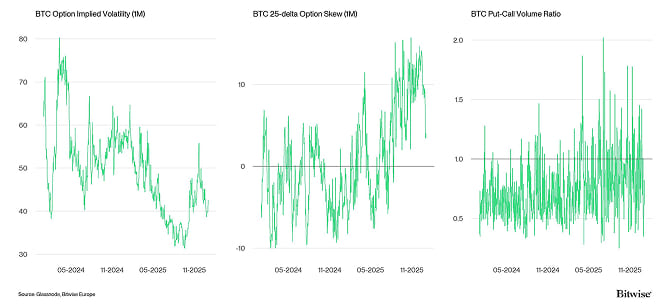
BTC options open interest has increased by +26.6k BTC across the week. Notably, -263k BTC of open interest expired across Christmas day, the largest expiration on record. In addition, the put-to-call open interest ratio surged following the expiry, rising from 0.52 to 0.74. However, this move was driven primarily by a sharp reduction in call open interest rather than an increase in put positioning, indicating a post-expiry unwind of upside exposure rather than the emergence of fresh bearish conviction.
This observation is supported by the 25-delta skew, which has declined meaningfully across all tenors this week, indicating that the cost of downside protection is moderating. A continuation of this trend would suggest a broader reset in investor expectations heading into the new year.
Bottom Line
- Last week, major cryptoassets outperformed traditional assets amid rising geopolitical risks but many traditional markets were mostly closed over the holidays and over weekend when the Venezuelan regime change took place.
- Our in-house “Cryptoasset Sentiment Index” has continued to recover and is now clearly signalling a bullish market sentiment.
- Chart-of-the-Week: Long-term holder selling in combination with the major liquidation event on the 10th of October have led to a significant decoupling of bitcoin from the ”debasement trade” in 2025. We think that positive macro tailwinds will most likely lead to a catch-up of bitcoin to gold and other major assets, and a gradual correction of this mispricing in 2026
Appendix
Bitcoin Price vs Cryptoasset Sentiment Index
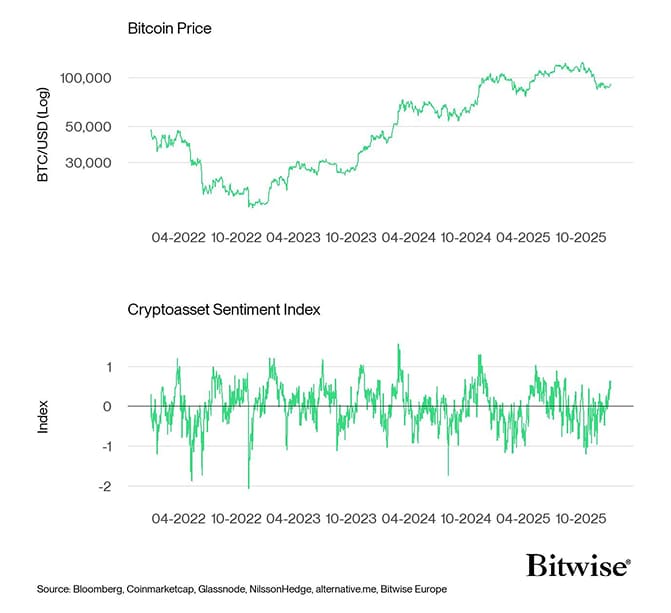 Source: Bloomberg, Coinmarketcap, Glassnode, NilssonHedge, alternative.me, Bitwise Europe
Cryptoasset Sentiment Index
Source: Bloomberg, Coinmarketcap, Glassnode, NilssonHedge, alternative.me, Bitwise Europe
Cryptoasset Sentiment Index
 Source: Bloomberg, Coinmarketcap, Glassnode, NilssonHedge, alternative.me, Bitwise Europe; *multiplied by (-1)
Cryptoasset Sentiment Index
Source: Bloomberg, Coinmarketcap, Glassnode, NilssonHedge, alternative.me, Bitwise Europe; *multiplied by (-1)
Cryptoasset Sentiment Index
 Source: Bloomberg, Coinmarketcap, Glassnode, NilssonHedge, alternative.me, Bitwise Europe
TradFi Sentiment Indicators
Source: Bloomberg, Coinmarketcap, Glassnode, NilssonHedge, alternative.me, Bitwise Europe
TradFi Sentiment Indicators
 Source: Bloomberg, NilssonHedge, Bitwise Europe
Crypto Sentiment Indicators
Source: Bloomberg, NilssonHedge, Bitwise Europe
Crypto Sentiment Indicators
 Source: Coinmarketcap, alternative.me, Bitwise Europe
Crypto Options' Sentiment Indicators
Source: Coinmarketcap, alternative.me, Bitwise Europe
Crypto Options' Sentiment Indicators
 Source: Glassnode, Bitwise Europe
Crypto Futures & Perpetuals' Sentiment Indicators
Source: Glassnode, Bitwise Europe
Crypto Futures & Perpetuals' Sentiment Indicators
 Source: Glassnode, Bitwise Europe; *Inverted
Crypto On-Chain Indicators
Source: Glassnode, Bitwise Europe; *Inverted
Crypto On-Chain Indicators
 Source: Glassnode, Bitwise Europe
Bitcoin vs Crypto Fear & Greed Index
Source: Glassnode, Bitwise Europe
Bitcoin vs Crypto Fear & Greed Index
 Source: alternative.me, Coinmarketcap, Bitwise Europe
Cryptoasset Sentiment Index: Daily vs Hourly
Source: alternative.me, Coinmarketcap, Bitwise Europe
Cryptoasset Sentiment Index: Daily vs Hourly
 Source: Bloomberg, Coinmarketcap, Glassnode, NilssonHedge, alternative.me, CFGI.io, Bitwise Europe
Bitcoin vs Global Crypto ETP Fund Flows
Source: Bloomberg, Coinmarketcap, Glassnode, NilssonHedge, alternative.me, CFGI.io, Bitwise Europe
Bitcoin vs Global Crypto ETP Fund Flows
 Source: Bloomberg, Bitwise Europe; ETPs only, data subject to change
Global Crypto ETP Fund Flows
Source: Bloomberg, Bitwise Europe; ETPs only, data subject to change
Global Crypto ETP Fund Flows
 Source: Bloomberg, Bitwise Europe; ETPs only; data subject to change
US Spot Bitcoin ETF Fund Flows
Source: Bloomberg, Bitwise Europe; ETPs only; data subject to change
US Spot Bitcoin ETF Fund Flows
 Source: Bloomberg, Bitwise Europe; data subject to change
US Spot Bitcoin ETFs: Flows since launch
Source: Bloomberg, Bitwise Europe; data subject to change
US Spot Bitcoin ETFs: Flows since launch
 Source: Bloomberg, Fund flows since traiding launch on 11/01/24; data subject to change
US Spot Bitcoin ETFs: 5-days flow
Source: Bloomberg, Fund flows since traiding launch on 11/01/24; data subject to change
US Spot Bitcoin ETFs: 5-days flow
 Source: Bloomber; data subject to change
US Bitcoin ETFs: Net Fund Flows since 11th Jan mn USD
Source: Bloomber; data subject to change
US Bitcoin ETFs: Net Fund Flows since 11th Jan mn USD
 Source: Bloomberg, Bitwise Europe; data as of 02-01-2026
US Spot Ethereum ETF Fund Flows
Source: Bloomberg, Bitwise Europe; data as of 02-01-2026
US Spot Ethereum ETF Fund Flows
 Source: Bloomberg, Bitwise Europe; data subject to change
US Spot Ethereum ETFs: Flows since launch
Source: Bloomberg, Bitwise Europe; data subject to change
US Spot Ethereum ETFs: Flows since launch
 Source: Bloomberg, Fund flows since trading launch on 23/07/24; data subject on change
US Spot Ethereum ETFs: 5-days flow
Source: Bloomberg, Fund flows since trading launch on 23/07/24; data subject on change
US Spot Ethereum ETFs: 5-days flow
 Source: Bloomberg; data subject on change
US Ethereum ETFs: Net Fund Flows since 23rd July
Source: Bloomberg; data subject on change
US Ethereum ETFs: Net Fund Flows since 23rd July
 Source: Bloomberg, Bitwise Europe; data as of 02-01-2026
Bitcoin vs Crypto Hedge Fund Beta
Source: Bloomberg, Bitwise Europe; data as of 02-01-2026
Bitcoin vs Crypto Hedge Fund Beta
 Source: Glassnode, Bloomberg, NilssonHedge, Bitwise Europe
Altseason Index
Source: Glassnode, Bloomberg, NilssonHedge, Bitwise Europe
Altseason Index
 Source: Coinmetrics, Bitwise Europe
Bitcoin vs Crypto Dispersion Index
Source: Coinmetrics, Bitwise Europe
Bitcoin vs Crypto Dispersion Index
 Source: Coinmarketcap, Bitwise Europe; Dispersion = (1 - Average Altcoin Correlation with Bitcoin)
Bitcoin Price vs Futures Basis Rate
Source: Coinmarketcap, Bitwise Europe; Dispersion = (1 - Average Altcoin Correlation with Bitcoin)
Bitcoin Price vs Futures Basis Rate
 Source: Glassnode, Bitwise Europe; data as of 2026-02-04
Ethereum Price vs Futures Basis Rate
Source: Glassnode, Bitwise Europe; data as of 2026-02-04
Ethereum Price vs Futures Basis Rate
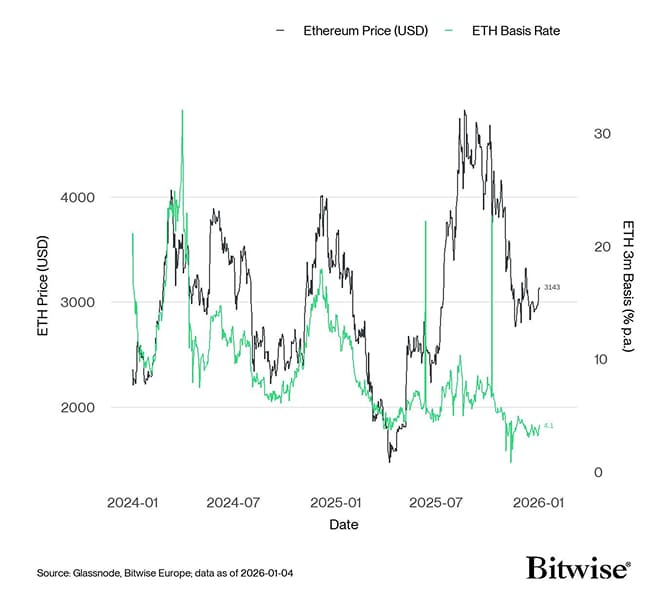 Source: Glassnode, Bitwise Europe; data as of 2026-02-04
BTC Net Exchange Volume by Size
Source: Glassnode, Bitwise Europe; data as of 2026-02-04
BTC Net Exchange Volume by Size
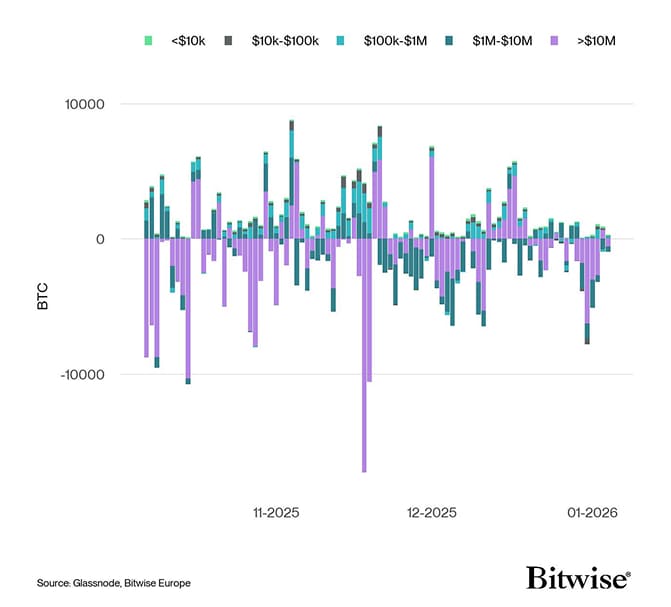 Source: Glassnode, Bitwise Europe
Important Information
This publication constitutes a marketing communication and is provided for informational purposes only. It does not constitute investment advice, a personal recommendation, or an offer or solicitation to buy or sell any financial instrument.
This document (which may take the form of a presentation, press release, social media post, blog article, broadcast communication or similar instrument – collectively referred to as a “Document”) is issued by Bitwise Europe GmbH (“BEU” or the “Issuer”) and has been prepared in accordance with applicable laws and regulations, including those relating to financial promotions.
Bitwise Europe GmbH, incorporated under the laws of Germany, is the issuer of the Exchange Traded Products (“ETPs”) referenced in this Document under a base prospectus and the applicable final terms, as supplemented from time to time, approved by the German Federal Financial Supervisory Authority (BaFin). The approval of the prospectus by BaFin relates solely to the completeness, coherence and comprehensibility of the prospectus in accordance with the Prospectus Regulation and does not constitute an endorsement, recommendation or assessment of the merits of the products.
The market analyses, views and scenarios presented reflect the assessment as of the date of publication and are based on information considered reliable. However, no representation or warranty is made as to their accuracy or completeness. Forward-looking statements involve risks and uncertainties and are not guarantees of future performance. Past performance is not a reliable indicator of future results.
Capital at risk. Cryptoassets are highly volatile and involve a high degree of risk. The value of investments in cryptoassets and crypto-linked ETPs may fluctuate significantly, and investors may lose part or all of their invested capital. No capital protection or guaranteed compensation mechanism applies in respect of market losses.
Any investment decision should be made solely on the basis of the relevant base prospectus, the applicable final terms and the key information document, in particular the section entitled “Risk Warning”. The base prospectus, final terms and additional risk information are available at: www.bitwiseinvestments.eu
Access to certain documents may require self-certification regarding your jurisdiction and investor status and may be subject to additional disclaimers and important information.
For further details, please refer to the full disclaimer available at: www.bitwiseinvestments.eu/disclaimer