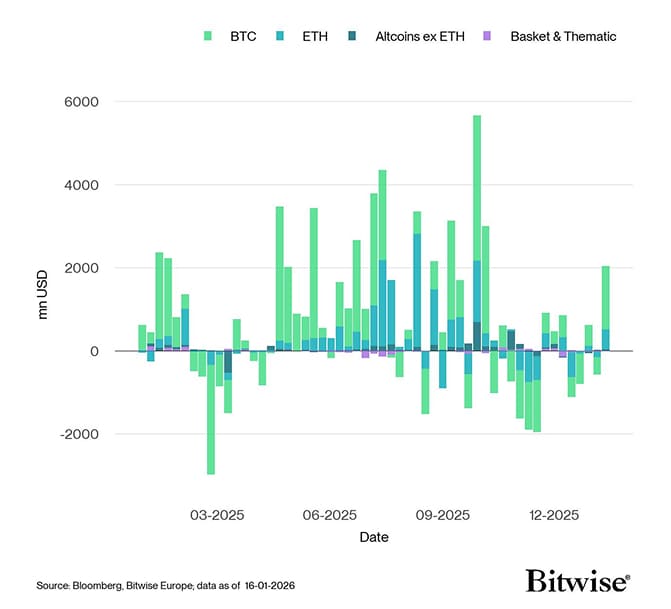
- Cryptoassets outperformed equities last week as institutional demand re-accelerated, with global crypto ETP inflows topping +$2bn led by Bitcoin (+$1.5bn) and Ethereum (almost +$0.5bn).
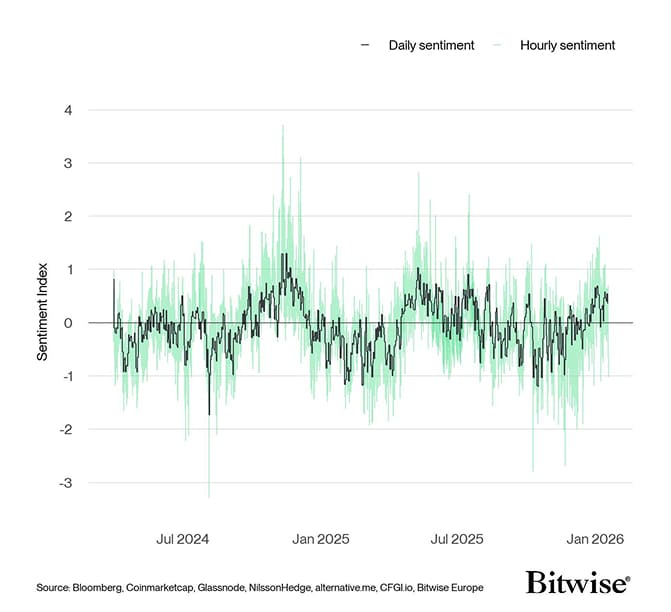
- Chart-of-the-Week: Weekly net flows into global crypto ETPs hit their highest level since October 2025, signalling a renewed risk appetite; the daily Cryptoasset Sentiment Index remains slightly bullish.
- Macro support is strengthening as the Fed’s balance sheet has risen (+$46bn since Dec 2025) amid a QT reversal and disinflation, but near-term headwinds persist from the delayed CLARITY Act and elevated geopolitical risk triggering liquidations.
Chart of the Week
Global Crypto ETP Weekly Fund Flows
Performance
Last week, cryptoassets outperformed traditional assets like equities due to accelerating institutional demand. For instance, weekly net flows into global crypto ETPs accelerated to the highest level since October 2025 in a sign of returning risk appetite (Chart-of-the-week).
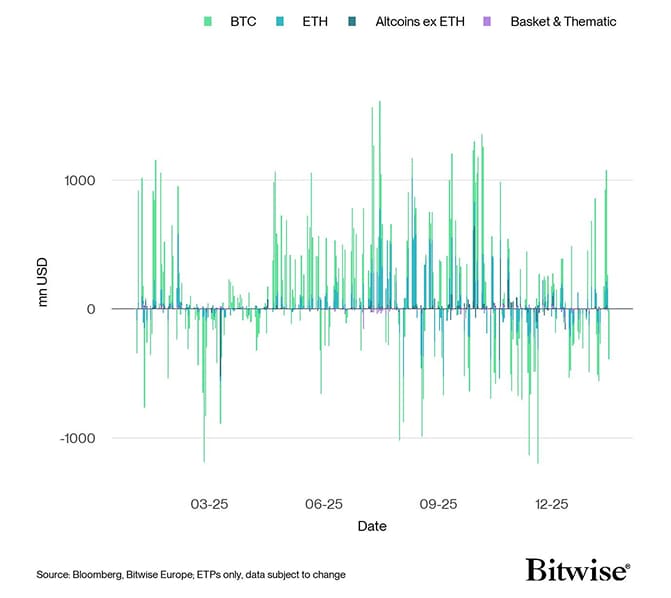
More specifically, global crypto ETPs raked in slightly more +2 bn USD last week of which +1.5 bn accrued to Bitcoin ETPs and almost +0.5 bn USD in net inflows accrued to Ethereum ETPs.
One of the potential macro drivers appears to be tied to a favourable outlook for US monetary and fiscal policy – this has been reaffirmed by Treasury secretary Scott Bessent who suggests that the current US administration will try to run the economy “hot” in order for nominal GDP growth to outpace fiscal debt growth.
In fact, the Fed's total assets have already increased by +46 bn USD since December 2025 due to the reversal of the Quantitative Tightening policy although there has been a slight decline at the beginning of January.
Meanwhile, Kevin Warsh has become the standout front-runner on Kalshi to be Trump's pick for Fed Chair after President Trump said in a recent press conference that he is hesitant to nominate Kevin Hassett, noting he would rather keep Hassett as a prominent administration adviser and spokesperson than move him into the typically more low-profile Fed position.
Furthermore, decelerating inflation dynamics in the US give the Fed potentially more wiggle room to continue easing monetary policy. However, Fed Funds Futures price in no rate cut in January due to accelerating economic growth and an improving labour market – for instance, the Fed of Atlanta's GDPNow nowcast already signals a strong acceleration in GDP growth in the fourth quarter.
That being said, a slight drawback for the market last week was the postponement of the Crypto Market Structure Bill (“CLARITY Act”). The bill was postponed after backlash over proposed amendments (seen as favouring banks/traditional finance) and a standoff over ethics provisions - culminating in Coinbase withdrawing its support, which helped trigger the delay.
One should expect the CLARITY Act markup to be rescheduled (not cancelled) while lawmakers and industry renegotiate dispute provisions - especially around stablecoin rewards and tokenization - after Coinbase's withdrawal of support signalled the draft lacks enough backing to advance as-is.
At the same time, geopolitical risks remain elevated which has weighed on bitcoin and other crypto markets in early Monday morning trading – the Trump administration has threatened to impose import tariffs of 10% on 8 EU countries following a rather symbolic relocation of a small batch of European soldiers to Greenland.
Moreover, Trump's latest comments on Truth Social imply a potential near-term escalation of the conflict in Greenland which continues to weigh on risk sentiment. As a result, precious metals like gold and silver continued to reach new all-time highs while risky assets such as stock futures and cryptoassets have pared gains. A spike in long bitcoin futures liquidations has exacerbated the very latest correction as well.
A couple of remarks are in order – firstly, geopolitical risks generally have a short-term negative effect on bitcoin's performance only based on historical data with no significant medium- to long-term effect visible in the data.
Secondly, accelerating economic growth should continue to support a favourable risk appetite in bitcoin and crypto markets as the vast majority of bitcoin's performance has historically been explained by macro factors, not idiosyncratic / coin-specific factors.
The implication is that once the negative effects of the preceding long-term holder supply distribution fade, positive macro factors should reassert itself as the dominant performance driver for bitcoin. Thus, short-term spikes in geopolitical risks could be used to increase exposure. In this context, we continue to expect economic growth to stay extraordinarily robust in 2026 as outlined in our latest Bitcoin Macro Investor report which should provide a significant tailwind in 2026.
Cross Asset Performance (Week-to-Date)
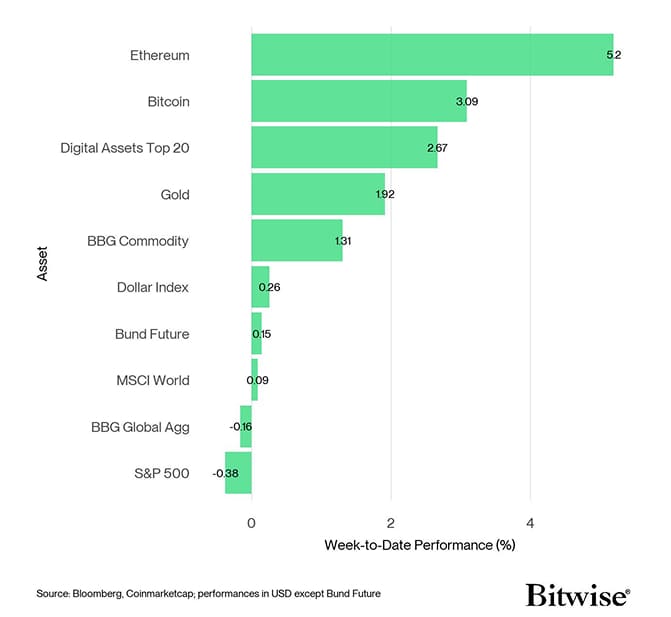 Source: Bloomberg, Coinmarketcap; performances in USD exept Bund Future
Top 10 Cryptoasset Performance (Week-to-Date)
Source: Bloomberg, Coinmarketcap; performances in USD exept Bund Future
Top 10 Cryptoasset Performance (Week-to-Date)
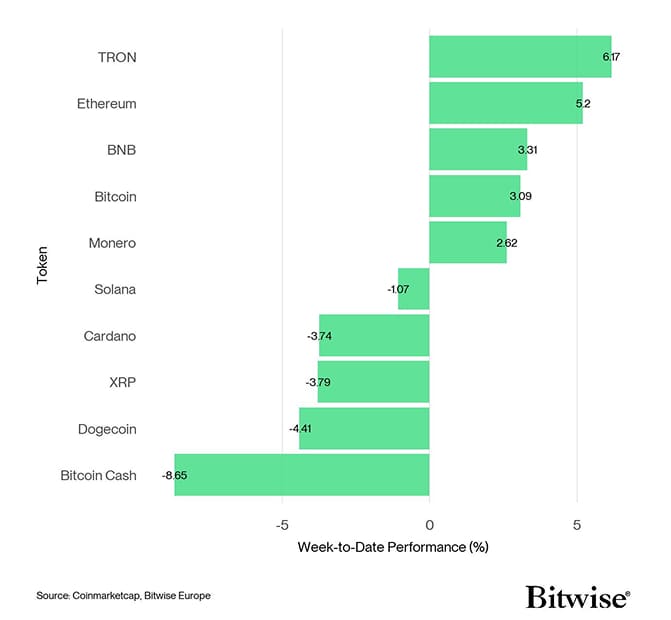 Source: Coinmarketcap
In general, among the top 10 crypto assets TRON, Ethereum, and BNB were the relative outperformers.
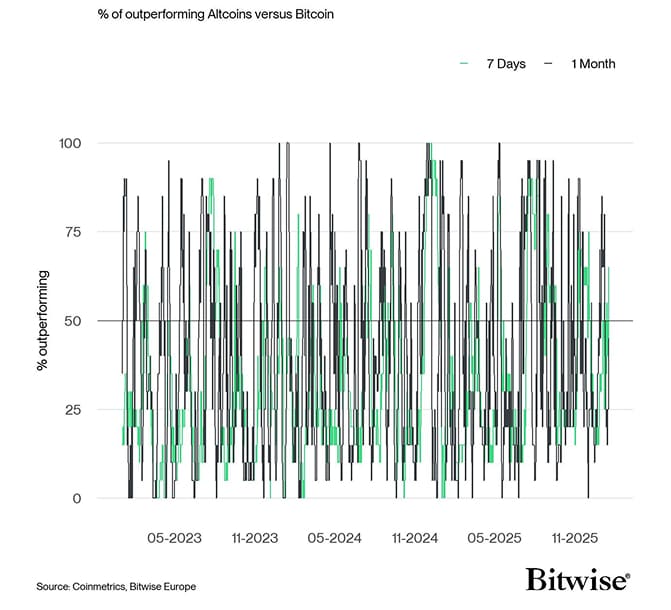
Overall, altcoin outperformance vis-à-vis bitcoin has increased slightly last week, with 45% of our tracked altcoins managing to outperform bitcoin on a weekly basis. Ethereum outperformed bitcoin last week.
Sentiment
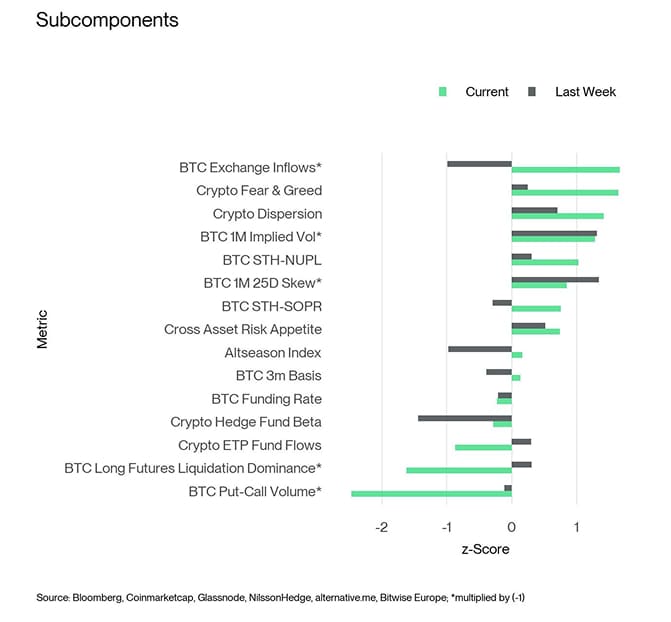
Our in-house “Cryptoasset Sentiment Index” increased significantly compared to last week. Starting last Monday at a neutral base, although increasing to, and staying in deep positive territory for the rest of the week.
At the moment, 10 out of 15 indicators are above their short-term trend.
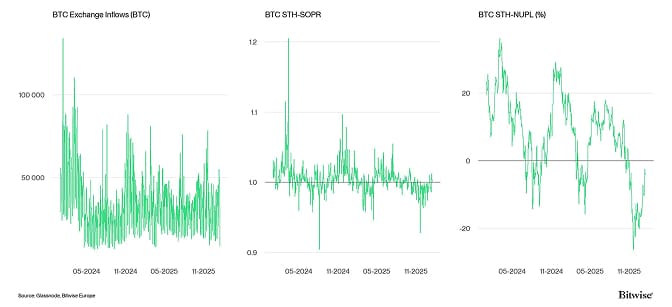
Last week, the BTC 1M 25D Skew, BTC Exchange Inflows, Crypto Dispersion, Crypto Fear and Greed, BTC 1M Implied Vol, Cross Asset Risk Appetite, BTC STH-NUPL, BTC SOPR, Alt Season Index, BTC 3m Basis metrics all showed positive momentum.
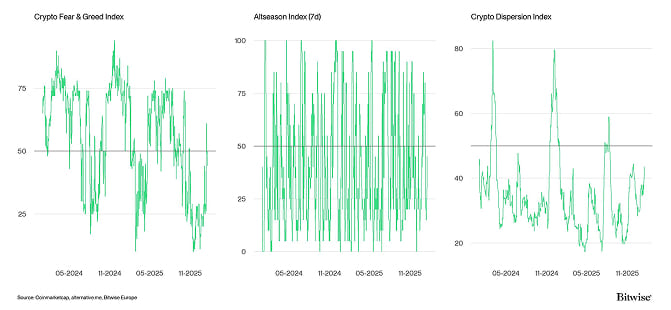
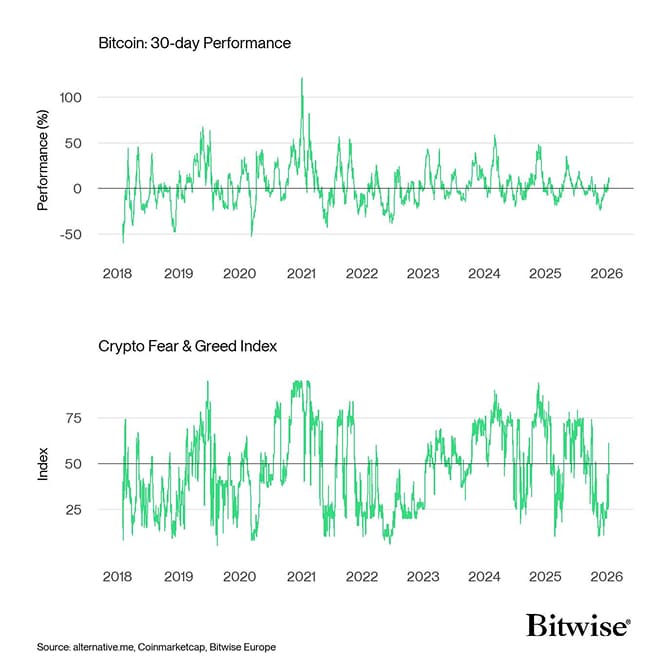
The Crypto Fear & Greed Index signals a “fear” level of sentiment as of this morning. The index has spent the whole month of November and December in either “fear” or “extreme fear” territory although turned to “Greed” briefly early in the third calendar week of January.
Performance dispersion among cryptoassets increased slightly last week from 0.38 to 0.44. When dispersion is high, it means that the market appears to be driven by a more diverse set of narratives which tends to be a sign of increasing risk appetite.
Altcoin outperformance vis-à-vis Bitcoin increased last week, with around 45% of our tracked altcoins. Ethereum outperformed Bitcoin by 2.1%-points on a weekly basis.
In general, increasing (decreasing) altcoin outperformance tends to be a sign of increasing (decreasing) risk appetite within cryptoasset markets.
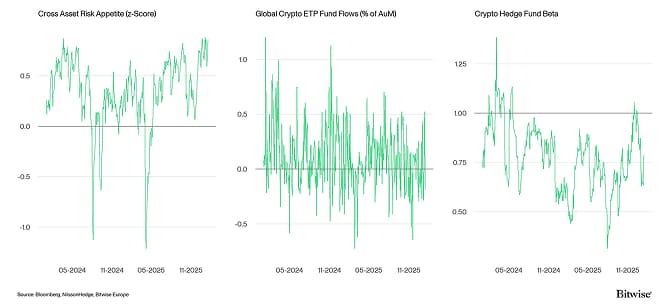
Sentiment in traditional financial markets as measured by our in-house measure of Cross Asset Risk Appetite (CARA) increased again to 0.86. This is a notable divergence between TradFi and crypto asset sentiment that should be continued to watch closely.
Fund Flows
Global crypto ETPs saw large total net inflows last week, across Bitcoin, Ethereum and Altcoin products. Although basket and thematic products saw net outflows.
Global crypto ETPs saw around +2019.9 mn USD in weekly net inflows across all types of cryptoassets, after -554.1 mn USD in net outflows the previous week.
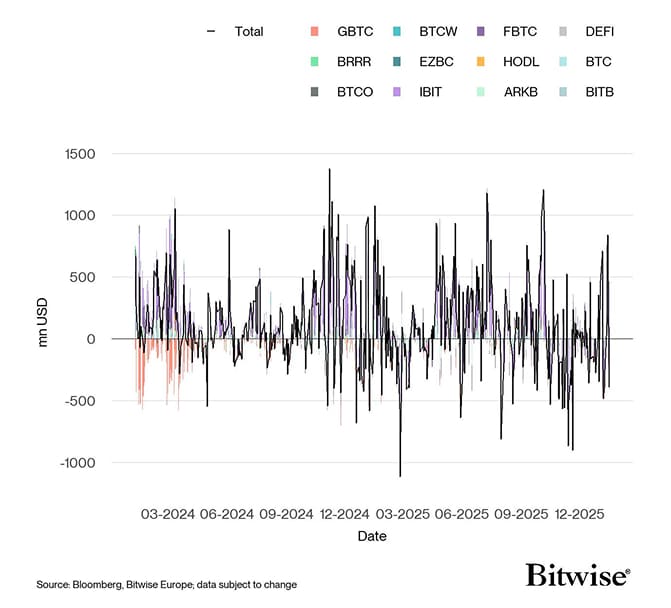
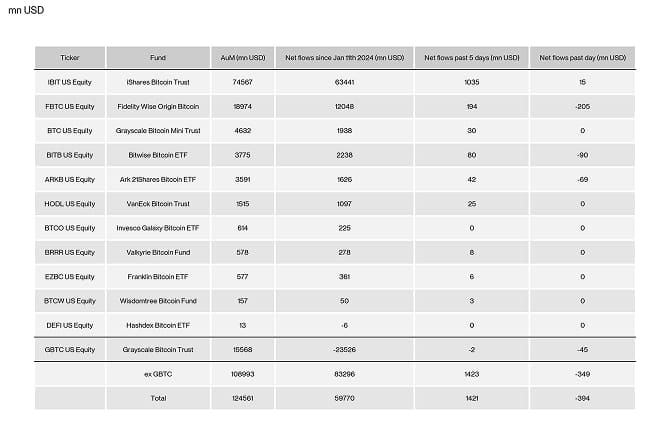
Global Bitcoin ETPs have experienced net inflows totalling +1520.1 mn USD last week, of which +1421.8 mn USD in net inflows were related to US spot Bitcoin ETFs.
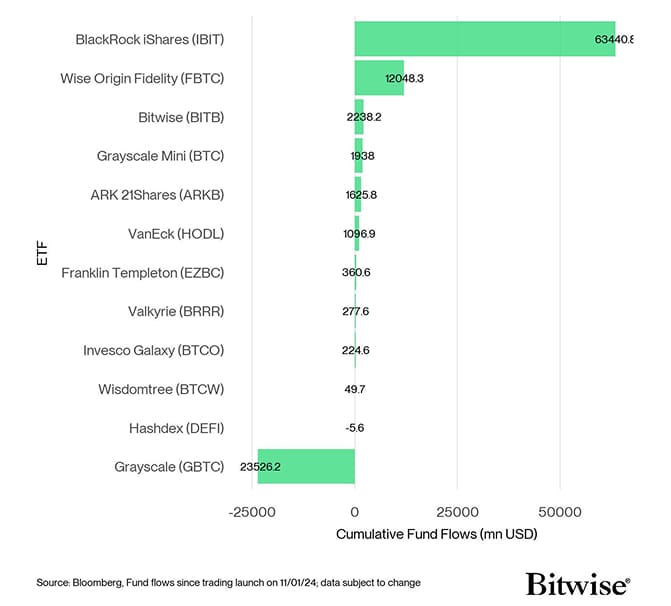
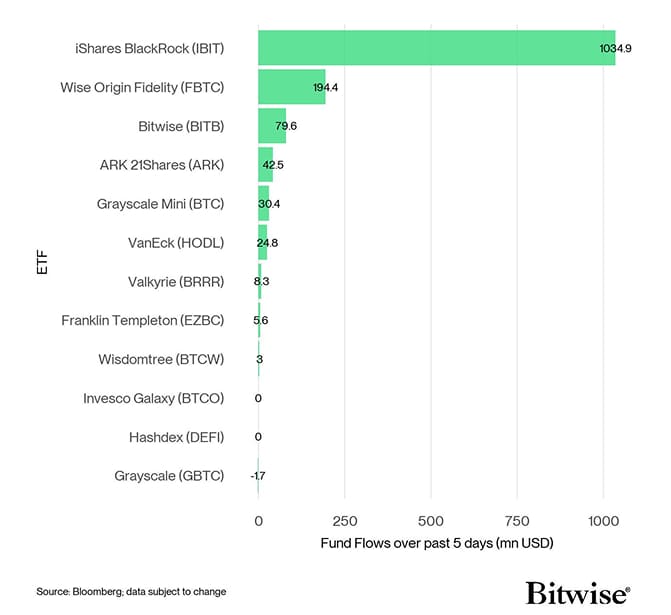
The Bitwise Bitcoin ETF (BITB) in the US experienced net inflows, totalling +79.6 mn USD last week.
In Europe, the Bitwise Physical Bitcoin ETP (BTCE) experienced net inflows equivalent to +2.2 mn USD, whereas the Bitwise Core Bitcoin ETP (BTC1) experienced minor net outflows of -0.9 mn USD.
The Grayscale Bitcoin Trust (GBTC) posted net outflows of -1.7 mn USD and the iShares Bitcoin Trust (IBIT) experienced net inflows of around +1034.9 mn USD last week.
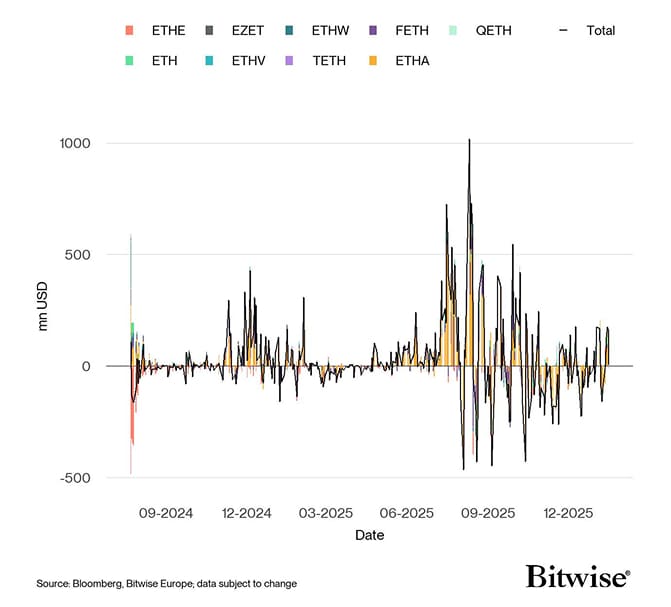
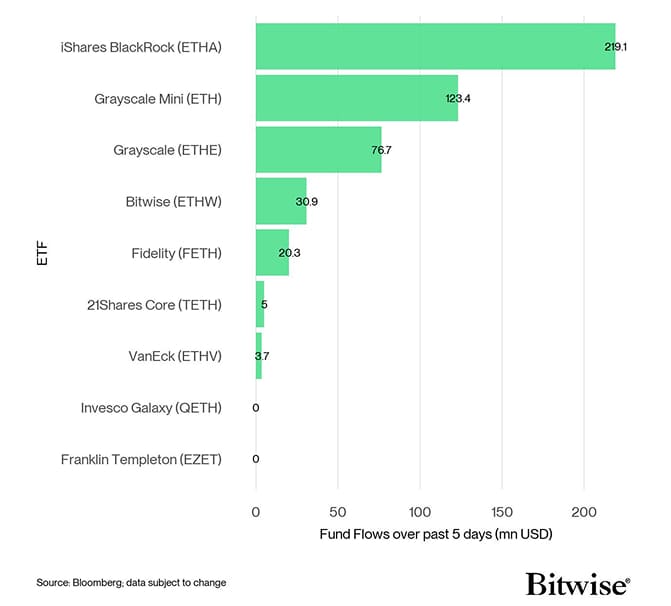
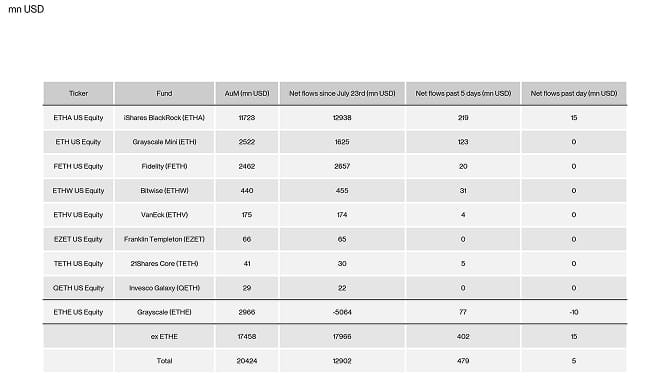
Meanwhile, global Ethereum ETPs also experienced +486.7 mn USD in net inflows last week, of which US spot Ethereum ETFs recorded net inflows of around +479 mn USD on aggregate.
The Grayscale Ethereum Trust (ETHE) posted net inflows of +76.7 mn USD, alongside the iShares Ethereum Trust (ETHA) that also experienced +219.1 mn USD of net inflows.
The Bitwise Ethereum ETF (ETHW) in the US has posted net inflows of +30.9 mn USD.
In Europe, the Bitwise Physical Ethereum ETP (ZETH) saw minor net inflows of +1.3 mn USD, as the Bitwise Ethereum Staking ETP (ET32) also saw +9.5 mn of net inflows.
Altcoin ETPs ex Ethereum experienced net inflows of +29.5 mn USD last week.
Thematic & basket crypto ETPs also posted net outflows of -16.5 mn USD on aggregate last week. The Bitwise MSCI Digital Assets Select 20 ETP (DA20) experienced negligible net inflows last week of + 0.4 mn USD on aggregate.
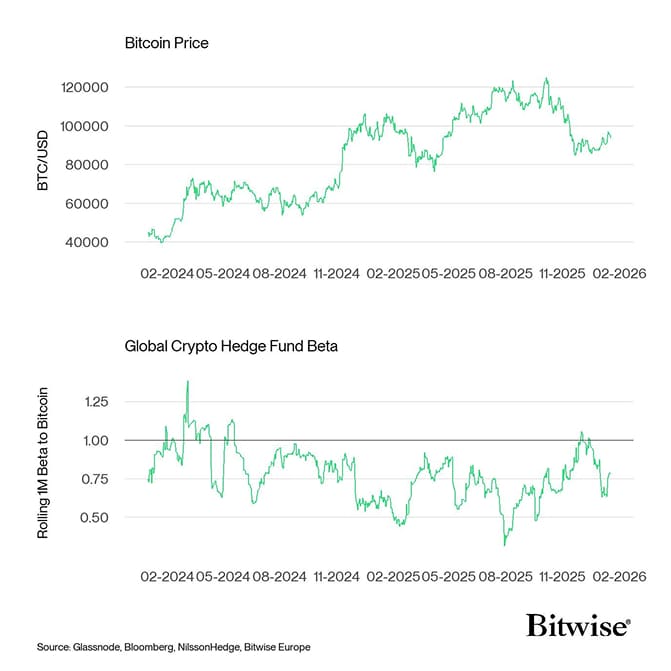
Global crypto hedge funds exposure to Bitcoin increased last week. The 20-days rolling beta of global crypto hedge funds' performance to Bitcoin climbed from 0.64 to 0.79 per yesterday's close.
On-Chain Data
Across the week, the market decisively broke above the $93.5K region, which we have long identified as the primary point of control, marking the first meaningful display of strength since the November collapse. Despite this improvement, price was rejected at the Short-Term Holder cost basis near $98.3K, which remains the next major resistance level. A decisive and sustained reclaim of this zone would represent the clearest confirmation of market momentum observed so far. Until then, the $93.5K to $98.3K range defines the primary trading band within the current market structure.
Supporting this price action, buy-side pressure remained dominant throughout the week. Intraday spot buying minus selling closed at approximately +$603mn, up from +$257mn the prior week. Notably, buy-side demand peaked near +$1.8bn, a magnitude exceeded on just 10 of 2,480 trading days, highlighting the exceptional strength of recent spot-driven demand.
Alongside this demand expansion, aggregate exchange inflow and outflow volumes increased from $6.5bn to $6.9bn, marking a third consecutive weekly rise in speculative activity. This keeps total volumes moving into and out of centralised exchanges above the yearly average of $6.5bn, indicating a gradual improvement in overall investor participation.
However, when viewed through a broader liquidity lens, global trading activity remains restrained. On a rolling one-year percentile basis, spot volume of $9.2bn sits at the 31st percentile, futures volume of $33.4bn at the 9th percentile, and options volume of $2.6bn at the 19th percentile. This subdued backdrop suggests liquidity conditions remain tight, leaving the market vulnerable to sharp moves in either direction and maintaining elevated volatility risk.
Investor sentiment has shown initial signs of stabilisation. The percentage of supply in profit has risen to 75.1%, now at parity with its long-term mean of 75.4%, a level that has historically acted as an important inflection point. While this threshold held during the Trump tariff shock and the yen carry unwind, it failed decisively during the November downturn. A sustained move above it would therefore signal a meaningful improvement in market confidence.
As more coins return to a state of profit, the total capital held at a loss has declined to $570bn. Aggregate unrealised losses now stand at approximately –$73bn, or around –$13.8K per coin. Although these losses remain historically elevated, their continued contraction reflects a gradual easing of downside pressure.
On-chain profit-taking has ticked higher but remains muted at approximately $323mn per day, extending a multi-week stretch of historically low readings relative to the past two years. At the same time, loss realization continues to cool, averaging around $134mn per day.
With realized profits now exceeding realized losses, early signs of positive capital inflows are beginning to emerge. This is a constructive development, however, the trend remains in its infancy. Confirmation will require a sustained trend and a clear regime shift toward persistently positive capital inflows.
Taken together, improving price structure, strong spot demand, and tentative capital inflows point toward a market in early repair. However, the Short-Term Holder cost basis at $98.3K remains the key decision point for both trend confirmation and a broader repair in market sentiment. Until this level is decisively reclaimed and sustained, the recovery remains incomplete, and conditions remain vulnerable to renewed complacency. While momentum is improving, further follow-through is required to validate a durable regime shift.
Futures, Options & Perpetuals
Over the past week, BTC perpetual futures open interest declined by –14.8K BTC across all exchanges, while CME futures open interest increased by +2.6K BTC, indicating a modest pickup in institutional positioning. In aggregate, total open interest has declined and remains subdued relative to recent months, suggesting the futures market is not currently the primary driver of overall price action.
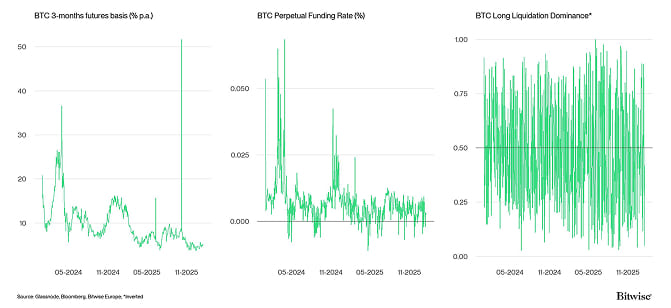
That said, as price accelerated higher, Bitcoin short-side liquidations surged to $588M across all exchanges, marking the largest short squeeze since the October 10th forced liquidation cascade ($2.5bn). Subsequently, a further $590M in long liquidations was triggered as price retraced sharply back toward the lower bound of the range near $93K. This two-sided liquidation flow highlights that, while broader market conditions remain largely spot-driven, pockets of crowded derivatives positioning have played a strong role in amplifying recent price movements.
From a positioning perspective, futures open interest is beginning to rebuild around the $98K level. This region sits in confluence with the Short-Term Holder cost basis and represents the highest price reached during the current rally, reinforcing $98K as a key decision point for the market.
To the downside, futures open interest remains elevated near $89K, highlighting this zone as a critical area to hold. This region is likely to be highly sensitive, with long positioning incentivising active defence, increasing the risk of heightened volatility should price revisit this level.
BTC perpetual funding rates declined week over week, signalling a contraction in long-side positioning. When detrended using the median funding rate, funding remains broadly negative, reinforcing the absence of aggressive leveraged longs.
In parallel, the BTC 3-month annualised basis remained largely flat at 5%, one of the lowest readings observed over the past two years. The fact that price continues to advance while funding rates and futures premiums remain subdued is constructive, indicating the rally is not being fuelled by excessive or speculative long positioning. Instead, leverage remains restrained, reducing the risk of instability typically associated with crowded, momentum-driven advances.
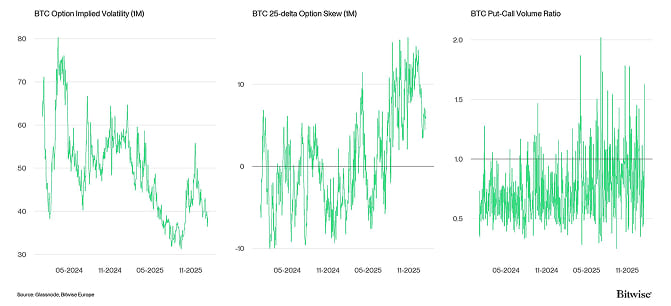
Turning to options markets, BTC options open interest increased by +21K BTC over the week as positioning begins to rebuild following the Christmas expiry. The put-to-call open interest ratio on Deribit remains elevated at 0.74, persisting after the sharp increase associated with the largest call option expiry over the holiday period. In parallel, the put-to-call ratio across IBIT options continues to trend higher, reaching 0.57.
Despite elevated put positioning, the 25-delta skew has softened across all tenors except the 1-week, signalling a moderation in the premium for longer-dated downside protection. At the same time, the persistence of an elevated near-term skew points to a pickup in short-horizon risk sensitivity. This divergence suggests that while defensive positioning remains in place, marginal demand for new longer-term hedges is easing, even as near-term uncertainty remains elevated.
Notably, options dealers remain significantly short gamma across the $95K–$102K range. As price advances into this zone, dealers are likely to hedge their exposure through spot purchases, introducing a source of mechanical demand that may act as a tailwind for the prevailing uptrend.
Overall, derivatives markets continue to reflect restrained positioning rather than speculative excess. Open interest remains subdued, funding rates and futures premiums are compressed, and leverage has not meaningfully rebuilt despite rising prices, indicating the advance is still primarily spot-driven. While liquidations and dealer gamma dynamics have provided support towards recent price action, confirmation of a more durable derivatives-led trend has yet to emerge.
Bottom Line
- Cryptoassets outperformed equities last week as institutional demand re-accelerated, with global crypto ETP inflows topping +$2bn led by Bitcoin (+$1.5bn) and Ethereum (almost +$0.5bn).
- Chart-of-the-Week: Weekly net flows into global crypto ETPs hit their highest level since October 2025, signalling a renewed risk appetite; the daily Cryptoasset Sentiment Index remains slightly bullish.
- Macro support is strengthening as the Fed’s balance sheet has risen (+$46bn since Dec 2025) amid a QT reversal and disinflation, but near-term headwinds persist from the delayed CLARITY Act and elevated geopolitical risk triggering liquidations.
Appendix
Bitcoin Price vs Cryptoasset Sentiment Index
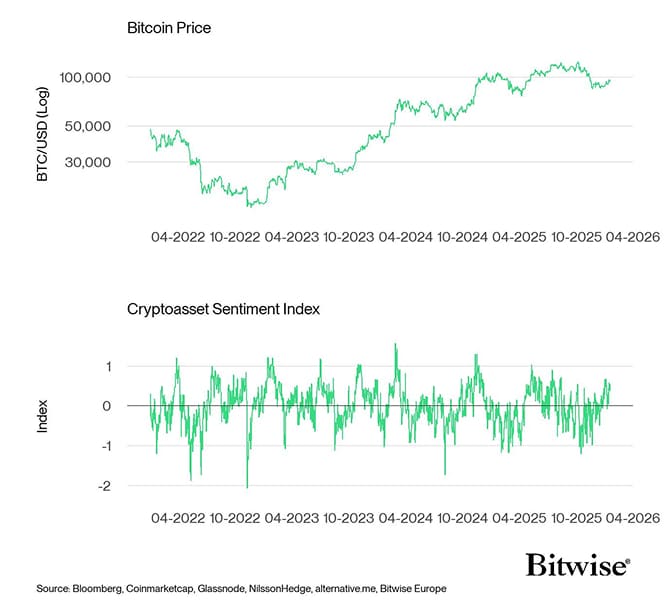 Source: Bloomberg, Coinmarketcap, Glassnode, NilssonHedge, alternative.me, Bitwise Europe
Cryptoasset Sentiment Index
Source: Bloomberg, Coinmarketcap, Glassnode, NilssonHedge, alternative.me, Bitwise Europe
Cryptoasset Sentiment Index
 Source: Bloomberg, Coinmarketcap, Glassnode, NilssonHedge, alternative.me, Bitwise Europe; *multiplied by (-1)
TradFi Sentiment Indicators
Source: Bloomberg, Coinmarketcap, Glassnode, NilssonHedge, alternative.me, Bitwise Europe; *multiplied by (-1)
TradFi Sentiment Indicators
 Source: Bloomberg, NilssonHedge, Bitwise Europe
Crypto Sentiment Indicators
Source: Bloomberg, NilssonHedge, Bitwise Europe
Crypto Sentiment Indicators
 Source: Coinmarketcap, alternative.me, Bitwise Europe
Crypto Options' Sentiment Indicators
Source: Coinmarketcap, alternative.me, Bitwise Europe
Crypto Options' Sentiment Indicators
 Source: Glassnode, Bitwise Europe
Crypto Futures & Perpetuals' Sentiment Indicators
Source: Glassnode, Bitwise Europe
Crypto Futures & Perpetuals' Sentiment Indicators
 Source: Glassnode, Bitwise Europe; *Inverted
Crypto On-Chain Indicators
Source: Glassnode, Bitwise Europe; *Inverted
Crypto On-Chain Indicators
 Source: Glassnode, Bitwise Europe
Bitcoin vs Crypto Fear & Greed Index
Source: Glassnode, Bitwise Europe
Bitcoin vs Crypto Fear & Greed Index
 Source: alternative.me, Coinmarketcap, Bitwise Europe
Cryptoasset Sentiment Index: Daily vs Hourly
Source: alternative.me, Coinmarketcap, Bitwise Europe
Cryptoasset Sentiment Index: Daily vs Hourly
 Source: Bloomberg, Coinmarketcap, Glassnode, NilssonHedge, alternative.me, CFGI.io, Bitwise Europe
Bitcoin vs Global Crypto ETP Fund Flows
Source: Bloomberg, Coinmarketcap, Glassnode, NilssonHedge, alternative.me, CFGI.io, Bitwise Europe
Bitcoin vs Global Crypto ETP Fund Flows
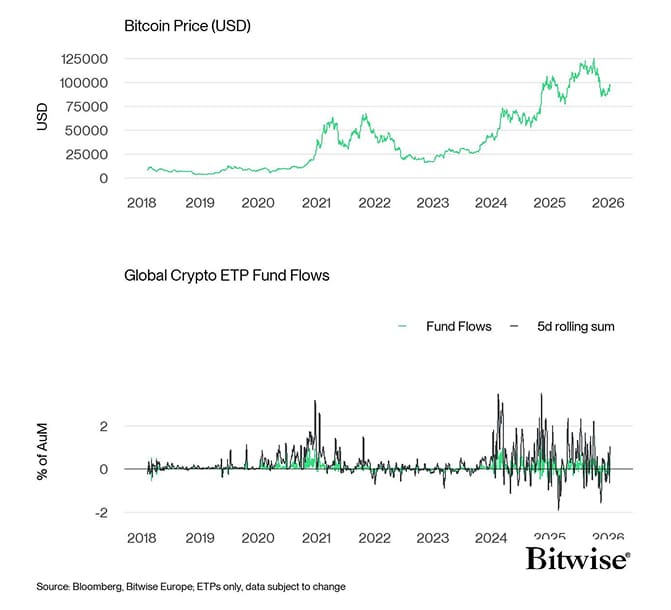 Source: Bloomberg, Bitwise Europe; ETPs only, data subject to change
Global Crypto ETP Fund Flows
Source: Bloomberg, Bitwise Europe; ETPs only, data subject to change
Global Crypto ETP Fund Flows
 Source: Bloomberg, Bitwise Europe; ETPs only; data subject to change
US Spot Bitcoin ETF Fund Flows
Source: Bloomberg, Bitwise Europe; ETPs only; data subject to change
US Spot Bitcoin ETF Fund Flows
 Source: Bloomberg, Bitwise Europe; data subject to change
US Spot Bitcoin ETFs: Flows since launch
Source: Bloomberg, Bitwise Europe; data subject to change
US Spot Bitcoin ETFs: Flows since launch
 Source: Bloomberg, Fund flows since traiding launch on 11/01/24; data subject to change
US Spot Bitcoin ETFs: 5-days flow
Source: Bloomberg, Fund flows since traiding launch on 11/01/24; data subject to change
US Spot Bitcoin ETFs: 5-days flow
 Source: Bloomber; data subject to change
US Bitcoin ETFs: Net Fund Flows since 11th Jan mn USD
Source: Bloomber; data subject to change
US Bitcoin ETFs: Net Fund Flows since 11th Jan mn USD
 Source: Bloomberg, Bitwise Europe; data as of 16-01-2026
US Spot Ethereum ETF Fund Flows
Source: Bloomberg, Bitwise Europe; data as of 16-01-2026
US Spot Ethereum ETF Fund Flows
 Source: Bloomberg, Bitwise Europe; data subject to change
US Spot Ethereum ETFs: Flows since launch
Source: Bloomberg, Bitwise Europe; data subject to change
US Spot Ethereum ETFs: Flows since launch
 Source: Bloomberg, Fund flows since trading launch on 23/07/24; data subject on change
US Spot Ethereum ETFs: 5-days flow
Source: Bloomberg, Fund flows since trading launch on 23/07/24; data subject on change
US Spot Ethereum ETFs: 5-days flow
 Source: Bloomberg; data subject on change
US Ethereum ETFs: Net Fund Flows since 23rd July
Source: Bloomberg; data subject on change
US Ethereum ETFs: Net Fund Flows since 23rd July
 Source: Bloomberg, Bitwise Europe; data as of 16-01-2026
Bitcoin vs Crypto Hedge Fund Beta
Source: Bloomberg, Bitwise Europe; data as of 16-01-2026
Bitcoin vs Crypto Hedge Fund Beta
 Source: Glassnode, Bloomberg, NilssonHedge, Bitwise Europe
Altseason Index
Source: Glassnode, Bloomberg, NilssonHedge, Bitwise Europe
Altseason Index
 Source: Coinmetrics, Bitwise Europe
Bitcoin vs Crypto Dispersion Index
Source: Coinmetrics, Bitwise Europe
Bitcoin vs Crypto Dispersion Index
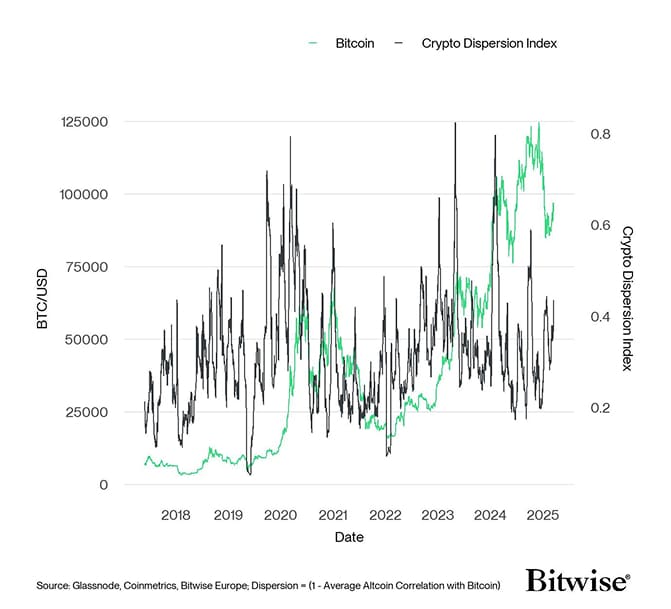 Source: Coinmarketcap, Bitwise Europe; Dispersion = (1 - Average Altcoin Correlation with Bitcoin)
Bitcoin Price vs Futures Basis Rate
Source: Coinmarketcap, Bitwise Europe; Dispersion = (1 - Average Altcoin Correlation with Bitcoin)
Bitcoin Price vs Futures Basis Rate
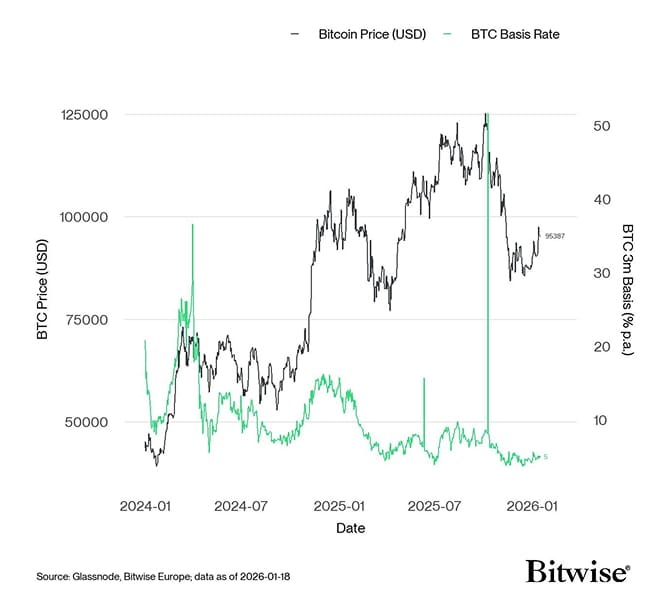 Source: Glassnode, Bitwise Europe; data as of 2026-01-18
Ethereum Price vs Futures Basis Rate
Source: Glassnode, Bitwise Europe; data as of 2026-01-18
Ethereum Price vs Futures Basis Rate
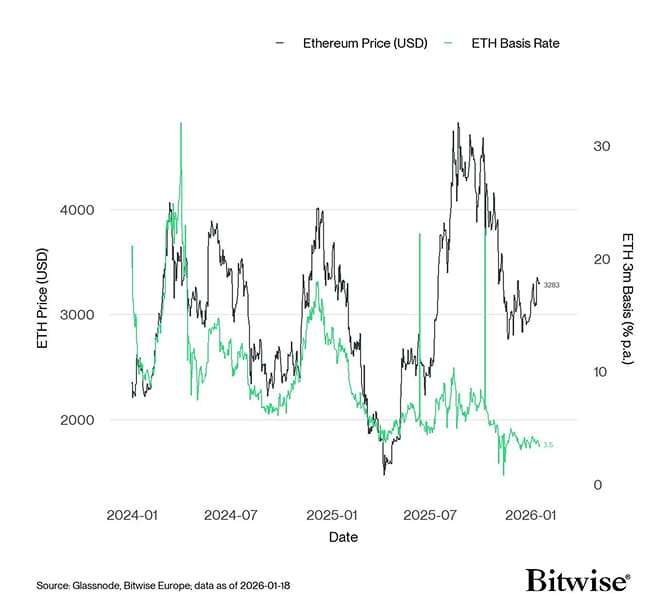 Source: Glassnode, Bitwise Europe; data as of 2026-01-18
BTC Net Exchange Volume by Size
Source: Glassnode, Bitwise Europe; data as of 2026-01-18
BTC Net Exchange Volume by Size
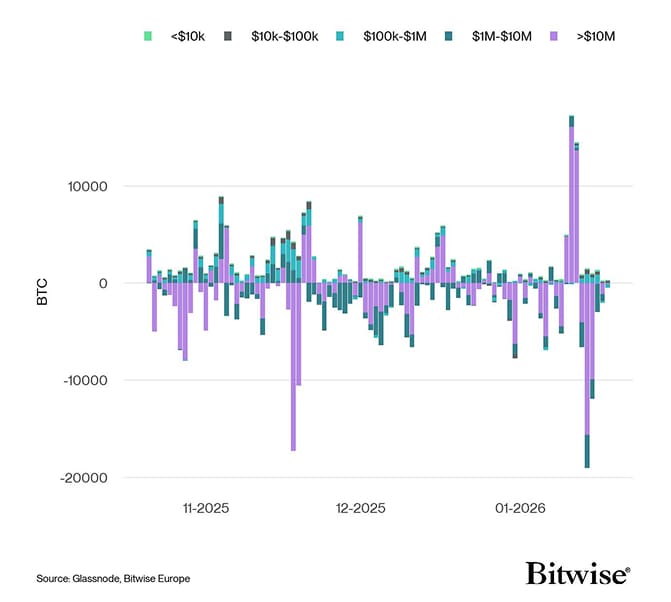 Source: Glassnode, Bitwise Europe
Important Information
This publication constitutes a marketing communication and is provided for informational purposes only. It does not constitute investment advice, a personal recommendation, or an offer or solicitation to buy or sell any financial instrument.
This document (which may take the form of a presentation, press release, social media post, blog article, broadcast communication or similar instrument – collectively referred to as a “Document”) is issued by Bitwise Europe GmbH (“BEU” or the “Issuer”) and has been prepared in accordance with applicable laws and regulations, including those relating to financial promotions.
Bitwise Europe GmbH, incorporated under the laws of Germany, is the issuer of the Exchange Traded Products (“ETPs”) referenced in this Document under a base prospectus and the applicable final terms, as supplemented from time to time, approved by the German Federal Financial Supervisory Authority (BaFin). The approval of the prospectus by BaFin relates solely to the completeness, coherence and comprehensibility of the prospectus in accordance with the Prospectus Regulation and does not constitute an endorsement, recommendation or assessment of the merits of the products.
The market analyses, views and scenarios presented reflect the assessment as of the date of publication and are based on information considered reliable. However, no representation or warranty is made as to their accuracy or completeness. Forward-looking statements involve risks and uncertainties and are not guarantees of future performance. Past performance is not a reliable indicator of future results.
Capital at risk. Cryptoassets are highly volatile and involve a high degree of risk. The value of investments in cryptoassets and crypto-linked ETPs may fluctuate significantly, and investors may lose part or all of their invested capital. No capital protection or guaranteed compensation mechanism applies in respect of market losses.
Any investment decision should be made solely on the basis of the relevant base prospectus, the applicable final terms and the key information document, in particular the section entitled “Risk Warning”. The base prospectus, final terms and additional risk information are available at: www.bitwiseinvestments.eu
Access to certain documents may require self-certification regarding your jurisdiction and investor status and may be subject to additional disclaimers and important information.
For further details, please refer to the full disclaimer available at: www.bitwiseinvestments.eu/disclaimer

 en
en  de
de  it
it  fr
fr  es
es